fuel FORD RANGER 2007 2.G Service Manual
[x] Cancel search | Manufacturer: FORD, Model Year: 2007, Model line: RANGER, Model: FORD RANGER 2007 2.GPages: 280, PDF Size: 2.9 MB
Page 246 of 280
•Have the vehicle loading and distribution the same every time.
Your results will be most accurate if your filling method is consistent.
Calculating fuel economy
1. Fill the fuel tank completely and record the initial odometer reading
(in miles or kilometers).
2. Each time you fill the tank, record the amount of fuel added (in
gallons or liters).
3. After at least three to five tank fill-ups, fill the fuel tank and record
the current odometer reading.
4. Subtract your initial odometer reading from the current odometer
reading.
5. Follow one of the simple calculations in order to determine fuel
economy:
Calculation 1:Divide total miles traveled by total gallons used.
Calculation 2:Multiply liters used by 100, then divide by total
kilometers traveled.
Keep a record for at least one month and record the type of driving (city
or highway). This will provide an accurate estimate of the vehicle’s fuel
economy under current driving conditions. Additionally, keeping records
during summer and winter will show how temperature impacts fuel
economy. In general, lower temperatures give lower fuel economy.
Driving style — good driving and fuel economy habits
Give consideration to the lists that follow and you may be able to change
a number of variables and improve your fuel economy.
Habits
•Smooth, moderate operation can yield up to 10% savings in fuel.
•Steady speeds without stopping will usually give the best fuel
economy.
•Idling for long periods of time (greater than one minute) may waste
fuel.
•Anticipate stopping; slowing down may eliminate the need to stop.
•Sudden or hard accelerations may reduce fuel economy.
•Slow down gradually.
•Driving at reasonable speeds (traveling at 55 mph [88 km/h] uses
15% less fuel than traveling at 65 mph [105 km/h]).
2007 Ranger(ran)
Owners Guide (post-2002-fmt)
USA(fus)
Maintenance and Specifications
246
Page 247 of 280
•Revving the engine before turning it off may reduce fuel economy.
•Using the air conditioner or defroster may reduce fuel economy.
•You may want to turn off the speed control in hilly terrain if
unnecessary shifting between third and fourth gear occurs.
Unnecessary shifting of this type could result in reduced fuel
economy.
•Warming up a vehicle on cold mornings is not required and may
reduce fuel economy.
•Resting your foot on the brake pedal while driving may reduce fuel
economy.
•Combine errands and minimize stop-and-go driving.
Maintenance
•Keep tires properly inflated and use only recommended size.
•Operating a vehicle with the wheels out of alignment will reduce fuel
economy.
•Use recommended engine oil. Refer toLubricant specificationsin
this chapter.
•Perform all regularly scheduled maintenance items. Follow the
recommended maintenance schedule and owner maintenance checks
found inscheduled maintenance information.
Conditions
•Heavily loading a vehicle or towing a trailer may reduce fuel economy
at any speed.
•Carrying unnecessary weight may reduce fuel economy (approximately
1 mpg [0.4 km/L] is lost for every 400 lb [180 kg] of weight carried).
•Adding certain accessories to your vehicle (for example bug
deflectors, rollbars/light bars, running boards, ski/luggage racks) may
reduce fuel economy.
•Using fuel blended with alcohol may lower fuel economy.
•Fuel economy may decrease with lower temperatures during the first
8–10 miles (12–16 km) of driving.
•Driving on flat terrain offers improved fuel economy as compared to
driving on hilly terrain.
•Transmissions give their best fuel economy when operated in the top
cruise gear and with steady pressure on the gas pedal.
2007 Ranger(ran)
Owners Guide (post-2002-fmt)
USA(fus)
Maintenance and Specifications
247
Page 248 of 280
•Four-wheel-drive operation (if equipped) is less fuel efficient than
two-wheel-drive operation.
•Close windows for high speed driving.
EPA window sticker
Every new vehicle should have the EPA window sticker. Contact your
authorized dealer if the window sticker is not supplied with your vehicle.
The EPA window sticker should be your guide for the fuel economy
comparisons with other vehicles.
It is important to note the box in the lower left corner of the window
sticker. These numbers represent the Range of MPG (L/100 km)
expected on the vehicle under optimum conditions. Your fuel economy
may vary depending upon the method of operation and conditions.
EMISSION CONTROL SYSTEM
Your vehicle is equipped with various emission control components and a
catalytic converter which will enable your vehicle to comply with
applicable exhaust emission standards. To make sure that the catalytic
converter and other emission control components continue to work
properly:
•Use only the specified fuel listed.
•Avoid running out of fuel.
•Do not turn off the ignition while your vehicle is moving, especially at
high speeds.
•Have the items listed inscheduled maintenance information
performed according to the specified schedule.
The scheduled maintenance items listed inscheduled maintenance
informationare essential to the life and performance of your vehicle
and to its emissions system.
If other than Ford, Motorcraft or Ford-authorized parts are used for
maintenance replacements or for service of components affecting
emission control, such non-Ford parts should be equivalent to genuine
Ford Motor Company parts in performance and durability.
Do not park, idle, or drive your vehicle in dry grass or other dry
ground cover. The emission system heats up the engine
compartment and exhaust system, which can start a fire.
Illumination of the
indicator, charging system warning light or the
temperature warning light, fluid leaks, strange odors, smoke or loss of
engine power could indicate that the emission control system is not
working properly.
2007 Ranger(ran)
Owners Guide (post-2002-fmt)
USA(fus)
Maintenance and Specifications
248
Page 249 of 280
Exhaust leaks may result in entry of harmful and potentially
lethal fumes into the passenger compartment.
Do not make any unauthorized changes to your vehicle or engine. By
law, vehicle owners and anyone who manufactures, repairs, services,
sells, leases, trades vehicles, or supervises a fleet of vehicles are not
permitted to intentionally remove an emission control device or prevent
it from working. Information about your vehicle’s emission system is on
the Vehicle Emission Control Information Decal located on or near the
engine. This decal identifies engine displacement and gives some tune up
specifications.
Please consult yourWarranty Guidefor complete emission warranty
information.
On board diagnostics (OBD-II)
Your vehicle is equipped with a computer that monitors the engine’s
emission control system. This system is commonly known as the On
Board Diagnostics System (OBD-II). This OBD-II system protects the
environment by ensuring that your vehicle continues to meet
government emission standards. The OBD-II system also assists your
authorized dealer in properly servicing your vehicle. When the
indicator illuminates, the OBD-II system has detected a malfunction.
Temporary malfunctions may cause the
indicator to illuminate.
Examples are:
1. The vehicle has run out of fuel—the engine may misfire or run poorly.
2. Poor fuel quality or water in the fuel.
3. The fuel cap may not have been securely tightened. SeeFuel filler
capin this chapter.
These temporary malfunctions can be corrected by filling the fuel tank
with good quality fuel and/or properly tightening the fuel cap. After three
driving cycles without these or any other temporary malfunctions
present, the
indicator should turn off—A driving cycle consists of a
cold engine startup followed by mixed city/highway driving. No additional
vehicle service is required.
If the
indicator remains on, have your vehicle serviced at the first
available opportunity.
2007 Ranger(ran)
Owners Guide (post-2002-fmt)
USA(fus)
Maintenance and Specifications
249
Page 257 of 280
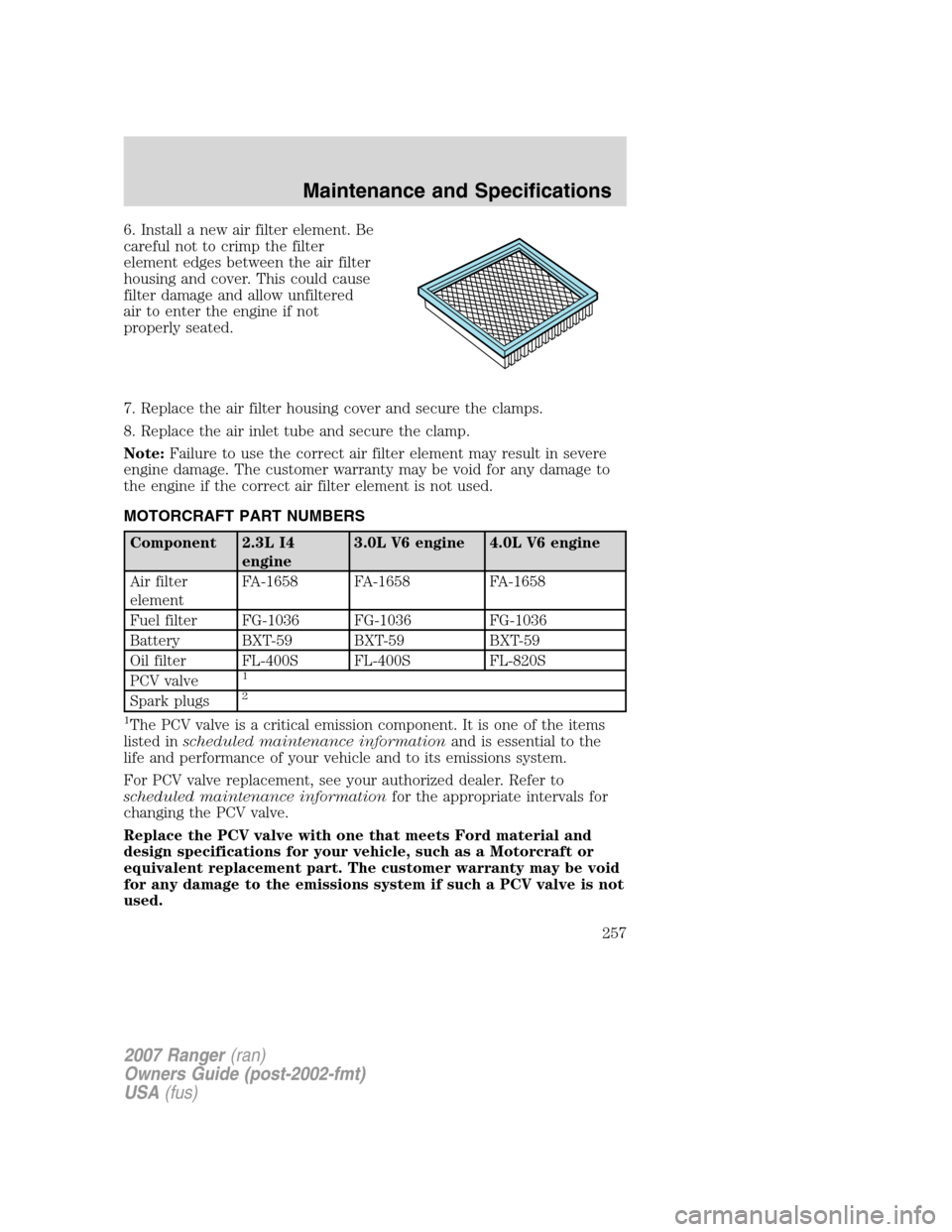
6. Install a new air filter element. Be
careful not to crimp the filter
element edges between the air filter
housing and cover. This could cause
filter damage and allow unfiltered
air to enter the engine if not
properly seated.
7. Replace the air filter housing cover and secure the clamps.
8. Replace the air inlet tube and secure the clamp.
Note:Failure to use the correct air filter element may result in severe
engine damage. The customer warranty may be void for any damage to
the engine if the correct air filter element is not used.
MOTORCRAFT PART NUMBERS
Component 2.3L I4
engine3.0L V6 engine 4.0L V6 engine
Air filter
elementFA-1658 FA-1658 FA-1658
Fuel filter FG-1036 FG-1036 FG-1036
Battery BXT-59 BXT-59 BXT-59
Oil filter FL-400S FL-400S FL-820S
PCV valve
1
Spark plugs2
1
The PCV valve is a critical emission component. It is one of the items
listed inscheduled maintenance informationand is essential to the
life and performance of your vehicle and to its emissions system.
For PCV valve replacement, see your authorized dealer. Refer to
scheduled maintenance informationfor the appropriate intervals for
changing the PCV valve.
Replace the PCV valve with one that meets Ford material and
design specifications for your vehicle, such as a Motorcraft or
equivalent replacement part. The customer warranty may be void
for any damage to the emissions system if such a PCV valve is not
used.
2007 Ranger(ran)
Owners Guide (post-2002-fmt)
USA(fus)
Maintenance and Specifications
257
Page 259 of 280
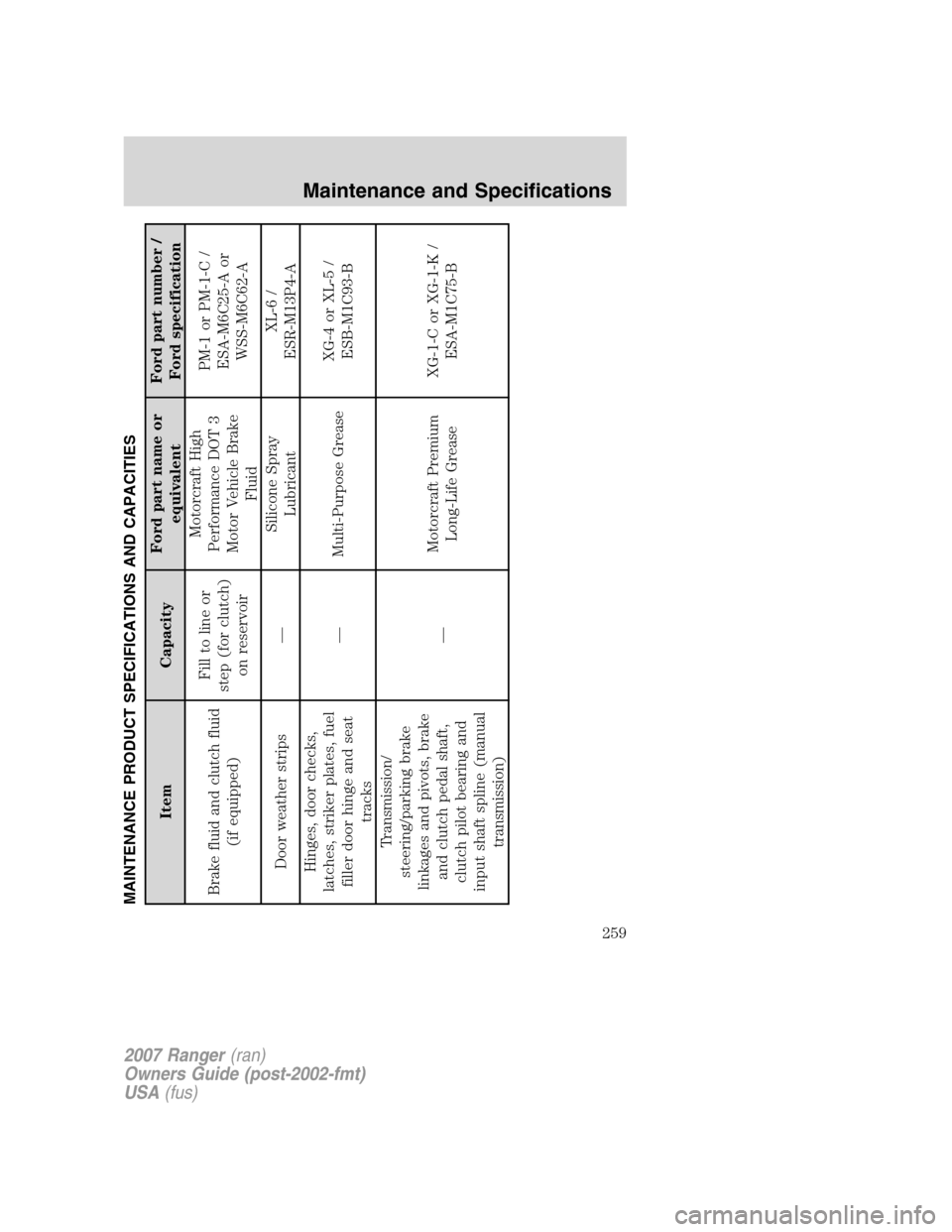
MAINTENANCE PRODUCT SPECIFICATIONS AND CAPACITIES
Item CapacityFord part name or
equivalentFord part number /
Ford specification
Brake fluid and clutch fluid
(if equipped)Fill to line or
step (for clutch)
on reservoirMotorcraft High
Performance DOT 3
Motor Vehicle Brake
FluidPM-1 or PM-1-C /
ESA-M6C25-A or
WSS-M6C62-A
Door weather strips —Silicone Spray
LubricantXL-6 /
ESR-M13P4-A
Hinges, door checks,
latches, striker plates, fuel
filler door hinge and seat
tracks— Multi-Purpose GreaseXG-4 or XL-5 /
ESB-M1C93-B
Transmission/
steering/parking brake
linkages and pivots, brake
and clutch pedal shaft,
clutch pilot bearing and
input shaft spline (manual
transmission)—Motorcraft Premium
Long-Life GreaseXG-1-C or XG-1-K /
ESA-M1C75-B
2007 Ranger(ran)
Owners Guide (post-2002-fmt)
USA(fus)
Maintenance and Specifications
259
Page 262 of 280
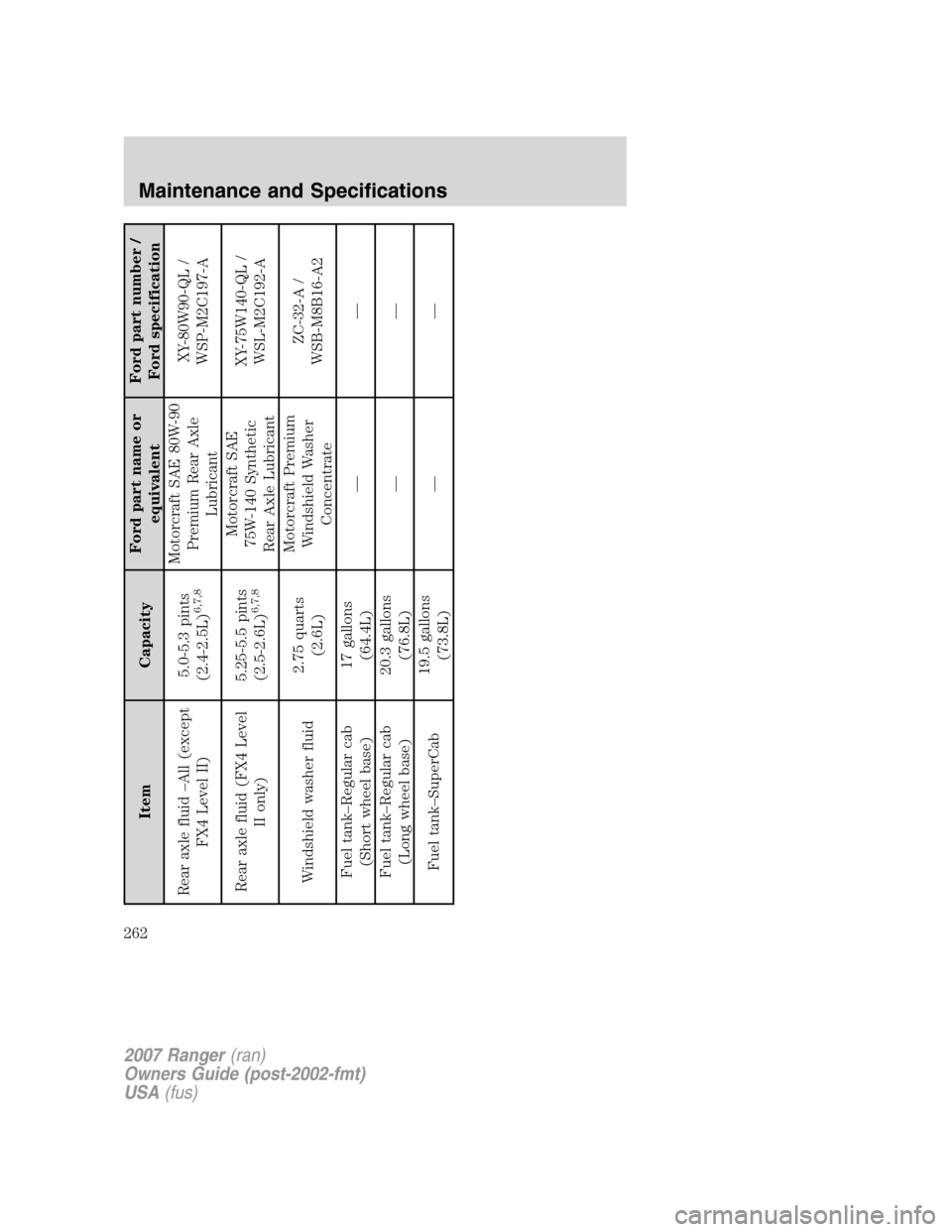
Item CapacityFord part name or
equivalentFord part number /
Ford specification
Rear axle fluid –All (except
FX4 Level II)5.0-5.3 pints
(2.4-2.5L)
6,7,8
Motorcraft SAE 80W-90
Premium Rear Axle
LubricantXY-80W90-QL /
WSP-M2C197-A
Rear axle fluid (FX4 Level
II only)5.25-5.5 pints
(2.5-2.6L)
6,7,8
Motorcraft SAE
75W-140 Synthetic
Rear Axle LubricantXY-75W140-QL /
WSL-M2C192-A
Windshield washer fluid2.75 quarts
(2.6L)Motorcraft Premium
Windshield Washer
ConcentrateZC-32-A /
WSB-M8B16-A2
Fuel tank–Regular cab
(Short wheel base)17 gallons
(64.4L)——
Fuel tank–Regular cab
(Long wheel base)20.3 gallons
(76.8L)——
Fuel tank–SuperCab19.5 gallons
(73.8L)——
2007 Ranger(ran)
Owners Guide (post-2002-fmt)
USA(fus)
Maintenance and Specifications
262
Page 264 of 280
ENGINE DATA
Engine 2.3L I4 engine 3.0L V6 engine 4.0L V6 engine
Cubic inches 138 182 245
Required fuel 87 octane 87 octane 87 octane
Firing order 1-3-4-2 1-4-2-5-3-6 1-4-2-5-3-6
Ignition system EDIS EDIS EDIS
Spark plug gap0.049–0.053 inch
(1.25–1.35 mm)0.051–0.057 inch
(1.29–1.45 mm)0.052–0.056 inch
(1.32–1.42 mm)
Compression
ratio9.7:1 9.6:1 9.7:1
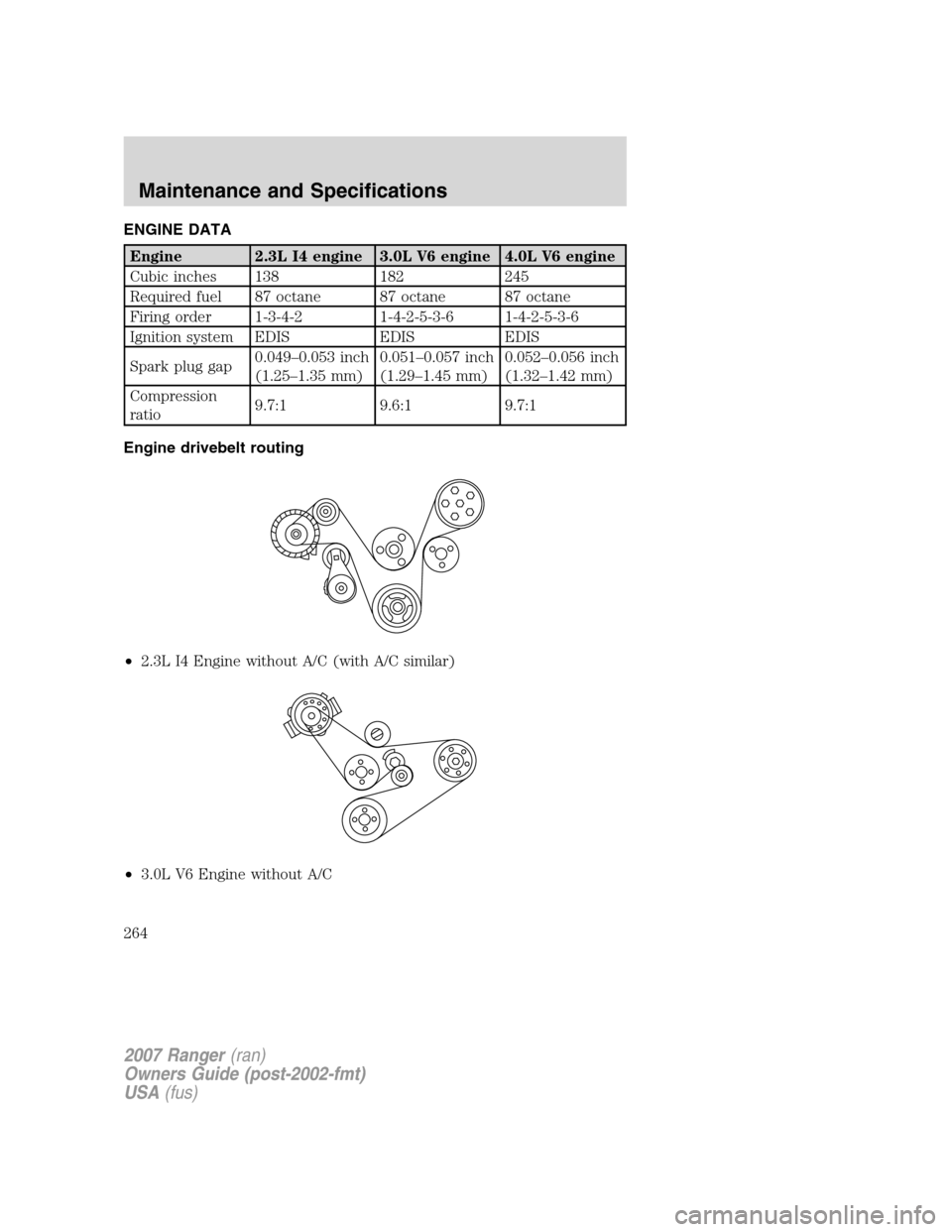
Engine drivebelt routing
•2.3L I4 Engine without A/C (with A/C similar)
•3.0L V6 Engine without A/C
2007 Ranger(ran)
Owners Guide (post-2002-fmt)
USA(fus)
Maintenance and Specifications
264
Page 272 of 280
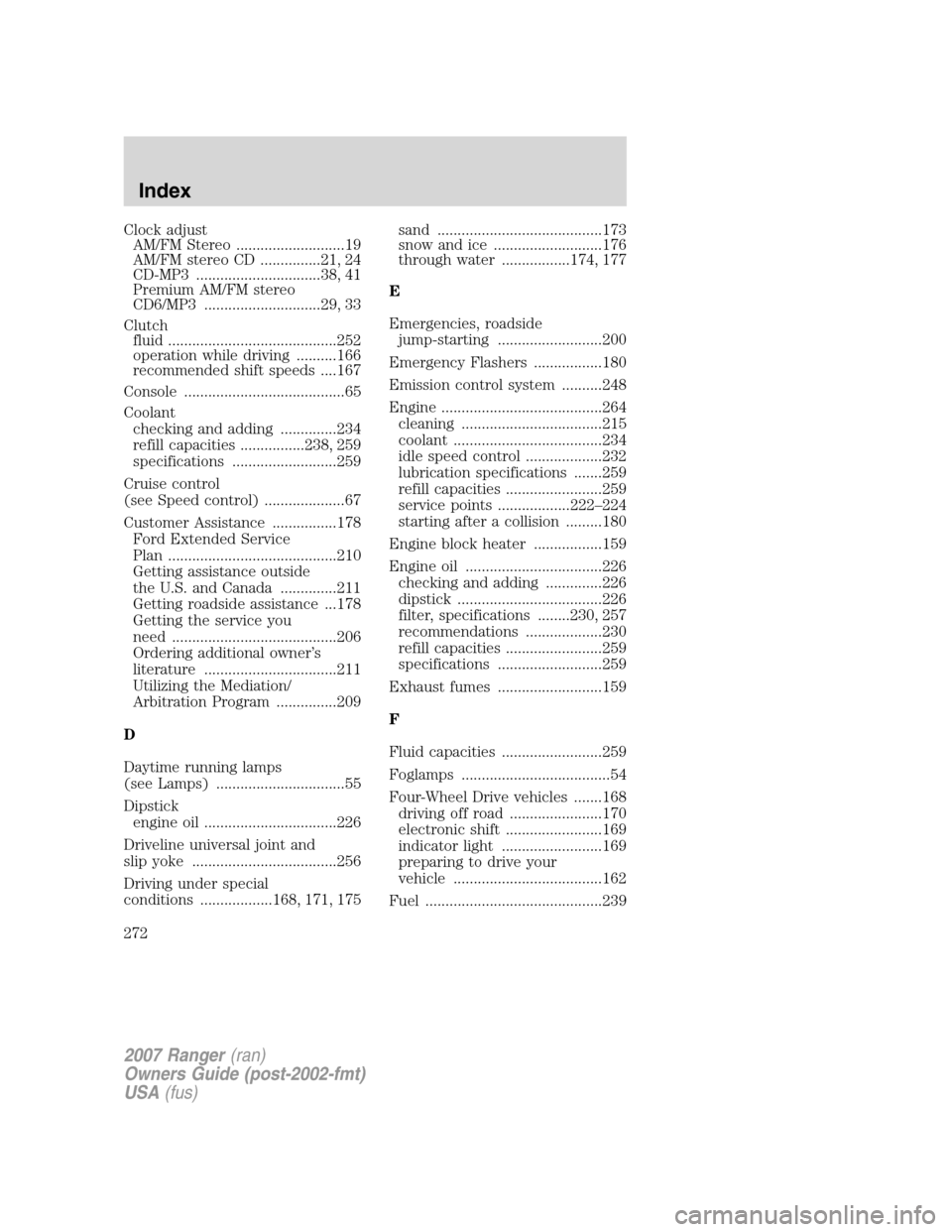
Clock adjust
AM/FM Stereo ...........................19
AM/FM stereo CD ...............21, 24
CD-MP3 ...............................38, 41
Premium AM/FM stereo
CD6/MP3 .............................29, 33
Clutch
fluid ..........................................252
operation while driving ..........166
recommended shift speeds ....167
Console ........................................65
Coolant
checking and adding ..............234
refill capacities ................238, 259
specifications ..........................259
Cruise control
(see Speed control) ....................67
Customer Assistance ................178
Ford Extended Service
Plan ..........................................210
Getting assistance outside
the U.S. and Canada ..............211
Getting roadside assistance ...178
Getting the service you
need .........................................206
Ordering additional owner’s
literature .................................211
Utilizing the Mediation/
Arbitration Program ...............209
D
Daytime running lamps
(see Lamps) ................................55
Dipstick
engine oil .................................226
Driveline universal joint and
slip yoke ....................................256
Driving under special
conditions ..................168, 171, 175sand .........................................173
snow and ice ...........................176
through water .................174, 177
E
Emergencies, roadside
jump-starting ..........................200
Emergency Flashers .................180
Emission control system ..........248
Engine ........................................264
cleaning ...................................215
coolant .....................................234
idle speed control ...................232
lubrication specifications .......259
refill capacities ........................259
service points ..................222–224
starting after a collision .........180
Engine block heater .................159
Engine oil ..................................226
checking and adding ..............226
dipstick ....................................226
filter, specifications ........230, 257
recommendations ...................230
refill capacities ........................259
specifications ..........................259
Exhaust fumes ..........................159
F
Fluid capacities .........................259
Foglamps .....................................54
Four-Wheel Drive vehicles .......168
driving off road .......................170
electronic shift ........................169
indicator light .........................169
preparing to drive your
vehicle .....................................162
Fuel ............................................239
2007 Ranger(ran)
Owners Guide (post-2002-fmt)
USA(fus)
Index
272
Page 273 of 280
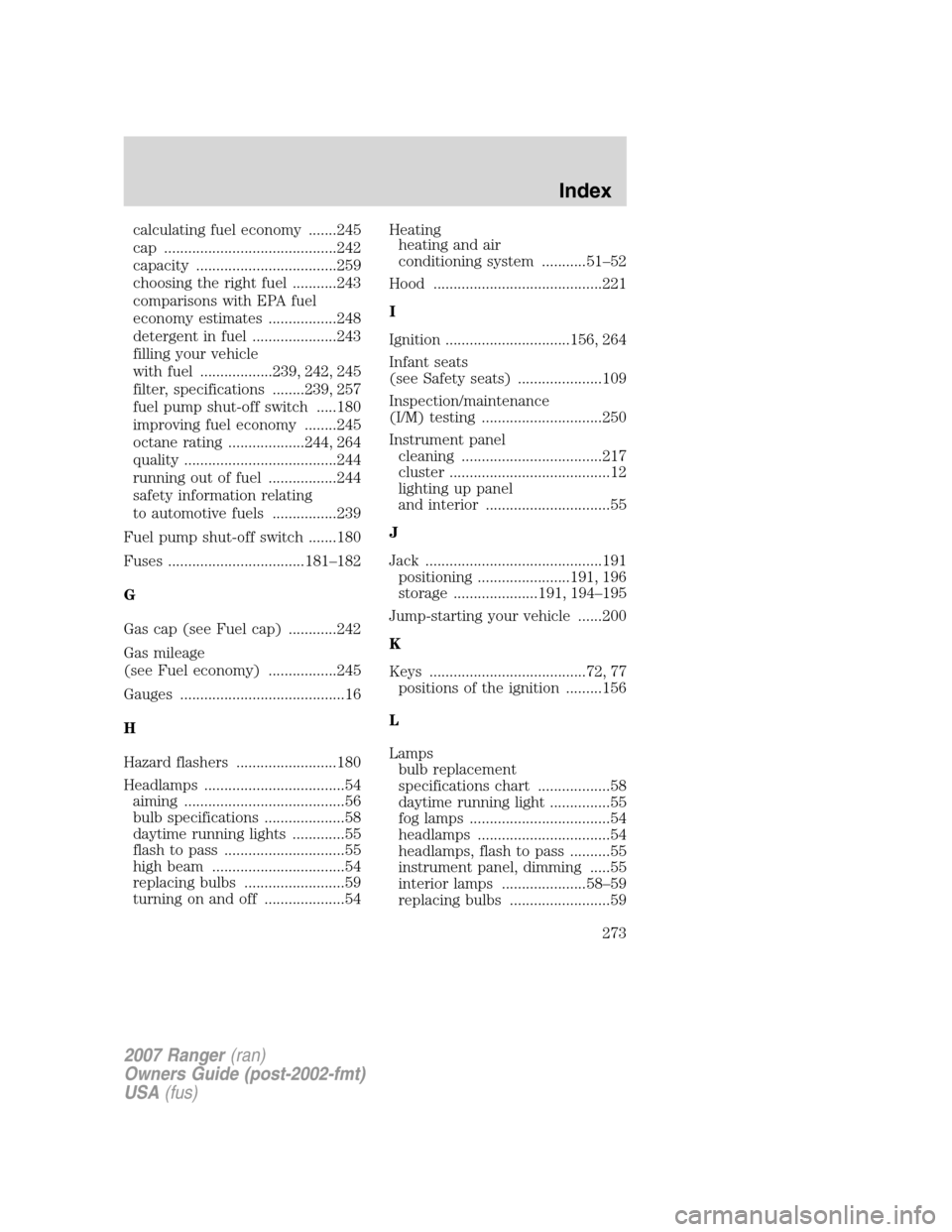
calculating fuel economy .......245
cap ...........................................242
capacity ...................................259
choosing the right fuel ...........243
comparisons with EPA fuel
economy estimates .................248
detergent in fuel .....................243
filling your vehicle
with fuel ..................239, 242, 245
filter, specifications ........239, 257
fuel pump shut-off switch .....180
improving fuel economy ........245
octane rating ...................244, 264
quality ......................................244
running out of fuel .................244
safety information relating
to automotive fuels ................239
Fuel pump shut-off switch .......180
Fuses ..................................181–182
G
Gas cap (see Fuel cap) ............242
Gas mileage
(see Fuel economy) .................245
Gauges .........................................16
H
Hazard flashers .........................180
Headlamps ...................................54
aiming ........................................56
bulb specifications ....................58
daytime running lights .............55
flash to pass ..............................55
high beam .................................54
replacing bulbs .........................59
turning on and off ....................54Heating
heating and air
conditioning system ...........51–52
Hood ..........................................221
I
Ignition ...............................156, 264
Infant seats
(see Safety seats) .....................109
Inspection/maintenance
(I/M) testing ..............................250
Instrument panel
cleaning ...................................217
cluster ........................................12
lighting up panel
and interior ...............................55
J
Jack ............................................191
positioning .......................191, 196
storage .....................191, 194–195
Jump-starting your vehicle ......200
K
Keys .......................................72, 77
positions of the ignition .........156
L
Lamps
bulb replacement
specifications chart ..................58
daytime running light ...............55
fog lamps ...................................54
headlamps .................................54
headlamps, flash to pass ..........55
instrument panel, dimming .....55
interior lamps .....................58–59
replacing bulbs .........................59
2007 Ranger(ran)
Owners Guide (post-2002-fmt)
USA(fus)
Index
273