lock FORD RANGER 2007 2.G Workshop Manual
[x] Cancel search | Manufacturer: FORD, Model Year: 2007, Model line: RANGER, Model: FORD RANGER 2007 2.GPages: 280, PDF Size: 2.9 MB
Page 178 of 280
ROADSIDE ASSISTANCE
Getting roadside assistance
To fully assist you should you have a vehicle concern, Ford Motor
Company offers a complimentary roadside assistance program. This
program is separate from the New Vehicle Limited Warranty. The service
is available:
•24–hours, seven days a week
•for the New Vehicle Limited Warranty period of three years or
36,000 miles (60,000 km), whichever occurs first on Ford and Mercury
vehicles, and four years or 50,000 miles (80,000 km) on Lincoln
vehicles.
Roadside assistance will cover:
•a flat tire change with a good spare (except Ford GT which has a tire
inflation kit)
•battery jump start
•lock-out assistance (key replacement cost is the customer’s
responsibility)
•fuel delivery – Independent Service Contractors, if not prohibited by
state, local or municipal law shall deliver up to 2.0 gallons (7.5L) of
gasoline or 5 gallons (18.9L) of diesel fuel to a disabled vehicle. Fuel
delivery service is limited to two no-charge occurrences within a
12-month period.
•winch out – available within 100 feet (30.5 meters) of a paved or
county maintained road, no recoveries.
•towing – Ford/Mercury/Lincoln eligible vehicle towed to an authorized
dealer within 35 miles (56.3 km) of the disablement location or to the
nearest authorized dealer. If a member requests to be towed to an
authorized dealer more than 35 miles (56.3 km) from the disablement
location, the member shall be responsible for any mileage costs in
excess of 35 miles (56.3 km).
Trailers shall be covered up to $100 if the disabled eligible vehicle
requires service at the nearest authorized dealer. If the trailer is disabled,
but the towing vehicle is operational, the trailer does not qualify for any
roadside services.
2007 Ranger(ran)
Owners Guide (post-2002-fmt)
USA(fus)
Roadside Emergencies
178
Page 184 of 280
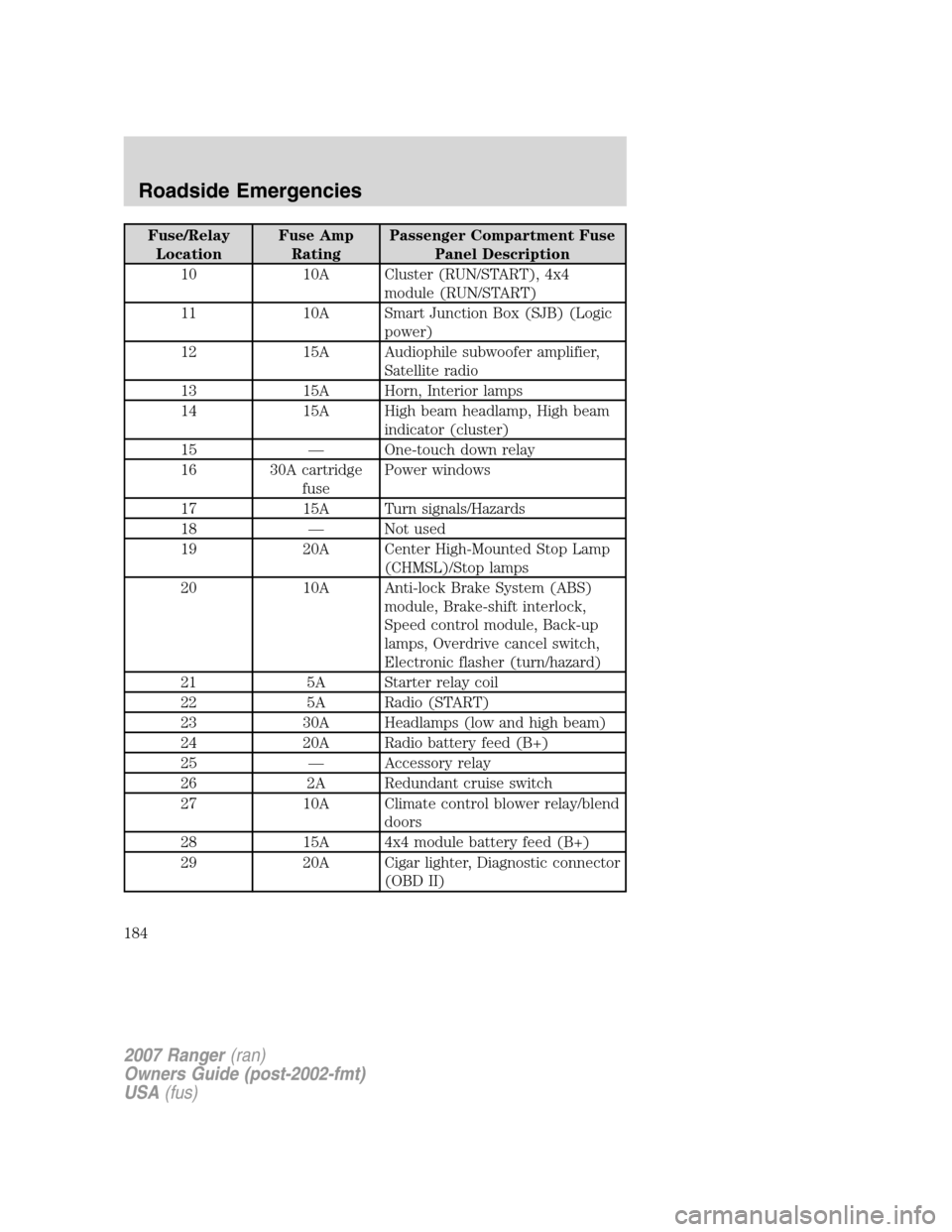
Fuse/Relay
LocationFuse Amp
RatingPassenger Compartment Fuse
Panel Description
10 10A Cluster (RUN/START), 4x4
module (RUN/START)
11 10A Smart Junction Box (SJB) (Logic
power)
12 15A Audiophile subwoofer amplifier,
Satellite radio
13 15A Horn, Interior lamps
14 15A High beam headlamp, High beam
indicator (cluster)
15 — One-touch down relay
16 30A cartridge
fusePower windows
17 15A Turn signals/Hazards
18 — Not used
19 20A Center High-Mounted Stop Lamp
(CHMSL)/Stop lamps
20 10A Anti-lock Brake System (ABS)
module, Brake-shift interlock,
Speed control module, Back-up
lamps, Overdrive cancel switch,
Electronic flasher (turn/hazard)
21 5A Starter relay coil
22 5A Radio (START)
23 30A Headlamps (low and high beam)
24 20A Radio battery feed (B+)
25 — Accessory relay
26 2A Redundant cruise switch
27 10A Climate control blower relay/blend
doors
28 15A 4x4 module battery feed (B+)
29 20A Cigar lighter, Diagnostic connector
(OBD II)
2007 Ranger(ran)
Owners Guide (post-2002-fmt)
USA(fus)
Roadside Emergencies
184
Page 185 of 280
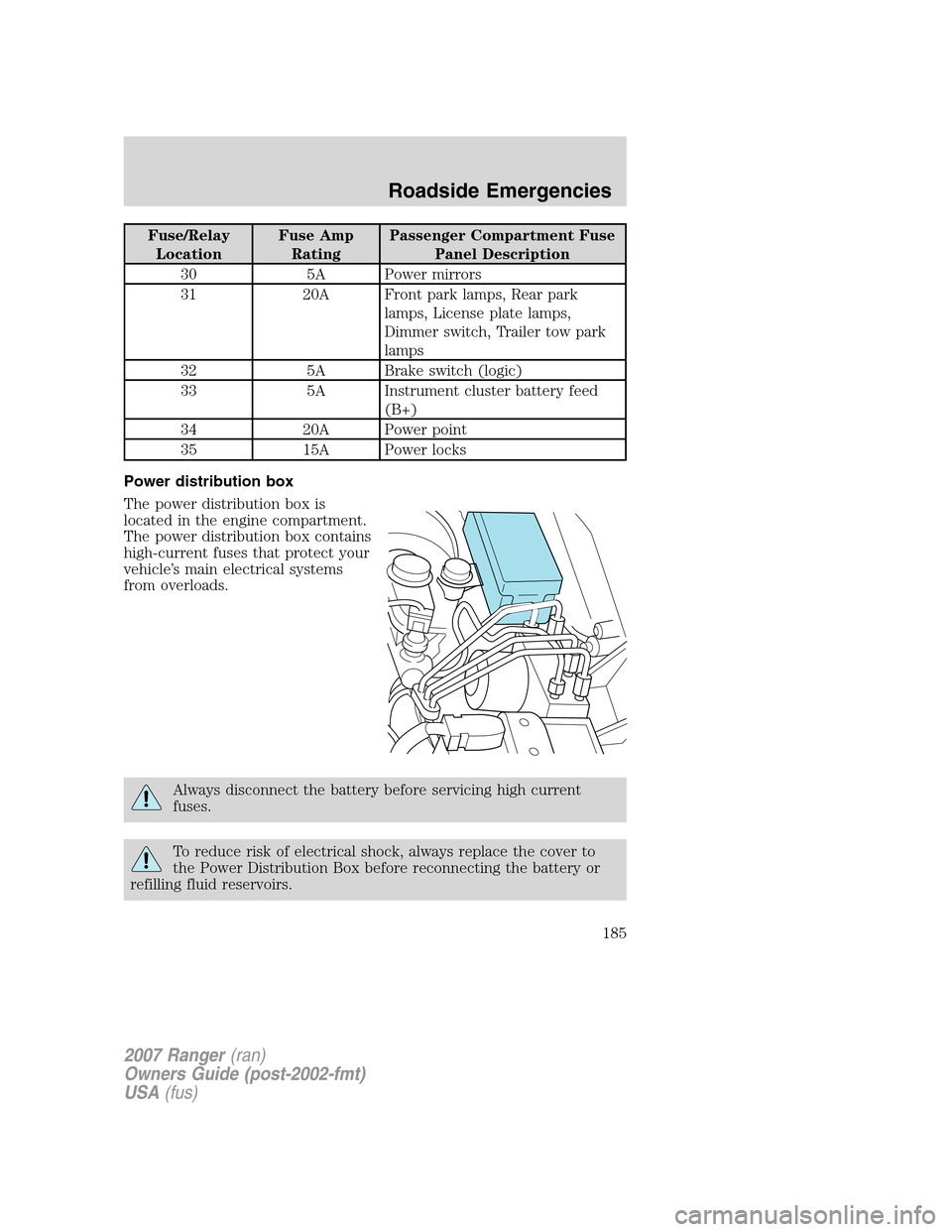
Fuse/Relay
LocationFuse Amp
RatingPassenger Compartment Fuse
Panel Description
30 5A Power mirrors
31 20A Front park lamps, Rear park
lamps, License plate lamps,
Dimmer switch, Trailer tow park
lamps
32 5A Brake switch (logic)
33 5A Instrument cluster battery feed
(B+)
34 20A Power point
35 15A Power locks
Power distribution box
The power distribution box is
located in the engine compartment.
The power distribution box contains
high-current fuses that protect your
vehicle’s main electrical systems
from overloads.
Always disconnect the battery before servicing high current
fuses.
To reduce risk of electrical shock, always replace the cover to
the Power Distribution Box before reconnecting the battery or
refilling fluid reservoirs.
2007 Ranger(ran)
Owners Guide (post-2002-fmt)
USA(fus)
Roadside Emergencies
185
Page 187 of 280
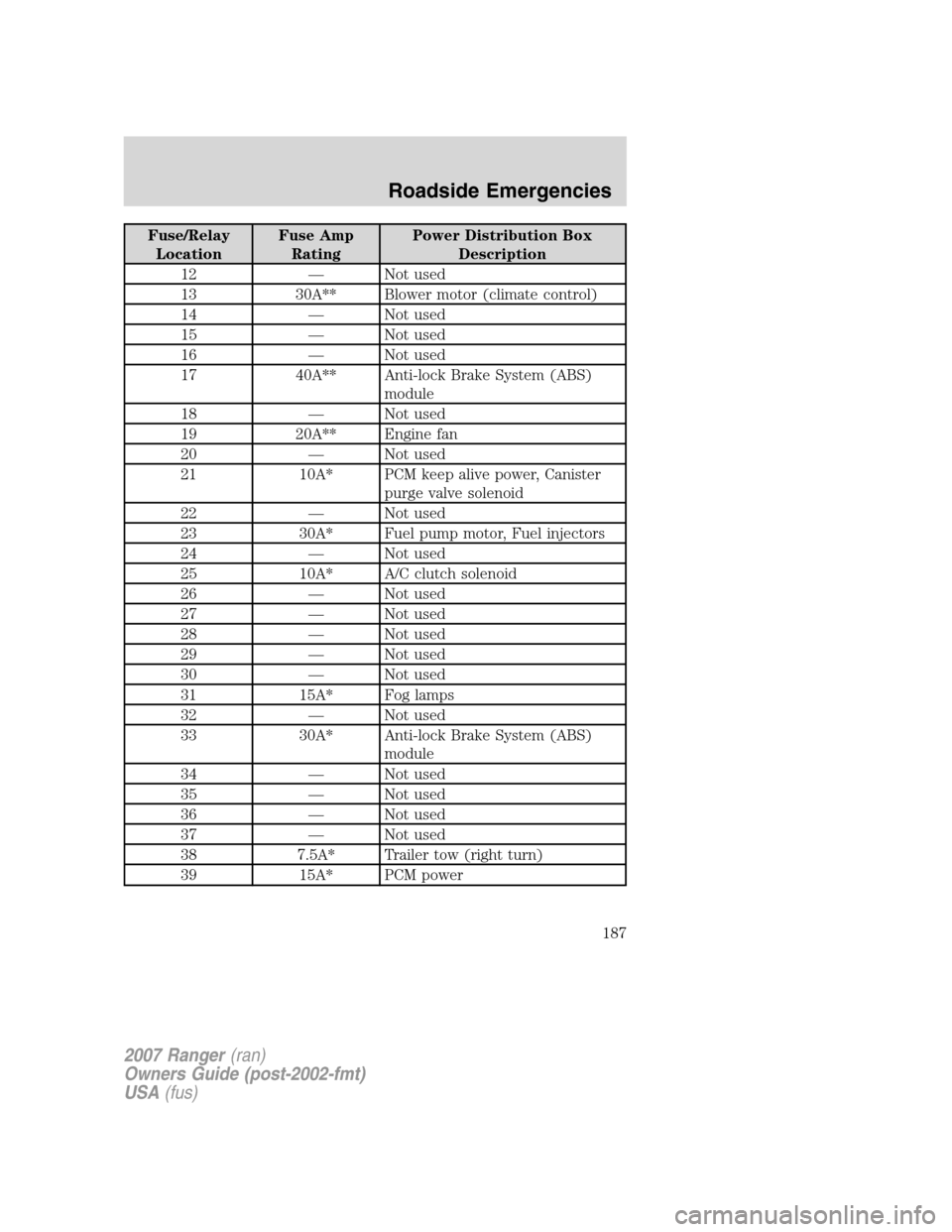
Fuse/Relay
LocationFuse Amp
RatingPower Distribution Box
Description
12 — Not used
13 30A** Blower motor (climate control)
14 — Not used
15 — Not used
16 — Not used
17 40A** Anti-lock Brake System (ABS)
module
18 — Not used
19 20A** Engine fan
20 — Not used
21 10A* PCM keep alive power, Canister
purge valve solenoid
22 — Not used
23 30A* Fuel pump motor, Fuel injectors
24 — Not used
25 10A* A/C clutch solenoid
26 — Not used
27 — Not used
28 — Not used
29 — Not used
30 — Not used
31 15A* Fog lamps
32 — Not used
33 30A* Anti-lock Brake System (ABS)
module
34 — Not used
35 — Not used
36 — Not used
37 — Not used
38 7.5A* Trailer tow (right turn)
39 15A* PCM power
2007 Ranger(ran)
Owners Guide (post-2002-fmt)
USA(fus)
Roadside Emergencies
187
Page 190 of 280
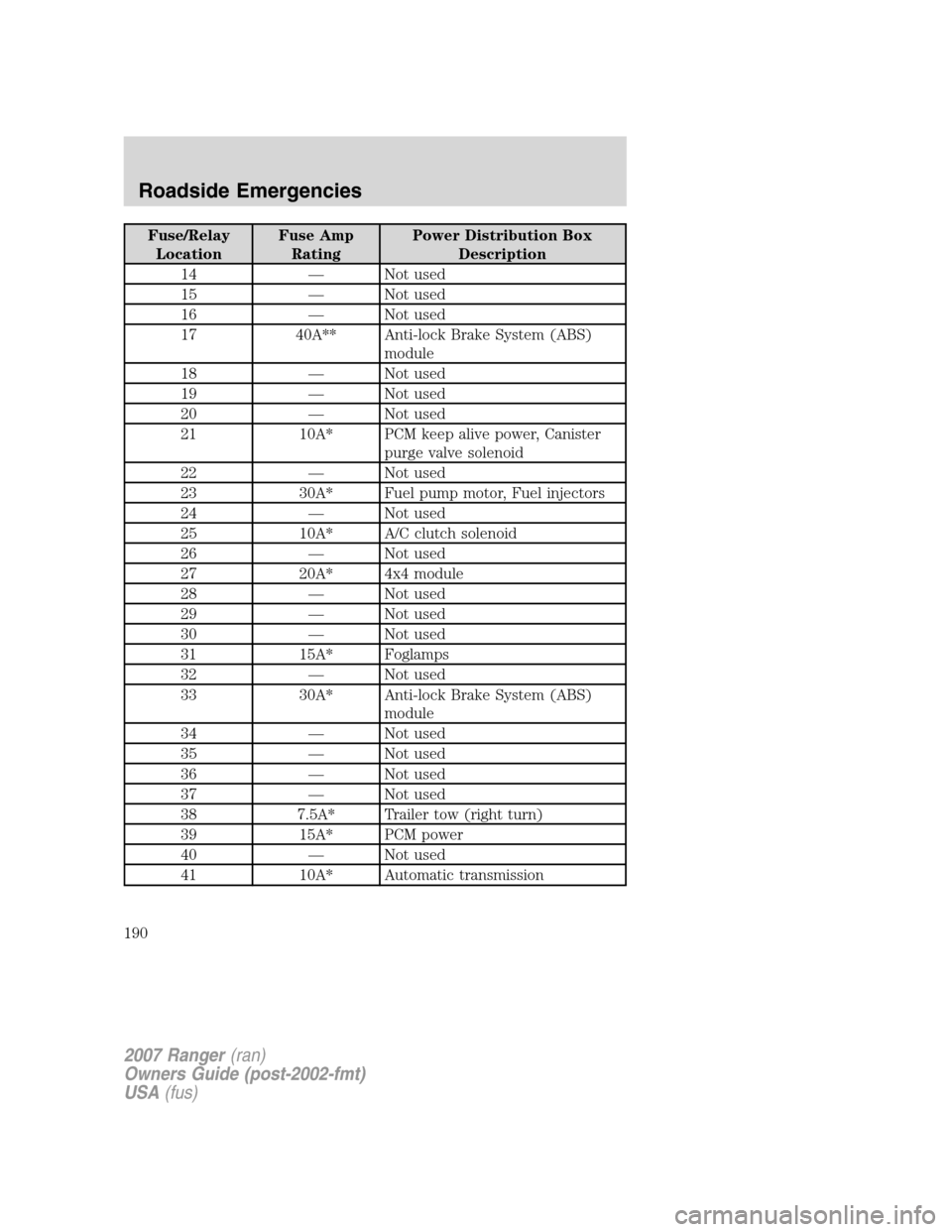
Fuse/Relay
LocationFuse Amp
RatingPower Distribution Box
Description
14 — Not used
15 — Not used
16 — Not used
17 40A** Anti-lock Brake System (ABS)
module
18 — Not used
19 — Not used
20 — Not used
21 10A* PCM keep alive power, Canister
purge valve solenoid
22 — Not used
23 30A* Fuel pump motor, Fuel injectors
24 — Not used
25 10A* A/C clutch solenoid
26 — Not used
27 20A* 4x4 module
28 — Not used
29 — Not used
30 — Not used
31 15A* Foglamps
32 — Not used
33 30A* Anti-lock Brake System (ABS)
module
34 — Not used
35 — Not used
36 — Not used
37 — Not used
38 7.5A* Trailer tow (right turn)
39 15A* PCM power
40 — Not used
41 10A* Automatic transmission
2007 Ranger(ran)
Owners Guide (post-2002-fmt)
USA(fus)
Roadside Emergencies
190
Page 194 of 280
Drive cautiously when using a full-size dissimilar spare tire/wheel and
seek service as soon as possible.
Full-size Matching Spare Tire/Wheel Information
This spare tire/wheel will match the road tire/wheel. When driving with
the full size matching spare tire/wheel, do not exceed 70 mph (113 km/h).
It is intended for temporary use only. This means if you need to use it,
you should replace it as soon as possible.
Location of the spare tire and tools
Note:The tire pressure monitoring system (TPMS) indicator light will
illuminate when the spare is in use. To restore the full functionality of
the TPMS system, all road wheels equipped with the tire pressure
monitoring sensors must be mounted on the vehicle.
Have a flat tire serviced by an authorized dealer in order to prevent
damage to the TPMS sensor, refer toTire Pressure Monitoring System
(TPMS)in theTires, Wheels and Loadingchapter. Replace the spare
tire with a road tire as soon as possible.
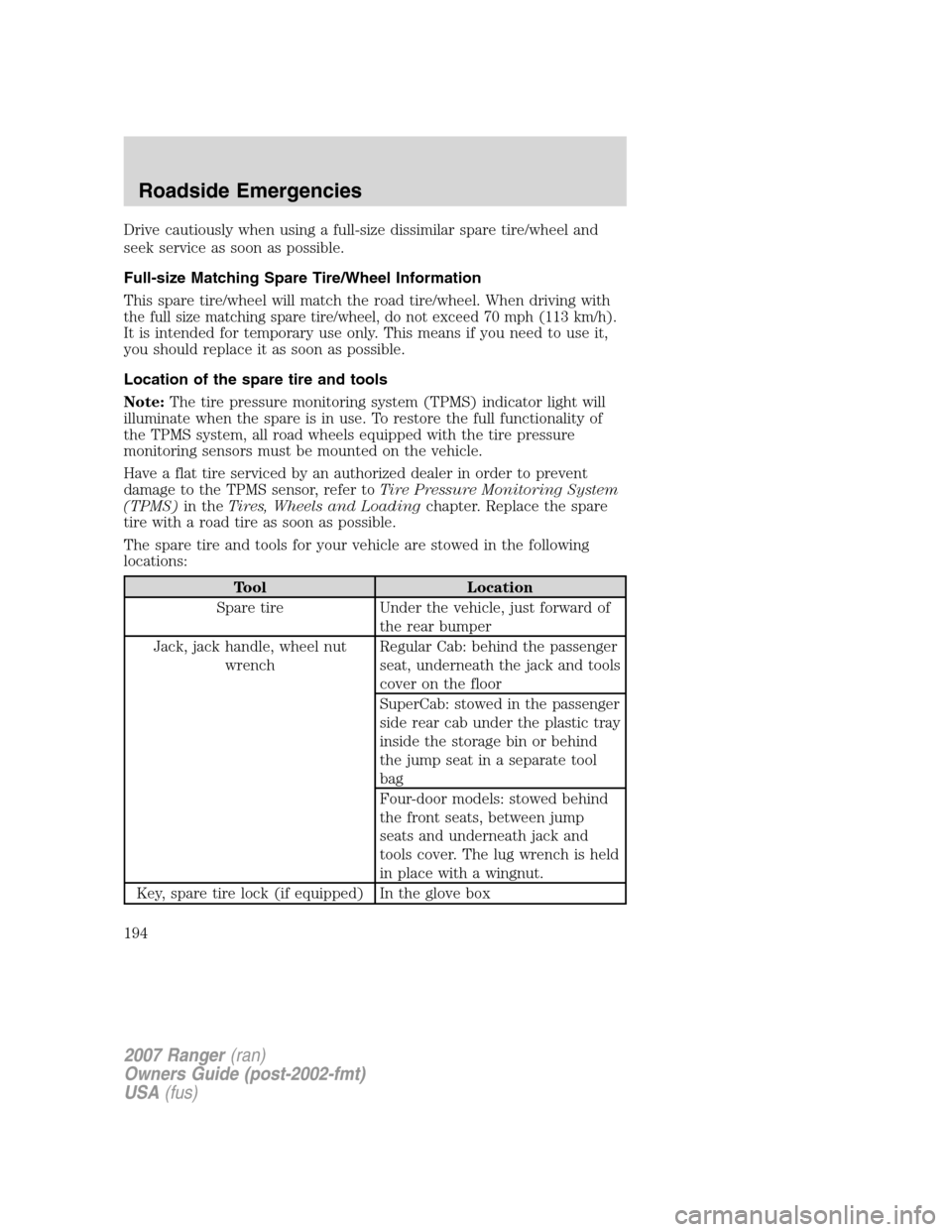
The spare tire and tools for your vehicle are stowed in the following
locations:
Tool Location
Spare tire Under the vehicle, just forward of
the rear bumper
Jack, jack handle, wheel nut
wrenchRegular Cab: behind the passenger
seat, underneath the jack and tools
cover on the floor
SuperCab: stowed in the passenger
side rear cab under the plastic tray
inside the storage bin or behind
the jump seat in a separate tool
bag
Four-door models: stowed behind
the front seats, between jump
seats and underneath jack and
tools cover. The lug wrench is held
in place with a wingnut.
Key, spare tire lock (if equipped) In the glove box
2007 Ranger(ran)
Owners Guide (post-2002-fmt)
USA(fus)
Roadside Emergencies
194
Page 195 of 280
Removing the spare tire
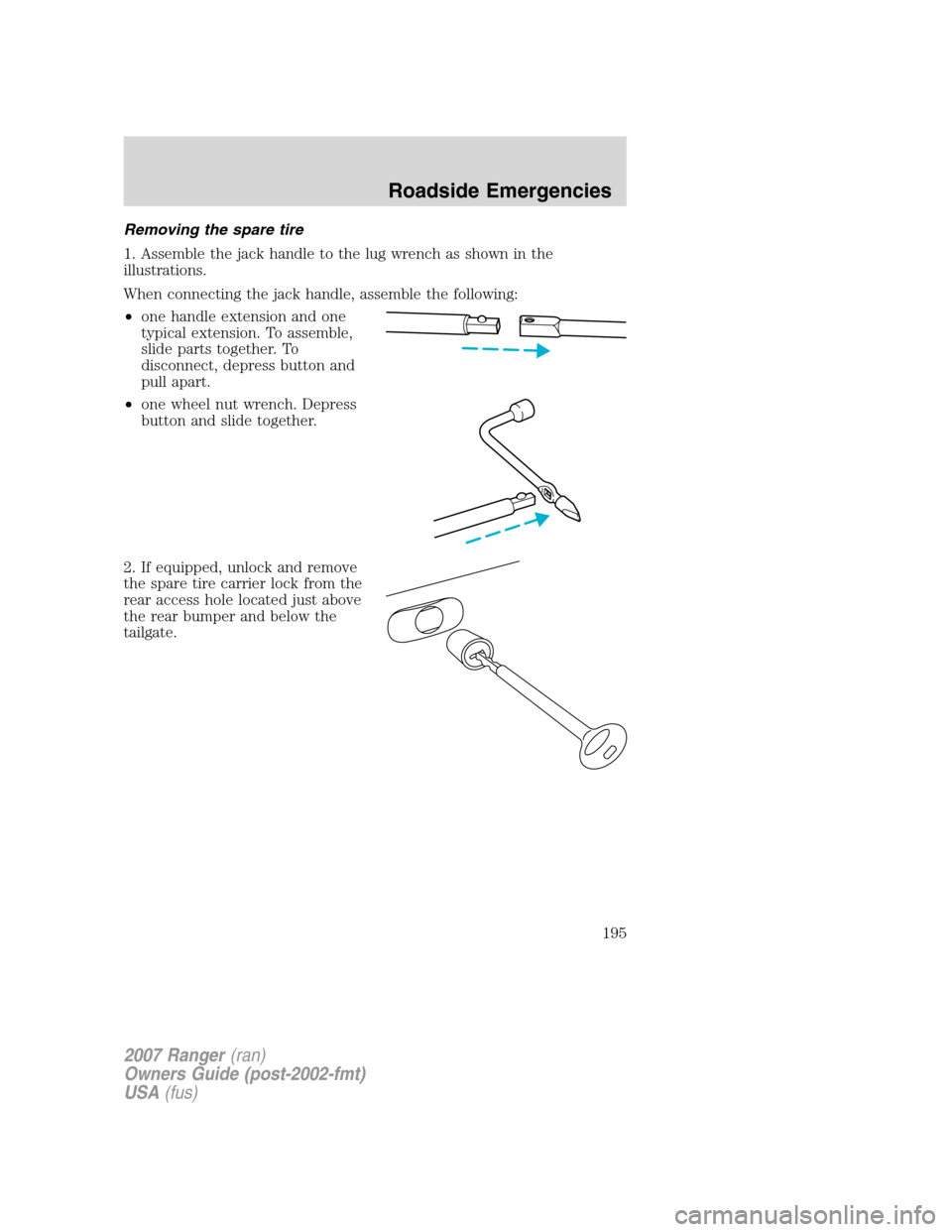
1. Assemble the jack handle to the lug wrench as shown in the
illustrations.
When connecting the jack handle, assemble the following:
•one handle extension and one
typical extension. To assemble,
slide parts together. To
disconnect, depress button and
pull apart.
•one wheel nut wrench. Depress
button and slide together.
2. If equipped, unlock and remove
the spare tire carrier lock from the
rear access hole located just above
the rear bumper and below the
tailgate.
2007 Ranger(ran)
Owners Guide (post-2002-fmt)
USA(fus)
Roadside Emergencies
195
Page 196 of 280
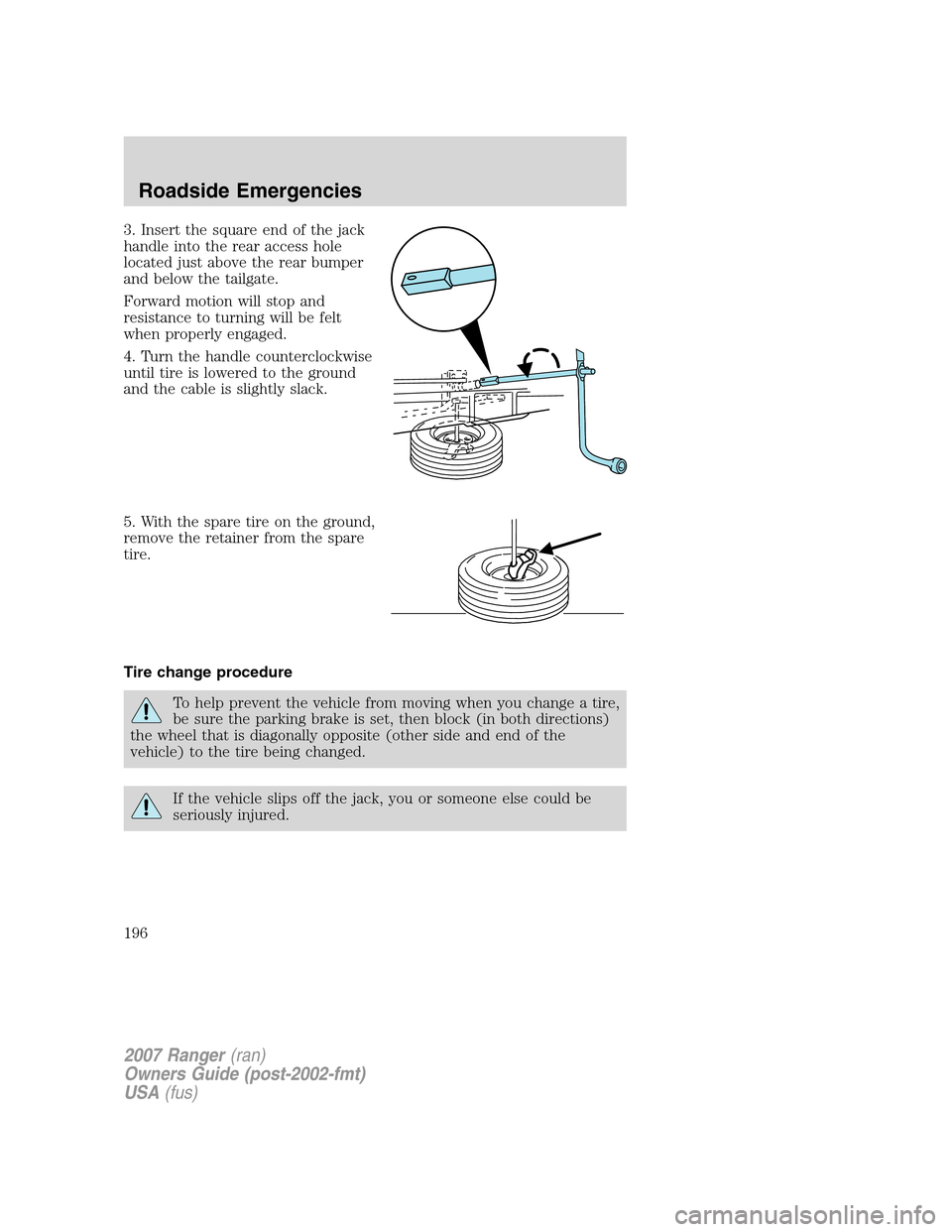
3. Insert the square end of the jack
handle into the rear access hole
located just above the rear bumper
and below the tailgate.
Forward motion will stop and
resistance to turning will be felt
when properly engaged.
4. Turn the handle counterclockwise
until tire is lowered to the ground
and the cable is slightly slack.
5. With the spare tire on the ground,
remove the retainer from the spare
tire.
Tire change procedure
To help prevent the vehicle from moving when you change a tire,
be sure the parking brake is set, then block (in both directions)
the wheel that is diagonally opposite (other side and end of the
vehicle) to the tire being changed.
If the vehicle slips off the jack, you or someone else could be
seriously injured.
2007 Ranger(ran)
Owners Guide (post-2002-fmt)
USA(fus)
Roadside Emergencies
196
Page 197 of 280
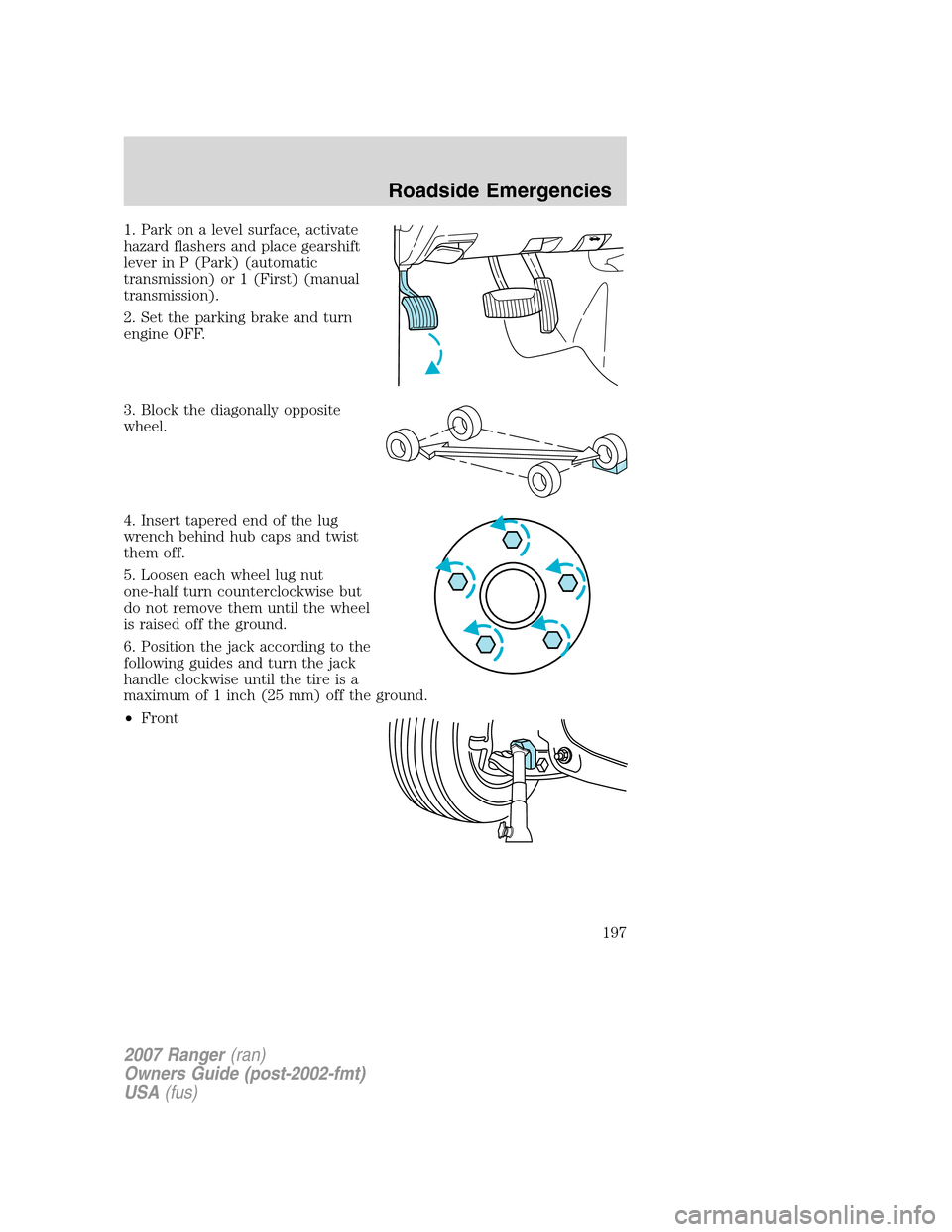
1. Park on a level surface, activate
hazard flashers and place gearshift
lever in P (Park) (automatic
transmission) or 1 (First) (manual
transmission).
2. Set the parking brake and turn
engine OFF.
3. Block the diagonally opposite
wheel.
4. Insert tapered end of the lug
wrench behind hub caps and twist
them off.
5. Loosen each wheel lug nut
one-half turn counterclockwise but
do not remove them until the wheel
is raised off the ground.
6. Position the jack according to the
following guides and turn the jack
handle clockwise until the tire is a
maximum of 1 inch (25 mm) off the ground.
•Front
2007 Ranger(ran)
Owners Guide (post-2002-fmt)
USA(fus)
Roadside Emergencies
197
Page 198 of 280
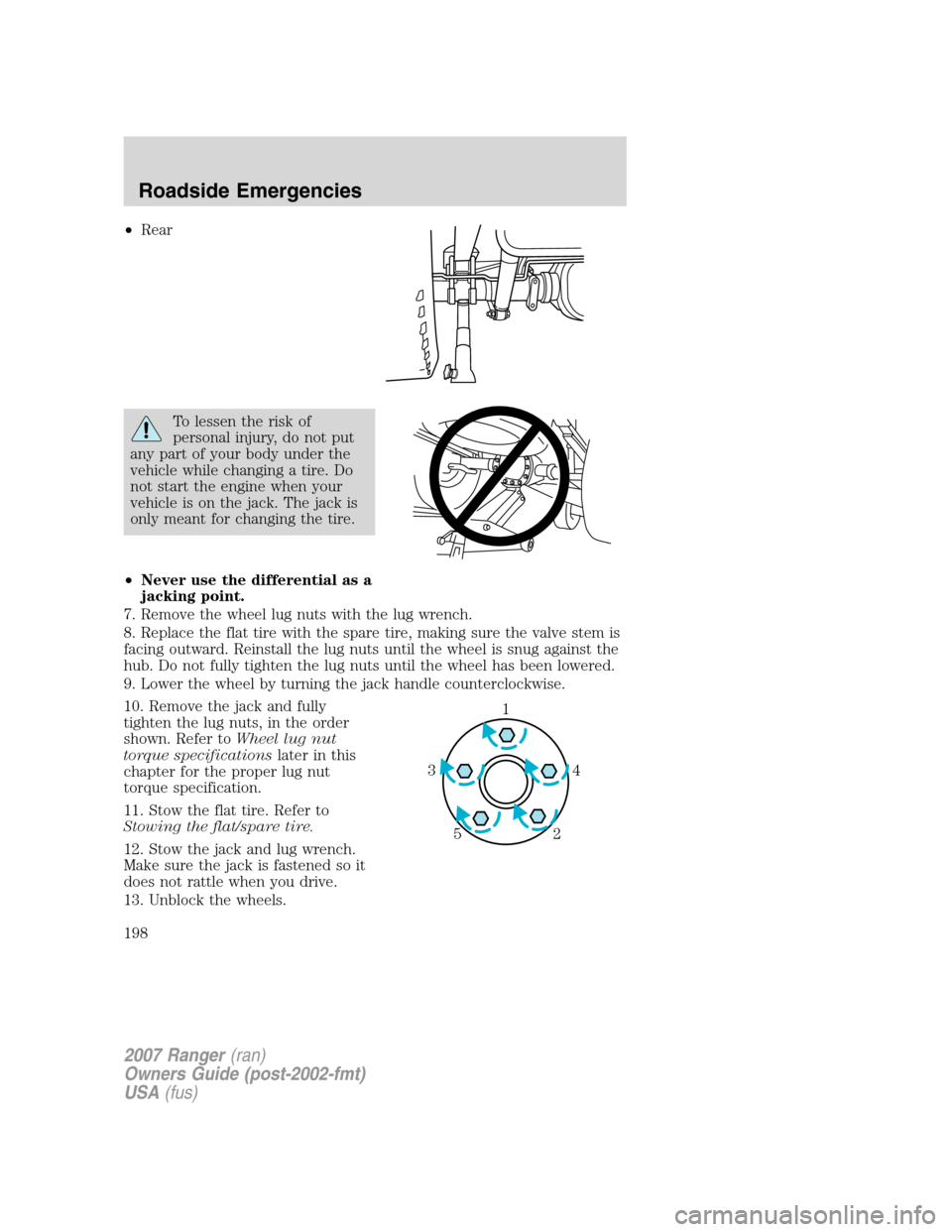
•Rear
To lessen the risk of
personal injury, do not put
any part of your body under the
vehicle while changing a tire. Do
not start the engine when your
vehicle is on the jack. The jack is
only meant for changing the tire.
•Never use the differential as a
jacking point.
7. Remove the wheel lug nuts with the lug wrench.
8. Replace the flat tire with the spare tire, making sure the valve stem is
facing outward. Reinstall the lug nuts until the wheel is snug against the
hub. Do not fully tighten the lug nuts until the wheel has been lowered.
9. Lower the wheel by turning the jack handle counterclockwise.
10. Remove the jack and fully
tighten the lug nuts, in the order
shown. Refer toWheel lug nut
torque specificationslater in this
chapter for the proper lug nut
torque specification.
11. Stow the flat tire. Refer to
Stowing the flat/spare tire.
12. Stow the jack and lug wrench.
Make sure the jack is fastened so it
does not rattle when you drive.
13. Unblock the wheels.
1
4 3
2 5
2007 Ranger(ran)
Owners Guide (post-2002-fmt)
USA(fus)
Roadside Emergencies
198