maintenance FORD RANGER 2008 2.G Workshop Manual
[x] Cancel search | Manufacturer: FORD, Model Year: 2008, Model line: RANGER, Model: FORD RANGER 2008 2.GPages: 272, PDF Size: 2.73 MB
Page 245 of 272
These temporary malfunctions can be corrected by filling the fuel tank
with good quality fuel, properly tightening the fuel cap or letting the
electrical system dry out. After three driving cycles without these or any
other temporary malfunctions present, the
indicator should stay off
the next time the engine is started. A driving cycle consists of a cold
engine startup followed by mixed city/highway driving. No additional
vehicle service is required.
If the
indicator remains on, have your vehicle serviced at the first
available opportunity. Although some malfunctions detected by the
OBD-II may not have symptoms that are apparent, continued driving
with the
indicator on can result in increased emissions, lower fuel
economy, reduced engine and transmission smoothness, and lead to more
costly repairs.
Readiness for Inspection/Maintenance (I/M) testing
Some state/provincial and local governments may have
Inspection/Maintenance (I/M) programs to inspect the emission control
equipment on your vehicle. Failure to pass this inspection could prevent
you from getting a vehicle registration. Your vehicle may not pass the I/M
test if the
indicator is on or not working properly (bulb is burned
out), or if the OBD-II system has determined that some of the emission
control systems have not been properly checked. In this case, the vehicle
is considered not ready for I/M testing.
If the
indicator is on or the bulb does not work, the vehicle may
need to be serviced. Refer to the On board diagnostics (OBD-II)
description in this chapter.
If the vehicle’s engine or transmission has just been serviced, or the
battery has recently run down or been replaced, the OBD-II system may
indicate that the vehicle is not ready for I/M testing. To determine if the
vehicle is ready for I/M testing, turn the ignition key to the ON position
for 15 seconds without cranking the engine. If the
indicator blinks
eight times, it means that the vehicle is not ready for I/M testing; if
the
indicator stays on solid, it means that the vehicle is ready for
I/M testing.
The OBD-II system is designed to check the emission control system
during normal driving. A complete check may take several days. If the
vehicle is not ready for I/M testing, the following driving cycle consisting
of mixed city and highway driving may be performed:
15 minutes of steady driving on an expressway/highway followed by 20
minutes of stop-and-go driving with at least four 30-second idle periods.
2008 Ranger(ran)
Owners Guide (post-2002-fmt)
USA(fus)
Maintenance and Specifications
245
Page 246 of 272
Allow the vehicle to sit for at least eight hours without starting the
engine. Then, start the engine and complete the above driving cycle. The
engine must warm up to its normal operating temperature. Once started,
do not turn off the engine until the above driving cycle is complete. If
the vehicle is still not ready for I/M testing, the above driving cycle will
have to be repeated.
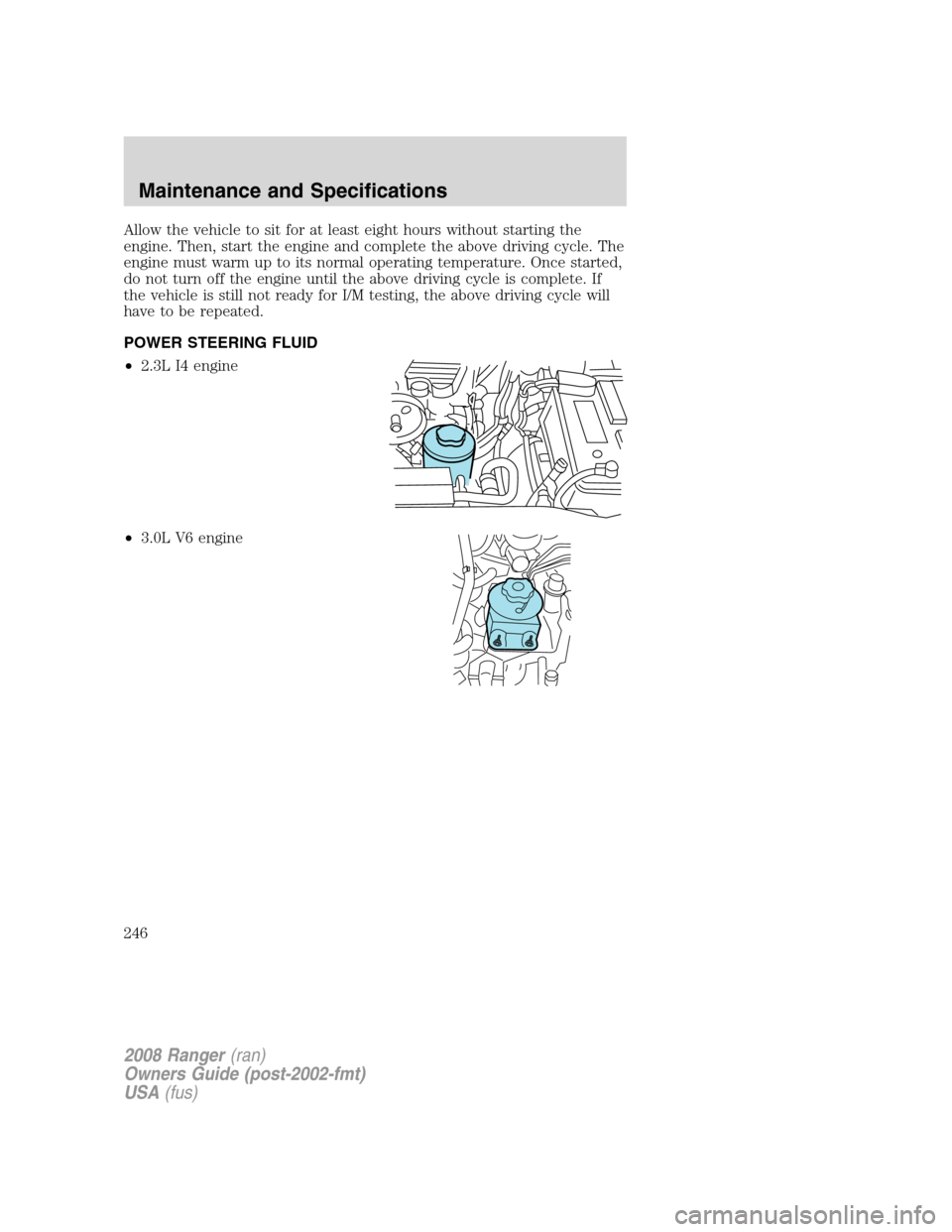
POWER STEERING FLUID
•2.3L I4 engine
•3.0L V6 engine
2008 Ranger(ran)
Owners Guide (post-2002-fmt)
USA(fus)
Maintenance and Specifications
246
Page 247 of 272
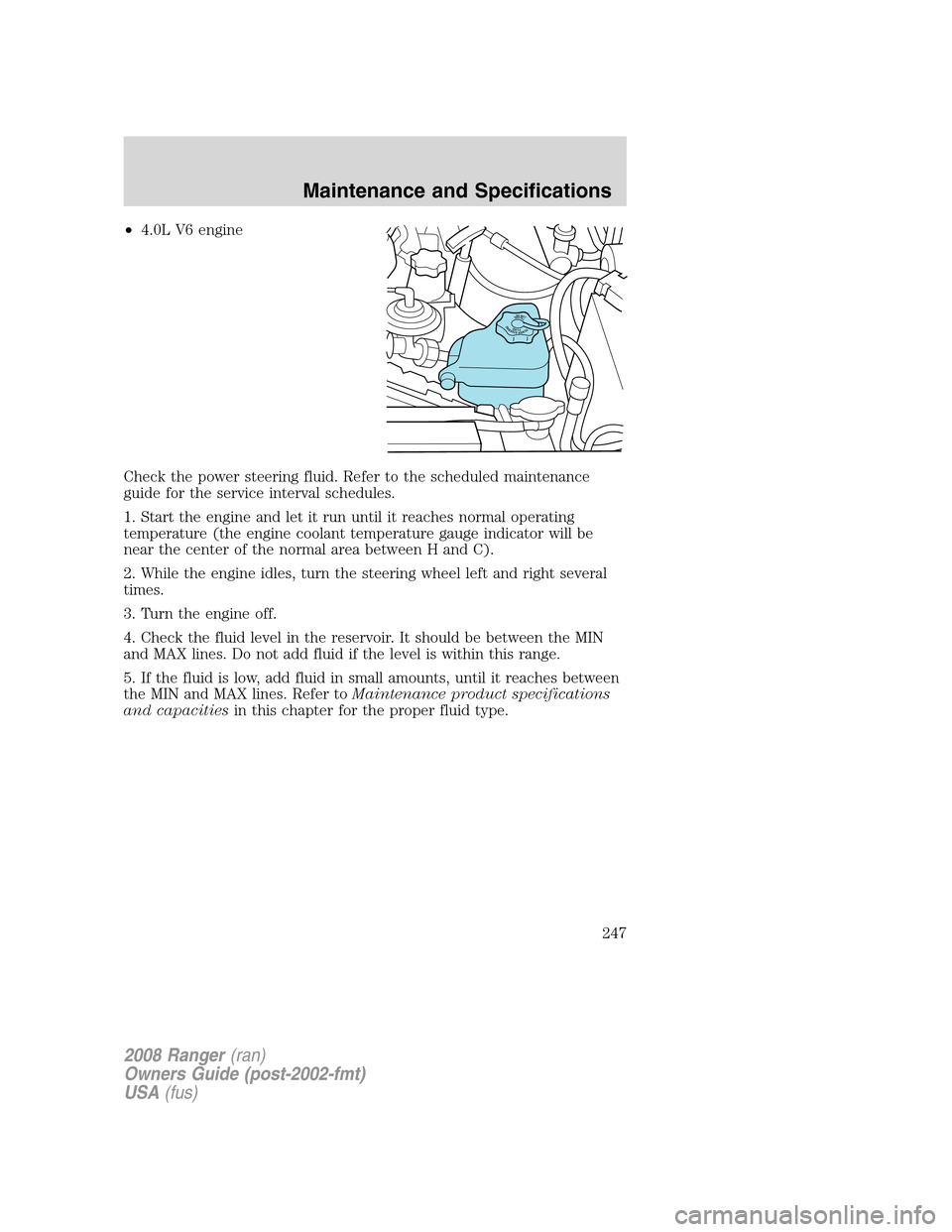
•4.0L V6 engine
Check the power steering fluid. Refer to the scheduled maintenance
guide for the service interval schedules.
1. Start the engine and let it run until it reaches normal operating
temperature (the engine coolant temperature gauge indicator will be
near the center of the normal area between H and C).
2. While the engine idles, turn the steering wheel left and right several
times.
3. Turn the engine off.
4. Check the fluid level in the reservoir. It should be between the MIN
and MAX lines. Do not add fluid if the level is within this range.
5. If the fluid is low, add fluid in small amounts, until it reaches between
the MIN and MAX lines. Refer toMaintenance product specifications
and capacitiesin this chapter for the proper fluid type.
DONOTOVERFILLPOWERSTEERINGFLUID
2008 Ranger(ran)
Owners Guide (post-2002-fmt)
USA(fus)
Maintenance and Specifications
247
Page 248 of 272
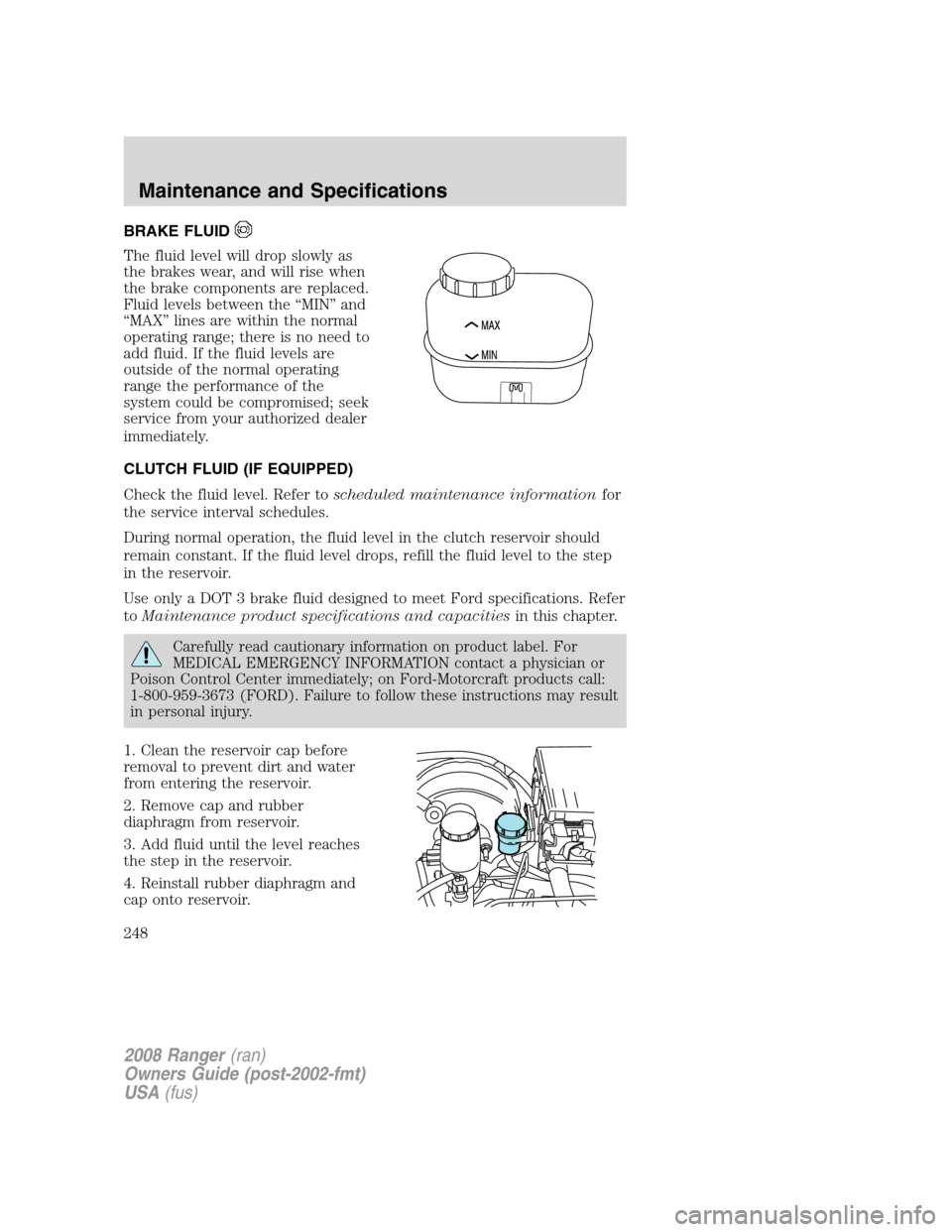
BRAKE FLUID
The fluid level will drop slowly as
the brakes wear, and will rise when
the brake components are replaced.
Fluid levels between the “MIN” and
“MAX” lines are within the normal
operating range; there is no need to
add fluid. If the fluid levels are
outside of the normal operating
range the performance of the
system could be compromised; seek
service from your authorized dealer
immediately.
CLUTCH FLUID (IF EQUIPPED)
Check the fluid level. Refer toscheduled maintenance informationfor
the service interval schedules.
During normal operation, the fluid level in the clutch reservoir should
remain constant. If the fluid level drops, refill the fluid level to the step
in the reservoir.
Use only a DOT 3 brake fluid designed to meet Ford specifications. Refer
toMaintenance product specifications and capacitiesin this chapter.
Carefully read cautionary information on product label. For
MEDICAL EMERGENCY INFORMATION contact a physician or
Poison Control Center immediately; on Ford-Motorcraft products call:
1-800-959-3673 (FORD). Failure to follow these instructions may result
in personal injury.
1. Clean the reservoir cap before
removal to prevent dirt and water
from entering the reservoir.
2. Remove cap and rubber
diaphragm from reservoir.
3. Add fluid until the level reaches
the step in the reservoir.
4. Reinstall rubber diaphragm and
cap onto reservoir.
2008 Ranger(ran)
Owners Guide (post-2002-fmt)
USA(fus)
Maintenance and Specifications
248
Page 249 of 272
TRANSMISSION FLUID
Checking automatic transmission fluid
•Refer toscheduled maintenance informationfor scheduled check
and change intervals.
•Transmission does not consume fluid.
•Check fluid when transmission is not operating properly or if you see
a leak.
•Fluid level must be checked at normal operating temperature, 20 miles
(30 km) of driving.
To check and add fluid:
1. Drive the vehicle 20 miles (30 km) to reach normal operating
temperatures.
2. If driven in hot weather, city traffic, pulling a trailer, allow
transmission to cool for 30 minutes before checking.
3. Engage parking brake, start engine.
4. Put your foot on the brake pedal and move the gearshift lever slowly
through all of the gear ranges.
5. Shift to P (Park) and leave the engine running.
6. Remove the dipstick, wipe clean with a dry lint free rag.
7. Install and fully seat the dipstick into the filler tube.
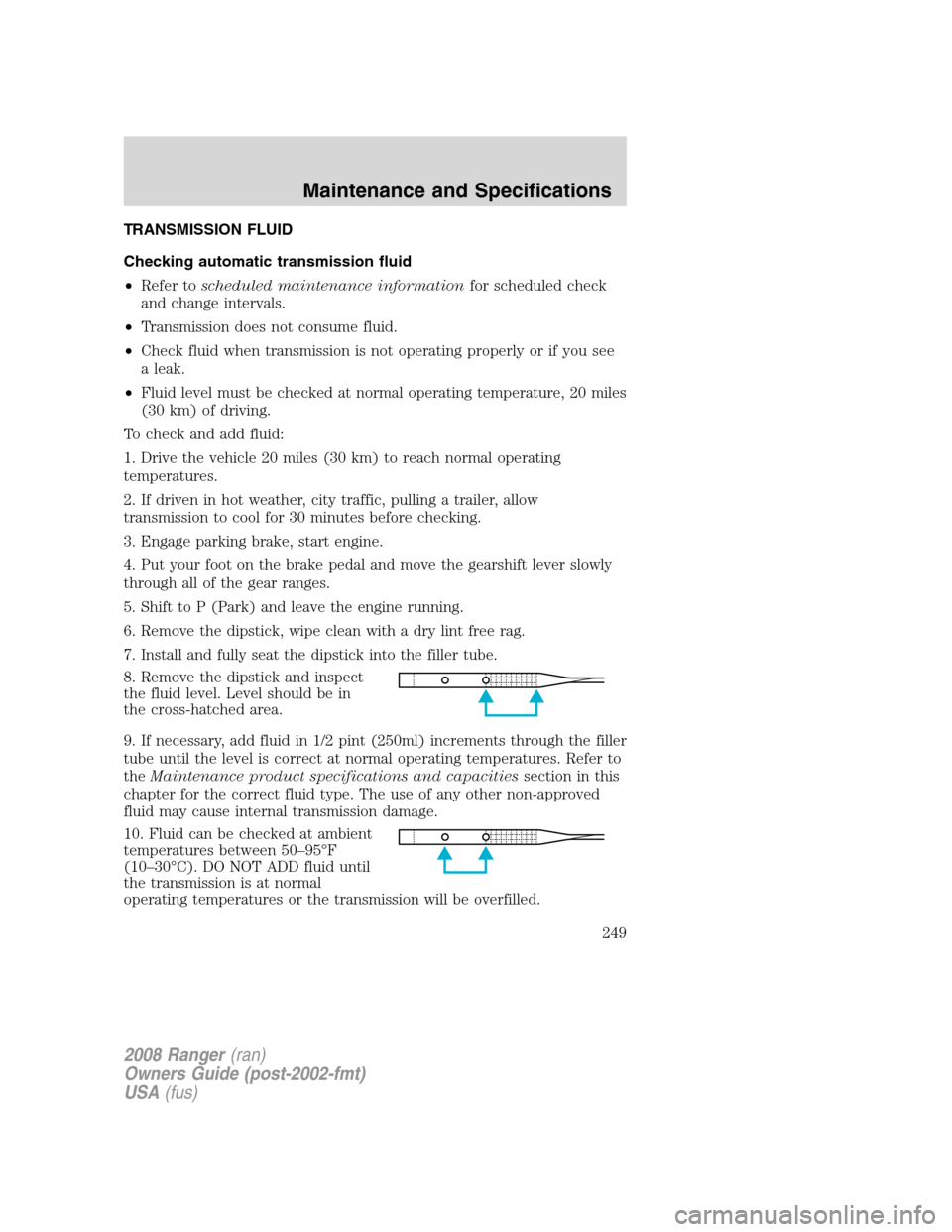
8. Remove the dipstick and inspect
the fluid level. Level should be in
the cross-hatched area.
9. If necessary, add fluid in 1/2 pint (250ml) increments through the filler
tube until the level is correct at normal operating temperatures. Refer to
theMaintenance product specifications and capacitiessection in this
chapter for the correct fluid type. The use of any other non-approved
fluid may cause internal transmission damage.
10. Fluid can be checked at ambient
temperatures between 50–95°F
(10–30°C). DO NOT ADD fluid until
the transmission is at normal
operating temperatures or the transmission will be overfilled.
2008 Ranger(ran)
Owners Guide (post-2002-fmt)
USA(fus)
Maintenance and Specifications
249
Page 250 of 272
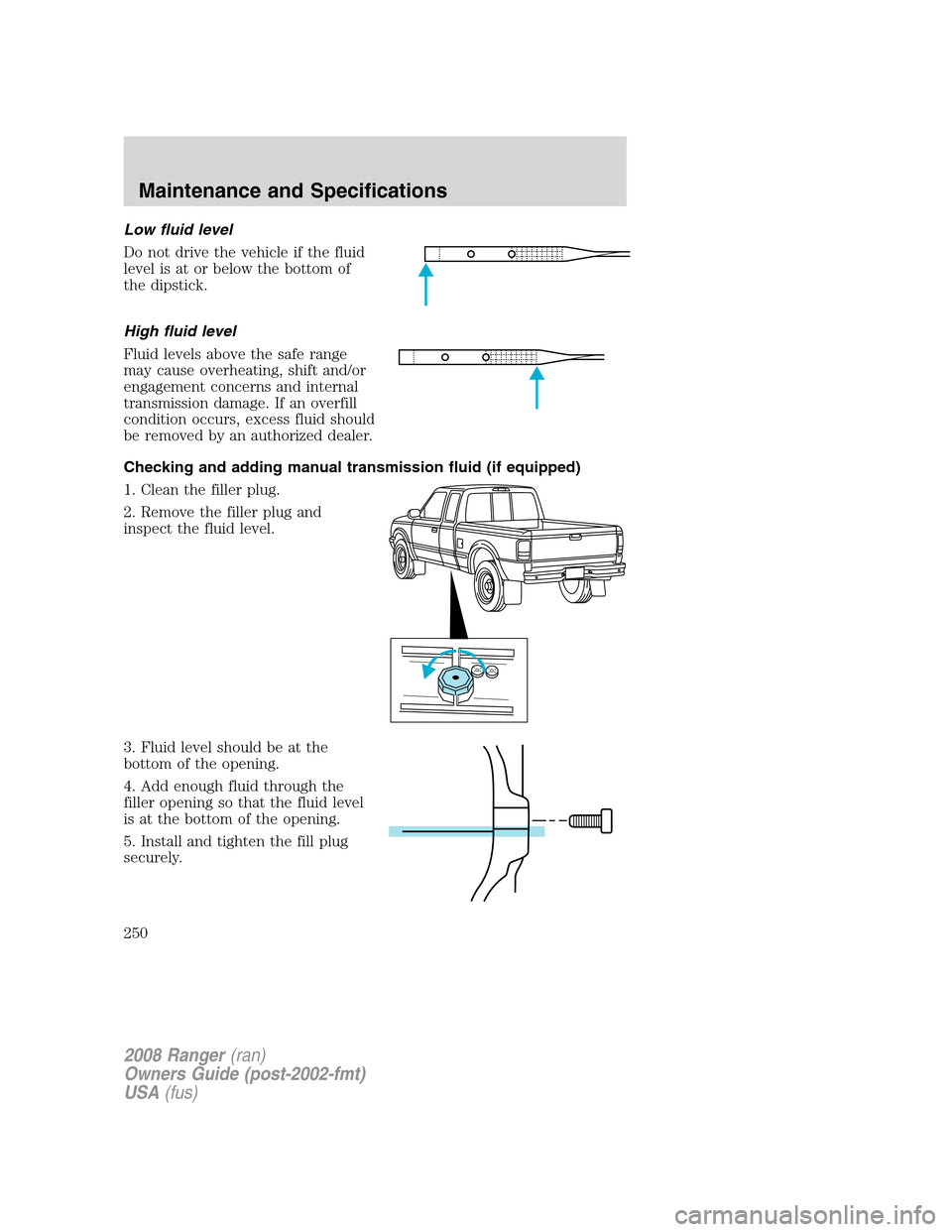
Low fluid level
Do not drive the vehicle if the fluid
level is at or below the bottom of
the dipstick.
High fluid level
Fluid levels above the safe range
may cause overheating, shift and/or
engagement concerns and internal
transmission damage. If an overfill
condition occurs, excess fluid should
be removed by an authorized dealer.
Checking and adding manual transmission fluid (if equipped)
1. Clean the filler plug.
2. Remove the filler plug and
inspect the fluid level.
3. Fluid level should be at the
bottom of the opening.
4. Add enough fluid through the
filler opening so that the fluid level
is at the bottom of the opening.
5. Install and tighten the fill plug
securely.
2008 Ranger(ran)
Owners Guide (post-2002-fmt)
USA(fus)
Maintenance and Specifications
250
Page 251 of 272
Use only fluid that meets Ford specifications. Refer to theMaintenance
product specifications and capacitiessection in this chapter.
TRANSFER CASE FLUID (IF EQUIPPED)
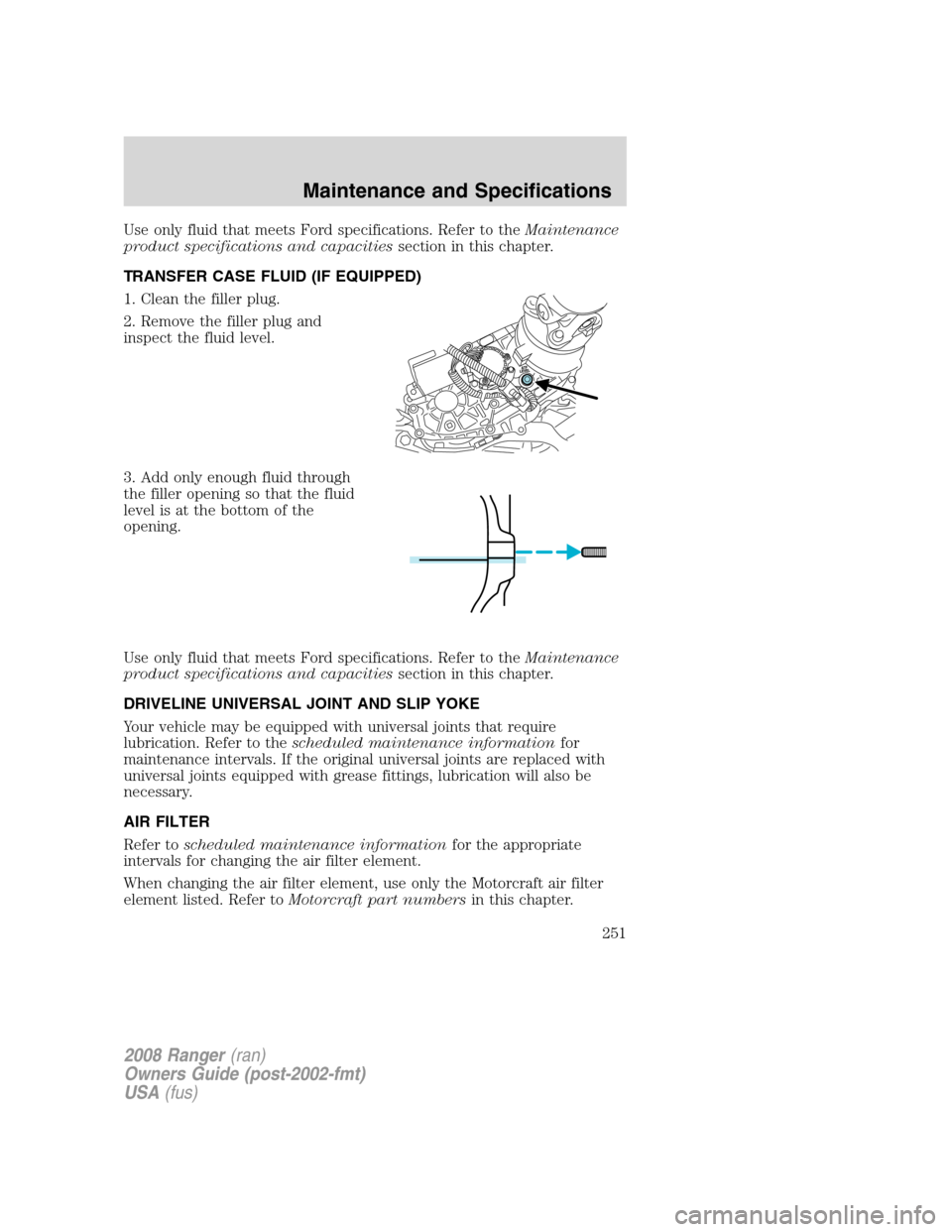
1. Clean the filler plug.
2. Remove the filler plug and
inspect the fluid level.
3. Add only enough fluid through
the filler opening so that the fluid
level is at the bottom of the
opening.
Use only fluid that meets Ford specifications. Refer to theMaintenance
product specifications and capacitiessection in this chapter.
DRIVELINE UNIVERSAL JOINT AND SLIP YOKE
Your vehicle may be equipped with universal joints that require
lubrication. Refer to thescheduled maintenance informationfor
maintenance intervals. If the original universal joints are replaced with
universal joints equipped with grease fittings, lubrication will also be
necessary.
AIR FILTER
Refer toscheduled maintenance informationfor the appropriate
intervals for changing the air filter element.
When changing the air filter element, use only the Motorcraft air filter
element listed. Refer toMotorcraft part numbersin this chapter.
2008 Ranger(ran)
Owners Guide (post-2002-fmt)
USA(fus)
Maintenance and Specifications
251
Page 252 of 272
To reduce the risk of vehicle damage and/or personal burn
injuries do not start your engine with the air cleaner removed
and do not remove it while the engine is running.
1. Loosen the clamp that secures the air inlet tube to the engine air filter
cover and disconnect the tube from the cover (for V6 only).
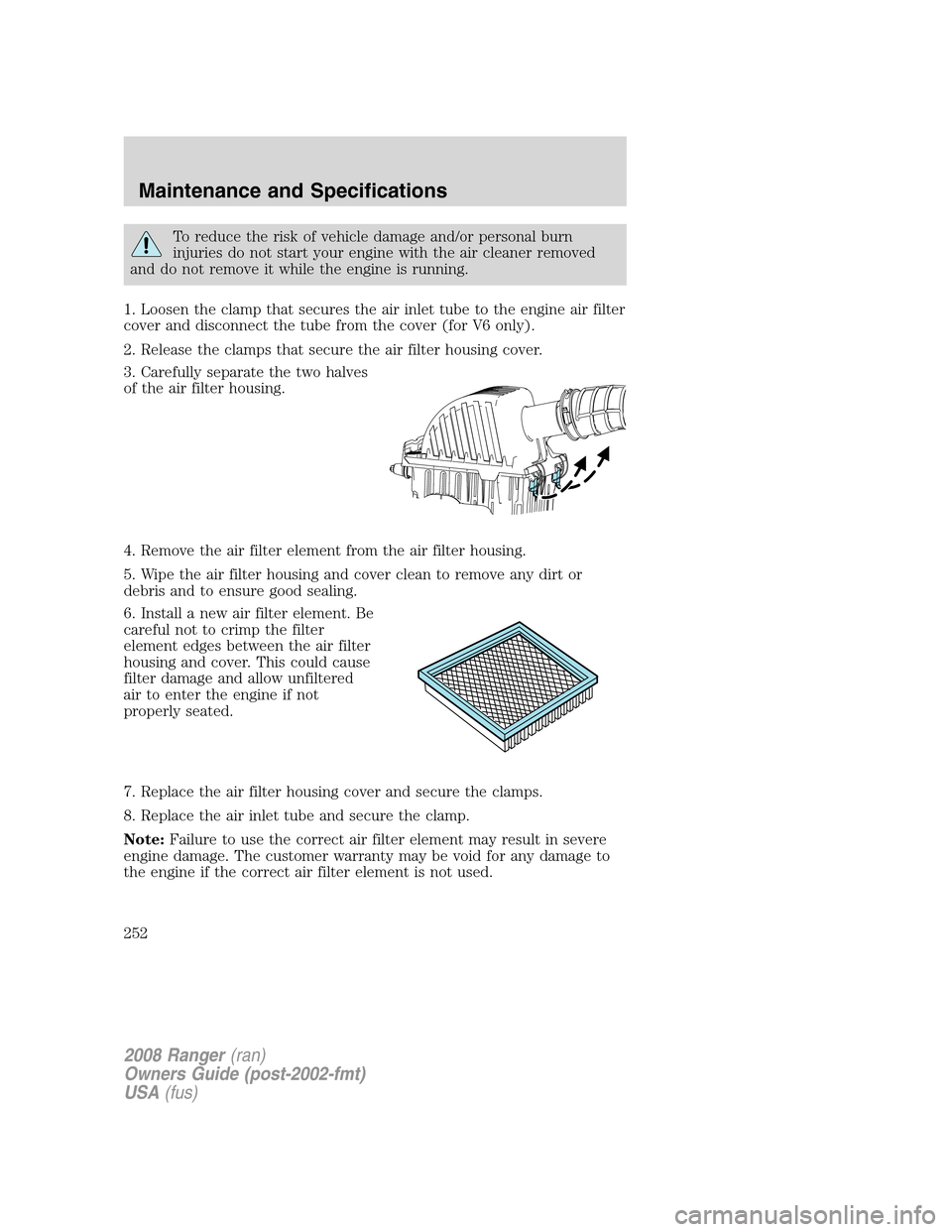
2. Release the clamps that secure the air filter housing cover.
3. Carefully separate the two halves
of the air filter housing.
4. Remove the air filter element from the air filter housing.
5. Wipe the air filter housing and cover clean to remove any dirt or
debris and to ensure good sealing.
6. Install a new air filter element. Be
careful not to crimp the filter
element edges between the air filter
housing and cover. This could cause
filter damage and allow unfiltered
air to enter the engine if not
properly seated.
7. Replace the air filter housing cover and secure the clamps.
8. Replace the air inlet tube and secure the clamp.
Note:Failure to use the correct air filter element may result in severe
engine damage. The customer warranty may be void for any damage to
the engine if the correct air filter element is not used.
2008 Ranger(ran)
Owners Guide (post-2002-fmt)
USA(fus)
Maintenance and Specifications
252
Page 253 of 272
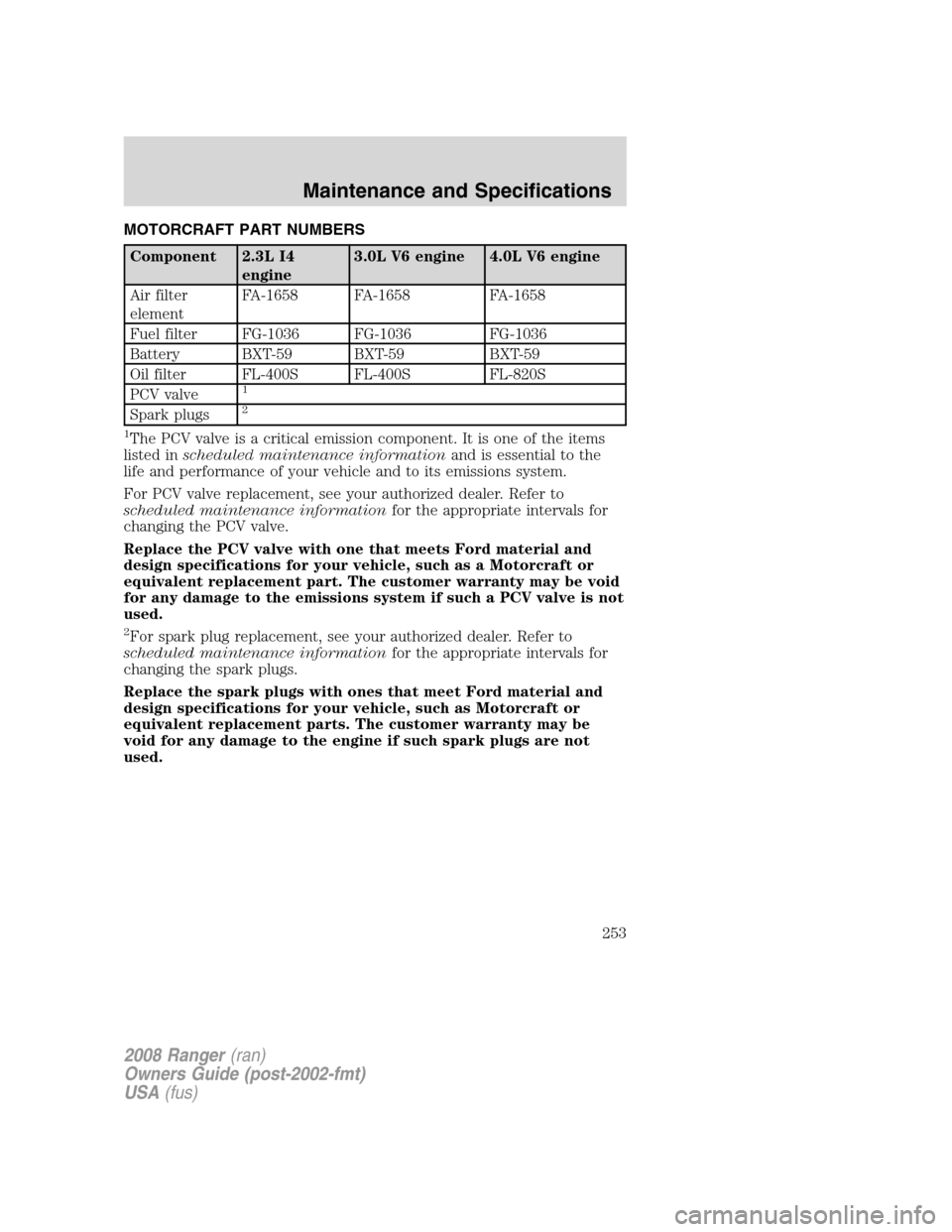
MOTORCRAFT PART NUMBERS
Component 2.3L I4
engine3.0L V6 engine 4.0L V6 engine
Air filter
elementFA-1658 FA-1658 FA-1658
Fuel filter FG-1036 FG-1036 FG-1036
Battery BXT-59 BXT-59 BXT-59
Oil filter FL-400S FL-400S FL-820S
PCV valve
1
Spark plugs2
1
The PCV valve is a critical emission component. It is one of the items
listed inscheduled maintenance informationand is essential to the
life and performance of your vehicle and to its emissions system.
For PCV valve replacement, see your authorized dealer. Refer to
scheduled maintenance informationfor the appropriate intervals for
changing the PCV valve.
Replace the PCV valve with one that meets Ford material and
design specifications for your vehicle, such as a Motorcraft or
equivalent replacement part. The customer warranty may be void
for any damage to the emissions system if such a PCV valve is not
used.
2For spark plug replacement, see your authorized dealer. Refer to
scheduled maintenance informationfor the appropriate intervals for
changing the spark plugs.
Replace the spark plugs with ones that meet Ford material and
design specifications for your vehicle, such as Motorcraft or
equivalent replacement parts. The customer warranty may be
void for any damage to the engine if such spark plugs are not
used.
2008 Ranger(ran)
Owners Guide (post-2002-fmt)
USA(fus)
Maintenance and Specifications
253
Page 254 of 272
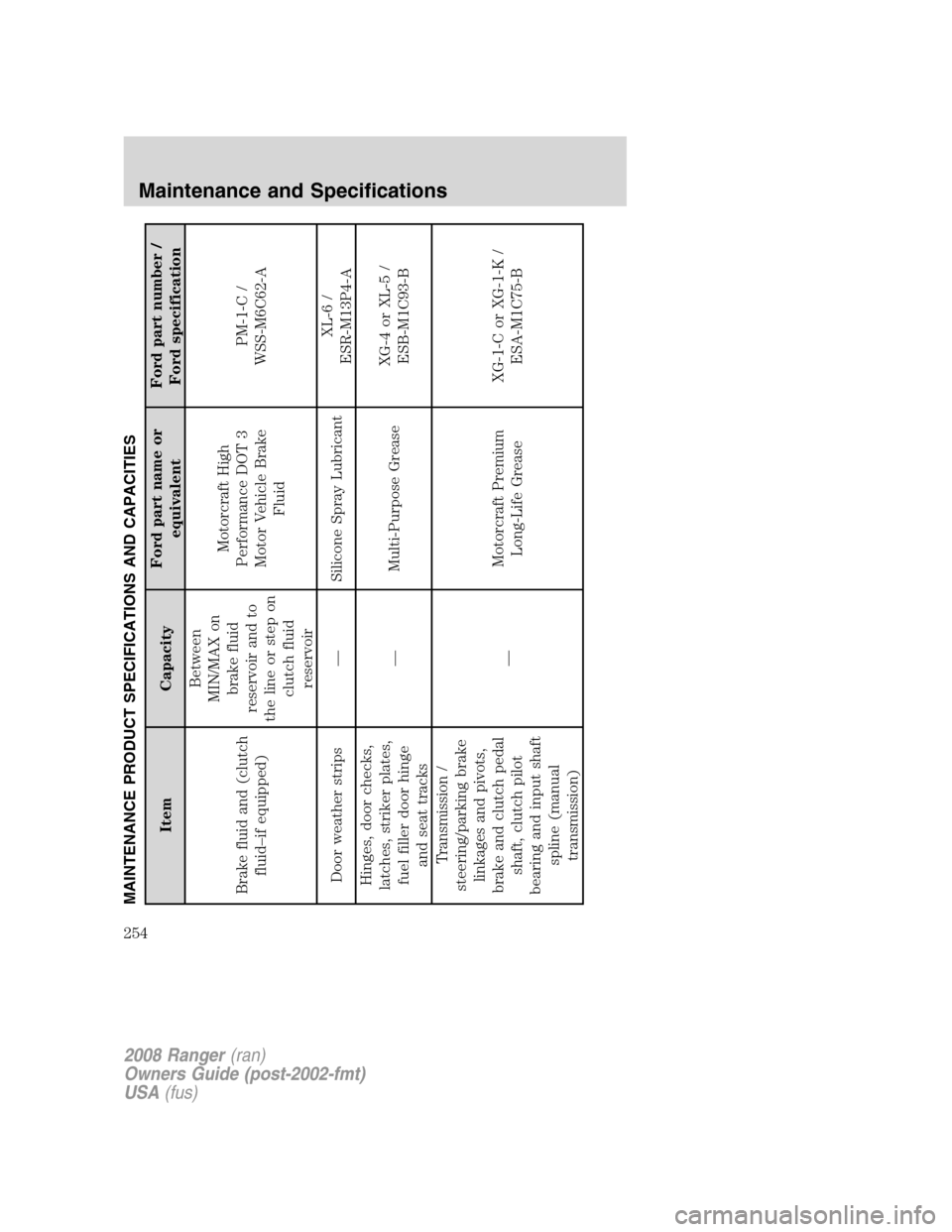
MAINTENANCE PRODUCT SPECIFICATIONS AND CAPACITIES
Item CapacityFord part name or
equivalentFord part number /
Ford specification
Brake fluid and (clutch
fluid–if equipped)Between
MIN/MAX on
brake fluid
reservoir and to
the line or step on
clutch fluid
reservoirMotorcraft High
Performance DOT 3
Motor Vehicle Brake
FluidPM-1-C /
WSS-M6C62-A
Door weather strips — Silicone Spray LubricantXL-6 /
ESR-M13P4-A
Hinges, door checks,
latches, striker plates,
fuel filler door hinge
and seat tracks— Multi-Purpose GreaseXG-4 or XL-5 /
ESB-M1C93-B
Transmission /
steering/parking brake
linkages and pivots,
brake and clutch pedal
shaft, clutch pilot
bearing and input shaft
spline (manual
transmission)—Motorcraft Premium
Long-Life GreaseXG-1-C or XG-1-K /
ESA-M1C75-B
2008 Ranger(ran)
Owners Guide (post-2002-fmt)
USA(fus)
Maintenance and Specifications
254