clock FORD RANGER 2010 2.G User Guide
[x] Cancel search | Manufacturer: FORD, Model Year: 2010, Model line: RANGER, Model: FORD RANGER 2010 2.GPages: 286, PDF Size: 2.57 MB
Page 207 of 286
WARNING:Do not attempt to change a tire on the side of the
vehicle close to moving traffic. Pull far enough off the road to
avoid the danger of being hit when operating the jack or changing the
wheel.
Note:Passengers should not remain in the vehicle when the vehicle is
being jacked.
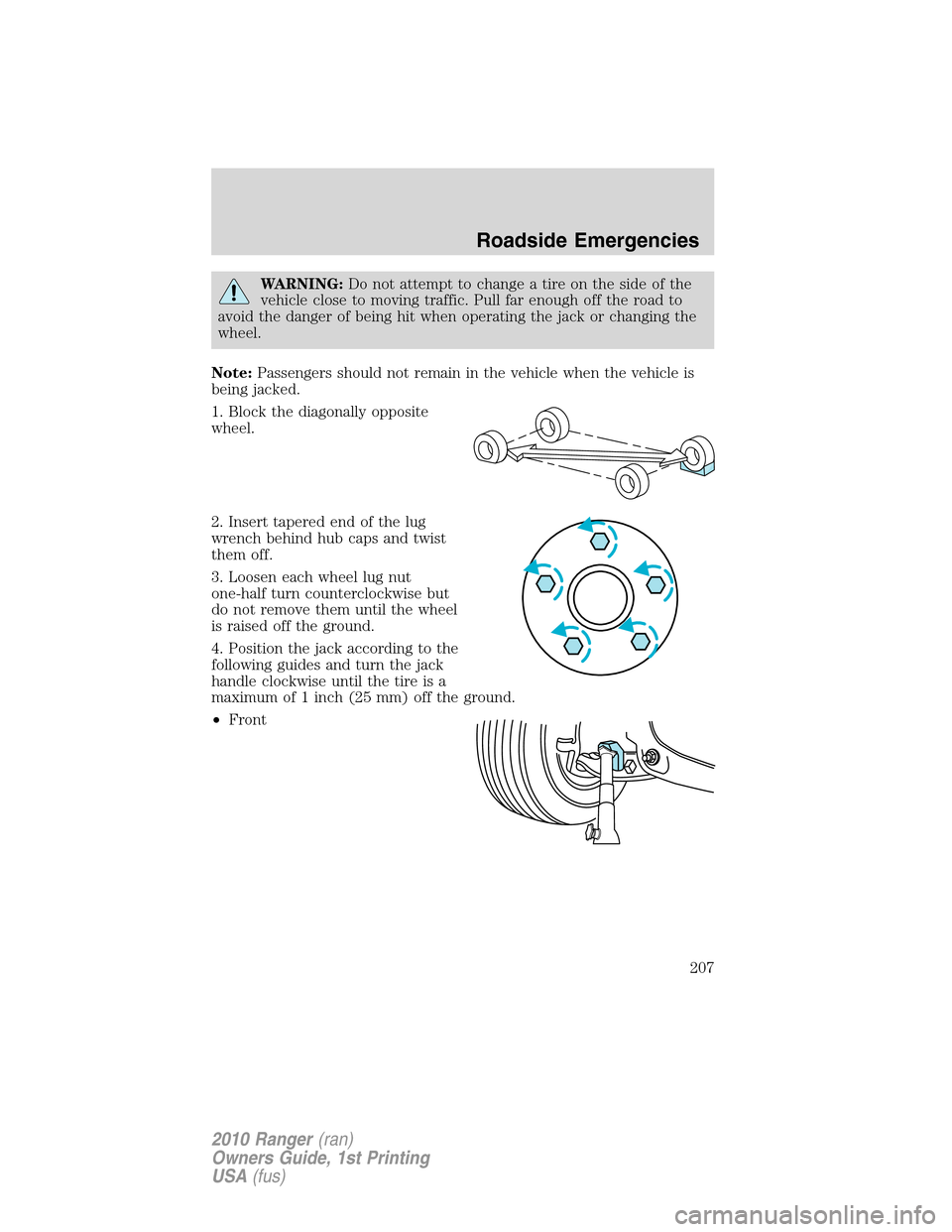
1. Block the diagonally opposite
wheel.
2. Insert tapered end of the lug
wrench behind hub caps and twist
them off.
3. Loosen each wheel lug nut
one-half turn counterclockwise but
do not remove them until the wheel
is raised off the ground.
4. Position the jack according to the
following guides and turn the jack
handle clockwise until the tire is a
maximum of 1 inch (25 mm) off the ground.
•Front
Roadside Emergencies
207
2010 Ranger(ran)
Owners Guide, 1st Printing
USA(fus)
Page 208 of 286
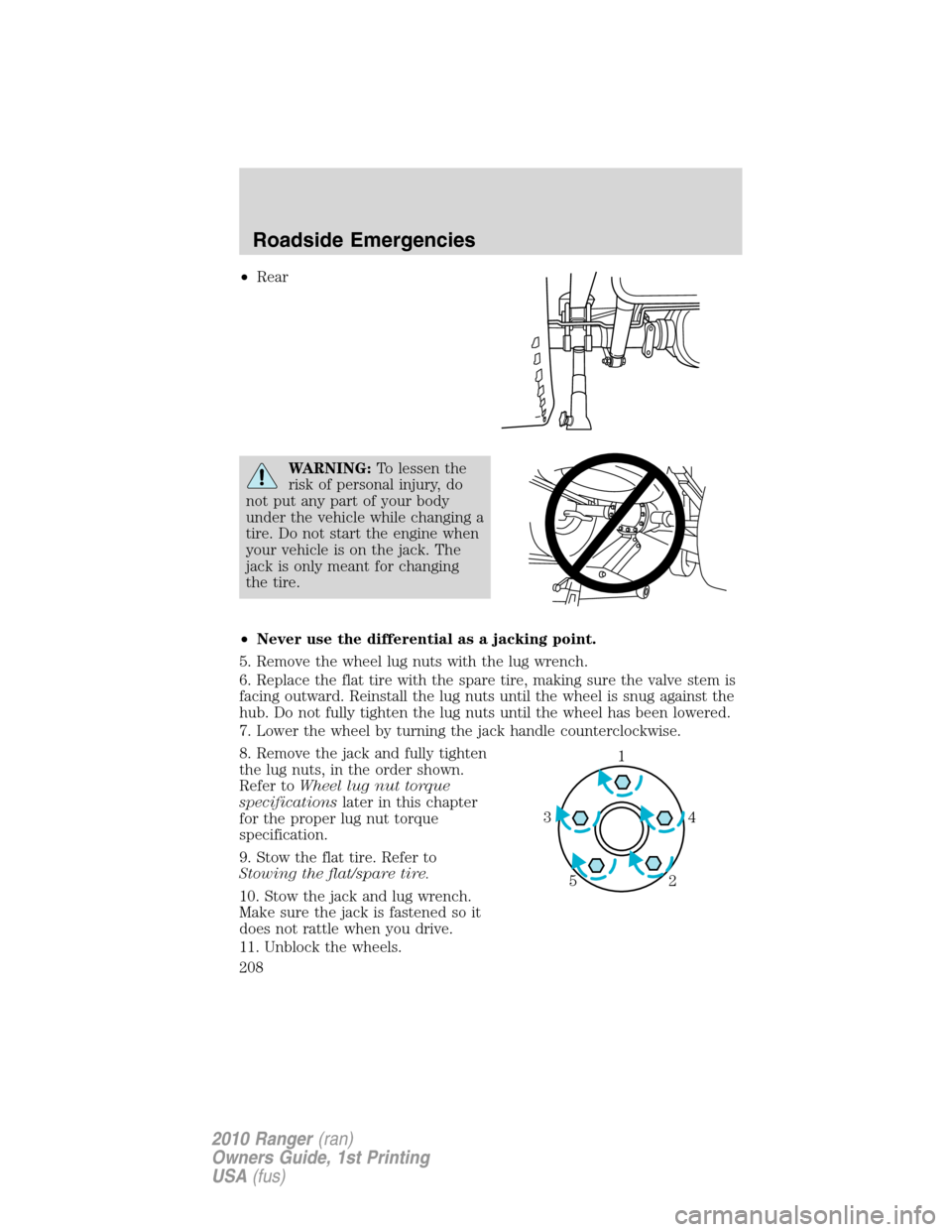
•Rear
WARNING:To lessen the
risk of personal injury, do
not put any part of your body
under the vehicle while changing a
tire. Do not start the engine when
your vehicle is on the jack. The
jack is only meant for changing
the tire.
•Never use the differential as a jacking point.
5. Remove the wheel lug nuts with the lug wrench.
6. Replace the flat tire with the spare tire, making sure the valve stem is
facing outward. Reinstall the lug nuts until the wheel is snug against the
hub. Do not fully tighten the lug nuts until the wheel has been lowered.
7. Lower the wheel by turning the jack handle counterclockwise.
8. Remove the jack and fully tighten
the lug nuts, in the order shown.
Refer toWheel lug nut torque
specificationslater in this chapter
for the proper lug nut torque
specification.
9. Stow the flat tire. Refer to
Stowing the flat/spare tire.
10. Stow the jack and lug wrench.
Make sure the jack is fastened so it
does not rattle when you drive.
11. Unblock the wheels.
1
4 3
2 5
Roadside Emergencies
208
2010 Ranger(ran)
Owners Guide, 1st Printing
USA(fus)
Page 209 of 286
Stowing the flat/spare tire
Note:Failure to follow spare tire stowage instructions may result in
failure of cable or loss of spare tire.
If you are stowing a tire that requires reattaching it to the
vehicle with a tether, perform these steps first, then proceed with
the steps following.
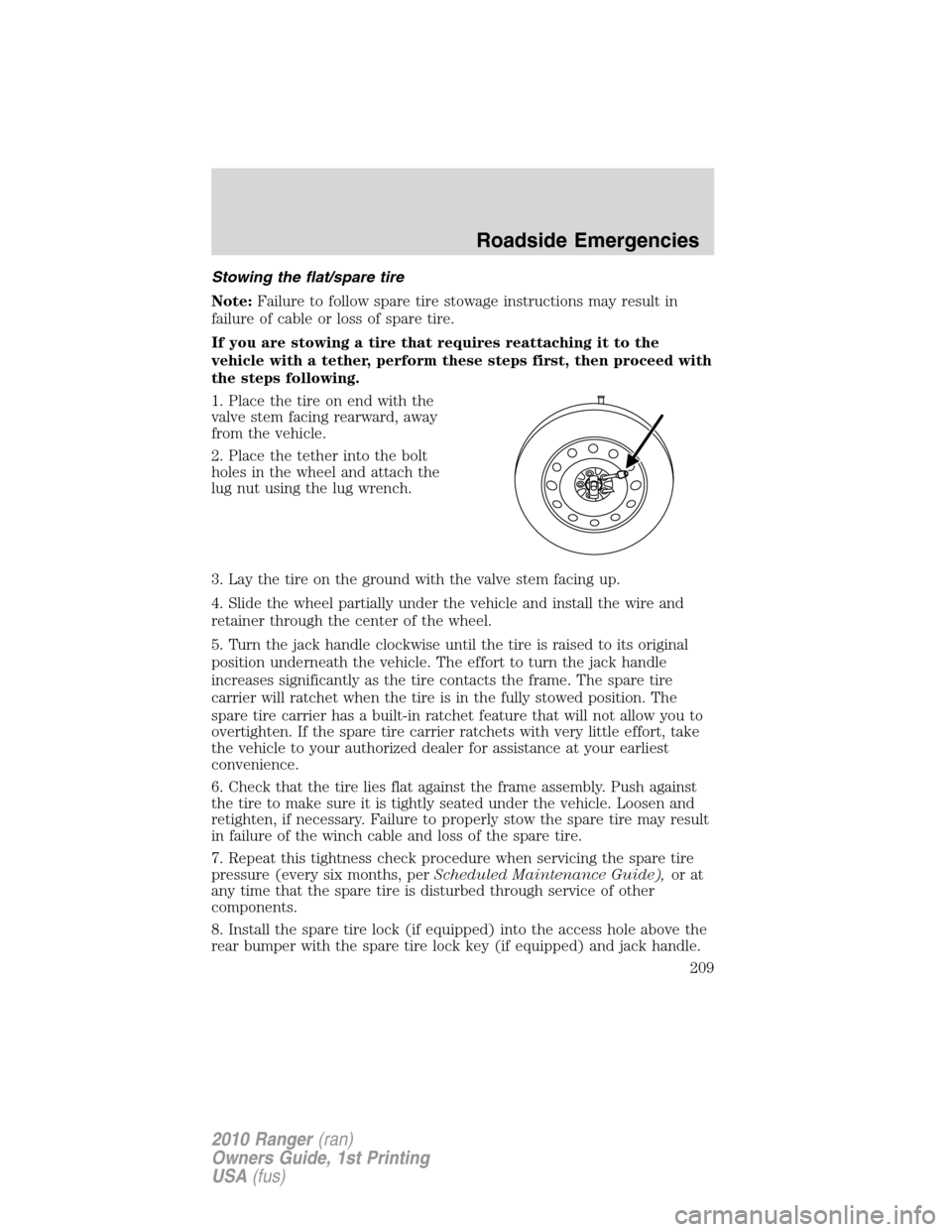
1. Place the tire on end with the
valve stem facing rearward, away
from the vehicle.
2. Place the tether into the bolt
holes in the wheel and attach the
lug nut using the lug wrench.
3. Lay the tire on the ground with the valve stem facing up.
4. Slide the wheel partially under the vehicle and install the wire and
retainer through the center of the wheel.
5. Turn the jack handle clockwise until the tire is raised to its original
position underneath the vehicle. The effort to turn the jack handle
increases significantly as the tire contacts the frame. The spare tire
carrier will ratchet when the tire is in the fully stowed position. The
spare tire carrier has a built-in ratchet feature that will not allow you to
overtighten. If the spare tire carrier ratchets with very little effort, take
the vehicle to your authorized dealer for assistance at your earliest
convenience.
6. Check that the tire lies flat against the frame assembly. Push against
the tire to make sure it is tightly seated under the vehicle. Loosen and
retighten, if necessary. Failure to properly stow the spare tire may result
in failure of the winch cable and loss of the spare tire.
7. Repeat this tightness check procedure when servicing the spare tire
pressure (every six months, perScheduled Maintenance Guide),or at
any time that the spare tire is disturbed through service of other
components.
8. Install the spare tire lock (if equipped) into the access hole above the
rear bumper with the spare tire lock key (if equipped) and jack handle.
Roadside Emergencies
209
2010 Ranger(ran)
Owners Guide, 1st Printing
USA(fus)
Page 244 of 286
6. Drive the vehicle to complete the relearning process.
•The vehicle may need to be driven 10 miles (16 km) or more to
relearn the idle and fuel trim strategy.
•If you do not allow the engine to relearn its idle trim, the idle
quality of your vehicle may be adversely affected until the idle
trim is eventually relearned.
When the battery is disconnected or a new battery installed, the
transmission must relearn its adaptive strategy. As a result of this, the
transmission may shift firmly. This operation is considered normal and
will not affect function or durability of the transmission. Over time the
adaptive learning process will fully update transmission operation to its
optimum shift feel.
If the battery has been disconnected or a new battery has been installed,
the clock and the preset radio stations must be reset once the battery is
reconnected.
•Always dispose of automotive
batteries in a responsible manner.
Follow your local authorized
standards for disposal. Call your
local authorized recycling center
to find out more about recycling
automotive batteries.
ENGINE COOLANT
Checking engine coolant
The concentration and level of engine coolant should be checked at the
intervals listed in thescheduled maintenance information.The coolant
concentration should be maintained at 50/50 coolant and distilled water,
which equates to a freeze point of -34°F (-36°C). Coolant concentration
testing is possible with a hydrometer or antifreeze tester. The level of
coolant should be maintained at the FULL COLD level or within the
COLD FILL RANGE in the coolant reservoir. If the level falls below, add
coolant per the instructions in theAdding engine coolantsection.
L
E
A
D
RETURN
RECYCLE
Maintenance and Specifications
244
2010 Ranger(ran)
Owners Guide, 1st Printing
USA(fus)
Page 248 of 286
WARNING:To reduce the risk of personal injury, make sure the
engine is cool before unscrewing the coolant pressure relief cap.
The cooling system is under pressure; steam and hot liquid can come
out forcefully when the cap is loosened slightly.
Add the proper mixture of coolant and water to the cooling system by
following these steps:
1. Before you begin, turn the engine off and let it cool.
2. When the engine is cool, wrap a thick cloth around the coolant
pressure relief cap on the coolant reservoir (a translucent plastic bottle).
Slowly turn cap counterclockwise (left) until pressure begins to release.
3. Step back while the pressure releases.
4. When you are sure that all the pressure has been released, use the
cloth to turn it counterclockwise and remove the cap.
5. Fill the coolant reservoir slowly with the proper coolant mixture, to
within the COLD FILL RANGE or the FULL COLD level on the reservoir.
If you removed the radiator cap in an overflow system, fill the radiator
until the coolant is visible and radiator is almost full.
6. Replace the cap. Turn until tightly installed. Cap must be tightly
installed to prevent coolant loss.
After any coolant has been added, check the coolant concentration (refer
toChecking engine coolant). If the concentration is not 50/50
(protection to –34°F/–36°C), drain some coolant and adjust the
concentration. It may take several drains and additions to obtain a 50/50
coolant concentration.
Whenever coolant has been added, the coolant level in the coolant
reservoir should be checked the next few times you drive the vehicle. If
necessary, add enough 50/50 concentration of engine coolant and
distilled water to bring the liquid level to the proper level.
If you have to add more than 1.0 quart (1.0 liter) of engine coolant per
month, have your authorized dealer check the engine cooling system.
Your cooling system may have a leak. Operating an engine with a low
level of coolant can result in engine overheating and possible engine
damage.
Recycled engine coolant
Ford Motor Company does NOT recommend the use of recycled engine
coolant since a Ford-approved recycling process is not yet available.
Maintenance and Specifications
248
2010 Ranger(ran)
Owners Guide, 1st Printing
USA(fus)
Page 252 of 286
Refueling
WARNING:Fuel vapor burns violently and a fuel fire can cause
severe injuries. To help avoid injuries to you and others:
•Read and follow all the instructions on the pump island;
•Turn off your engine when you are refueling;
•Do not smoke if you are near fuel or refueling your vehicle;
•Keep sparks, flames and smoking materials away from fuel;
•Stay outside your vehicle and do not leave the fuel pump unattended
when refueling your vehicle — this is against the law in some places;
•Keep children away from the fuel pump; never let children pump
fuel.
Use the following guidelines to avoid electrostatic charge build-up when
filling an ungrounded fuel container:
•Place approved fuel container on the ground.
•DO NOT fill a fuel container while it is in the vehicle (including the
cargo area).
•Keep the fuel pump nozzle in contact with the fuel container while
filling.
•DO NOT use a device that would hold the fuel pump handle in the fill
position.
Fuel filler cap
When fueling your vehicle:
1. Turn the engine off.
2. Carefully turn the fuel filler cap counterclockwise until it spins off.
3. Carefully hang the cap from the tether.
4. To install the cap, place the cap into the filler pipe and rotate until
you hear at least one click.
If the check fuel cap light
comes on, the fuel filler cap may not be
properly installed. The light can come on after several driving events
after you’ve refueled your vehicle.
At the next opportunity, safely pull off of the road, remove the fuel filler
cap, align the cap properly and reinstall it. The check fuel cap
light
may not reset immediately; it may take several driving cycles for
Maintenance and Specifications
252
2010 Ranger(ran)
Owners Guide, 1st Printing
USA(fus)
Page 282 of 286
wheels ......................................226
wiper blades ............................228
Clock adjust
AM/FM .......................................20
AM/FM stereo CD .....................21
Premium AM/FM stereo
CD6/MP3 ...................................27
Clutch
fluid ..........................................262
operation while driving ..........176
recommended shift speeds ....177
Console ........................................56
Coolant
checking and adding ..............244
refill capacities ................249, 268
specifications ..........................268
Cruise control
(see Speed control) ....................59
Customer Assistance ................188
Ford Extended Service
Plan ..........................................278
Getting assistance outside the
U.S. and Canada .....................222
Getting roadside assistance ...188
Getting the service you
need .........................................218
Ordering additional owner’s
literature .................................223
Utilizing the
Mediation/Arbitration
Program ...................................221
D
Daytime running lamps
(see Lamps) ................................45
Dipstick
engine oil .................................237
Driveline universal joint and
slip yoke ....................................266Driving under special
conditions ..................178, 181, 184
sand .........................................183
snow and ice ...........................185
through water .................183, 187
E
Emergencies, roadside
jump-starting ..........................210
Emergency Flashers .................189
Emission control system ..........258
Engine ........................................272
cleaning ...................................227
coolant .....................................244
idle speed control ...................242
lubrication specifications .......268
refill capacities ........................268
service points ..................234–235
starting after a collision .........190
Engine block heater .................162
Engine oil ..................................237
checking and adding ..............237
dipstick ....................................237
filter, specifications ........240, 267
recommendations ...................240
refill capacities ........................268
specifications ..........................268
Event data recording ....................7
Exhaust fumes ..........................162
F
Fluid capacities .........................268
Fog lamps ....................................44
Four-Wheel Drive vehicles .......178
driving off road .......................180
electronic shift ........................179
indicator light .........................179
Index
282
2010 Ranger(ran)
Owners Guide, 1st Printing
USA(fus)
Page 285 of 286
for adults .......................79, 81–82
for children .............................101
lap belt ......................................80
Occupant Classification
Sensor ........................................76
safety belt maintenance .........117
warning light and chime ....84–85
Safety restraints - LATCH
anchors ......................................110
Safety seats for children ..........105
Safety Compliance
Certification Label ....................274
Satellite Radio Information ........38
Seats ............................................69
child safety seats ....................105
SecuriLock passive anti-theft
system ..........................................66
Servicing your vehicle ..............232
Setting the clock
AM/FM stereo ...........................20
AM/FM stereo CD .....................21
Premium AM/FM stereo
CD6/MP3 ...................................27
Snowplowing .................................7
Spark plugs,
specifications .....................267, 272
Special notice
ambulance conversions ..............7
utility-type vehicles ....................6
Specification chart,
lubricants ...................................268
Speed control ..............................59
Starting your vehicle ........159–161
jump starting ..........................210
Steering wheel
tilting .........................................56
T
Tilt steering wheel ......................56Tire Pressure Monitoring
System (TPMS)
Tires, Wheels and Loading ....135
Tires ...........................120–121, 201
alignment ................................128
care ..........................................125
changing ..........................201, 206
checking the pressure ............125
inflating ...................................122
label .........................................134
replacing ..................................126
rotating ....................................129
safety practices .......................128
sidewall information ...............130
snow tires and chains ............140
spare tire .................................201
terminology .............................122
tire grades ...............................121
treadwear ........................121, 125
Towing .......................................147
recreational towing .................157
trailer towing ..........................147
wrecker ....................................216
Transfer case
fluid checking .........................265
Transmission
automatic operation ...............174
brake-shift interlock (BSI) ....173
fluid, checking and adding
(manual) .................................264
fluid, refill capacities ..............268
lubricant specifications ..........268
manual operation ....................176
Turn signal ..................................48
V
Vehicle Identification Number
(VIN) ..........................................274
Vehicle loading ..........................140
Index
285
2010 Ranger(ran)
Owners Guide, 1st Printing
USA(fus)