Transmission FORD RANGER 2010 2.G Owner's Manual
[x] Cancel search | Manufacturer: FORD, Model Year: 2010, Model line: RANGER, Model: FORD RANGER 2010 2.GPages: 286, PDF Size: 2.57 MB
Page 174 of 286
AUTOMATIC TRANSMISSION OPERATION (IF EQUIPPED)
Driving with a 5–speed automatic transmission (if equipped)
This vehicle is equipped with an adaptive Transmission Shift Strategy.
Adaptive Shift Strategy offers the optimal transmission operation and
shift quality. When the vehicle’s battery has been disconnected for any
type of service or repair, the transmission will need to relearn the normal
shift strategy parameters, much like having to reset your radio stations
when your vehicle battery has been disconnected. The Adaptive
Transmission Strategy allows the transmission to relearn these operating
parameters. This learning process could take several transmission
upshifts and downshifts; during this learning process, slightly firmer
shifts may occur. After this learning process, normal shift feel and shift
scheduling will resume.
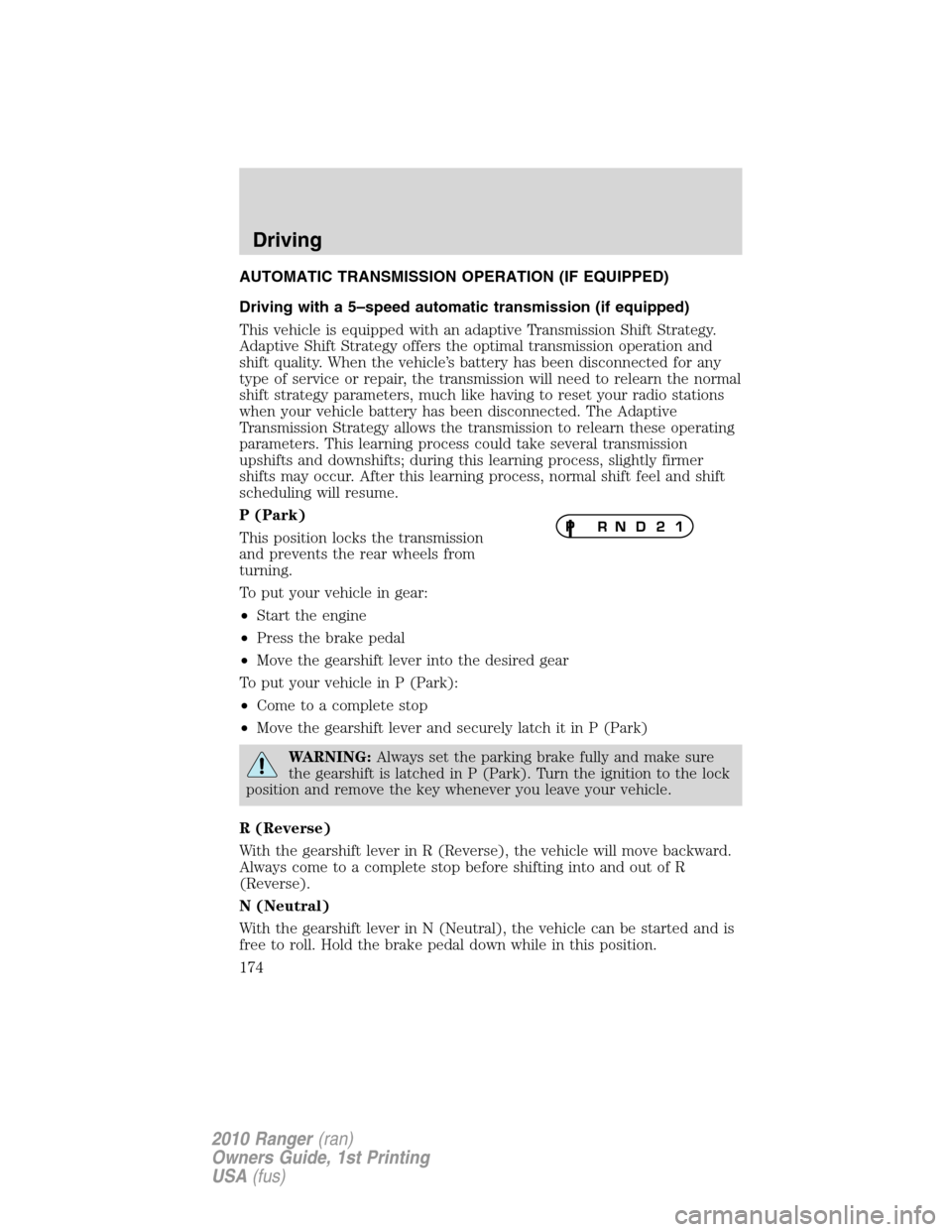
P (Park)
This position locks the transmission
and prevents the rear wheels from
turning.
To put your vehicle in gear:
•Start the engine
•Press the brake pedal
•Move the gearshift lever into the desired gear
To put your vehicle in P (Park):
•Come to a complete stop
•Move the gearshift lever and securely latch it in P (Park)
WARNING:Always set the parking brake fully and make sure
the gearshift is latched in P (Park). Turn the ignition to the lock
position and remove the key whenever you leave your vehicle.
R (Reverse)
With the gearshift lever in R (Reverse), the vehicle will move backward.
Always come to a complete stop before shifting into and out of R
(Reverse).
N (Neutral)
With the gearshift lever in N (Neutral), the vehicle can be started and is
free to roll. Hold the brake pedal down while in this position.
Driving
174
2010 Ranger(ran)
Owners Guide, 1st Printing
USA(fus)
Page 175 of 286
D (Drive) with Overdrive
The normal driving position for the
best fuel economy. Transmission
operates in gears one through five.
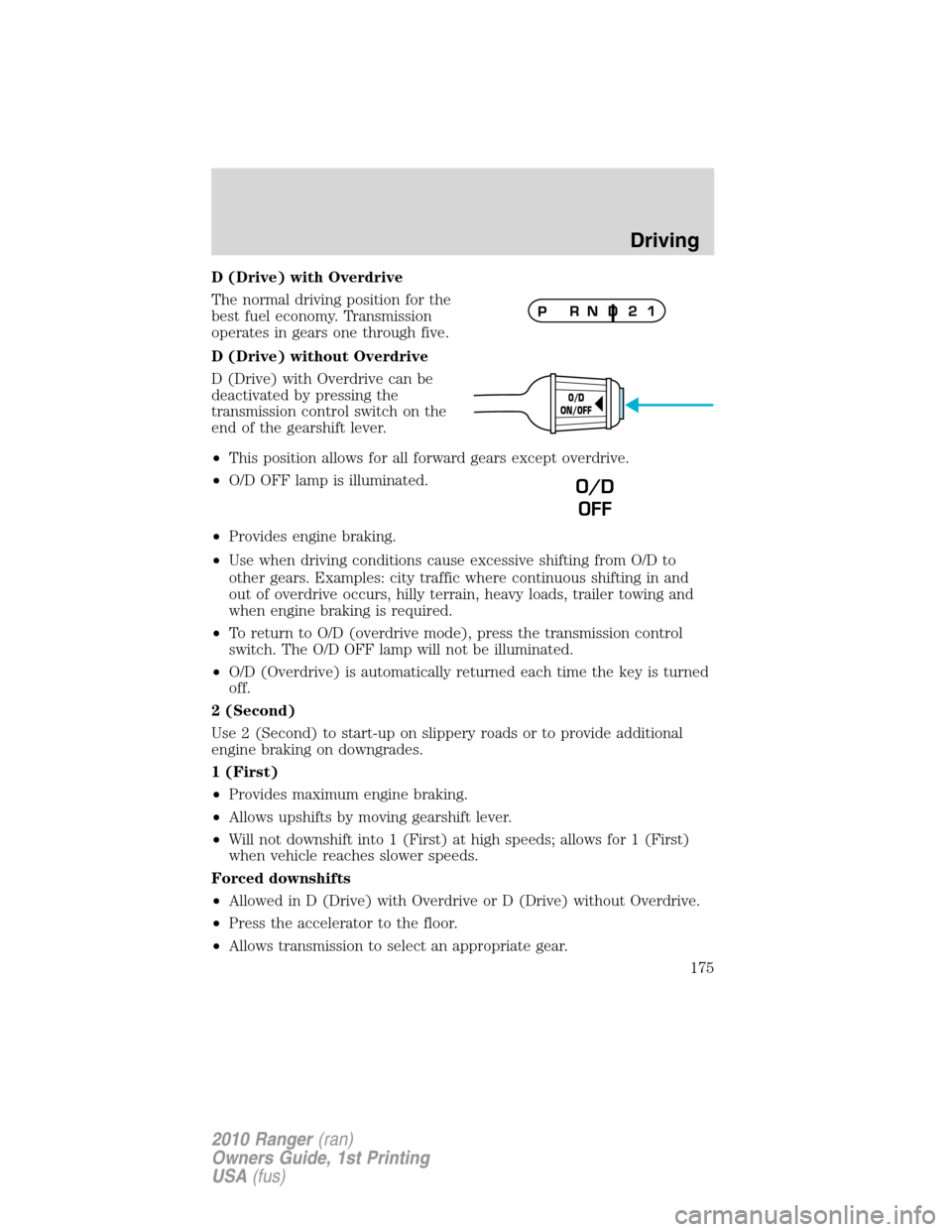
D (Drive) without Overdrive
D (Drive) with Overdrive can be
deactivated by pressing the
transmission control switch on the
end of the gearshift lever.
•This position allows for all forward gears except overdrive.
•O/D OFF lamp is illuminated.
•Provides engine braking.
•Use when driving conditions cause excessive shifting from O/D to
other gears. Examples: city traffic where continuous shifting in and
out of overdrive occurs, hilly terrain, heavy loads, trailer towing and
when engine braking is required.
•To return to O/D (overdrive mode), press the transmission control
switch. The O/D OFF lamp will not be illuminated.
•O/D (Overdrive) is automatically returned each time the key is turned
off.
2 (Second)
Use 2 (Second) to start-up on slippery roads or to provide additional
engine braking on downgrades.
1 (First)
•Provides maximum engine braking.
•Allows upshifts by moving gearshift lever.
•Will not downshift into 1 (First) at high speeds; allows for 1 (First)
when vehicle reaches slower speeds.
Forced downshifts
•Allowed in D (Drive) with Overdrive or D (Drive) without Overdrive.
•Press the accelerator to the floor.
•Allows transmission to select an appropriate gear.
O/D
ON/OFF
O/D
OFF
Driving
175
2010 Ranger(ran)
Owners Guide, 1st Printing
USA(fus)
Page 176 of 286
MANUAL TRANSMISSION OPERATION (IF EQUIPPED)
Using the clutch
Manual transmission vehicles have a starter interlock that prevents
cranking the engine unless the clutch pedal is fully pressed.
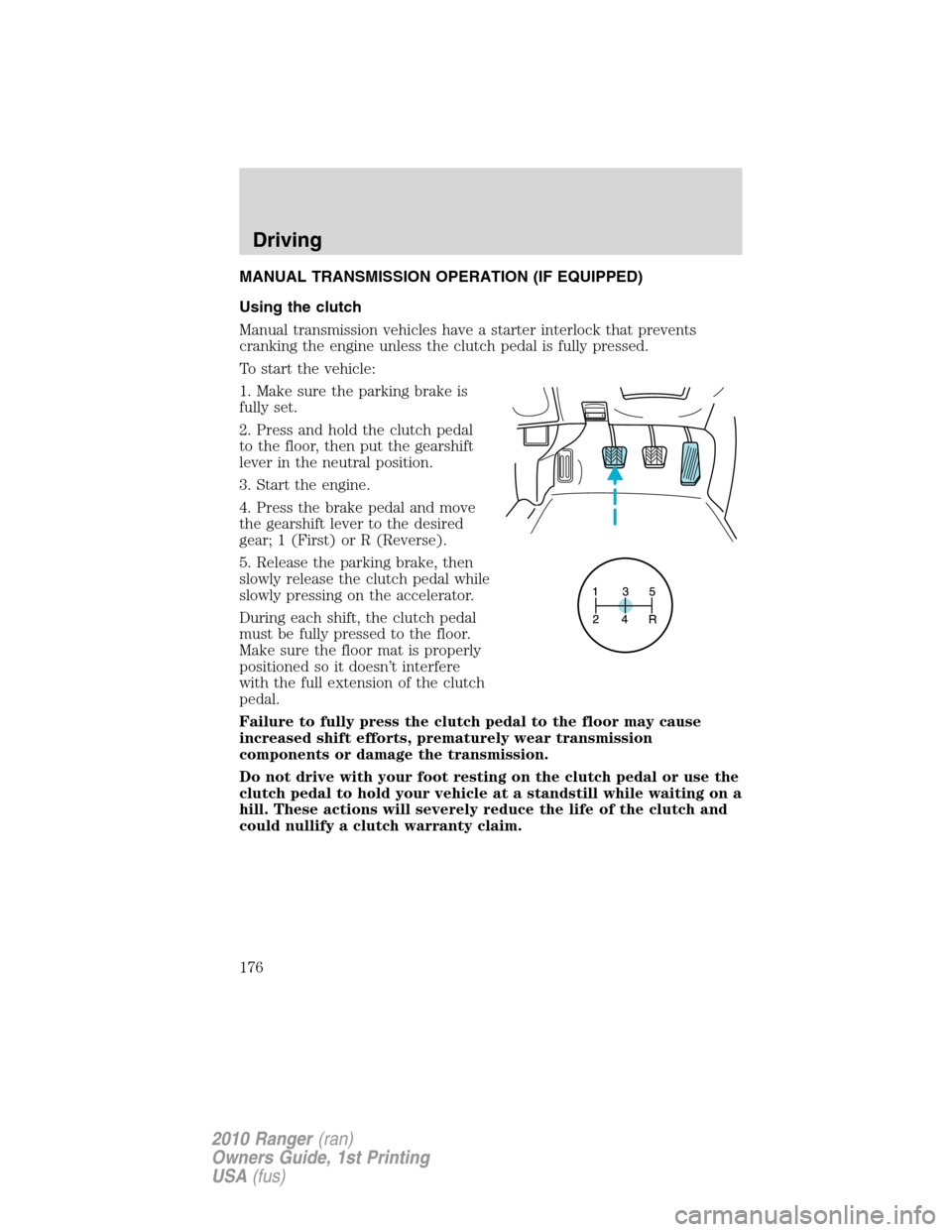
To start the vehicle:
1. Make sure the parking brake is
fully set.
2. Press and hold the clutch pedal
to the floor, then put the gearshift
lever in the neutral position.
3. Start the engine.
4. Press the brake pedal and move
the gearshift lever to the desired
gear; 1 (First) or R (Reverse).
5. Release the parking brake, then
slowly release the clutch pedal while
slowly pressing on the accelerator.
During each shift, the clutch pedal
must be fully pressed to the floor.
Make sure the floor mat is properly
positioned so it doesn’t interfere
with the full extension of the clutch
pedal.
Failure to fully press the clutch pedal to the floor may cause
increased shift efforts, prematurely wear transmission
components or damage the transmission.
Do not drive with your foot resting on the clutch pedal or use the
clutch pedal to hold your vehicle at a standstill while waiting on a
hill. These actions will severely reduce the life of the clutch and
could nullify a clutch warranty claim.
Driving
176
2010 Ranger(ran)
Owners Guide, 1st Printing
USA(fus)
Page 177 of 286
Recommended shift speeds
Upshift and downshift according to the following charts:
Upshifts when accelerating (for best fuel economy)
Shift from:Transfer case position (if equipped)
2H or 4H 4L
1 - 2 10 mph (14 km/h) 4 mph (5 km/h)
2 - 3 22 mph (32 km/h) 9 mph (11 km/h)
3 - 4 33 mph (50 km/h) 13 mph (19 km/h)
4 - 5 (Overdrive) 41 mph (71 km/h) 17 mph (27 km/h)
Upshifts when cruising (recommended for best fuel economy)
Shift from:Transfer case position (if equipped)
2H or 4H 4L
1 - 2 10 mph (16 km/h) 4 mph (6 km/h)
2 - 3 19 mph (26 km/h) 8 mph (10 km/h)
3 - 4 28 mph (43 km/h) 12 mph (16 km/h)
4 - 5 (Overdrive) 40 mph (68 km/h) 16 mph (26 km/h)
Maximum downshift speeds
Shift from:Transfer case position (if equipped)
2H or 4H 4L
5 (Overdrive) - 4 55 mph (88 km/h) 22 mph (34 km/h)
4 - 3 45 mph (72 km/h) 18 mph (27 km/h)
3 - 2 35 mph (56 km/h) 14 mph (21 km/h)
2 - 1 20 mph (32 km/h) 8 mph (11 km/h)
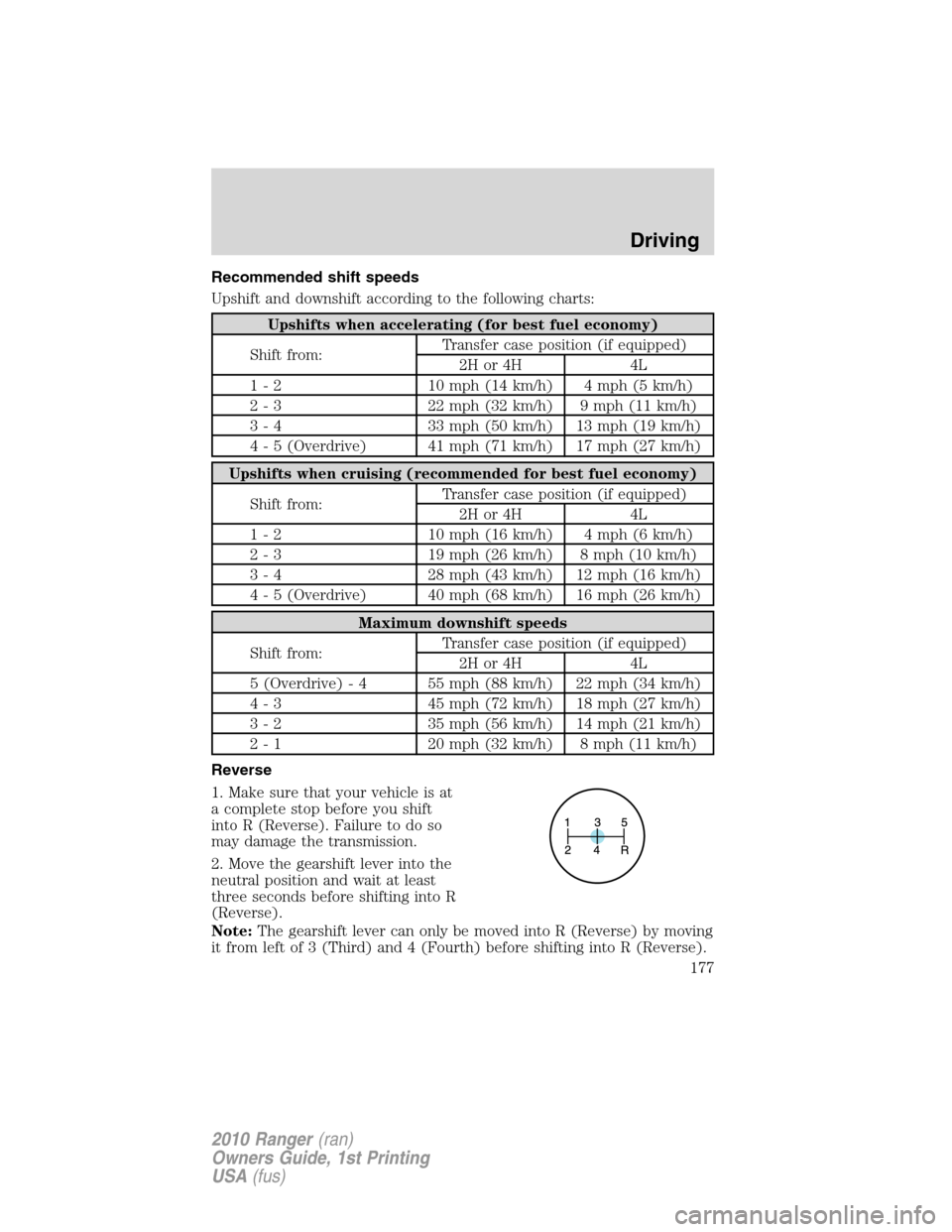
Reverse
1. Make sure that your vehicle is at
a complete stop before you shift
into R (Reverse). Failure to do so
may damage the transmission.
2. Move the gearshift lever into the
neutral position and wait at least
three seconds before shifting into R
(Reverse).
Note:The gearshift lever can only be moved into R (Reverse) by moving
it from left of 3 (Third) and 4 (Fourth) before shifting into R (Reverse).
Driving
177
2010 Ranger(ran)
Owners Guide, 1st Printing
USA(fus)
Page 178 of 286
This is a lockout feature that protects the transmission from accidentally
being shifted into R (Reverse) from 5 (Overdrive).
Parking your vehicle
1. Apply the brake and shift into the neutral position.
2. Fully apply the parking brake, then shift into 1 (First).
3. Turn the ignition off.
WARNING:Do not park your vehicle in Neutral, it may move
unexpectedly and injure someone. Use 1 (First) gear and set the
parking brake fully.
Removing the key
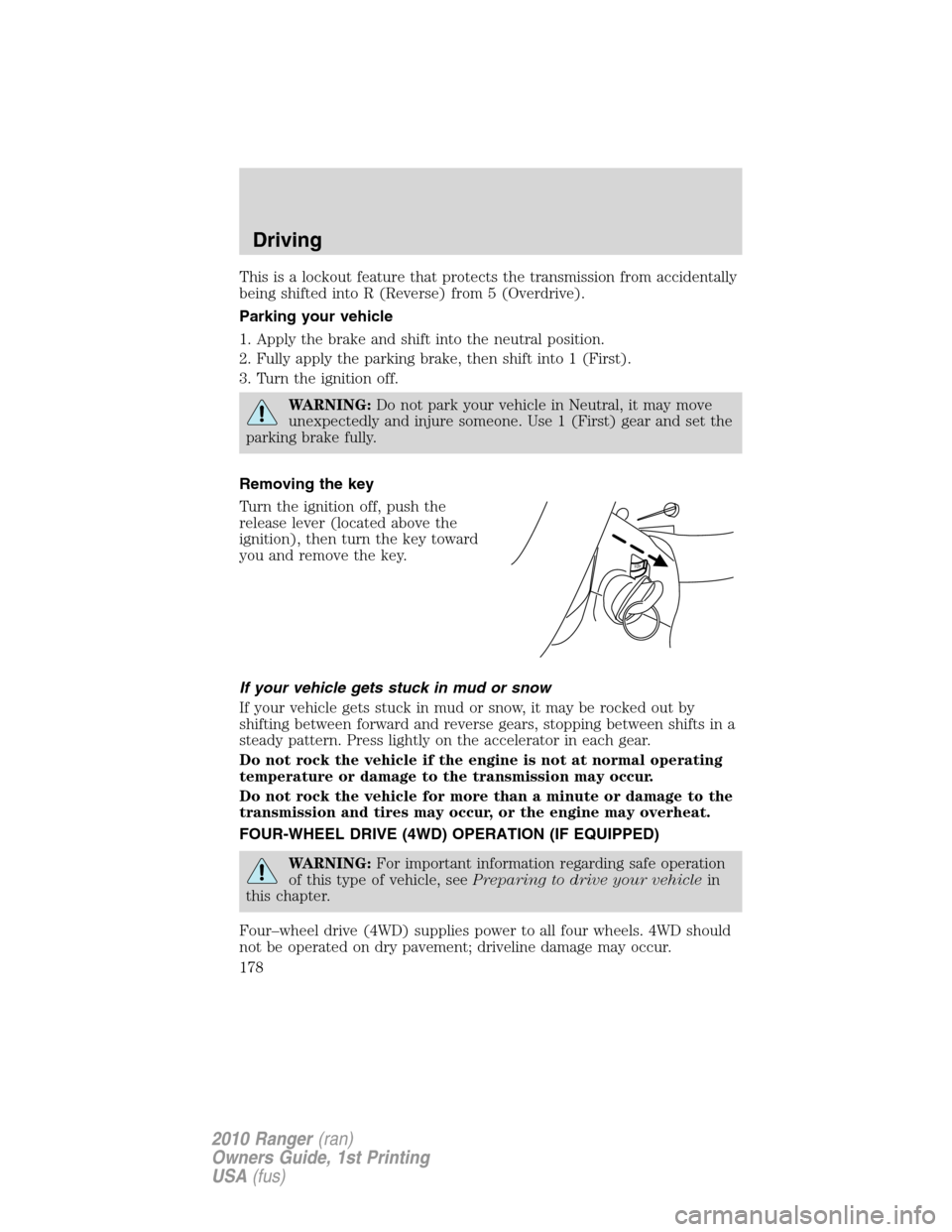
Turn the ignition off, push the
release lever (located above the
ignition), then turn the key toward
you and remove the key.
If your vehicle gets stuck in mud or snow
If your vehicle gets stuck in mud or snow, it may be rocked out by
shifting between forward and reverse gears, stopping between shifts in a
steady pattern. Press lightly on the accelerator in each gear.
Do not rock the vehicle if the engine is not at normal operating
temperature or damage to the transmission may occur.
Do not rock the vehicle for more than a minute or damage to the
transmission and tires may occur, or the engine may overheat.
FOUR-WHEEL DRIVE (4WD) OPERATION (IF EQUIPPED)
WARNING:For important information regarding safe operation
of this type of vehicle, seePreparing to drive your vehiclein
this chapter.
Four–wheel drive (4WD) supplies power to all four wheels. 4WD should
not be operated on dry pavement; driveline damage may occur.
P
U
S
H
Driving
178
2010 Ranger(ran)
Owners Guide, 1st Printing
USA(fus)
Page 180 of 286
2. On vehicles equipped with an automatic transmission, place the
transmission in N (Neutral); on vehicles equipped with a manual
transmission, press the clutch.
3. Move the 4WD control to the desired position.
•If shifting into 4L (4WD Low), wait for the 4WD LOW light in the
instrument cluster to turnonindicating the shift is complete.
•If shifting out of 4L (4WD Low), wait for the 4WD LOW light in the
instrument cluster to turnoffindicating the shift is complete.
Driving off-road with truck and utility vehicles
4WD vehicles are specially equipped for driving on sand, snow, mud and
rough terrain and have operating characteristics that are somewhat
different from conventional vehicles, both on and off the road.
How your vehicle differs from other vehicles
Truck and utility vehicles can differ from some other vehicles. Your
vehicle may be higher to allow it to travel over rough terrain without
getting hung up or damaging underbody components.
The differences that make your vehicle so versatile also make it handle
differently than an ordinary passenger car.
Maintain steering wheel control at all times, especially in rough terrain.
Since sudden changes in terrain can result in abrupt steering wheel
motion, make sure you grip the steering wheel from the outside. Do not
grip the spokes.
Drive cautiously to avoid vehicle damage from concealed objects such as
rocks and stumps.
You should either know the terrain or examine maps of the area before
driving. Map out your route before driving in the area. To maintain
steering and braking control of your vehicle, you must have all four
wheels on the ground and they must be rolling, not sliding or spinning.
Basic operating principles
•Do not use 4WD on dry, hard surfaced roads. Doing so will produce
excessive noise, increase tire wear and may damage drive components.
4WD modes are only intended for consistently slippery or loose
surfaces.
•Drive slower in strong crosswinds which can affect the normal steering
characteristics of your vehicle.
•Be extremely careful when driving on pavement made slippery by
loose sand, water, gravel, snow or ice.
Driving
180
2010 Ranger(ran)
Owners Guide, 1st Printing
USA(fus)
Page 181 of 286
If your vehicle goes off the edge of the pavement
•If your vehicle goes off the edge of the pavement, slow down, but
avoid severe brake application, ease the vehicle back onto the
pavement only after reducing your speed. Do not turn the steering
wheel too sharply while returning to the road surface.
•It may be safer to stay on the apron or shoulder of the road and slow
down gradually before returning to the pavement. You may lose
control if you do not slow down or if you turn the steering wheel too
sharply or abruptly.
•It often may be less risky to strike small objects, such as highway
reflectors, with minor damage to your vehicle rather than attempt a
sudden return to the pavement which could cause the vehicle to slide
sideways out of control or roll over. Remember, your safety and the
safety of others should be your primary concern.
WARNING:Vehicles with a higher center of gravity such as
utility and four-wheel drive vehicles handle differently than
vehicles with a lower center of gravity. Utility and four-wheel drive
vehicles arenotdesigned for cornering at speeds as high as passenger
cars any more than low-slung sports cars are designed to perform
satisfactorily under off-road conditions. Avoid sharp turns, excessive
speed and abrupt maneuvers in these vehicles. Failure to drive
cautiously could result in an increased risk of loss of vehicle control,
vehicle rollover, personal injury and death.
If your vehicle gets stuck
If your vehicle gets stuck in mud or snow it may be rocked out by
shifting between forward and reverse gears, stopping between shifts, in a
steady pattern. Press lightly on the accelerator in each gear.
Do not rock the vehicle if the engine is not at normal operating
temperature or damage to the transmission may occur.
Do not rock the vehicle for more than a few minutes or damage
to the transmission and tires may occur or the engine may
overheat.
WARNING:Do not spin the wheels at over 35 mph (56 km/h).
The tires may fail and injure a passenger or bystander.
Driving
181
2010 Ranger(ran)
Owners Guide, 1st Printing
USA(fus)
Page 183 of 286
Normal characteristics
On some 4WD models, the initial shift from two-wheel drive to 4x4 while
the vehicle is moving can cause some momentary clunk and ratcheting
sounds.
Sand
When driving over sand, try to keep all four wheels on the most solid
area of the trail. Avoid reducing the tire pressures but shift to a lower
gear and drive steadily through the terrain. Apply the accelerator slowly
and avoid spinning the wheels.
Avoid excessive speed because vehicle momentum can work against you
and cause the vehicle to become stuck to the point that assistance may
be required from another vehicle. Remember, you may be able to back
out the way you came if you proceed with caution.
Mud and water
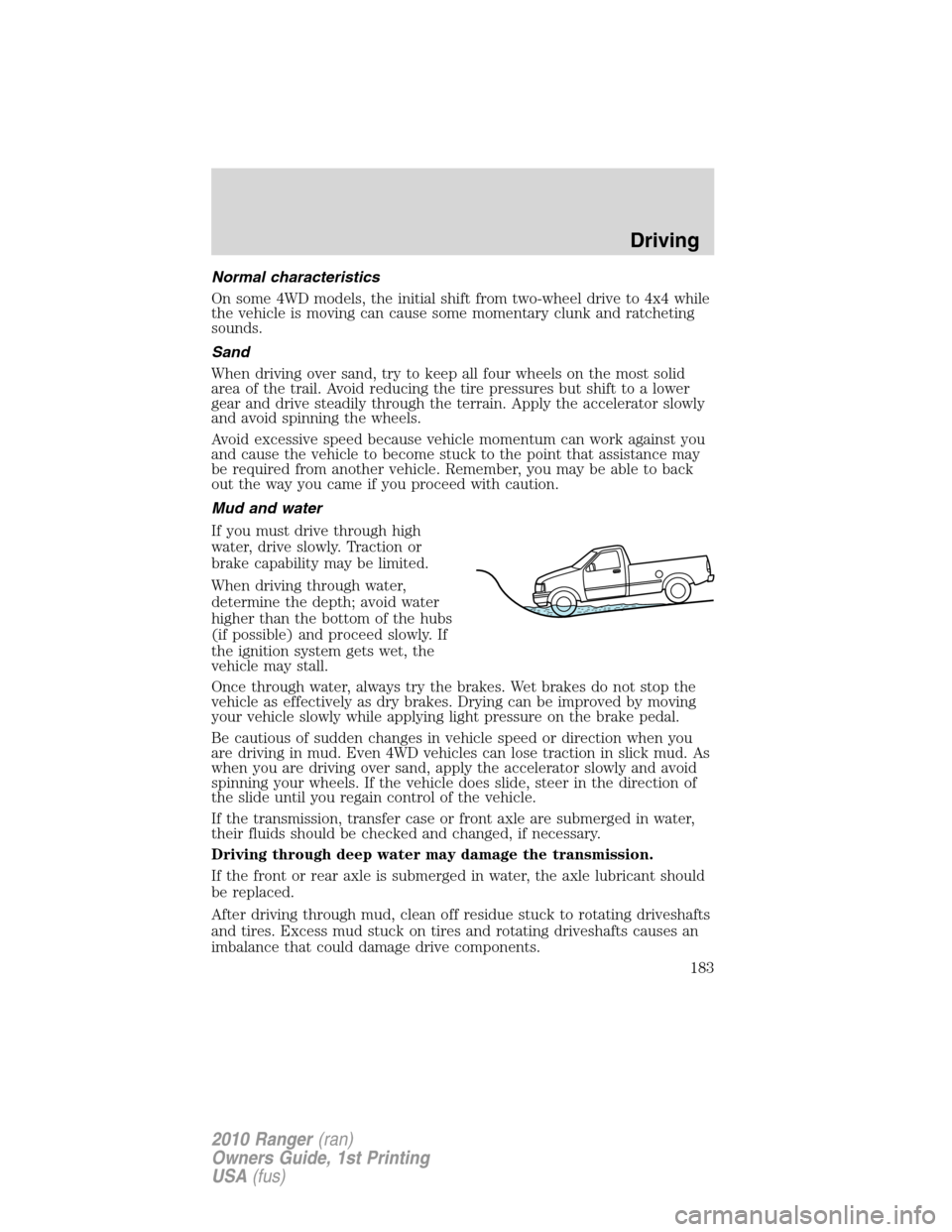
If you must drive through high
water, drive slowly. Traction or
brake capability may be limited.
When driving through water,
determine the depth; avoid water
higher than the bottom of the hubs
(if possible) and proceed slowly. If
the ignition system gets wet, the
vehicle may stall.
Once through water, always try the brakes. Wet brakes do not stop the
vehicle as effectively as dry brakes. Drying can be improved by moving
your vehicle slowly while applying light pressure on the brake pedal.
Be cautious of sudden changes in vehicle speed or direction when you
are driving in mud. Even 4WD vehicles can lose traction in slick mud. As
when you are driving over sand, apply the accelerator slowly and avoid
spinning your wheels. If the vehicle does slide, steer in the direction of
the slide until you regain control of the vehicle.
If the transmission, transfer case or front axle are submerged in water,
their fluids should be checked and changed, if necessary.
Driving through deep water may damage the transmission.
If the front or rear axle is submerged in water, the axle lubricant should
be replaced.
After driving through mud, clean off residue stuck to rotating driveshafts
and tires. Excess mud stuck on tires and rotating driveshafts causes an
imbalance that could damage drive components.
Driving
183
2010 Ranger(ran)
Owners Guide, 1st Printing
USA(fus)
Page 187 of 286
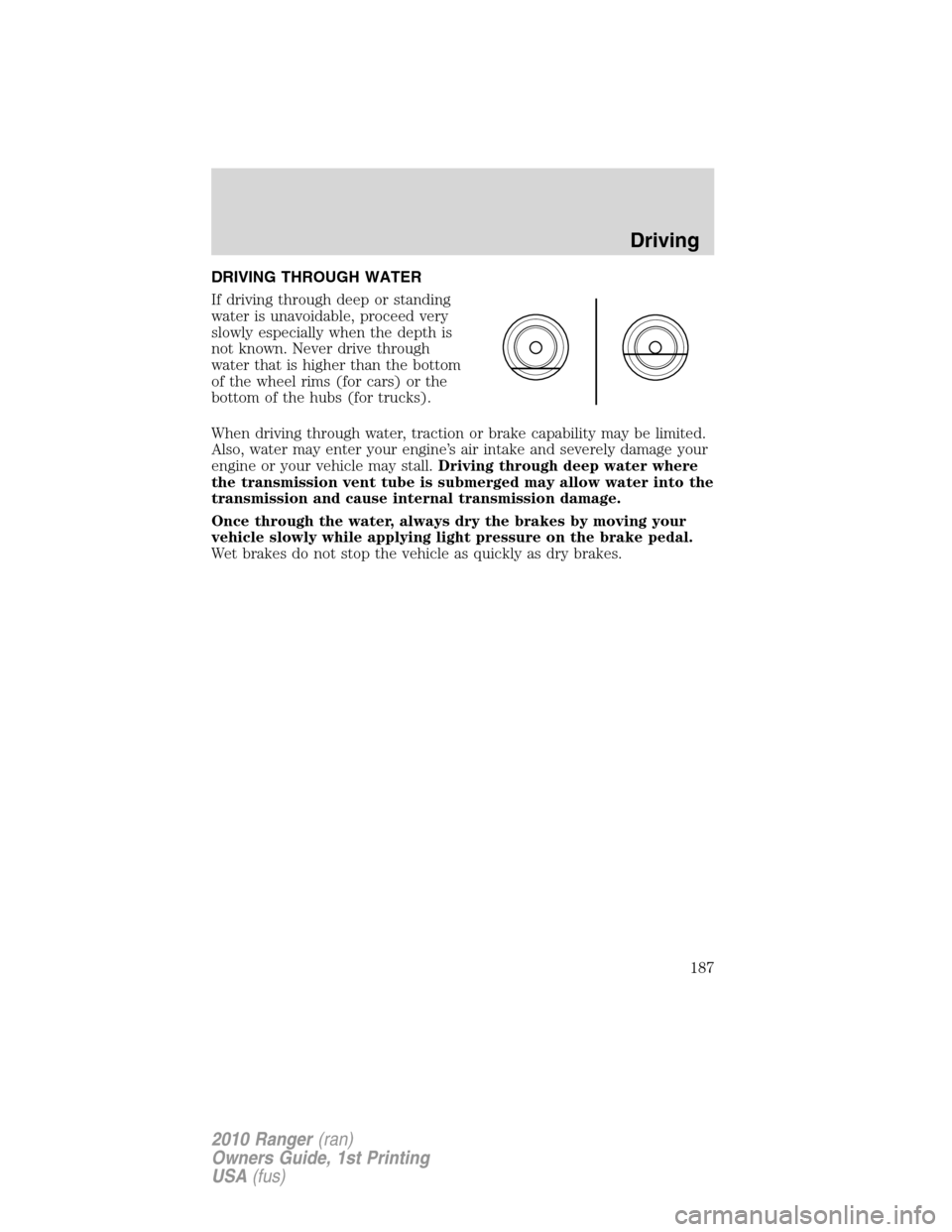
DRIVING THROUGH WATER
If driving through deep or standing
water is unavoidable, proceed very
slowly especially when the depth is
not known. Never drive through
water that is higher than the bottom
of the wheel rims (for cars) or the
bottom of the hubs (for trucks).
When driving through water, traction or brake capability may be limited.
Also, water may enter your engine’s air intake and severely damage your
engine or your vehicle may stall.Driving through deep water where
the transmission vent tube is submerged may allow water into the
transmission and cause internal transmission damage.
Once through the water, always dry the brakes by moving your
vehicle slowly while applying light pressure on the brake pedal.
Wet brakes do not stop the vehicle as quickly as dry brakes.
Driving
187
2010 Ranger(ran)
Owners Guide, 1st Printing
USA(fus)
Page 197 of 286
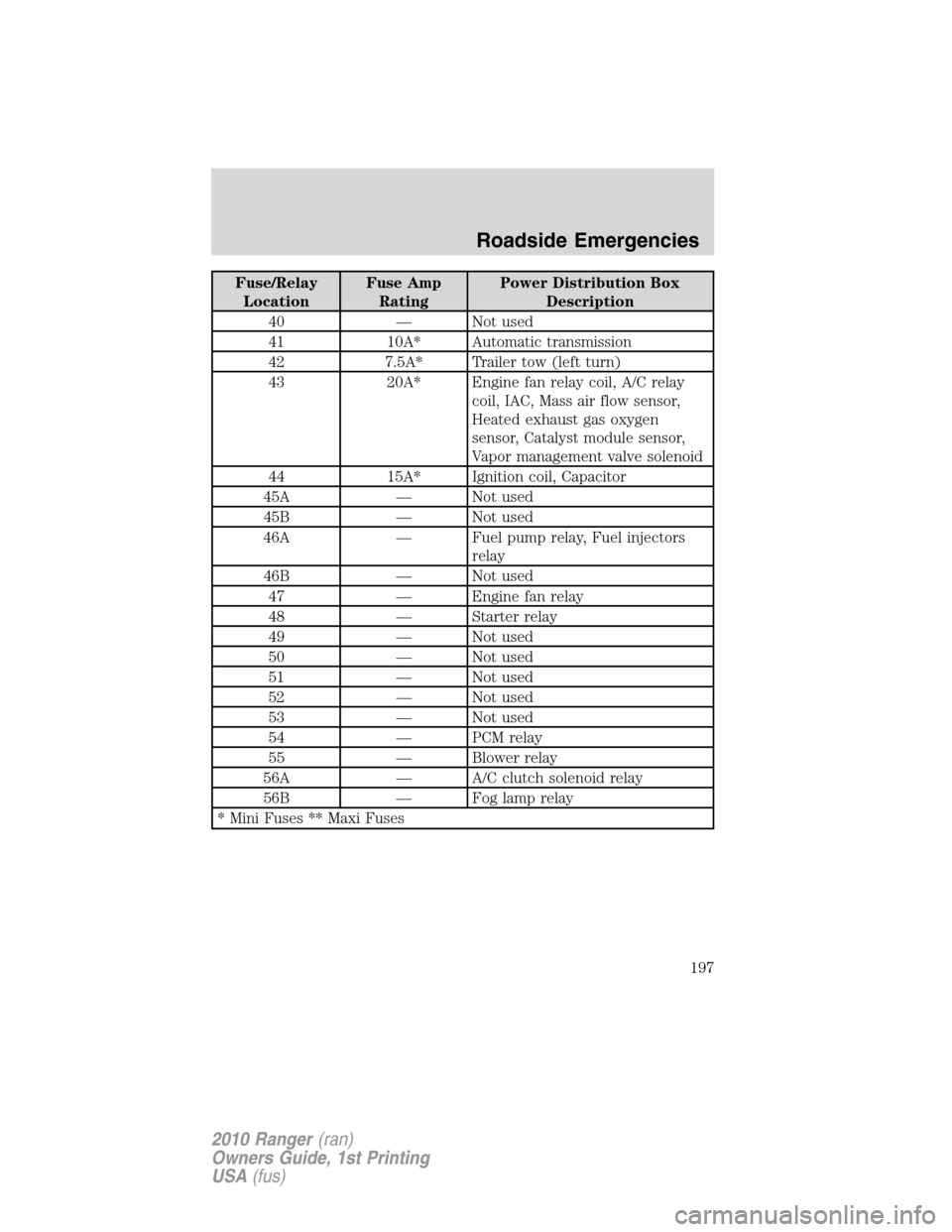
Fuse/Relay
LocationFuse Amp
RatingPower Distribution Box
Description
40 — Not used
41 10A* Automatic transmission
42 7.5A* Trailer tow (left turn)
43 20A* Engine fan relay coil, A/C relay
coil, IAC, Mass air flow sensor,
Heated exhaust gas oxygen
sensor, Catalyst module sensor,
Vapor management valve solenoid
44 15A* Ignition coil, Capacitor
45A — Not used
45B — Not used
46A — Fuel pump relay, Fuel injectors
relay
46B — Not used
47 — Engine fan relay
48 — Starter relay
49 — Not used
50 — Not used
51 — Not used
52 — Not used
53 — Not used
54 — PCM relay
55 — Blower relay
56A — A/C clutch solenoid relay
56B — Fog lamp relay
* Mini Fuses ** Maxi Fuses
Roadside Emergencies
197
2010 Ranger(ran)
Owners Guide, 1st Printing
USA(fus)