automatic transmission FORD RANGER 2011 2.G User Guide
[x] Cancel search | Manufacturer: FORD, Model Year: 2011, Model line: RANGER, Model: FORD RANGER 2011 2.GPages: 302, PDF Size: 2.33 MB
Page 150 of 302
STARTING
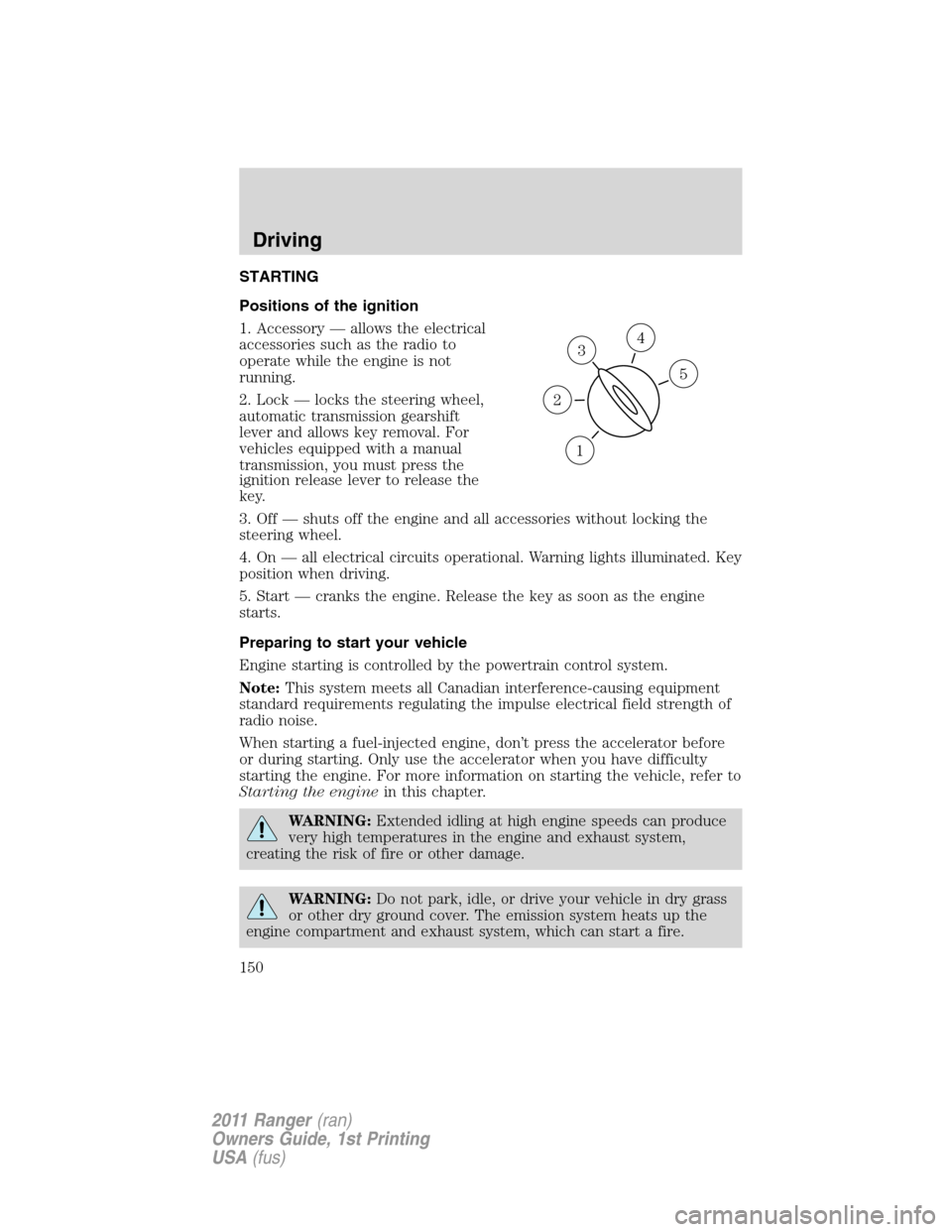
Positions of the ignition
1. Accessory — allows the electrical
accessories such as the radio to
operate while the engine is not
running.
2. Lock — locks the steering wheel,
automatic transmission gearshift
lever and allows key removal. For
vehicles equipped with a manual
transmission, you must press the
ignition release lever to release the
key.
3. Off — shuts off the engine and all accessories without locking the
steering wheel.
4. On — all electrical circuits operational. Warning lights illuminated. Key
position when driving.
5. Start — cranks the engine. Release the key as soon as the engine
starts.
Preparing to start your vehicle
Engine starting is controlled by the powertrain control system.
Note:This system meets all Canadian interference-causing equipment
standard requirements regulating the impulse electrical field strength of
radio noise.
When starting a fuel-injected engine, don’t press the accelerator before
or during starting. Only use the accelerator when you have difficulty
starting the engine. For more information on starting the vehicle, refer to
Starting the enginein this chapter.
WARNING:Extended idling at high engine speeds can produce
very high temperatures in the engine and exhaust system,
creating the risk of fire or other damage.
WARNING:Do not park, idle, or drive your vehicle in dry grass
or other dry ground cover. The emission system heats up the
engine compartment and exhaust system, which can start a fire.
3
1
2
5
4
Driving
150
2011 Ranger(ran)
Owners Guide, 1st Printing
USA(fus)
Page 151 of 302
WARNING:Do not start your vehicle in a closed garage or in
other enclosed areas. Exhaust fumes can be toxic. Always open
the garage door before you start the engine. SeeGuarding against
exhaust fumesin this chapter for more instructions.
WARNING:If you smell exhaust fumes inside your vehicle, have
your dealer inspect your vehicle immediately. Do not drive if you
smell exhaust fumes.
Important safety precautions
When the engine starts, the idle RPM runs faster to warm the engine. If
the engine idle speed does not slow down automatically, have the vehicle
checked.
Before starting the vehicle:
1. Make sure all occupants buckle their safety belts. For more
information on safety belts and their proper usage, refer to theSeating
and Safety Restraintschapter.
2. Make sure the headlamps and electrical accessories are off.
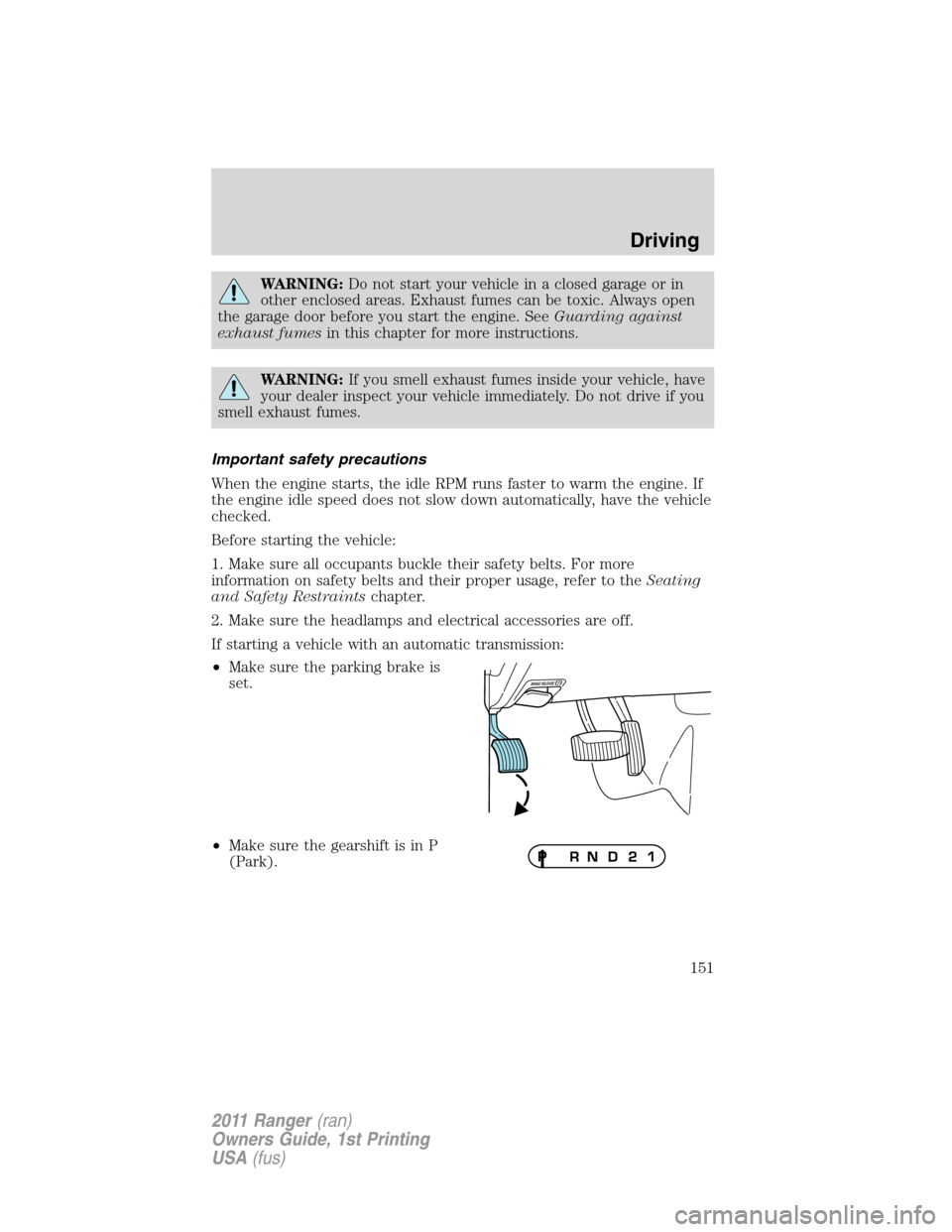
If starting a vehicle with an automatic transmission:
•Make sure the parking brake is
set.
•Make sure the gearshift is in P
(Park).
Driving
151
2011 Ranger(ran)
Owners Guide, 1st Printing
USA(fus)
Page 157 of 302
Parking brake
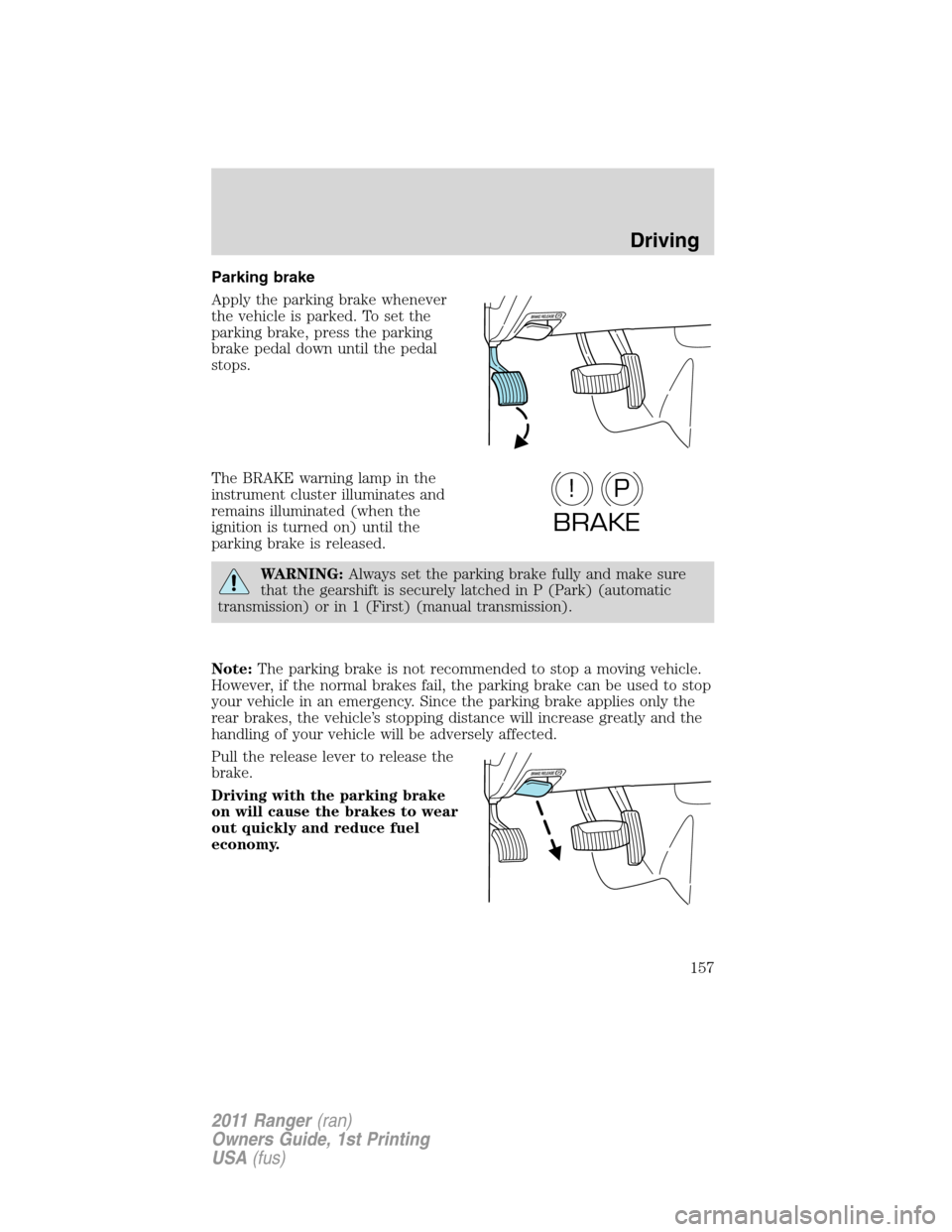
Apply the parking brake whenever
the vehicle is parked. To set the
parking brake, press the parking
brake pedal down until the pedal
stops.
The BRAKE warning lamp in the
instrument cluster illuminates and
remains illuminated (when the
ignition is turned on) until the
parking brake is released.
WARNING:Always set the parking brake fully and make sure
that the gearshift is securely latched in P (Park) (automatic
transmission) or in 1 (First) (manual transmission).
Note:The parking brake is not recommended to stop a moving vehicle.
However, if the normal brakes fail, the parking brake can be used to stop
your vehicle in an emergency. Since the parking brake applies only the
rear brakes, the vehicle’s stopping distance will increase greatly and the
handling of your vehicle will be adversely affected.
Pull the release lever to release the
brake.
Driving with the parking brake
on will cause the brakes to wear
out quickly and reduce fuel
economy.
P!
BRAKE
Driving
157
2011 Ranger(ran)
Owners Guide, 1st Printing
USA(fus)
Page 166 of 302
AUTOMATIC TRANSMISSION OPERATION (IF EQUIPPED)
Driving with a 5–speed automatic transmission (if equipped)
This vehicle is equipped with an adaptive transmission shift strategy.
Adaptive shift strategy offers the optimal transmission operation and
shift quality. When the vehicle’s battery has been disconnected for any
type of service or repair, the transmission will need to relearn the normal
shift strategy parameters, much like having to reset your radio stations
when your vehicle battery has been disconnected. The adaptive
transmission strategy allows the transmission to relearn these operating
parameters. This learning process could take several transmission
upshifts and downshifts; during this learning process, slightly firmer
shifts may occur. After this learning process, normal shift feel and shift
scheduling will resume.
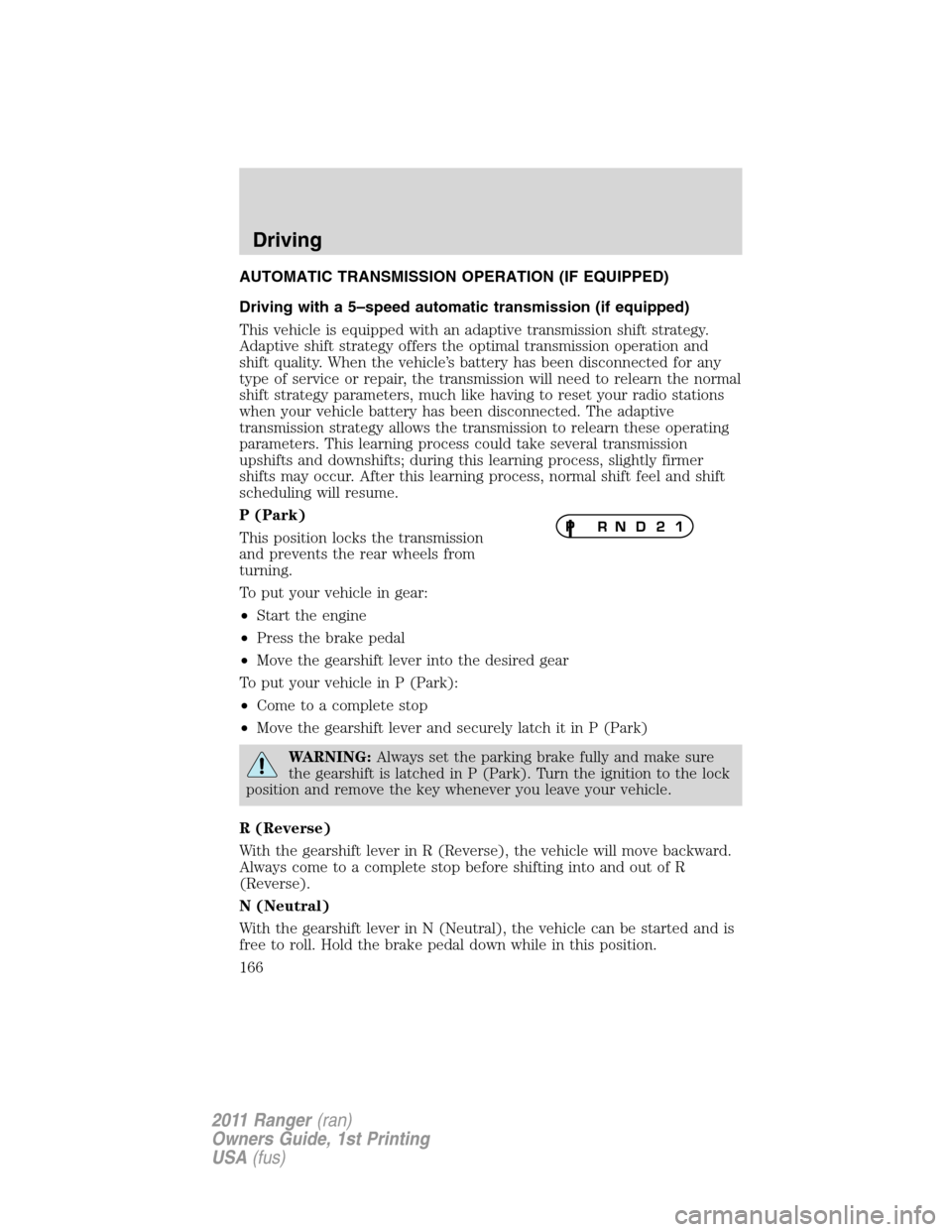
P (Park)
This position locks the transmission
and prevents the rear wheels from
turning.
To put your vehicle in gear:
•Start the engine
•Press the brake pedal
•Move the gearshift lever into the desired gear
To put your vehicle in P (Park):
•Come to a complete stop
•Move the gearshift lever and securely latch it in P (Park)
WARNING:Always set the parking brake fully and make sure
the gearshift is latched in P (Park). Turn the ignition to the lock
position and remove the key whenever you leave your vehicle.
R (Reverse)
With the gearshift lever in R (Reverse), the vehicle will move backward.
Always come to a complete stop before shifting into and out of R
(Reverse).
N (Neutral)
With the gearshift lever in N (Neutral), the vehicle can be started and is
free to roll. Hold the brake pedal down while in this position.
Driving
166
2011 Ranger(ran)
Owners Guide, 1st Printing
USA(fus)
Page 167 of 302
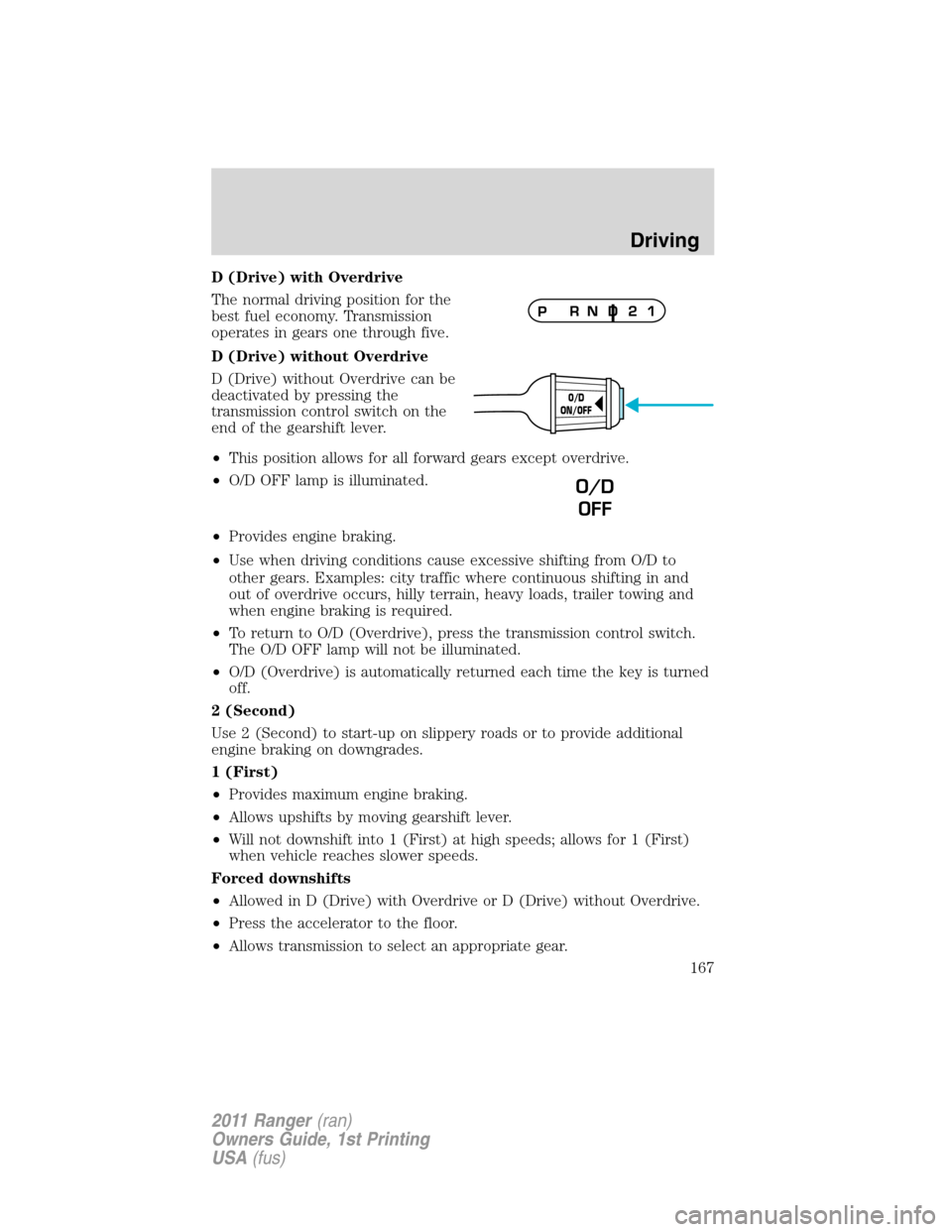
D (Drive) with Overdrive
The normal driving position for the
best fuel economy. Transmission
operates in gears one through five.
D (Drive) without Overdrive
D (Drive) without Overdrive can be
deactivated by pressing the
transmission control switch on the
end of the gearshift lever.
•This position allows for all forward gears except overdrive.
•O/D OFF lamp is illuminated.
•Provides engine braking.
•Use when driving conditions cause excessive shifting from O/D to
other gears. Examples: city traffic where continuous shifting in and
out of overdrive occurs, hilly terrain, heavy loads, trailer towing and
when engine braking is required.
•To return to O/D (Overdrive), press the transmission control switch.
The O/D OFF lamp will not be illuminated.
•O/D (Overdrive) is automatically returned each time the key is turned
off.
2 (Second)
Use 2 (Second) to start-up on slippery roads or to provide additional
engine braking on downgrades.
1 (First)
•Provides maximum engine braking.
•Allows upshifts by moving gearshift lever.
•Will not downshift into 1 (First) at high speeds; allows for 1 (First)
when vehicle reaches slower speeds.
Forced downshifts
•Allowed in D (Drive) with Overdrive or D (Drive) without Overdrive.
•Press the accelerator to the floor.
•Allows transmission to select an appropriate gear.
O/D
ON/OFF
O/D
OFF
Driving
167
2011 Ranger(ran)
Owners Guide, 1st Printing
USA(fus)
Page 172 of 302
Shifting between 2H (2WD High) and 4H (4WD High)
•Move the 4WD control between 2H and 4H at a stop or any forward
speed.
Note:Do not perform this operation if the rear wheels are slipping.
Shifting to/from 4L (4WD Low)
Note:Some noise may be heard as the 4WD system shifts or engages.
This is normal and should be no reason for concern.
1. Bring the vehicle to a speed of 3 mph (5 km/h) or slower.
2. On vehicles equipped with an automatic transmission, place the
transmission in N (Neutral). On vehicles equipped with a manual
transmission, press the clutch.
3. Move the 4WD control to the desired position.
•If the vehicle speed or transmission gear requirements are not met,
the shift will not occur.
•If shifting into 4L (4WD Low), wait for the 4WD LOW light in the
instrument cluster to turnonindicating the shift is complete.
•If shifting out of 4L (4WD Low), wait for the 4WD LOW light in the
instrument cluster to turnoffindicating the shift is complete.
Driving off-road with truck and utility vehicles
4WD vehicles are specially equipped for driving on sand, snow, mud and
rough terrain and have operating characteristics that are somewhat
different from conventional vehicles, both on and off the road.
How your vehicle differs from other vehicles
Truck and utility vehicles can differ from some other vehicles. Your
vehicle may be higher to allow it to travel over rough terrain without
getting hung up or damaging underbody components.
The differences that make your vehicle so versatile also make it handle
differently than an ordinary passenger car.
Maintain steering wheel control at all times, especially in rough terrain.
Since sudden changes in terrain can result in abrupt steering wheel
motion, make sure you grip the steering wheel from the outside. Do not
grip the spokes.
Drive cautiously to avoid vehicle damage from concealed objects such as
rocks and stumps.
You should either know the terrain or examine maps of the area before
driving. Map out your route before driving in the area. To maintain
Driving
172
2011 Ranger(ran)
Owners Guide, 1st Printing
USA(fus)
Page 188 of 302
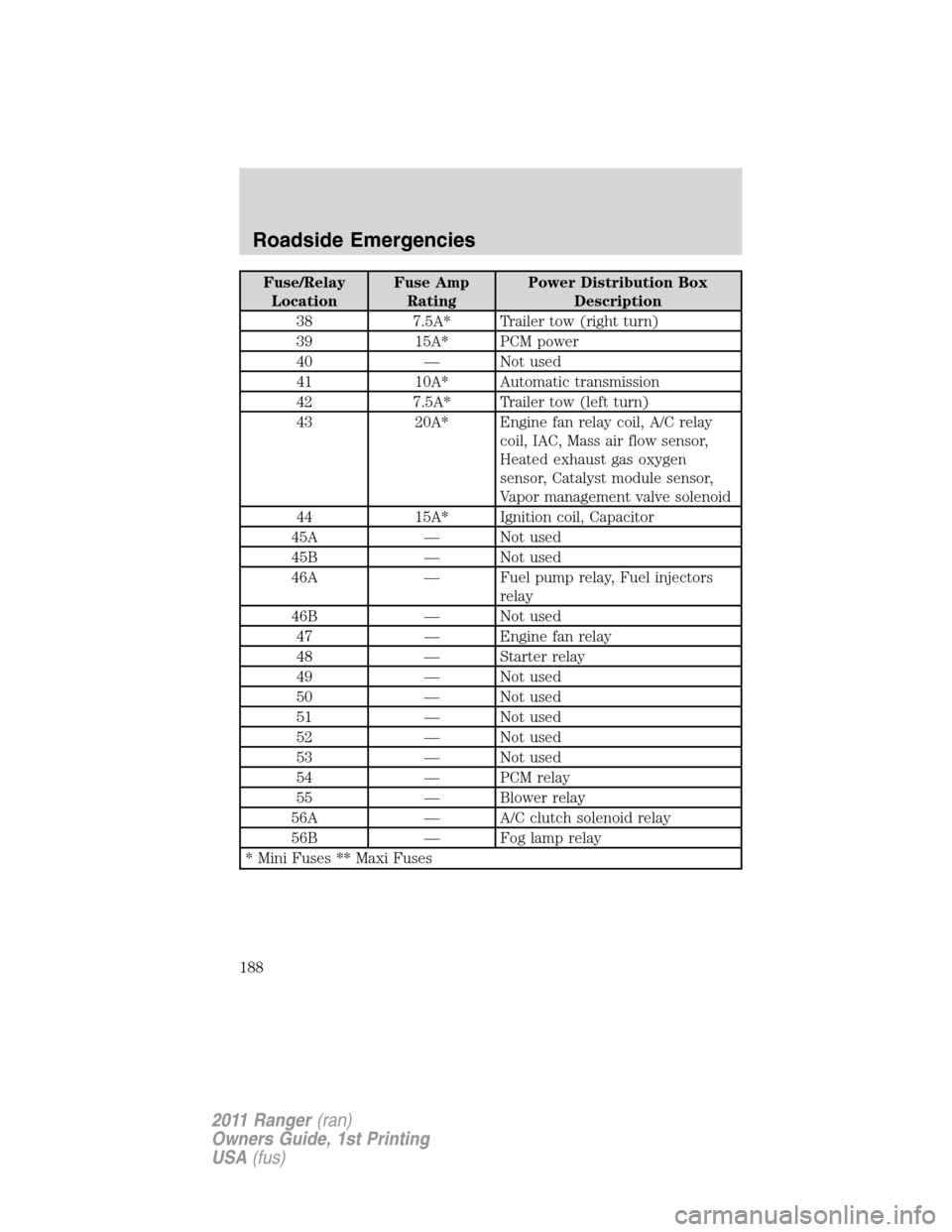
Fuse/Relay
LocationFuse Amp
RatingPower Distribution Box
Description
38 7.5A* Trailer tow (right turn)
39 15A* PCM power
40 — Not used
41 10A* Automatic transmission
42 7.5A* Trailer tow (left turn)
43 20A* Engine fan relay coil, A/C relay
coil, IAC, Mass air flow sensor,
Heated exhaust gas oxygen
sensor, Catalyst module sensor,
Vapor management valve solenoid
44 15A* Ignition coil, Capacitor
45A — Not used
45B — Not used
46A — Fuel pump relay, Fuel injectors
relay
46B — Not used
47 — Engine fan relay
48 — Starter relay
49 — Not used
50 — Not used
51 — Not used
52 — Not used
53 — Not used
54 — PCM relay
55 — Blower relay
56A — A/C clutch solenoid relay
56B — Fog lamp relay
* Mini Fuses ** Maxi Fuses
Roadside Emergencies
188
2011 Ranger(ran)
Owners Guide, 1st Printing
USA(fus)
Page 190 of 302
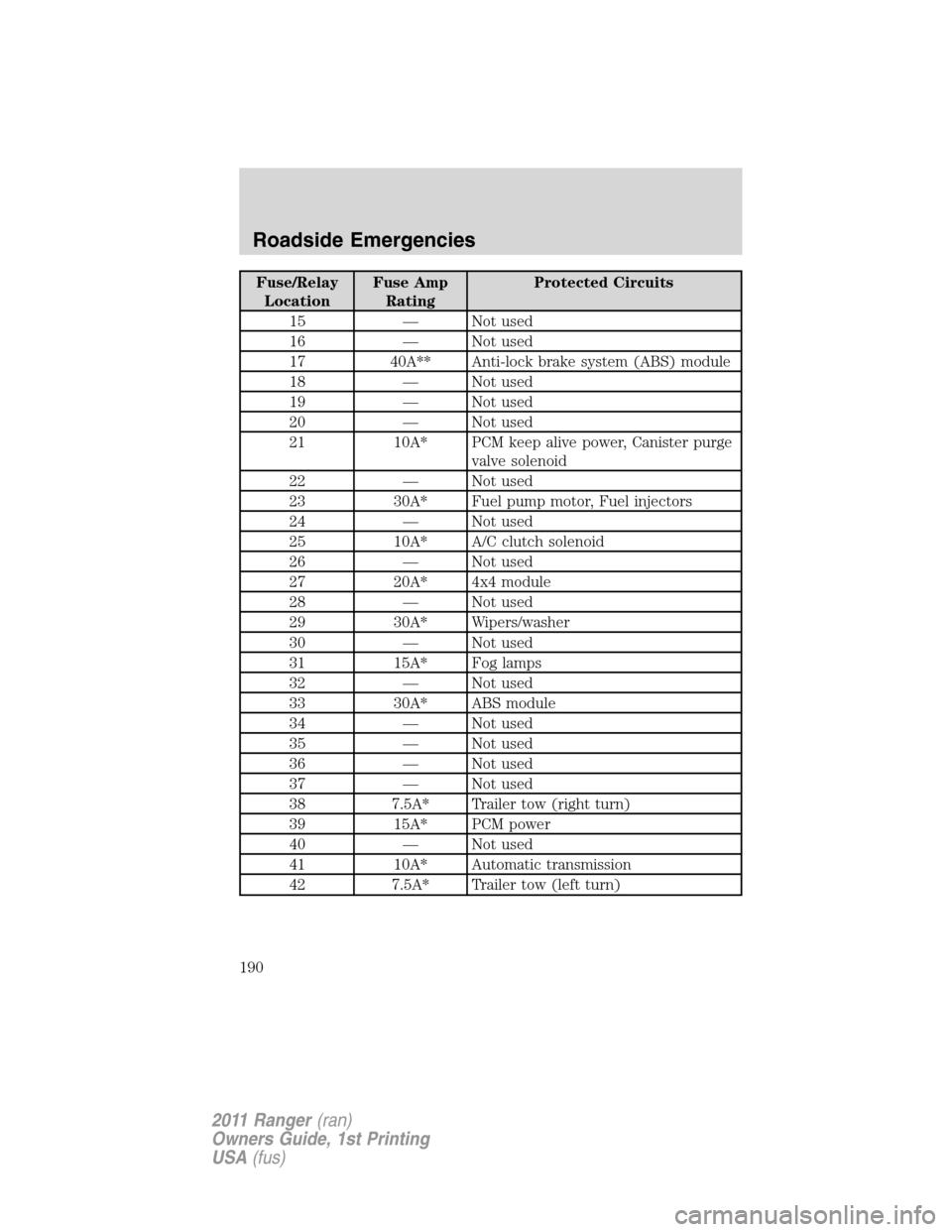
Fuse/Relay
LocationFuse Amp
RatingProtected Circuits
15 — Not used
16 — Not used
17 40A** Anti-lock brake system (ABS) module
18 — Not used
19 — Not used
20 — Not used
21 10A* PCM keep alive power, Canister purge
valve solenoid
22 — Not used
23 30A* Fuel pump motor, Fuel injectors
24 — Not used
25 10A* A/C clutch solenoid
26 — Not used
27 20A* 4x4 module
28 — Not used
29 30A* Wipers/washer
30 — Not used
31 15A* Fog lamps
32 — Not used
33 30A* ABS module
34 — Not used
35 — Not used
36 — Not used
37 — Not used
38 7.5A* Trailer tow (right turn)
39 15A* PCM power
40 — Not used
41 10A* Automatic transmission
42 7.5A* Trailer tow (left turn)
Roadside Emergencies
190
2011 Ranger(ran)
Owners Guide, 1st Printing
USA(fus)
Page 194 of 302
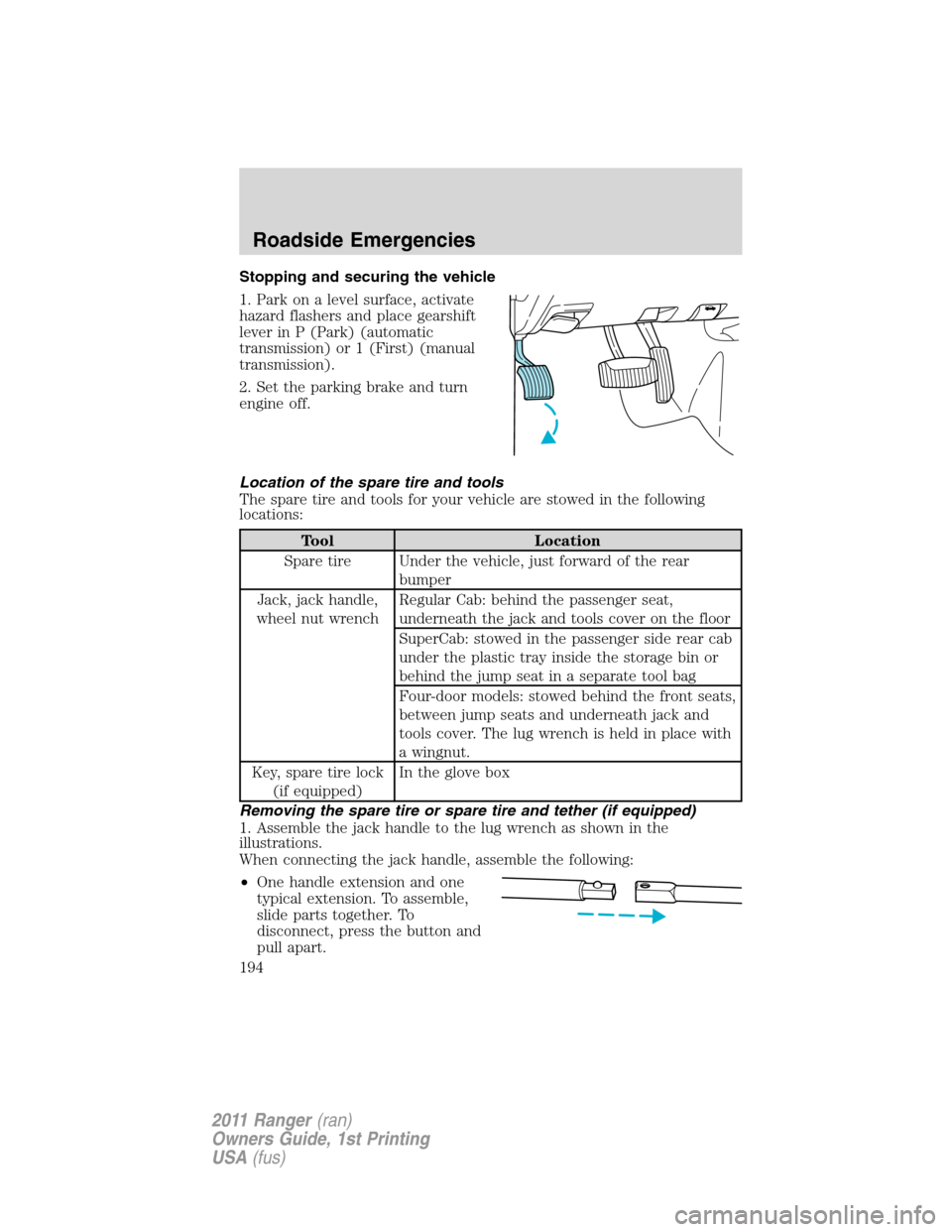
Stopping and securing the vehicle
1. Park on a level surface, activate
hazard flashers and place gearshift
lever in P (Park) (automatic
transmission) or 1 (First) (manual
transmission).
2. Set the parking brake and turn
engine off.
Location of the spare tire and tools
The spare tire and tools for your vehicle are stowed in the following
locations:
Tool Location
Spare tire Under the vehicle, just forward of the rear
bumper
Jack, jack handle,
wheel nut wrenchRegular Cab: behind the passenger seat,
underneath the jack and tools cover on the floor
SuperCab: stowed in the passenger side rear cab
under the plastic tray inside the storage bin or
behind the jump seat in a separate tool bag
Four-door models: stowed behind the front seats,
between jump seats and underneath jack and
tools cover. The lug wrench is held in place with
a wingnut.
Key, spare tire lock
(if equipped)In the glove box
Removing the spare tire or spare tire and tether (if equipped)
1. Assemble the jack handle to the lug wrench as shown in the
illustrations.
When connecting the jack handle, assemble the following:
•One handle extension and one
typical extension. To assemble,
slide parts together. To
disconnect, press the button and
pull apart.
Roadside Emergencies
194
2011 Ranger(ran)
Owners Guide, 1st Printing
USA(fus)
Page 196 of 302
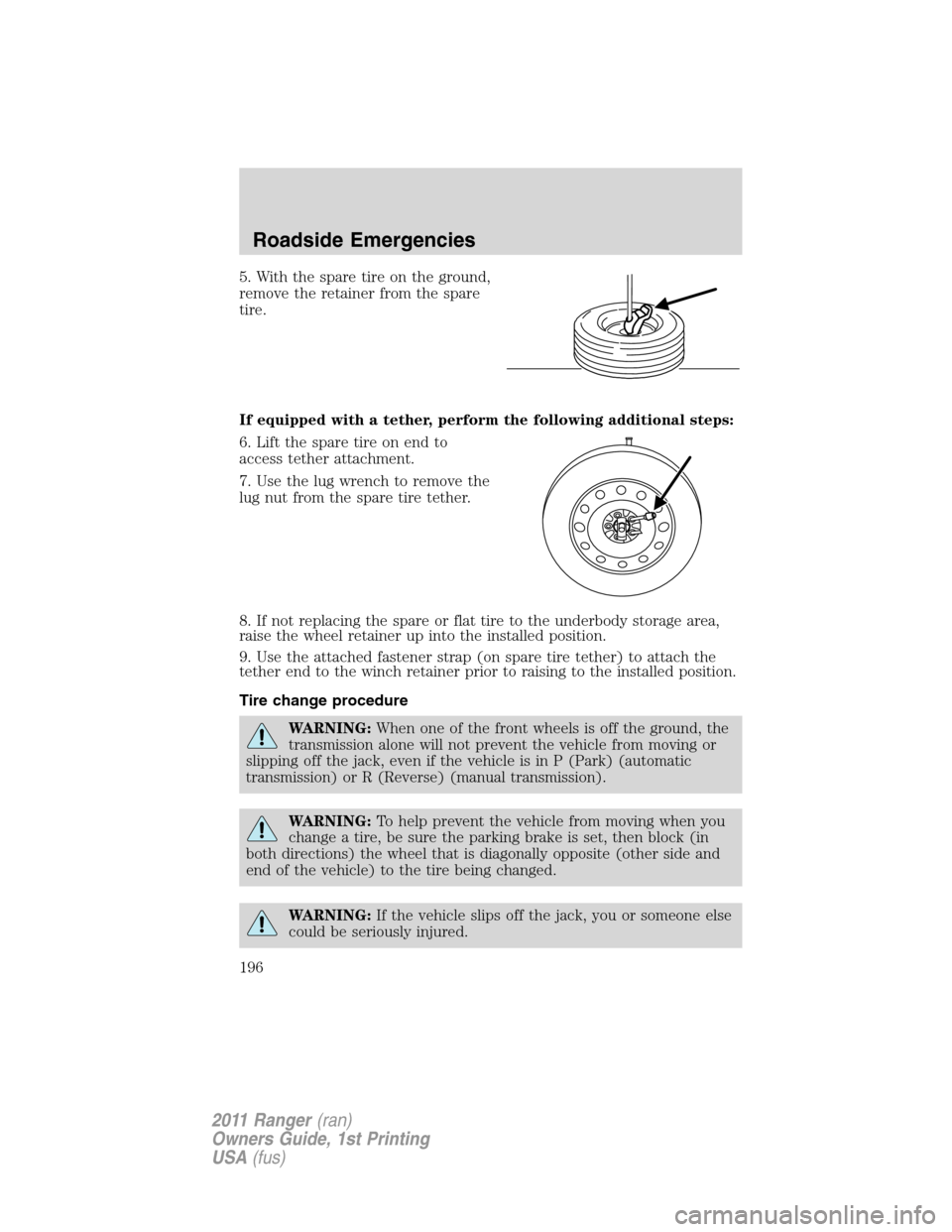
5. With the spare tire on the ground,
remove the retainer from the spare
tire.
If equipped with a tether, perform the following additional steps:
6. Lift the spare tire on end to
access tether attachment.
7. Use the lug wrench to remove the
lug nut from the spare tire tether.
8. If not replacing the spare or flat tire to the underbody storage area,
raise the wheel retainer up into the installed position.
9. Use the attached fastener strap (on spare tire tether) to attach the
tether end to the winch retainer prior to raising to the installed position.
Tire change procedure
WARNING:When one of the front wheels is off the ground, the
transmission alone will not prevent the vehicle from moving or
slipping off the jack, even if the vehicle is in P (Park) (automatic
transmission) or R (Reverse) (manual transmission).
WARNING:To help prevent the vehicle from moving when you
change a tire, be sure the parking brake is set, then block (in
both directions) the wheel that is diagonally opposite (other side and
end of the vehicle) to the tire being changed.
WARNING:If the vehicle slips off the jack, you or someone else
could be seriously injured.
Roadside Emergencies
196
2011 Ranger(ran)
Owners Guide, 1st Printing
USA(fus)