traction control FORD RANGER 2020 Owner's Manual
[x] Cancel search | Manufacturer: FORD, Model Year: 2020, Model line: RANGER, Model: FORD RANGER 2020Pages: 478, PDF Size: 7.44 MB
Page 293 of 478
GENERAL INFORMATION
Notice to utility vehicle and truck
owners
WARNING: Utility vehicles have a
significantly higher rollover rate than
other types of vehicles. WARNING:
Vehicles with a higher
center of gravity (utility and four-wheel
drive vehicles) handle differently than
vehicles with a lower center of gravity
(passenger cars). Avoid sharp turns,
excessive speed and abrupt steering in
these vehicles. Failure to drive cautiously
increases the risk of losing control of your
vehicle, vehicle rollover, personal injury
and death. WARNING:
In a rollover crash, an
unbelted person is significantly more
likely to die than a person wearing a
seatbelt. WARNING:
Do not become
overconfident in the ability of four-wheel
drive vehicles. Although a four-wheel
drive vehicle may accelerate better than
a two-wheel drive vehicle in low traction
situations, it won't stop any faster than
two-wheel drive vehicles. Always drive
at a safe speed.
Utility vehicles and trucks handle
differently than passenger cars in the
various driving conditions that are
encountered on streets, highways and
off-road. Utility vehicles and trucks are not
designed for cornering at speeds as high
as passenger cars any more than low-slung
sports cars are designed to perform
satisfactorily under off-road conditions. Study your owner's manual and any
supplements for specific information about
equipment features, instructions for safe
driving and additional precautions to
reduce the risk of an accident or serious
injury.
Four-wheel drive system
(If Equipped)
A vehicle equipped with four-wheel drive
(when selected) has the ability to use all
four wheels to power itself. This increases
traction which could enable you to safely
drive over terrain and road conditions that
a conventional two-wheel drive vehicle
cannot.
On some four-wheel drive models, the
initial shift from two-wheel drive to
four-wheel drive while the vehicle is
moving can cause a momentary clunk and
ratcheting sound. These sounds are normal
as the front drivetrain comes up to speed
and are not cause for concern.
Note: In four-wheel drive vehicles, the size
of the spare tire relative to the remaining
tires can have an effect on the 4x4 system's
ability to engage and disengage.
Operating 4WD Vehicles with a
Spare tire or Mismatched Tires
On four-wheel drive vehicles, the size of
the spare tire can affect the 4X4 system.
If there is a significant difference between
the size of the spare tire and the remaining
tires, the four-wheel drive functionality will
be limited.
When driving with the full-size dissimilar
spare wheel and tire assembly, we
recommend that you do not:
• Exceed
50 mph (80 km/h) with 4WD
mode turned on.
• Turn on a 4WD mode unless the
vehicle is stationary.
• Use 4WD mode on dry pavement.
290
Ranger (TFG) Canada/United States of America, Vehicles Built From: 18-11-2019, LB3J 19A321 AB enUSA, Edition date: 202002, Second-Printing Wheels and Tires
Page 295 of 478
Tire Quality Grades apply to new
pneumatic passenger car tires.
They do not apply to deep tread,
winter-type snow tires,
space-saver or temporary use
spare tires, light truck or LT type
tires, tires with nominal rim
diameters of 10 to 12 inches or
limited production tires as defined
in Title 49 Code of Federal
Regulations Part 575.104 (c)(2).
U.S. Department of
Transportation Tire quality
grades: The U.S. Department of
Transportation requires us to give
you the following information
about tire grades exactly as the
government has written it.
Treadwear
The treadwear grade is a
comparative rating based on the
wear rate of the tire when tested
under controlled conditions on a
specified government test course.
For example, a tire graded 150
would wear one and one-half (1
½) times as well on the
government course as a tire
graded 100. The relative
performance of tires depends
upon the actual conditions of their
use, however, and could depart
significantly from the norm due to
variations in driving habits, service
practices, and differences in road
characteristics and climate. Traction AA A B C WARNING:
The traction
grade assigned to this tire is
based on straight-ahead braking
traction tests, and does not
include acceleration, cornering,
hydroplaning or peak traction
characteristics.
The traction grades, from highest
to lowest are AA, A, B, and C. The
grades represent the tire ’s ability
to stop on wet pavement as
measured under controlled
conditions on specified
government test surfaces of
asphalt and concrete. A tire
marked C could have poor traction
performance.
Temperature A B C WARNING:
The
temperature grade for this tire is
established for a tire that is
properly inflated and not
overloaded. Excessive speed,
underinflation, or excessive
loading, either separately or in
combination, can cause heat
buildup and possible tire failure.
The temperature grades are A
(the highest), B and C,
representing the tire ’s resistance
to the generation of heat and its
ability to dissipate heat when
tested under controlled conditions
on a specified indoor laboratory
292
Ranger (TFG) Canada/United States of America, Vehicles Built From: 18-11-2019, LB3J 19A321 AB enUSA, Edition date: 202002, Second-Printing Wheels and Tires
Page 299 of 478
the last four numbers represent
the week and year the tire was
built. For example, the numbers
317 mean the 31st week of 1997.
After 2000 the numbers go to four
digits. For example, 2501 means
the 25th week of 2001. The
numbers in between are
identification codes used for
traceability. This information is
used to contact customers if a tire
defect requires a recall.
I.
M+S or M/S: Mud and Snow, or
AT:
All Terrain, or
AS:
All Season.
J. Tire Ply Composition and
Material Used:
Indicates the
number of plies or the number of
layers of rubber-coated fabric in
the tire tread and sidewall. Tire
manufacturers also must indicate
the ply materials in the tire and the
sidewall, which include steel,
nylon, polyester, and others.
K. Maximum Load: Indicates the
maximum load in kilograms and
pounds that can be carried by the
tire (affixed to either the door
hinge pillar, door-latch post, or the
door edge that meets the
door-latch post, next to the
driver's seating position), or Tire
Label located on the B-pillar or
the edge of the driver's door.
L. Treadwear, Traction and
Temperature Grades: *
Treadwear: The treadwear
grade is a comparative rating
based on the wear rate of the tire
when tested under controlled
conditions on a specified
government test course. For
example, a tire graded 150 would
wear 1½ times as well on the
government course as a tire
graded 100.
*
Traction: The traction grades,
from highest to lowest are AA, A,
B, and C. The grades represent the
tire's ability to stop on wet
pavement as measured under
controlled conditions on specified
government test surfaces of
asphalt and concrete. A tire
marked C could have poor traction
performance.
*
Temperature: The temperature
grades are A (the highest), B and
C, representing the tire's
resistance to the generation of
heat and its ability to dissipate
heat when tested under controlled
conditions on a specified indoor
laboratory test wheel.
M. Maximum Inflation
Pressure:
Indicates the tire
manufacturers' maximum
permissible pressure or the
pressure at which the maximum
load can be carried by the tire. This
pressure is normally higher than
the vehicle manufacturer's
recommended cold inflation
pressure which can be found on
the Safety Compliance
Certification Label (affixed to
either the door hinge pillar,
296
Ranger (TFG) Canada/United States of America, Vehicles Built From: 18-11-2019, LB3J 19A321 AB enUSA, Edition date: 202002, Second-Printing Wheels and Tires
Page 310 of 478
The tires on your vehicle have all-weather
treads to provide traction in rain and snow.
However, in some climates, you may need
to use snow tires and snow chains. If you
need to use snow chains, we recommend
you use steel wheels of the same size and
specifications, as snow chains may chip
aluminum wheels.
Note:
Only use snow chains on applicable
tire sizes.
Only fit snow chains to the following
specified tires:
• 255/70 R16 111T.
• 255/65 R17 110T.
• 265/65 R17 112T.
• 265/60 R18 110T.
• LT265/65 R17 109T.
Only use S-Class snow chains, 0.6 in
(15 mm) chain links.
Only use manual tensioning chains. Do not
use self-tensioning chains.
Only use snow chains in pairs on the rear
axle.
Note: The anti-lock brake system continues
to operate normally.
Follow these guidelines when using snow
tires and chains:
• If possible, avoid fully loading your
vehicle.
• Install chains securely, verifying that
the chains do not touch any wiring,
brake lines, or fuel lines.
• Drive cautiously. If you hear the chains
rub or bang against your vehicle, stop
and retighten the chains. If this does
not work, remove the chains to prevent
damage to your vehicle.
• Remove the tire chains when you no
longer need them. Do not use tire
chains on dry roads. If you have any questions regarding snow
chains, please contact your authorized
dealer.
Vehicles with Stability Control
When stability control is on, your vehicle
may exhibit some unusual driving
characteristics. To reduce this, switch
traction control off. See
Using Traction
Control (page 174).
TIRE PRESSURE MONITORING
SYSTEM WARNING:
The tire pressure
monitoring system is not a substitute for
manually checking tire pressures. You
should periodically check tire pressures
using a pressure gauge. Failure to
correctly maintain tire pressures could
increase the risk of tire failure, loss of
control, vehicle rollover and personal
injury.
Note: You should only use tire sealants in
roadside emergencies as they could cause
damage to the tire pressure monitoring
system sensor.
Note: If the tire pressure monitoring system
sensor becomes damaged, it will not
function. Each tire, including the spare (if
provided), should be checked
monthly when cold and inflated
to the inflation pressure recommended by
the vehicle manufacturer on the vehicle
placard or tire inflation pressure label. (If
your vehicle has tires of a different size
than the size indicated on the vehicle
placard or tire inflation pressure label, you
should determine the proper tire inflation
pressure for those tires).
307
Ranger (TFG) Canada/United States of America, Vehicles Built From: 18-11-2019, LB3J 19A321 AB enUSA, Edition date: 202002, Second-Printing Wheels and Tires
Page 441 of 478
TRADEMARKS: This EULA does not grant
you any rights in connection with any
trademarks or service marks of FORD
MOTOR COMPANY, its affiliates, and third
party software and service providers.
PRODUCT SUPPORT: Please refer to
FORD MOTOR COMPANY instructions
provided in the documentation for the
DEVICES product support, such as the
vehicle owner guide.
Should you have any questions concerning
this EULA, or if you desire to contact FORD
MOTOR COMPANY for any other reason,
please refer to the address provided in the
documentation for the DEVICES.
No Liability for Certain Damages:
EXCEPT AS PROHIBITED BY LAW, FORD
MOTOR COMPANY, ANY THIRD PARTY
SOFTWARE OR SERVICES SUPPLIERS,
AND THEIR AFFILIATES SHALL HAVE NO
LIABILITY FOR ANY INDIRECT, SPECIAL,
CONSEQUENTIAL OR INCIDENTAL
DAMAGES ARISING FROM OR IN
CONNECTION WITH THE USE OR
PERFORMANCE OF THE SOFTWARE. THIS
LIMITATION SHALL APPLY EVEN IF ANY
REMEDY FAILS OF ITS ESSENTIAL
PURPOSE. THERE ARE NO WARRANTIES
OTHER THAN THOSE THAT MAY BE
EXPRESSLY PROVIDED FOR YOUR NEW
VEHICLE.
SYNC® Automotive Important Safety
Information Read and follow
instructions:
• Before using your SYNC® system, read
and follow all instructions and safety
information provided in this end user
manual ("Owner Guide".) Not
following precautions found in the
Owner Guide can lead to an accident
or other serious injuries. General Operation
•
Voice Command Control
: Certain
functions within the SYNC® system
may be accomplished using voice
commands. Using voice commands
while driving helps you to operate the
system without removing your hands
from the wheel or eyes from the road.
• Prolonged Views of Screen:
Do not
access any function requiring a
prolonged view of the screen while you
are driving. Pull over in a safe and legal
manner before attempting to access a
function of the system requiring
prolonged attention.
• Volume Setting:
Do not raise the
volume excessively. Keep the volume
at a level where you can still hear
outside traffic and emergency signals
while driving. Driving while unable to
hear these sounds could cause an
accident.
• Navigation Features:
Any navigation
features included in the system are
intended to provide turn by turn
instructions to get you to a desired
destination. Please make certain all
persons using this system carefully
read and follow instructions and safety
information fully.
• Distraction Hazard:
Any navigation
features may require manual
(non-verbal) setup. Attempting to
perform such set-up or insert data
while driving can distract your attention
and could cause an accident or other
serious injury. Stop the vehicle in a safe
and legal manner before attempting
these operations.
• Let Your Judgment Prevail:
Any
navigation features are provided only
as an aid. Make your driving decisions
based on your observations of local
conditions and existing traffic
regulations. Any such feature is not a
438
Ranger (TFG) Canada/United States of America, Vehicles Built From: 18-11-2019, LB3J 19A321 AB enUSA, Edition date: 202002, Second-Printing Appendices
Page 472 of 478
Heated Exterior Mirrors...............................122
Heated Rear Window..................................122
Heated Seats.................................................130
Heated Windshield.......................................122 Windshield Wiper De-Icer................................ 122
Heating See: Climate Control........................................... 117
Hill Start Assist...............................................172 Switching the System On and Off................173
Using Hill Start Assist........................................ 173
Hints on Controlling the Interior Climate..........................................................120
Defogging the Side Windows in Cold Weather............................................................. 122
General Hints....................................................... 120
Quickly Cooling the Interior.............................. 121
Quickly Heating the Interior............................ 120
Recommended Settings for Cooling............121
Recommended Settings for Heating............121
Hints on Driving With Anti-Lock Brakes..............................................................171
Hood Lock See: Opening and Closing the Hood..........262
Horn.....................................................................74
I
Ignition Switch
...............................................139
Starting the Engine............................................ 140
Switching the Ignition Off............................... 140
Switching the Ignition On................................ 140
Switching the Ignition to Accessory Mode.................................................................. 140
In California (U.S. Only)............................240
Information Display Control.......................74
Information Displays....................................96 General Information........................................... 96
Information Messages
...............................104
4WD........................................................................\
.. 116
Adaptive Cruise Control................................... 104
Airbag...................................................................... 105
Alarm and Security............................................ 105
Auto-Start-Stop................................................. 106
Battery and Charging System........................ 107
Blind Spot Information and Cross Traffic Alert System.................................................... 107
Doors and Locks................................................. 108
Driver Alert............................................................ 108Drivetrain...............................................................
109
Engine..................................................................... 109
Fuel........................................................................\
.. 109
Keys and Intelligent Access............................. 110
Lane Keeping System.......................................... 111
Maintenance........................................................... 111
MyKey....................................................................... 112
Park Aid.................................................................... 113
Power Steering..................................................... 113
Pre-Collision Assist............................................. 113
Remote Start......................................................... 114
Starting System ................................................... 114
Tire Pressure Monitoring System................... 114
Traction Control................................................... 114
Trail Control........................................................... 115
Trailer........................................................................\
115
Installing Child Restraints............................21 Child Restraints...................................................... 21
Combining Seatbelt and LATCH Lower Anchors for Attaching Child
Restraints........................................................... 25
Front Seat Tether Strap Attachment (SuperCab)....................................................... 26
Rear Seat Tether Strap Attachment (SuperCab)........................................................ 27
Use of Inboard Lower Anchors from the Outermost Seating Positions (Center
Seating Use) ..................................................... 25
Using Lap and Shoulder Belts ......................... 21
Using Lower Anchors and Tethers for CHildren (LATCH)............................................ 23
Using Tether Straps............................................. 25
Instrument Cluster
........................................89
Instrument Lighting Dimmer......................78 Vehicles With Front Fog Lamps...................... 79
Vehicles Without Front Fog Lamps...............79
Instrument Panel.............................................17
Interior Lamps
..................................................81
Courtesy Lamp....................................................... 81
Reading Lamps..................................................... 82
Rear Courtesy Lamp........................................... 82
Interior Mirror
....................................................87
Automatic Dimming Mirror.............................. 88
Manual Dimming Mirror..................................... 87
Introduction.........................................................7
469
Ranger (TFG) Canada/United States of America, Vehicles Built From: 18-11-2019, LB3J 19A321 AB enUSA, Edition date: 202002, Second-Printing Index
Page 476 of 478
Voice Control.......................................................
394
Setting the Trail Control Speed..............180
Side Airbags.....................................................45
Sitting in the Correct Position..................124
Snow Chains See: Using Snow Chains................................. 306
Spare Wheel See: Changing a Road Wheel.......................... 311
Special Notices
................................................14
New Vehicle Limited Warranty......................... 14
Notice to Owners of Pickup Trucks and Utility Type Vehicles........................................ 15
On Board Diagnostics Data Link Connector ............................................................ 14
Special Instructions.............................................. 14
Using Your Vehicle as an Ambulance............15
Using Your Vehicle With a Snowplow...........15
Special Operating Conditions Scheduled Maintenance...............................................418
Exceptions........................................................... 420
Speed Control See: Cruise Control............................................ 188
Stability Control
.............................................175
Principle of Operation....................................... 175
Starter Switch See: Ignition Switch........................................... 139
Starting a Gasoline Engine.......................140 Automatic Engine Shutdown......................... 142
Failure to Start..................................................... 142
Guarding Against Exhaust Fumes................143
Important Ventilating Information...............143
Stopping the Engine When Your Vehicle is Moving................................................................ 143
Stopping the Engine When Your Vehicle is Stationary......................................................... 142
Vehicles with an Ignition Key........................... 141
Vehicles with Keyless Start.............................. 141
Starting and Stopping the Engine..........139 General Information.......................................... 139
Steering...........................................................209 Electric Power Steering................................... 209
Steering Wheel
................................................72
Storage Compartments.............................137
Sun Visors.........................................................88 Illuminated Vanity Mirror................................... 88
Supplementary Restraints System..........41 Principle of Operation......................................... 41
Switching Trail Control On and Off.......180 Symbols Glossary
.............................................7
SYNC™ 3.........................................................372
General Information.......................................... 372
SYNC™ 3 Troubleshooting......................395 Additional Information and
Assistance....................................................... 407
Apps....................................................................... 402
Navigation............................................................. 401
Personal Profiles............................................... 405
Phone..................................................................... 399
Resetting the System....................................... 407
USB and Bluetooth Audio.............................. 396
Voice Recognition.............................................. 395
Wi-Fi Connectivity............................................ 404
SYNC™ Applications and Services........................................................359
911 Assist............................................................... 359
SYNC Mobile Apps............................................. 361
SYNC™............................................................355 General Information......................................... 355
SYNC™ Troubleshooting.........................363
T
Tailgate Lock....................................................68 Power Tailgate Lock............................................ 68
Tailgate..............................................................68
Technical Specifications See: Capacities and Specifications............323
Terrain Control
...............................................178
Principle of Operation....................................... 178
The Better Business Bureau (BBB) Auto Line Program (U.S. Only)........................241
Tire Care
...........................................................291
Glossary of Tire Terminology......................... 293
Information About Uniform Tire Quality Grading.............................................................. 291
Information Contained on the Tire Sidewall........................................................... 294
Temperature A B C............................................ 292
Traction AA A B C............................................... 292
Treadwear............................................................. 292
Tire Pressure Monitoring System...........307 Changing Tires With a Tire Pressure
Monitoring System...................................... 308
Understanding Your Tire Pressure Monitoring System ..................................... 309
473
Ranger (TFG) Canada/United States of America, Vehicles Built From: 18-11-2019, LB3J 19A321 AB enUSA, Edition date: 202002, Second-Printing Index
Page 477 of 478
Tires
See: Wheels and Tires..................................... 290
Towing a Trailer............................................220
Towing Points................................................238
Towing the Vehicle on Four Wheels..........................................................226
Emergency Towing............................................. 227
Recreational Towing.......................................... 227
Towing.............................................................220
Traction Control.............................................174 Principle of Operation....................................... 174
Trail Control Indicators................................181
Trail Control
....................................................180
Trail Control – Troubleshooting..................... 181
Trail Control – Troubleshooting...............181 Trail Control – Information Messages.........181
Trailer Sway Control.....................................221
Transmission Code Designation............326
Transmission..................................................158
Transporting the Vehicle
...........................237
U
Under Hood Overview...............................263
Under Seat Storage.....................................138 SuperCab............................................................... 138
Unique Driving Characteristics................145
Universal Garage Door Opener.................131 HomeLink Wireless Control System.............131
USB Port
.........................................................353
Using Adaptive Cruise Control................189 Automatic Cancellation................................... 192
Blocked Sensor................................................... 194
Canceling the Set Speed................................. 192
Changing the Set Speed.................................. 192
Detection Issues.................................................. 193
Following a Vehicle............................................ 190
Hilly Condition Usage........................................ 192
Overriding the Set Speed................................. 191
Resuming the Set Speed................................. 192
Setting the Adaptive Cruise Speed.............190
Setting the Gap Distance................................. 191
Switching Adaptive Cruise Control Off....................................................................... 193
Switching Adaptive Cruise Control On........................................................................\
190
Switching to Normal Cruise Control............195
System Not Available....................................... 194Using Cruise Control...................................188
Canceling the Set Speed................................. 188
Changing the Set Speed................................. 188
Resuming the Set Speed................................. 189
Setting the Cruise Speed................................ 188
Switching Cruise Control Off......................... 189
Switching Cruise Control On.......................... 188
Using Four-Wheel Drive.............................162 4WD Indicator Lights........................................ 162
Driving Off-Road With Truck and Utility Vehicles............................................................. 164
How Your Vehicle Differs From Other Vehicles............................................................. 163
Using the Electronic Shift on the Fly 4WD system................................................................ 162
Using MyKey With Remote Start Systems...........................................................61
Using Snow Chains....................................306 Vehicles with Stability Control..................... 307
Using Stability Control................................176 AdvanceTrac ™ with Roll Stability Control ™
(RSC™)............................................................. 176
Using SYNC™ With Your Media Player............................................................362
Audio Voice Commands................................. 363
Media Sources.................................................... 362
Using SYNC™ With Your Phone
............358
Accessing Features through the Phone
Menu.................................................................. 359
Pairing a Phone.................................................. 358
Phone Controls...................................................359
Phone Voice Commands................................ 358
Using Traction Control................................174 Switching the System Off ............................... 174
System Indicator Lights and Messages........................................................... 174
Using Voice Recognition
...........................356
Apps........................................................................\
379
Automatic Blower Motor Speed Reduction........................................................ 380
Climate................................................................... 376
Entertainment..................................................... 375
General................................................................... 374
Initiating a Voice Session................................ 356
Navigation............................................................. 378
Phone...................................................................... 377
SiriusXM Traffic and Travel Link................... 379
System Interaction and Feedback...............357
474
Ranger (TFG) Canada/United States of America, Vehicles Built From: 18-11-2019, LB3J 19A321 AB enUSA, Edition date: 202002, Second-Printing Index
Page 478 of 478
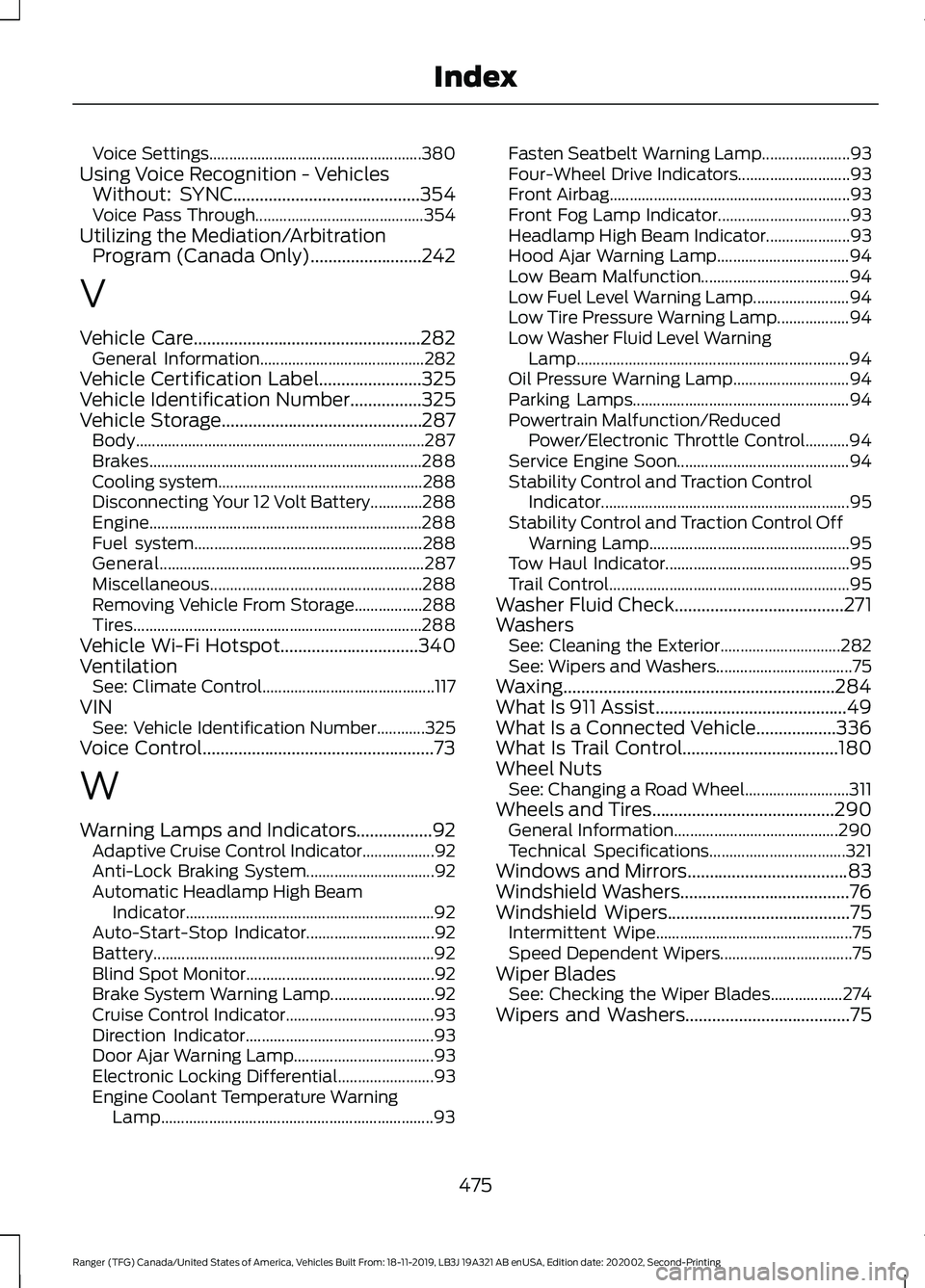
Voice Settings.....................................................
380
Using Voice Recognition - Vehicles Without: SYNC..........................................354
Voice Pass Through.......................................... 354
Utilizing the Mediation/Arbitration Program (Canada Only).........................242
V
Vehicle Care...................................................282 General Information......................................... 282
Vehicle Certification Label.......................325
Vehicle Identification Number................325
Vehicle Storage.............................................287 Body........................................................................\
287
Brakes.................................................................... 288
Cooling system................................................... 288
Disconnecting Your 12 Volt Battery.............288
Engine.................................................................... 288
Fuel system......................................................... 288
General.................................................................. 287
Miscellaneous..................................................... 288
Removing Vehicle From Storage.................288
Tires........................................................................\
288
Vehicle Wi-Fi Hotspot...............................340
Ventilation See: Climate Control........................................... 117
VIN See: Vehicle Identification Number............325
Voice Control....................................................73
W
Warning Lamps and Indicators
.................92
Adaptive Cruise Control Indicator.................. 92
Anti-Lock Braking System................................ 92
Automatic Headlamp High Beam Indicator.............................................................. 92
Auto-Start-Stop Indicator................................ 92
Battery...................................................................... 92
Blind Spot Monitor............................................... 92
Brake System Warning Lamp.......................... 92
Cruise Control Indicator..................................... 93
Direction Indicator............................................... 93
Door Ajar Warning Lamp................................... 93
Electronic Locking Differential........................ 93
Engine Coolant Temperature Warning Lamp
.................................................................... 93Fasten Seatbelt Warning Lamp......................
93
Four-Wheel Drive Indicators............................ 93
Front Airbag............................................................ 93
Front Fog Lamp Indicator................................. 93
Headlamp High Beam Indicator..................... 93
Hood Ajar Warning Lamp................................. 94
Low Beam Malfunction..................................... 94
Low Fuel Level Warning Lamp........................ 94
Low Tire Pressure Warning Lamp.................. 94
Low Washer Fluid Level Warning Lamp.................................................................... 94
Oil Pressure Warning Lamp............................. 94
Parking Lamps...................................................... 94
Powertrain Malfunction/Reduced Power/Electronic Throttle Control...........94
Service Engine Soon........................................... 94
Stability Control and Traction Control Indicator.............................................................. 95
Stability Control and Traction Control Off Warning Lamp.................................................. 95
Tow Haul Indicator.............................................. 95
Trail Control............................................................ 95
Washer Fluid Check......................................271
Washers See: Cleaning the Exterior.............................. 282
See: Wipers and Washers.................................. 75
Waxing.............................................................284
What Is 911 Assist...........................................49
What Is a Connected Vehicle..................336
What Is Trail Control
...................................180
Wheel Nuts See: Changing a Road Wheel.......................... 311
Wheels and Tires.........................................290 General Information......................................... 290
Technical Specifications.................................. 321
Windows and Mirrors
....................................83
Windshield Washers......................................76
Windshield Wipers.........................................75
Intermittent Wipe................................................. 75
Speed Dependent Wipers................................. 75
Wiper Blades See: Checking the Wiper Blades.................. 274
Wipers and Washers.....................................75
475
Ranger (TFG) Canada/United States of America, Vehicles Built From: 18-11-2019, LB3J 19A321 AB enUSA, Edition date: 202002, Second-Printing Index