height FORD RANGER 2021 User Guide
[x] Cancel search | Manufacturer: FORD, Model Year: 2021, Model line: RANGER, Model: FORD RANGER 2021Pages: 475, PDF Size: 7.9 MB
Page 129 of 475
WARNING: Make sure the seat fully
locks into place by rocking it backward
and forward.
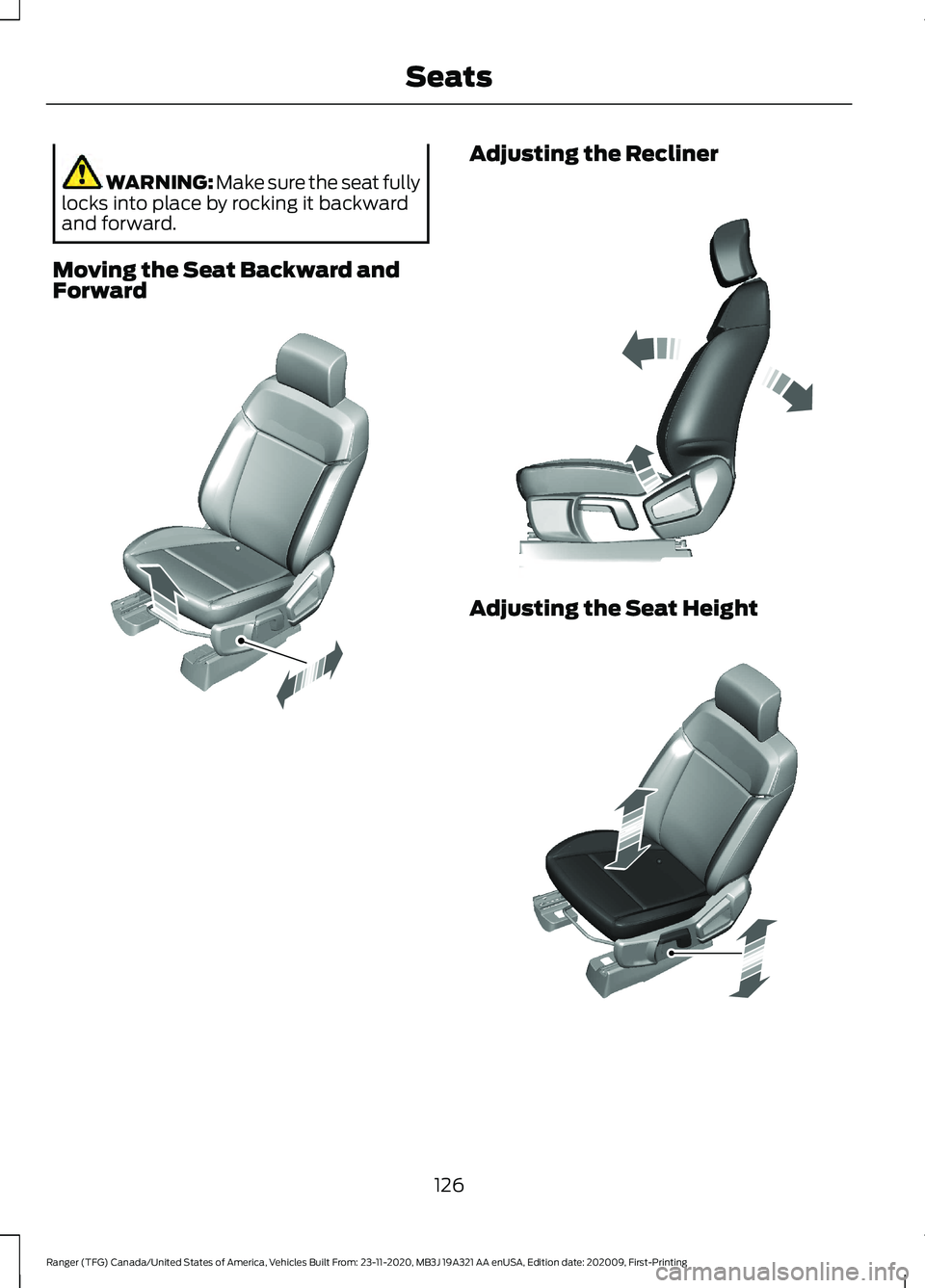
Moving the Seat Backward and
Forward Adjusting the Recliner
Adjusting the Seat Height
126
Ranger (TFG) Canada/United States of America, Vehicles Built From: 23-11-2020, MB3J 19A321 AA enUSA, Edition date: 202009, First-Printing SeatsE331208 E331209 E331210
Page 130 of 475
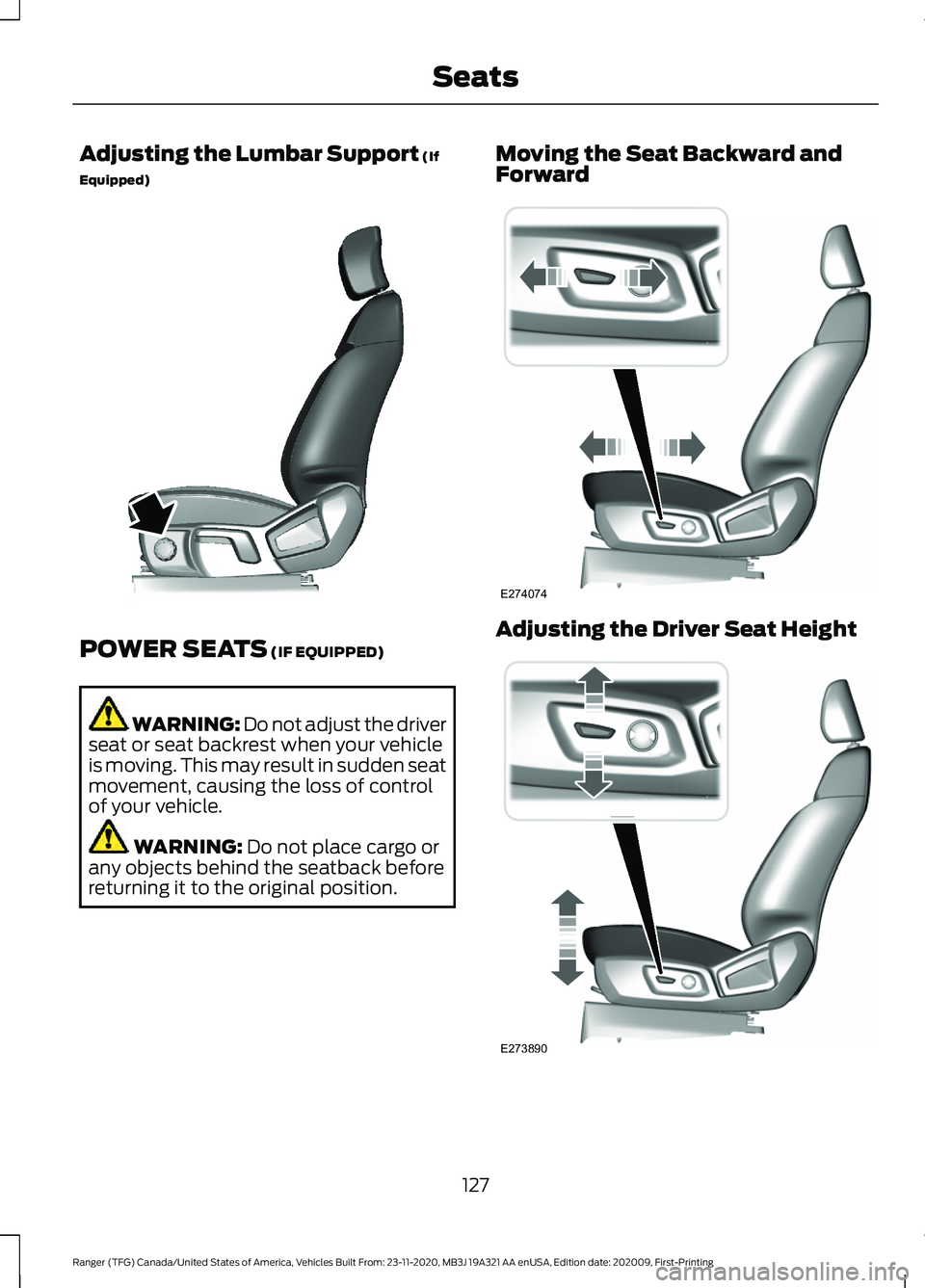
Adjusting the Lumbar Support (If
Equipped) POWER SEATS
(IF EQUIPPED)
WARNING: Do not adjust the driver
seat or seat backrest when your vehicle
is moving. This may result in sudden seat
movement, causing the loss of control
of your vehicle. WARNING:
Do not place cargo or
any objects behind the seatback before
returning it to the original position. Moving the Seat Backward and
Forward
Adjusting the Driver Seat Height
127
Ranger (TFG) Canada/United States of America, Vehicles Built From: 23-11-2020, MB3J 19A321 AA enUSA, Edition date: 202009, First-Printing SeatsE331529 E274074 E273890
Page 201 of 475
DRIVER ALERT (IF EQUIPPED)
PRINCIPLE OF OPERATION WARNING: You are responsible for
controlling your vehicle at all times. The
system is designed to be an aid and does
not relieve you of your responsibility to
drive with due care and attention. Failure
to follow this instruction could result in
the loss of control of your vehicle,
personal injury or death. WARNING:
The system may not
function if the sensor is blocked. WARNING:
Take regular rest
breaks if you feel tired. Do not wait for
the system to warn you. WARNING:
Certain driving styles
may result in the system warning you
even if you are not feeling tired. WARNING:
In cold and severe
weather conditions the system may not
function. Rain, snow and spray can all
limit sensor performance. WARNING:
The system will not
operate if the sensor cannot track the
road lane markings. WARNING:
If damage occurs in the
immediate area surrounding the sensor,
have your vehicle checked as soon as
possible. WARNING:
The system may not
correctly operate if your vehicle is fitted
with a suspension kit not approved by
us.
Note: The system may not operate correctly
if you modify the ride height. Note:
Keep the windshield free from
obstructions. For example, bird droppings,
insects, snow or ice.
Note: If the camera is blocked or if the
windshield is damaged, the system may not
function.
Note: If enabled in the menu, the system
activates at speeds above
40 mph
(64 km/h). When below the activation
speed, the information display informs the
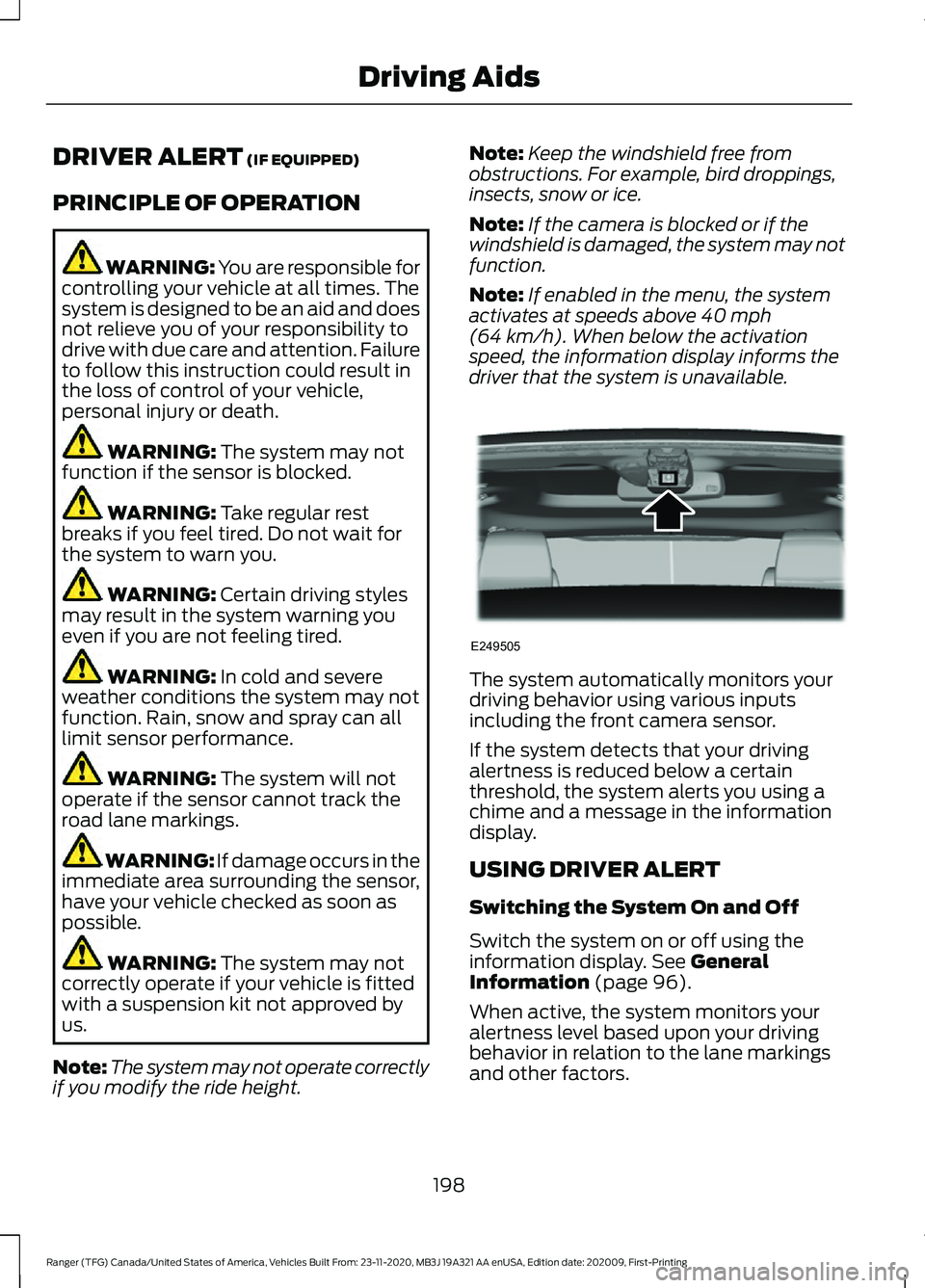
driver that the system is unavailable. The system automatically monitors your
driving behavior using various inputs
including the front camera sensor.
If the system detects that your driving
alertness is reduced below a certain
threshold, the system alerts you using a
chime and a message in the information
display.
USING DRIVER ALERT
Switching the System On and Off
Switch the system on or off using the
information display.
See General
Information (page 96).
When active, the system monitors your
alertness level based upon your driving
behavior in relation to the lane markings
and other factors.
198
Ranger (TFG) Canada/United States of America, Vehicles Built From: 23-11-2020, MB3J 19A321 AA enUSA, Edition date: 202009, First-Printing Driving AidsE249505
Page 280 of 475
1. Pull the wiper blade and arm away
from the glass. 2. Squeeze the blade's lock pin and tab
on the bottom of the arm to release
the wiper blade.
3. Slide the blade out to remove it from the arm hook.
4. Install in the reverse order.
Note: Make sure that the wiper blade locks
into place.
ADJUSTING THE HEADLAMPS
Vertical Aim Adjustment
If your vehicle has been involved in a crash,
have the aim of the headlamp beam
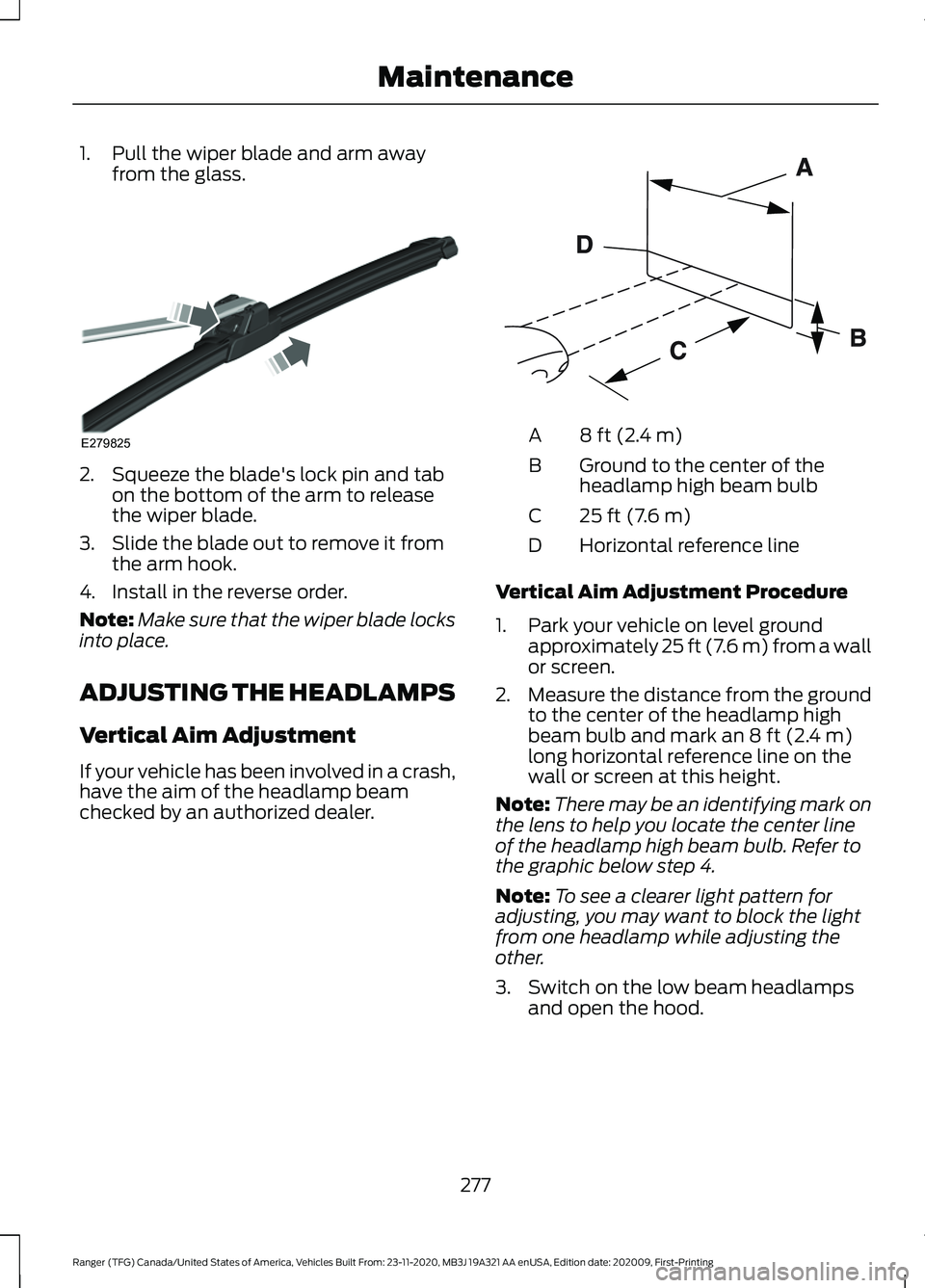
checked by an authorized dealer. 8 ft (2.4 m)
A
Ground to the center of the
headlamp high beam bulb
B
25 ft (7.6 m)
C
Horizontal reference line
D
Vertical Aim Adjustment Procedure
1. Park your vehicle on level ground approximately 25 ft (7.6 m) from a wall
or screen.
2. Measure the distance from the ground
to the center of the headlamp high
beam bulb and mark an
8 ft (2.4 m)
long horizontal reference line on the
wall or screen at this height.
Note: There may be an identifying mark on
the lens to help you locate the center line
of the headlamp high beam bulb. Refer to
the graphic below step 4.
Note: To see a clearer light pattern for
adjusting, you may want to block the light
from one headlamp while adjusting the
other.
3. Switch on the low beam headlamps and open the hood.
277
Ranger (TFG) Canada/United States of America, Vehicles Built From: 23-11-2020, MB3J 19A321 AA enUSA, Edition date: 202009, First-Printing MaintenanceE279825 E142592
Page 299 of 475
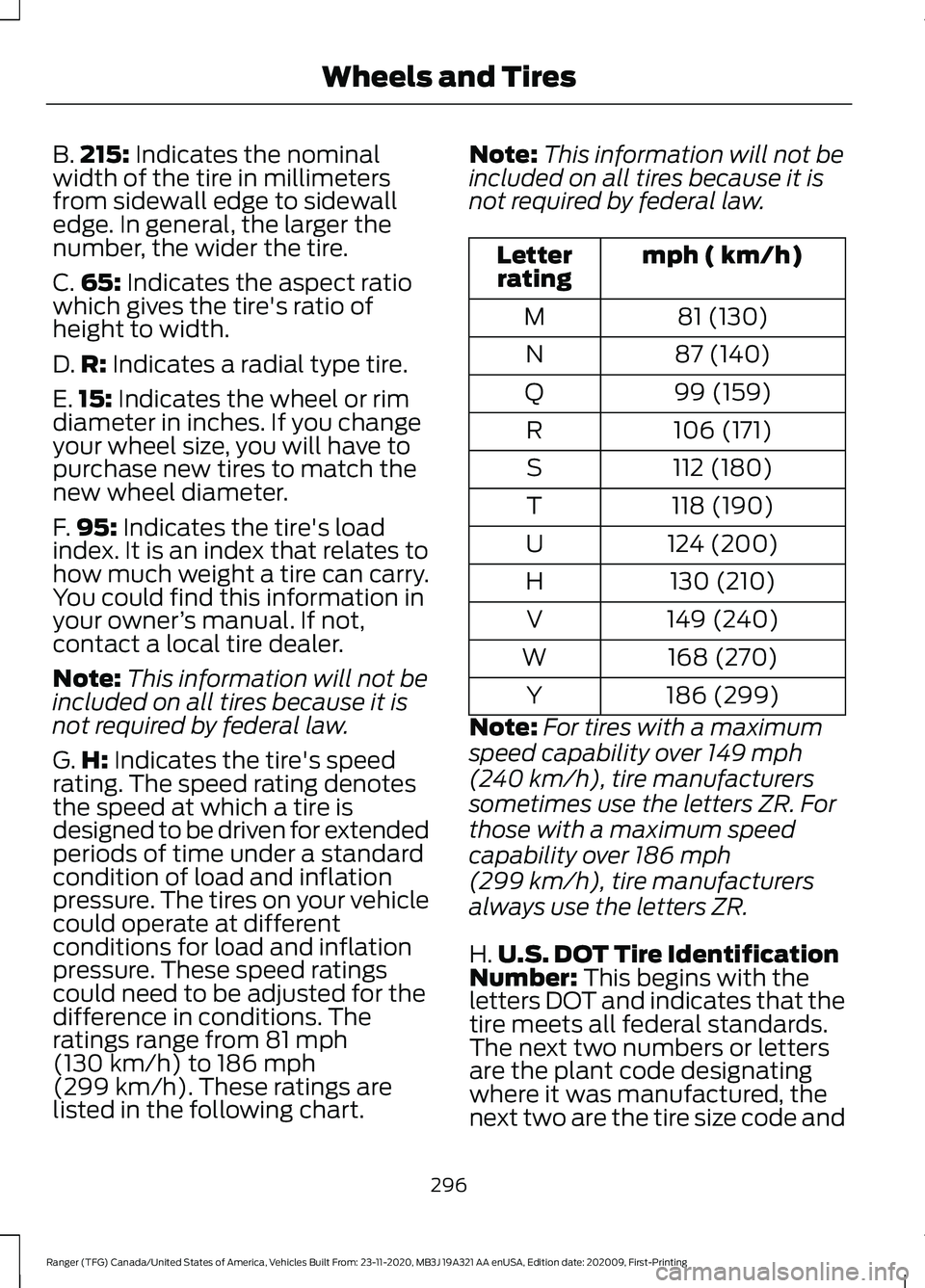
B.
215: Indicates the nominal
width of the tire in millimeters
from sidewall edge to sidewall
edge. In general, the larger the
number, the wider the tire.
C. 65:
Indicates the aspect ratio
which gives the tire's ratio of
height to width.
D. R:
Indicates a radial type tire.
E. 15:
Indicates the wheel or rim
diameter in inches. If you change
your wheel size, you will have to
purchase new tires to match the
new wheel diameter.
F. 95:
Indicates the tire's load
index. It is an index that relates to
how much weight a tire can carry.
You could find this information in
your owner ’s manual. If not,
contact a local tire dealer.
Note: This information will not be
included on all tires because it is
not required by federal law.
G. H:
Indicates the tire's speed
rating. The speed rating denotes
the speed at which a tire is
designed to be driven for extended
periods of time under a standard
condition of load and inflation
pressure. The tires on your vehicle
could operate at different
conditions for load and inflation
pressure. These speed ratings
could need to be adjusted for the
difference in conditions. The
ratings range from
81 mph
(130 km/h) to 186 mph
(299 km/h)
. These ratings are
listed in the following chart. Note:
This information will not be
included on all tires because it is
not required by federal law. mph ( km/h)
Letter
rating
81 (130)
M
87 (140)
N
99 (159)
Q
106 (171)
R
112 (180)
S
118 (190)
T
124 (200)
U
130 (210)
H
149 (240)
V
168 (270)
W
186 (299)
Y
Note: For tires with a maximum
speed capability over
149 mph
(240 km/h)
, tire manufacturers
sometimes use the letters ZR. For
those with a maximum speed
capability over
186 mph
(299 km/h)
, tire manufacturers
always use the letters ZR.
H. U.S. DOT Tire Identification
Number:
This begins with the
letters DOT and indicates that the
tire meets all federal standards.
The next two numbers or letters
are the plant code designating
where it was manufactured, the
next two are the tire size code and
296
Ranger (TFG) Canada/United States of America, Vehicles Built From: 23-11-2020, MB3J 19A321 AA enUSA, Edition date: 202009, First-Printing Wheels and Tires
Page 302 of 475
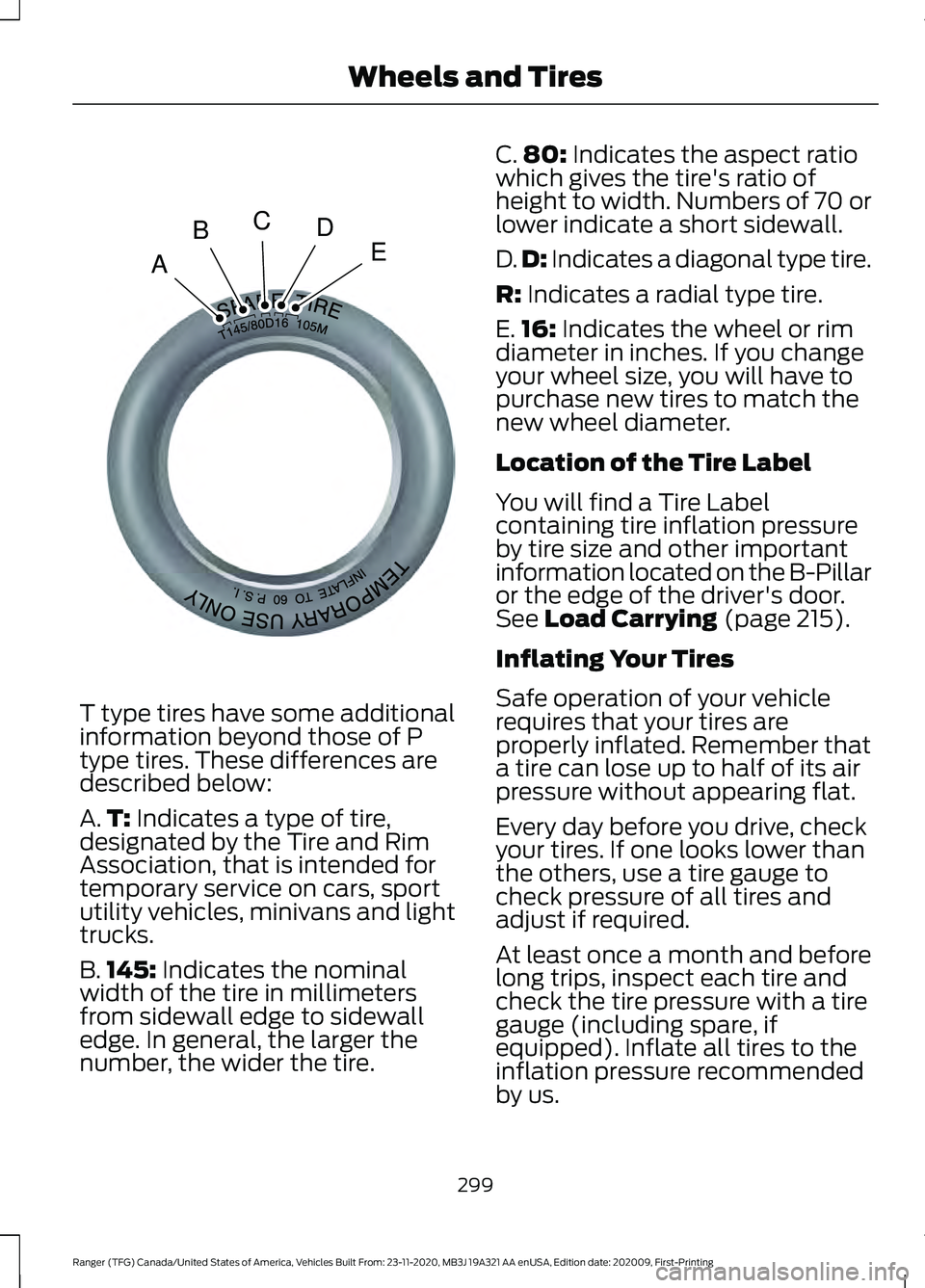
T type tires have some additional
information beyond those of P
type tires. These differences are
described below:
A.
T: Indicates a type of tire,
designated by the Tire and Rim
Association, that is intended for
temporary service on cars, sport
utility vehicles, minivans and light
trucks.
B. 145:
Indicates the nominal
width of the tire in millimeters
from sidewall edge to sidewall
edge. In general, the larger the
number, the wider the tire. C.
80:
Indicates the aspect ratio
which gives the tire's ratio of
height to width. Numbers of 70 or
lower indicate a short sidewall.
D. D:
Indicates a diagonal type tire.
R:
Indicates a radial type tire.
E. 16:
Indicates the wheel or rim
diameter in inches. If you change
your wheel size, you will have to
purchase new tires to match the
new wheel diameter.
Location of the Tire Label
You will find a Tire Label
containing tire inflation pressure
by tire size and other important
information located on the B-Pillar
or the edge of the driver's door.
See
Load Carrying (page 215).
Inflating Your Tires
Safe operation of your vehicle
requires that your tires are
properly inflated. Remember that
a tire can lose up to half of its air
pressure without appearing flat.
Every day before you drive, check
your tires. If one looks lower than
the others, use a tire gauge to
check pressure of all tires and
adjust if required.
At least once a month and before
long trips, inspect each tire and
check the tire pressure with a tire
gauge (including spare, if
equipped). Inflate all tires to the
inflation pressure recommended
by us.
299
Ranger (TFG) Canada/United States of America, Vehicles Built From: 23-11-2020, MB3J 19A321 AA enUSA, Edition date: 202009, First-Printing Wheels and TiresA
BCDEE142545
Page 306 of 475
When the tire tread wears down
to the same height as these wear
bars, the tire is worn out and must
be replaced.
Damage
Periodically inspect the tire treads
and sidewalls for damage (such
as bulges in the tread or sidewalls,
cracks in the tread groove and
separation in the tread or
sidewall). If damage is observed
or suspected have the tire
inspected by a tire professional.
Tires can be damaged during
off-road use, so inspection after
off-road use is also
recommended.
Age
WARNING: Tires degrade
over time depending on many
factors such as weather, storage
conditions, and conditions of use
(load, speed, inflation pressure)
the tires experience throughout
their lives. WARNING: In general, tires
should be replaced after six
years regardless of tread wear.
However, heat caused by hot
climates or frequent high loading
conditions can accelerate the
aging process and may require
tires to be replaced more
frequently. WARNING:
You should
replace your spare tire when you
replace the road tires or after six
years due to aging even if it has
not been used.
U.S. DOT Tire Identification
Number
Both United States and Canada
Federal regulations require tire
manufacturers to place
standardized information on the
sidewall of all tires. This
information identifies and
describes the fundamental
characteristics of the tire and also
provides a U.S. DOT Tire
Identification Number for safety
standard certification and in case
of a recall.
This begins with the letters DOT
and indicates that the tire meets
all federal standards. The next
two numbers or letters are the
plant code designating where it
was manufactured, the next two
are the tire size code and the last
four numbers represent the week
and year the tire was built. For
example, the numbers 317 mean
the 31st week of 1997. After 2000
the numbers go to four digits. For
example, 2501 means the 25th
week of 2001. The numbers in
between are identification codes
used for traceability. This
information is used to contact
customers if a tire defect requires
a recall.
303
Ranger (TFG) Canada/United States of America, Vehicles Built From: 23-11-2020, MB3J 19A321 AA enUSA, Edition date: 202009, First-Printing Wheels and Tires
Page 324 of 475
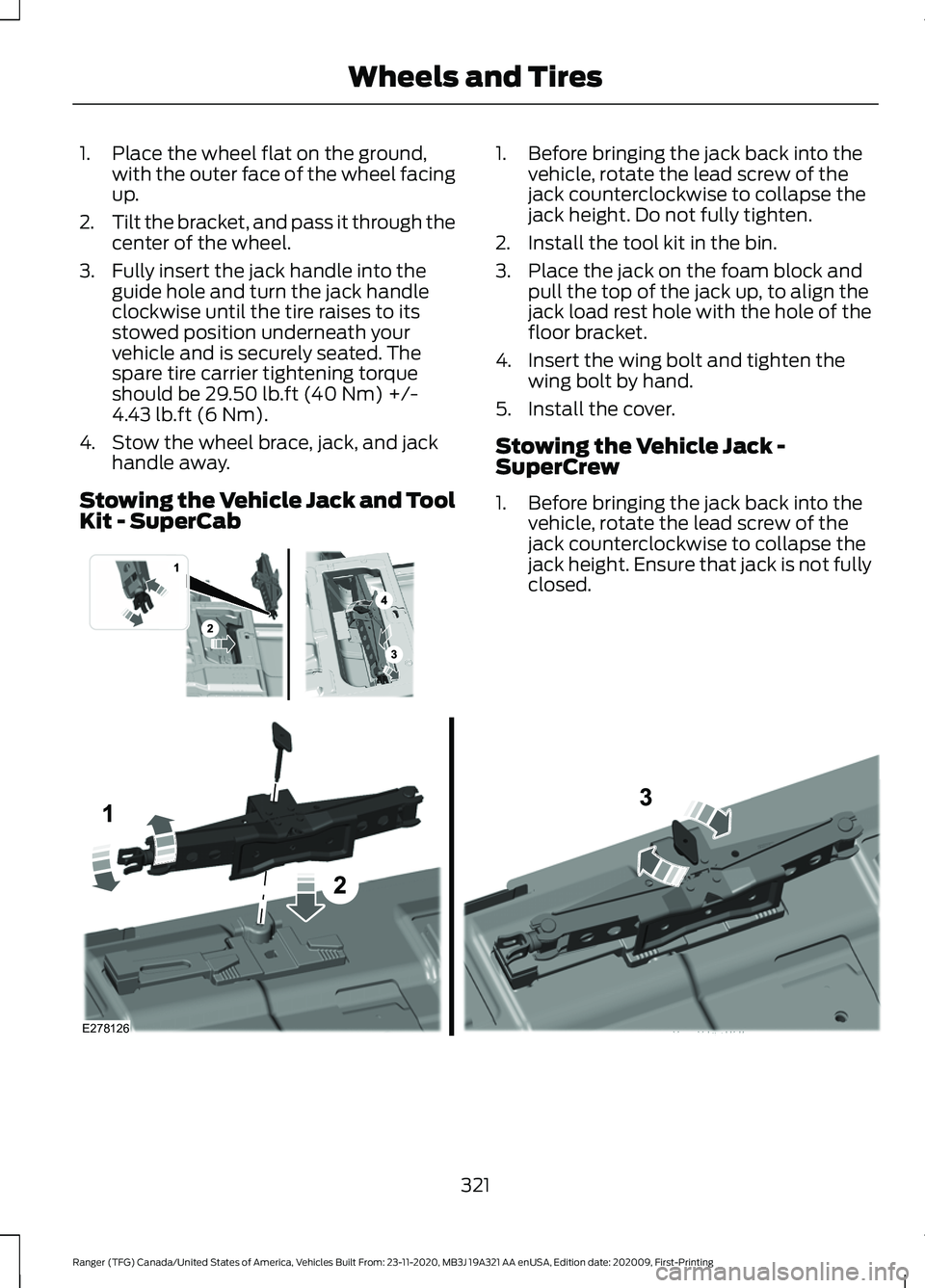
1. Place the wheel flat on the ground,
with the outer face of the wheel facing
up.
2. Tilt the bracket, and pass it through the
center of the wheel.
3. Fully insert the jack handle into the guide hole and turn the jack handle
clockwise until the tire raises to its
stowed position underneath your
vehicle and is securely seated. The
spare tire carrier tightening torque
should be 29.50 lb.ft (40 Nm) +/-
4.43 lb.ft (6 Nm).
4. Stow the wheel brace, jack, and jack handle away.
Stowing the Vehicle Jack and Tool
Kit - SuperCab 1. Before bringing the jack back into the
vehicle, rotate the lead screw of the
jack counterclockwise to collapse the
jack height. Do not fully tighten.
2. Install the tool kit in the bin.
3. Place the jack on the foam block and pull the top of the jack up, to align the
jack load rest hole with the hole of the
floor bracket.
4. Insert the wing bolt and tighten the wing bolt by hand.
5. Install the cover.
Stowing the Vehicle Jack -
SuperCrew
1. Before bringing the jack back into the vehicle, rotate the lead screw of the
jack counterclockwise to collapse the
jack height. Ensure that jack is not fully
closed. 321
Ranger (TFG) Canada/United States of America, Vehicles Built From: 23-11-2020, MB3J 19A321 AA enUSA, Edition date: 202009, First-Printing Wheels and Tires E296013 E278126
Page 469 of 475
J
Jump Starting the Vehicle........................236
Connecting the Jumper Cables.................... 236
Jump Starting...................................................... 237
Preparing Your Vehicle..................................... 236
Removing the Jumper Cables........................ 237
K
Keyless Entry...................................................66 SECURICODE™ KEYLESS ENTRY
KEYPAD.............................................................. 66
Keyless Starting.............................................142 Ignition Modes..................................................... 142
Keys and Remote Controls..........................51
L
Lane Keeping System.................................199 Switching the System On and Off..............200
Lighting Control...............................................77
Flashing the Headlamp High Beam..............78
Headlamp High Beam......................................... 77
Lighting...............................................................77 General Information............................................. 77
Load Carriers See: Roof Racks and Load Carriers..............219
Load Carrying.................................................215
Load Limit........................................................215 Special Loading Instructions for Owners of
Pick-up Trucks and Utility-type
Vehicles............................................................. 219
Vehicle Loading - with and without a Trailer.................................................................. 215
Load Retaining Fixtures
..............................219
Tie Down Points.................................................. 219
Locking and Unlocking.................................63 Activating Intelligent Access........................... 64
Autolock.................................................................. 65
Locking and Unlocking the Doors with the Key Blade............................................................ 63
Mislock..................................................................... 65
Opening a Rear Door from the Inside...........64
Power Door Locks................................................ 63
Remote Control.................................................... 63
Smart Unlocks for Integrated Keyhead Transmitter........................................................ 65Lug Nuts
See: Changing a Road Wheel......................... 312
M
Maintenance..................................................262 General Information......................................... 262
Manual Climate Control
..............................117
Directing the Airflow........................................... 117
Setting the Blower Motor Speed.................... 117
Setting the Temperature................................... 117
Switching Maximum Air Conditioning On and Off................................................................ 118
Switching Maximum Defrost On and Off........................................................................\
118
Switching Recirculated Air On and Off........................................................................\
118
Switching the Air Conditioning On and Off........................................................................\
. 117
Switching the Climate Control On and Off........................................................................\
. 117
Manual Seats.................................................125 Adjusting the Lumbar Support...................... 127
Adjusting the Recliner....................................... 126
Adjusting the Seat Height............................... 126
Moving the Seat Backward and Forward............................................................. 126
Media Hub......................................................354
Message Center See: Information Displays................................. 96
Mirrors See: Windows and Mirrors................................ 83
Mobile Communications Equipment.......15
Motorcraft Parts...........................................325
MyKey – Troubleshooting............................61
MyKey ™
.............................................................58
Principle of Operation........................................ 58
N
Navigation......................................................387 Changing the Format of the Map................388
cityseeker............................................................. 390
Michelin Travel Guide........................................ 391
Navigation Map Accuracy and Updates............................................................ 392
Route Guidance................................................. 389
Setting a Destination........................................ 387
466
Ranger (TFG) Canada/United States of America, Vehicles Built From: 23-11-2020, MB3J 19A321 AA enUSA, Edition date: 202009, First-Printing Index
Page 470 of 475
SiriusXM Traffic and Travel Link....................
391
Zoom...................................................................... 388
Normal Scheduled Maintenance...........419 Intelligent Oil-Life Monitor™......................... 419
Normal Maintenance Intervals...................... 421
O
Off-Road Driving...........................................231 After Off-Road Driving..................................... 232
Basic Off-road Driving Techniques..............231
Crossing Obstacles............................................ 231
Hill Climbing.......................................................... 231
Oil Change Indicator Reset.......................267
Oil Check See: Engine Oil Check...................................... 265
Opening and Closing the Hood..............263 Closing the Hood............................................... 263
Opening the Hood............................................. 263
Ordering Additional Owner's Literature......................................................245
Obtaining a French Owner ’s Manual.........245
Overhead Console
........................................139
P
Parking Aids
....................................................184
Principle of Operation.......................................184
Parking Brake
..................................................174
Passive Anti-Theft System.........................70 Programming a Spare Intelligent Access
Key........................................................................\
70
SecuriLock®........................................................... 70
Passive Key Backup Position
......................57
PATS See: Passive Anti-Theft System..................... 70
Perchlorate........................................................13
Personal Safety System ™
.........................40
How Does the Personal Safety System
Work?.................................................................. 40
Phone...............................................................385 Android Auto....................................................... 386
Apple CarPlay..................................................... 386
Pairing Your Cell Phone for the First Time................................................................... 385
Text Messaging.................................................. 386
Using Your Cell Phone..................................... 385Power Door Locks
See: Locking and Unlocking............................. 63
Power Seats
....................................................127
Adjusting the Driver Seat Height .................. 127
Adjusting the Lumbar....................................... 128
Adjusting the Recliner....................................... 128
Moving the Seat Backward and Forward.............................................................. 127
Power Steering Fluid Check.....................273
Power Windows
..............................................83
Bounce-Back......................................................... 85
Driver Door Switches (Double Cab).............84
Driver Door Switches (Single Cab)................83
Front and Rear Passenger Door Switches............................................................. 84
Opening and Closing Other Windows Automatically................................................... 84
Opening and Closing the Driver Side Window Automatically................................. 84
Resetting the Memory of the Electric Windows - Vehicle with One Touch
Up/Down on Driver Side only..................... 85
Safety Mode........................................................... 85
Safety Switch for the Rear Windows...........84
Pre-Collision Assist
.......................................211
Using the Pre-Collision Assist
System............................................................... 212
Protecting the Environment........................16
Puncture See: Changing a Road Wheel......................... 312
R
Radio................................................................348 Antenna................................................................ 348
Rear Axle
...........................................................171
Rear Occupant Alert System Audible Warnings.......................................................132
Rear Occupant Alert System Indicators......................................................132
Rear Occupant Alert System Limitations
.....................................................131
Rear Occupant Alert System Precautions...................................................131
Rear Occupant Alert System.....................131
Rear Parking Aid............................................185 Obstacle Distance Indicator........................... 185
Rear Seat Armrest.......................................140
467
Ranger (TFG) Canada/United States of America, Vehicles Built From: 23-11-2020, MB3J 19A321 AA enUSA, Edition date: 202009, First-Printing Index