charging FORD RANGER 2021 Owners Manual
[x] Cancel search | Manufacturer: FORD, Model Year: 2021, Model line: RANGER, Model: FORD RANGER 2021Pages: 475, PDF Size: 7.9 MB
Page 7 of 475
Using Adaptive Cruise Control
................191
Driving Aids
Driver Alert .....................................................
198
Lane Keeping System ................................
199
Blind Spot Information System ............
204
Cross Traffic Alert .......................................
207
Steering ...........................................................
210
Pre-Collision Assist ......................................
211
Load Carrying
Load Limit .......................................................
215
Roof Racks and Load Carriers ................
219
Load Retaining Fixtures .............................
219
Towing
Towing a Trailer .............................................
221
Trailer Sway Control ...................................
222
Recommended Towing Weights ...........
222
Essential Towing Checks .........................
224
Towing the Vehicle on Four Wheels ......
227
Driving Hints
Breaking-In ....................................................
230
Economical Driving ....................................
230
Cold Weather Precautions .......................
231
Off-Road Driving ..........................................
231
Driving Through Water ..............................
232
Floor Mats ......................................................
233
Roadside Emergencies
Roadside Assistance .................................
234
Hazard Flashers ...........................................
235
Fuel Shutoff ..................................................
235
Jump Starting the Vehicle .......................
236
Transporting the Vehicle ..........................
238
Towing Points ...............................................
238Customer Assistance
Getting the Services You Need
.............
240
In California (U.S. Only) .............................
241
The Better Business Bureau (BBB) Auto Line Program (U.S. Only) .....................
242
Utilizing the Mediation/Arbitration Program (Canada Only) ......................
243
Getting Assistance Outside the U.S. and Canada .......................................................
243
Ordering Additional Owner's Literature ........................................................................\
245
Reporting Safety Defects (U.S. Only) ........................................................................\
245
Reporting Safety Defects (Canada Only) ........................................................................\
245
Fuses
Fuse Box Locations ....................................
247
Fuse Specification Chart .........................
248
Changing a Fuse .........................................
260
Maintenance
General Information ..................................
262
Opening and Closing the Hood .............
263
Under Hood Overview ..............................
264
Engine Oil Dipstick .....................................
265
Engine Oil Check .........................................
265
Changing the Engine Air Filter ...............
266
Oil Change Indicator Reset ......................
267
Engine Coolant Check ..............................
268
Automatic Transmission Fluid Check ........................................................................\
.
272
Brake Fluid Check ........................................
272
Power Steering Fluid Check ....................
273
Fuel Filter ........................................................
273
Charging the 12V Battery ..........................
273
Changing the 12V Battery ........................
274
Washer Fluid Check ...................................
276
Checking the Wiper Blades .....................
276
Changing the Wiper Blades ....................
276
Adjusting the Headlamps .........................
277
4
Ranger (TFG) Canada/United States of America, Vehicles Built From: 23-11-2020, MB3J 19A321 AA enUSA, Edition date: 202009, First-Printing Table of Contents
Page 110 of 475
Battery and Charging System
Action
Message
The charging system needs servicing. If the warning stays onor continues to come on, have your vehicle checked as soon as possible.
Check Charging System
The battery management system detects an extended low-voltage condition. Your vehicle will disable various features
to help preserve the battery. Turn off as many of the electrical loads as soon as possible to improve system voltage. If the system voltage has recovered, the disabled features will operate again as normal.
Low Battery Features
Temporarily Turned Off
The battery management system determines that the batteryis at a low state of charge. Turn your ignition off as soon as
possible to protect the battery. This message will clear once you restart your vehicle and the battery state of charge has
recovered. Turning off unnecessary electrical loads will allow faster battery state-of-charge recovery.
Turn Power Off To Save
Battery
The charging system needs servicing. If the warning stays onor continues to come on, have your vehicle checked as soon as possible.
Charging System Service
Soon
The charging system needs servicing. Have your vehiclechecked as soon as possible.
Charging System Service
Now
The battery management system determines that the batteryis at a low state of charge. Turn your ignition off as soon as
possible to protect the battery. This message clears once you restart your vehicle and the battery state of charge has recovered.
Battery State of Charge
Low
Blind Spot Information and Cross Traffic Alert System Action
Message
A fault with the system has occurred. Have your vehiclechecked as soon as possible.
Blindspot System Fault
The system sensors are blocked. See Blind Spot Informa-
tion System (page 204).
Blindspot Not Available
Sensor Blocked See Manual
The system detects a vehicle.
Cross Traffic Alert
107
Ranger (TFG) Canada/United States of America, Vehicles Built From: 23-11-2020, MB3J 19A321 AA enUSA, Edition date: 202009, First-Printing Information Displays
Page 119 of 475
Action
Message
There is a fault with your trailer turn lamp. Check your lamp.
Trailer Right Turn Lamps Fault
Check Lamps
There is a fault with your trailer battery. See Towing
a Trailer (page 221).
Trailer Battery Not Charging See
Manual
There is a fault with your vehicle trailer lighting module.See
Towing a Trailer (page 221).
Trailer Lighting Module Fault
See Manual
4WD Action
Message
A 4X4 system fault is present. Have your vehiclechecked as soon as possible.
Check 4x4
The 4X4 system is making a shift.
4x4 Shift in Progress
Displays when you attempt to switch to 4X4 LOW andyou do not shift the transmission to neutral (N).
For 4x4 LOW Shift to N
Displays when you attempt to switch to 4X4 LOW andyour vehicle's speed is greater than
3 mph (5 km/h).
For 4x4 LOW Slow to 3 MPH
Displays when you attempt to switch from 4X4 LOWand you do not shift the transmission to neutral (N).
To Exit 4x4 LOW Shift to N
Displays when you attempt to switch from 4X4 LOWand your vehicle's speed is greater than
3 mph
(5 km/h).
To Exit 4x4 LOW Slow to 3 MPH
116
Ranger (TFG) Canada/United States of America, Vehicles Built From: 23-11-2020, MB3J 19A321 AA enUSA, Edition date: 202009, First-Printing Information Displays
Page 161 of 475
If you use anything other than our parts for
maintenance replacements or for service
of components affecting emission control,
such aftermarket parts should be
equivalent to our genuine parts in
performance and durability.
Illumination of the service engine soon
indicator, charging system warning light or
the temperature warning light, fluid leaks,
strange odors, smoke or loss of engine
power could indicate that the emission
control system is not working properly.
An improperly operating or damaged
exhaust system may allow exhaust to
enter the vehicle. Have a damaged or
improperly operating exhaust system
inspected and repaired immediately.
Do not make any unauthorized changes to
your vehicle or engine. By law, vehicle
owners and anyone who manufactures,
repairs, services, sells, leases, trades
vehicles, or supervises a fleet of vehicles
are not permitted to intentionally remove
an emission control device or prevent it
from working. Information about your
vehicle
’s emission system is on the Vehicle
Emission Control Information Decal
located on or near the engine. This decal
also lists engine displacement.
Please consult your warranty information
for complete details.
On-Board Diagnostics (OBD-II)
Your vehicle has a computer known as the
on-board diagnostics system (OBD-II) that
monitors the engine ’s emission control
system. The system protects the
environment by making sure that your
vehicle continues to meet government
emission standards. The OBD-II system
also assists a service technician in properly
servicing your vehicle. When the service engine soon
indicator illuminates, the OBD-II
system has detected a
malfunction. Temporary malfunctions may
cause the service engine soon indicator to
illuminate. Examples are:
1. Your vehicle has run out of fuel —the
engine may misfire or run poorly.
2. Poor fuel quality or water in the fuel —the engine may misfire or run
poorly.
3. The fuel fill inlet may not have closed properly. See Refueling (page 152).
4. Driving through deep water —the
electrical system may be wet.
You can correct these temporary
malfunctions by filling the fuel tank with
good quality fuel, properly closing the fuel
fill inlet or letting the electrical system dry
out. After three driving cycles without these
or any other temporary malfunctions
present, the service engine soon indicator
should stay off the next time you start the
engine. A driving cycle consists of a cold
engine startup followed by mixed city and
highway driving. You do not require
additional vehicle service.
If the service engine soon indicator remains
on, have your vehicle serviced at the first
available opportunity. Although some
malfunctions detected by the OBD-II may
not have symptoms that are apparent,
continued driving with the service engine
soon indicator on can result in increased
emissions, lower fuel economy, reduced
engine and transmission smoothness and
lead to more costly repairs.
158
Ranger (TFG) Canada/United States of America, Vehicles Built From: 23-11-2020, MB3J 19A321 AA enUSA, Edition date: 202009, First-Printing Engine Emission Control
Page 276 of 475
1. Park your vehicle on a level surface.
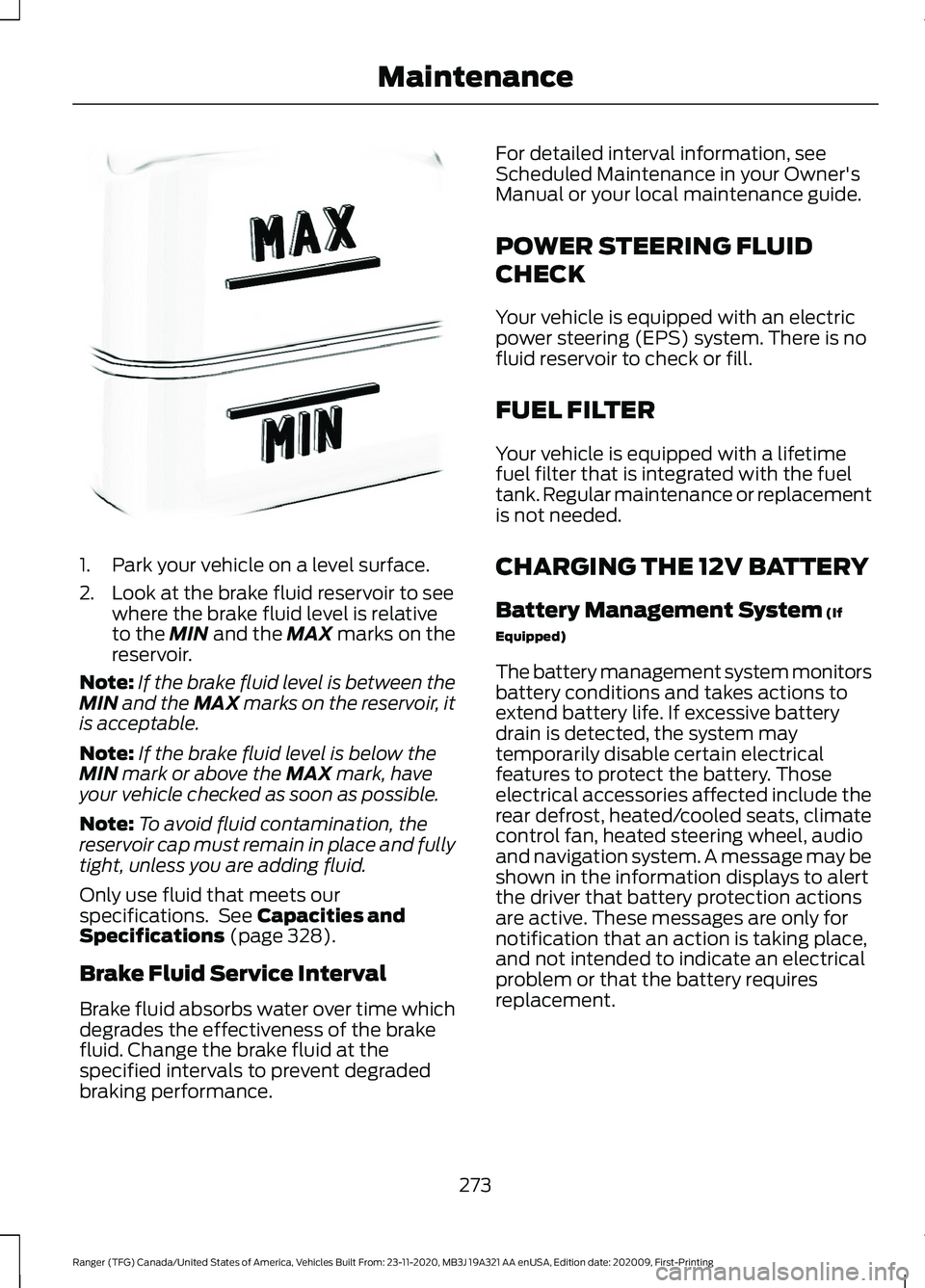
2. Look at the brake fluid reservoir to see
where the brake fluid level is relative
to the MIN and the MAX marks on the
reservoir.
Note: If the brake fluid level is between the
MIN
and the MAX marks on the reservoir, it
is acceptable.
Note: If the brake fluid level is below the
MIN
mark or above the MAX mark, have
your vehicle checked as soon as possible.
Note: To avoid fluid contamination, the
reservoir cap must remain in place and fully
tight, unless you are adding fluid.
Only use fluid that meets our
specifications. See
Capacities and
Specifications (page 328).
Brake Fluid Service Interval
Brake fluid absorbs water over time which
degrades the effectiveness of the brake
fluid. Change the brake fluid at the
specified intervals to prevent degraded
braking performance. For detailed interval information, see
Scheduled Maintenance in your Owner's
Manual or your local maintenance guide.
POWER STEERING FLUID
CHECK
Your vehicle is equipped with an electric
power steering (EPS) system. There is no
fluid reservoir to check or fill.
FUEL FILTER
Your vehicle is equipped with a lifetime
fuel filter that is integrated with the fuel
tank. Regular maintenance or replacement
is not needed.
CHARGING THE 12V BATTERY
Battery Management System
(If
Equipped)
The battery management system monitors
battery conditions and takes actions to
extend battery life. If excessive battery
drain is detected, the system may
temporarily disable certain electrical
features to protect the battery. Those
electrical accessories affected include the
rear defrost, heated/cooled seats, climate
control fan, heated steering wheel, audio
and navigation system. A message may be
shown in the information displays to alert
the driver that battery protection actions
are active. These messages are only for
notification that an action is taking place,
and not intended to indicate an electrical
problem or that the battery requires
replacement.
273
Ranger (TFG) Canada/United States of America, Vehicles Built From: 23-11-2020, MB3J 19A321 AA enUSA, Edition date: 202009, First-Printing MaintenanceE170684
Page 277 of 475
Electrical accessory installation
Note:
Charging and replacing the battery
requires the driver power window to be
re-initialized. See Windows and Mirrors
(page 83).
To ensure proper operation of the Battery
Management System, any electrical
devices that are added to your vehicle
should not have their ground connection
made directly at the negative battery post.
A connection at the negative battery
terminal can cause inaccurate
measurements of the battery condition
and potential incorrect system operation.
When a battery replacement is required,
you must use a recommended
replacement battery that matches the
electrical requirements of the vehicle.
After battery replacement, or in some
cases after charging the battery with the
external charger, the Battery Management
System requires eight hours of vehicle
sleep time (key off with doors closed) to
relearn the new battery state of charge.
Prior to relearning the state of charge, the
Battery Management System may disable
electrical features (to protect the battery)
earlier than normal.
CHANGING THE 12V BATTERY WARNING:
Batteries normally
produce explosive gases which can
cause personal injury. Therefore, do not
allow flames, sparks or lighted
substances to come near the battery.
When working near the battery, always
shield your face and protect your eyes.
Always provide correct ventilation. WARNING:
When lifting a
plastic-cased battery, excessive pressure
on the end walls could cause acid to flow
through the vent caps, resulting in
personal injury and damage to the
vehicle or battery. Lift the battery with a
battery carrier or with your hands on
opposite corners. WARNING:
Keep batteries out of
reach of children. Batteries contain
sulfuric acid. Avoid contact with skin,
eyes or clothing. Shield your eyes when
working near the battery to protect
against possible splashing of acid
solution. In case of acid contact with skin
or eyes, flush immediately with water for
a minimum of 15 minutes and get prompt
medical attention. If acid is swallowed,
call a physician immediately. WARNING:
Battery posts,
terminals and related accessories
contain lead and lead compounds. Wash
hands after handling. WARNING:
This vehicle may have
more than one battery. Removing the
battery cables from only one battery
does not disconnect your vehicle
electrical system. Make sure you
disconnect the battery cables from all
batteries when disconnecting power.
Failure to do so may cause serious
personal injury or property damage. WARNING:
For vehicles with
Auto-Start-Stop the battery requirement
is different. You must replace the battery
with one of exactly the same
specification.
The battery is located in the engine
compartment. See
Under Hood
Overview (page 264).
274
Ranger (TFG) Canada/United States of America, Vehicles Built From: 23-11-2020, MB3J 19A321 AA enUSA, Edition date: 202009, First-Printing Maintenance
Page 292 of 475
Body
•
Wash your vehicle thoroughly to
remove dirt, grease, oil, tar or mud from
exterior surfaces, rear-wheel housing
and the underside of front fenders.
• Periodically wash your vehicle if it is
stored in exposed locations.
• Touch-up exposed or primed metal to
prevent rust.
• Cover chrome and stainless steel parts
with a thick coat of auto wax to prevent
discoloration. Re-wax as necessary
when you wash your vehicle.
• Lubricate all hood, door and luggage
compartment hinges and latches with
a light grade oil.
• Cover interior trim to prevent fading.
• Keep all rubber parts free from oil and
solvents.
Engine
• Change the engine oil and filter prior to
storage because used engine oil
contains contaminates which may
cause engine damage.
• Start the engine every 15 days for a
minimum of 15 minutes. Run at fast
idle with the climate controls set to
defrost until the engine reaches normal
operating temperature.
• With your foot on the brake, shift
through all the gears while the engine
is running.
• We recommend that you change the
engine oil before you use your vehicle
again.
Fuel system
• Fill the fuel tank with high-quality fuel
until the first automatic shutoff of the
fuel pump nozzle. Cooling system
•
Protect against freezing temperatures.
• When removing your vehicle from
storage, check coolant fluid level.
Confirm that there are no cooling
system leaks and that fluid is at the
recommended level.
Disconnecting Your 12 Volt Battery
• Check and recharge as necessary. Keep
connections clean.
• If storing your vehicle for more than 30
days without recharging the battery,
we recommend that you disconnect
the battery cables to maintain battery
charge for quick starting.
Note: It is necessary to reset memory
features if you disconnect the battery
cables.
Brakes
• Make sure the brakes and parking brake
release fully.
Tires
• Maintain recommended air pressure.
Miscellaneous
• Make sure all linkages, cables, levers
and pins under your vehicle are covered
with grease to prevent rust.
• Move vehicles at least 25 ft (7.5 m)
every 15 days to lubricate working parts
and prevent corrosion.
289
Ranger (TFG) Canada/United States of America, Vehicles Built From: 23-11-2020, MB3J 19A321 AA enUSA, Edition date: 202009, First-Printing Vehicle Care
Page 356 of 475
hand-held device while driving and
encourage the use of voice-operated
systems when possible. Make sure you
are aware of all applicable local laws
that may affect the use of electronic
devices while driving.
WARNING: Always place your
device in a secure location in your vehicle
so it does not become a projectile in a
sudden stop or crash. Failure to follow
this instruction could result in personal
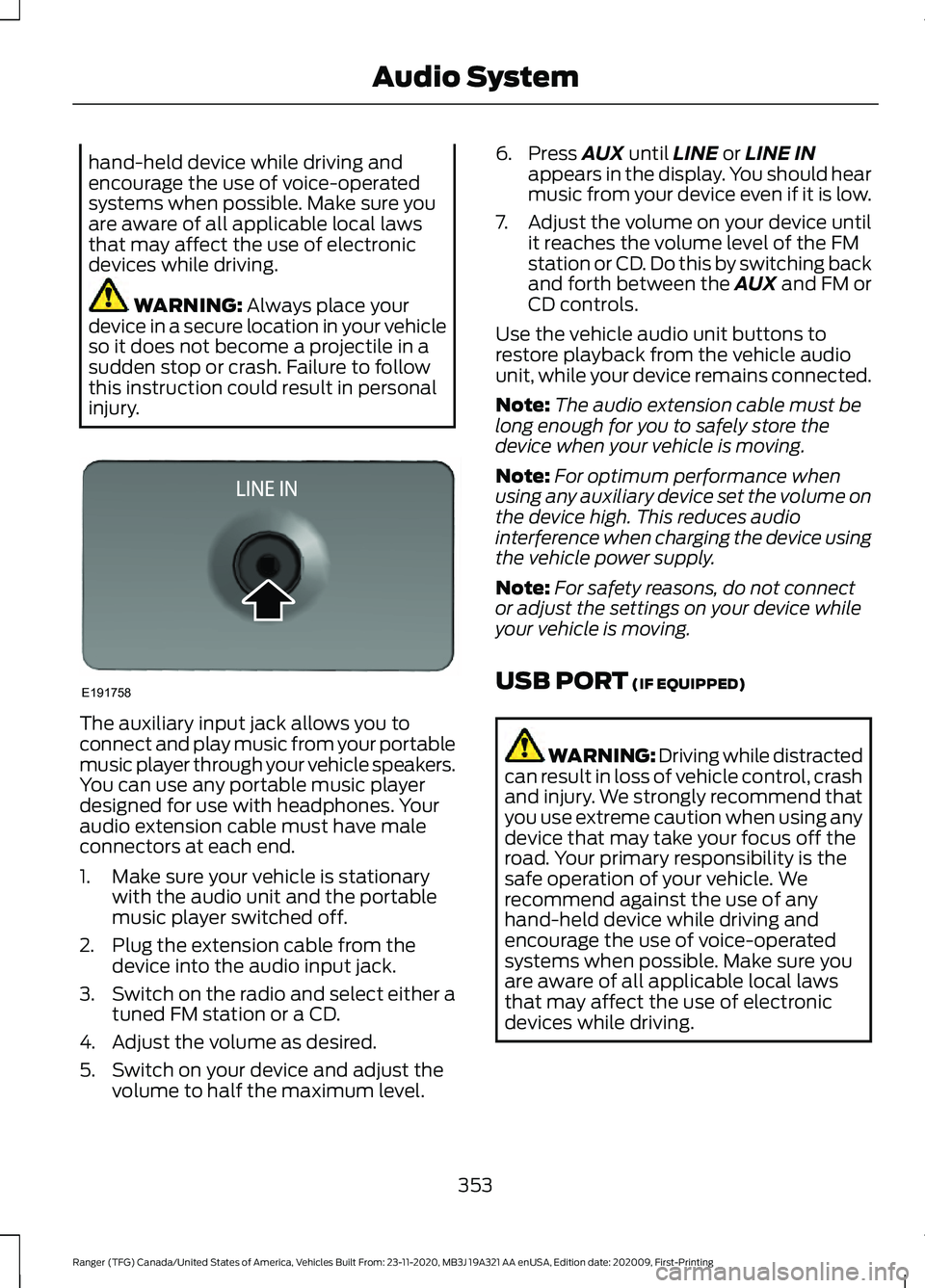
injury. The auxiliary input jack allows you to
connect and play music from your portable
music player through your vehicle speakers.
You can use any portable music player
designed for use with headphones. Your
audio extension cable must have male
connectors at each end.
1. Make sure your vehicle is stationary
with the audio unit and the portable
music player switched off.
2. Plug the extension cable from the device into the audio input jack.
3. Switch on the radio and select either a
tuned FM station or a CD.
4. Adjust the volume as desired.
5. Switch on your device and adjust the volume to half the maximum level. 6. Press
AUX until LINE or LINE IN
appears in the display. You should hear
music from your device even if it is low.
7. Adjust the volume on your device until
it reaches the volume level of the FM
station or CD. Do this by switching back
and forth between the AUX and FM or
CD controls.
Use the vehicle audio unit buttons to
restore playback from the vehicle audio
unit, while your device remains connected.
Note: The audio extension cable must be
long enough for you to safely store the
device when your vehicle is moving.
Note: For optimum performance when
using any auxiliary device set the volume on
the device high. This reduces audio
interference when charging the device using
the vehicle power supply.
Note: For safety reasons, do not connect
or adjust the settings on your device while
your vehicle is moving.
USB PORT
(IF EQUIPPED) WARNING: Driving while distracted
can result in loss of vehicle control, crash
and injury. We strongly recommend that
you use extreme caution when using any
device that may take your focus off the
road. Your primary responsibility is the
safe operation of your vehicle. We
recommend against the use of any
hand-held device while driving and
encourage the use of voice-operated
systems when possible. Make sure you
are aware of all applicable local laws
that may affect the use of electronic
devices while driving.
353
Ranger (TFG) Canada/United States of America, Vehicles Built From: 23-11-2020, MB3J 19A321 AA enUSA, Edition date: 202009, First-Printing Audio SystemE191758
Page 463 of 475
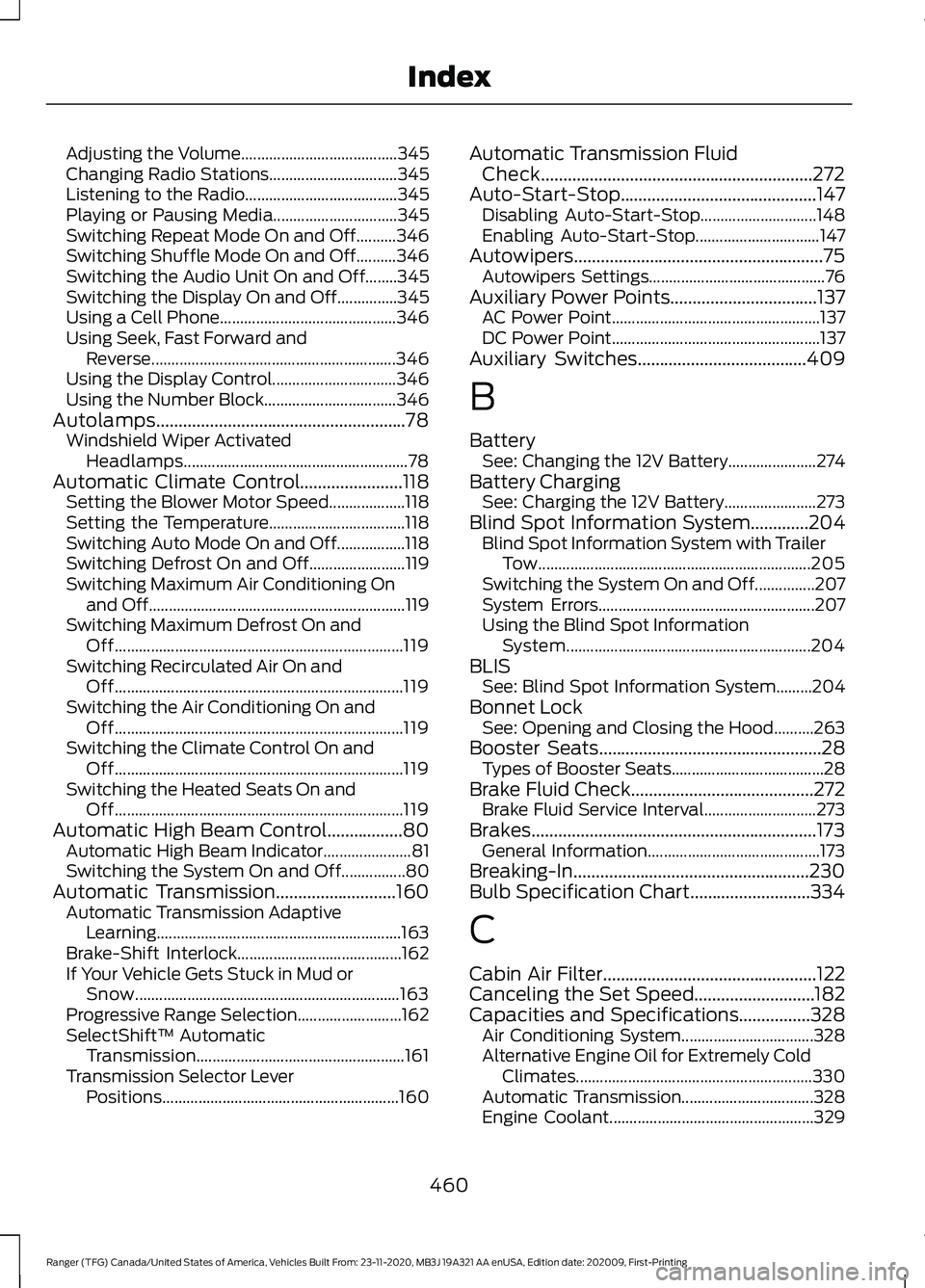
Adjusting the Volume.......................................
345
Changing Radio Stations................................ 345
Listening to the Radio...................................... 345
Playing or Pausing Media............................... 345
Switching Repeat Mode On and Off..........346
Switching Shuffle Mode On and Off..........346
Switching the Audio Unit On and Off........345
Switching the Display On and Off...............345
Using a Cell Phone............................................ 346
Using Seek, Fast Forward and Reverse............................................................. 346
Using the Display Control............................... 346
Using the Number Block................................. 346
Autolamps........................................................78 Windshield Wiper Activated
Headlamps........................................................ 78
Automatic Climate Control.......................118
Setting the Blower Motor Speed................... 118
Setting the Temperature.................................. 118
Switching Auto Mode On and Off.................118
Switching Defrost On and Off........................ 119
Switching Maximum Air Conditioning On and Off................................................................ 119
Switching Maximum Defrost On and Off........................................................................\
119
Switching Recirculated Air On and Off........................................................................\
119
Switching the Air Conditioning On and Off........................................................................\
119
Switching the Climate Control On and Off........................................................................\
119
Switching the Heated Seats On and Off........................................................................\
119
Automatic High Beam Control.................80 Automatic High Beam Indicator...................... 81
Switching the System On and Off................80
Automatic Transmission
...........................160
Automatic Transmission Adaptive
Learning............................................................. 163
Brake-Shift Interlock......................................... 162
If Your Vehicle Gets Stuck in Mud or Snow.................................................................. 163
Progressive Range Selection.......................... 162
SelectShift™ Automatic Transmission.................................................... 161
Transmission Selector Lever Positions........................................................... 160Automatic Transmission Fluid
Check.............................................................272
Auto-Start-Stop............................................147 Disabling Auto-Start-Stop............................. 148
Enabling Auto-Start-Stop............................... 147
Autowipers........................................................75 Autowipers Settings............................................ 76
Auxiliary Power Points.................................137 AC Power Point.................................................... 137
DC Power Point.................................................... 137
Auxiliary Switches
......................................409
B
Battery See: Changing the 12V Battery...................... 274
Battery Charging See: Charging the 12V Battery....................... 273
Blind Spot Information System
.............204
Blind Spot Information System with Trailer
Tow.................................................................... 205
Switching the System On and Off...............207
System Errors...................................................... 207
Using the Blind Spot Information System............................................................. 204
BLIS See: Blind Spot Information System.........204
Bonnet Lock See: Opening and Closing the Hood..........263
Booster Seats..................................................28 Types of Booster Seats...................................... 28
Brake Fluid Check.........................................272 Brake Fluid Service Interval............................ 273
Brakes................................................................173 General Information........................................... 173
Breaking-In.....................................................230
Bulb Specification Chart...........................334
C
Cabin Air Filter
................................................122
Canceling the Set Speed...........................182
Capacities and Specifications................328 Air Conditioning System................................. 328
Alternative Engine Oil for Extremely Cold Climates........................................................... 330
Automatic Transmission................................. 328
Engine Coolant................................................... 329
460
Ranger (TFG) Canada/United States of America, Vehicles Built From: 23-11-2020, MB3J 19A321 AA enUSA, Edition date: 202009, First-Printing Index
Page 464 of 475
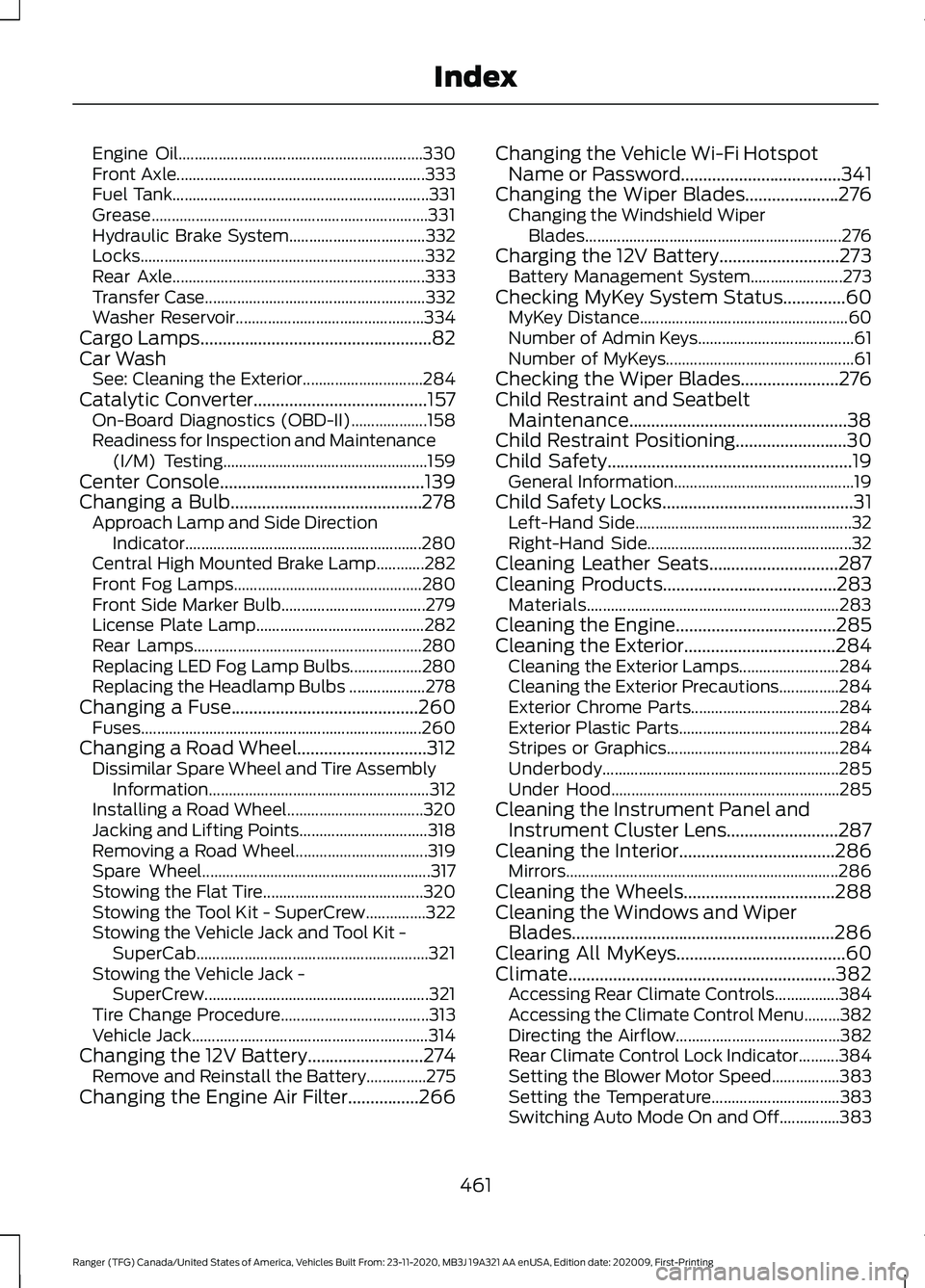
Engine Oil.............................................................
330
Front Axle.............................................................. 333
Fuel Tank................................................................ 331
Grease..................................................................... 331
Hydraulic Brake System.................................. 332
Locks....................................................................... 332
Rear Axle............................................................... 333
Transfer Case....................................................... 332
Washer Reservoir............................................... 334
Cargo Lamps....................................................82
Car Wash See: Cleaning the Exterior.............................. 284
Catalytic Converter
.......................................157
On-Board Diagnostics (OBD-II)................... 158
Readiness for Inspection and Maintenance (I/M) Testing................................................... 159
Center Console..............................................139
Changing a Bulb...........................................278 Approach Lamp and Side Direction
Indicator........................................................... 280
Central High Mounted Brake Lamp............282
Front Fog Lamps............................................... 280
Front Side Marker Bulb.................................... 279
License Plate Lamp.......................................... 282
Rear Lamps......................................................... 280
Replacing LED Fog Lamp Bulbs.................. 280
Replacing the Headlamp Bulbs ................... 278
Changing a Fuse..........................................260 Fuses...................................................................... 260
Changing a Road Wheel
.............................312
Dissimilar Spare Wheel and Tire Assembly
Information....................................................... 312
Installing a Road Wheel.................................. 320
Jacking and Lifting Points................................ 318
Removing a Road Wheel................................. 319
Spare Wheel......................................................... 317
Stowing the Flat Tire........................................ 320
Stowing the Tool Kit - SuperCrew...............322
Stowing the Vehicle Jack and Tool Kit - SuperCab.......................................................... 321
Stowing the Vehicle Jack - SuperCrew........................................................ 321
Tire Change Procedure..................................... 313
Vehicle Jack........................................................... 314
Changing the 12V Battery..........................274 Remove and Reinstall the Battery...............275
Changing the Engine Air Filter................266 Changing the Vehicle Wi-Fi Hotspot
Name or Password
....................................341
Changing the Wiper Blades.....................276 Changing the Windshield Wiper
Blades................................................................ 276
Charging the 12V Battery...........................273 Battery Management System....................... 273
Checking MyKey System Status..............60 MyKey Distance.................................................... 60
Number of Admin Keys....................................... 61
Number of MyKeys............................................... 61
Checking the Wiper Blades
......................276
Child Restraint and Seatbelt Maintenance.................................................38
Child Restraint Positioning
.........................30
Child Safety.......................................................19
General Information............................................. 19
Child Safety Locks...........................................31 Left-Hand Side...................................................... 32
Right-Hand Side................................................... 32
Cleaning Leather Seats.............................287
Cleaning Products
.......................................283
Materials............................................................... 283
Cleaning the Engine....................................285
Cleaning the Exterior..................................284 Cleaning the Exterior Lamps......................... 284
Cleaning the Exterior Precautions...............284
Exterior Chrome Parts..................................... 284
Exterior Plastic Parts........................................ 284
Stripes or Graphics........................................... 284
Underbody........................................................... 285
Under Hood......................................................... 285
Cleaning the Instrument Panel and Instrument Cluster Lens.........................287
Cleaning the Interior...................................286 Mirrors.................................................................... 286
Cleaning the Wheels..................................288
Cleaning the Windows and Wiper Blades...........................................................286
Clearing All MyKeys......................................60
Climate............................................................382 Accessing Rear Climate Controls................384
Accessing the Climate Control Menu.........382
Directing the Airflow......................................... 382
Rear Climate Control Lock Indicator..........384
Setting the Blower Motor Speed.................383
Setting the Temperature................................ 383
Switching Auto Mode On and Off...............383
461
Ranger (TFG) Canada/United States of America, Vehicles Built From: 23-11-2020, MB3J 19A321 AA enUSA, Edition date: 202009, First-Printing Index