brakes FORD SUPER DUTY 2000 1.G User Guide
[x] Cancel search | Manufacturer: FORD, Model Year: 2000, Model line: SUPER DUTY, Model: FORD SUPER DUTY 2000 1.GPages: 256, PDF Size: 2.06 MB
Page 135 of 256
Driving through deep water where the transmission vent tube is
submerged may allow water into the transmission and cause
internal transmission damage.
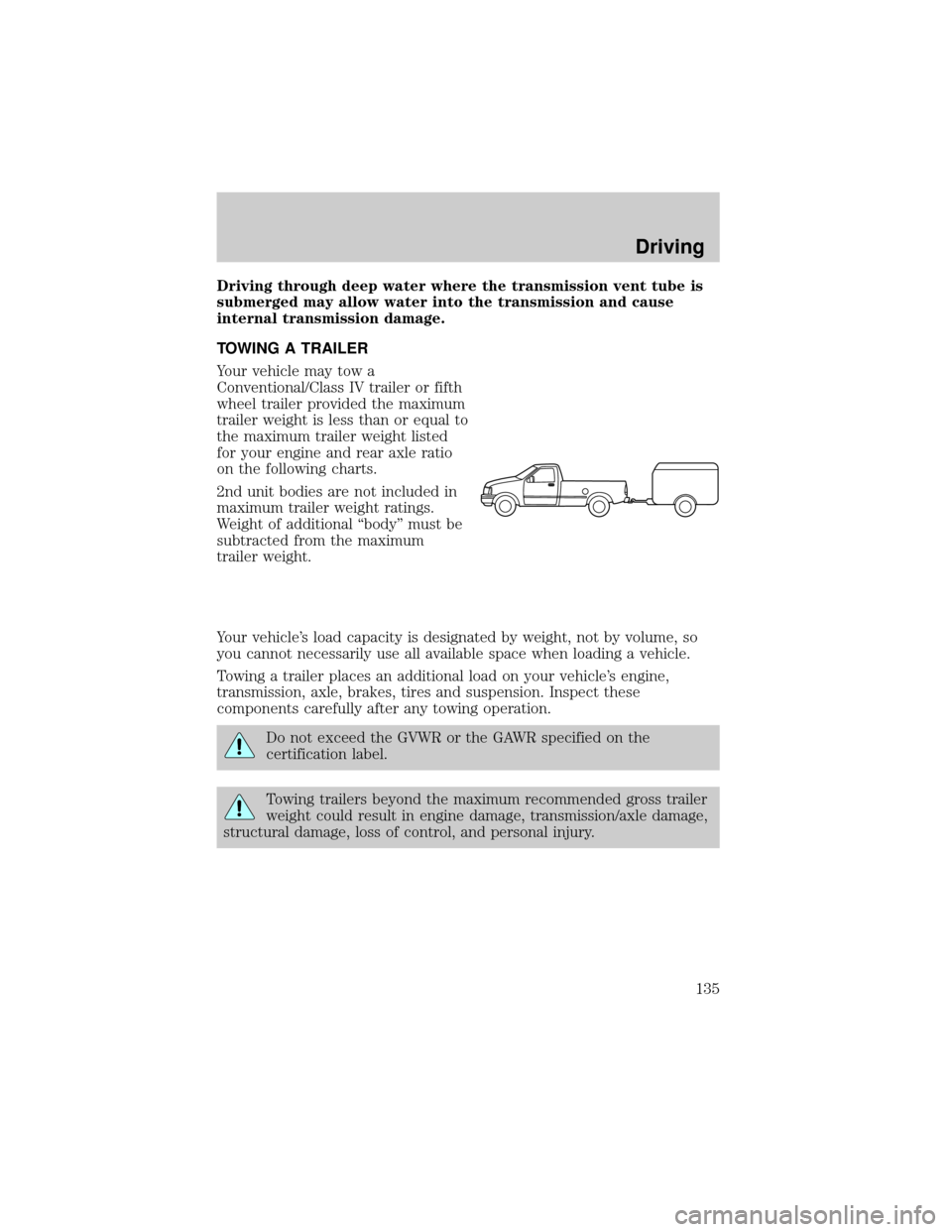
TOWING A TRAILER
Your vehicle may tow a
Conventional/Class IV trailer or fifth
wheel trailer provided the maximum
trailer weight is less than or equal to
the maximum trailer weight listed
for your engine and rear axle ratio
on the following charts.
2nd unit bodies are not included in
maximum trailer weight ratings.
Weight of additional ªbodyº must be
subtracted from the maximum
trailer weight.
Your vehicle's load capacity is designated by weight, not by volume, so
you cannot necessarily use all available space when loading a vehicle.
Towing a trailer places an additional load on your vehicle's engine,
transmission, axle, brakes, tires and suspension. Inspect these
components carefully after any towing operation.
Do not exceed the GVWR or the GAWR specified on the
certification label.
Towing trailers beyond the maximum recommended gross trailer
weight could result in engine damage, transmission/axle damage,
structural damage, loss of control, and personal injury.
Driving
135
Page 139 of 256
Trailer brakes
Electric brakes and manual, automatic or surge-type trailer brakes are safe
if installed properly and adjusted to the manufacturer's specifications. The
trailer brakes must meet local and Federal regulations.
Do not connect a trailer's hydraulic brake system directly to your
vehicle's brake system. Your vehicle may not have enough
braking power and your chances of having a collision greatly increase.
The braking system of the tow vehicle is rated for operation at the
GVWR not GCWR.
Trailer lamps
Trailer lamps are required on most towed vehicles. Make sure your
trailer lamps conform to local and Federal regulations. See your dealer or
trailer rental agency for proper instructions and equipment for hooking
up trailer lamps.
Using a step bumper (if equipped)
The rear bumper is equipped with an integral hitch and requires only a
ball with a 25.4 mm (one inch) shank diameter. The bumper hasa2270
kg (5 000 lb.) trailer weight and 227 kg (500 lb.) tongue weight
capability.
If it is necessary to relocate the trailer hitch ball position, a
frame-mounted trailer hitch must be installed.
Driving while you tow
When towing a trailer:
²Ensure that you turn off your speed control. The speed control may
shut off automatically when you are towing on long, steep grades.
²Consult your local motor vehicle speed regulations for towing a trailer.
²Use a lower gear when towing up or down steep hills. This will
eliminate excessive downshifting and upshifting for optimum fuel
economy and transmission cooling.
²Anticipate stops and brake gradually.
Exceeding the GCWR rating may cause internal transmission
damage and void your warranty coverage.
Driving
139
Page 179 of 256
BRAKE FLUID
Checking and adding brake fluidÐgasoline engine
Brake fluid should be checked and
refilled as needed. Refer to the
Scheduled Maintenance Guide for
the service interval schedules.
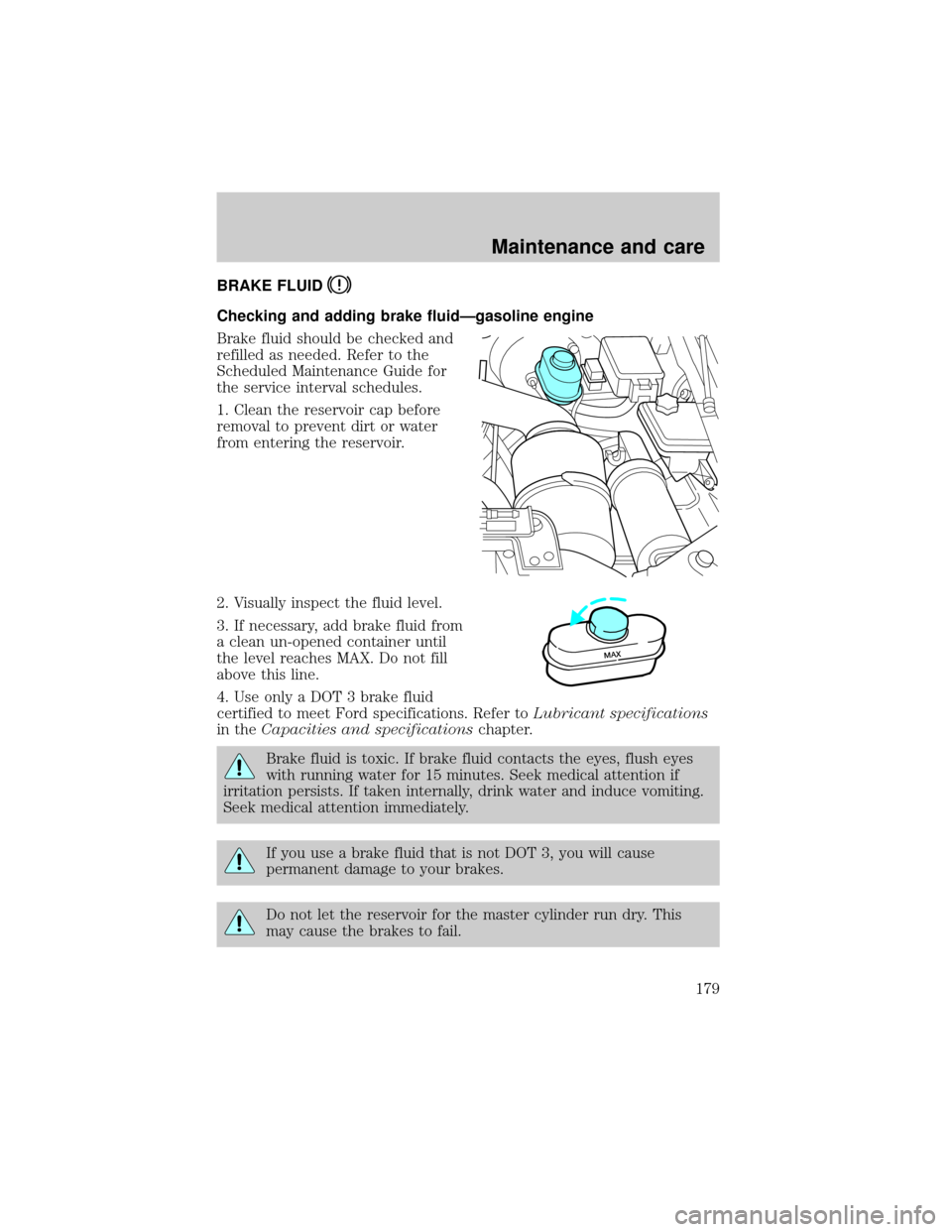
1. Clean the reservoir cap before
removal to prevent dirt or water
from entering the reservoir.
2. Visually inspect the fluid level.
3. If necessary, add brake fluid from
a clean un-opened container until
the level reaches MAX. Do not fill
above this line.
4. Use only a DOT 3 brake fluid
certified to meet Ford specifications. Refer toLubricant specifications
in theCapacities and specificationschapter.
Brake fluid is toxic. If brake fluid contacts the eyes, flush eyes
with running water for 15 minutes. Seek medical attention if
irritation persists. If taken internally, drink water and induce vomiting.
Seek medical attention immediately.
If you use a brake fluid that is not DOT 3, you will cause
permanent damage to your brakes.
Do not let the reservoir for the master cylinder run dry. This
may cause the brakes to fail.
MAX
Maintenance and care
179
Page 180 of 256
Checking and adding brake fluidÐdiesel engine
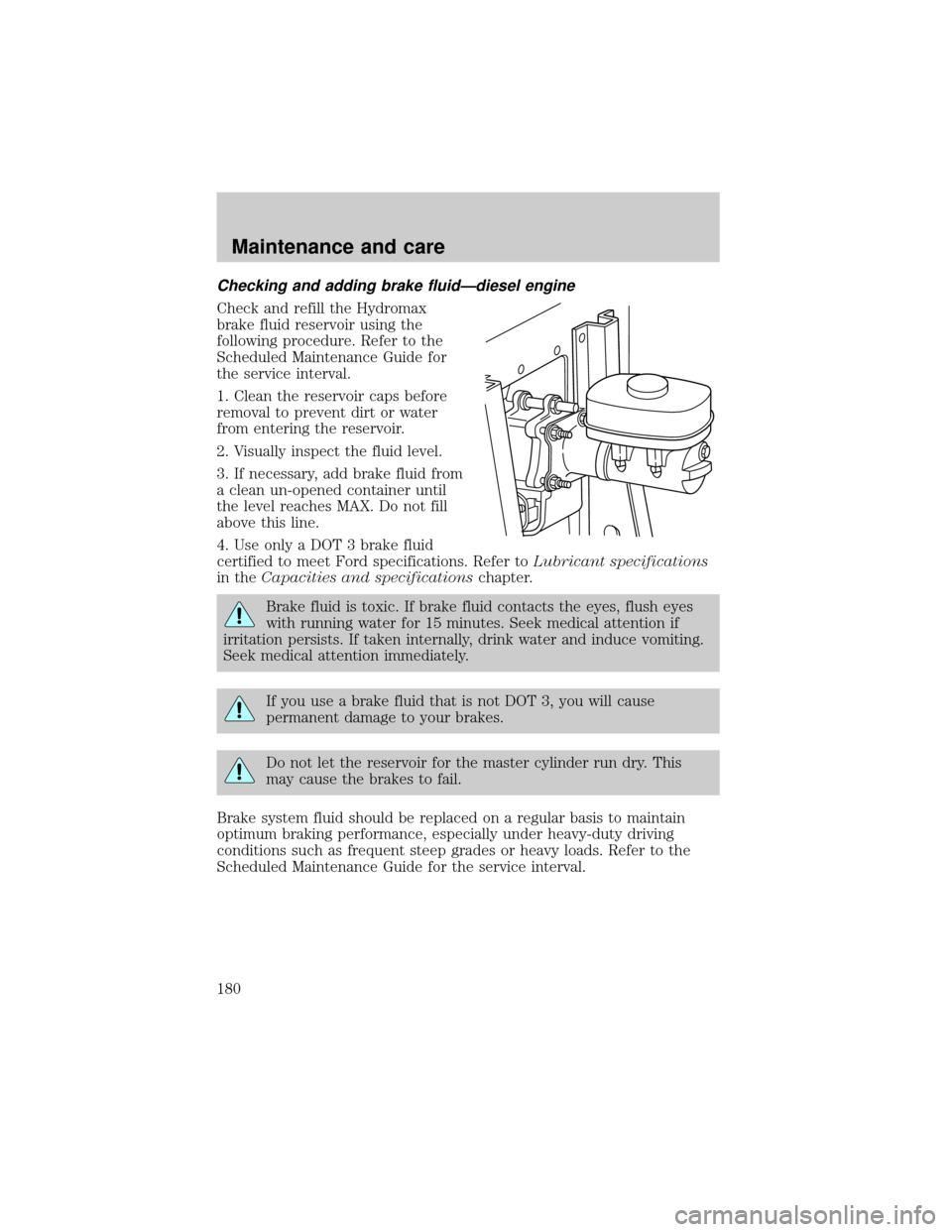
Check and refill the Hydromax
brake fluid reservoir using the
following procedure. Refer to the
Scheduled Maintenance Guide for
the service interval.
1. Clean the reservoir caps before
removal to prevent dirt or water
from entering the reservoir.
2. Visually inspect the fluid level.
3. If necessary, add brake fluid from
a clean un-opened container until
the level reaches MAX. Do not fill
above this line.
4. Use only a DOT 3 brake fluid
certified to meet Ford specifications. Refer toLubricant specifications
in theCapacities and specificationschapter.
Brake fluid is toxic. If brake fluid contacts the eyes, flush eyes
with running water for 15 minutes. Seek medical attention if
irritation persists. If taken internally, drink water and induce vomiting.
Seek medical attention immediately.
If you use a brake fluid that is not DOT 3, you will cause
permanent damage to your brakes.
Do not let the reservoir for the master cylinder run dry. This
may cause the brakes to fail.
Brake system fluid should be replaced on a regular basis to maintain
optimum braking performance, especially under heavy-duty driving
conditions such as frequent steep grades or heavy loads. Refer to the
Scheduled Maintenance Guide for the service interval.
Maintenance and care
180
Page 218 of 256
Washing your vehicle
Wash your vehicle regularly with
cold or lukewarm water. Never use
strong detergents or soap. If your
vehicle is particularly dirty, use a
quality car wash detergent. Always
use a clean sponge, washing glove
or similar device and plenty of water
for best results. To avoid spots,
avoid washing when the hood is still
warm, immediately after or during
exposure to strong sunlight.
During winter months, it is especially important to wash the vehicle on a
regular basis. Large quantities of dirt and road salt are difficult to
remove and also cause damage to the vehicle.
Any gasoline spilled on the vehicle or deposits such as bird droppings
should be washed and sponged off as soon as possible. Deposits not
removed promptly can cause damage to the vehicle's paintwork.
Remove any exterior accessories (such as antennas) and fold in the side
view mirrors before entering a car wash. If you have wax applied to the
vehicle at a commercial car wash, it is recommended that you clean the
wiper blades and windshield as described inCleaning the wiper blades
and windshield.
After washing, apply the brakes several times to dry them.
Waxing your vehicle
Waxing your vehicle on a regular basis will reduce minor scratches and
paint damage.
Wax when water stops beading on the surface. This could be every three
or four months, depending on operating conditions.
Use only carnauba or synthetic-based waxes. Use a cleaning fluid with a
clean cloth to remove any bugs before waxing your vehicle. Use tar
remover to remove any tar spots.
Avoid getting wax on the windshield, or on any surfaces which appear
coarse or bumpy. If you have wax applied at a commercial car wash, it is
recommended that you clean the wiper blades and windshield as
described inCleaning the wiper blades and windshield.
Maintenance and care
218
Page 247 of 256

Accessory delay ..........................63
Air bag supplemental
restraint system ..........................88
and child safety seats ..............89
description ................................88
disposal ......................................92
driver air bag ............................90
indicator light ......................13,91
operation ...................................90
passenger air bag .....................90
passenger
deactivation switch ...................92
Air cleaner filter ................193,222
Air conditioning ..........................27
Ambulance packages ....................4
Antifreeze (see Engine
coolant) .....................................182
Anti-lock brake system
(see Brakes) .......................110,111
Audio system (see Radio) .........32
Automatic transmission
driving an automatic
overdrive .................................115
fluid, adding ............................189
fluid, checking ........................189
fluid, refill capacities ..............222
fluid, specification ..................227
Auxiliary power point .................27
Axle
lubricant specifications ...225,227
refill capacities ........................222
traction lok ..............................112
Battery .......................................194
acid, treating emergencies .....194
charging system
warning light .............................14
jumping a disabled battery ....166
maintenance-free ....................194
replacement, specifications ...222
servicing ..................................194
voltage gauge ............................19
Belt minder .................................84Brakes ........................................109
anti-lock .....................109,110,111
anti-lock brake system (ABS)
warning light ......................14,110
brake warning light ..................13
fluid, checking and adding ....179
fluid, refill capacities ..............222
fluid, specifications ..........225,227
lubricant specifications ...225,227
parking ....................................111
shift interlock ..........................114
Break-in period .............................3
Capacities for refilling fluids ....222
Certification Label ....................232
Child safety restraints ................97
child safety belts ......................97
Child safety seats ........................98
attaching with tether straps ..102
in front seat ..............................99
in rear seat ................................99
tether anchorage hardware ...102
Cleaning your vehicle ...............217
engine compartment ..............219
exterior ....................................219
exterior lamps .........................220
instrument panel ....................220
instrument panel lens ............220
interior .....................................221
plastic parts ............................219
safety belts ..............................221
washing ....................................218
waxing .....................................218
wheels ......................................219
wiper blades ............................220
Climate control (see Air
conditioning or Heating) ............27
Clock ..................................36,42,52
Clutch
fluid ..........................................181
operation while driving ..........117
recommended shift speeds ....119
Compass, electronic ....................22
Index
247
Page 250 of 256

replacing
bulbs ............212,213,214,215,216
Lane change indicator
(see Turn signal) ........................56
Lights, warning and indicator ....10
air bag ........................................13
anti-lock brakes (ABS) .....14,110
brake ..........................................13
charging system ........................14
check coolant ............................15
cruise indicator .........................15
door ajar ....................................15
engine oil pressure ...................15
high beam .................................14
low fuel ......................................10
safety belt .................................13
service engine soon .............10,11
turn signal indicator .................14
Load limits .................................132
GAWR ......................................132
GVWR ......................................132
trailer towing ..........................132
Loading instructions .................134
Locks
childproof ..................................64
Lubricant specifications ....225,227
Lumbar support, seats ...............75
Manual transmission .................117
fluid capacities ........................222
lubricant specifications ..........227
reverse .....................................121
Message center ...........................20
english/metric button ...............20
menu button .............................20
Mirrors .........................................66
fold away ...................................65
heated ........................................65
side view mirrors (power) .......64
Motorcraft parts .................206,222
Octane rating ............................204
Odometer .....................................18
Oil (see Engine oil) ..................176Overdrive .....................................61
Panic alarm feature, remote
entry system ................................68
Parking brake ............................111
Parts (see Motorcraft parts) ....222
Power distribution box
(see Fuses) ...............................152
Power door locks ........................63
Power steering ..........................112
fluid, checking and adding ....188
fluid, refill capacity ................222
fluid, specifications ..........225,227
Preparing to
drive your vehicle .....................113
Radio ............................................32
Relays ........................................147
Remote entry system ............67,68
illuminated entry ......................69
locking/unlocking doors ...........67
panic alarm ...............................68
replacement/additional
transmitters ..........................70,71
replacing the batteries .............68
Safety belts (see Safety
restraints) ...........16,75,77,78,79,81
Safety defects, reporting ..........246
Safety restraints ......75,77,78,79,81
belt minder ...............................84
cleaning the safety belts ...87,221
extension assembly ..................83
for adults .........................77,78,79
for children ..........................96,97
lap belt ......................................82
warning light
and chime ...................13,16,83,84
Safety seats for children ............98
Seat belts
(see Safety restraints) ...............75
Seats ............................................72
child safety seats ......................98
cleaning ...................................221
Servicing your vehicle ..............172
Index
250