warning light FORD SUPER DUTY 2001 1.G User Guide
[x] Cancel search | Manufacturer: FORD, Model Year: 2001, Model line: SUPER DUTY, Model: FORD SUPER DUTY 2001 1.GPages: 288, PDF Size: 1.86 MB
Page 106 of 288
•After step 5 the safety belt warning light will be turned on for three
seconds.
6. Within seven seconds of the safety belt warning light turning off,
buckle then unbuckle the safety belt.
•This will disable Belt Minder if it is currently enabled, or enable Belt
Minder if it is currently disabled.
7. Confirmation of disabling Belt Minder is provided by the safety belt
warning light flashing four times per second for three seconds.
8. Confirmation of enabling Belt Minder is provided by:
•The safety belt warning light flashing four times per second for three
seconds.
•Followed by three seconds with the safety belt warning light off.
•Once again, the safety belt warning light will flash four times per
second for three seconds.
9. After receiving confirmation, the deactivation/activation procedure is
complete.
Safety belt maintenance
Inspect the safety belt systems periodically to make sure they work
properly and are not damaged. Inspect the safety belts to make sure there
are no nicks, tears or cuts. Replace if necessary. All safety belt assemblies,
including retractors, buckles, front seat belt buckle assemblies, buckle
support assemblies (slide bar-if equipped), shoulder belt height adjusters
(if equipped), shoulder belt guide on seatback (if equipped), child safety
seat tether bracket assemblies (if equipped), LATCH child seat tether
anchors and lower anchors (if equipped), and attaching hardware, should
be inspected after a collision. Ford recommends that all safety belt
assemblies used in vehicles involved in a collision be replaced. However, if
the collision was minor and a qualified technician finds that the belts do
not show damage and continue to operate properly, they do not need to be
replaced. Safety belt assemblies not in use during a collision should also be
inspected and replaced if either damage or improper operation is noted.
Failure to inspect and if necessary replace the safety belt
assembly under the above conditions could result in severe
personal injuries in the event of a collision.
Refer toCleaning and maintaining the safety beltsin the
Maintenacne and Caresection.
Seating and safety restraints
106
Page 111 of 288
The diagnostic module monitors its own internal circuits and the
supplemental air bag electrical system warning (including the impact
sensors), the system wiring, the air bag system readiness light, the air
bag back up power and the air bag ignitors.
Determining if the system is operational
The SRS uses a readiness light in the instrument cluster or a tone to
indicate the condition of the system. Refer to theAir bag readiness
section in theInstrumentationchapter. Routine maintenance of the air
bag is not required.
A difficulty with the system is indicated by one or more of the following:
•The readiness light will either
flash or stay lit.
•The readiness light will not
illuminate immediately after
ignition is turned on.
•A series of five beeps will be heard. The tone pattern will repeat
periodically until the problem and/or light are repaired.
If any of these things happen, even intermittently, have the SRS serviced
at your dealership or by a qualified technician immediately. Unless
serviced, the system may not function properly in the event of a
collision.
Disposal of air bags and air bag equipped vehicles
(including pretensioners)
For disposal of air bags or air bag equipped vehicles, see your local
dealership or qualified technician. Air bags MUST BE disposed of by
qualified personnel.
Seating and safety restraints
111
Page 112 of 288
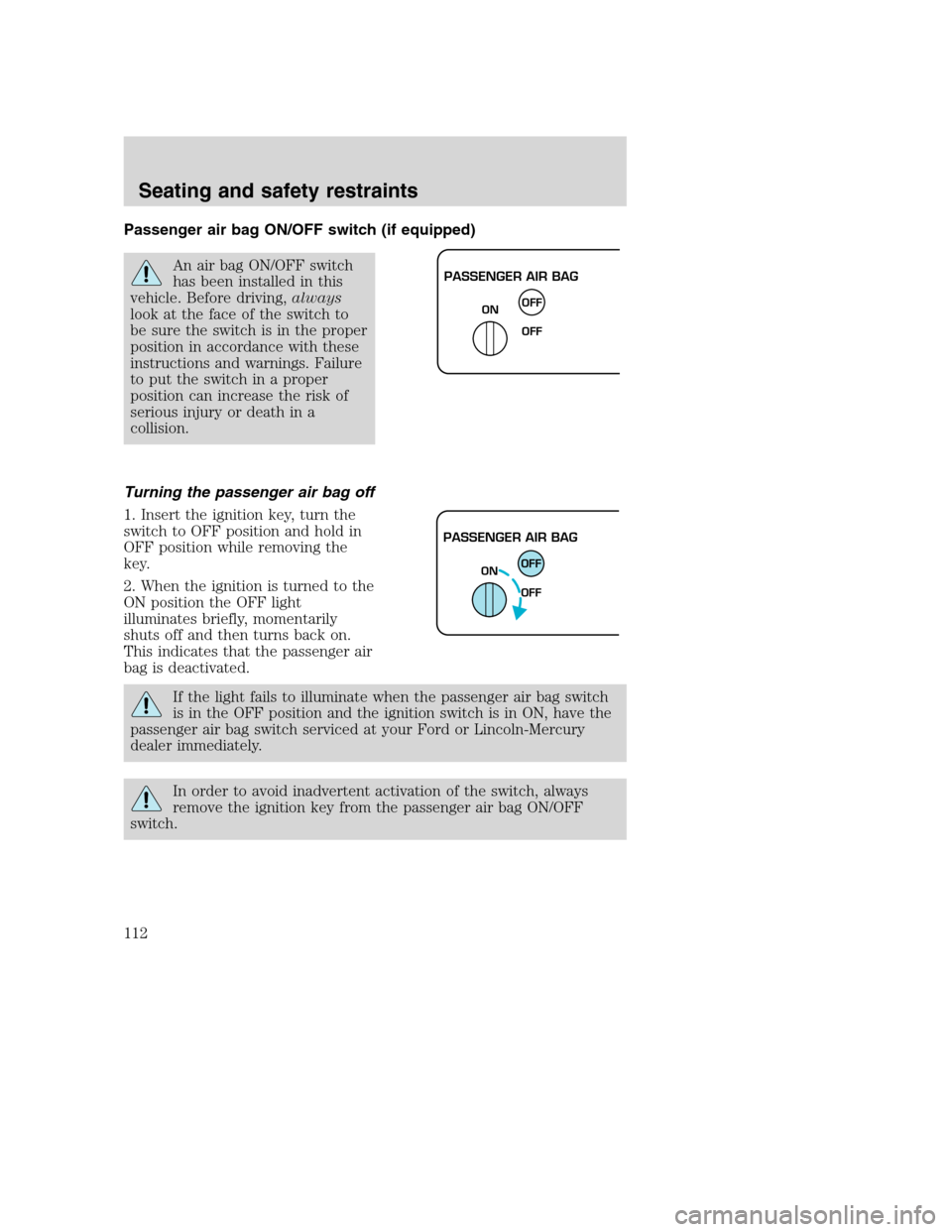
Passenger air bag ON/OFF switch (if equipped)
An air bag ON/OFF switch
has been installed in this
vehicle. Before driving,always
look at the face of the switch to
be sure the switch is in the proper
position in accordance with these
instructions and warnings. Failure
to put the switch in a proper
position can increase the risk of
serious injury or death in a
collision.
Turning the passenger air bag off
1. Insert the ignition key, turn the
switch to OFF position and hold in
OFF position while removing the
key.
2. When the ignition is turned to the
ON position the OFF light
illuminates briefly, momentarily
shuts off and then turns back on.
This indicates that the passenger air
bag is deactivated.
If the light fails to illuminate when the passenger air bag switch
is in the OFF position and the ignition switch is in ON, have the
passenger air bag switch serviced at your Ford or Lincoln-Mercury
dealer immediately.
In order to avoid inadvertent activation of the switch, always
remove the ignition key from the passenger air bag ON/OFF
switch.
PASSENGER AIR BAG
OFF
OFF ON
PASSENGER AIR BAG
OFF
OFF ON
Seating and safety restraints
112
Page 132 of 288
Using four wheel ABS
•In an emergency or when maximum efficiency from the four wheel
ABS is required, apply continuous force on the brake. The four wheel
ABS will be activated immediately, thus allowing you to retain full
steering control of your vehicle and, providing there is sufficient
space, will enable you to avoid obstacles and bring the vehicle to a
controlled stop.
•The anti-lock system does not decrease the time necessary to apply
the brakes or always reduce stopping distance. Always leave enough
room between your vehicle and the vehicle in front of you to stop.
•We recommend that you familiarize yourself with this braking
technique. However, avoid taking any unnecessary risks.
ABS warning lamp
ABS
TheABSwarning lamp in the instrument cluster momentarily illuminates
when the ignition is turned to the ON position. If the light does not
illuminate momentarily at start up, remains on or continues to flash, the
ABS needs to be serviced.
With the ABS light on, the anti-lock
brake system is disabled and normal
braking is still effective unless the
brake warning light also remains
illuminated with parking brake
released. (If your brake warning lamp illuminates, have your vehicle
serviced immediately.)
Driving
132
Page 136 of 288
AUTOMATIC TRANSMISSION OPERATION (IF EQUIPPED)
Brake-shift interlock
This vehicle is equipped with a brake-shift interlock feature that prevents
the gearshift lever from being moved from P (Park) when the ignition is
in the ON position unless brake pedal is depressed.
If you cannot move the gearshift lever out of P (Park) with ignition in
the ON position and the brake pedal depressed:
1. Apply the parking brake, turn ignition to the LOCK position, then
remove the key.
2. Reinsert the key and turn the ignition to the OFF position.
3. Press and hold down the brake pedal and shift into N (Neutral).
4. Start the vehicle.
If it is necessary to use the above procedure to move the gearshift lever,
it is possible that a fuse has blown or the vehicle’s brakelamps are not
operating properly. Refer toFuses and relaysin theRoadside
emergencieschapter.
Do not drive your vehicle until you verify that the brakelamps
are working.
If your vehicle gets stuck in mud or snow it may be rocked out by
shifting from forward and reverse gears, stopping between shifts, in a
steady pattern. Press lightly on the accelerator in each gear.
Do not rock the vehicle for more than a few minutes. The
transmission and tires may be damaged or the engine may
overheat.
Always set the parking brake fully and make sure the gearshift is
latched in P (Park). Turn off the ignition whenever you leave
your vehicle.
If the parking brake is fully released, but the brake warning lamp
remains illuminated, the brakes may not be working properly.
See your dealer or a qualified service technician.
Driving
136
Page 236 of 288
Do not park, idle, or drive your vehicle in dry grass or other dry
ground cover. The emission system heats up the engine
compartment and exhaust system, which can start a fire.
Illumination of the “Service Engine Soon” light, charging system warning
light or the temperature warning light, fluid leaks, strange odors, smoke
or loss of engine power, could indicate that the emission control system
is not working properly.
Exhaust leaks may result in entry of harmful and potentially
lethal fumes into the passenger compartment.
Do not make any unauthorized changes to your vehicle or engine. By
law, vehicle owners and anyone who manufactures, repairs, services,
sells, leases, trades vehicles, or supervises a fleet of vehicles are not
permitted to intentionally remove an emission control device or prevent
it from working. Information about your vehicle’s emission system is on
the Vehicle Emission Control Information Decal located on or near the
engine. This decal identifies engine displacement and gives some tune up
specifications.
Please consult yourWarranty Guidefor complete emission warranty
information.
Readiness for Inspection/Maintenance (I/M) testing
In some localities, it may be a legal requirement to pass an I/M test of
the on-board diagnostics system. If your “Check Engine/Service Engine
Soon” light is on, refer to the description in theWarning lights and
chimessection of theInstrumentationchapter. Your vehicle may not
pass the I/M test with the “Check Engine/Service Engine Soon” light on.
If the vehicle’s powertrain system or its battery has just been serviced,
the on-board diagnostics system is reset to a “not ready for I/M test”
condition. To ready the on-board diagnostics system for I/M testing, a
minimum of 30 minutes of city and highway driving is necessary as
described below:
•First, at least 10 minutes of driving on an expressway or highway.
•Next, at least 20 minutes driving in stop-and-go, city-type traffic with
at least four idle periods.
Maintenance and care
236
Page 278 of 288
A
Accessory delay ..........................80
Air bag supplemental
restraint system ........................107
and child safety seats ............109
description ..............................107
disposal ....................................111
driver air bag ..........................109
indicator light ...................11, 111
operation .................................109
passenger air bag ...................109
passenger deactivation
switch ......................................112
Air cleaner filter .......217–218, 249
Air conditioning ..........................29
Ambulance packages ....................4
Antifreeze (see Engine
coolant) .....................................206
Anti-lock brake system
(see Brakes) ......................131–132
Audio system (see Radio) ...35, 56
Automatic transmission
driving an automatic
overdrive .................................137
fluid, adding ............................214
fluid, checking ........................214
fluid, refill capacities ..............249
fluid, specification ..................256
Auxiliary power point ...........29, 83
Axle
lubricant specifications ..253, 256
refill capacities ........................249
traction lok ..............................134
B
Battery .......................................219acid, treating emergencies .....219
charging system
warning light .............................13
jumping a disabled battery ....191
maintenance-free ....................219
replacement, specifications ...249
servicing ..................................219
voltage gauge ............................19
Belt minder ...............................103
Brakes ........................................131
anti-lock ...........................131–132
anti-lock brake system
(ABS) warning light .........13, 132
brake warning light ..................12
fluid, checking and adding ....204
fluid, refill capacities ..............249
fluid, specifications .........253, 256
lubricant specifications ..253, 256
parking ....................................133
pedals (see Power adjustable
foot pedals) ...............................26
shift interlock ..........................136
Break-in period .............................3
C
Capacities for refilling fluids ....249
Certification Label ....................261
Child safety restraints ..............117
child safety belts ....................117
Child safety seats ......................118
attaching with tether straps ..122
in front seat ............................119
in rear seat ..............................119
tether anchorage hardware ...122
Cleaning your vehicle ...............243
engine compartment ..............246
exterior ............................244–245
exterior lamps .........................246
Index
278
Page 279 of 288
instrument cluster lens ..........247
instrument panel ....................247
interior .....................................247
plastic parts ............................246
safety belts ..............................248
washing ....................................244
waxing .....................................244
wheels ......................................245
wiper blades ............................247
Climate control (see Air
conditioning or Heating) ............29
Clock ..........................38, 45, 55, 69
Clutch
fluid ..........................................205
operation while driving ..........139
recommended shift speeds ....141
Compass, electronic ....................21
calibration .................................23
set zone adjustment .................22
Console ........................................83
Controls
power seat .................................90
Coolant
checking and adding ..............206
refill capacities ................210, 249
specifications ..................253, 256
Cruise control (see Speed
control) ........................................72
Customer Assistance ................167
Ford accessories for your
vehicle .....................................270
Ford Extended Service
Plan ..........................................263
Getting assistance outside the
U.S. and Canada .....................269
Getting roadside assistance ...167
Getting the service you
need .........................................263Ordering additional owner’s
literature .................................275
The Dispute Settlement
Board .......................................265
Utilizing the
Mediation/Arbitration
Program ...................................269
D
Daytime running lamps
(see Lamps) ................................25
Dipstick
automatic transmission
fluid ..........................................214
engine oil .................................201
Doors
door ajar warning .....................14
lubricant specifications ..........253
Driveline universal joint and
slip yoke ....................................219
Driving under special
conditions ..........................152–153
mud ..........................................152
sand .........................................152
snow and ice ...........................153
through water .................152, 156
E
Emergencies, roadside
jump-starting ..........................191
Emission control system ..........235
Engine ........................................256
check engine/service engine
soon light ..................................10
cleaning ...................................246
coolant .....................................206
diesel ...........................................3
Index
279
Page 280 of 288
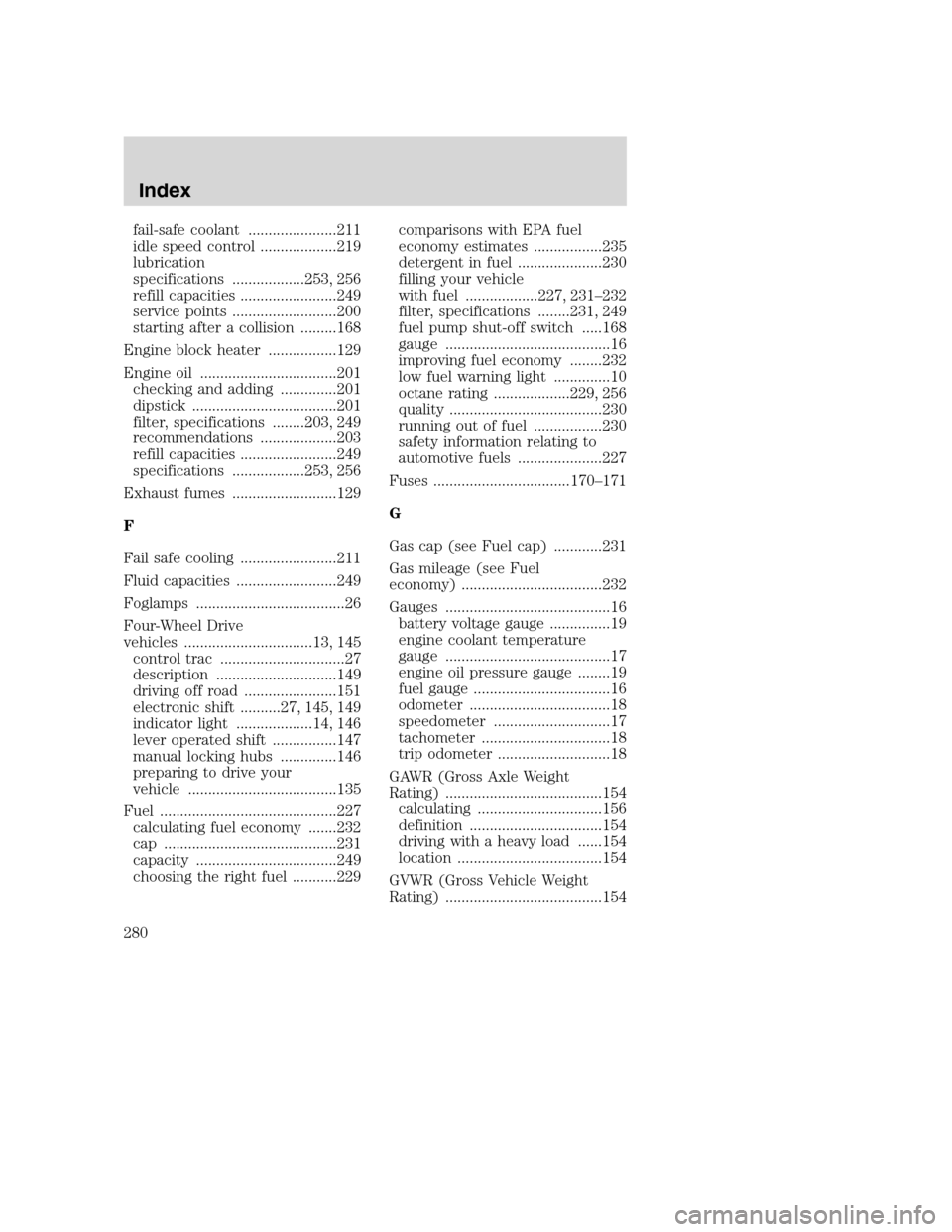
fail-safe coolant ......................211
idle speed control ...................219
lubrication
specifications ..................253, 256
refill capacities ........................249
service points ..........................200
starting after a collision .........168
Engine block heater .................129
Engine oil ..................................201
checking and adding ..............201
dipstick ....................................201
filter, specifications ........203, 249
recommendations ...................203
refill capacities ........................249
specifications ..................253, 256
Exhaust fumes ..........................129
F
Fail safe cooling ........................211
Fluid capacities .........................249
Foglamps .....................................26
Four-Wheel Drive
vehicles ................................13, 145
control trac ...............................27
description ..............................149
driving off road .......................151
electronic shift ..........27, 145, 149
indicator light ...................14, 146
lever operated shift ................147
manual locking hubs ..............146
preparing to drive your
vehicle .....................................135
Fuel ............................................227
calculating fuel economy .......232
cap ...........................................231
capacity ...................................249
choosing the right fuel ...........229comparisons with EPA fuel
economy estimates .................235
detergent in fuel .....................230
filling your vehicle
with fuel ..................227, 231–232
filter, specifications ........231, 249
fuel pump shut-off switch .....168
gauge .........................................16
improving fuel economy ........232
low fuel warning light ..............10
octane rating ...................229, 256
quality ......................................230
running out of fuel .................230
safety information relating to
automotive fuels .....................227
Fuses ..................................170–171
G
Gas cap (see Fuel cap) ............231
Gas mileage (see Fuel
economy) ...................................232
Gauges .........................................16
battery voltage gauge ...............19
engine coolant temperature
gauge .........................................17
engine oil pressure gauge ........19
fuel gauge ..................................16
odometer ...................................18
speedometer .............................17
tachometer ................................18
trip odometer ............................18
GAWR (Gross Axle Weight
Rating) .......................................154
calculating ...............................156
definition .................................154
driving with a heavy load ......154
location ....................................154
GVWR (Gross Vehicle Weight
Rating) .......................................154
Index
280
Page 281 of 288
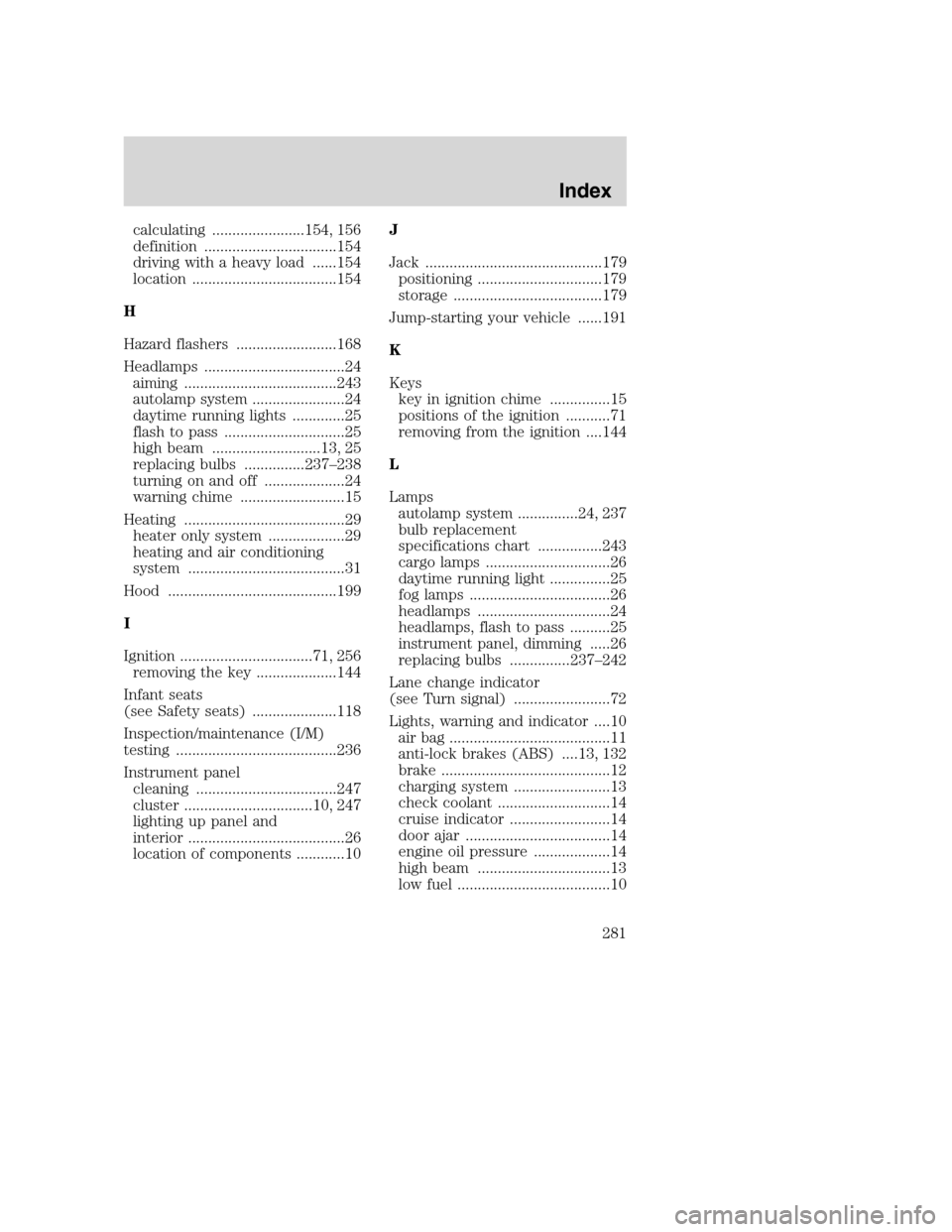
calculating .......................154, 156
definition .................................154
driving with a heavy load ......154
location ....................................154
H
Hazard flashers .........................168
Headlamps ...................................24
aiming ......................................243
autolamp system .......................24
daytime running lights .............25
flash to pass ..............................25
high beam ...........................13, 25
replacing bulbs ...............237–238
turning on and off ....................24
warning chime ..........................15
Heating ........................................29
heater only system ...................29
heating and air conditioning
system .......................................31
Hood ..........................................199
I
Ignition .................................71, 256
removing the key ....................144
Infant seats
(see Safety seats) .....................118
Inspection/maintenance (I/M)
testing ........................................236
Instrument panel
cleaning ...................................247
cluster ................................10, 247
lighting up panel and
interior .......................................26
location of components ............10J
Jack ............................................179
positioning ...............................179
storage .....................................179
Jump-starting your vehicle ......191
K
Keys
key in ignition chime ...............15
positions of the ignition ...........71
removing from the ignition ....144
L
Lamps
autolamp system ...............24, 237
bulb replacement
specifications chart ................243
cargo lamps ...............................26
daytime running light ...............25
fog lamps ...................................26
headlamps .................................24
headlamps, flash to pass ..........25
instrument panel, dimming .....26
replacing bulbs ...............237–242
Lane change indicator
(see Turn signal) ........................72
Lights, warning and indicator ....10
air bag ........................................11
anti-lock brakes (ABS) ....13, 132
brake ..........................................12
charging system ........................13
check coolant ............................14
cruise indicator .........................14
door ajar ....................................14
engine oil pressure ...................14
high beam .................................13
low fuel ......................................10
Index
281