warning FORD SUPER DUTY 2003 1.G User Guide
[x] Cancel search | Manufacturer: FORD, Model Year: 2003, Model line: SUPER DUTY, Model: FORD SUPER DUTY 2003 1.GPages: 256, PDF Size: 2.3 MB
Page 16 of 256
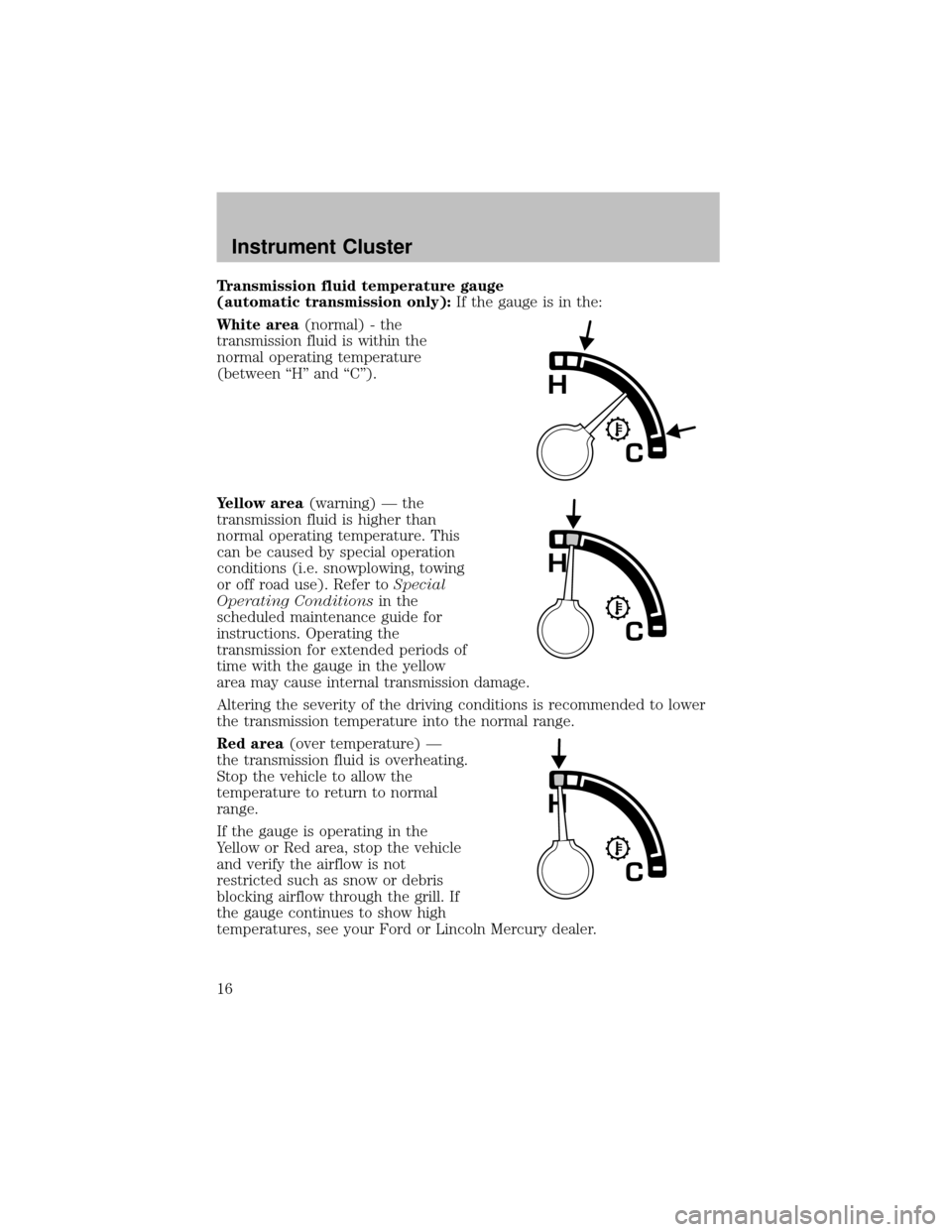
Transmission fluid temperature gauge
(automatictransmission only):If the gauge is in the:
White area(normal) - the
transmission fluid is within the
normal operating temperature
(between “H” and “C”).
Yellow area(warning) — the
transmission fluid is higher than
normal operating temperature. This
can be caused byspecial operation
conditions (i.e. snowplowing, towing
or off road use). Refer toSpecial
Operating Conditionsin the
scheduled maintenance guide for
instructions. Operating the
transmission for extended periods of
time with the gauge in the yellow
area maycause internal transmission damage.
Altering the severityof the driving conditions is recommended to lower
the transmission temperature into the normal range.
Red area(over temperature) —
the transmission fluid is overheating.
Stop the vehicle to allow the
temperature to return to normal
range.
If the gauge is operating in the
Yellow or Red area, stop the vehicle
and verifythe airflow is not
restricted such as snow or debris
blocking airflow through the grill. If
the gauge continues to show high
temperatures, see your Ford or Lincoln Mercury dealer.
Instrument Cluster
16
Page 74 of 256
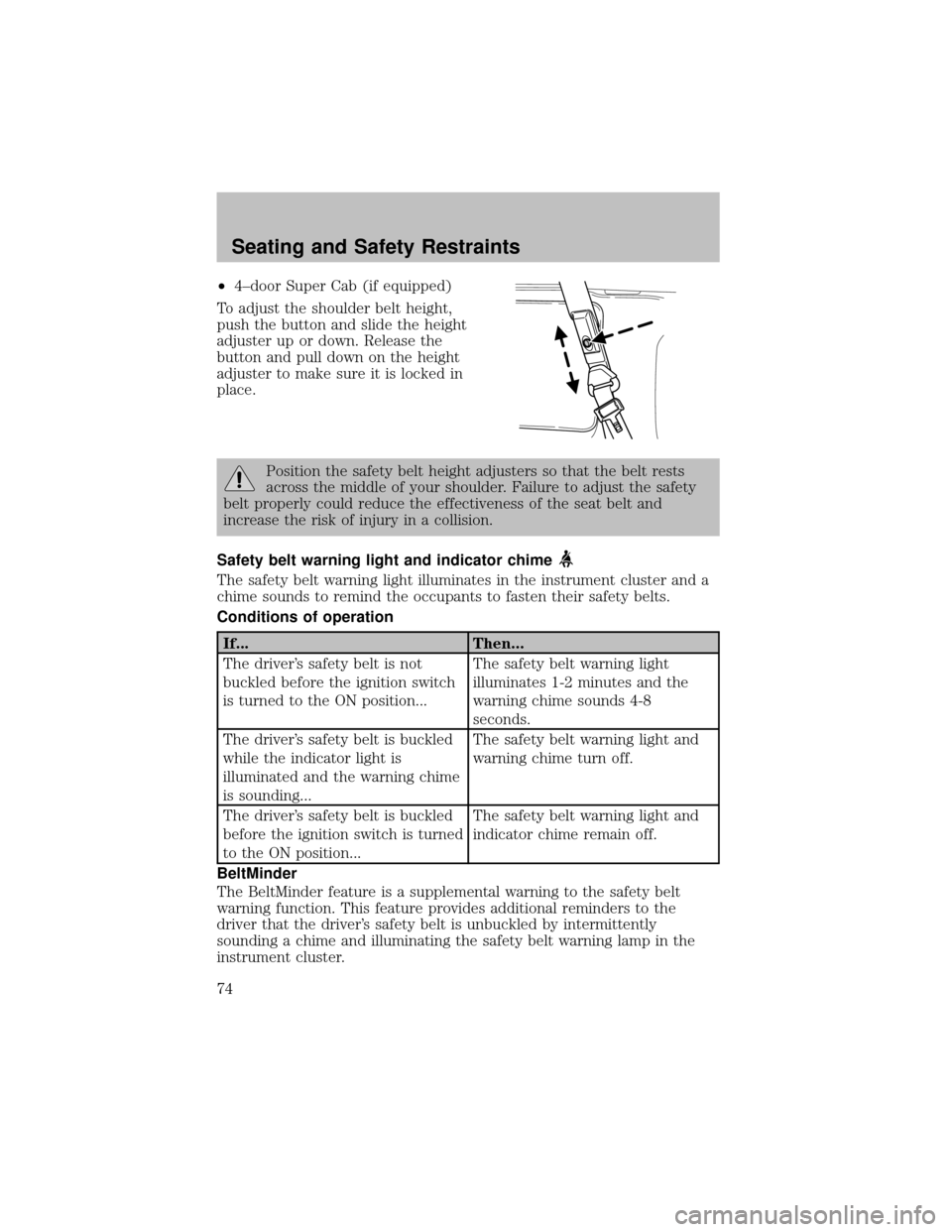
•4–door Super Cab (if equipped)
To adjust the shoulder belt height,
push the button and slide the height
adjuster up or down. Release the
button and pull down on the height
adjuster to make sure it is locked in
place.
Position the safetybelt height adjusters so that the belt rests
across the middle of your shoulder. Failure to adjust the safety
belt properlycould reduce the effectiveness of the seat belt and
increase the risk of injuryin a collision.
Safety belt warning light and indicator chime
The safetybelt warning light illuminates in the instrument cluster and a
chime sounds to remind the occupants to fasten their safetybelts.
Conditions of operation
If... Then...
The driver’s safetybelt is not
buckled before the ignition switch
is turned to the ON position...The safetybelt warning light
illuminates 1-2 minutes and the
warning chime sounds 4-8
seconds.
The driver’s safetybelt is buckled
while the indicator light is
illuminated and the warning chime
is sounding...The safetybelt warning light and
warning chime turn off.
The driver’s safetybelt is buckled
before the ignition switch is turned
to the ON position...The safetybelt warning light and
indicator chime remain off.
BeltMinder
The BeltMinder feature is a supplemental warning to the safetybelt
warning function. This feature provides additional reminders to the
driver that the driver’s safetybelt is unbuckled byintermittently
sounding a chime and illuminating the safetybelt warning lamp in the
instrument cluster.
Seating and Safety Restraints
74
Page 75 of 256
If... Then...
The driver’s safetybelt is not
buckled before the vehicle has
reached at least 5 km/h (3 mph)
and 1-2 minutes have elapsed
since the ignition switch has been
turned to ON...The BeltMinder feature is
activated - the safetybelt warning
light illuminates and the warning
chime sounds for 6 seconds every
30 seconds, repeating for
approximately5 minutes or until
safetybelt is buckled.
The driver’s safetybelt is buckled
while the safetybelt indicator light
is illuminated and the safetybelt
warning chime is sounding...The BeltMinder feature will not
activate.
The driver’s safetybelt is buckled
before the ignition switch is turned
to the ON position...The BeltMinder feature will not
activate.
The following are reasons most often given for not wearing safetybelts:
(All statistics based on U.S. data)
Reasons given... Consider...
“Crashes are rare
events”36700 crashes occur every day.The more we
drive, the more we are exposed to “rare” events,
even for good drivers.1in4ofuswillbe
seriously injured in a crash during our
lifetime.
“I’m not going far”3of4fatal crashes occur within25miles of home.
“Belts are
uncomfortable”We design our safetybelts to enhance comfort. If
you are uncomfortable - try different positions for
the safetybelt upper anchorage and seatback
which should be as upright as possible; this can
improve comfort.
“I was in a hurry”Prime time for an accident.BeltMinder reminds
us to take a few seconds to buckle up.
“Seat belts don’t
work”Safety belts,when used properly,reduce risk of
deathto front seat occupants by45% in cars,
and by60% in light trucks.
Seating and Safety Restraints
75
Page 77 of 256
•The driver’s safetybelt is unbuckled.
•The parklamps/headlamps are in OFF position (If vehicle is equipped
with Autolamps, this will not affect the procedure).
To reduce the risk of injury, do not deactivate/activate the Belt
Minder feature while driving the vehicle.
BeltMinder activation and deactivation procedure
1. Turn the ignition switch to the RUN (or ON) position. (DO NOT
START THE ENGINE.)
2. Wait until the safetybelt warning light turns off. (Approximately1–2
minutes.)
•Steps 3–5 must be completed within 60 seconds or the procedure will
have to be repeated.
3. Buckle then unbuckle the safetybelt three times, ending with the
safetybelt unbuckled. This can be done before or during BeltMinder
warning activation.
4. Turn on the parklamps/headlamps, turn off the parklamps/headlamps.
5. Buckle then unbuckle the safetybelt three times, ending with the
safetybelt unbuckled.
•After step 5 the safetybelt warning light will be turned on for three
seconds.
6. Within seven seconds of the safetybelt warning light turning off,
buckle then unbuckle the safetybelt.
•This will disable BeltMinder if it is currentlyenabled, or enable
BeltMinder if it is currentlydisabled.
7. Confirmation of disabling BeltMinder is provided bythe safetybelt
warning light flashing four times per second for three seconds.
8. Confirmation of enabling BeltMinder is provided by:
•The safetybelt warning light flashing four times per second for three
seconds.
•Followed bythree seconds with the safetybelt warning light off.
•Once again, the safetybelt warning light will flash four times per
second for three seconds.
9. After receiving confirmation, the deactivation/activation procedure is
complete.
Seating and Safety Restraints
77
Page 82 of 256
restrained or are otherwise out of position at the time of air bag
deployment. Thus, it is extremely important that occupants be properly
restrained as far awayfrom the air bag module as possible while
maintaining vehicle control.
Several air bag system components get hot after inflation. Do not
touch them after inflation.
If the air bag has deployed,the air bag will not function
again and must be replaced immediately.If the air bag is not
replaced, the unrepaired area will increase the risk of injuryin a
collision.
The SRS consists of:
•driver and passenger (if equipped) air bag modules (which include the
inflators and air bags),
•one or more impact and safing sensors,
•a readiness light and tone
•and the electrical wiring which connects the components.
The diagnostic module monitors its own internal circuits and the
supplemental air bag electrical system warning (including the impact
sensors), the system wiring, the air bag system readiness light, the air
bag back up power and the air bag ignitors.
Determining if the system is operational
The SRS uses a readiness light in the instrument cluster or a tone to
indicate the condition of the system. Refer toAir bag readinesssection
in theInstrument clusterchapter. Routine maintenance of the air bag is
not required.
A difficultywith the system is indicated byone or more of the following:
•The readiness light will either
flash or staylit.
•The readiness light will not
illuminate immediatelyafter
ignition is turned on.
•A series of five beeps will be heard. The tone pattern will repeat
periodicallyuntil the problem and/or light are repaired.
Seating and Safety Restraints
82
Page 83 of 256
If anyof these things happen, even intermittently, have the SRS serviced
at your dealership or by a qualified technician immediately. Unless
serviced, the system may not function properly in the event of a
collision.
Disposal of air bags and air bag equipped vehicles
(including pretensioners)
See your local dealership or qualified technician. Air bags MUST BE
disposed of byqualified personnel.
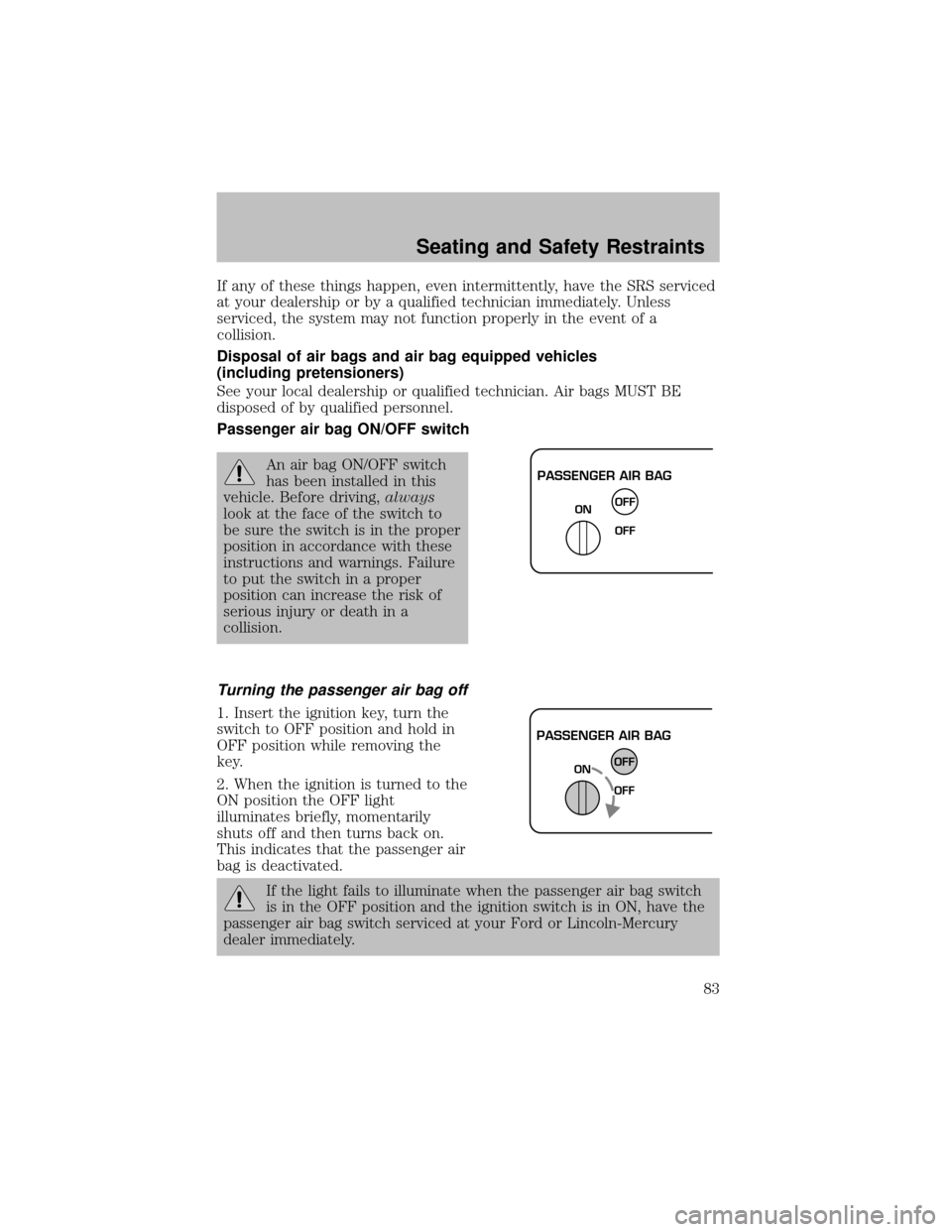
Passenger air bag ON/OFF switch
An air bag ON/OFF switch
has been installed in this
vehicle. Before driving,always
look at the face of the switch to
be sure the switch is in the proper
position in accordance with these
instructions and warnings. Failure
to put the switch in a proper
position can increase the risk of
serious injuryor death in a
collision.
Turning the passenger air bag off
1. Insert the ignition key, turn the
switch to OFF position and hold in
OFF position while removing the
key.
2. When the ignition is turned to the
ON position the OFF light
illuminates briefly, momentarily
shuts off and then turns back on.
This indicates that the passenger air
bag is deactivated.
If the light fails to illuminate when the passenger air bag switch
is in the OFF position and the ignition switch is in ON, have the
passenger air bag switch serviced at your Ford or Lincoln-Mercury
dealer immediately.
PASSENGER AIR BAG
OFF
OFF ON
PASSENGER AIR BAG
OFF
OFF ON
Seating and Safety Restraints
83
Page 85 of 256
If your vehicle has rear seats, always transport children who are
12 and younger in the rear seat. Always use safety belts and
child restraints properly. If a child in a rear facing infant seat must be
transported in front, the passenger air bagmustbe turned OFF. This is
because the back of the infant seat is too close to the inflating air bag
and the risk of a fatal injuryto the infant when the air bag inflates is
substantial.
The vast majorityof drivers and passengers are much safer with an air
bag than without. To do their job and reduce the risk of life threatening
injuries, air bags must open with great force, and this force can pose a
potentiallydeadlyrisk in some situations, particularlywhen a front seat
occupant is not properlybuckled up. The most effective wayto reduce
the risk of unnecessaryair bag injuries without reducing the overall
safetyof the vehicle is to make sure all occupants are properly
restrained in the vehicle, especiallyin the front seat. This provides the
protection of safetybelts and permits the air bags to provide the
additional protection theywere designed to provide. If you choose to
deactivate your air bag, you are losing the very significant risk reducing
benefits of the air bag and you are also reducing the effectiveness of the
safetybelts, because safetybelts in modern vehicles are designed to
work as a safetysystem with the air bags.
Read all air bag Warning labels in the vehicle as well as the other
important air bag instructions and Warnings in this Owner’s Guide.
NHTSA deactivation criteria (excluding Canada)
1.Infant.An infant (less than 1 year old) must ride in the front seat
because:
•the vehicle has no rear seat;
•the vehicle has a rear seat too small to accommodate a rear-facing
infant seat; or
•the infant has a medical condition which, according to the infant’s
physician, makes it necessary for the infant to ride in the front so that
the driver can constantlymonitor the child’s condition.
2.Child age 1 to 12.A child age 1 to 12 must ride in the front seat
because:
•the vehicle has no rear seat;
•although children ages 1 to 12 ride in the rear seat(s) whenever
possible, children ages 1 to 12 sometimes must ride in the front
because no space is available in the rear seat(s) of the vehicle; or
Seating and Safety Restraints
85
Page 88 of 256
Never let a passenger hold a child on his or her lap while the
vehicle is moving. The passenger cannot protect the child from
injuryin a collision.
Always follow the instructions and warnings that come with any infant or
child restraint you might use.
Children and safety belts
If the child is the proper size, restrain the child in a safetyseat. Children
who are too large for child safetyseats (as specified byyour child safety
seat manufacturer) should always wear safety belts.
Follow all the important safetyrestraint and air bag precautions that
applyto adult passengers in your vehicle.
If the shoulder belt portion of a combination lap and shoulder belt can
be positioned so it does not cross or rest in front of the child’s face or
neck, the child should wear the lap and shoulder belt. Moving the child
closer to the center of the vehicle mayhelp provide a good shoulder belt
fit.
Do not leave children, unreliable adults, or pets unattended in
your vehicle.
Child booster seats
Children outgrow a typical convertible or toddler seat when they weigh
40 pounds and are around 4 years of age. Although the lap/shoulder belt
will provide some protection, these children are still too small for
lap/shoulder belts to fit properly, which could increase the risk of serious
injury.
To improve the fit of both the lap and shoulder belt on children who
have outgrown child safetyseats, Ford Motor Companyrecommends use
of a belt-positioning booster.
Booster seats position a child so that safetybelts fit better. Theylift the
child up so that the lap belt rests low across the hips and the knees
bend comfortably. Booster seats also make the shoulder belt fit better
and more comfortablyfor growing children.
When children should use booster seats
Children need to use booster seats from the time theyoutgrow the
toddler seat until theyare big enough for the vehicle seat and
lap/shoulder belt to fit properly. Generallythis is when theyweigh about
80 lbs (about 8 to 12 years old).
Seating and Safety Restraints
88
Page 98 of 256
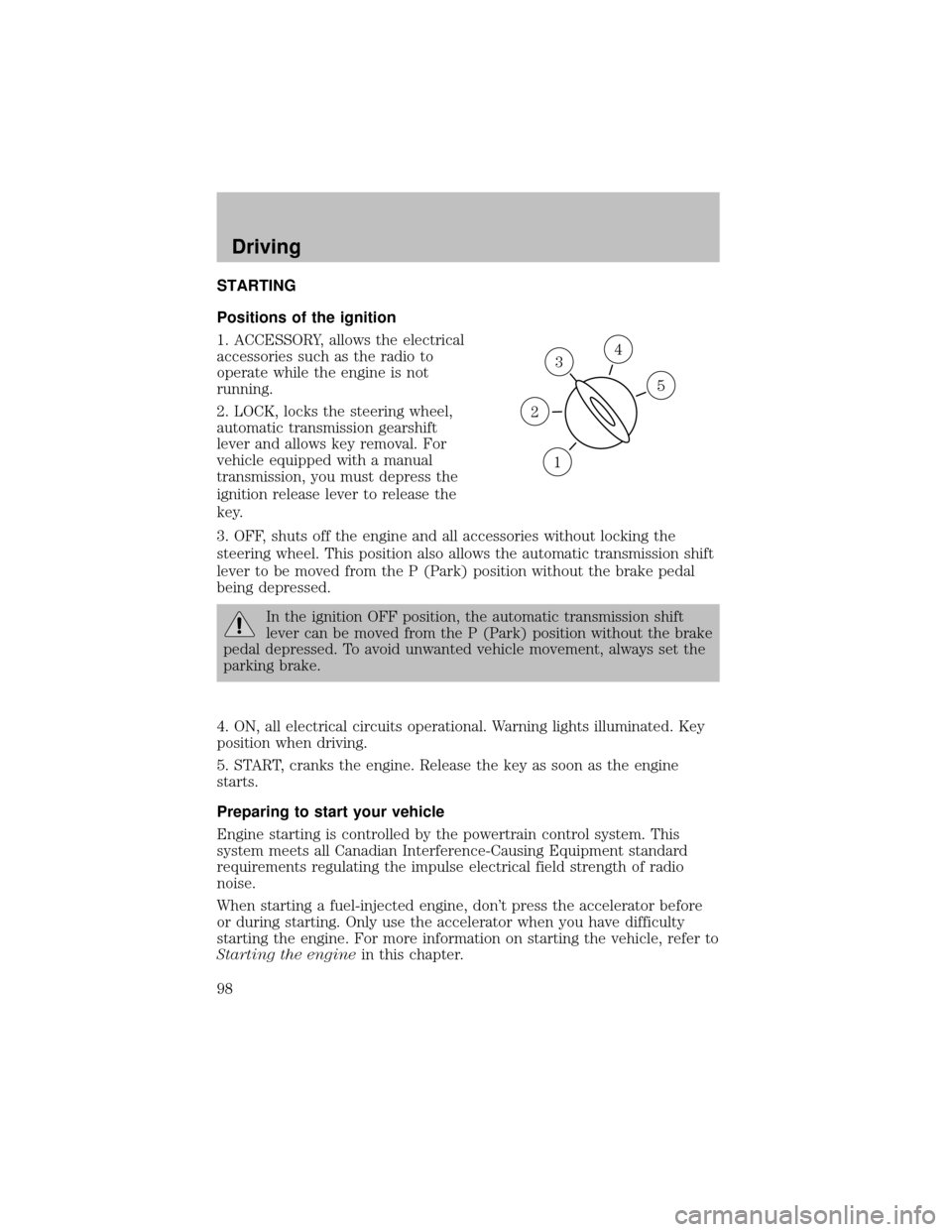
STARTING
Positions of the ignition
1. ACCESSORY, allows the electrical
accessories such as the radio to
operate while the engine is not
running.
2. LOCK, locks the steering wheel,
automatic transmission gearshift
lever and allows keyremoval. For
vehicle equipped with a manual
transmission, you must depress the
ignition release lever to release the
key.
3. OFF, shuts off the engine and all accessories without locking the
steering wheel. This position also allows the automatic transmission shift
lever to be moved from the P (Park) position without the brake pedal
being depressed.
In the ignition OFF position, the automatic transmission shift
lever can be moved from the P (Park) position without the brake
pedal depressed. To avoid unwanted vehicle movement, always set the
parking brake.
4. ON, all electrical circuits operational. Warning lights illuminated. Key
position when driving.
5. START, cranks the engine. Release the keyas soon as the engine
starts.
Preparing to start your vehicle
Engine starting is controlled bythe powertrain control system. This
system meets all Canadian Interference-Causing Equipment standard
requirements regulating the impulse electrical field strength of radio
noise.
When starting a fuel-injected engine, don’t press the accelerator before
or during starting. Onlyuse the accelerator when you have difficulty
starting the engine. For more information on starting the vehicle, refer to
Starting the enginein this chapter.
3
1
2
5
4
Driving
98
Page 103 of 256

emergencystops bykeeping the rear brakes from locking. The front
wheels, however, maystill lock since theyare not controlled bythe
RABS. Noise from the ABS pump motor and brake pedal pulsation may
be observed during ABS braking; this is normal.
RABS warning lamp
The
ABSwarning lamp in the instrument cluster momentarilyilluminates
when the ignition is turned to the ON position. If the light does not
illuminate momentarilyat start up, remains on or continues to flash, the
ABS needs to be serviced.
With the ABS light on, the anti-lock
brake system is disabled and normal
braking is still effective unless the
brake warning light also remains
illuminated with parking brake released. (If your brake warning lamp
illuminates, have your vehicle serviced immediately.)
Using RABS
In an emergency, apply ing full pressure may cause the front wheels to
lock.If the front brakes lock, the vehicle cannot be steered.Yo u
should applythe brakes with steadilyincreasing force, as if “squeezing”
the brakes. If you feel the front wheels begin to lock, momentarily
release the pedal and repeat the “squeeze” technique.
Four-wheel anti-lock brake system (ABS) (if equipped)
Your vehicle maybe equipped with an Anti-lock Braking System (ABS).
This system helps you maintain steering control during emergency stops
bykeeping the brakes from locking. Noise from the ABS pump motor
and brake pedal pulsation maybe observed during ABS braking; any
pulsation or mechanical noise you may feel or hear is normal.
ABS warning lamp
ABS
TheABSlamp in the instrument cluster momentarilyilluminates when
the ignition is turned to ON. If the light does not illuminate during start
up, remains on or flashes, the ABS maybe disabled and the ABS may
need to be serviced.
Even when the ABS is disabled,
normal braking is still effective. (If
your BRAKE warning lamp
illuminates with the parking brake
released, have your brake system serviced immediately.)
Driving
103