tow FORD SUPER DUTY 2003 1.G Owner's Manual
[x] Cancel search | Manufacturer: FORD, Model Year: 2003, Model line: SUPER DUTY, Model: FORD SUPER DUTY 2003 1.GPages: 256, PDF Size: 2.3 MB
Page 94 of 256
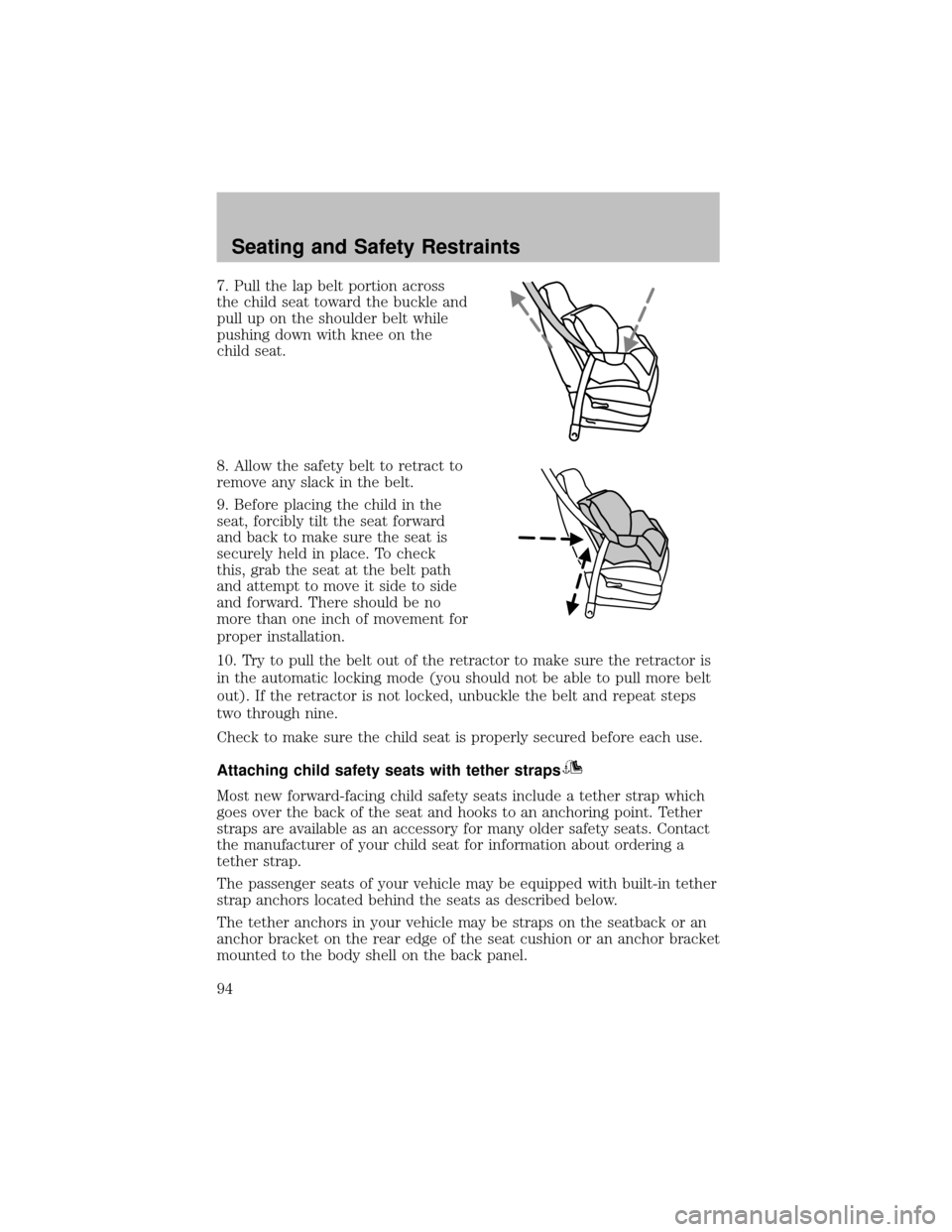
7. Pull the lap belt portion across
the child seat toward the buckle and
pull up on the shoulder belt while
pushing down with knee on the
child seat.
8. Allow the safetybelt to retract to
remove anyslack in the belt.
9. Before placing the child in the
seat, forciblytilt the seat forward
and back to make sure the seat is
securelyheld in place. To check
this, grab the seat at the belt path
and attempt to move it side to side
and forward. There should be no
more than one inch of movement for
proper installation.
10. Tryto pull the belt out of the retractor to make sure the retractor is
in the automatic locking mode (you should not be able to pull more belt
out). If the retractor is not locked, unbuckle the belt and repeat steps
two through nine.
Check to make sure the child seat is properlysecured before each use.
Attaching child safety seats with tether straps
Most new forward-facing child safetyseats include a tether strap which
goes over the back of the seat and hooks to an anchoring point. Tether
straps are available as an accessoryfor manyolder safetyseats. Contact
the manufacturer of your child seat for information about ordering a
tether strap.
The passenger seats of your vehicle may be equipped with built-in tether
strap anchors located behind the seats as described below.
The tether anchors in your vehicle may be straps on the seatback or an
anchor bracket on the rear edge of the seat cushion or an anchor bracket
mounted to the bodyshell on the back panel.
Seating and Safety Restraints
94
Page 108 of 256
N (Neutral)
With the gearshift lever in N (Neutral), the vehicle can be started and is
free to roll. Hold the brake pedal down while in this position.
(Overdrive)
The normal driving position for the best fuel economy. Transmission
operates in gears one through four.
(Overdrive) can be deactivated
bypressing the transmission control switch on the end of the gearshift
lever. This will illuminate the O/D OFF lamp and activate Drive.
Drive (not shown)
Drive is activated when the transmission control switch is pressed.
•This position allows for all forward gears except overdrive.
•O/D OFF lamp is illuminated.
•Provides engine braking.
•Use when driving conditions cause excessive shifting from O/D to
other gears. Examples: citytraffic, hillyterrain, heavyloads, trailer
towing and when engine braking is required.
•To return to O/D (overdrive mode), press the transmission control
switch. The O/D OFF lamp will not be illuminated.
•O/D (Overdrive) is automaticallyreturned each time the keyis turned
off.
2 (Second)
This position allows for second gear only.
•Provides engine braking.
•Use to start-up on slipperyroads.
•To return to
(Overdrive), move the gearshift lever into the
(Overdrive) position.
•Selecting 2 (Second) at higher speeds will cause the transmission to
downshift to second gear at the appropriate vehicle speed.
1 (First)
•Provides maximum engine braking.
•Allows upshifts bymoving gearshift lever.
•Will not downshift into 1 (First) at high speeds; allows for 1 (First)
when vehicle reaches slower speeds.
Forced downshifts
•Allowed in
(Overdrive) or Drive.
Driving
108
Page 111 of 256
Do not park your vehicle in Neutral, it may move unexpectedly
and injure someone. Use 1 (First) gear and set the parking brake
fully.
Removing the key
Turn the ignition off, push the release lever (located above the ignition),
then turn the keytoward you and remove the key.
REVERSE SENSING SYSTEM (IF EQUIPPED)
The Reverse Sensing System (RSS) sounds a tone to warn the driver of
obstacles near the rear bumper when the R (Reverse) is selected and the
vehicle is moving at speeds less than 5 km/h (3 mph). The system is not
effective at speeds above 5 km/h (3 mph) and maynot detect certain
angular or moving objects.
To help avoid personal injury, please read and understand the
limitations of the reverse sensing system as contained in this
section. Reverse sensing is onlyan aid for some (generallylarge and
fixed) objects when moving in reverse on a flat surface at “parking
speeds”. Inclement weather mayalso affect the function of the RSS;
this mayinclude reduced performance or a false activation.
To help avoid personal injury, alway s use caution when in
reverse and when using the RSS.
This system is not designed to prevent contact with small or
moving objects. The system is designed to provide a warning to
assist the driver in detecting large stationaryobjects to avoid damaging
the vehicle. The system may not detect smaller objects, particularly
those close to the ground.
Driving
111
Page 115 of 256
Note:Do not perform this operation if the rear wheels are slipping.
Shifting to/from 4L (4WD Low)
1. Bring the vehicle to a complete stop.
2. Depress the brake.
3. On vehicles equipped with an automatic transmission, place the
transmission in N (Neutral); on vehicles equipped with a manual
transmission, depress the clutch.
4. Move the transfer case lever through N (Neutral) directlyto the
desired position. The LOW RANGE indicator will illuminate once the
transfer case has engaged.
•If the transfer casedoes notengage, repeat steps 1 through 4.
Using the N (Neutral) position
The transfer case N (Neutral) position overrides the transmission
and puts the vehicle in neutral regardless of transmission
gearshift lever position. The vehicle can move forward or
backward.
This position should onlybe used when towing the vehicle.
Do not leave the vehicle unattended with the transfer case in the
N (Neutral) position. Always set the parking brake fully and turn
off the ignition when leaving the vehicle.
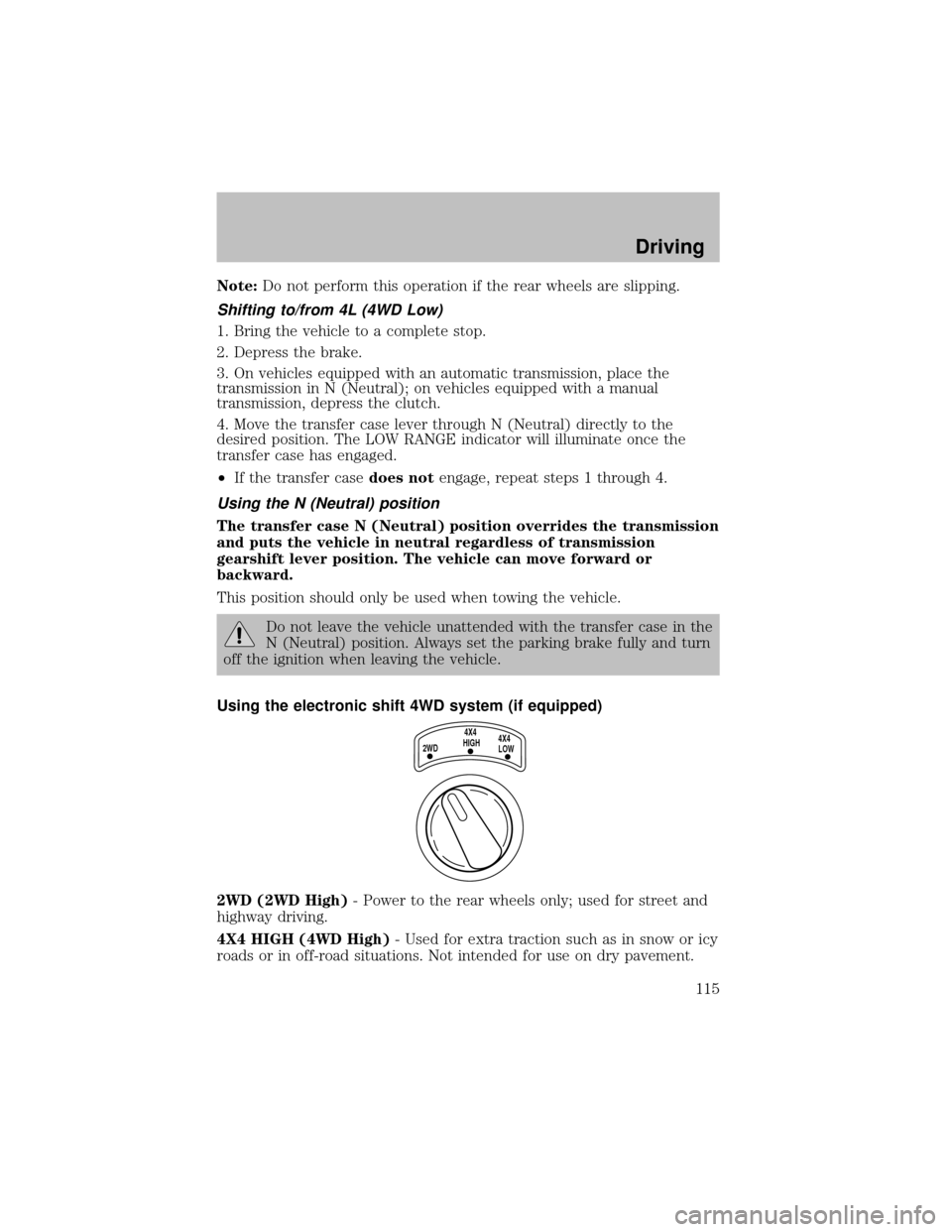
Using the electronic shift 4WD system (if equipped)
2WD (2WD High)- Power to the rear wheels only; used for street and
highwaydriving.
4X4 HIGH (4WD High)- Used for extra traction such as in snow or icy
roads or in off-road situations. Not intended for use on drypavement.
2WD4X4
HIGH4X4
LOW
Driving
115
Page 126 of 256
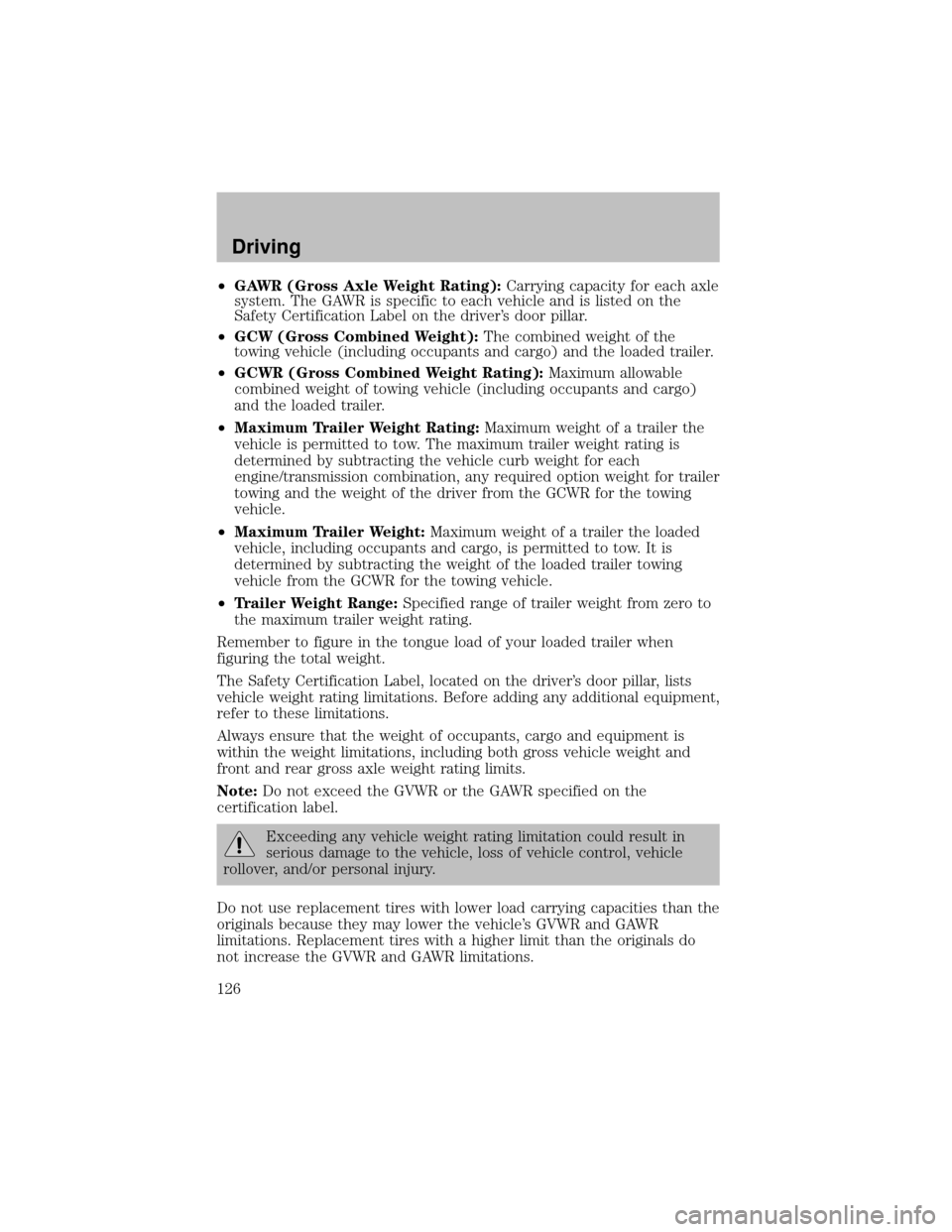
•GAWR (Gross Axle Weight Rating):Carrying capacity for each axle
system. The GAWR is specific to each vehicle and is listed on the
SafetyCertification Label on the driver’s door pillar.
•GCW (Gross Combined Weight):The combined weight of the
towing vehicle (including occupants and cargo) and the loaded trailer.
•GCWR (Gross Combined Weight Rating):Maximum allowable
combined weight of towing vehicle (including occupants and cargo)
and the loaded trailer.
•Maximum Trailer Weight Rating:Maximum weight of a trailer the
vehicle is permitted to tow. The maximum trailer weight rating is
determined bysubtracting the vehicle curb weight for each
engine/transmission combination, anyrequired option weight for trailer
towing and the weight of the driver from the GCWR for the towing
vehicle.
•Maximum Trailer Weight:Maximum weight of a trailer the loaded
vehicle, including occupants and cargo, is permitted to tow. It is
determined bysubtracting the weight of the loaded trailer towing
vehicle from the GCWR for the towing vehicle.
•Trailer Weight Range:Specified range of trailer weight from zero to
the maximum trailer weight rating.
Remember to figure in the tongue load of your loaded trailer when
figuring the total weight.
The SafetyCertification Label, located on the driver’s door pillar, lists
vehicle weight rating limitations. Before adding anyadditional equipment,
refer to these limitations.
Always ensure that the weight of occupants, cargo and equipment is
within the weight limitations, including both gross vehicle weight and
front and rear gross axle weight rating limits.
Note:Do not exceed the GVWR or the GAWR specified on the
certification label.
Exceeding anyvehicle weight rating limitation could result in
serious damage to the vehicle, loss of vehicle control, vehicle
rollover, and/or personal injury.
Do not use replacement tires with lower load carrying capacities than the
originals because theymaylower the vehicle’s GVWR and GAWR
limitations. Replacement tires with a higher limit than the originals do
not increase the GVWR and GAWR limitations.
Driving
126
Page 127 of 256
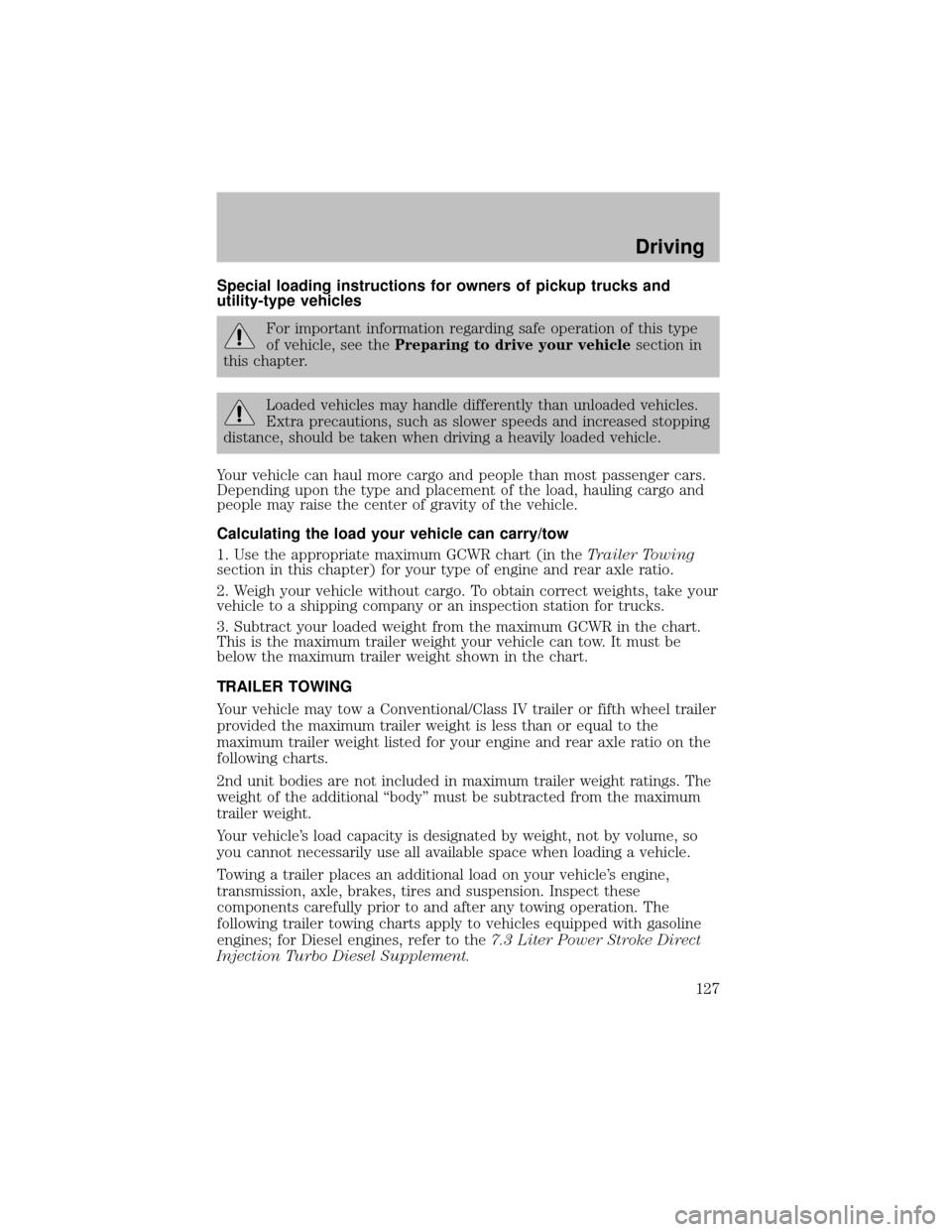
Special loading instructions for owners of pickup trucks and
utility-type vehicles
For important information regarding safe operation of this type
of vehicle, see thePreparing to drive your vehiclesection in
this chapter.
Loaded vehicles mayhandle differentlythan unloaded vehicles.
Extra precautions, such as slower speeds and increased stopping
distance, should be taken when driving a heavilyloaded vehicle.
Your vehicle can haul more cargo and people than most passenger cars.
Depending upon the type and placement of the load, hauling cargo and
people mayraise the center of gravityof the vehicle.
Calculating the load your vehicle can carry/tow
1. Use the appropriate maximum GCWR chart (in theTrailer Towing
section in this chapter) for your type of engine and rear axle ratio.
2. Weigh your vehicle without cargo. To obtain correct weights, take your
vehicle to a shipping companyor an inspection station for trucks.
3. Subtract your loaded weight from the maximum GCWR in the chart.
This is the maximum trailer weight your vehicle can tow. It must be
below the maximum trailer weight shown in the chart.
TRAILER TOWING
Your vehicle maytow a Conventional/Class IV trailer or fifth wheel trailer
provided the maximum trailer weight is less than or equal to the
maximum trailer weight listed for your engine and rear axle ratio on the
following charts.
2nd unit bodies are not included in maximum trailer weight ratings. The
weight of the additional “body” must be subtracted from the maximum
trailer weight.
Your vehicle’s load capacityis designated byweight, not byvolume, so
you cannot necessarily use all available space when loading a vehicle.
Towing a trailer places an additional load on your vehicle’s engine,
transmission, axle, brakes, tires and suspension. Inspect these
components carefullyprior to and after anytowing operation. The
following trailer towing charts applyto vehicles equipped with gasoline
engines; for Diesel engines, refer to the7.3 Liter Power Stroke Direct
Injection Turbo Diesel Supplement.
Driving
127
Page 128 of 256
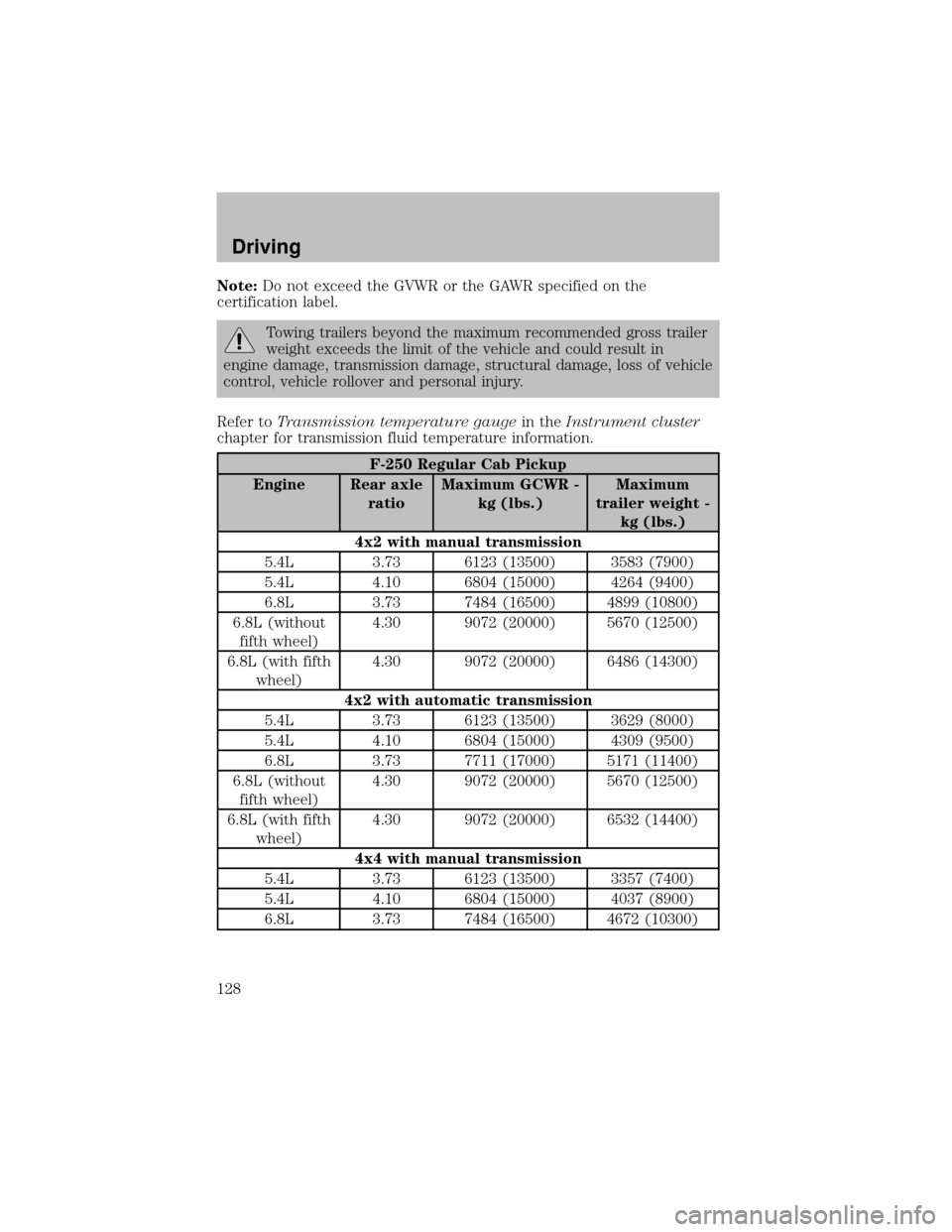
Note:Do not exceed the GVWR or the GAWR specified on the
certification label.
Towing trailers beyond the maximum recommended gross trailer
weight exceeds the limit of the vehicle and could result in
engine damage, transmission damage, structural damage, loss of vehicle
control, vehicle rollover and personal injury.
Refer toTransmission temperature gaugein theInstrument cluster
chapter for transmission fluid temperature information.
F-250 Regular Cab Pickup
Engine Rear axle
ratioMaximum GCWR -
kg (lbs.)Maximum
trailer weight -
kg (lbs.)
4x2 with manual transmission
5.4L 3.73 6123 (13500) 3583 (7900)
5.4L 4.10 6804 (15000) 4264 (9400)
6.8L 3.73 7484 (16500) 4899 (10800)
6.8L (without
fifth wheel)4.30 9072 (20000) 5670 (12500)
6.8L (with fifth
wheel)4.30 9072 (20000) 6486 (14300)
4x2 with automatictransmission
5.4L 3.73 6123 (13500) 3629 (8000)
5.4L 4.10 6804 (15000) 4309 (9500)
6.8L 3.73 7711 (17000) 5171 (11400)
6.8L (without
fifth wheel)4.30 9072 (20000) 5670 (12500)
6.8L (with fifth
wheel)4.30 9072 (20000) 6532 (14400)
4x4 with manual transmission
5.4L 3.73 6123 (13500) 3357 (7400)
5.4L 4.10 6804 (15000) 4037 (8900)
6.8L 3.73 7484 (16500) 4672 (10300)
Driving
128
Page 138 of 256
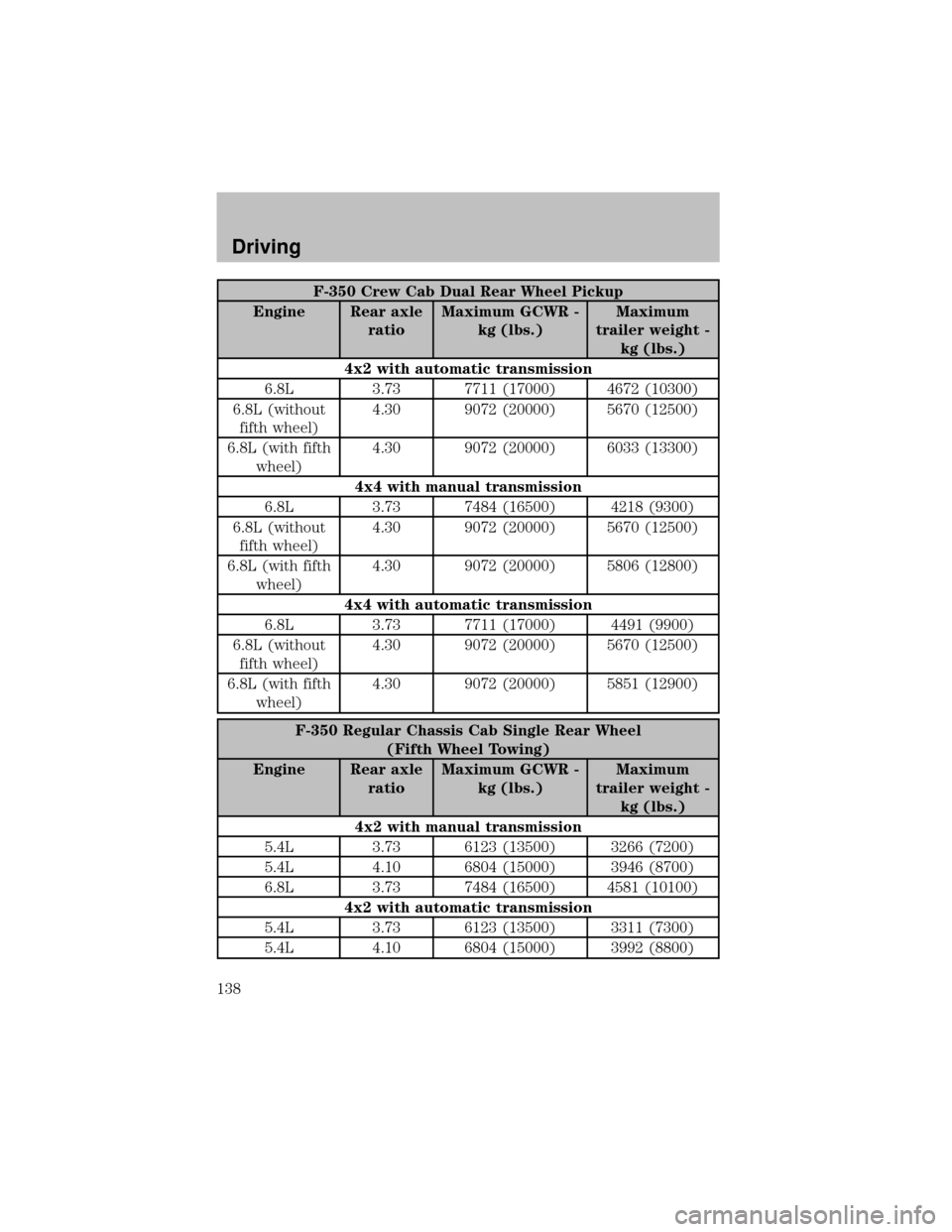
F-350 Crew Cab Dual Rear Wheel Pickup
Engine Rear axle
ratioMaximum GCWR -
kg (lbs.)Maximum
trailer weight -
kg (lbs.)
4x2 with automatictransmission
6.8L 3.73 7711 (17000) 4672 (10300)
6.8L (without
fifth wheel)4.30 9072 (20000) 5670 (12500)
6.8L (with fifth
wheel)4.30 9072 (20000) 6033 (13300)
4x4 with manual transmission
6.8L 3.73 7484 (16500) 4218 (9300)
6.8L (without
fifth wheel)4.30 9072 (20000) 5670 (12500)
6.8L (with fifth
wheel)4.30 9072 (20000) 5806 (12800)
4x4 with automatictransmission
6.8L 3.73 7711 (17000) 4491 (9900)
6.8L (without
fifth wheel)4.30 9072 (20000) 5670 (12500)
6.8L (with fifth
wheel)4.30 9072 (20000) 5851 (12900)
F-350 Regular Chassis Cab Single Rear Wheel
(Fifth Wheel Towing)
Engine Rear axle
ratioMaximum GCWR -
kg (lbs.)Maximum
trailer weight -
kg (lbs.)
4x2 with manual transmission
5.4L 3.73 6123 (13500) 3266 (7200)
5.4L 4.10 6804 (15000) 3946 (8700)
6.8L 3.73 7484 (16500) 4581 (10100)
4x2 with automatictransmission
5.4L 3.73 6123 (13500) 3311 (7300)
5.4L 4.10 6804 (15000) 3992 (8800)
Driving
138
Page 139 of 256
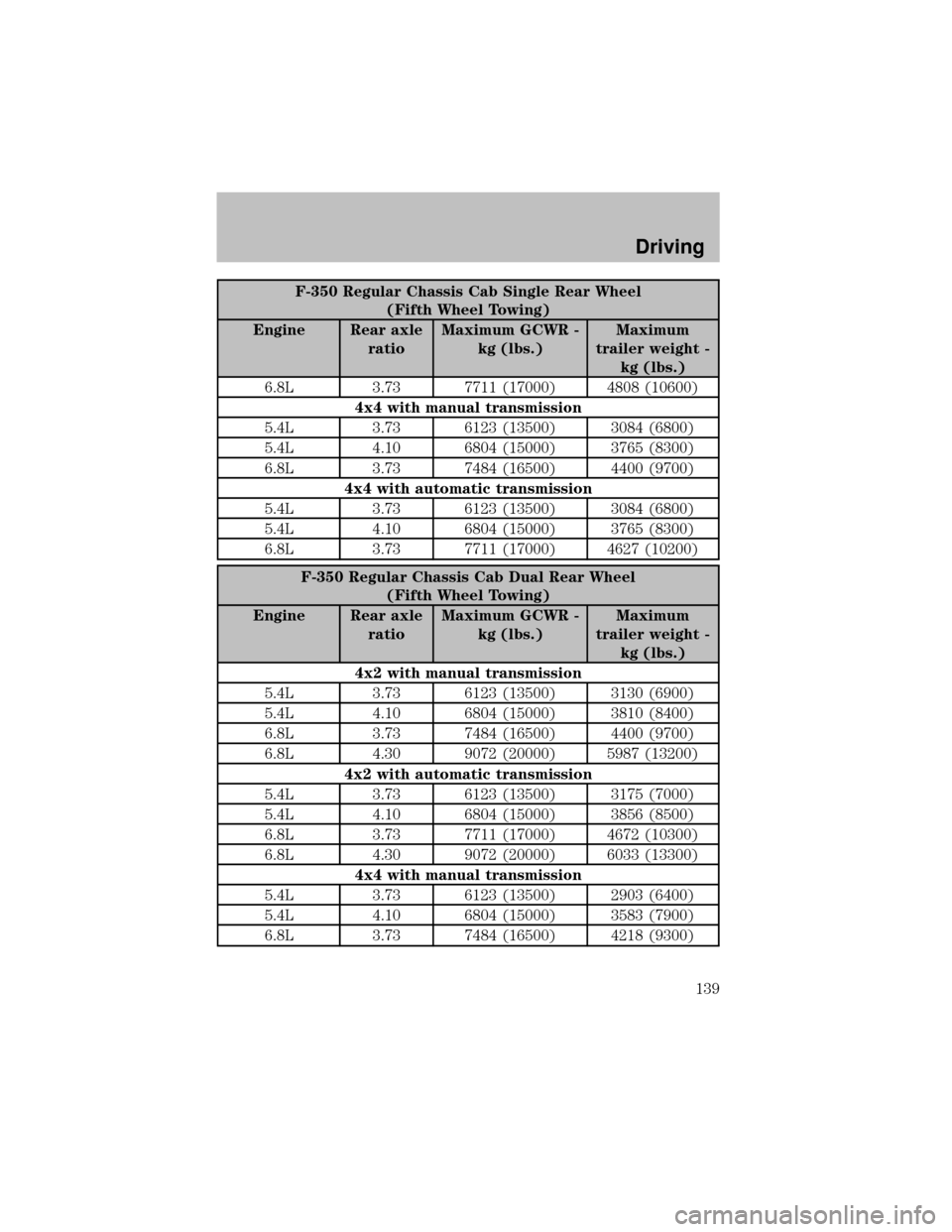
F-350 Regular Chassis Cab Single Rear Wheel
(Fifth Wheel Towing)
Engine Rear axle
ratioMaximum GCWR -
kg (lbs.)Maximum
trailer weight -
kg (lbs.)
6.8L 3.73 7711 (17000) 4808 (10600)
4x4 with manual transmission
5.4L 3.73 6123 (13500) 3084 (6800)
5.4L 4.10 6804 (15000) 3765 (8300)
6.8L 3.73 7484 (16500) 4400 (9700)
4x4 with automatictransmission
5.4L 3.73 6123 (13500) 3084 (6800)
5.4L 4.10 6804 (15000) 3765 (8300)
6.8L 3.73 7711 (17000) 4627 (10200)
F-350 Regular Chassis Cab Dual Rear Wheel
(Fifth Wheel Towing)
Engine Rear axle
ratioMaximum GCWR -
kg (lbs.)Maximum
trailer weight -
kg (lbs.)
4x2 with manual transmission
5.4L 3.73 6123 (13500) 3130 (6900)
5.4L 4.10 6804 (15000) 3810 (8400)
6.8L 3.73 7484 (16500) 4400 (9700)
6.8L 4.30 9072 (20000) 5987 (13200)
4x2 with automatictransmission
5.4L 3.73 6123 (13500) 3175 (7000)
5.4L 4.10 6804 (15000) 3856 (8500)
6.8L 3.73 7711 (17000) 4672 (10300)
6.8L 4.30 9072 (20000) 6033 (13300)
4x4 with manual transmission
5.4L 3.73 6123 (13500) 2903 (6400)
5.4L 4.10 6804 (15000) 3583 (7900)
6.8L 3.73 7484 (16500) 4218 (9300)
Driving
139
Page 140 of 256
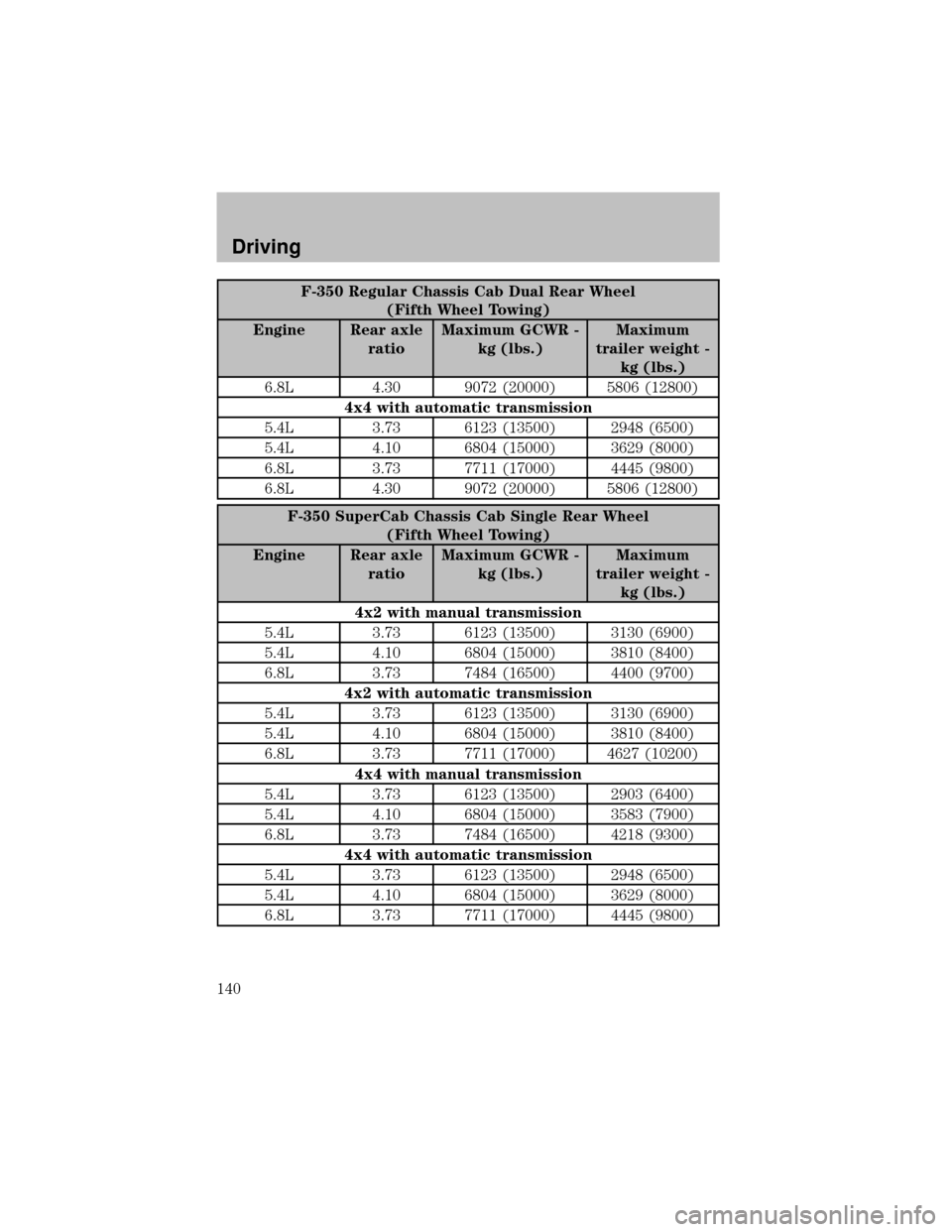
F-350 Regular Chassis Cab Dual Rear Wheel
(Fifth Wheel Towing)
Engine Rear axle
ratioMaximum GCWR -
kg (lbs.)Maximum
trailer weight -
kg (lbs.)
6.8L 4.30 9072 (20000) 5806 (12800)
4x4 with automatictransmission
5.4L 3.73 6123 (13500) 2948 (6500)
5.4L 4.10 6804 (15000) 3629 (8000)
6.8L 3.73 7711 (17000) 4445 (9800)
6.8L 4.30 9072 (20000) 5806 (12800)
F-350 SuperCab Chassis Cab Single Rear Wheel
(Fifth Wheel Towing)
Engine Rear axle
ratioMaximum GCWR -
kg (lbs.)Maximum
trailer weight -
kg (lbs.)
4x2 with manual transmission
5.4L 3.73 6123 (13500) 3130 (6900)
5.4L 4.10 6804 (15000) 3810 (8400)
6.8L 3.73 7484 (16500) 4400 (9700)
4x2 with automatictransmission
5.4L 3.73 6123 (13500) 3130 (6900)
5.4L 4.10 6804 (15000) 3810 (8400)
6.8L 3.73 7711 (17000) 4627 (10200)
4x4 with manual transmission
5.4L 3.73 6123 (13500) 2903 (6400)
5.4L 4.10 6804 (15000) 3583 (7900)
6.8L 3.73 7484 (16500) 4218 (9300)
4x4 with automatictransmission
5.4L 3.73 6123 (13500) 2948 (6500)
5.4L 4.10 6804 (15000) 3629 (8000)
6.8L 3.73 7711 (17000) 4445 (9800)
Driving
140