ESP FORD SUPER DUTY 2003 1.G Owners Manual
[x] Cancel search | Manufacturer: FORD, Model Year: 2003, Model line: SUPER DUTY, Model: FORD SUPER DUTY 2003 1.GPages: 256, PDF Size: 2.3 MB
Page 5 of 256
Warning symbols on your vehicle
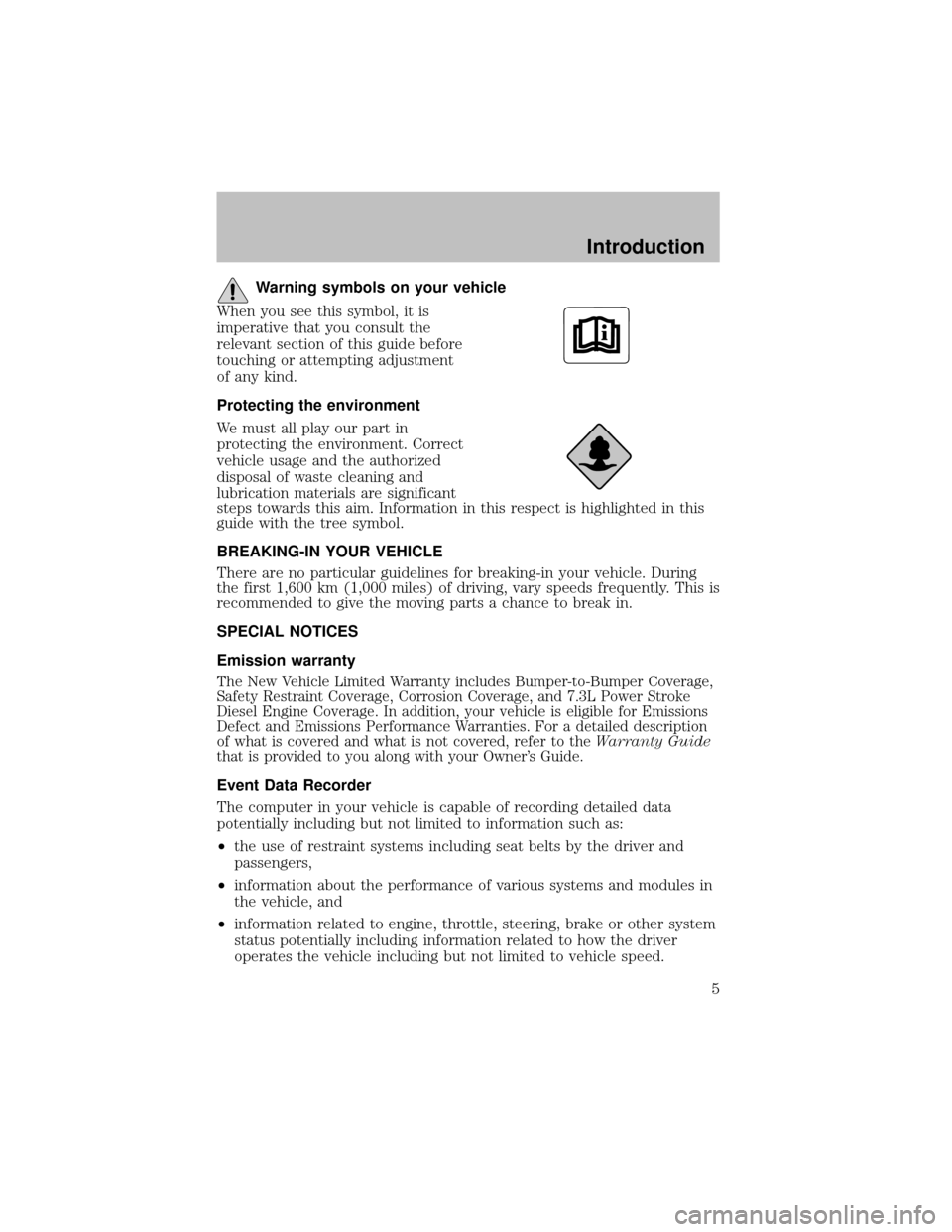
When you see this symbol, it is
imperative that you consult the
relevant section of this guide before
touching or attempting adjustment
of anykind.
Protecting the environment
We must all playour part in
protecting the environment. Correct
vehicle usage and the authorized
disposal of waste cleaning and
lubrication materials are significant
steps towards this aim. Information in this respect is highlighted in this
guide with the tree symbol.
BREAKING-IN YOUR VEHICLE
There are no particular guidelines for breaking-in your vehicle. During
the first 1,600 km (1,000 miles) of driving, varyspeeds frequently. This is
recommended to give the moving parts a chance to break in.
SPECIAL NOTICES
Emission warranty
The New Vehicle Limited Warrantyincludes Bumper-to-Bumper Coverage,
SafetyRestraint Coverage, Corrosion Coverage, and 7.3L Power Stroke
Diesel Engine Coverage. In addition, your vehicle is eligible for Emissions
Defect and Emissions Performance Warranties. For a detailed description
of what is covered and what is not covered, refer to theWarranty Guide
that is provided to you along with your Owner’s Guide.
Event Data Recorder
The computer in your vehicle is capable of recording detailed data
potentiallyincluding but not limited to information such as:
•the use of restraint systems including seat belts by the driver and
passengers,
•information about the performance of various systems and modules in
the vehicle, and
•information related to engine, throttle, steering, brake or other system
status potentiallyincluding information related to how the driver
operates the vehicle including but not limited to vehicle speed.
Introduction
5
Page 10 of 256
WARNING LIGHTS AND CHIMES
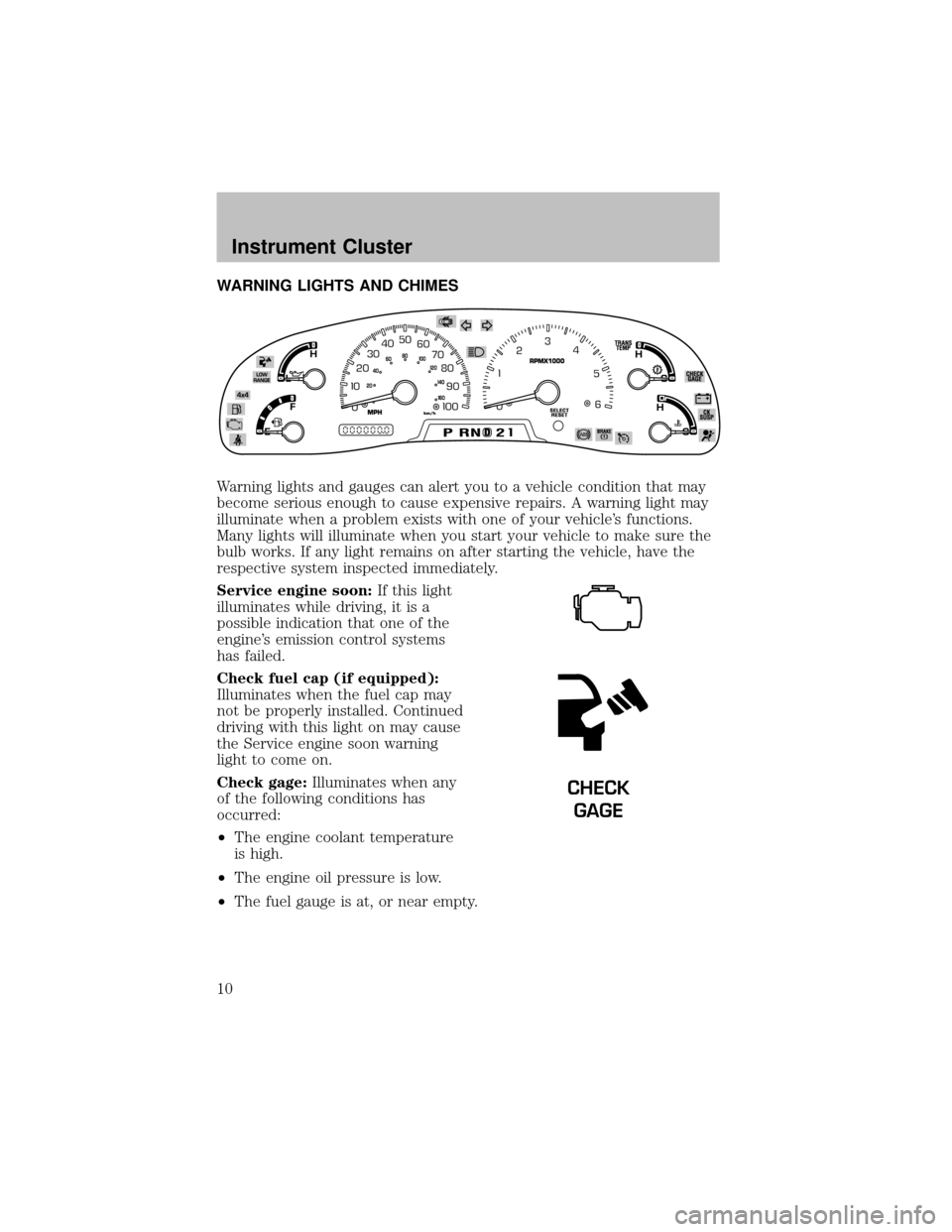
Warning lights and gauges can alert you to a vehicle condition that may
become serious enough to cause expensive repairs. A warning light may
illuminate when a problem exists with one of your vehicle’s functions.
Many lights will illuminate when you start your vehicle to make sure the
bulb works. If anylight remains on after starting the vehicle, have the
respective system inspected immediately.
Service engine soon:If this light
illuminates while driving, it is a
possible indication that one of the
engine’s emission control systems
has failed.
Check fuel cap (if equipped):
Illuminates when the fuel cap may
not be properlyinstalled. Continued
driving with this light on maycause
the Service engine soon warning
light to come on.
Check gage:Illuminates when any
of the following conditions has
occurred:
•The engine coolant temperature
is high.
•The engine oil pressure is low.
•The fuel gauge is at, or near empty.
CHECK
GAGE
Instrument Cluster
10
Page 30 of 256

To remove discs:
1. Slide the corresponding lever on the opposite side of the magazine
window. The disc will partiallyeject.
2. Remove the disc.
Radio power must be turned on to playthe CDs in the changer. The
magazine maybe stored in the glove box when not being used.
The CD magazine maybe inserted or ejected with the radio power off.
ONLY use the magazine supplied with the CD changer, other types will
damage the unit.
Keep the CD changer door closed. Coins and foreign objects will damage
the CD player and void your audio system warranty.
RADIO FREQUENCIES
AM and FM frequencies are established bythe Federal Communications
Commission (FCC) and the Canadian Radio and Telecommunications
Commission (CRTC). Those frequencies are:
AM - 530, 540–1700, 1710 kHz
FM- 87.7, 87.9–107.7, 107.9 MHz
RADIO RECEPTION FACTORS
There are three factors that can effect radio reception:
•Distance/strength: The further you travel from an FM station, the
weaker the signal and the weaker the reception.
•Terrain: Hills, mountains, tall buildings, power lines, electric fences,
traffic lights and thunderstorms can interfere with your reception.
•Station overload: When you pass a broadcast tower, a stronger signal
mayovertake a weaker one and playwhile the weak station frequency
is displayed.
CASSETTE/PLAYER CARE
Do:
•Use onlycassettes that are 90 minutes long or less.
•Tighten veryloose tapes byinserting a finger or pencil into the hole
and turning the hub.
•Remove loose labels before inserting tapes.
•Allow tapes which have been subjected to extreme heat, humidityor
cold to reach a moderate temperature before playing.
Entertainment Systems
30
Page 48 of 256
Fold-away mirrors
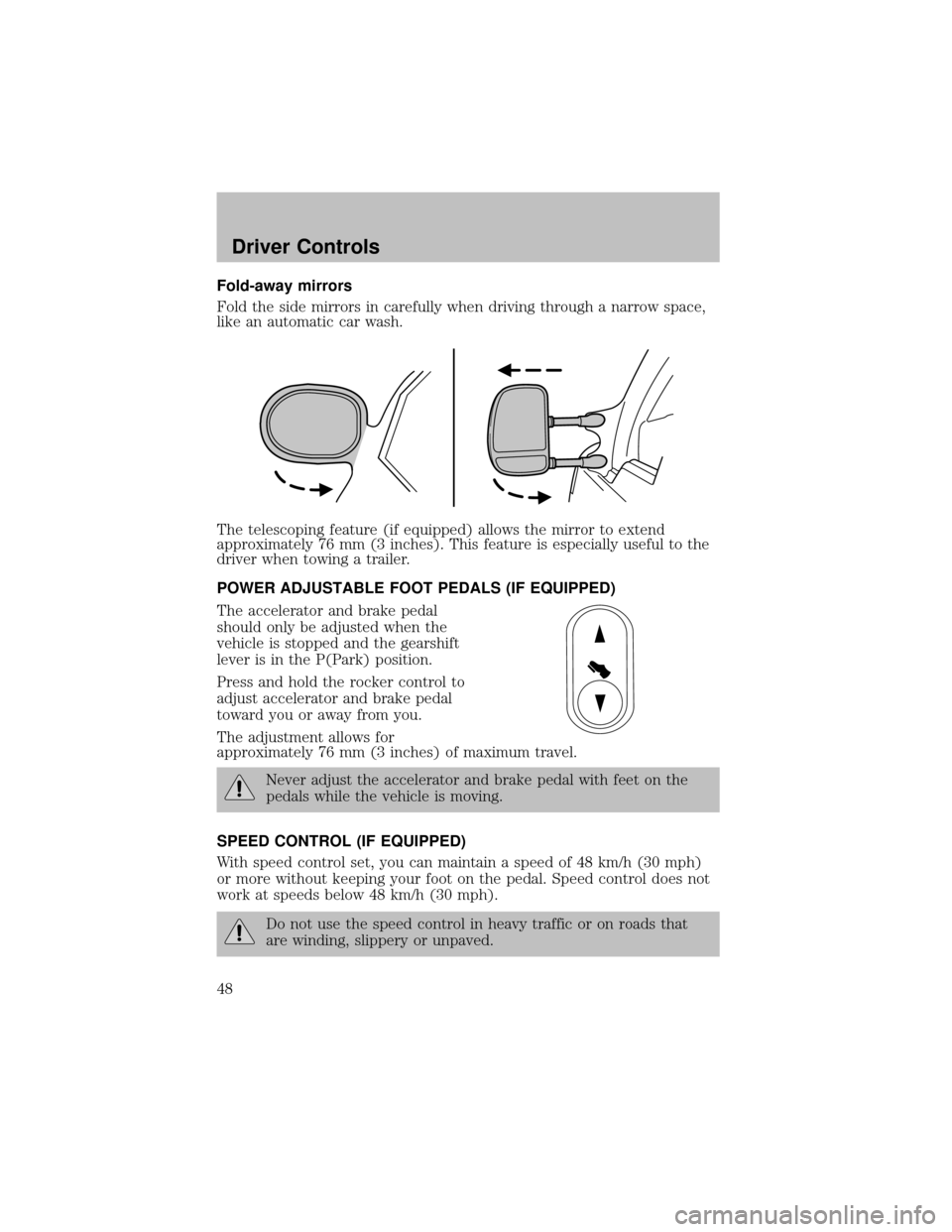
Fold the side mirrors in carefullywhen driving through a narrow space,
like an automatic car wash.
The telescoping feature (if equipped) allows the mirror to extend
approximately76 mm (3 inches). This feature is especiallyuseful to the
driver when towing a trailer.
POWER ADJUSTABLE FOOT PEDALS (IF EQUIPPED)
The accelerator and brake pedal
should onlybe adjusted when the
vehicle is stopped and the gearshift
lever is in the P(Park) position.
Press and hold the rocker control to
adjust accelerator and brake pedal
toward you or away from you.
The adjustment allows for
approximately76 mm (3 inches) of maximum travel.
Never adjust the accelerator and brake pedal with feet on the
pedals while the vehicle is moving.
SPEED CONTROL (IF EQUIPPED)
With speed control set, you can maintain a speed of 48 km/h (30 mph)
or more without keeping your foot on the pedal. Speed control does not
work at speeds below 48 km/h (30 mph).
Do not use the speed control in heavytraffic or on roads that
are winding, slipperyor unpaved.
Driver Controls
48
Page 57 of 256

Childproof door locks
•When these locks are set, the
rear doors cannot be opened from
the inside.
•The rear doors can be opened
from the outside when the doors
are unlocked.
The childproof locks are located on
rear edge of each rear door and
must be set separatelyfor each
door. Setting the lock for one door
will not automaticallyset the lock
for both doors.
•Move lock control up to engage
the childproof lock.
•Move control down to disengage
childproof locks.
REMOTE ENTRY SYSTEM (IF EQUIPPED)
This device complies with part 15 of the FCC rules and with RS-210 of
IndustryCanada. Operation is subject to the following two conditions:
(1) This device maynot cause harmful interference, and (2) This device
must accept anyinterference received, including interference that may
cause undesired operation.
Changes or modifications not expressly approved by the party
responsible for compliance could void the user’s authority to
operate the equipment.
Locks and Security
57
Page 70 of 256
The front and rear outboard safetyrestraints in the vehicle are
combination lap and shoulder belts. The front passenger and rear seat
outboard safetybelts have two types of locking modes described below:
Vehicle sensitive mode
This is the normal retractor mode, which allows free shoulder belt length
adjustment to your movements and locking in response to vehicle
movement. For example, if the driver brakes suddenlyor turns a corner
sharply, or the vehicle receives an impact of approximately 8 km/h (5
mph) or more, the combination safetybelts will lock to help reduce
forward movement of the driver and passengers.
On SuperCab and CrewCab models, the front seat belt system can also
be made to lock manuallybyquicklypulling on the shoulder belt.
Rear seat belts (if equipped) cannot be made to lock up bypulling
quicklyon the belt.
Automatic locking mode
The automatic locking mode is not available on the driver safetybelt.
When to use the automatic locking mode
In this mode, the shoulder belt is automaticallypre-locked. The belt will
still retract to remove anyslack in the shoulder belt. The automatic
locking mode is not available on the driver safetybelt.
This mode should be usedany timea child safetyseat is installed in a
passenger front or outboard rear seating position (if equipped). Children
12 years old and under should be properly restrained in the rear seat
whenever possible. Refer toSafety restraints for childrenorSafety
seats for childrenlater in this chapter.
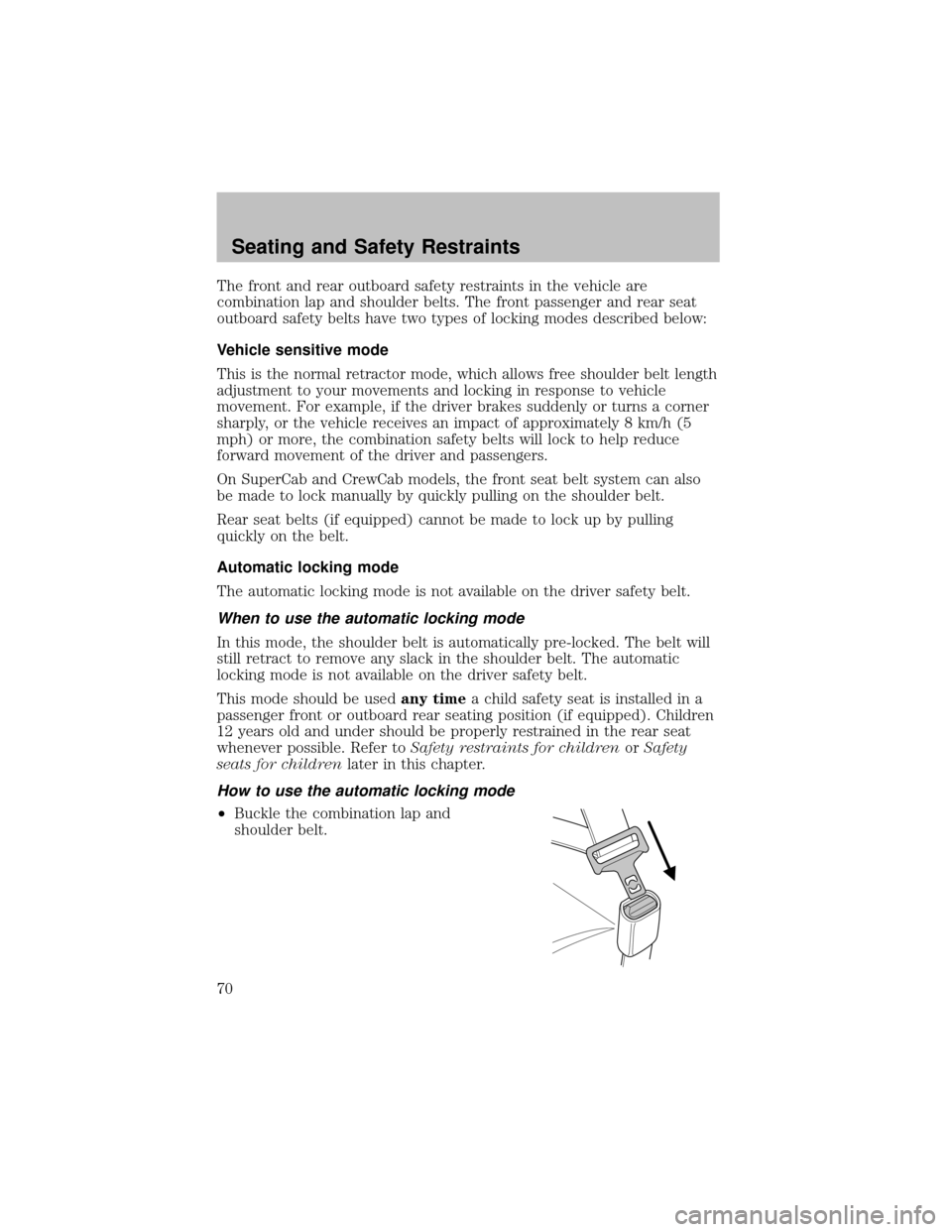
How to use the automatic locking mode
•Buckle the combination lap and
shoulder belt.
Seating and Safety Restraints
70
Page 85 of 256
If your vehicle has rear seats, always transport children who are
12 and younger in the rear seat. Always use safety belts and
child restraints properly. If a child in a rear facing infant seat must be
transported in front, the passenger air bagmustbe turned OFF. This is
because the back of the infant seat is too close to the inflating air bag
and the risk of a fatal injuryto the infant when the air bag inflates is
substantial.
The vast majorityof drivers and passengers are much safer with an air
bag than without. To do their job and reduce the risk of life threatening
injuries, air bags must open with great force, and this force can pose a
potentiallydeadlyrisk in some situations, particularlywhen a front seat
occupant is not properlybuckled up. The most effective wayto reduce
the risk of unnecessaryair bag injuries without reducing the overall
safetyof the vehicle is to make sure all occupants are properly
restrained in the vehicle, especiallyin the front seat. This provides the
protection of safetybelts and permits the air bags to provide the
additional protection theywere designed to provide. If you choose to
deactivate your air bag, you are losing the very significant risk reducing
benefits of the air bag and you are also reducing the effectiveness of the
safetybelts, because safetybelts in modern vehicles are designed to
work as a safetysystem with the air bags.
Read all air bag Warning labels in the vehicle as well as the other
important air bag instructions and Warnings in this Owner’s Guide.
NHTSA deactivation criteria (excluding Canada)
1.Infant.An infant (less than 1 year old) must ride in the front seat
because:
•the vehicle has no rear seat;
•the vehicle has a rear seat too small to accommodate a rear-facing
infant seat; or
•the infant has a medical condition which, according to the infant’s
physician, makes it necessary for the infant to ride in the front so that
the driver can constantlymonitor the child’s condition.
2.Child age 1 to 12.A child age 1 to 12 must ride in the front seat
because:
•the vehicle has no rear seat;
•although children ages 1 to 12 ride in the rear seat(s) whenever
possible, children ages 1 to 12 sometimes must ride in the front
because no space is available in the rear seat(s) of the vehicle; or
Seating and Safety Restraints
85
Page 87 of 256
•the child has a medical condition that, according to the child’s
physician, makes it necessary for the child to ride in the front seat so
that the driver can monitor the child’s condition.
3.Medical condition:A passenger has a medical condition that,
according to his or her physician:
•poses a special risk for the passenger if the air bag deploys; and
•makes the potential harm from the passenger air bag deployment
greater than the potential harm from turning OFF the air bag and
experiencing a crash without the protection offered bythe air bag
This vehicle has special energymanagement safetybelts for the
driver and right front passenger. These particular belts are
specificallydesigned to work with air bags to help reduce the risk of
injuryin a collision. The energymanagement safetybelt is designed to
give or release additional belt webbing in some accidents to reduce
concentration of force on an occupant’s chest and reduce the risk of
certain bone fractures and injuries to underlying organs. In a crash, if
the air bag is turned OFF, this energymanagement safetybelt might
permit the person wearing the belt to move forward enough to incur a
serious or fatal injury. The more severe the crash, and the heavier the
occupant, the greater the risk is. Be sure the air bag is turned ON for
anyperson who does not qualifyunder the NHTSA deactivation
criteria.
SAFETY RESTRAINTS FOR CHILDREN
See the following sections for directions on how to properlyuse safety
restraints for children. Also seeAir bag supplemental restraint system
(SRS)in this chapter for special instructions about using air bags.
Important child restraint precautions
You are required bylaw to use safetyrestraints for children in the U.S.
and Canada. If small children (generallychildren who are four years old
or younger and who weigh 18 kg [40 lbs] or less) ride in your vehicle,
you must put them in safetyseats made especiallyfor children. Check
your local and state or provincial laws for specific requirements
regarding the safety of children in your vehicle. When possible, always
place children under age 12 in the rear seat of your vehicle. Accident
statistics suggest that children are safer when properlyrestrained in the
rear seating positions than in the front seating position.
Seating and Safety Restraints
87
Page 101 of 256
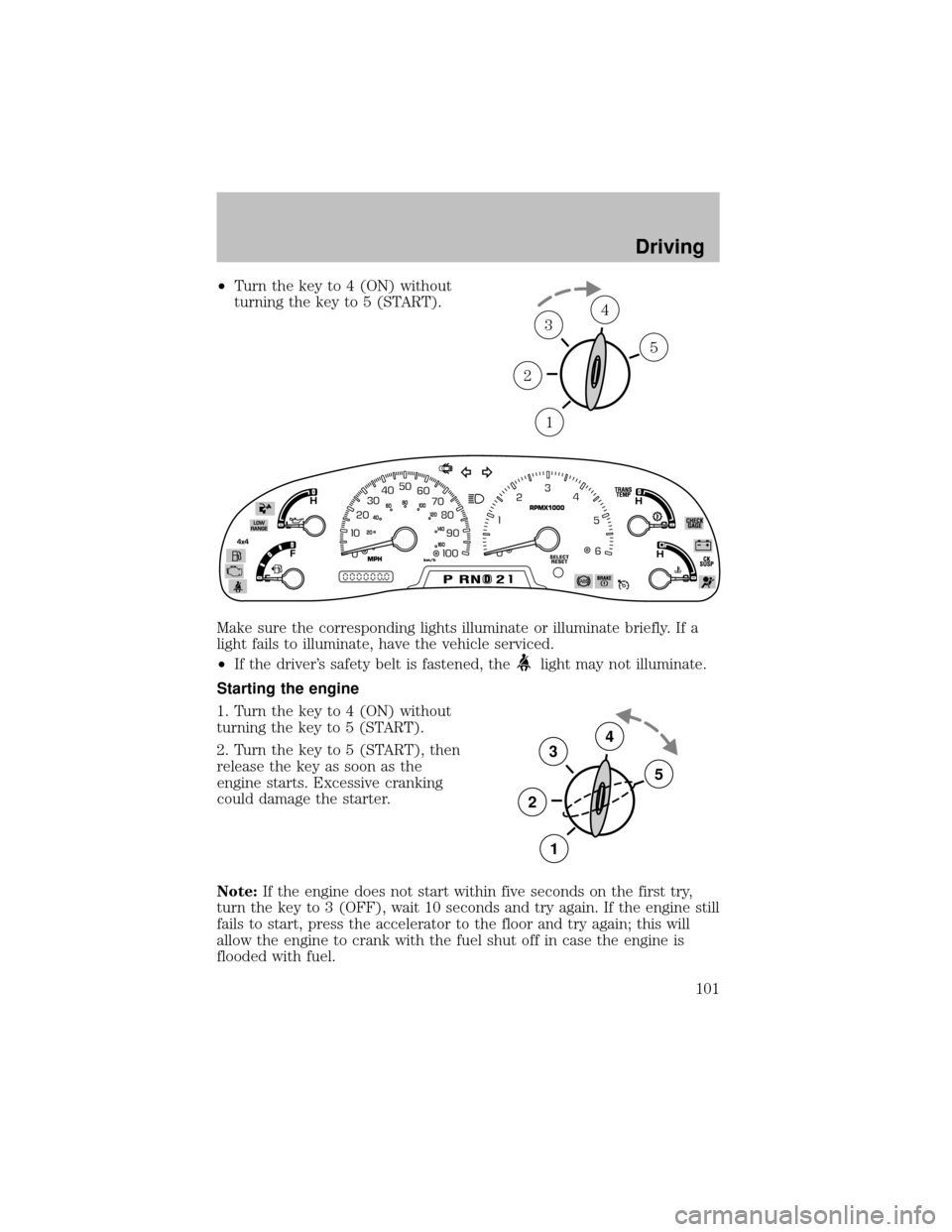
•Turn the keyto 4 (ON) without
turning the keyto 5 (START).
Make sure the corresponding lights illuminate or illuminate briefly. If a
light fails to illuminate, have the vehicle serviced.
•If the driver’s safetybelt is fastened, the
light maynot illuminate.
Starting the engine
1. Turn the keyto 4 (ON) without
turning the keyto 5 (START).
2. Turn the keyto 5 (START), then
release the keyas soon as the
engine starts. Excessive cranking
could damage the starter.
Note:If the engine does not start within five seconds on the first try,
turn the keyto 3 (OFF), wait 10 seconds and tryagain. If the engine still
fails to start, press the accelerator to the floor and tryagain; this will
allow the engine to crank with the fuel shut off in case the engine is
flooded with fuel.
1
2
34
5
3
2
1
5
4
Driving
101
Page 116 of 256

4X4 LOW (4WD Low)- Uses extra gearing to provide maximum power
to all four wheels. Intended onlyfor off-road applications such as deep
sand, steep grades or pulling heavyobjects. 4L (4WD Low) will not
engage while the vehicle is moving; this is normal and should be no
reason for concern. Refer toShifting to/from 4L (4WD Low)for proper
operation.
Shifting between 2WD (2WD High) and 4X4 HIGH (4WD High)
•Move the 4WD control between 2WD and 4X4 HIGH at anyforward
speed.
Note:Do not perform this operation at speeds above 72 km/h (45 mph)
if the outside temperature is below 0°C (32°F).
Note:Do not perform this operation if the rear wheels are slipping.
Shifting to/from 4X4 LOW (4WD Low)
1. Bring the vehicle to a complete stop
2. Depress the brake
3. On vehicles equipped with an automatic transmission, place the
transmission in N (Neutral); on vehicles equipped with a manual
transmission, depress the clutch.
4. Move the 4WD control to the desired position.
•If shifting into 4X4 LOW (4WD Low), wait for the LOW RANGE light
in the instrument cluster to turnonindicating the shift is complete.
•If shifting out of 4X4 LOW (4WD Low), wait for the LOW RANGE light
in the instrument cluster to turnoffindicating the shift is complete.
Driving off-road with truck and utility vehicles
4WD vehicles are speciallyequipped for driving on sand, snow, mud and
rough terrain and have operating characteristics that are somewhat
different from conventional vehicles, both on and off the road.
How your vehicle differs from other vehicles
Truck and utilityvehicles can differ from some other vehicles. Your
vehicle maybe higher to allow it to travel over rough terrain without
getting hung up or damaging underbodycomponents.
The differences that make your vehicle so versatile also make it handle
differentlythan an ordinarypassenger car.
Maintain steering wheel control at all times, especiallyin rough terrain.
Since sudden changes in terrain can result in abrupt steering wheel
motion, make sure you grip the steering wheel from the outside. Do not
grip the spokes.
Driving
116