instrument cluster FORD SUPER DUTY 2004 1.G Diesel Supplement Manual
[x] Cancel search | Manufacturer: FORD, Model Year: 2004, Model line: SUPER DUTY, Model: FORD SUPER DUTY 2004 1.GPages: 64, PDF Size: 0.37 MB
Page 3 of 64
overpressurization and the risk of fuel expulsion and fires. To determine
whether the vehicle is equipped with theFord Ambulance Preparation
Package,inspect the information plate on the driver’s side door pillar.
Contact the manufacturer of your vehicle to determine whether the
ambulance manufacturer’s followed Ford’s recommendations.
WARNINGS
Throughout this guide, you will find warnings identified by the
symbol
. Warnings remind you to be especially careful to reduce the
risk of personal injury.
NEW VEHICLE BREAK-IN
Your vehicle does not need an extensive break-in. Try not to drive
continuously at the same speed for the first 1,600 km (1,000 miles) of
new vehicle operation. Vary your speed to allow parts to adjust
themselves to other parts.
Drive your new vehicle at least 800 km (500 miles) before towing a
trailer.
Do not add friction modifier compounds or special break-in oils during
the first few thousand kilometers (miles) of operation, since these
additives may prevent piston ring seating. SeeEngine oilin the
Maintenance and specificationssection for more information on oil
usage.
DIESEL ENGINE INFORMATION
The Diesel engine fuel system consists of:
•an engine-mounted secondary fuel filter
•frame-mounted Horizontal Fuel Conditioner Module (HFCM)
•a unit injector for each cylinder
The HFCM acts as a primary fuel filter/water separator which removes
both water and impurities from the fuel. The engine-mounted fuel filter
and the HFCM filter should be changed at the recommended service
interval. Refer to theGeneral Owner’s Informationsection of this
supplement for more information.
The HFCM should be drained at
regular intervals or when the
WATER IN FUEL light illuminates in
the instrument cluster.
Introduction
3
Page 8 of 64
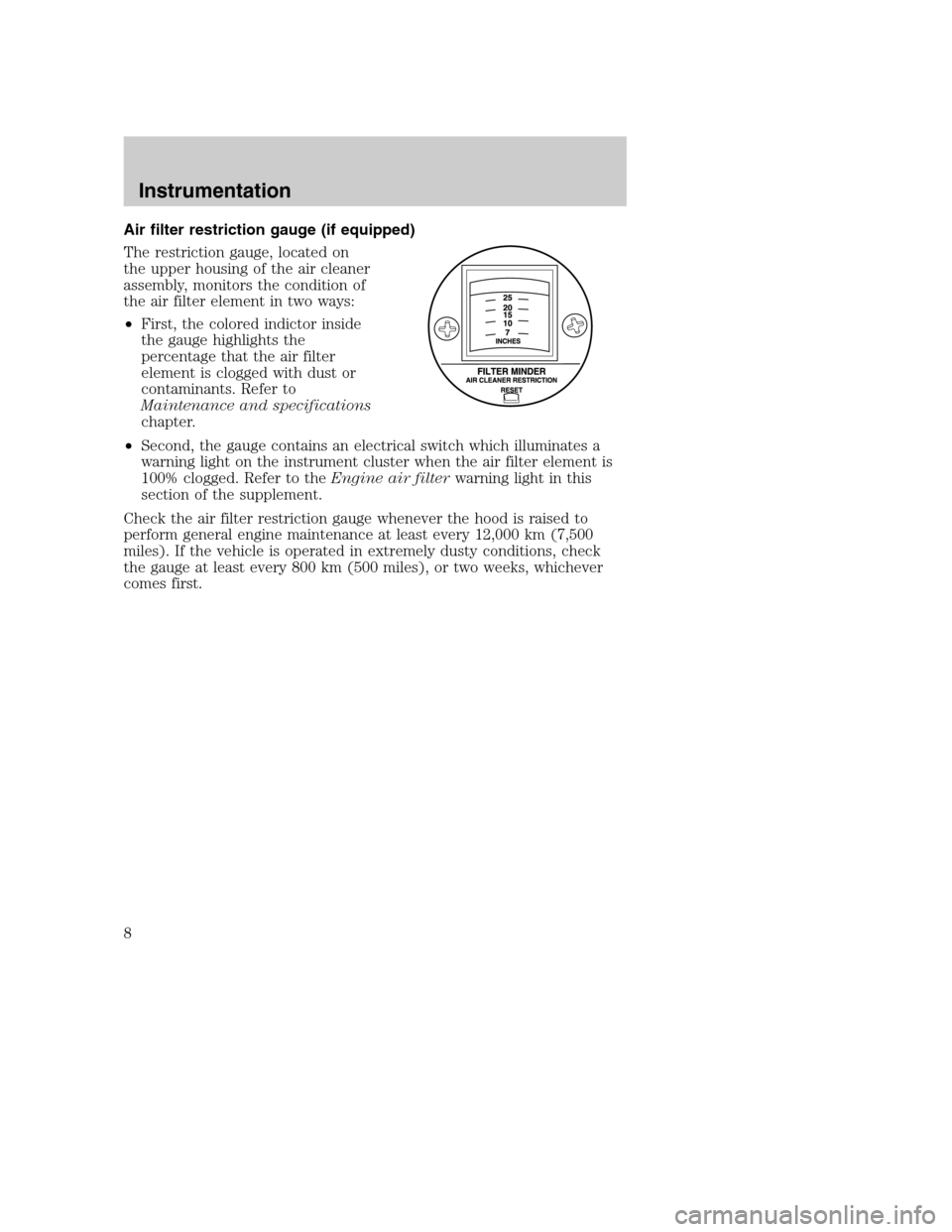
Air filter restriction gauge (if equipped)
The restriction gauge, located on
the upper housing of the air cleaner
assembly, monitors the condition of
the air filter element in two ways:
•First, the colored indictor inside
the gauge highlights the
percentage that the air filter
element is clogged with dust or
contaminants. Refer to
Maintenance and specifications
chapter.
•Second, the gauge contains an electrical switch which illuminates a
warning light on the instrument cluster when the air filter element is
100% clogged. Refer to theEngine air filterwarning light in this
section of the supplement.
Check the air filter restriction gauge whenever the hood is raised to
perform general engine maintenance at least every 12,000 km (7,500
miles). If the vehicle is operated in extremely dusty conditions, check
the gauge at least every 800 km (500 miles), or two weeks, whichever
comes first.
Instrumentation
8
Page 9 of 64
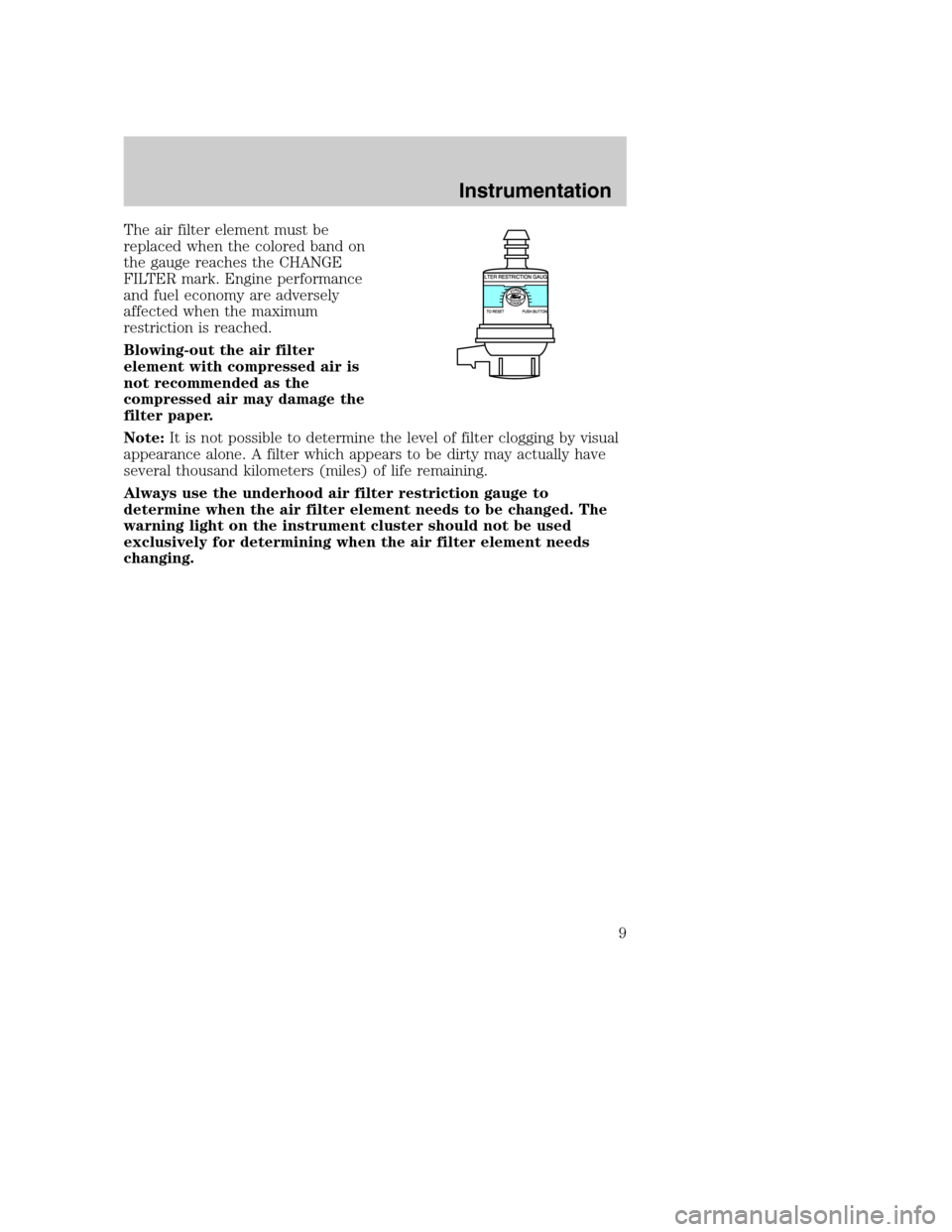
The air filter element must be
replaced when the colored band on
the gauge reaches the CHANGE
FILTER mark. Engine performance
and fuel economy are adversely
affected when the maximum
restriction is reached.
Blowing-out the air filter
element with compressed air is
not recommended as the
compressed air may damage the
filter paper.
Note:It is not possible to determine the level of filter clogging by visual
appearance alone. A filter which appears to be dirty may actually have
several thousand kilometers (miles) of life remaining.
Always use the underhood air filter restriction gauge to
determine when the air filter element needs to be changed. The
warning light on the instrument cluster should not be used
exclusively for determining when the air filter element needs
changing.
Instrumentation
9
Page 10 of 64

After servicing the air filter element,
reset the restriction gauge by
pressing the button on the end of
the gauge.
Note:If the vehicle is operated in a
heavy snow storm, in blowing snow
or the vehicle is equipped with a
snowplow, the engine air filter
element may become partially
clogged with snow and/or ice. If this
occurs, the air filter restriction
gauge will move to the CHANGE FILTER mark and the engine may
experience a significant reduction in power output. The vehicle may be
driven under these conditions for up to 160 km (100 miles) without
damage to the engine or related components.
At the earliest opportunity, clear all snow and ice from the air induction
system and reset the restriction gauge by pressing the button on the end
of the gauge. If the air filter restriction gauge moves the CHANGE
FILTER mark after clearing snow and/or ice, then replace the filter.
Reset filter restriction gauge after changing the air filter element.
The air filter warning light on the instrument cluster may be used, in
addition to the underhood restriction gauge, to monitor the condition of
the air filter element. Refer to theEngine air filterwarning light in this
section of the supplement.
Instrumentation
10