transmission fluid FORD SUPER DUTY 2004 1.G Diesel Supplement Manual
[x] Cancel search | Manufacturer: FORD, Model Year: 2004, Model line: SUPER DUTY, Model: FORD SUPER DUTY 2004 1.GPages: 64, PDF Size: 0.37 MB
Page 2 of 64
California Proposition 65 Warning
WARNING:Engine exhaust, some of its constituents, and
certain vehicle components contain or emit chemicals known to
the State of California to cause cancer and birth defects or other
reproductive harm. Certain fluids contained in vehicles and certain
products of components contain or emit chemicals known to the State
of California to cause cancer and birth defects or other reproductive
harm.
Your new Diesel engine will feel, drive and function somewhat differently
than a gasoline engine. Therefore it is very important that you read and
thoroughly familiarize yourself and others operating the vehicle with this
guide.
This guide will acquaint you with the 6.0L Power Stroke Diesel engine. It
provides recommendations on engine care and operating procedures. For
complete vehicle information, also refer to the Owner Guide included
with the vehicle. It also describes equipment and gives specifications for
equipment that was in effect when this guide was approved for printing,
and should be considered a permanent part of the vehicle.
Some aftermarket products may cause severe engine and/or
transmission damage. There are various manufacturers offering
devices to increase turbocharger boost, exhaust brakes to
increase stopping/hauling capacity or other such devices to
increase the power/torque of the Power Stroke engine. Many
owners’ past experience with these products has been very poor.
Severe powertrain damage may result from the use of these
aftermarket products which will not be covered by the Ford
warranty.
Ford may discontinue models or change specifications without any notice
and without incurring obligations.
IMPORTANT NOTICE
Ford vehicles are suitable for producing ambulances only if equipped
with theFord Ambulance Preparation Package.In addition, Ford
urges ambulance manufacturers to follow the recommendation of the
Ford Incomplete Vehicle Manual, Ford Truck Body Builder’s Layout
Book(and pertinent supplements) and theQualified Vehicle Modifiers
Guidelines. Using a Ford vehicle without theFord Ambulance
Preparation Packageto produce an ambulance voids the Ford warranty
and could result in elevated underbody temperatures, fuel
Introduction
2
Page 11 of 64
STARTING THE ENGINE
Read all starting instructions carefully before you start your vehicle.
For temperatures below 0°C (32°F), the use of the correct grade engine
oil is essential for proper operation.
If your vehicle is equipped with a manual transmission, make sure the
parking brake is set fully before you turn the key. Depress the clutch
pedal and place the gearshift in the neutral position. The clutch must be
fully depressed in order to operate the starter. Do not press the
accelerator during starting.
If your vehicle is equipped with an automatic transmission, ensure the
gearshift lever is in P (Park) and the parking brake is set before you turn
the key. Do not press the accelerator during starting.
COLD WEATHER STARTING
Do not crank the engine for more than 30 seconds as starter damage
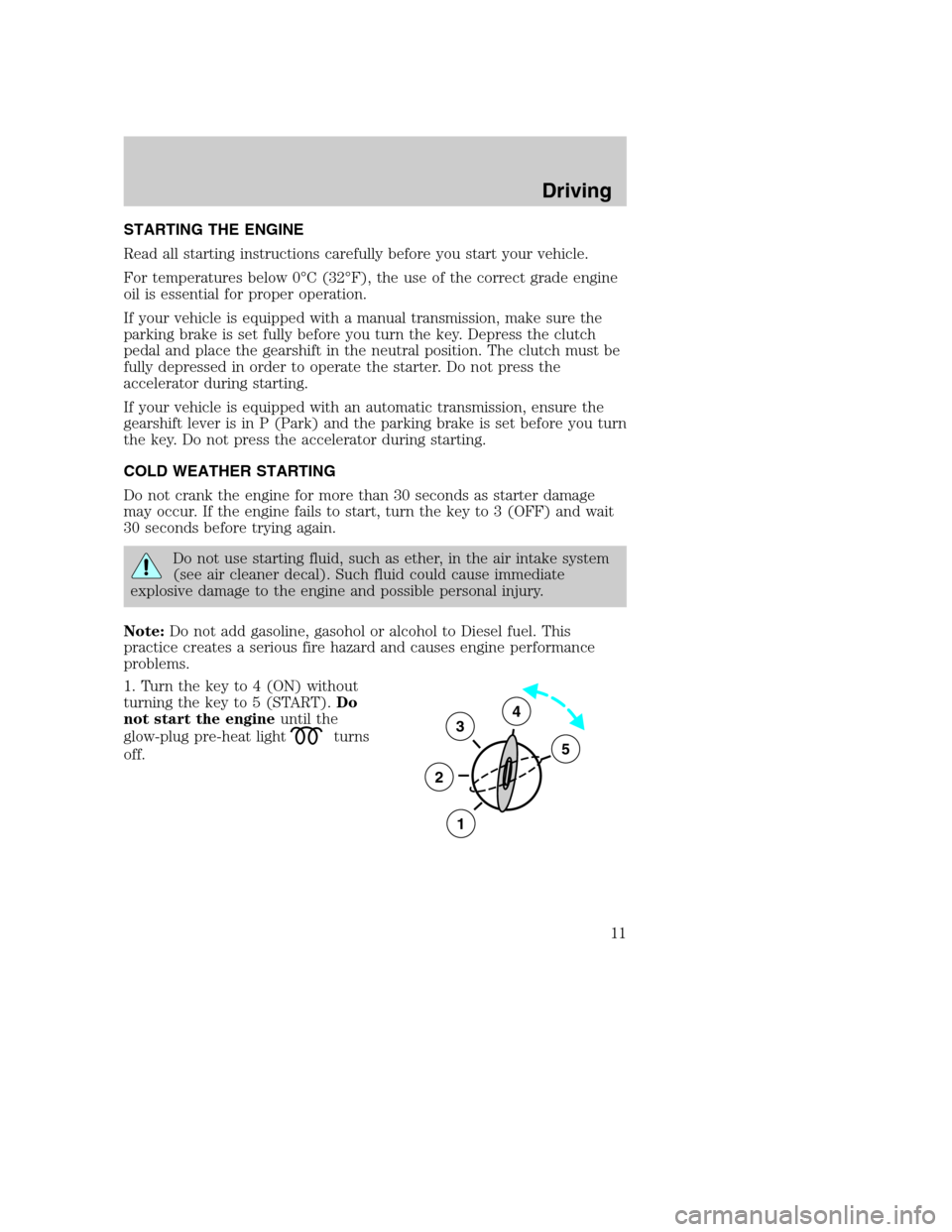
may occur. If the engine fails to start, turn the key to 3 (OFF) and wait
30 seconds before trying again.
Do not use starting fluid, such as ether, in the air intake system
(see air cleaner decal). Such fluid could cause immediate
explosive damage to the engine and possible personal injury.
Note:Do not add gasoline, gasohol or alcohol to Diesel fuel. This
practice creates a serious fire hazard and causes engine performance
problems.
1. Turn the key to 4 (ON) without
turning the key to 5 (START).Do
not start the engineuntil the
glow-plug pre-heat light
turns
off.3
2
1
5
4
Driving
Driving
11
Page 24 of 64
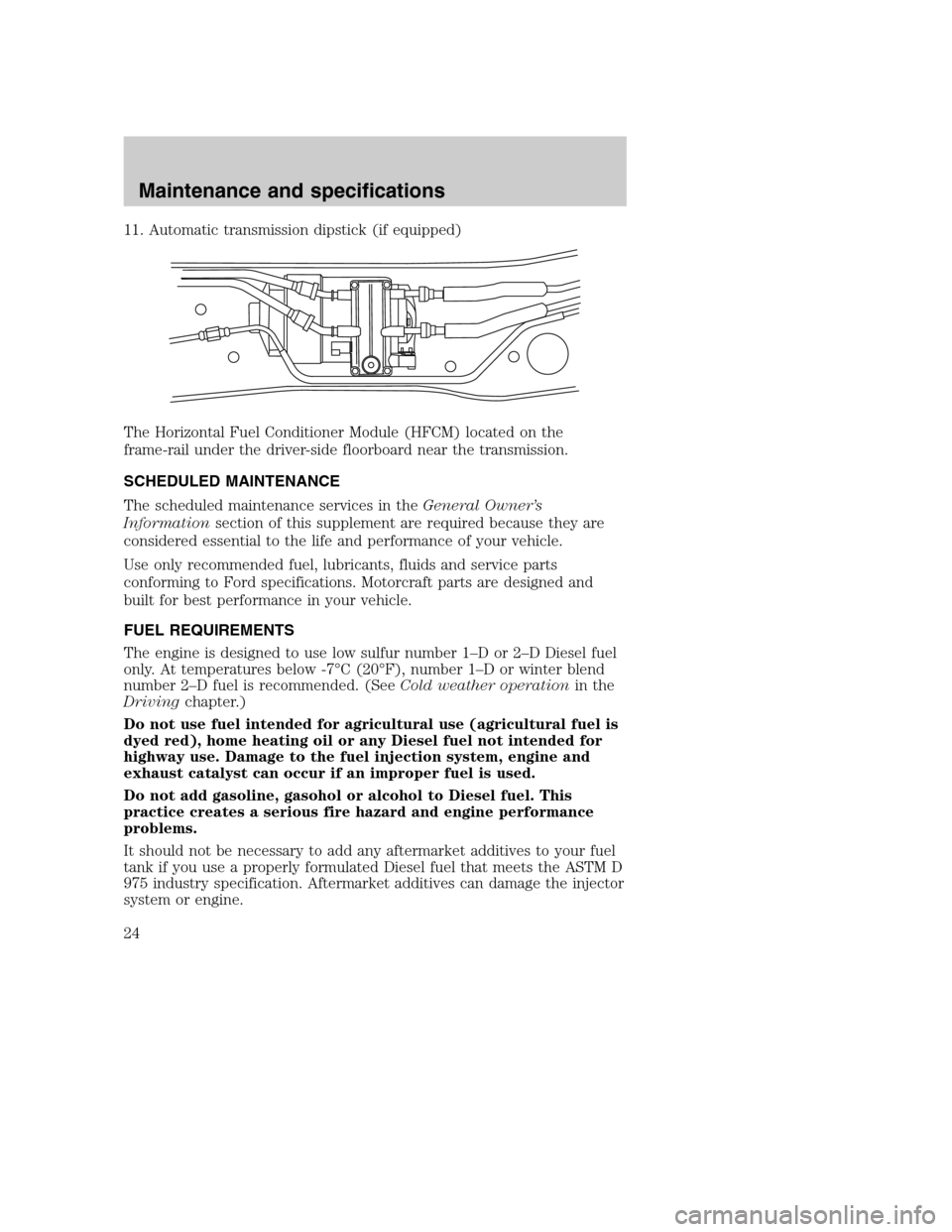
11. Automatic transmission dipstick (if equipped)
The Horizontal Fuel Conditioner Module (HFCM) located on the
frame-rail under the driver-side floorboard near the transmission.
SCHEDULED MAINTENANCE
The scheduled maintenance services in theGeneral Owner’s
Informationsection of this supplement are required because they are
considered essential to the life and performance of your vehicle.
Use only recommended fuel, lubricants, fluids and service parts
conforming to Ford specifications. Motorcraft parts are designed and
built for best performance in your vehicle.
FUEL REQUIREMENTS
The engine is designed to use low sulfur number 1–Dor2–D Diesel fuel
only. At temperatures below -7°C (20°F), number 1–D or winter blend
number 2–D fuel is recommended. (SeeCold weather operationin the
Drivingchapter.)
Do not use fuel intended for agricultural use (agricultural fuel is
dyed red), home heating oil or any Diesel fuel not intended for
highway use. Damage to the fuel injection system, engine and
exhaust catalyst can occur if an improper fuel is used.
Do not add gasoline, gasohol or alcohol to Diesel fuel. This
practice creates a serious fire hazard and engine performance
problems.
It should not be necessary to add any aftermarket additives to your fuel
tank if you use a properly formulated Diesel fuel that meets the ASTM D
975 industry specification. Aftermarket additives can damage the injector
system or engine.
Maintenance and specifications
24
Page 47 of 64
•Inspect engine cooling system and hoses
•Inspect brake system
•Inspect exhaust system and heat shields
•Check wheels for end play and noise
•Inspect and lubricate 4x2 ball joints (except F-450/F-550)
•Inspect and lubricate steering idler arms
•Inspect and lubricate 4x4 front axle shaft u-joints
•Replace cabin air filter, if equipped
•Inspect half-shaft boots, if equipped
36,000 km (22,500 miles)
•Change engine oil and replace oil filter
•Inspect engine air filter minder, replace filter as required
48,000 km (30,000 miles)
•Change engine oil and replace oil filter
•Inspect tires for wear and measure tread depth
•Rotate tires
•Inspect engine air filter minder, replace filter as required
•Replace engine- and frame-mounted fuel filters
•Inspect steering linkage, suspension and, if equipped, driveshaft and
ball joints
•Inspect engine cooling system and hoses
•Inspect brake system
•Inspect exhaust system and heat shields
•Change automatic transmission fluid and external filter element
•Check wheels for end play and noise
•Inspect and lubricate 4x2 ball joints (except F-450/F-550)
•Inspect and lubricate steering idler arms
•Inspect and lubricate 4x4 front axle shaft u-joints
•Replace cabin air filter, if equipped
•Inspect half-shaft boots, if equipped
60,000 km (37,500 miles)
•Change engine oil and replace oil filter
•Inspect engine air filter minder, replace filter as required
General Owner’s Information
47
Page 48 of 64
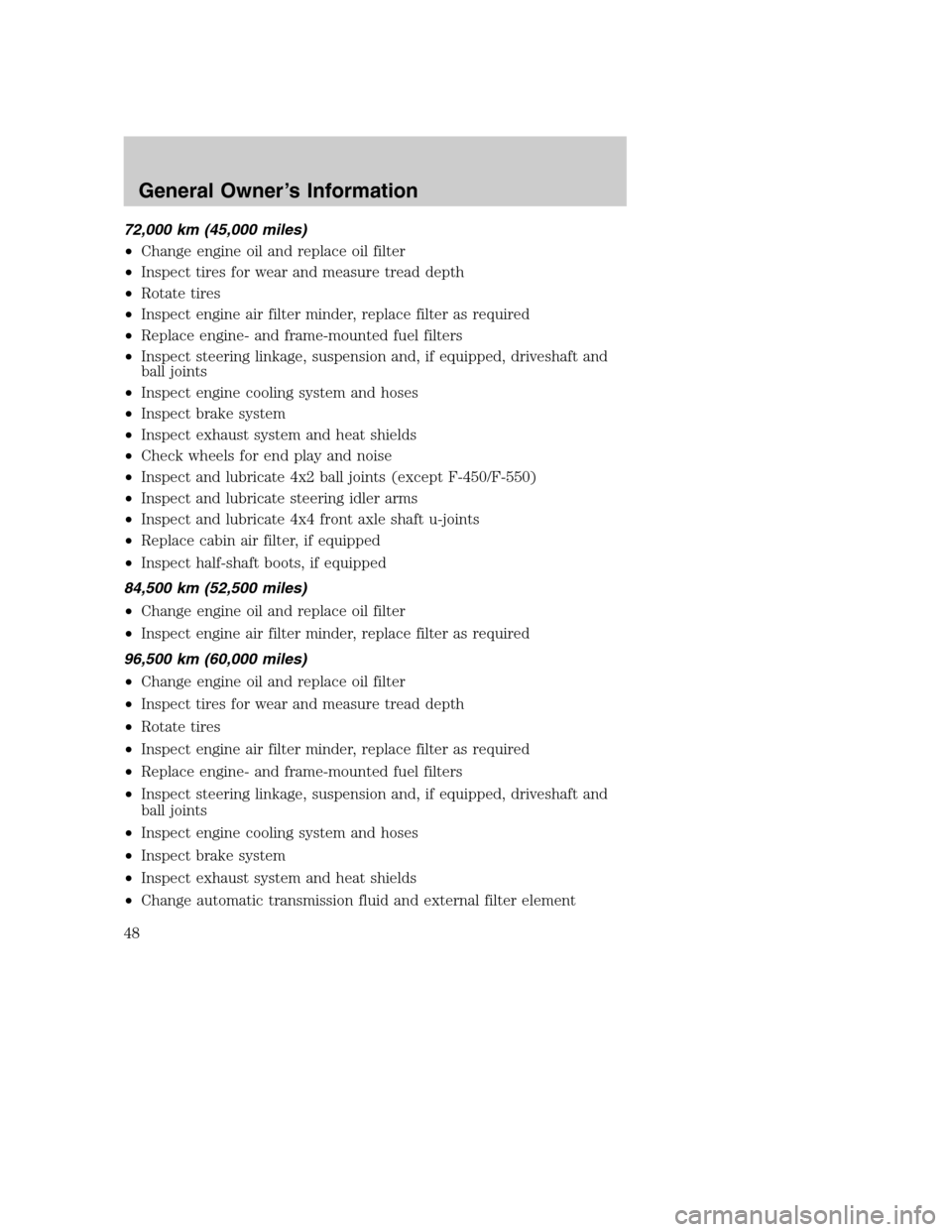
72,000 km (45,000 miles)
•Change engine oil and replace oil filter
•Inspect tires for wear and measure tread depth
•Rotate tires
•Inspect engine air filter minder, replace filter as required
•Replace engine- and frame-mounted fuel filters
•Inspect steering linkage, suspension and, if equipped, driveshaft and
ball joints
•Inspect engine cooling system and hoses
•Inspect brake system
•Inspect exhaust system and heat shields
•Check wheels for end play and noise
•Inspect and lubricate 4x2 ball joints (except F-450/F-550)
•Inspect and lubricate steering idler arms
•Inspect and lubricate 4x4 front axle shaft u-joints
•Replace cabin air filter, if equipped
•Inspect half-shaft boots, if equipped
84,500 km (52,500 miles)
•Change engine oil and replace oil filter
•Inspect engine air filter minder, replace filter as required
96,500 km (60,000 miles)
•Change engine oil and replace oil filter
•Inspect tires for wear and measure tread depth
•Rotate tires
•Inspect engine air filter minder, replace filter as required
•Replace engine- and frame-mounted fuel filters
•Inspect steering linkage, suspension and, if equipped, driveshaft and
ball joints
•Inspect engine cooling system and hoses
•Inspect brake system
•Inspect exhaust system and heat shields
•Change automatic transmission fluid and external filter element
General Owner’s Information
48
Page 49 of 64
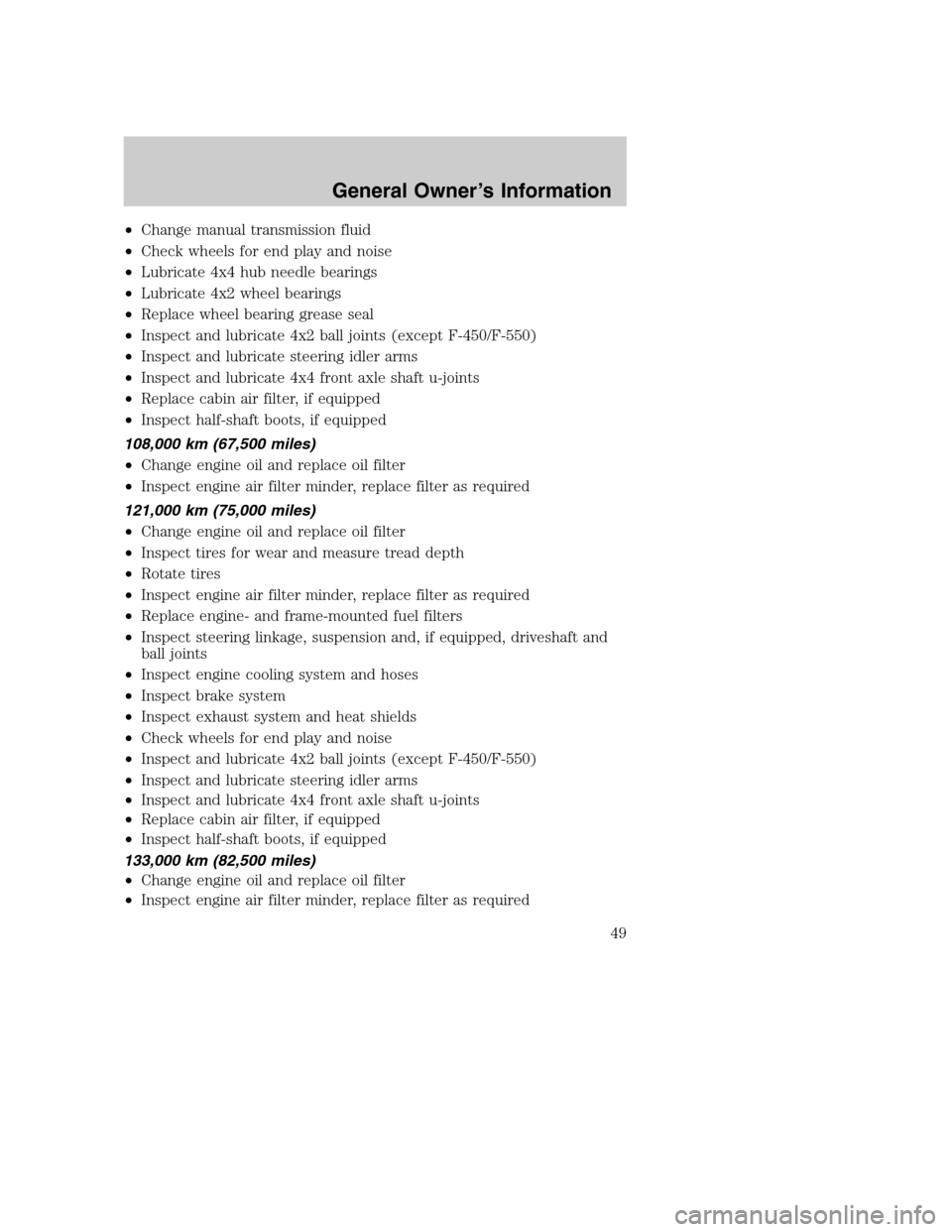
•Change manual transmission fluid
•Check wheels for end play and noise
•Lubricate 4x4 hub needle bearings
•Lubricate 4x2 wheel bearings
•Replace wheel bearing grease seal
•Inspect and lubricate 4x2 ball joints (except F-450/F-550)
•Inspect and lubricate steering idler arms
•Inspect and lubricate 4x4 front axle shaft u-joints
•Replace cabin air filter, if equipped
•Inspect half-shaft boots, if equipped
108,000 km (67,500 miles)
•Change engine oil and replace oil filter
•Inspect engine air filter minder, replace filter as required
121,000 km (75,000 miles)
•Change engine oil and replace oil filter
•Inspect tires for wear and measure tread depth
•Rotate tires
•Inspect engine air filter minder, replace filter as required
•Replace engine- and frame-mounted fuel filters
•Inspect steering linkage, suspension and, if equipped, driveshaft and
ball joints
•Inspect engine cooling system and hoses
•Inspect brake system
•Inspect exhaust system and heat shields
•Check wheels for end play and noise
•Inspect and lubricate 4x2 ball joints (except F-450/F-550)
•Inspect and lubricate steering idler arms
•Inspect and lubricate 4x4 front axle shaft u-joints
•Replace cabin air filter, if equipped
•Inspect half-shaft boots, if equipped
133,000 km (82,500 miles)
•Change engine oil and replace oil filter
•Inspect engine air filter minder, replace filter as required
General Owner’s Information
49
Page 50 of 64
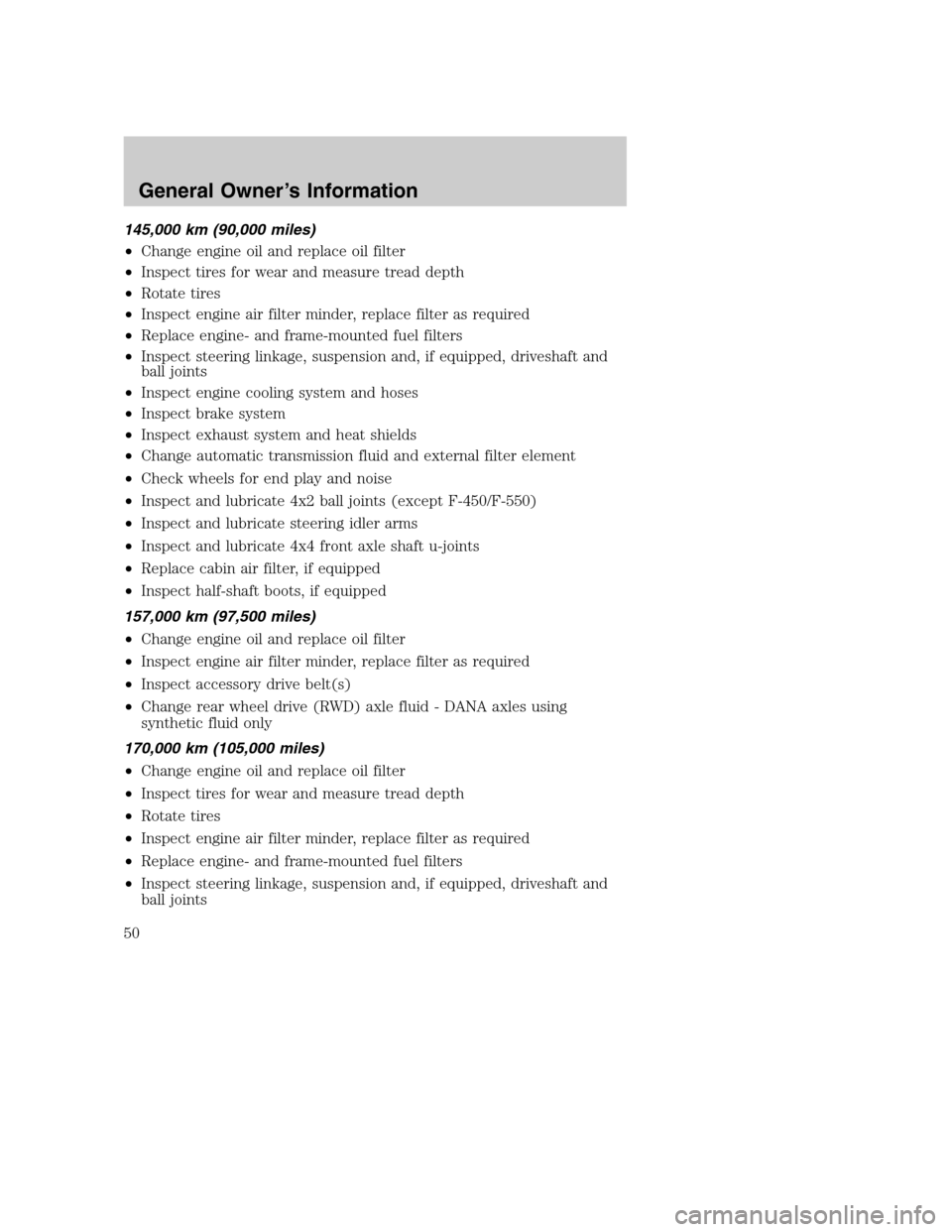
145,000 km (90,000 miles)
•Change engine oil and replace oil filter
•Inspect tires for wear and measure tread depth
•Rotate tires
•Inspect engine air filter minder, replace filter as required
•Replace engine- and frame-mounted fuel filters
•Inspect steering linkage, suspension and, if equipped, driveshaft and
ball joints
•Inspect engine cooling system and hoses
•Inspect brake system
•Inspect exhaust system and heat shields
•Change automatic transmission fluid and external filter element
•Check wheels for end play and noise
•Inspect and lubricate 4x2 ball joints (except F-450/F-550)
•Inspect and lubricate steering idler arms
•Inspect and lubricate 4x4 front axle shaft u-joints
•Replace cabin air filter, if equipped
•Inspect half-shaft boots, if equipped
157,000 km (97,500 miles)
•Change engine oil and replace oil filter
•Inspect engine air filter minder, replace filter as required
•Inspect accessory drive belt(s)
•Change rear wheel drive (RWD) axle fluid - DANA axles using
synthetic fluid only
170,000 km (105,000 miles)
•Change engine oil and replace oil filter
•Inspect tires for wear and measure tread depth
•Rotate tires
•Inspect engine air filter minder, replace filter as required
•Replace engine- and frame-mounted fuel filters
•Inspect steering linkage, suspension and, if equipped, driveshaft and
ball joints
General Owner’s Information
50
Page 51 of 64
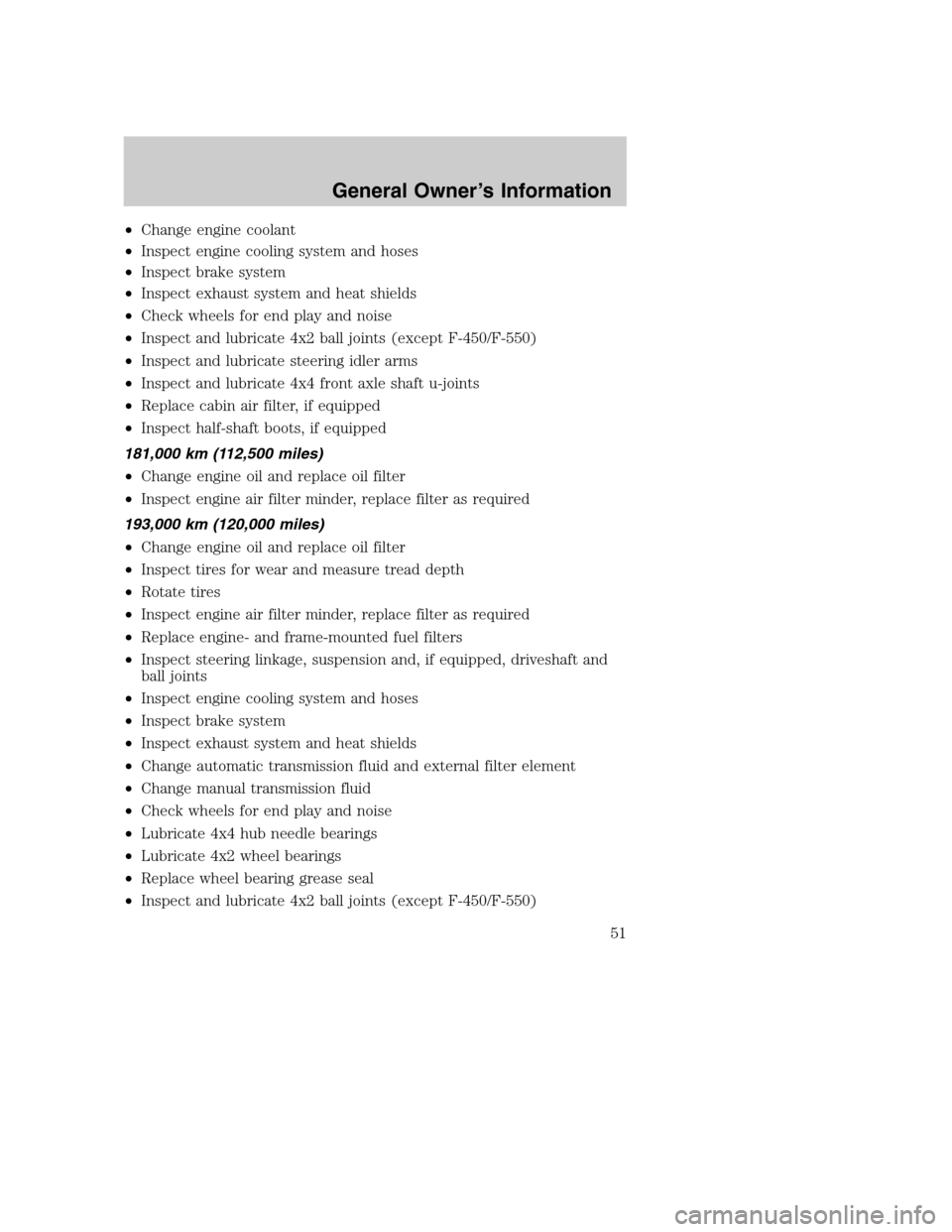
•Change engine coolant
•Inspect engine cooling system and hoses
•Inspect brake system
•Inspect exhaust system and heat shields
•Check wheels for end play and noise
•Inspect and lubricate 4x2 ball joints (except F-450/F-550)
•Inspect and lubricate steering idler arms
•Inspect and lubricate 4x4 front axle shaft u-joints
•Replace cabin air filter, if equipped
•Inspect half-shaft boots, if equipped
181,000 km (112,500 miles)
•Change engine oil and replace oil filter
•Inspect engine air filter minder, replace filter as required
193,000 km (120,000 miles)
•Change engine oil and replace oil filter
•Inspect tires for wear and measure tread depth
•Rotate tires
•Inspect engine air filter minder, replace filter as required
•Replace engine- and frame-mounted fuel filters
•Inspect steering linkage, suspension and, if equipped, driveshaft and
ball joints
•Inspect engine cooling system and hoses
•Inspect brake system
•Inspect exhaust system and heat shields
•Change automatic transmission fluid and external filter element
•Change manual transmission fluid
•Check wheels for end play and noise
•Lubricate 4x4 hub needle bearings
•Lubricate 4x2 wheel bearings
•Replace wheel bearing grease seal
•Inspect and lubricate 4x2 ball joints (except F-450/F-550)
General Owner’s Information
51
Page 53 of 64
•Inspect engine air filter minder, replace filter as required
•Replace engine- and frame-mounted fuel filters
•Inspect steering linkage, suspension and, if equipped, driveshaft and
ball joints
•Inspect engine cooling system and hoses
•Inspect brake system
•Inspect exhaust system and heat shields
•Replace accessory drive belt(s)
•Change engine coolant
•Change automatic transmission fluid and external filter element
•Change rear wheel drive (RWD) axle fluid - DANA axles using
synthetic fluid only
•Change transfer case fluid
•Check wheels for end play and noise
•Lubricate 4x2 wheel bearings
•Replace wheel bearing grease seal
•Inspect and lubricate 4x2 ball joints (except F-450/F-550)
•Inspect and lubricate steering idler arms
•Inspect and lubricate 4x4 front axle shaft u-joints
•Replace cabin air filter, if equipped
•Inspect half-shaft boots, if equipped
Exceptions
In addition, there are several exceptions to the Normal Schedule. They
are listed below:
Yellow coolant
•5 years or 100,000 miles - change yellow coolant (whichever comes
first)
•After initial change - change yellow coolant every 3 years or 50,000
miles
Normal vehicle axle maintenance
Rear axles and power take off (PTO) units containing synthetic lubricant
and light duty trucks equipped with Ford-design axles are lubricated for
General Owner’s Information
53
Page 54 of 64
life. These lubricants are not to be checked or changed unless a leak is
suspected, service is required or the axle assembly has been submerged
in water. The axle and PTO lubricant should be changed anytime the
axle and PTO have been submerged in water. Non-synthetic rear axle
lubricants should be replaced every 3,000 miles or 3 months, whichever
occurs first, during extended trailer tow operation above 21 Celsius (70
degrees Fahrenheit) ambient and wide open throttle for extended
periods above 45 mph. The 3,000 mile lube change interval may be
waived if the axle was filled with 75W140 synthetic gear lubricant
meeting Ford specification WSL-M2C192-A, part number F1TZ-19580-B
or equivalent. Add four ounces of additive friction modifier
C8AZ-19B546-A (EST-M2C118-A) or equivalent for complete refill of
Traction-Lok rear axles. The axle lubricant should be changed anytime
an axle has been submerged in water.
F-450 and F-550 axle maintenance
Replace rear axle lubricant every 100,000 miles under normal driving
conditions on all F-450 and F-550 commercial applications. For F-450
and F-550 trucks operated at or near maximum Gross Vehicle Weights,
the rear axle lubricant should be replaced every 50,000 miles. In
addition, this 50,000 mile schedule should be observed when the vehicles
are operated under the Special Operating Conditions.
SPECIAL OPERATING CONDITIONS
Towing a trailer or using a camper or car-top carrier
Every 5,000 miles or 6 months:Change engine oil and replace filter
Every 15,000 miles:Inspect and lubricate 4x2 ball joints and steering
idler arms
Every 30,000 miles:Lubricate 4x4 hub needle bearings
Every 60,000 miles:Change transfer case fluid
As required:Change manual transmission fluid
Extensive idling and/or low-speed driving for long distances as in
heavy commercial use such as delivery, taxi, patrol or livery
Every 5,000 miles, 6 months or 200 hours (whichever comes
first):Change engine oil and replace filter
Every 5,000 miles:Inspect brake system. Inspect and lubricate 4x2 ball
joints and steering idler arms
30,000 miles and 90,000 miles:Lubricate 4x2 wheel bearings. Replace
wheel bearing grease seal.
General Owner’s Information
54