fuel filter FORD SUPER DUTY 2005 1.G Diesel Supplement Manual
[x] Cancel search | Manufacturer: FORD, Model Year: 2005, Model line: SUPER DUTY, Model: FORD SUPER DUTY 2005 1.GPages: 72, PDF Size: 0.52 MB
Page 3 of 72
overpressurization and the risk of fuel expulsion and fires. To determine
whether the vehicle is equipped with the Ford ambulance preparation
package, inspect the information plate on the driver’s side door pillar.
Contact the manufacturer of your vehicle to determine whether the
ambulance manufacturer’s followed Ford’s recommendations.
WARNINGS
Throughout this guide, you will find warnings identified by the
symbol
. Warnings remind you to be especially careful to reduce the
risk of personal injury.
NEW VEHICLE BREAK-IN
Your vehicle does not need an extensive break-in. Try not to drive
continuously at the same speed for the first 1,600 km (1,000 miles) of
new vehicle operation. Vary your speed to allow parts to adjust
themselves to other parts.
Drive your new vehicle at least 800 km (500 miles) before towing a
trailer.
Do not add friction modifier compounds or special break-in oils during
the first few thousand kilometers (miles) of operation, since these
additives may prevent piston ring seating. SeeEngine oilin the
Maintenance and Specificationssection of this supplement for more
information on oil usage.
DIESEL ENGINE INFORMATION
The Diesel engine fuel system consists of:
•On F-Super Duty and Excursion vehicles,a frame-mounted
Horizontal Fuel Conditioner Module (HFCM)
•On E-Series vehicles,a Fuel Conditioner Module (FCM) mounted on
the driver-side of the transmission case
•an engine-mounted secondary fuel filter
•a unit injector for each cylinder
The FCM/HFCM acts as a primary fuel filter/water separator which
removes both water and impurities from the fuel. The engine-mounted
fuel filter and the FCM/HFCM filter should be changed at the
recommended service interval. Refer to theGeneral Owner’s
Informationsection of this supplement for more information.
Introduction
3
Page 7 of 72
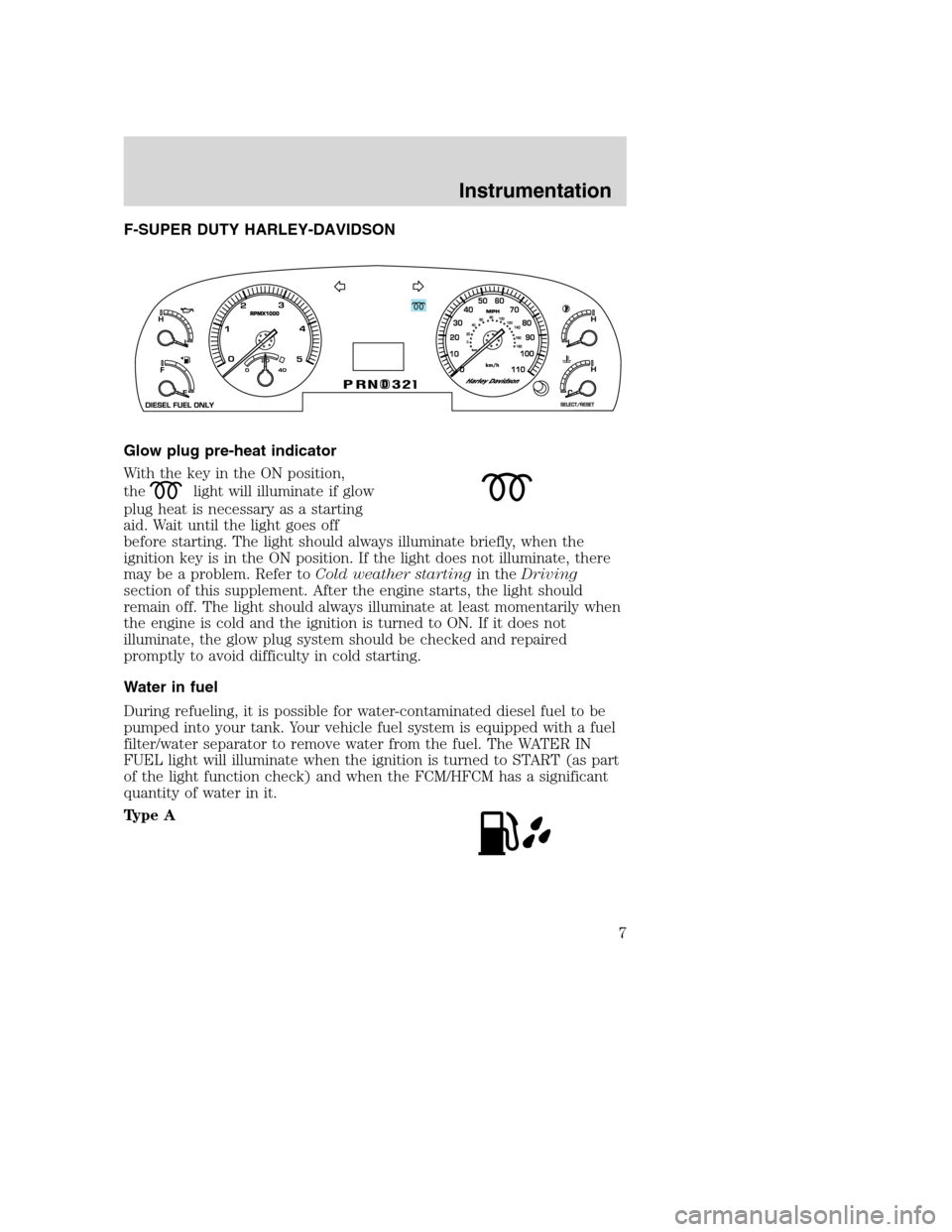
F-SUPER DUTY HARLEY-DAVIDSON
Glow plug pre-heat indicator
With the key in the ON position,
the
light will illuminate if glow
plug heat is necessary as a starting
aid. Wait until the light goes off
before starting. The light should always illuminate briefly, when the
ignition key is in the ON position. If the light does not illuminate, there
may be a problem. Refer toCold weather startingin theDriving
section of this supplement. After the engine starts, the light should
remain off. The light should always illuminate at least momentarily when
the engine is cold and the ignition is turned to ON. If it does not
illuminate, the glow plug system should be checked and repaired
promptly to avoid difficulty in cold starting.
Water in fuel
During refueling, it is possible for water-contaminated diesel fuel to be
pumped into your tank. Your vehicle fuel system is equipped with a fuel
filter/water separator to remove water from the fuel. The WATER IN
FUEL light will illuminate when the ignition is turned to START (as part
of the light function check) and when the FCM/HFCM has a significant
quantity of water in it.
Type A
Instrumentation
7
Page 8 of 72

Type B
Type C
If the light illuminates when the engine is running, stop the vehicle as
soon as safely possible, shut off the engine, then drain the FCM/HFCM.
Refer toDraining the FCM/HFCM and changing the fuel filtersin the
Maintenance and Specificationssection of this supplement for the
drain procedure. Allowing water to stay in the system could result in
extensive damage to, or failure of, the fuel injection system.
Do not drain the water separator while the engine is running.
Fuel may ignite if the separator is drained while the engine is
running or the vehicle is moving.
Engine air filter (if equipped)
The engine air filter warning light illuminates when the air filter
restriction gauge reaches the CHANGE FILTER mark.
Type A
Type B
Type C
The condition should be verified by inspecting the underhood air filter
restriction gauge; the warning light is only a secondary indicator. Always
use the underhood air filter restriction gauge to determine when the air
filter element needs to be changed.
Instrumentation
8
Page 10 of 72

The air filter element must be
replaced when the colored band on
the gauge reaches the CHANGE
FILTER mark. Engine performance
and fuel economy are adversely
affected when the maximum
restriction is reached.
Blowing-out the air filter
element with compressed air is
not recommended as the
compressed air may damage the
filter paper.
Note:It is not possible to determine
the level of filter clogging by visual
appearance alone. A filter which
appears to be dirty may actually
have several thousand miles
(kilometers) of life remaining.
Always use the underhood air
filter restriction gauge to
determine when the air filter element needs to be changed. The
warning light on the instrument cluster should not be used
exclusively for determining when the air filter element needs
changing.
AIRFILTERRESTAA
CHANGE FILTER
PUSH BUTTON RESET75%
50%65%
Instrumentation
10
Page 13 of 72
2. When the glow plug pre-heat
indicator turns off, turn the key to 5
(START), then release the key as
soon as the engine starts. The glow
plugs will continue to be activated for two minutes after the glow plug
pre-heat indicator
has turned off. If the engine is not started
before the glow plug activation time ends, the glow plugs will need to be
reset by turning the key to 3 (OFF).
3. After the engine starts, allow it to idle for about 15 seconds. Do not
increase engine speed until the oil pressure gauge indicates normal
pressure.
STOPPING THE ENGINE
Turn the ignition to 3 (OFF). To prolong engine life (after extended high
speed or maximum GVW operation), it is recommended that a hot engine
be allowed to operate at low idle for about 7–10 minutes which would
allow sufficient time for the turbocharged engine to cool down.
COLD WEATHER OPERATION
Changing to a lighter grade engine oil also makes starting easier under
these conditions. Refer toEngine oil specificationsin theMaintenance
and Specificationssection of this supplement.
At temperatures below 20°F(–7°C), Number 2–D diesel fuel may thicken
enough to clog the fuel filter. Your vehicle is equipped with either an
FCM (E-Series) or an HFCM (F-Super Duty and Excursion) which acts
as a fuel filter/heater/water separator to keep the wax melted which will
help prevent fuel filter clogging. However, if the engine starts but stalls
after a short time and will not restart, the fuel filter(s) may be clogged.
For best results in cold weather, use Number 1–D diesel fuel or
“winterized”Number 2–D diesel fuel which has an additive to minimize
wax formation.
Your vehicle is also equipped with a bypass relief valve, located on the
fuel control module, which provides fuel flow to the engine if the fuel
pickup should become plugged by ice or wax. To allow this bypass valve
to function and avoid engine fuel starvation, it is recommended that,
during cold weather operation 32°F(0°C) or below, the fuel level in your
tank should not be allowed to drop below
1⁄4full. This will help prevent
air from entering the fuel system and stalling the engine.
In cold weather below 32°F (0°C) your diesel engine will slowly increase
to a higher idle speed if left idling in P (Park). As the engine warms-up,
Driving
13
Page 14 of 72
the engine sound level will decrease due to the activation of
PCM-controlled sound reduction features.
If your vehicle is operated in a heavy snow storm or blowing snow
conditions, the engine air induction may become partially clogged with
snow and/or ice. If this occurs, the engine may experience a significant
reduction in power output. At the earliest opportunity, clear all the snow
and/or ice away from the air induction inlet.
Operation in snow
Vehicle operation in heavy snowfall or in dry loose snow that may swirl
around the front of the vehicle may feed excessive amounts of snow into
the air intake system. This could plug the air cleaner with snow and
cause the engine to stall and/or lose power.
Refer toAir filter restriction gaugeandEngine air filterin the
Instrumentationsection of this supplement for more information.
Operation in standing water
Ingestion of water into the diesel engine can result in immediate and
severe damage to the engine. If driving through water, slow down to
avoid splashing water into the intake. If the engine stalls, and ingestion
of water into the engine is suspected, do not try to restart the engine.
Consult your dealer for service immediately.
Engine block heater (if equipped)
Refer to theDrivingchapter in theOwner’s Guide.
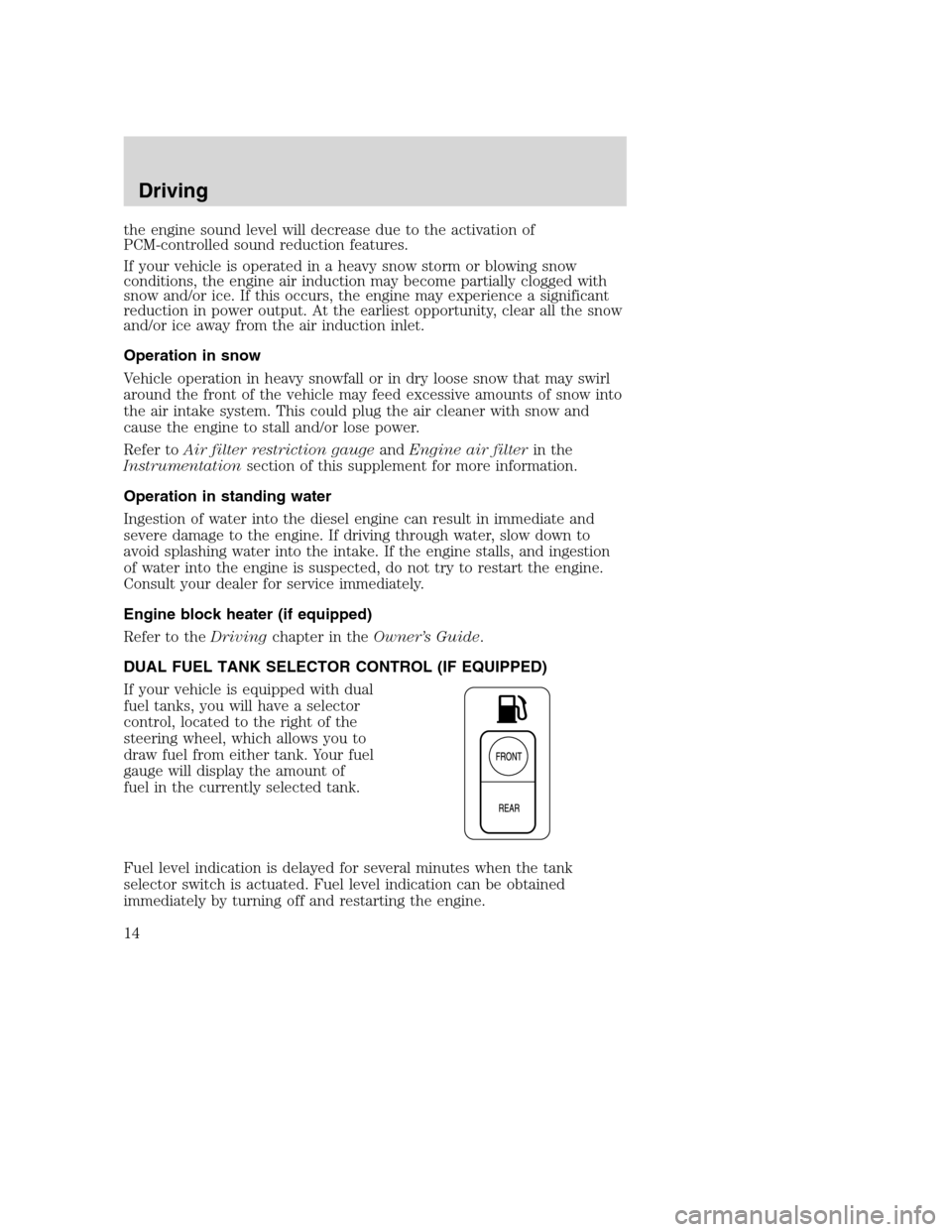
DUAL FUEL TANK SELECTOR CONTROL (IF EQUIPPED)
If your vehicle is equipped with dual
fuel tanks, you will have a selector
control, located to the right of the
steering wheel, which allows you to
draw fuel from either tank. Your fuel
gauge will display the amount of
fuel in the currently selected tank.
Fuel level indication is delayed for several minutes when the tank
selector switch is actuated. Fuel level indication can be obtained
immediately by turning off and restarting the engine.
Driving
14
Page 27 of 72
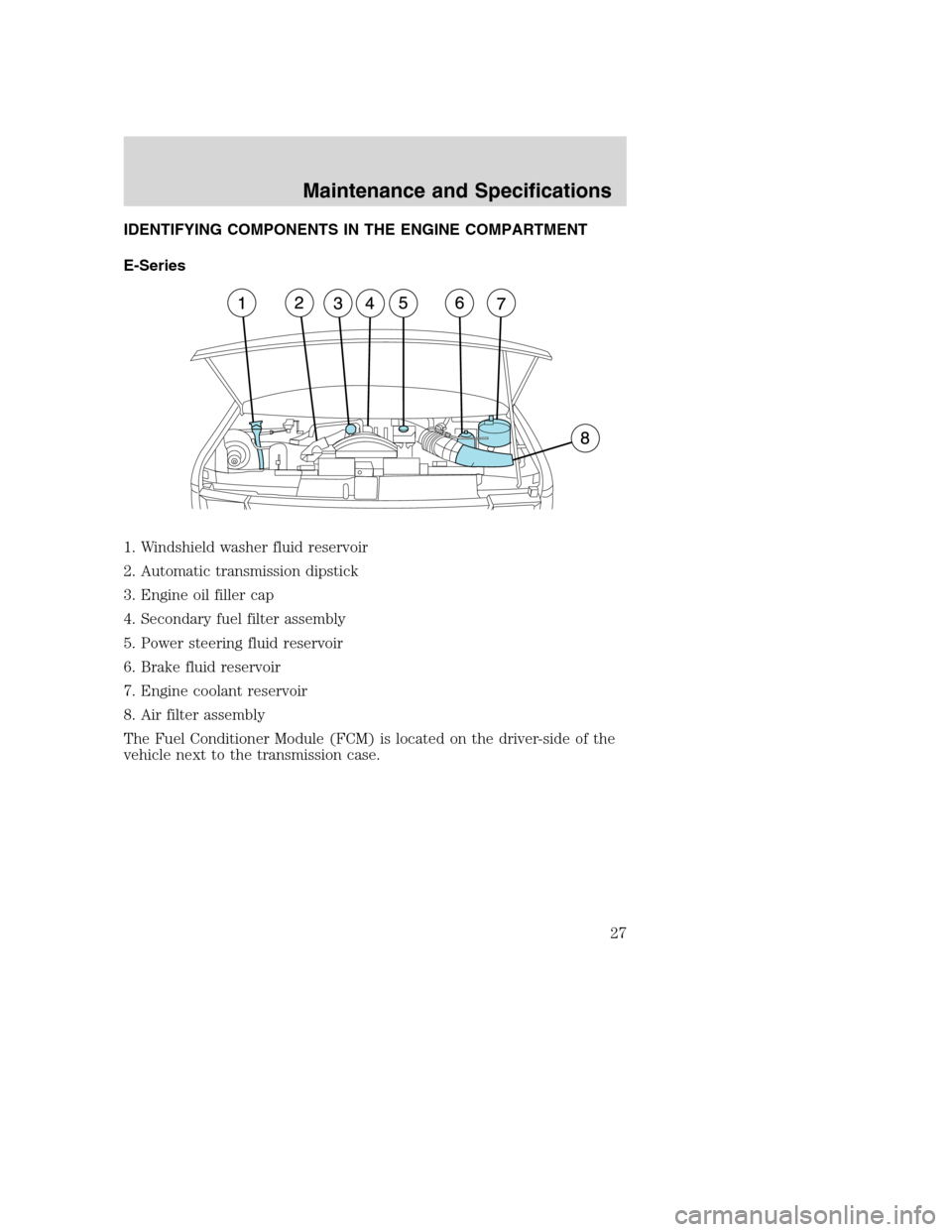
IDENTIFYING COMPONENTS IN THE ENGINE COMPARTMENT
E-Series
1. Windshield washer fluid reservoir
2. Automatic transmission dipstick
3. Engine oil filler cap
4. Secondary fuel filter assembly
5. Power steering fluid reservoir
6. Brake fluid reservoir
7. Engine coolant reservoir
8. Air filter assembly
The Fuel Conditioner Module (FCM) is located on the driver-side of the
vehicle next to the transmission case.
Maintenance and Specifications
Maintenance and Specifications
27
Page 28 of 72
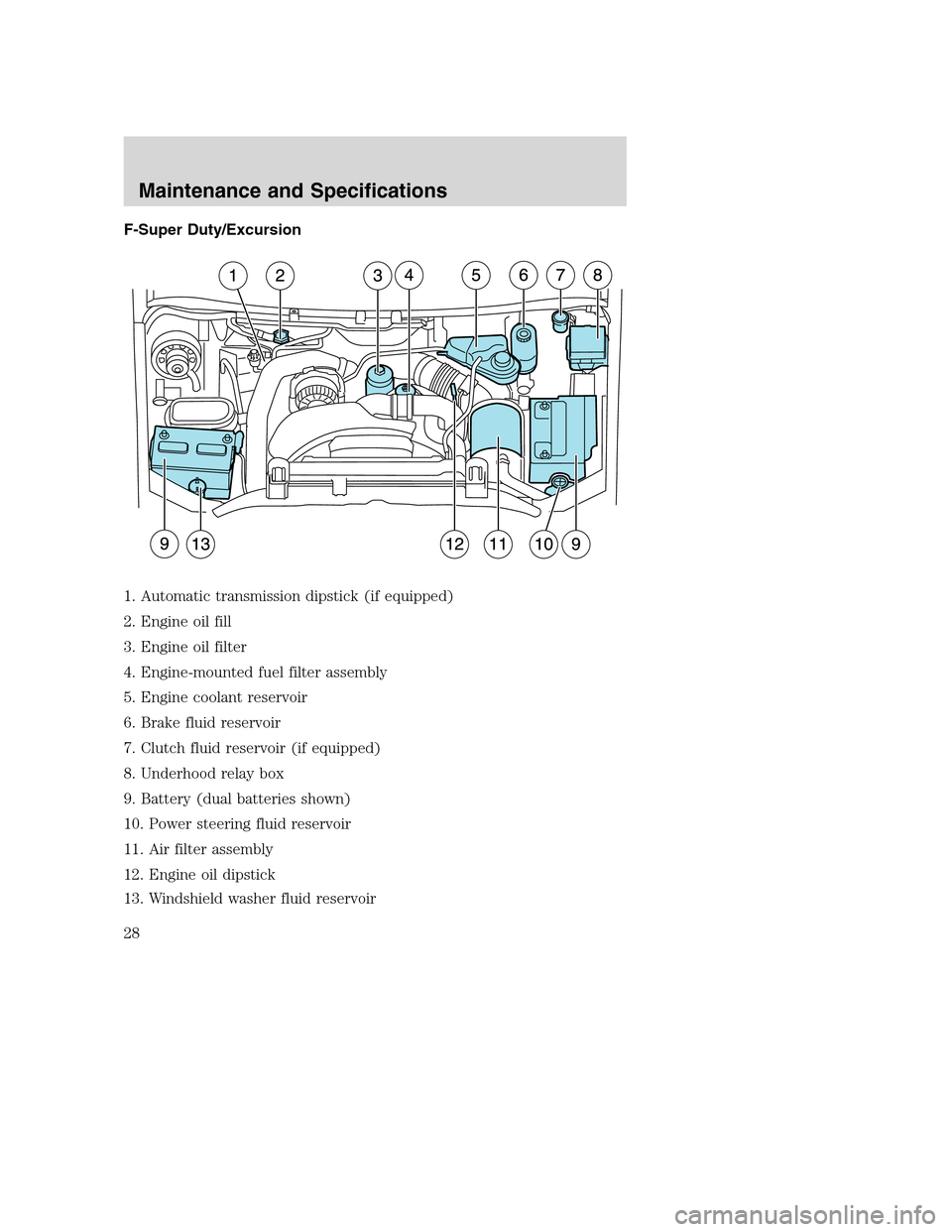
F-Super Duty/Excursion
1. Automatic transmission dipstick (if equipped)
2. Engine oil fill
3. Engine oil filter
4. Engine-mounted fuel filter assembly
5. Engine coolant reservoir
6. Brake fluid reservoir
7. Clutch fluid reservoir (if equipped)
8. Underhood relay box
9. Battery (dual batteries shown)
10. Power steering fluid reservoir
11. Air filter assembly
12. Engine oil dipstick
13. Windshield washer fluid reservoir
Maintenance and Specifications
28
Page 30 of 72
975 industry specification. Aftermarket additives can damage the injector
system or engine. Repairs to correct the effects of using an aftermarket
product in your fuel may not be covered by your warranty.
Do not blend used engine oil with diesel fuel under any
circumstances.Blending used oil with the fuel will significantly increase
your vehicle’s exhaust emissions and reduce engine life due to increased
internal wear.
Many of the world’s automakers approved the World-wide Fuel Charter
that recommends diesel fuel specifications to provide improved
performance and emission control system protection for your vehicle.
Diesel fuel that meets the World-wide Fuel Charter should be used when
available. Ask your fuel supplier about fuel that meets the World-wide
Fuel Charter.
Fueling tips
If the engine fails to start in 30 seconds, turn the key to the OFF
position and wait 30 seconds before trying again.
Truck stops have pumps and nozzles designed for larger, heavy-duty
trucks. When refueling at truck stops: if the nozzle shuts off repeatedly
when refueling, wait 5–10 seconds; then use a slower rate of flow (don’t
depress the nozzle trigger as far).
If air is allowed to enter the fuel system (during fuel filter change or if
you run out of fuel) the engine will purge the trapped air as it runs. The
engine may run rough and produce white smoke while air is in the
system. This is normal and should correct itself in a short time.
An engine that suddenly becomes noisy or operates poorly after a fuel fill
could be using substandard fuel (i.e., high water content, low cetane
rating or gasoline in the fuel). Diesel fuel should be purchased from a
reputable station which sells a large amount of diesel fuel.
Care should be taken whenever diesel fuel is stored. Use only clean,
approved containers which will prevent the entry of dirt or water.
Diesel fuel must not be stored in a galvanized container. The fuel will
dissolve the zinc in a galvanized container. The zinc will then remain in
solution until it is run through the engine where it will be deposited in
the fuel injectors causing expensive-to-repair damage.
Diesel fuel dispensing nozzle fill rate
This truck is equipped with a fuel fill pipe which is able to accept fuel up
to 20 gallons per minute from an 1 1/8 inch fuel dispensing nozzle.
Pumping fuel at greater flow rates may result in premature nozzle
shut-off or spitback.
Maintenance and Specifications
30
Page 31 of 72
FUEL CONDITIONER MODULE (FCM - E-SERIES)/HORIZONTAL
FUEL CONDITIONING MODULE (HFCM - F-SUPER
DUTY/EXCURSION) - FUEL FILTER/WATER SEPARATOR
HFCM - F-Super Duty/Excursion
The vehicle is equipped with a Horizontal Fuel Conditioning Module
(HFCM) located on the frame-rail under the driver-side floorboard near
the transmission.
Water should be drained from the
module assembly whenever the
warning light comes on. The WATER
IN FUEL light will come on when
approximately 100 cc (0.2 pints) of water accumulates in the module.
Replace the fuel filters with Ford Part No. FD–4604. This part number
includes filters and seals for both the engine-mounted and
frame-mounted filters.
FCM - E-Series
The vehicle is equipped with a Fuel Conditioning Module (FCM) located
on the driver-side of the vehicle next to the transmission case.
Water should be drained from the
module assembly whenever the
warning light comes on. The WATER
IN FUEL light will come on when
approximately 100 cc (0.2 pints) of water accumulates in the module.
Replace the fuel filters with Ford Part No. FD–4604. This part number
includes filters and seals for both the engine-mounted filter and the FCM
filter.
DRAINING THE FCM/HFCM AND CHANGING THE FUEL FILTERS
Your vehicle is equipped with two fuel filters; one is mounted on top of
the engine.On F-Super Duty and Excursion vehicles,the second
filter, inside the HFCM, is mounted inside the frame rail under the
driver-side floorboard near the transmission.On E-Series vehicles,the
second filter, inside the FCM, is mounted on the driver-side of the
vehicle next to the transmission case.On all vehicles,both filters
should be replaced at the same time. The Motorcraft part number for the
replacement filters is FD-4604.
Maintenance and Specifications
31