tow FORD SUPER DUTY 2005 1.G Diesel Supplement Manual
[x] Cancel search | Manufacturer: FORD, Model Year: 2005, Model line: SUPER DUTY, Model: FORD SUPER DUTY 2005 1.GPages: 72, PDF Size: 0.52 MB
Page 3 of 72
overpressurization and the risk of fuel expulsion and fires. To determine
whether the vehicle is equipped with the Ford ambulance preparation
package, inspect the information plate on the driver’s side door pillar.
Contact the manufacturer of your vehicle to determine whether the
ambulance manufacturer’s followed Ford’s recommendations.
WARNINGS
Throughout this guide, you will find warnings identified by the
symbol
. Warnings remind you to be especially careful to reduce the
risk of personal injury.
NEW VEHICLE BREAK-IN
Your vehicle does not need an extensive break-in. Try not to drive
continuously at the same speed for the first 1,600 km (1,000 miles) of
new vehicle operation. Vary your speed to allow parts to adjust
themselves to other parts.
Drive your new vehicle at least 800 km (500 miles) before towing a
trailer.
Do not add friction modifier compounds or special break-in oils during
the first few thousand kilometers (miles) of operation, since these
additives may prevent piston ring seating. SeeEngine oilin the
Maintenance and Specificationssection of this supplement for more
information on oil usage.
DIESEL ENGINE INFORMATION
The Diesel engine fuel system consists of:
•On F-Super Duty and Excursion vehicles,a frame-mounted
Horizontal Fuel Conditioner Module (HFCM)
•On E-Series vehicles,a Fuel Conditioner Module (FCM) mounted on
the driver-side of the transmission case
•an engine-mounted secondary fuel filter
•a unit injector for each cylinder
The FCM/HFCM acts as a primary fuel filter/water separator which
removes both water and impurities from the fuel. The engine-mounted
fuel filter and the FCM/HFCM filter should be changed at the
recommended service interval. Refer to theGeneral Owner’s
Informationsection of this supplement for more information.
Introduction
3
Page 6 of 72
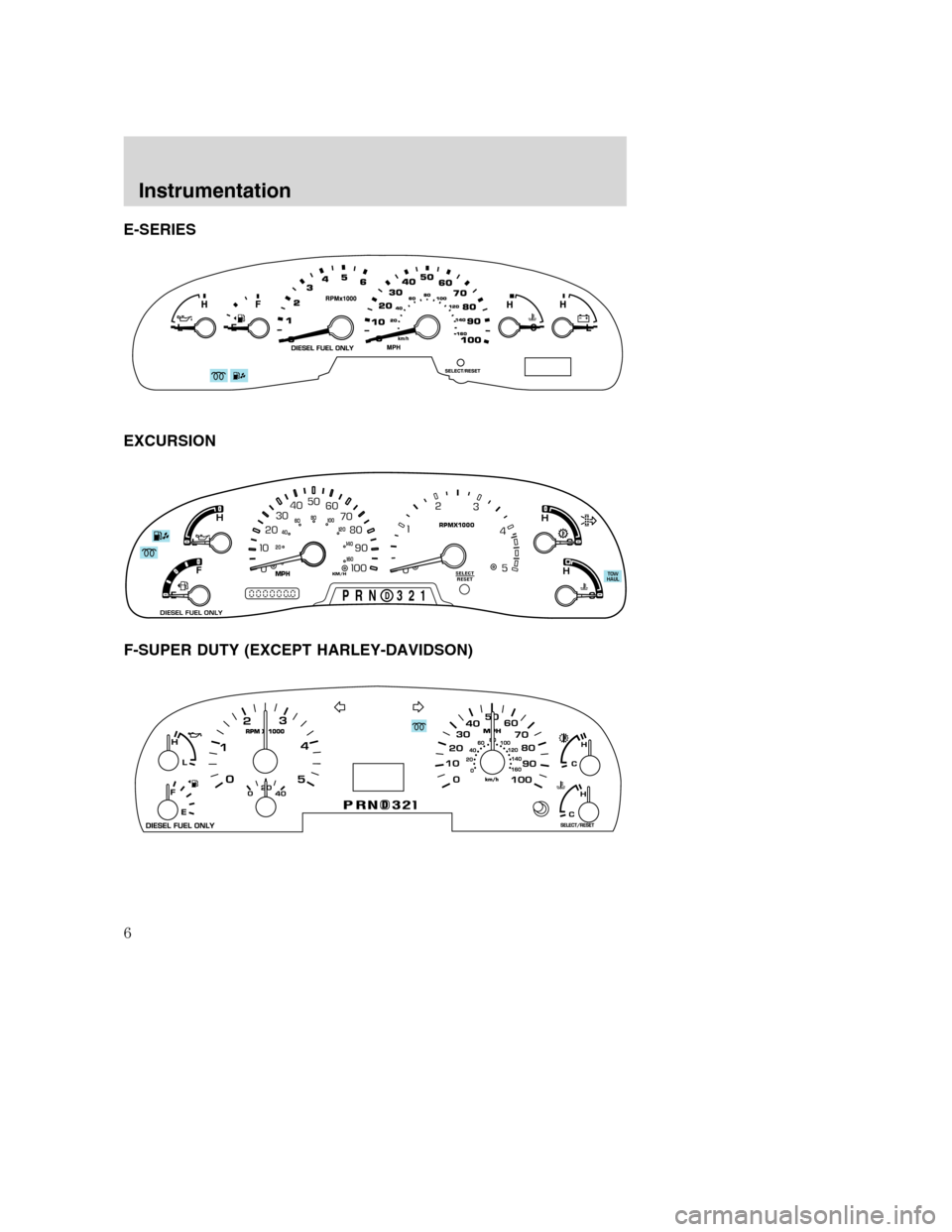
E-SERIES
EXCURSION
F-SUPER DUTY (EXCEPT HARLEY-DAVIDSON)
C
H
LH
E
F
CHSELECT
RESET
RPMX1000
DIESEL FUEL ONLYP R N 3 2 1D
TOW
HAULMPHKM/H020406080
00
20
40
60
Instrumentation
Instrumentation
6
Page 9 of 72
The vehicle may be driven with the engine air filter warning light
illuminated/or when the underhood air filter restriction gauge has moved
to the CHANGE FILTER mark for up to 400 km (250 miles) without
damaging the engine or related components. However, the air filter
element must be replaced at the earliest opportunity. Refer toAir filter
restriction gauge (if equipped)in this section of the supplement for
more information.
Transmission Tow/Haul Feature
(if equipped):Illuminates when
the Tow/Haul feature has been
selected. Refer to theDriving
chapter for transmission function and operation. If the light flashes
steadily or does not illuminate, have the transmission serviced soon, or
damage may occur.
Air filter restriction gauge (if equipped)
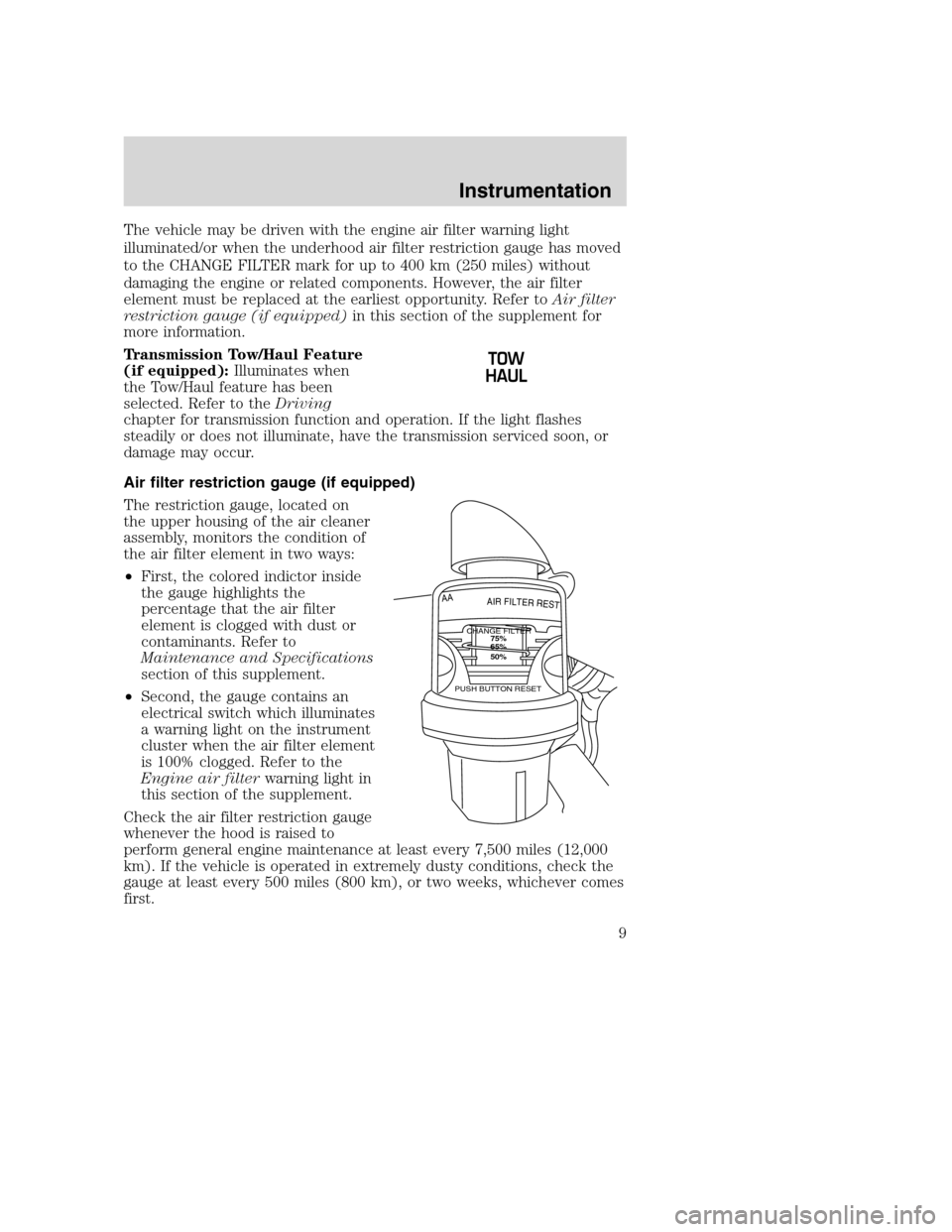
The restriction gauge, located on
the upper housing of the air cleaner
assembly, monitors the condition of
the air filter element in two ways:
•First, the colored indictor inside
the gauge highlights the
percentage that the air filter
element is clogged with dust or
contaminants. Refer to
Maintenance and Specifications
section of this supplement.
•Second, the gauge contains an
electrical switch which illuminates
a warning light on the instrument
cluster when the air filter element
is 100% clogged. Refer to the
Engine air filterwarning light in
this section of the supplement.
Check the air filter restriction gauge
whenever the hood is raised to
perform general engine maintenance at least every 7,500 miles (12,000
km). If the vehicle is operated in extremely dusty conditions, check the
gauge at least every 500 miles (800 km), or two weeks, whichever comes
first.
AIRFILTERRESTAA
CHANGE FILTER
PUSH BUTTON RESET75%
50%65%
Instrumentation
9
Page 15 of 72
TRAILER TOWING
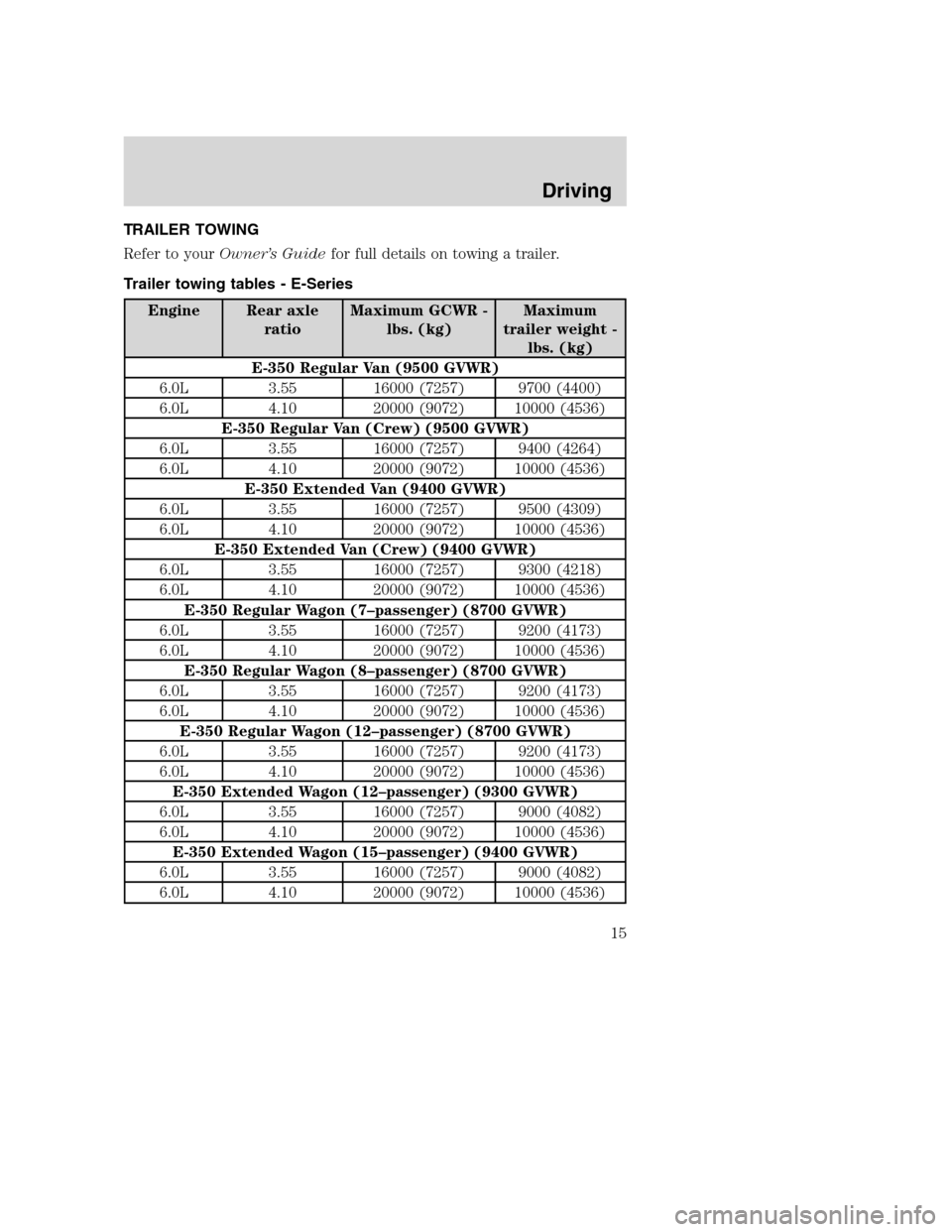
Refer to yourOwner’s Guidefor full details on towing a trailer.
Trailer towing tables - E-Series
Engine Rear axle
ratioMaximum GCWR -
lbs. (kg)Maximum
trailer weight -
lbs. (kg)
E-350 Regular Van (9500 GVWR)
6.0L 3.55 16000 (7257) 9700 (4400)
6.0L 4.10 20000 (9072) 10000 (4536)
E-350 Regular Van (Crew) (9500 GVWR)
6.0L 3.55 16000 (7257) 9400 (4264)
6.0L 4.10 20000 (9072) 10000 (4536)
E-350 Extended Van (9400 GVWR)
6.0L 3.55 16000 (7257) 9500 (4309)
6.0L 4.10 20000 (9072) 10000 (4536)
E-350 Extended Van (Crew) (9400 GVWR)
6.0L 3.55 16000 (7257) 9300 (4218)
6.0L 4.10 20000 (9072) 10000 (4536)
E-350 Regular Wagon (7–passenger) (8700 GVWR)
6.0L 3.55 16000 (7257) 9200 (4173)
6.0L 4.10 20000 (9072) 10000 (4536)
E-350 Regular Wagon (8–passenger) (8700 GVWR)
6.0L 3.55 16000 (7257) 9200 (4173)
6.0L 4.10 20000 (9072) 10000 (4536)
E-350 Regular Wagon (12–passenger) (8700 GVWR)
6.0L 3.55 16000 (7257) 9200 (4173)
6.0L 4.10 20000 (9072) 10000 (4536)
E-350 Extended Wagon (12–passenger) (9300 GVWR)
6.0L 3.55 16000 (7257) 9000 (4082)
6.0L 4.10 20000 (9072) 10000 (4536)
E-350 Extended Wagon (15–passenger) (9400 GVWR)
6.0L 3.55 16000 (7257) 9000 (4082)
6.0L 4.10 20000 (9072) 10000 (4536)
Driving
15
Page 16 of 72
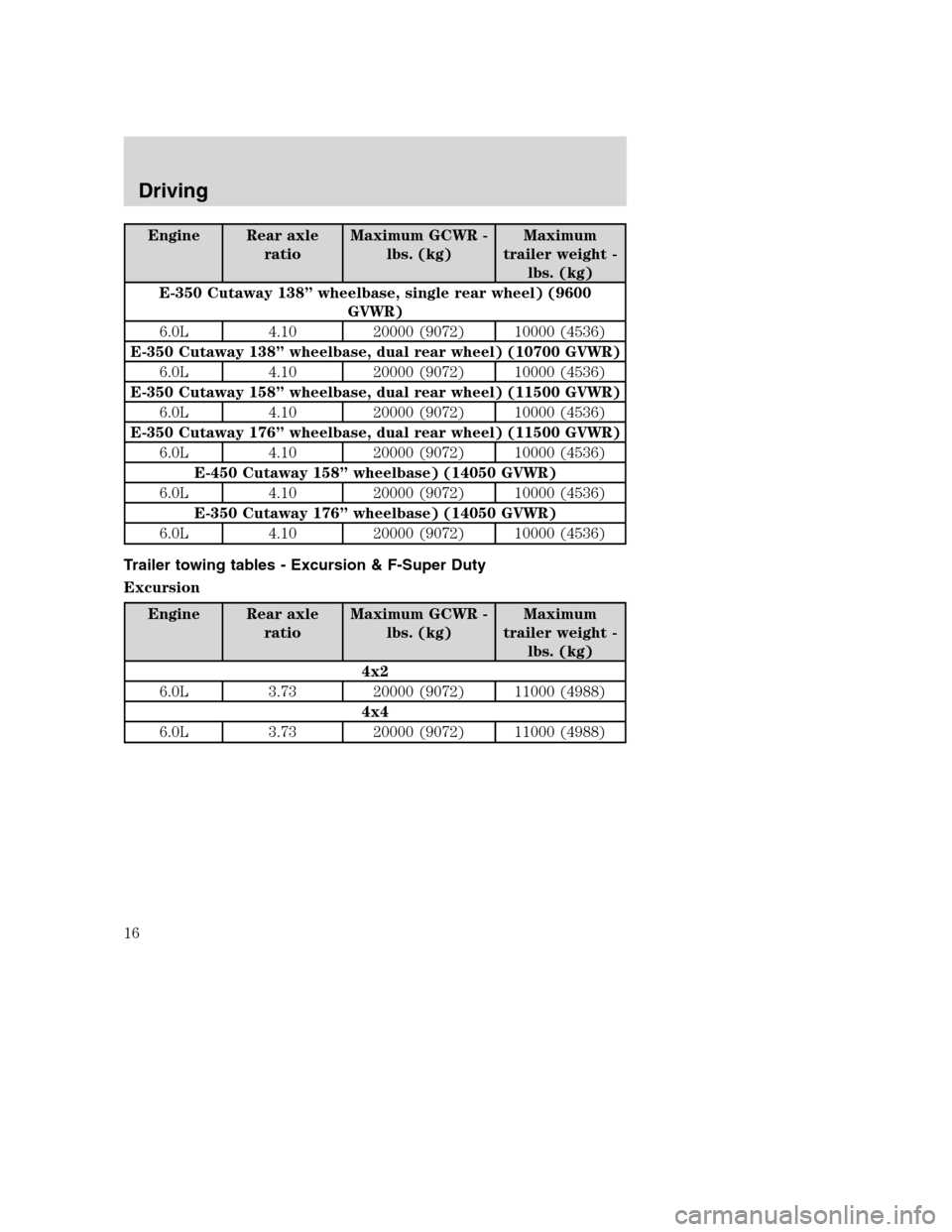
Engine Rear axle
ratioMaximum GCWR -
lbs. (kg)Maximum
trailer weight -
lbs. (kg)
E-350 Cutaway 138”wheelbase, single rear wheel) (9600
GVWR)
6.0L 4.10 20000 (9072) 10000 (4536)
E-350 Cutaway 138”wheelbase, dual rear wheel) (10700 GVWR)
6.0L 4.10 20000 (9072) 10000 (4536)
E-350 Cutaway 158”wheelbase, dual rear wheel) (11500 GVWR)
6.0L 4.10 20000 (9072) 10000 (4536)
E-350 Cutaway 176”wheelbase, dual rear wheel) (11500 GVWR)
6.0L 4.10 20000 (9072) 10000 (4536)
E-450 Cutaway 158”wheelbase) (14050 GVWR)
6.0L 4.10 20000 (9072) 10000 (4536)
E-350 Cutaway 176”wheelbase) (14050 GVWR)
6.0L 4.10 20000 (9072) 10000 (4536)
Trailer towing tables - Excursion & F-Super Duty
Excursion
Engine Rear axle
ratioMaximum GCWR -
lbs. (kg)Maximum
trailer weight -
lbs. (kg)
4x2
6.0L 3.73 20000 (9072) 11000 (4988)
4x4
6.0L 3.73 20000 (9072) 11000 (4988)
Driving
16
Page 17 of 72
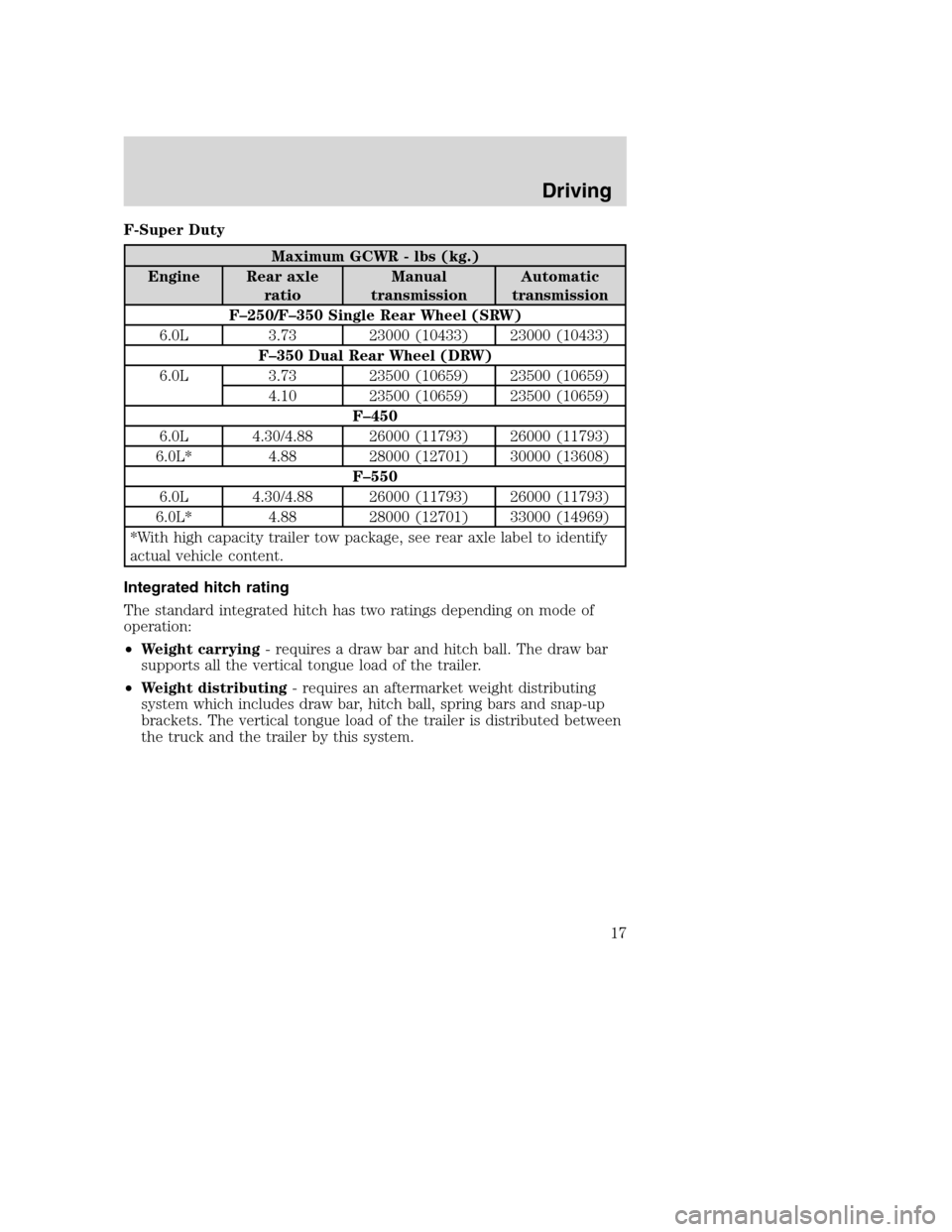
F-Super Duty
Maximum GCWR - lbs (kg.)
Engine Rear axle
ratioManual
transmissionAutomatic
transmission
F–250/F–350 Single Rear Wheel (SRW)
6.0L 3.73 23000 (10433) 23000 (10433)
F–350 Dual Rear Wheel (DRW)
6.0L 3.73 23500 (10659) 23500 (10659)
4.10 23500 (10659) 23500 (10659)
F–450
6.0L 4.30/4.88 26000 (11793) 26000 (11793)
6.0L* 4.88 28000 (12701) 30000 (13608)
F–550
6.0L 4.30/4.88 26000 (11793) 26000 (11793)
6.0L* 4.88 28000 (12701) 33000 (14969)
*With high capacity trailer tow package, see rear axle label to identify
actual vehicle content.
Integrated hitch rating
The standard integrated hitch has two ratings depending on mode of
operation:
•Weight carrying- requires a draw bar and hitch ball. The draw bar
supports all the vertical tongue load of the trailer.
•Weight distributing- requires an aftermarket weight distributing
system which includes draw bar, hitch ball, spring bars and snap-up
brackets. The vertical tongue load of the trailer is distributed between
the truck and the trailer by this system.
Driving
17
Page 18 of 72
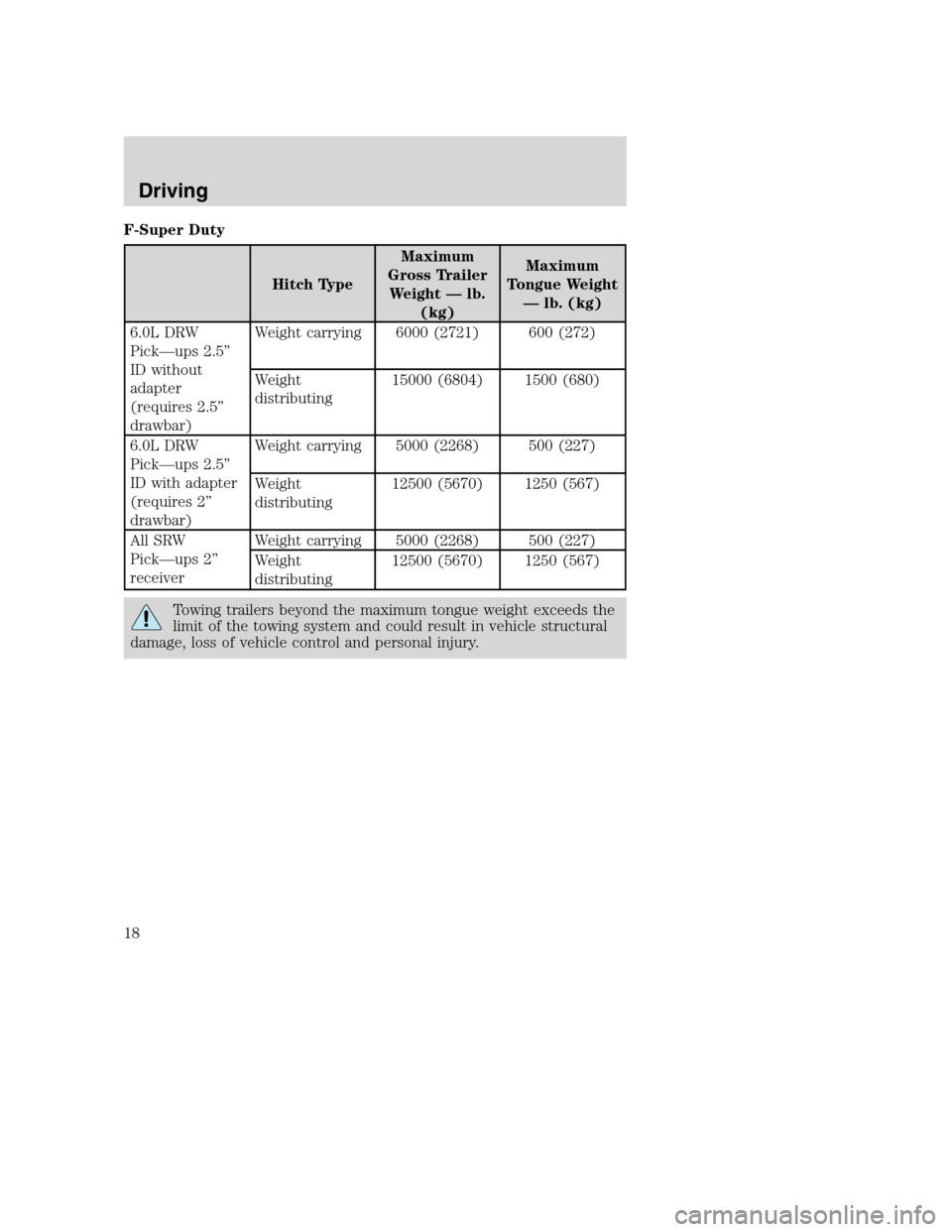
F-Super Duty
Hitch TypeMaximum
Gross Trailer
Weight—lb.
(kg)Maximum
Tongue Weight
—lb. (kg)
6.0L DRW
Pick—ups 2.5”
ID without
adapter
(requires 2.5”
drawbar)Weight carrying 6000 (2721) 600 (272)
Weight
distributing15000 (6804) 1500 (680)
6.0L DRW
Pick—ups 2.5”
ID with adapter
(requires 2”
drawbar)Weight carrying 5000 (2268) 500 (227)
Weight
distributing12500 (5670) 1250 (567)
All SRW
Pick—ups 2”
receiverWeight carrying 5000 (2268) 500 (227)
Weight
distributing12500 (5670) 1250 (567)
Towing trailers beyond the maximum tongue weight exceeds the
limit of the towing system and could result in vehicle structural
damage, loss of vehicle control and personal injury.
Driving
18
Page 32 of 72
FCM/HFCM drain procedure
1. Stop the vehicle andshut offthe engine.
The vehicle must be stopped with the engine off when draining
the HFCM/FCM. Fuel may ignite if the separator is drained while
the engine is running or vehicle is moving.
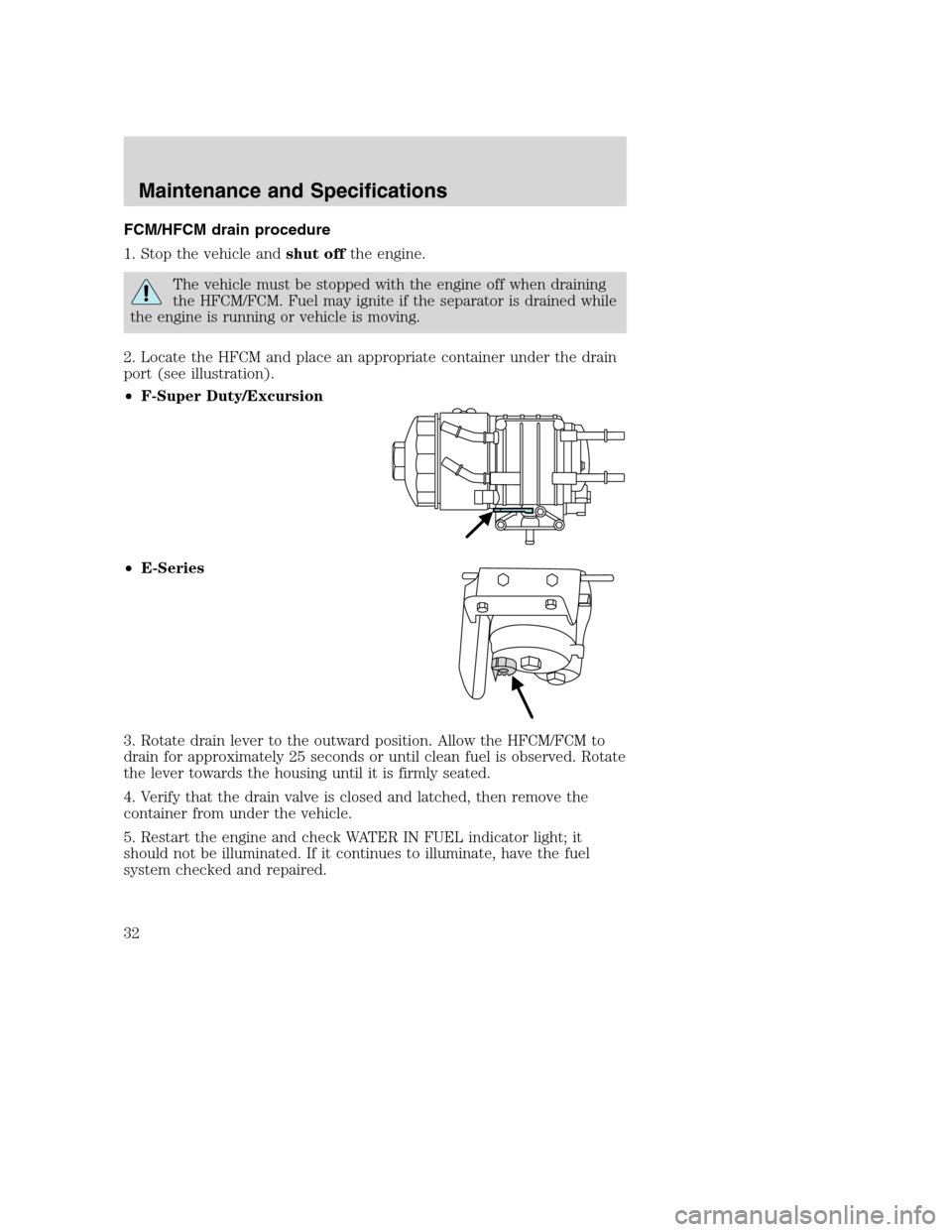
2. Locate the HFCM and place an appropriate container under the drain
port (see illustration).
•F-Super Duty/Excursion
•E-Series
3. Rotate drain lever to the outward position. Allow the HFCM/FCM to
drain for approximately 25 seconds or until clean fuel is observed. Rotate
the lever towards the housing until it is firmly seated.
4. Verify that the drain valve is closed and latched, then remove the
container from under the vehicle.
5. Restart the engine and check WATER IN FUEL indicator light; it
should not be illuminated. If it continues to illuminate, have the fuel
system checked and repaired.
Maintenance and Specifications
32
Page 36 of 72
Engine oil specifications
To help achieve proper engine performance and durability, it is important
that only engine lubricating oils of the proper quality are used in your
diesel engine and that the engine oil is changedno laterthan the
recommended interval. Diesel engines require specially formulated oil to
resist contamination. Proper quality oils also provide maximum efficiency
of the crankcase ventilating system which reduces air pollution.
For normal or severe service, use Motorcraft oil or an equivalent oil
conforming to Ford Specification WSS-M2C171–D or API Service
categories CI-4, CI-4/SL or DHD-1. If CI-4 oil is not available, CH-4 is
acceptable..
Engine oils with improved fuel economy properties (energy conserving)
are currently available. If you use an energy conserving oil, be sure it
meets the recommended Ford Specification,APIservice categories and
SAE viscosity grades listed in the Lubricant and Maintenance Materials
Specifications chart. Some energy conserving oilsdo notmeet the
requirements necessary for your diesel engine.
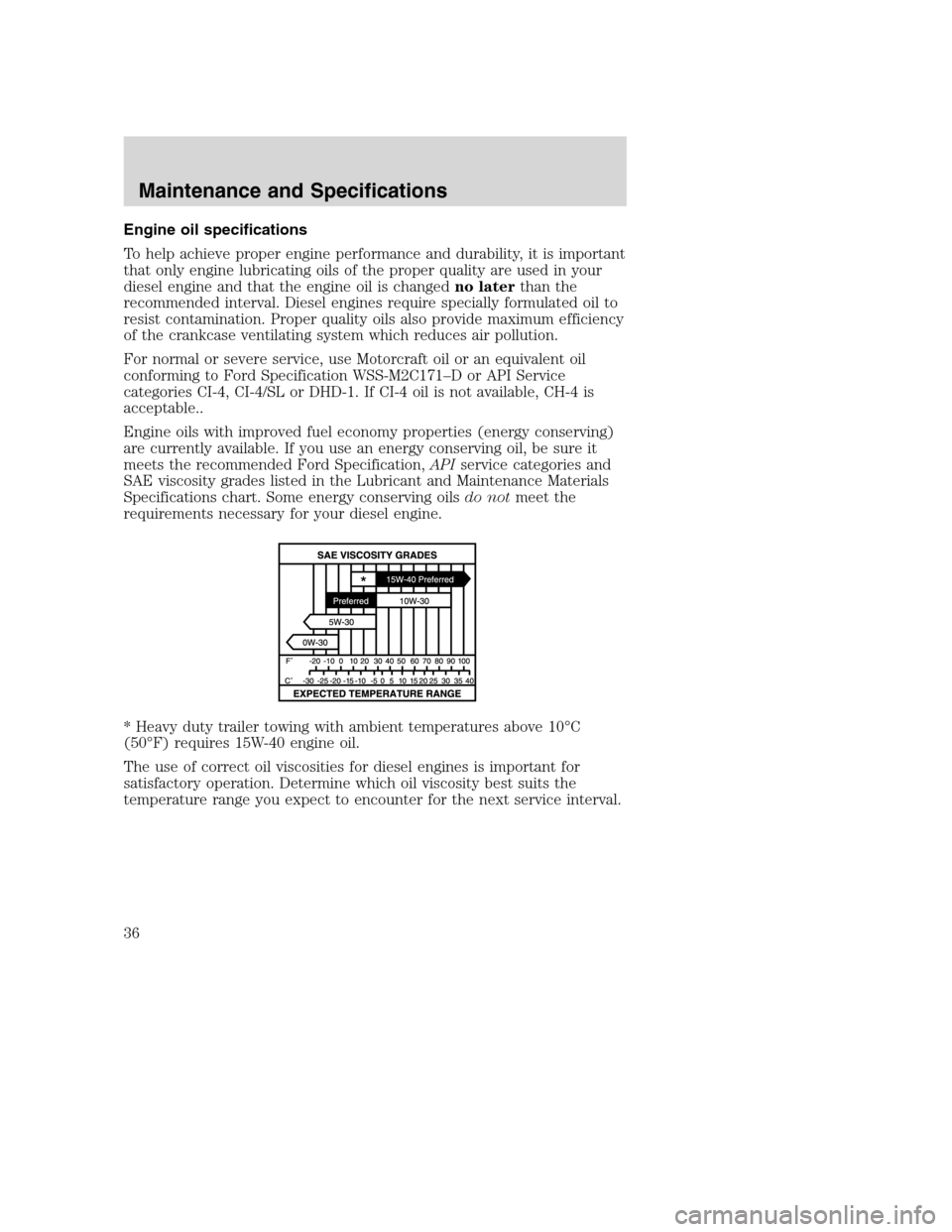
* Heavy duty trailer towing with ambient temperatures above 10°C
(50°F) requires 15W-40 engine oil.
The use of correct oil viscosities for diesel engines is important for
satisfactory operation. Determine which oil viscosity best suits the
temperature range you expect to encounter for the next service interval.
Maintenance and Specifications
36
Page 37 of 72
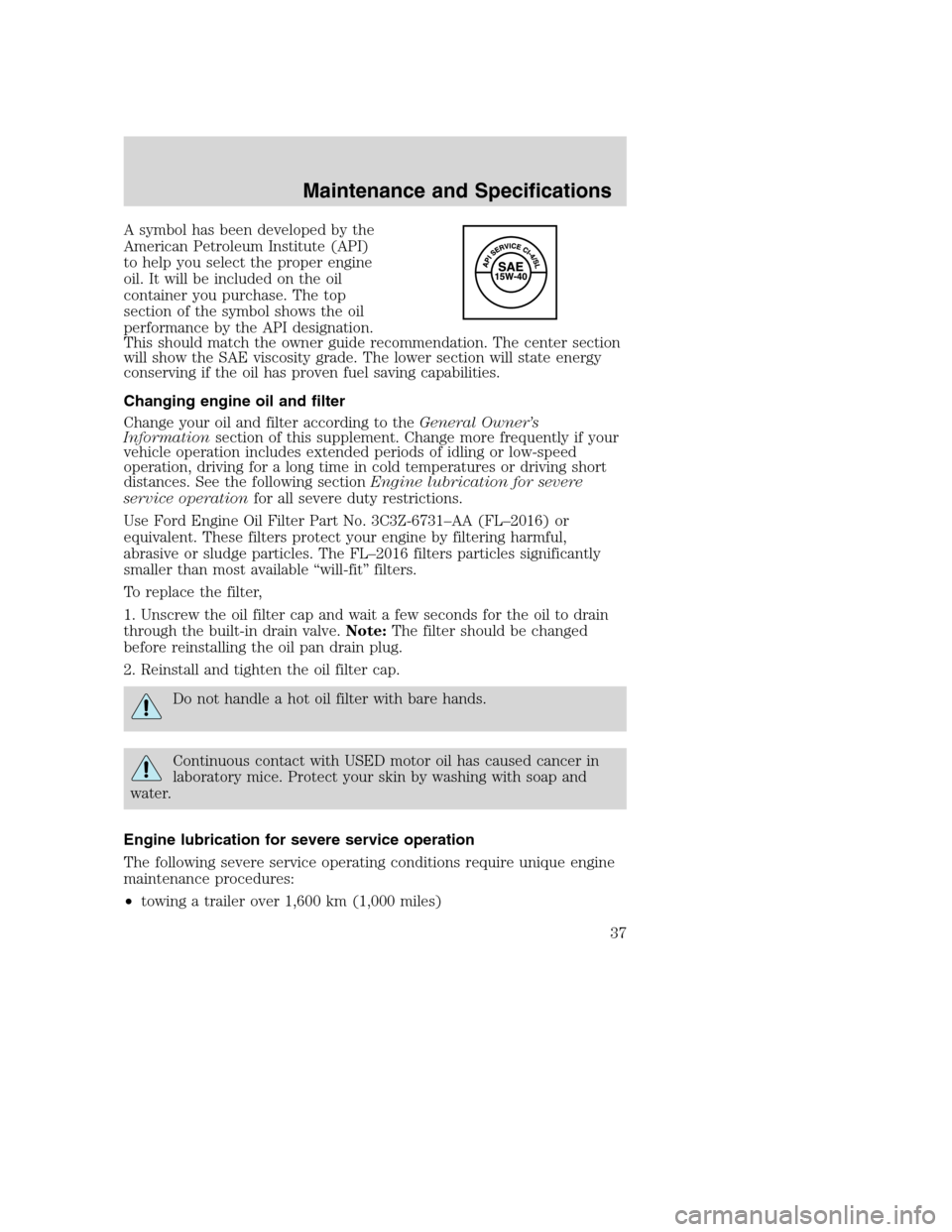
A symbol has been developed by the
American Petroleum Institute (API)
to help you select the proper engine
oil. It will be included on the oil
container you purchase. The top
section of the symbol shows the oil
performance by the API designation.
This should match the owner guide recommendation. The center section
will show the SAE viscosity grade. The lower section will state energy
conserving if the oil has proven fuel saving capabilities.
Changing engine oil and filter
Change your oil and filter according to theGeneral Owner’s
Informationsection of this supplement. Change more frequently if your
vehicle operation includes extended periods of idling or low-speed
operation, driving for a long time in cold temperatures or driving short
distances. See the following sectionEngine lubrication for severe
service operationfor all severe duty restrictions.
Use Ford Engine Oil Filter Part No. 3C3Z-6731–AA (FL–2016) or
equivalent. These filters protect your engine by filtering harmful,
abrasive or sludge particles. The FL–2016 filters particles significantly
smaller than most available“will-fit”filters.
To replace the filter,
1. Unscrew the oil filter cap and wait a few seconds for the oil to drain
through the built-in drain valve.Note:The filter should be changed
before reinstalling the oil pan drain plug.
2. Reinstall and tighten the oil filter cap.
Do not handle a hot oil filter with bare hands.
Continuous contact with USED motor oil has caused cancer in
laboratory mice. Protect your skin by washing with soap and
water.
Engine lubrication for severe service operation
The following severe service operating conditions require unique engine
maintenance procedures:
•towing a trailer over 1,600 km (1,000 miles)
Maintenance and Specifications
37