air condition FORD SUPER DUTY 2006 1.G Diesel Supplement Manual
[x] Cancel search | Manufacturer: FORD, Model Year: 2006, Model line: SUPER DUTY, Model: FORD SUPER DUTY 2006 1.GPages: 72, PDF Size: 0.57 MB
Page 8 of 72
Do not drain the water separator while the engine is running.
Fuel may ignite if the separator is drained while the engine is
running or the vehicle is moving.
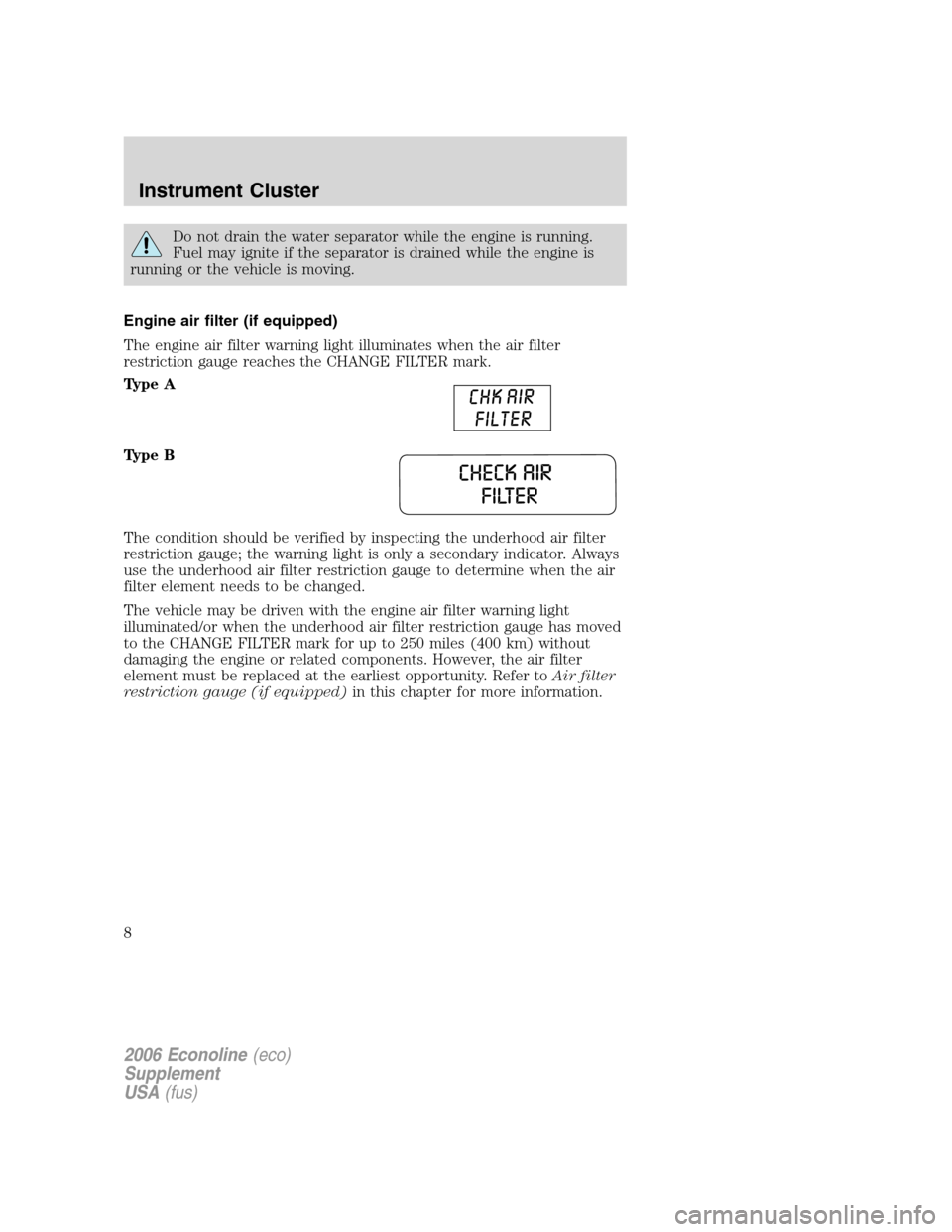
Engine air filter (if equipped)
The engine air filter warning light illuminates when the air filter
restriction gauge reaches the CHANGE FILTER mark.
Type A
Type B
The condition should be verified by inspecting the underhood air filter
restriction gauge; the warning light is only a secondary indicator. Always
use the underhood air filter restriction gauge to determine when the air
filter element needs to be changed.
The vehicle may be driven with the engine air filter warning light
illuminated/or when the underhood air filter restriction gauge has moved
to the CHANGE FILTER mark for up to 250 miles (400 km) without
damaging the engine or related components. However, the air filter
element must be replaced at the earliest opportunity. Refer toAir filter
restriction gauge (if equipped)in this chapter for more information.
2006 Econoline(eco)
Supplement
USA(fus)
Instrument Cluster
8
Page 9 of 72
AIR FILTER RESTRICTION GAUGE (IF EQUIPPED)
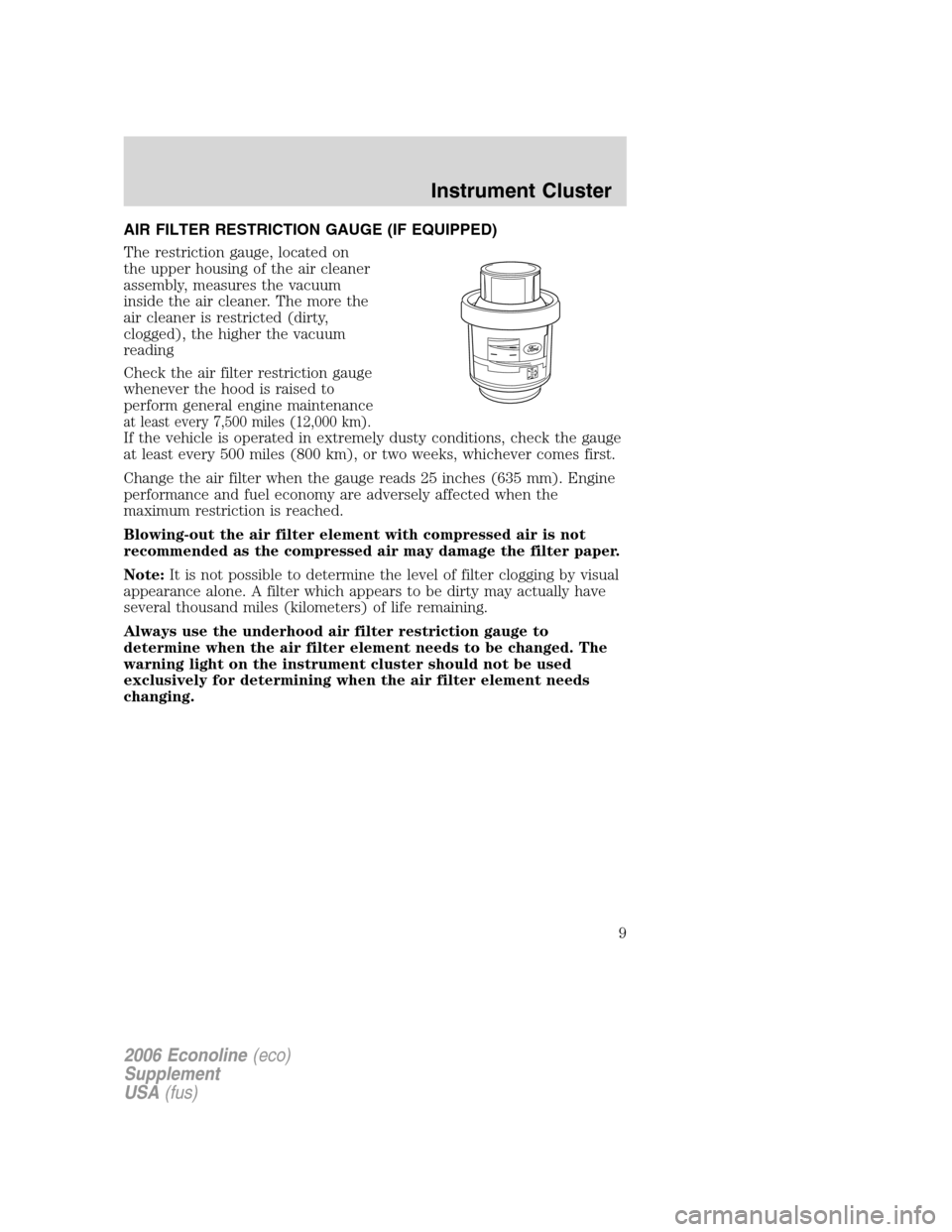
The restriction gauge, located on
the upper housing of the air cleaner
assembly, measures the vacuum
inside the air cleaner. The more the
air cleaner is restricted (dirty,
clogged), the higher the vacuum
reading
Check the air filter restriction gauge
whenever the hood is raised to
perform general engine maintenance
at least every 7,500 miles (12,000 km).
If the vehicle is operated in extremely dusty conditions, check the gauge
at least every 500 miles (800 km), or two weeks, whichever comes first.
Change the air filter when the gauge reads 25 inches (635 mm). Engine
performance and fuel economy are adversely affected when the
maximum restriction is reached.
Blowing-out the air filter element with compressed air is not
recommended as the compressed air may damage the filter paper.
Note:It is not possible to determine the level of filter clogging by visual
appearance alone. A filter which appears to be dirty may actually have
several thousand miles (kilometers) of life remaining.
Always use the underhood air filter restriction gauge to
determine when the air filter element needs to be changed. The
warning light on the instrument cluster should not be used
exclusively for determining when the air filter element needs
changing.
2006 Econoline(eco)
Supplement
USA(fus)
Instrument Cluster
9
Page 10 of 72
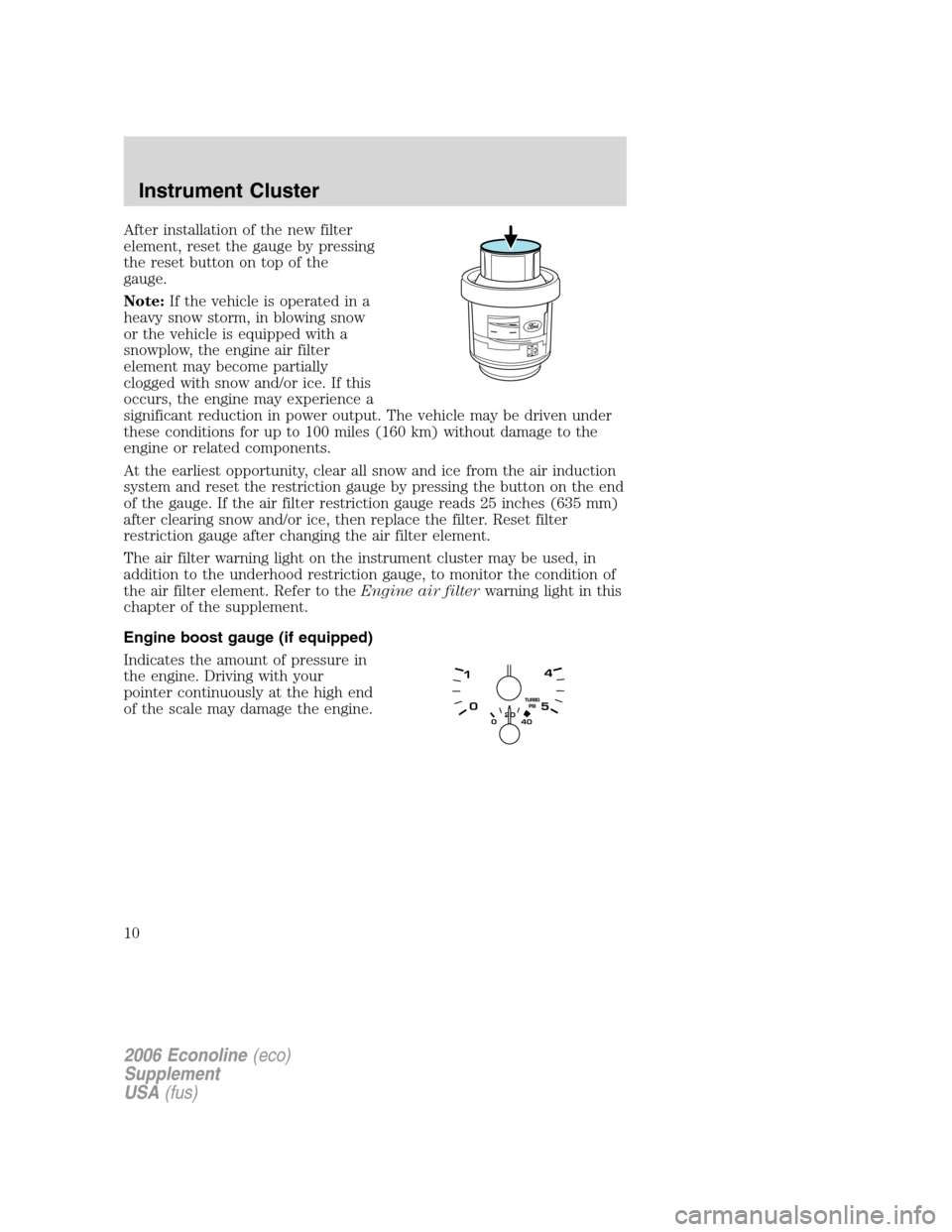
After installation of the new filter
element, reset the gauge by pressing
the reset button on top of the
gauge.
Note:If the vehicle is operated in a
heavy snow storm, in blowing snow
or the vehicle is equipped with a
snowplow, the engine air filter
element may become partially
clogged with snow and/or ice. If this
occurs, the engine may experience a
significant reduction in power output. The vehicle may be driven under
these conditions for up to 100 miles (160 km) without damage to the
engine or related components.
At the earliest opportunity, clear all snow and ice from the air induction
system and reset the restriction gauge by pressing the button on the end
of the gauge. If the air filter restriction gauge reads 25 inches (635 mm)
after clearing snow and/or ice, then replace the filter. Reset filter
restriction gauge after changing the air filter element.
The air filter warning light on the instrument cluster may be used, in
addition to the underhood restriction gauge, to monitor the condition of
the air filter element. Refer to theEngine air filterwarning light in this
chapter of the supplement.
Engine boost gauge (if equipped)
Indicates the amount of pressure in
the engine. Driving with your
pointer continuously at the high end
of the scale may damage the engine.
2006 Econoline(eco)
Supplement
USA(fus)
Instrument Cluster
10
Page 13 of 72
Your vehicle is also equipped with a bypass relief valve, located on the
fuel control module, which provides fuel flow to the engine if the fuel
pickup should become plugged by ice or wax. To allow this bypass valve
to function and avoid engine fuel starvation, it is recommended that,
during cold weather operation 32°F (0°C) or below, the fuel level in your
tank should not be allowed to drop below
14full. This will help prevent
air from entering the fuel system and stalling the engine.
In cold weather below 32°F (0°C) your diesel engine will slowly increase
to a higher idle speed if left idling in P (Park). As the engine warms-up,
the engine sound level will decrease due to the activation of
PCM-controlled sound reduction features.
If your vehicle is operated in a heavy snow storm or blowing snow
conditions, the engine air induction may become partially clogged with
snow and/or ice. If this occurs, the engine may experience a significant
reduction in power output. At the earliest opportunity, clear all the snow
and/or ice away from the air induction inlet.
Operation in snow
Vehicle operation in heavy snowfall or in dry loose snow that may swirl
around the front of the vehicle may feed excessive amounts of snow into
the air intake system. This could plug the air cleaner with snow and
cause the engine to stall and/or lose power.
Refer toAir filter restriction gaugeandEngine air filterin the
Instrument Clusterchapter of this supplement for more information.
Operation in standing water
Ingestion of water into the diesel engine can result in immediate and
severe damage to the engine. If driving through water, slow down to
avoid splashing water into the intake. If the engine stalls, and ingestion
of water into the engine is suspected, do not try to restart the engine.
Consult your dealer for service immediately.
Engine block heater (if equipped)
Refer to theDrivingchapter in theOwner’s Guide.
2006 Econoline(eco)
Supplement
USA(fus)
Driving
13
Page 26 of 72
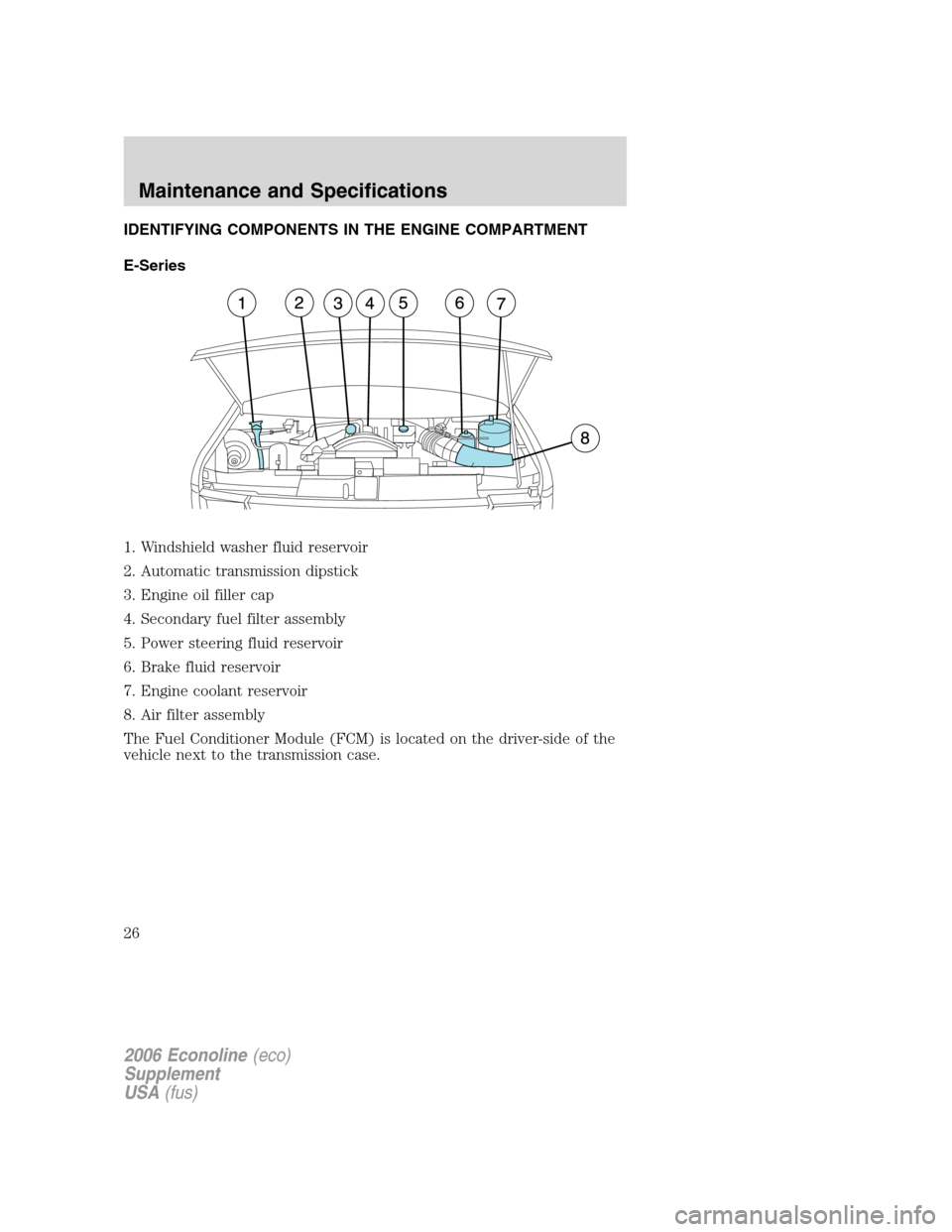
IDENTIFYING COMPONENTS IN THE ENGINE COMPARTMENT
E-Series
1. Windshield washer fluid reservoir
2. Automatic transmission dipstick
3. Engine oil filler cap
4. Secondary fuel filter assembly
5. Power steering fluid reservoir
6. Brake fluid reservoir
7. Engine coolant reservoir
8. Air filter assembly
The Fuel Conditioner Module (FCM) is located on the driver-side of the
vehicle next to the transmission case.
2006 Econoline(eco)
Supplement
USA(fus)
Maintenance and Specifications
26
Page 30 of 72
Fueling tips
If the engine fails to start in 30 seconds, turn the key to the OFF
position and wait 30 seconds before trying again.
Truck stops have pumps and nozzles designed for larger, heavy-duty
trucks. When refueling at truck stops: if the nozzle shuts off repeatedly
when refueling, wait 5–10 seconds; then use a slower rate of flow (don’t
depress the nozzle trigger as far).
If air is allowed to enter the fuel system (during fuel filter change or if
you run out of fuel) the engine will purge the trapped air as it runs. The
engine may run rough and produce white smoke while air is in the
system. This is normal and should correct itself in a short time.
An engine that suddenly becomes noisy or operates poorly after a fuel fill
could be using substandard fuel (i.e., high water content, low cetane
rating or gasoline in the fuel). Diesel fuel should be purchased from a
reputable station which sells a large amount of diesel fuel.
Care should be taken whenever diesel fuel is stored. Use only clean,
approved containers which will prevent the entry of dirt or water.
Diesel fuel must not be stored in a galvanized container. The fuel will
dissolve the zinc in a galvanized container. The zinc will then remain in
solution until it is run through the engine where it will be deposited in
the fuel injectors causing expensive-to-repair damage.
Diesel fuel dispensing nozzle fill rate
This truck is equipped with a fuel fill pipe which is able to accept fuel up
to 20 gallons per minute from an 1 1/8 inch fuel dispensing nozzle.
Pumping fuel at greater flow rates may result in premature nozzle
shut-off or spitback.
FUEL CONDITIONER MODULE (FCM - E-SERIES)/HORIZONTAL
FUEL CONDITIONING MODULE (HFCM - F-SUPER DUTY - FUEL
FILTER/WATER SEPARATOR
HFCM - F-Super Duty
The vehicle is equipped with a Horizontal Fuel Conditioning Module
(HFCM) located on the frame-rail under the driver-side floorboard near
the transmission.
2006 Econoline(eco)
Supplement
USA(fus)
Maintenance and Specifications
30
Page 38 of 72
![FORD SUPER DUTY 2006 1.G Diesel Supplement Manual •sustained, high speed driving at Gross Vehicle Weight Rating
(maximum loaded weight for vehicle operation during hot
weather-above 90°F [32°C]).
•frequent or extended idling (over 10 minutes pe](/img/11/5266/w960_5266-37.png "FORD SUPER DUTY 2006 1.G Diesel Supplement Manual •sustained, high speed driving at Gross Vehicle Weight Rating
(maximum loaded weight for vehicle operation during hot
weather-above 90°F [32°C]).
•frequent or extended idling (over 10 minutes pe")
•sustained, high speed driving at Gross Vehicle Weight Rating
(maximum loaded weight for vehicle operation during hot
weather-above 90°F [32°C]).
•frequent or extended idling (over 10 minutes per hour of normal
driving).
•operating in severe dust conditions.
•frequent, short trips of 10 miles (16 km) or less during freezing
weather
If you are operating your vehicle under any of these conditions, observe
the following service procedures:
•Change engine oil and filter every 5,000 miles (8,000 km).
•Use Motorcraft oil or an equivalent oil conforming to Ford
Specification WSS-M2C171–D or API categories CI-4, CI–4/SL, CI-4
PLUS or DHD-1. If CI-4 oil is not available, CH-4 is acceptable.
For more information refer thescheduled maintenance information
section of this supplement.
AIR FILTER
When replacing the air filter element, use the Motorcraft air filter
element listed. Refer to theMotorcraft part numberschart in this
chapter.
Note: Do not start your engine with the air cleaner removed and do not
remove it while the engine is running.
Failure to use the correct air filter element may result in severe
engine damage.
•E-series air filter element:
1. Disconnect the hoses from the air cleaner outlet tube.
2. Loosen the clamp and disconnect
the air cleaner outlet tube.
2006 Econoline(eco)
Supplement
USA(fus)
Maintenance and Specifications
38
Page 41 of 72
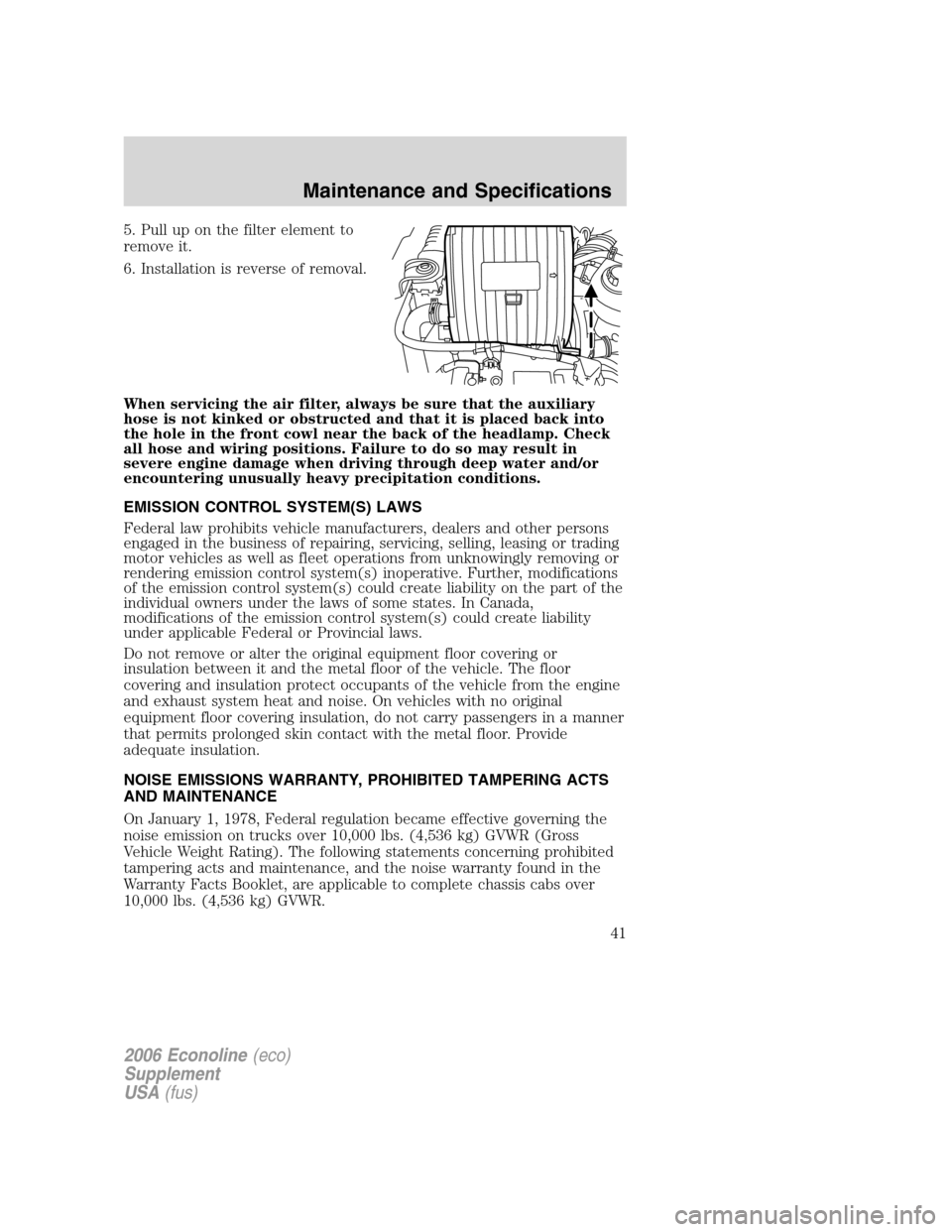
5. Pull up on the filter element to
remove it.
6. Installation is reverse of removal.
When servicing the air filter, always be sure that the auxiliary
hose is not kinked or obstructed and that it is placed back into
the hole in the front cowl near the back of the headlamp. Check
all hose and wiring positions. Failure to do so may result in
severe engine damage when driving through deep water and/or
encountering unusually heavy precipitation conditions.
EMISSION CONTROL SYSTEM(S) LAWS
Federal law prohibits vehicle manufacturers, dealers and other persons
engaged in the business of repairing, servicing, selling, leasing or trading
motor vehicles as well as fleet operations from unknowingly removing or
rendering emission control system(s) inoperative. Further, modifications
of the emission control system(s) could create liability on the part of the
individual owners under the laws of some states. In Canada,
modifications of the emission control system(s) could create liability
under applicable Federal or Provincial laws.
Do not remove or alter the original equipment floor covering or
insulation between it and the metal floor of the vehicle. The floor
covering and insulation protect occupants of the vehicle from the engine
and exhaust system heat and noise. On vehicles with no original
equipment floor covering insulation, do not carry passengers in a manner
that permits prolonged skin contact with the metal floor. Provide
adequate insulation.
NOISE EMISSIONS WARRANTY, PROHIBITED TAMPERING ACTS
AND MAINTENANCE
On January 1, 1978, Federal regulation became effective governing the
noise emission on trucks over 10,000 lbs. (4,536 kg) GVWR (Gross
Vehicle Weight Rating). The following statements concerning prohibited
tampering acts and maintenance, and the noise warranty found in the
Warranty Facts Booklet, are applicable to complete chassis cabs over
10,000 lbs. (4,536 kg) GVWR.
2006 Econoline(eco)
Supplement
USA(fus)
Maintenance and Specifications
41
Page 42 of 72
Tampering with noise control system prohibited
Federal law prohibits the following acts or the causing thereof: (1) The
removal or rendering inoperative by any person other than for purposes
of maintenance, repair or replacement of any device or element of design
incorporated into any new vehicle for the purpose of noise control prior
to its sale or delivery to the ultimate purchaser or while it is in use, or
(2) the use of the vehicle after such device or element of design has
been removed or rendered inoperative by any person.
Among those acts which the U.S. Environmental Protection Agency may
presume to constitute tampering are the acts listed below:
•Removal of hood blanket, fender apron absorbers, fender apron
barriers, underbody noise shields or acoustically absorptive material.
•Tampering or rendering inoperative the engine speed governor, so as
to allow engine speed to exceed manufacturer’s specifications.
The complexity of the diesel engine makes it so the owner is discouraged
from attempting to perform maintenance other than the services
described in this supplement.
If you experience difficult starting, rough idling, excessive exhaust
smoke, a decrease in engine performance or excess fuel consumption,
perform the following checks:
•a plugged air inlet system or engine air filter element.
•water in the fuel filter/water separator.
•a clogged fuel filter.
•contaminated fuel.
•air in the fuel system, due to loose connections.
•an open or pinched sensor hose.
•low engine oil level.
•wrong fuel or oil viscosity for climactic conditions.
If these checks do not help you correct the engine performance problem
you are experiencing, consult an authorized dealer.
FUELING
Do not use starting fluid such as ether or gasoline in the diesel
air intake system. Such fluids can cause immediate explosive
damage to the engine and possible personal injury.
2006 Econoline(eco)
Supplement
USA(fus)
Maintenance and Specifications
42
Page 49 of 72
Genuine Ford and Motorcraft Replacement Parts
Ford and Lincoln Mercury dealerships stock Ford and Motorcraft
branded replacement parts. These parts meet or exceed Ford Motor
Company’s specifications, and we stand behind them. Maintenance parts
installed at your Ford or Lincoln Mercury dealership carry a nationwide,
12 months, 12,000 mile (19,500 km) parts and labor limited warranty.
Your dealer can give you details.
Value Shopping for Your Vehicle’s Maintenance Needs
Your dealership recognizes the competitive landscape of maintenance and
light repair automotive services. With factory-trained technicians, and
one-stop service from routine maintenance like oil changes and tire
rotations to repairs like brake service, check out the value your Ford and
Lincoln Mercury dealers can offer.
WHICH MAINTENANCE SCHEDULE SHOULD YOU FOLLOW?
Owner Checks and Services
Refer to Mileage Intervals for Additional Checks and Services
Certain basic maintenance checks and inspections should be performed
by the owner or a service technician at the intervals indicated. Service
information and supporting specifications are provided in theOwner’s
Guide .
Any adverse condition should be brought to the attention of your dealer
or qualified service technician as soon as possible for the proper service
advice. The owner maintenance service checks are generally not covered
by warranties so you may be charged for labor, parts or lubricants used.
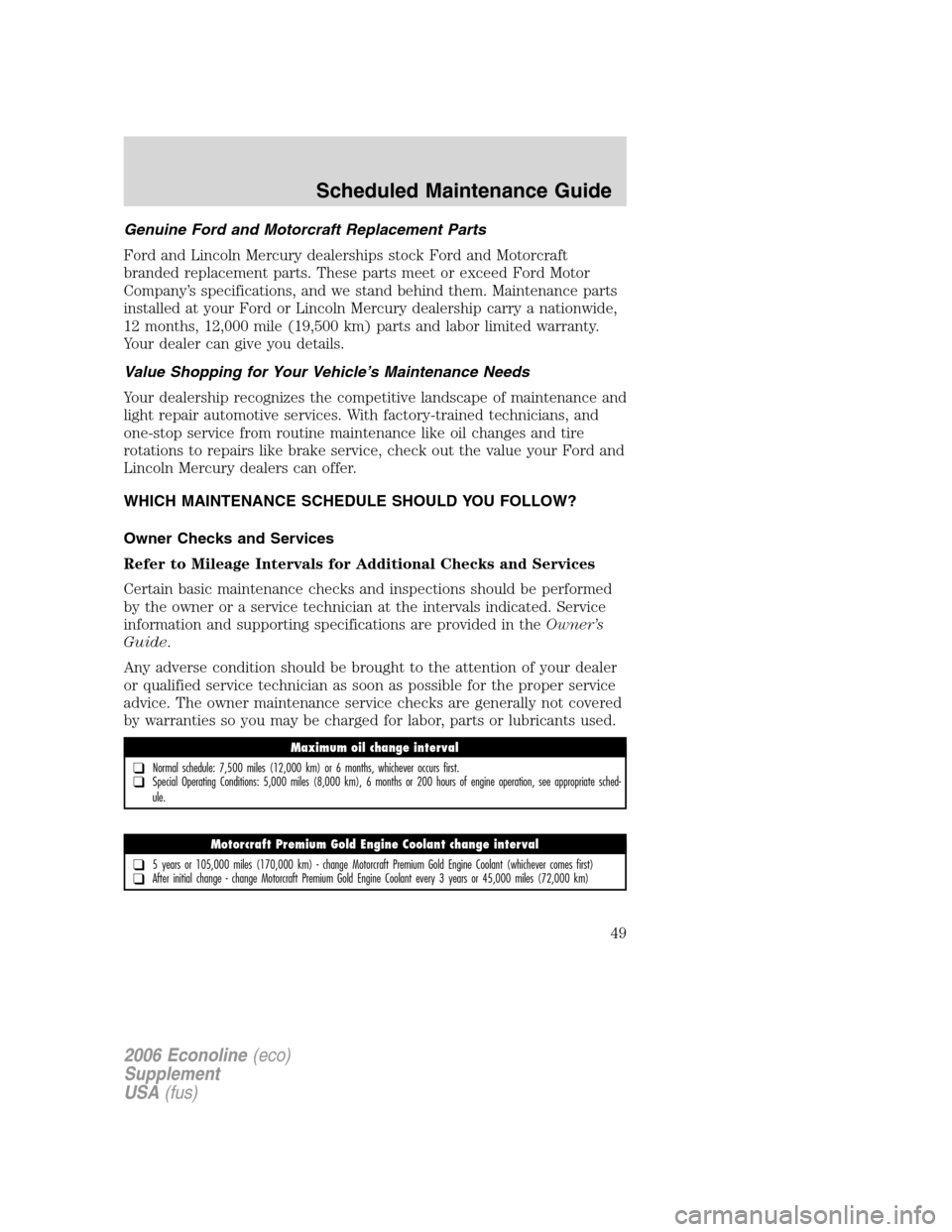
Maximum oil change interval
❑Normal schedule: 7,500 miles (12,000 km) or 6 months, whichever occurs first.❑Special Operating Conditions: 5,000 miles (8,000 km), 6 months or 200 hours of engine operation, see appropriate sched-
ule.
Motorcraft Premium Gold Engine Coolant change interval
❑5 years or 105,000 miles (170,000 km) - change Motorcraft Premium Gold Engine Coolant (whichever comes first)❑After initial change - change Motorcraft Premium Gold Engine Coolant every 3 years or 45,000 miles (72,000 km)
2006 Econoline (eco)
Supplement
USA (fus)
Scheduled Maintenance Guide
49