engine FORD SUPER DUTY 2009 2.G Diesel Supplement Manual
[x] Cancel search | Manufacturer: FORD, Model Year: 2009, Model line: SUPER DUTY, Model: FORD SUPER DUTY 2009 2.GPages: 103, PDF Size: 0.75 MB
Page 28 of 103
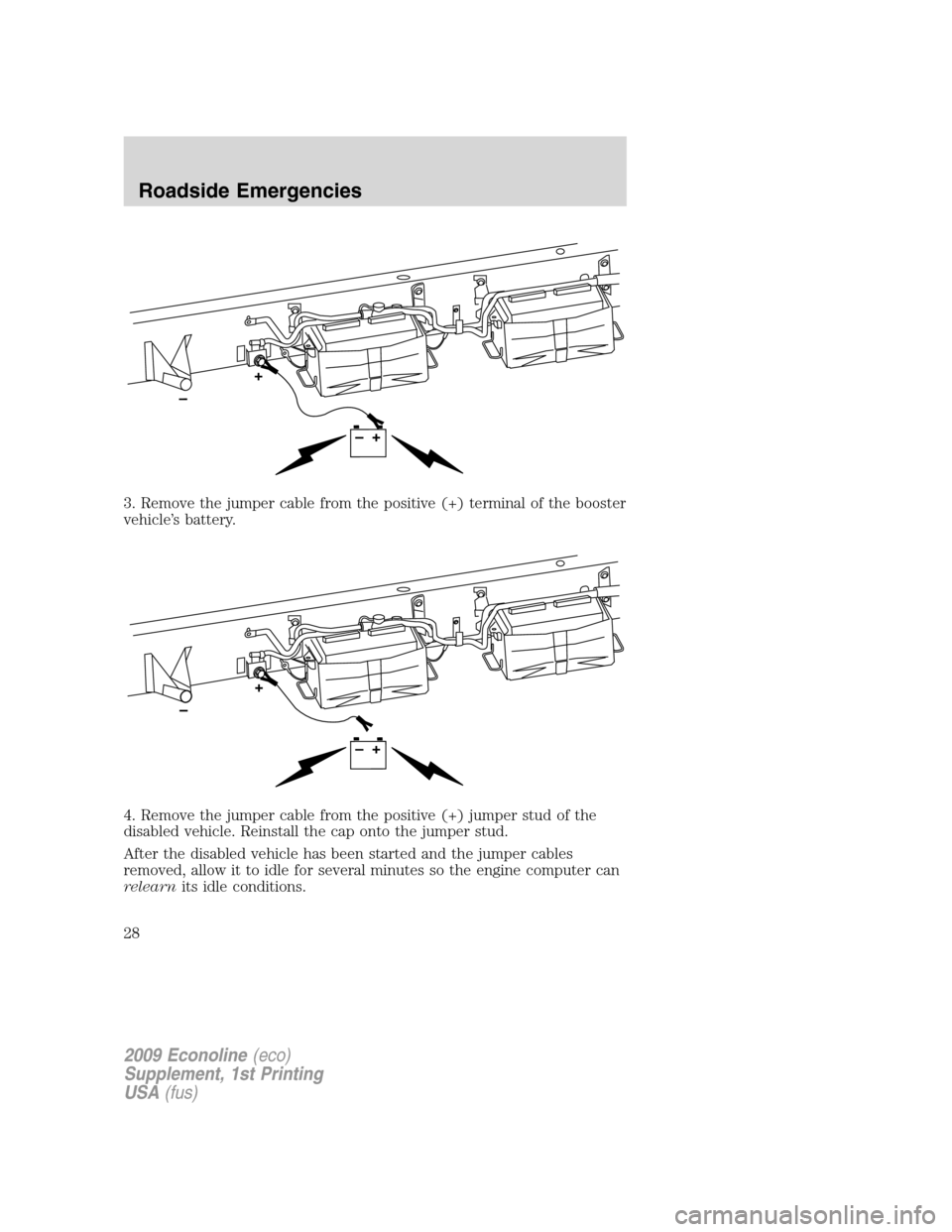
3. Remove the jumper cable from the positive (+) terminal of the booster
vehicle’s battery.
4. Remove the jumper cable from the positive (+) jumper stud of the
disabled vehicle. Reinstall the cap onto the jumper stud.
After the disabled vehicle has been started and the jumper cables
removed, allow it to idle for several minutes so the engine computer can
relearnits idle conditions.
2009 Econoline(eco)
Supplement, 1st Printing
USA(fus)
Roadside Emergencies
28
Page 29 of 103
ENGINE
Engines are more efficient when they are clean because grease and dirt
buildup keep the engine warmer than normal. When washing:
•Take care when using a power washer to clean the engine. The
high-pressure fluid could penetrate the sealed parts and cause
damage.
•Do not spray a hot engine with cold water to avoid cracking the
engine block or other engine components.
•Spray Motorcraft Engine Shampoo and Degreaser (ZC-20) on all parts
that require cleaning and pressure rinse clean.
•Never wash or rinse the engine while it is running; water in the
running engine may cause internal damage.
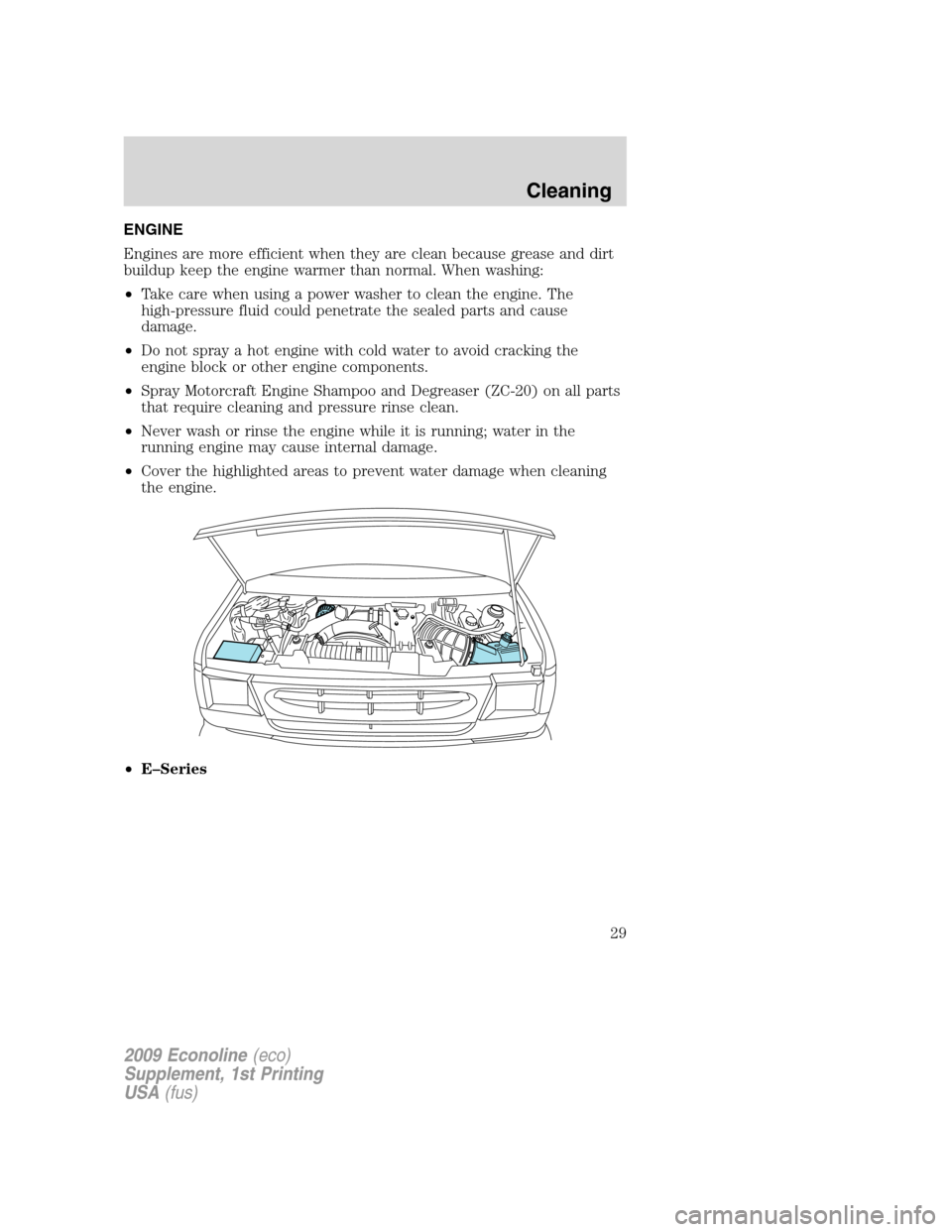
•Cover the highlighted areas to prevent water damage when cleaning
the engine.
•E–Series
2009 Econoline(eco)
Supplement, 1st Printing
USA(fus)
Cleaning
29
Page 31 of 103
WARNING:Failure to maintain the functional holes, in the
tailpipe section of the exhaust, clean and free of debris or
foreign material may result in the holes becoming blocked or plugged.
Do not modify or remove the tail-pipe section. Blocked or plugged
holes or removal/modification of the system could result in elevated
exhaust gas temperatures which may result in vehicle/property damage
or personal injury
WARNING:The normal operating temperature of the exhaust
system is very high. Never work around or attempt to repair any
part of the exhaust system until it has cooled. Use special care when
working around the diesel oxidation catalytic converter and/or the
diesel particulate filter (DPF). The diesel oxidation catalytic converter
and/or the DPF heats up to a high temperature after only a short
period of engine operation and can stay hot even after the engine is
turned off. Failure to follow these instructions may result in personal
injury.
2009 Econoline(eco)
Supplement, 1st Printing
USA(fus)
Cleaning
31
Page 32 of 103
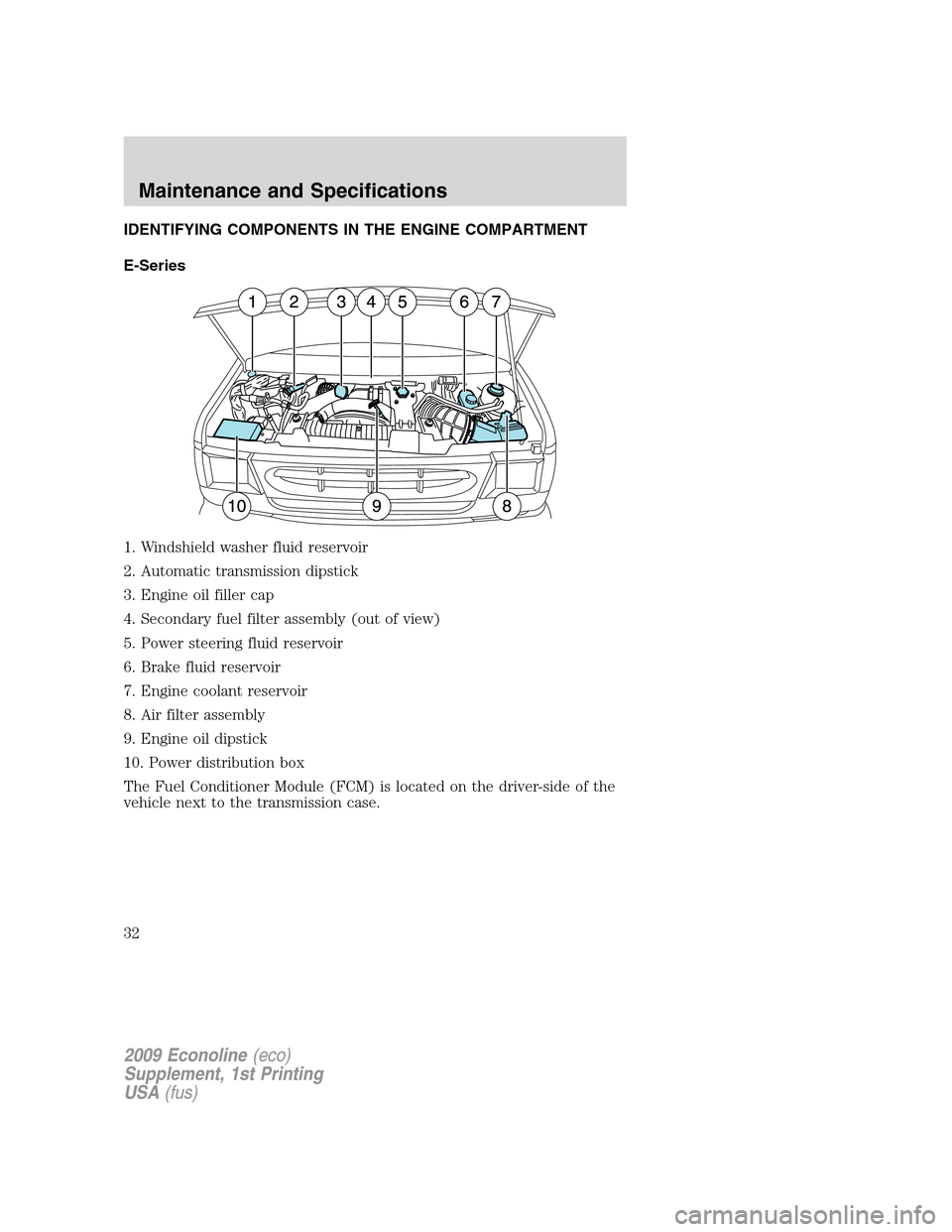
IDENTIFYING COMPONENTS IN THE ENGINE COMPARTMENT
E-Series
1. Windshield washer fluid reservoir
2. Automatic transmission dipstick
3. Engine oil filler cap
4. Secondary fuel filter assembly (out of view)
5. Power steering fluid reservoir
6. Brake fluid reservoir
7. Engine coolant reservoir
8. Air filter assembly
9. Engine oil dipstick
10. Power distribution box
The Fuel Conditioner Module (FCM) is located on the driver-side of the
vehicle next to the transmission case.
2009 Econoline(eco)
Supplement, 1st Printing
USA(fus)
Maintenance and Specifications
32
Page 33 of 103
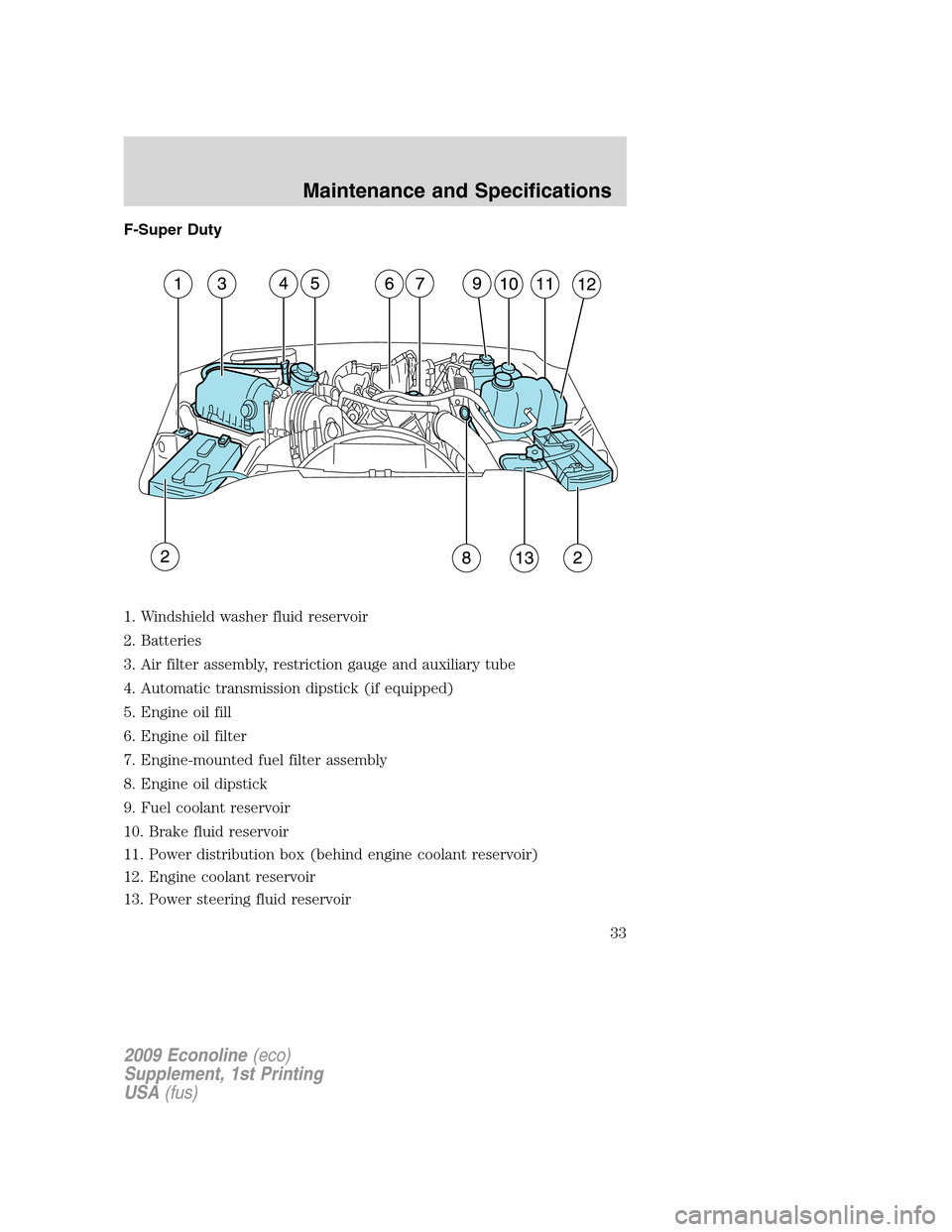
F-Super Duty
1. Windshield washer fluid reservoir
2. Batteries
3. Air filter assembly, restriction gauge and auxiliary tube
4. Automatic transmission dipstick (if equipped)
5. Engine oil fill
6. Engine oil filter
7. Engine-mounted fuel filter assembly
8. Engine oil dipstick
9. Fuel coolant reservoir
10. Brake fluid reservoir
11. Power distribution box (behind engine coolant reservoir)
12. Engine coolant reservoir
13. Power steering fluid reservoir
2009 Econoline(eco)
Supplement, 1st Printing
USA(fus)
Maintenance and Specifications
33
Page 34 of 103
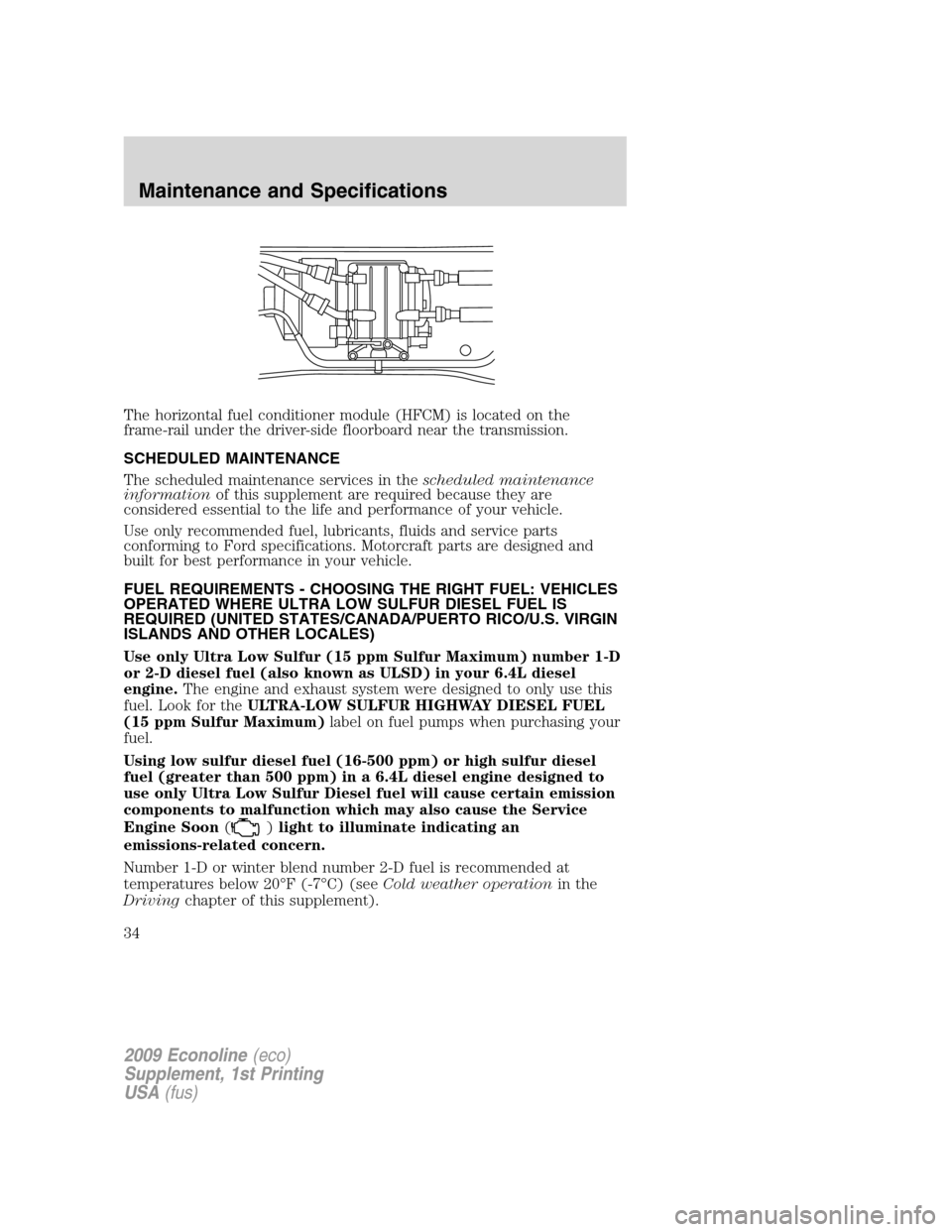
The horizontal fuel conditioner module (HFCM) is located on the
frame-rail under the driver-side floorboard near the transmission.
SCHEDULED MAINTENANCE
The scheduled maintenance services in thescheduled maintenance
informationof this supplement are required because they are
considered essential to the life and performance of your vehicle.
Use only recommended fuel, lubricants, fluids and service parts
conforming to Ford specifications. Motorcraft parts are designed and
built for best performance in your vehicle.
FUEL REQUIREMENTS - CHOOSING THE RIGHT FUEL: VEHICLES
OPERATED WHERE ULTRA LOW SULFUR DIESEL FUEL IS
REQUIRED (UNITED STATES/CANADA/PUERTO RICO/U.S. VIRGIN
ISLANDS AND OTHER LOCALES)
Use only Ultra Low Sulfur (15 ppm Sulfur Maximum) number 1-D
or 2-D diesel fuel (also known as ULSD) in your 6.4L diesel
engine.The engine and exhaust system were designed to only use this
fuel. Look for theULTRA-LOW SULFUR HIGHWAY DIESEL FUEL
(15 ppm Sulfur Maximum)label on fuel pumps when purchasing your
fuel.
Using low sulfur diesel fuel (16-500 ppm) or high sulfur diesel
fuel (greater than 500 ppm) in a 6.4L diesel engine designed to
use only Ultra Low Sulfur Diesel fuel will cause certain emission
components to malfunction which may also cause the Service
Engine Soon(
)light to illuminate indicating an
emissions-related concern.
Number 1-D or winter blend number 2-D fuel is recommended at
temperatures below 20°F (-7°C) (seeCold weather operationin the
Drivingchapter of this supplement).
2009 Econoline(eco)
Supplement, 1st Printing
USA(fus)
Maintenance and Specifications
34
Page 35 of 103
BIODIESEL
Diesel fuel containing no more than 5% biodiesel may be used. To help
achieve acceptable engine performance and durability, it is important to
only use biodiesel of good quality in your diesel engine. At a minimum,
the biodiesel should comply with ASTM D6751 or an equivalent
specification.
Use of biodiesel in concentrations greater than 5% may cause damage to
your vehicles fuel system components such as fuel tank, fuel lines, fuel
pump, fuel sender and fuel injectors. Concentrations greater than 5% can
also cause fuel filter restrictions that may result in a lack of power and
or fuel pump and fuel injector failure.
Look for a label on the fuel pump to confirm the amount of biodiesel
contained in a diesel fuel. Biodiesel content is often indicated with the
letter “B” followed by the percent of biodiesel in the fuel. For example,
B5 indicates a fuel containing 5% biodiesel. Ask the service station
attendant to confirm the biodiesel content of a diesel fuel if you do not
see a label on the fuel pump.
Biodiesel should not be stored in the fuel tank for more than three
months. If your vehicle will be parked or stored for more than three
months, then your vehicle should be drained and filled with a diesel fuel
not containing biodiesel.
During cold weather, if you have problems operating on biodiesel, you
may need to use a diesel fuel with lower biodiesel content, try another
brand, or discontinue the use of biodiesel.
Biodiesel use may affect the recommended oil change intervals. Refer to
theSpecial Operating Conditionssection in theschedule
maintenance guidefor more information about oil change intervals and
other maintenance when operating on biodiesel.
Biodiesel fuel is a product that has been converted from renewable fuel
sources, including vegetable oil, animal fat and cooking oil. Raw or
refined vegetable oil, animal fat, cooking oil or recycled greases should
not be used.
Do not use home heating oil, agricultural fuel or any diesel fuel
not intended for highway use. Damage to the fuel injection
system, engine and exhaust catalyst can occur if an improper fuel
is used. Do not add gasoline, gasohol or alcohol to diesel fuel.
This practice creates a serious fire hazard and engine
performance problems.
2009 Econoline(eco)
Supplement, 1st Printing
USA(fus)
Maintenance and Specifications
35
Page 36 of 103
FUEL REQUIREMENTS - CHOOSING THE RIGHT FUEL: VEHICLES
OPERATED WHERE ULTRA LOW SULFUR DIESEL FUEL IS NOT
REQUIRED
For a 6.4L engine to operate reliably on low sulfur or high sulfur diesel
fuel, the 6.4L engine must be a high sulfur configured engine or a ULSD
fuel-configured engine that has been retrofitted for high sulfur diesel fuel
use.
Use only a 6.4L diesel engine that has been configured for use
with high sulfur diesel fuel in markets with diesel fuel that has
sulfur content greater than 15 ppm. Using low sulfur diesel fuel
(16–500 ppm) or high sulfur diesel fuel (greater than 500 ppm) in
a 6.4L diesel engine designed to use only Ultra Low Sulfur Diesel
fuel increases the likelihood of engine oil dilution with fuel which
may lead to major engine damage. Engine damage from using the
improper type of fuel is not covered under your warranty.
Vehicles with 6.4L engines configured for use with high sulfur diesel fuel
will only be made available for sale in countries where ULSD fuel is not
available or mandated by the government. Vehicles originally sold in a
ULSD fuel market that are subsequently exported to non-ULSD fuel
markets will need to be retrofitted (at the customer’s expense) in order
to be reliably operated on non-ULSD fuel.
Vehicles equipped with a 6.0L engine that are operated in a market that
does not require ULSD fuel may be operated on higher sulfur fuel
without any engine fuel system or emissions-related concerns.
Number 1-D or winter blend number 2-D fuel is recommended at
temperatures below 20°F (-7°C) (seeCold weather operationin the
Drivingchapter of this supplement).
BIODIESEL
Diesel fuel containing no more than 5% biodiesel may be used. To help
achieve acceptable engine performance and durability, it is important to
only use biodiesel of good quality in your diesel engine. At a minimum,
the biodiesel should comply with ASTM D6751 or an equivalent
specification.
Use of biodiesel in concentrations greater than 5% may cause damage to
your vehicles fuel system components such as fuel tank, fuel lines, fuel
pump, fuel sender and fuel injectors. Concentrations greater than 5% can
also cause fuel filter restrictions that may result in a lack of power and
or fuel pump and fuel injector failure.
Look for a label on the fuel pump to confirm the amount of biodiesel
contained in a diesel fuel. Biodiesel content is often indicated with the
2009 Econoline(eco)
Supplement, 1st Printing
USA(fus)
Maintenance and Specifications
36
Page 37 of 103
letter “B” followed by the percent of biodiesel in the fuel. For example,
B5 indicates a fuel containing 5% biodiesel. Ask the service station
attendant to confirm the biodiesel content of a diesel fuel if you do not
see a label on the fuel pump.
Biodiesel should not be stored in the fuel tank for more than three
months. If your vehicle will be parked or stored for more than three
months, then your vehicle should be drained and filled with a diesel fuel
not containing biodiesel.
During cold weather, if you have problems operating on biodiesel, you
may need to use a diesel fuel with lower biodiesel content, try another
brand, or discontinue the use of biodiesel.
Biodiesel use may affect the recommended oil change intervals. Refer to
theSpecial Operating Conditionssection in theschedule
maintenance guidefor more information about oil change intervals and
other maintenance when operating on biodiesel.
Biodiesel fuel is a product that has been converted from renewable fuel
sources, including vegetable oil, animal fat and cooking oil. Raw or
refined vegetable oil, animal fat, cooking oil or recycled greases should
not be used.
Do not use home heating oil, agricultural fuel or any diesel fuel
not intended for highway use. Damage to the fuel injection
system, engine and exhaust catalyst can occur if an improper fuel
is used. Do not add gasoline, gasohol or alcohol to diesel fuel.
This practice creates a serious fire hazard and engine
performance problems.
Fuel quality
It should not be necessary to add any aftermarket additives to your fuel
tank if you use a properly formulated diesel fuel that meets the ASTM D
975 industry specification. Aftermarket additives can damage the injector
system or engine. Repairs to correct the effects of using an aftermarket
product in your fuel may not be covered by your warranty.
Do not blend used engine oil with diesel fuel under any
circumstances.Blending used oil with the fuel will significantly increase
your vehicle’s exhaust emissions and reduce engine life due to increased
internal wear.
Many of the world’s automakers approved the World-wide Fuel Charter
that recommends diesel fuel specifications to provide improved
performance and emission control system protection for your vehicle.
Diesel fuel that meets the World-wide Fuel Charter should be used when
available. Ask your fuel supplier about fuel that meets the World-wide
Fuel Charter.
2009 Econoline(eco)
Supplement, 1st Printing
USA(fus)
Maintenance and Specifications
37
Page 38 of 103
Diesel fuel conditioner
Additives that will improve fuel cetane numbers may be used to
verify/enhance fuel quality. Use Motorcraft Cetane Booster &
Performance Improver, PM-22-A (U.S.) / PM-22-B (Canada) or
equivalent. The customer warranty may be void from using additives that
do not meet or exceed Ford specifications.
Do not use alcohol based additives to correct fuel gelling. This may
result in damage to the fuel injectors/system. Use Motorcraft Anti-Gel &
Performance Improver, PM-23-A (U.S.) / PM-23-B (Canada) or
equivalent. The customer warranty may be void from using additives that
do not meet or exceed Ford specifications.
Note:This ultra-low sulfur formulation is designed to meet the emissions
standards for the 6.4L engine and is backward compatible as well (i.e.,
can be used in Ford 6.9L, 7.3L, and 6.0L diesel engines).
Fueling tips
If the engine fails to start in 30 seconds, turn the key to the off position
and wait 30 seconds before trying again.
Truck stops have pumps and nozzles designed for larger, heavy-duty
trucks. When refueling at truck stops: if the nozzle shuts off repeatedly
when refueling, wait 5–10 seconds; then use a slower rate of flow (don’t
depress the nozzle trigger as far).
If air is allowed to enter the fuel system (during fuel filter change or if
you run out of fuel) the engine will purge the trapped air as it runs. The
engine may run rough and produce white smoke while air is in the
system. This is normal and should correct itself in a short time.
An engine that suddenly becomes noisy or operates poorly after a fuel fill
could be using substandard fuel (i.e., high water content, low cetane
rating or gasoline in the fuel). Diesel fuel should be purchased from a
reputable station which sells a large amount of diesel fuel.
Care should be taken whenever diesel fuel is stored. Use only clean,
approved containers which will prevent the entry of dirt or water.
Diesel fuel must not be stored in a galvanized container. The fuel will
dissolve the zinc in a galvanized container. The zinc will then remain in
the solution until it is run through the engine where it will be deposited
in the fuel injectors causing expensive-to-repair damage.
Diesel fuel dispensing nozzle fill rate
This truck is equipped with a fuel fill pipe which is able to accept fuel up
to 20 gallons per minute from an 1
18” fuel dispensing nozzle. Pumping
fuel at greater flow rates may result in premature nozzle shut-off or
spitback.
2009 Econoline(eco)
Supplement, 1st Printing
USA(fus)
Maintenance and Specifications
38