light FORD SUPER DUTY 2010 2.G Diesel Supplement Manual
[x] Cancel search | Manufacturer: FORD, Model Year: 2010, Model line: SUPER DUTY, Model: FORD SUPER DUTY 2010 2.GPages: 104, PDF Size: 0.63 MB
Page 41 of 104
1. Stop the vehicle andshut offthe engine.
WARNING:The vehicle must be stopped with the engine off
when draining the HFCM/FCM. Fuel may ignite if the separator
is drained while the engine is running or vehicle is moving.
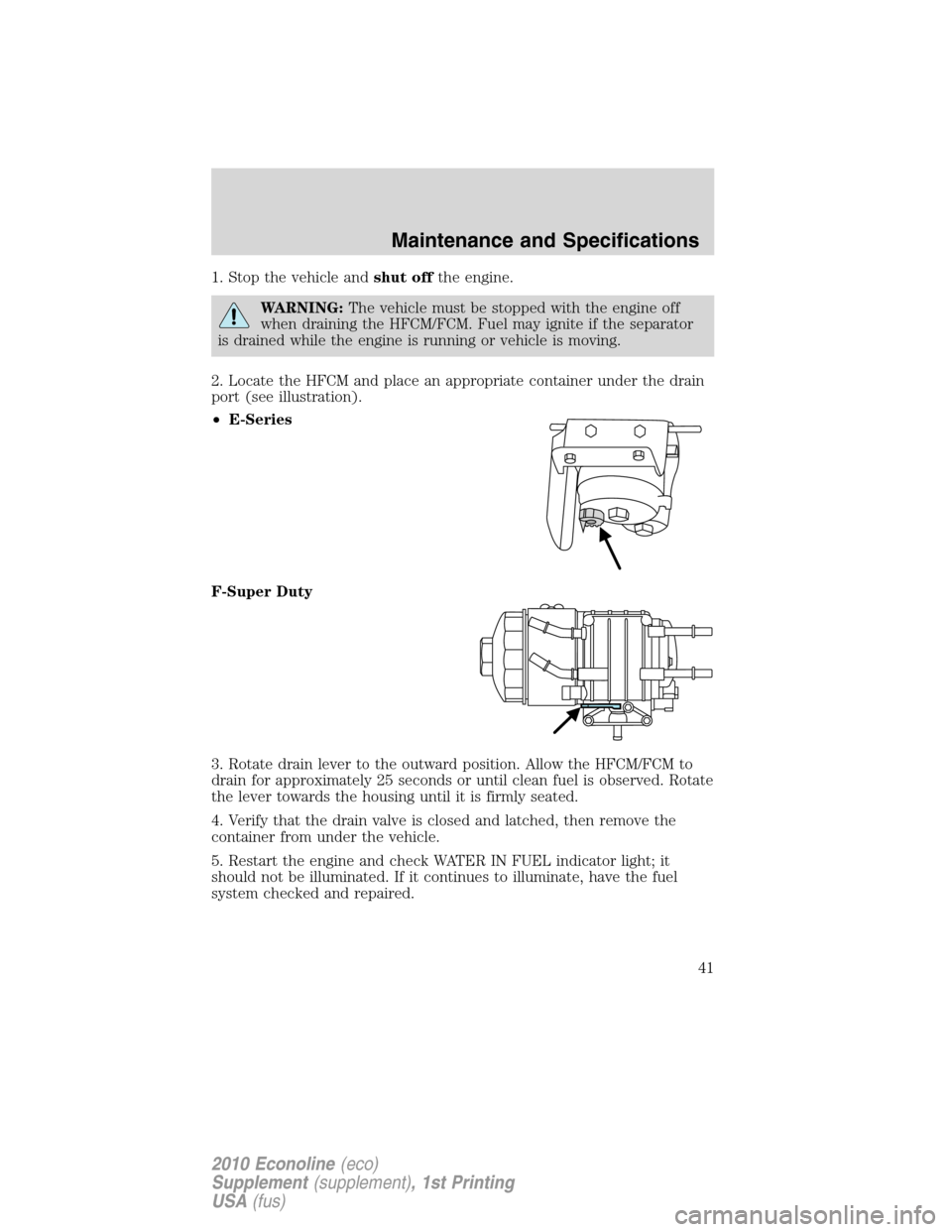
2. Locate the HFCM and place an appropriate container under the drain
port (see illustration).
•E-Series
F-Super Duty
3. Rotate drain lever to the outward position. Allow the HFCM/FCM to
drain for approximately 25 seconds or until clean fuel is observed. Rotate
the lever towards the housing until it is firmly seated.
4. Verify that the drain valve is closed and latched, then remove the
container from under the vehicle.
5. Restart the engine and check WATER IN FUEL indicator light; it
should not be illuminated. If it continues to illuminate, have the fuel
system checked and repaired.
Maintenance and Specifications
41
2010 Econoline(eco)
Supplement(supplement), 1st Printing
USA(fus)
Page 48 of 104
•use of biodiesel, up to and including 5% Biodiesel (B5)
•use of high sulfur diesel fuel
If you are operating your vehicle under any of these conditions, change
engine oil and filter every 5,000 miles (8,000 km).
AIR FILTER RESTRICTION GAUGE AND AIR FILTER
REPLACEMENT
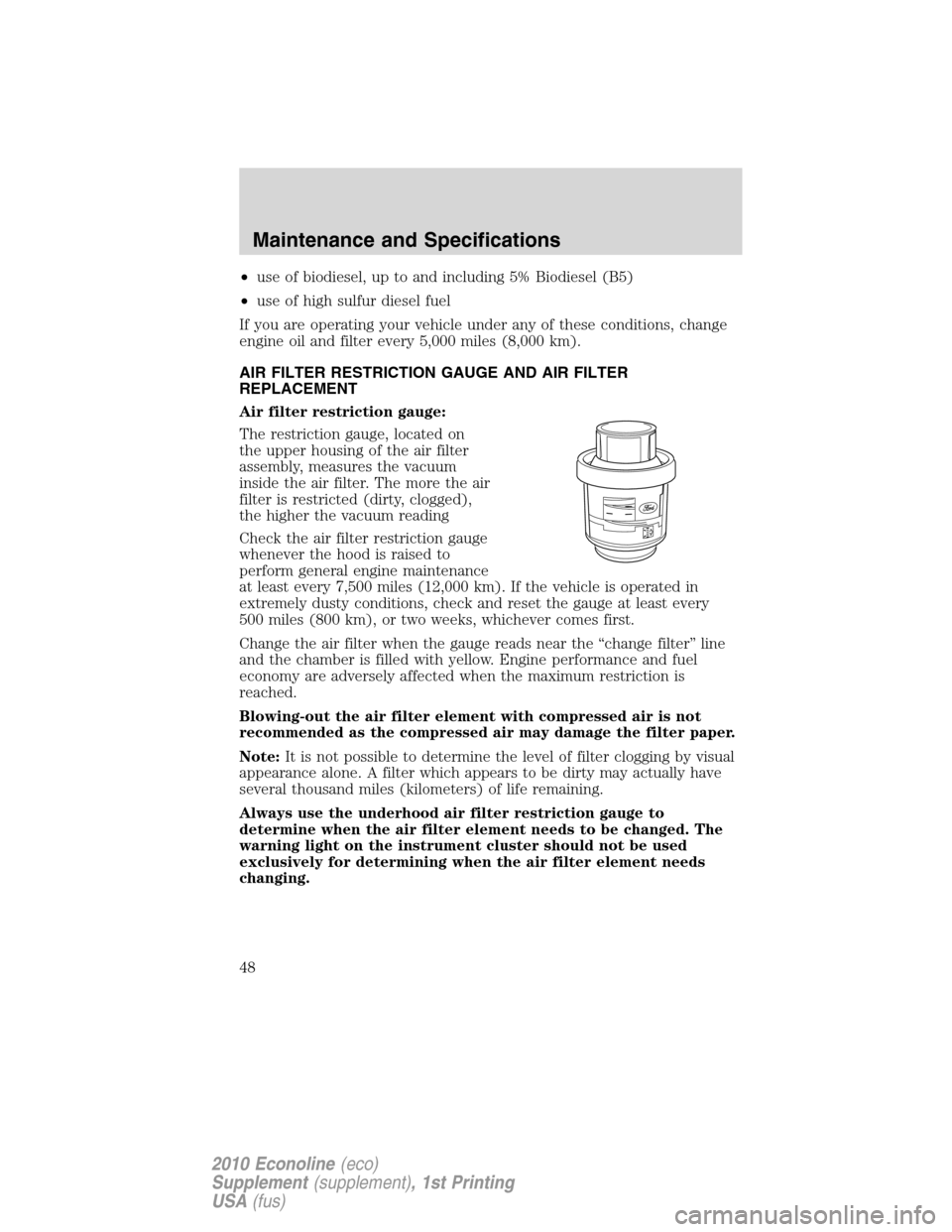
Air filter restriction gauge:
The restriction gauge, located on
the upper housing of the air filter
assembly, measures the vacuum
inside the air filter. The more the air
filter is restricted (dirty, clogged),
the higher the vacuum reading
Check the air filter restriction gauge
whenever the hood is raised to
perform general engine maintenance
at least every 7,500 miles (12,000 km). If the vehicle is operated in
extremely dusty conditions, check and reset the gauge at least every
500 miles (800 km), or two weeks, whichever comes first.
Change the air filter when the gauge reads near the “change filter” line
and the chamber is filled with yellow. Engine performance and fuel
economy are adversely affected when the maximum restriction is
reached.
Blowing-out the air filter element with compressed air is not
recommended as the compressed air may damage the filter paper.
Note:It is not possible to determine the level of filter clogging by visual
appearance alone. A filter which appears to be dirty may actually have
several thousand miles (kilometers) of life remaining.
Always use the underhood air filter restriction gauge to
determine when the air filter element needs to be changed. The
warning light on the instrument cluster should not be used
exclusively for determining when the air filter element needs
changing.
Maintenance and Specifications
48
2010 Econoline(eco)
Supplement(supplement), 1st Printing
USA(fus)
Page 52 of 104
At certain times, the message center will display various messages
related to the DPF. SeeMessage centerin theInstrument Cluster
chapter for more information.
Passive regeneration
In passive regeneration, the exhaust constituents / temperature are at an
appropriate level where some soot can be reduced or oxidized (burned)
thus cleaning the filter. This method occurs naturally as a result of
normal engine operating conditions (at varying levels due to drive
patterns).
Active regeneration
If there is not enough passive regeneration naturally occurring due to
vehicle drive patterns, the engine control system will initiate an active
regeneration. In an active regeneration, the filter is cleaned by raising
the exhaust temperature to a point where the soot is burned away. This
is accomplished through various engine actions which raise the exhaust
temperature in the oxidation catalyst/DPF system to an appropriate high
level where the soot is burned off. After the soot is burned off, the
exhaust temperature and back-pressure (restriction) fall back to normal
levels.
Filter service/maintenance
Over time a slight amount of ash will build up in the DPF which is not
removed during the regeneration process. The DPF may need to be
removed for ash cleaning at approximately 120,000 miles (193,000 km)
or greater (actual mileage can vary greatly depending upon
engine/vehicle operating conditions) and replaced with a new or
remanufactured (ash cleaned) part. The filter may need to be replaced
at approximately 250,000 miles (400,000 km) depending upon
engine/vehicle operating conditions. In both cases the engine control
system will set a service light (
) to inform you to bring the vehicle
to the dealer for service.
If there are any issues with the oxidation catalyst/DPF system a service
light (
or) will be set by the engine control system to inform
you to bring the vehicle into a dealership for service.
Resonator/Tailpipe assembly maintenance
The diesel resonator tail-pipe assembly is a uniquely functioning device
that accompanies the Oxidation Catalyst/DPF assembly. The assembly
serves multiple functions. First it serves as an acoustic device to
Maintenance and Specifications
52
2010 Econoline(eco)
Supplement(supplement), 1st Printing
USA(fus)
Page 56 of 104
If the engine won’t crank
Turn on the headlights. If the lights are dim, do not go on at all or when
the ignition is turned to START the lights become dim or go out, the
battery connections may be loose or corroded, or the battery may be
discharged. If there is a clicking or stuttering sound coming from the
engine compartment when you turn the key to START, this may also
indicate a loose or corroded battery connection.
Check the battery connections at the battery posts, cable connection to
the engine grounding point and at the starter connection.
If a discharged battery is suspected, have it checked and corrected.
WARNING:Battery posts, terminals and related accessories
contain lead and lead compounds.Wash hands after handling.
•For vehicles with manual transmissions,the clutch pedalmustbe
fully depressed in order for the starter to operate.
•For vehicles with automatic transmissions,the gearshift lever
must be in P (Park) or N (Neutral) in order for the starter to operate.
•Try operating the starter switch several times. Should the switch be
corroded, this operation may clean the contacts or make the switch
temporarily operable until you can reach the dealer.
•If all electrical connections are tight and you need assistance to start,
refer toJump startingin theRoadside Emergencieschapter of your
Owner’s Guide(F-Super Duty) or refer to theJump startingsection
in theRoadside Emergencieschapter of this supplement (E-Series).
If engine cranks but won’t start
Prolonged starter cranking (in excess of 10 seconds) could cause
damage to the starter motor.
•Check the fuel gauge. You may be out of fuel. If the gauge shows that
there is fuel in the tank, the trouble may be in the electrical system or
the fuel system. If equipped with an auxiliary tank, be sure that the
tank control switch is set for the tank with fuel and not on an empty
tank.
•Leaving the ignition key turned to on for over two minutes without
starting may make starting difficult because the glow plugs will cease
activation. Reset the system by turning the ignition key to off and
then back to on again.
Maintenance and Specifications
56
2010 Econoline(eco)
Supplement(supplement), 1st Printing
USA(fus)
Page 64 of 104
Genuine Ford and Motorcraft Replacement Parts
Ford dealerships stock Ford and Motorcraft branded replacement parts.
These parts meet or exceed Ford Motor Company’s specifications, and
we stand behind them. Maintenance parts installed at your Ford
dealership carry a nationwide, 12 months, 12,000 mile (20,000 km) parts
and labor limited warranty. Your dealer can give you details.
Value Shopping for Your Vehicle’s Maintenance Needs
Your dealership recognizes the competitive landscape of maintenance and
light repair automotive services. With factory-trained technicians, and
one-stop service from routine maintenance like oil changes and tire
rotations to repairs like brake service, check out the value your Ford
dealers can offer.
WHICH MAINTENANCE SCHEDULE SHOULD YOU FOLLOW?
Owner Checks and Services
Refer to Mileage Intervals for Additional Checks and Services
Certain basic maintenance checks and inspections should be performed
by the owner or a service technician at the intervals indicated. Service
information and supporting specifications are provided in theOwner’s
Guide.
Any adverse condition should be brought to the attention of your dealer
or qualified service technician as soon as possible for the proper service
advice. The owner maintenance service checks are generally not covered
by warranties so you may be charged for labor, parts or lubricants used.
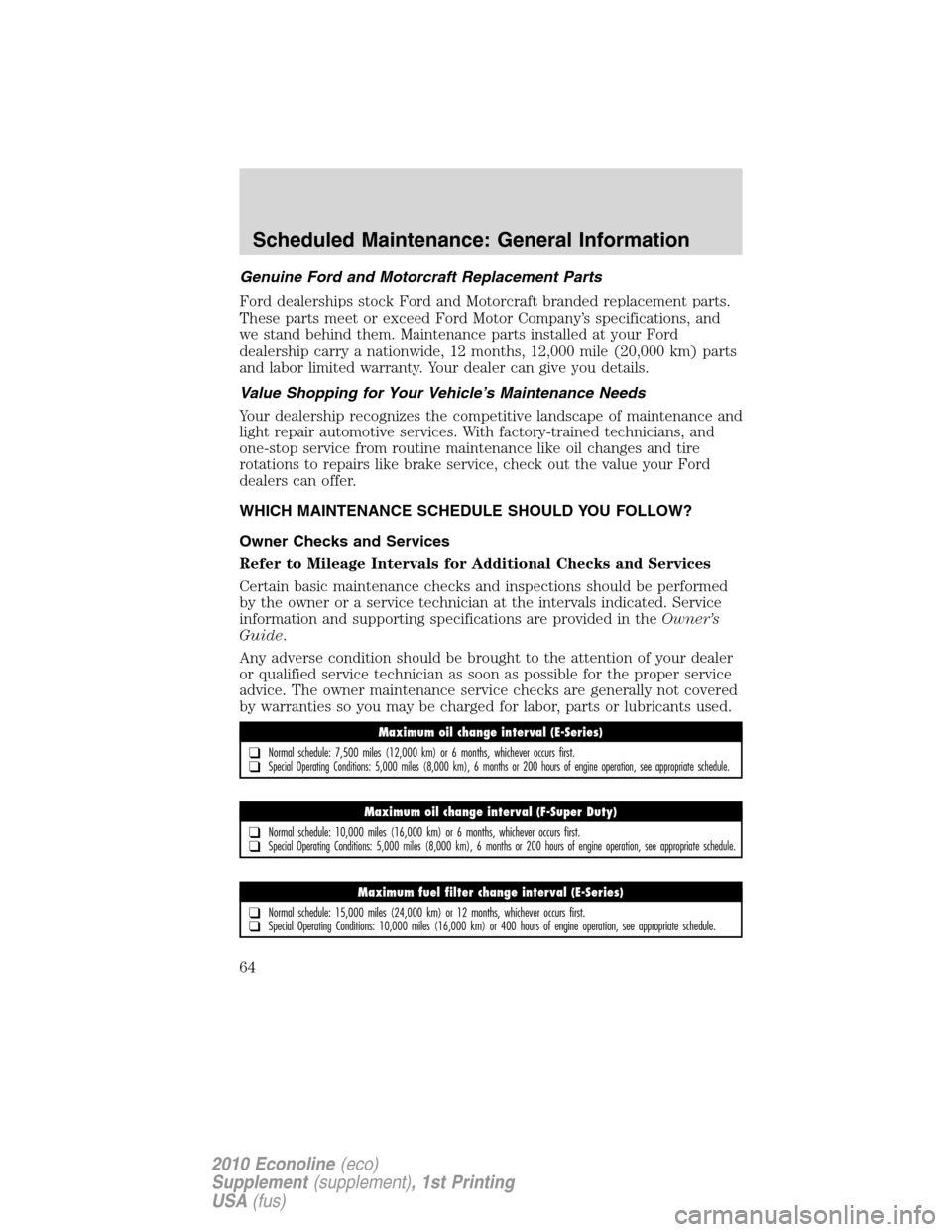
Maximum oil change interval (E-Series)
❑Normal schedule: 7,500 miles (12,000 km) or 6 months, whichever occurs first.❑Special Operating Conditions: 5,000 miles (8,000 km), 6 months or 200 hours of engine operation, see appropriate schedule.
Maximum oil change interval (F-Super Duty)
❑Normal schedule: 10,000 miles (16,000 km) or 6 months, whichever occurs first.❑Special Operating Conditions: 5,000 miles (8,000 km), 6 months or 200 hours of engine operation, see appropriate schedule.
Maximum fuel filter change interval (E-Series)
❑Normal schedule: 15,000 miles (24,000 km) or 12 months, whichever occurs first.❑Special Operating Conditions: 10,000 miles (16,000 km) or 400 hours of engine operation, see appropriate schedule.
Scheduled Maintenance: General Information
64
2010 Econoline(eco)
Supplement(supplement), 1st Printing
USA(fus)
Page 65 of 104
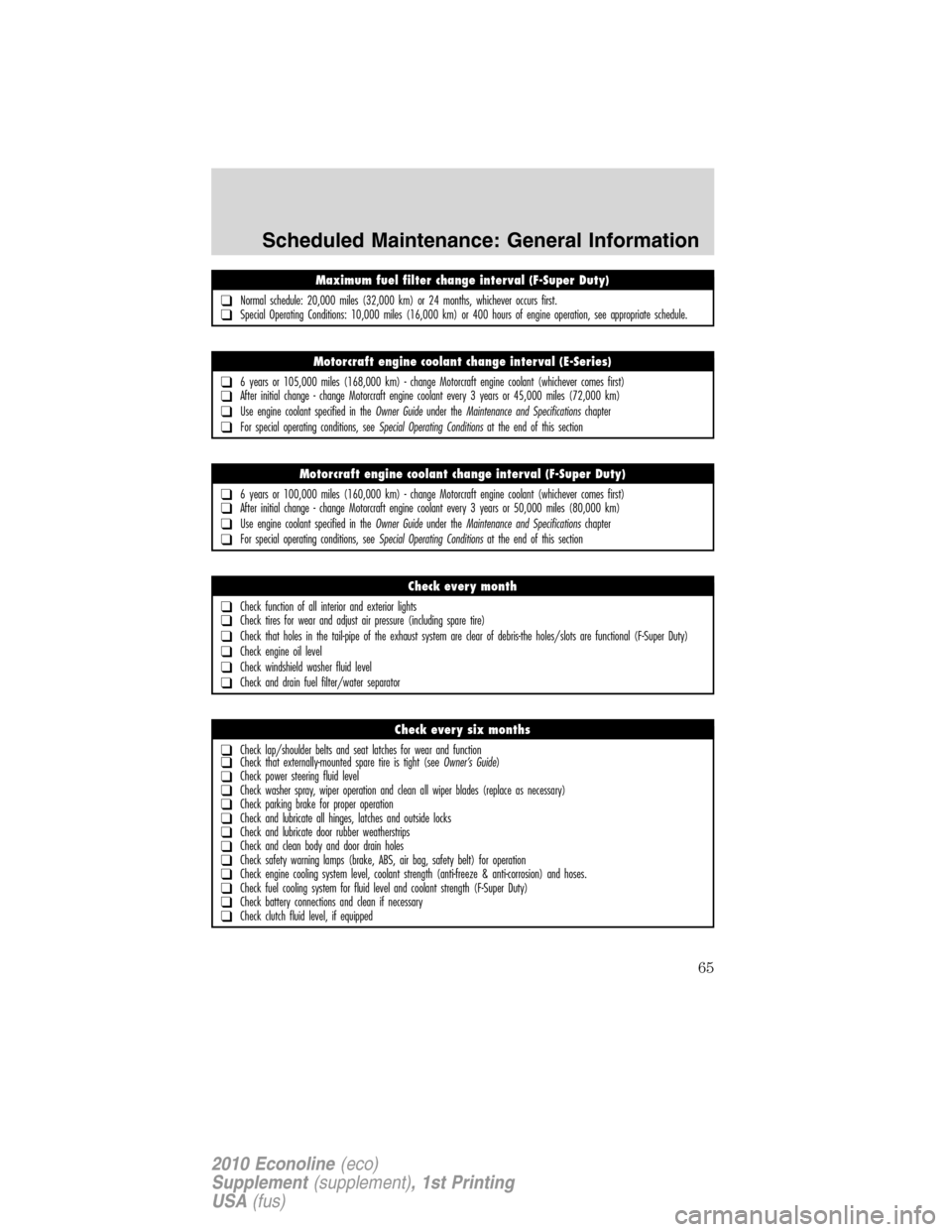
Maximum fuel filter change interval (F-Super Duty)
❑Normal schedule: 20,000 miles (32,000 km) or 24 months, whichever occurs first.❑Special Operating Conditions: 10,000 miles (16,000 km) or 400 hours of engine operation, see appropriate schedule.
Motorcraft engine coolant change interval (E-Series)
❑6 years or 105,000 miles (168,000 km) - change Motorcraft engine coolant (whichever comes first)❑After initial change - change Motorcraft engine coolant every 3 years or 45,000 miles (72,000 km)
❑Use engine coolant specified in theOwner Guideunder theMaintenance and Specificationschapter
❑For special operating conditions, seeSpecial Operating Conditionsat the end of this section
Motorcraft engine coolant change interval (F-Super Duty)
❑6 years or 100,000 miles (160,000 km) - change Motorcraft engine coolant (whichever comes first)❑After initial change - change Motorcraft engine coolant every 3 years or 50,000 miles (80,000 km)
❑Use engine coolant specified in theOwner Guideunder theMaintenance and Specificationschapter
❑For special operating conditions, seeSpecial Operating Conditionsat the end of this section
Check every month
❑Check function of all interior and exterior lights❑Check tires for wear and adjust air pressure (including spare tire)
❑Check that holes in the tail-pipe of the exhaust system are clear of debris-the holes/slots are functional (F-Super Duty)
❑Check engine oil level
❑Check windshield washer fluid level
❑Check and drain fuel filter/water separator
Check every six months
❑Check lap/shoulder belts and seat latches for wear and function❑Check that externally-mounted spare tire is tight (seeOwner’s Guide)❑Check power steering fluid level❑Check washer spray, wiper operation and clean all wiper blades (replace as necessary)❑Check parking brake for proper operation❑Check and lubricate all hinges, latches and outside locks❑Check and lubricate door rubber weatherstrips❑Check and clean body and door drain holes❑Check safety warning lamps (brake, ABS, air bag, safety belt) for operation❑Check engine cooling system level, coolant strength (anti-freeze & anti-corrosion) and hoses.❑Check fuel cooling system for fluid level and coolant strength (F-Super Duty)❑Check battery connections and clean if necessary❑Check clutch fluid level, if equipped
Scheduled Maintenance: General Information
65
2010 Econoline(eco)
Supplement(supplement), 1st Printing
USA(fus)
Page 66 of 104
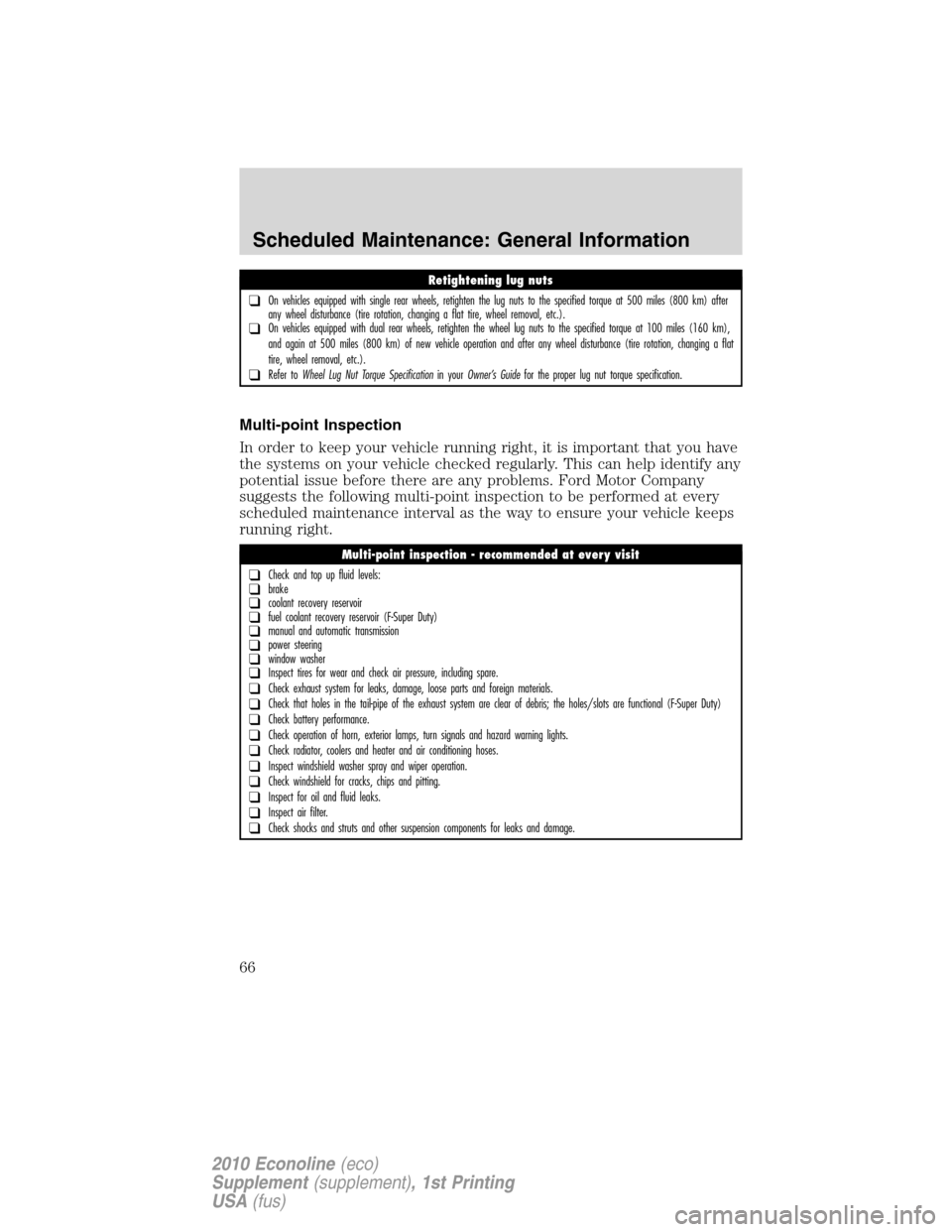
Multi-point Inspection
In order to keep your vehicle running right, it is important that you have
the systems on your vehicle checked regularly. This can help identify any
potential issue before there are any problems. Ford Motor Company
suggests the following multi-point inspection to be performed at every
scheduled maintenance interval as the way to ensure your vehicle keeps
running right.
Retightening lug nuts
❑On vehicles equipped with single rear wheels, retighten the lug nuts to the specified torque at 500 miles (800 km) after
any wheel disturbance (tire rotation, changing a flat tire, wheel removal, etc.).
❑On vehicles equipped with dual rear wheels, retighten the wheel lug nuts to the specified torque at 100 miles (160 km),
and again at 500 miles (800 km) of new vehicle operation and after any wheel disturbance (tire rotation, changing a flat
tire, wheel removal, etc.).
❑Refer toWheel Lug Nut Torque Specificationin yourOwner’s Guidefor the proper lug nut torque specification.
Multi-point inspection - recommended at every visit
❑Check and top up fluid levels:❑brake❑coolant recovery reservoir❑fuel coolant recovery reservoir (F-Super Duty)❑manual and automatic transmission❑power steering❑window washer❑Inspect tires for wear and check air pressure, including spare.
❑Check exhaust system for leaks, damage, loose parts and foreign materials.
❑Check that holes in the tail-pipe of the exhaust system are clear of debris; the holes/slots are functional (F-Super Duty)
❑Check battery performance.
❑Check operation of horn, exterior lamps, turn signals and hazard warning lights.
❑Check radiator, coolers and heater and air conditioning hoses.
❑Inspect windshield washer spray and wiper operation.
❑Check windshield for cracks, chips and pitting.
❑Inspect for oil and fluid leaks.
❑Inspect air filter.
❑Check shocks and struts and other suspension components for leaks and damage.
Scheduled Maintenance: General Information
66
2010 Econoline(eco)
Supplement(supplement), 1st Printing
USA(fus)
Page 101 of 104
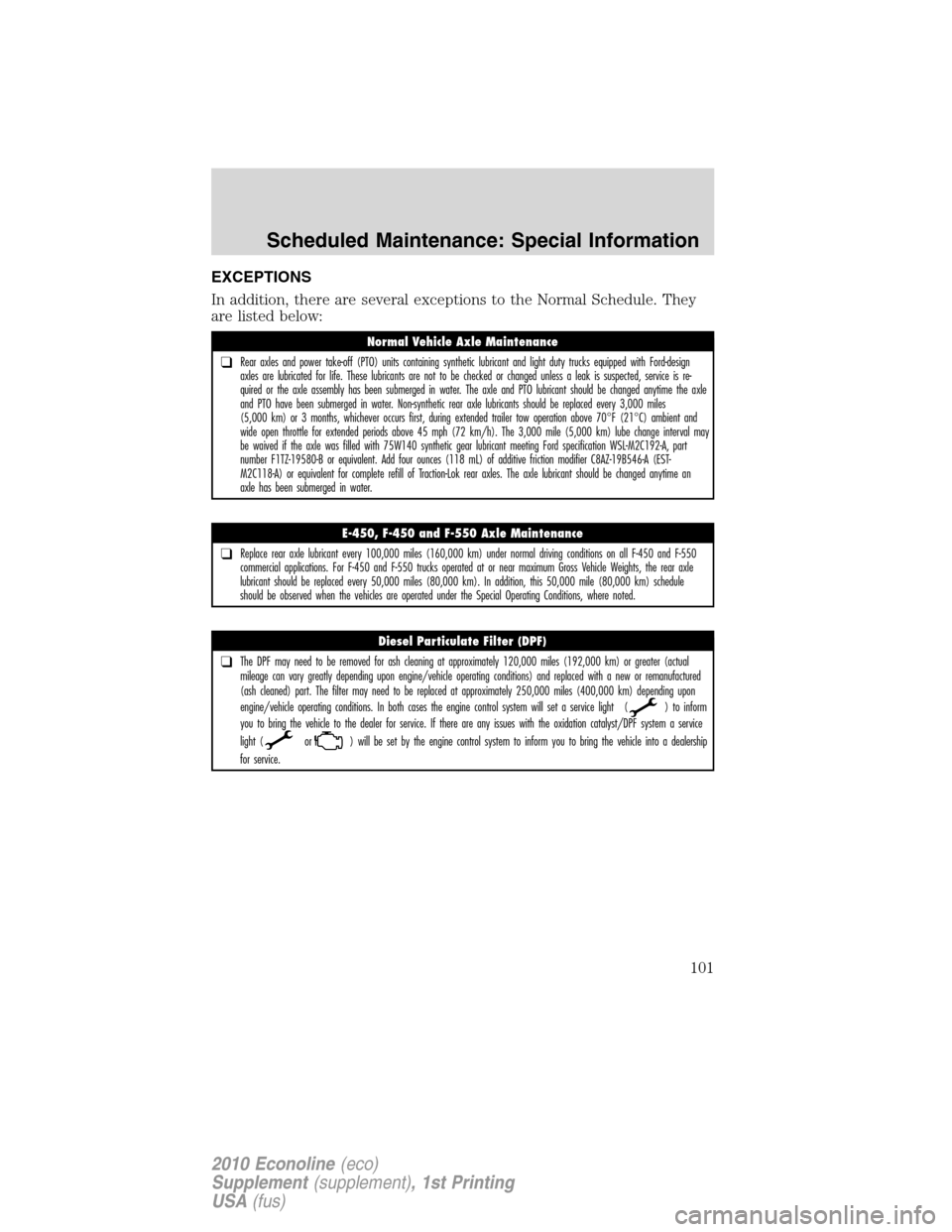
EXCEPTIONS
In addition, there are several exceptions to the Normal Schedule. They
are listed below:
Normal Vehicle Axle Maintenance
❑Rear axles and power take-off (PTO) units containing synthetic lubricant and light duty trucks equipped with Ford-design
axles are lubricated for life. These lubricants are not to be checked or changed unless a leak is suspected, service is re-
quired or the axle assembly has been submerged in water. The axle and PTO lubricant should be changed anytime the axle
and PTO have been submerged in water. Non-synthetic rear axle lubricants should be replaced every 3,000 miles
(5,000 km) or 3 months, whichever occurs first, during extended trailer tow operation above 70°F (21°C) ambient and
wide open throttle for extended periods above 45 mph (72 km/h). The 3,000 mile (5,000 km) lube change interval may
be waived if the axle was filled with 75W140 synthetic gear lubricant meeting Ford specification WSL-M2C192-A, part
number F1TZ-19580-B or equivalent. Add four ounces (118 mL) of additive friction modifier C8AZ-19B546-A (EST-
M2C118-A) or equivalent for complete refill of Traction-Lok rear axles. The axle lubricant should be changed anytime an
axle has been submerged in water.
E-450, F-450 and F-550 Axle Maintenance
❑Replace rear axle lubricant every 100,000 miles (160,000 km) under normal driving conditions on all F-450 and F-550
commercial applications. For F-450 and F-550 trucks operated at or near maximum Gross Vehicle Weights, the rear axle
lubricant should be replaced every 50,000 miles (80,000 km). In addition, this 50,000 mile (80,000 km) schedule
should be observed when the vehicles are operated under the Special Operating Conditions, where noted.
Diesel Particulate Filter (DPF)
❑The DPF may need to be removed for ash cleaning at approximately 120,000 miles (192,000 km) or greater (actual
mileage can vary greatly depending upon engine/vehicle operating conditions) and replaced with a new or remanufactured
(ash cleaned) part. The filter may need to be replaced at approximately 250,000 miles (400,000 km) depending upon
engine/vehicle operating conditions. In both cases the engine control system will set a service light (
) to inform
you to bring the vehicle to the dealer for service. If there are any issues with the oxidation catalyst/DPF system a service
light (
or) will be set by the engine control system to inform you to bring the vehicle into a dealership
for service.
Scheduled Maintenance: Special Information
101
2010 Econoline(eco)
Supplement(supplement), 1st Printing
USA(fus)