warning FORD SUPER DUTY 2010 2.G Diesel Supplement Manual
[x] Cancel search | Manufacturer: FORD, Model Year: 2010, Model line: SUPER DUTY, Model: FORD SUPER DUTY 2010 2.GPages: 104, PDF Size: 0.63 MB
Page 32 of 104
WARNING:Failure to maintain the functional holes, in the
tailpipe section of the exhaust, clean and free of debris or
foreign material may result in the holes becoming blocked or plugged.
Do not modify or remove the tail-pipe section. Blocked or plugged
holes or removal/modification of the system could result in elevated
exhaust gas temperatures which may result in vehicle/property damage
or personal injury
WARNING:The normal operating temperature of the exhaust
system is very high. Never work around or attempt to repair any
part of the exhaust system until it has cooled. Use special care when
working around the diesel oxidation catalytic converter and/or the
diesel particulate filter (DPF). The diesel oxidation catalytic converter
and/or the DPF heats up to a high temperature after only a short
period of engine operation and can stay hot even after the engine is
turned off. Failure to follow these instructions may result in personal
injury.
Cleaning
32
2010 Econoline(eco)
Supplement(supplement), 1st Printing
USA(fus)
Page 37 of 104
(exhaust catalyst and particulate filter) failures. Concentrations greater
than 5% can also cause fuel filter restrictions that may result in a lack of
power and or damage to components such as fuel tank, fuel lines, fuel
pump, fuel sender and fuel injectors fuel pump and fuel injector failures.
Look for a label on the fuel pump to confirm the amount of biodiesel
contained in a diesel fuel. Biodiesel content is often indicated with the
letter “B” followed by the percent of biodiesel in the fuel. For example,
B5 indicates a fuel containing 5% biodiesel. Ask the service station
attendant to confirm the biodiesel content of a diesel fuel if you do not
see a label on the fuel pump.
Biodiesel should not be stored in the fuel tank for more than three
months. If your vehicle will be parked or stored for more than three
months, then your vehicle should be drained and filled with a diesel fuel
not containing biodiesel.
During cold weather, if you have problems operating on biodiesel, you
may need to use a diesel fuel with lower biodiesel content, try another
brand, or discontinue the use of biodiesel.
Biodiesel use may affect the recommended oil change intervals. Refer to
theSpecial operating conditionssection in theschedule maintenance
guidefor more information about oil change intervals and other
maintenance when operating on biodiesel.
Biodiesel fuel is a product that has been converted from renewable fuel
sources, including vegetable oil, animal fat and cooking oil. Raw or
refined vegetable oil, animal fat, cooking oil or recycled greases should
NOTbe used.
WARNING:Do not use home heating oil, agricultural fuel or any
diesel fuel not intended for highway use. Damage to the fuel
injection system, engine and exhaust catalyst can occur if an improper
fuel is used. Do not add gasoline, gasohol or alcohol to diesel fuel. This
practice creates a serious fire hazard and engine performance
problems.
Fuel quality
It should not be necessary to add any aftermarket additives to your fuel
tank if you use a properly formulated diesel fuel that meets the ASTM D
975 industry specification. Aftermarket additives can damage the injector
system or engine. Repairs to correct the effects of using an aftermarket
product in your fuel may not be covered by your warranty.
Maintenance and Specifications
37
2010 Econoline(eco)
Supplement(supplement), 1st Printing
USA(fus)
Page 39 of 104
Care should be taken whenever diesel fuel is stored. Use only clean,
approved containers which will prevent the entry of dirt or water.
Diesel fuel must not be stored in a galvanized container. The fuel will
dissolve the zinc in a galvanized container. The zinc will then remain in
the solution until it is run through the engine where it will be deposited
in the fuel injectors causing expensive-to-repair damage.
Diesel fuel dispensing nozzle fill rate
This truck is equipped with a fuel fill pipe which is able to accept fuel up
to 20 gallons per minute from an 118” fuel dispensing nozzle. Pumping fuel
at greater flow rates may result in premature nozzle shut-off or spitback.
Fuel filler cap
Your fuel tank filler cap has an indexed design with a 1/4 turn on/off
feature.
When fueling your vehicle:
1. Turn the engine off.
2. Carefully turn the filler cap counterclockwise until it spins off.
3. Pull to remove the cap from the fuel filler pipe.
4. To install the cap, align the tabs on the cap with the notches on the
filler pipe.
5. Turn the filler cap clockwise 1/4 of a turn until it clicks at least once.
If you must replace the fuel filler cap, replace it with a fuel filler
cap that is designed for your vehicle. The vehicle warranty may
be void for any damage to the fuel tank or fuel system if the
correct genuine Ford or Motorcraft fuel filler cap is not used.
WARNING:The fuel system may be under pressure. If the fuel
filler cap is venting vapor or if you hear a hissing sound, wait
until it stops before completely removing the fuel filler cap. Otherwise,
fuel may spray out and injure you or others.
WARNING:If you do not use the proper fuel filler cap,
excessive pressure or vacuum in the fuel tank may damage the
fuel system or cause the fuel cap to disengage in a collision, which may
result in possible personal injury.
Maintenance and Specifications
39
2010 Econoline(eco)
Supplement(supplement), 1st Printing
USA(fus)
Page 40 of 104
FUEL FILTER/WATER SEPARATOR
Fuel Conditioner Module (FCM - E-Series)
The vehicle is equipped with a Fuel Conditioning Module (FCM) located
on the driver-side of the vehicle next to the transmission case.
Water should be drained from the
module assembly whenever the
warning light comes on. The WATER
IN FUEL light will come on when
approximately 0.2 pints (100 ml) of water accumulates in the module. If
water level is allowed to exceed this level, the water may be passed
through to the engine and may cause FIE (Fuel Injection Equipment)
damage.
Horizontal Fuel Conditioner Module (HFCM - F-Super Duty)
The vehicle is equipped with a Horizontal Fuel Conditioning Module
(HFCM) located on the frame-rail under the driver-side floorboard near
the transmission
Water should be drained from the
module assembly whenever the
warning light comes on. The WATER
IN FUEL light will come on when
approximately 0.13–0.16 pints (60–75 ml) of water accumulates in the
module. If water level is allowed to exceed this level, the water may be
passed through to the engine and may cause FIE (Fuel Injection
Equipment) damage.
DRAINING THE HFCM AND CHANGING THE ENGINE AND
VEHICLE FUEL FILTERS
Your vehicle is equipped with two fuel filters; one is mounted on top of
the engine.On F-Super Duty,the second filter, inside the HFCM, is
mounted inside the frame rail under the driver-side floorboard near the
transmission.On E-Series,the second filter, inside the FCM, is mounted
on the driver-side of the vehicle next to the transmission case.On all
vehicles,both filters should be replaced at the same time. Regular fuel
filter changes are an important part of engine maintenance; failing to
keep with the scheduled maintenance could lead to engine performance
issues and/or fuel injection system damage. Refer to theScheduled
maintenance guidechapter of this supplement for more information.
Refer toMotorcraft part numberslater in this chapter for the fuel filter
replacement part number. This part number includes filters and seals for
both the engine-mounted and frame-mounted filters.
Maintenance and Specifications
40
2010 Econoline(eco)
Supplement(supplement), 1st Printing
USA(fus)
Page 41 of 104
1. Stop the vehicle andshut offthe engine.
WARNING:The vehicle must be stopped with the engine off
when draining the HFCM/FCM. Fuel may ignite if the separator
is drained while the engine is running or vehicle is moving.
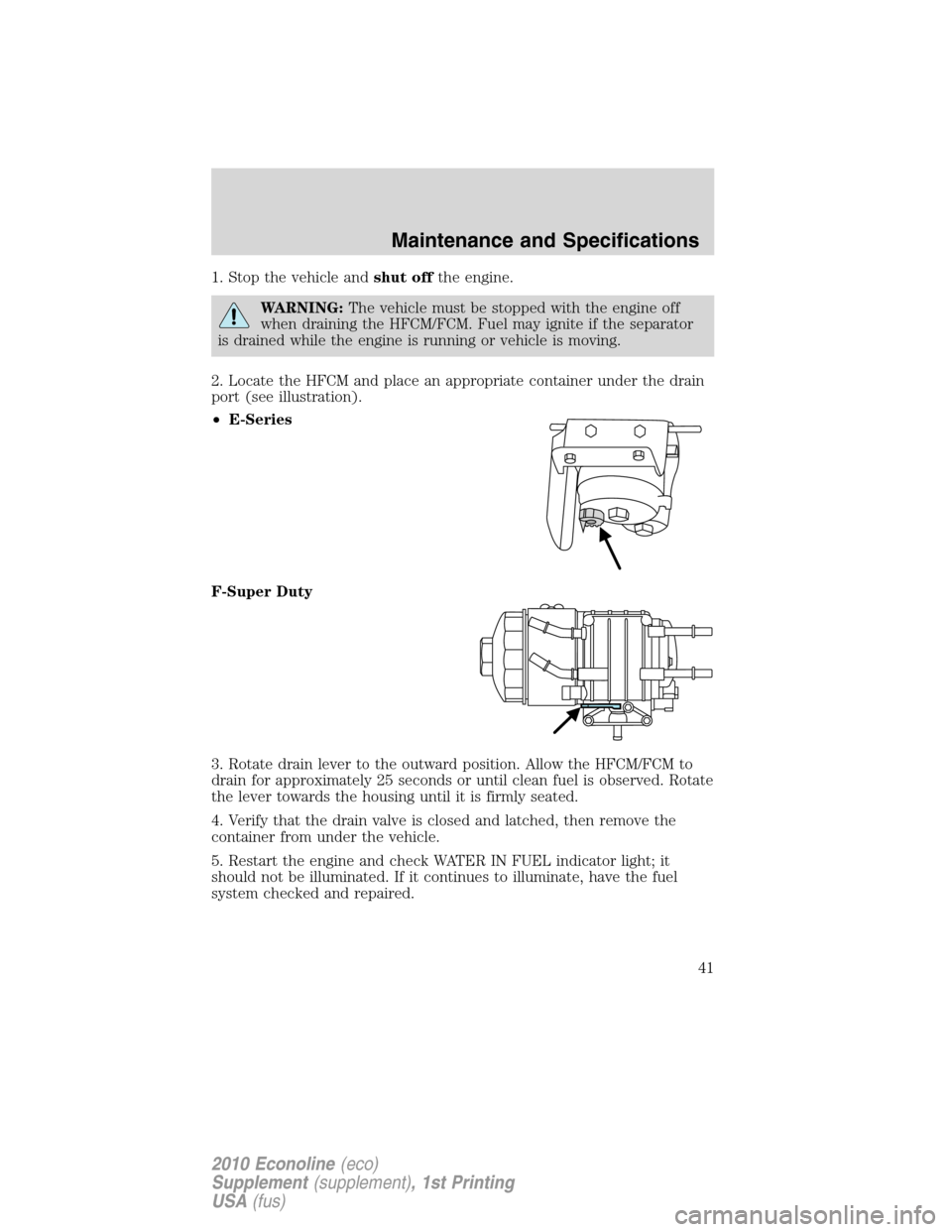
2. Locate the HFCM and place an appropriate container under the drain
port (see illustration).
•E-Series
F-Super Duty
3. Rotate drain lever to the outward position. Allow the HFCM/FCM to
drain for approximately 25 seconds or until clean fuel is observed. Rotate
the lever towards the housing until it is firmly seated.
4. Verify that the drain valve is closed and latched, then remove the
container from under the vehicle.
5. Restart the engine and check WATER IN FUEL indicator light; it
should not be illuminated. If it continues to illuminate, have the fuel
system checked and repaired.
Maintenance and Specifications
41
2010 Econoline(eco)
Supplement(supplement), 1st Printing
USA(fus)
Page 47 of 104
Changing engine oil and filter
Change your oil and filter according to thescheduled maintenance
informationin this supplement. Change more frequently if your vehicle
operation includes extended periods of idling or low-speed operation,
driving for a long time in cold temperatures or driving short distances.
See the following sectionEngine lubrication for severe service
operationfor all severe duty restrictions.
Refer toMotorcraft part numberslater in this chapter for the engine oil
filter part number. This filter protects your engine by filtering harmful,
abrasive or sludge particles and particles significantly smaller than most
available “will-fit” filters.
To replace the filter,
1. Unscrew the oil filter cap and wait a few seconds for the oil to drain
through the built-in drain valve.Note:The filter should be changed
before reinstalling the oil pan drain plug.
2. Reinstall and tighten the oil filter cap.
WARNING:Do not handle a hot oil filter with bare hands.
WARNING:Continuous contact with USED motor oil has caused
cancer in laboratory mice. Protect your skin by washing with
soap and water.
Engine lubrication for severe service operation
The following severe service operating conditions require unique engine
maintenance procedures:
•frequent or extended idling (over 10 minutes per hour of normal
driving).
•if vehicle is operated in sustained ambient temperatures below -10°F
(-23°C) or above 100°F (38°C)
•frequent low speed operation, consistent heavy traffic less than
25 mph (40 km/h)
•operating in severe dust conditions.
•towing a trailer over 1,000 miles (1,600 km)
•sustained, high speed driving at Gross Vehicle Weight Rating
(maximum loaded weight for vehicle operation)
Maintenance and Specifications
47
2010 Econoline(eco)
Supplement(supplement), 1st Printing
USA(fus)
Page 48 of 104
•use of biodiesel, up to and including 5% Biodiesel (B5)
•use of high sulfur diesel fuel
If you are operating your vehicle under any of these conditions, change
engine oil and filter every 5,000 miles (8,000 km).
AIR FILTER RESTRICTION GAUGE AND AIR FILTER
REPLACEMENT
Air filter restriction gauge:
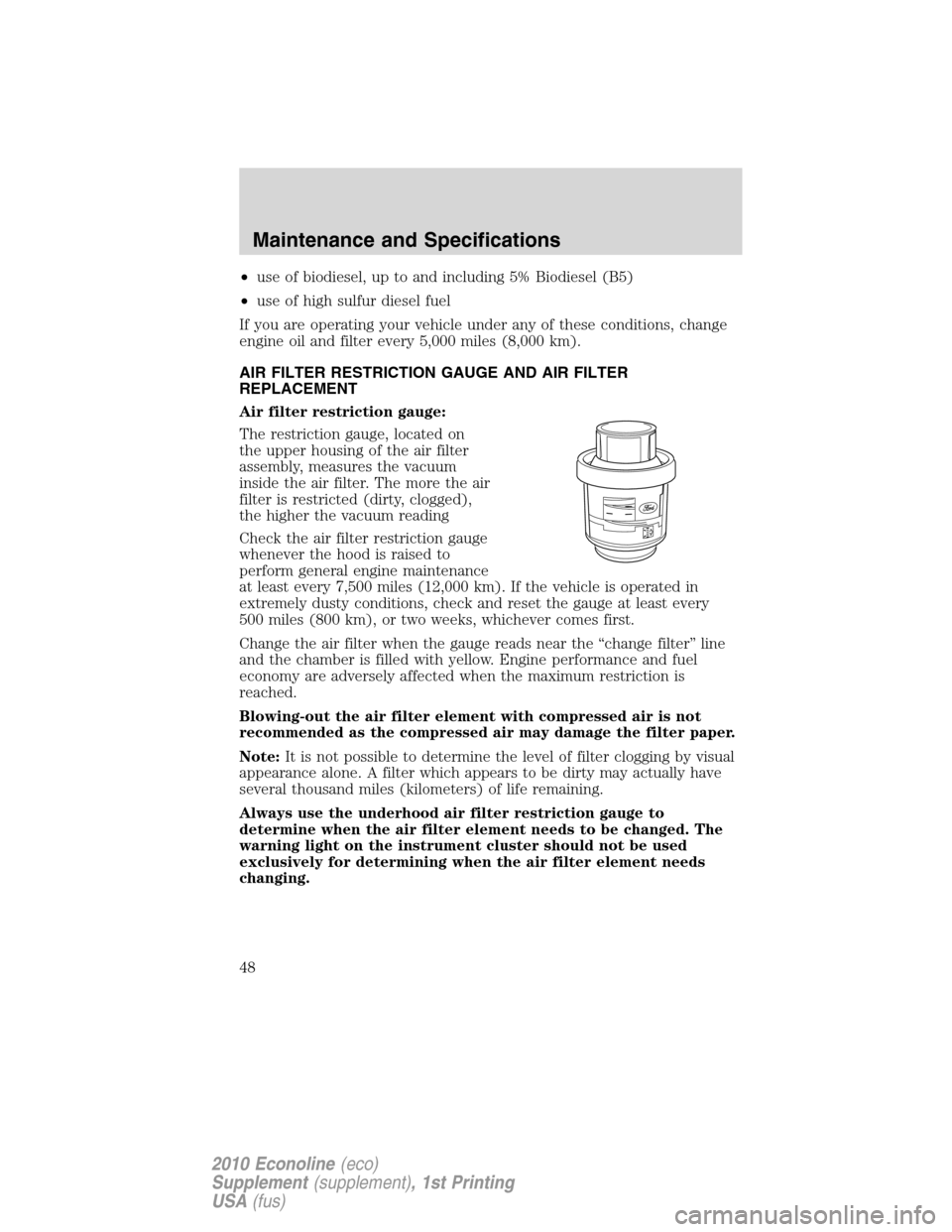
The restriction gauge, located on
the upper housing of the air filter
assembly, measures the vacuum
inside the air filter. The more the air
filter is restricted (dirty, clogged),
the higher the vacuum reading
Check the air filter restriction gauge
whenever the hood is raised to
perform general engine maintenance
at least every 7,500 miles (12,000 km). If the vehicle is operated in
extremely dusty conditions, check and reset the gauge at least every
500 miles (800 km), or two weeks, whichever comes first.
Change the air filter when the gauge reads near the “change filter” line
and the chamber is filled with yellow. Engine performance and fuel
economy are adversely affected when the maximum restriction is
reached.
Blowing-out the air filter element with compressed air is not
recommended as the compressed air may damage the filter paper.
Note:It is not possible to determine the level of filter clogging by visual
appearance alone. A filter which appears to be dirty may actually have
several thousand miles (kilometers) of life remaining.
Always use the underhood air filter restriction gauge to
determine when the air filter element needs to be changed. The
warning light on the instrument cluster should not be used
exclusively for determining when the air filter element needs
changing.
Maintenance and Specifications
48
2010 Econoline(eco)
Supplement(supplement), 1st Printing
USA(fus)
Page 49 of 104
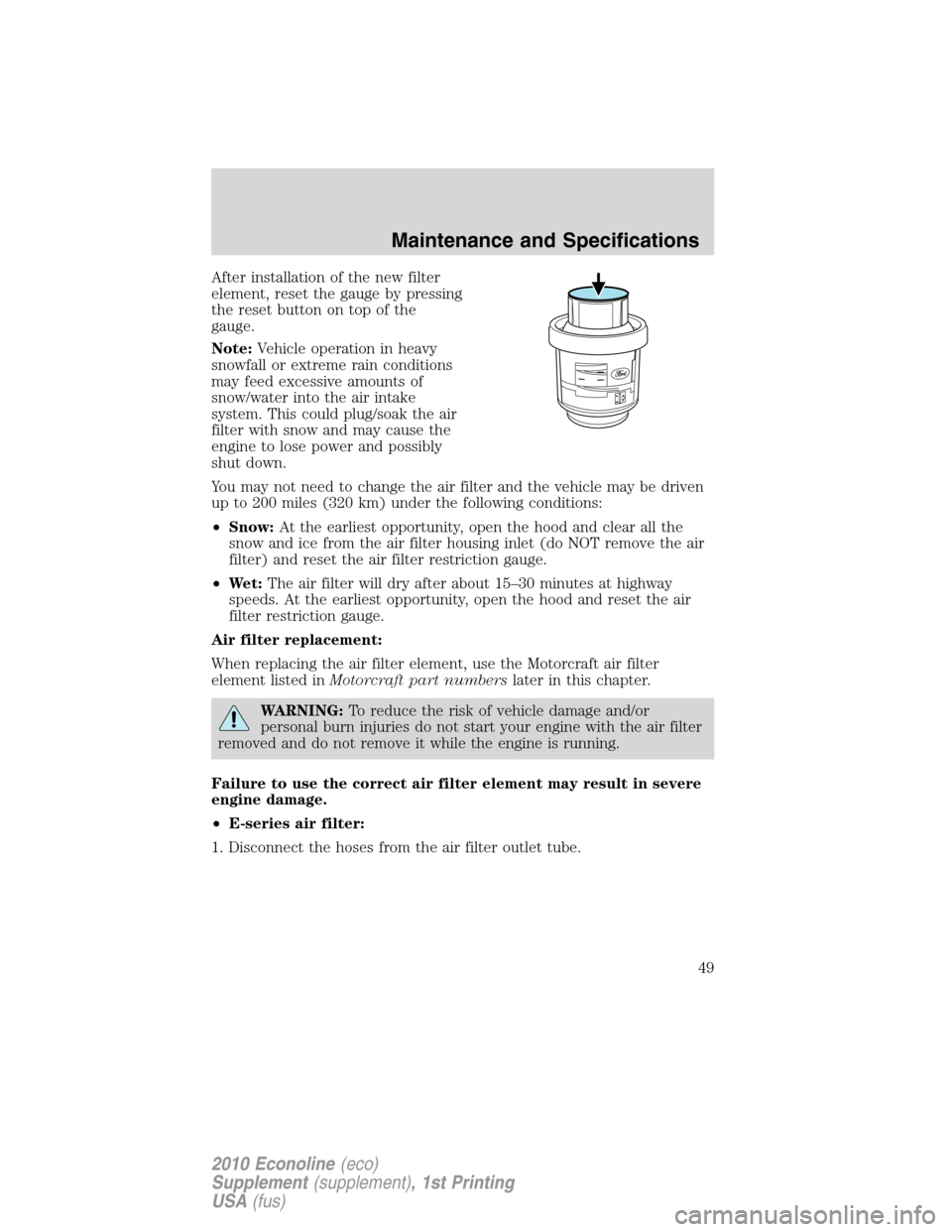
After installation of the new filter
element, reset the gauge by pressing
the reset button on top of the
gauge.
Note:Vehicle operation in heavy
snowfall or extreme rain conditions
may feed excessive amounts of
snow/water into the air intake
system. This could plug/soak the air
filter with snow and may cause the
engine to lose power and possibly
shut down.
You may not need to change the air filter and the vehicle may be driven
up to 200 miles (320 km) under the following conditions:
•Snow:At the earliest opportunity, open the hood and clear all the
snow and ice from the air filter housing inlet (do NOT remove the air
filter) and reset the air filter restriction gauge.
•Wet:The air filter will dry after about 15–30 minutes at highway
speeds. At the earliest opportunity, open the hood and reset the air
filter restriction gauge.
Air filter replacement:
When replacing the air filter element, use the Motorcraft air filter
element listed inMotorcraft part numberslater in this chapter.
WARNING:To reduce the risk of vehicle damage and/or
personal burn injuries do not start your engine with the air filter
removed and do not remove it while the engine is running.
Failure to use the correct air filter element may result in severe
engine damage.
•E-series air filter:
1. Disconnect the hoses from the air filter outlet tube.
Maintenance and Specifications
49
2010 Econoline(eco)
Supplement(supplement), 1st Printing
USA(fus)
Page 53 of 104
attenuate exhaust noise. Second it provides an exit path for the exhaust
from the vehicle. It also is designed to help control the temperature of
the exhaust during DPF regeneration events. The visible holes in each
leg of the twin tip and the holes under the shield just inboard of the
right rear tire(s) are functional. The holes need to be kept clear of
mud/debris or foreign material to maintain proper function of the
exhaust system. Clean and remove debris or foreign material if present
as needed. Spraying with a hose during regular washing of vehicle should
help keep holes clean and clear of debris or foreign material.
Note:Additions of aftermarket devices or modifications to the exhaust
system can reduce the effectiveness of the exhaust system as well as
cause damage to the exhaust system and/or engine. These actions may
also affect the vehicle’s warranty. See theCustomer Information Guide
for more information.
WARNING:Failure to maintain the functional holes, in the
tailpipe section of the exhaust, clean and free of debris or
foreign material may result in the holes becoming blocked or plugged.
Do not modify or remove the tail-pipe section. Blocked or plugged
holes or removal/modification of the system could result in elevated
exhaust gas temperatures which may result in vehicle/property damage
or personal injury.
WARNING:The normal operating temperature of the exhaust
system is very high. Never work around or attempt to repair any
part of the exhaust system until it has cooled. Use special care when
working around the diesel oxidation catalytic converter and/or the
diesel particulate filter (DPF). The diesel oxidation catalytic converter
and/or the DPF heats up to a high temperature after only a short
period of engine operation and can stay hot even after the engine is
turned off. Failure to follow these instructions may result in personal
injury.
EMISSION CONTROL SYSTEM(S) LAWS
Federal law prohibits vehicle manufacturers, dealers and other persons
engaged in the business of repairing, servicing, selling, leasing or trading
motor vehicles as well as fleet operations from unknowingly removing or
rendering emission control system(s) inoperative. Further, modifications
of the emission control system(s) could create liability on the part of the
individual owners under the laws of some states. In Canada,
Maintenance and Specifications
53
2010 Econoline(eco)
Supplement(supplement), 1st Printing
USA(fus)
Page 55 of 104
If you experience difficult starting, rough idling, excessive exhaust
smoke, a decrease in engine performance or excess fuel consumption,
perform the following checks:
•a plugged air inlet system or engine air filter element.
•water in the fuel filter/water separator.
•a clogged fuel filter.
•contaminated fuel.
•air in the fuel system, due to loose connections.
•an open or pinched sensor hose.
•low engine oil level.
•wrong fuel or oil viscosity for climactic conditions.
If these checks do not help you correct the engine performance problem
you are experiencing, consult an authorized dealer.
FUELING
WARNING:Do not use starting fluid such as ether or gasoline
in the diesel air intake system. Such fluids can cause immediate
explosive damage to the engine and possible personal injury.
If you fuel your vehicle at a truck stop, you may notice that the fuel
nozzle may shut off every 5–10 seconds. This is due to the flow rates
being designed for larger heavy duty trucks. You may have to fuel at a
slower rate (don’t depress the nozzle trigger fully).
Do not run your diesel vehicle out of fuel as this will allow air to enter
the fuel system which will make restarting difficult. The engine is
designed to run roughly as the fuel tank nears Empty. This is a warning
to the driver to add fuel as soon as possible. Longer engine cranking
time may be required once air is in the fuel system. If air enters the fuel
system (either through running the fuel tank(s) empty or during a fuel
filter change), the engine will self-purge the trapped air once it starts
running. The engine may run roughly and produce white smoke while air
is in the fuel system; this is normal and should stop after a short time.
MINOR TROUBLESHOOTING GUIDE
Air purge procedure
Turn the key on for 30 seconds, then turn off. Repeat procedure four or
five times.
Maintenance and Specifications
55
2010 Econoline(eco)
Supplement(supplement), 1st Printing
USA(fus)