seats FORD SUPER DUTY 2012 3.G User Guide
[x] Cancel search | Manufacturer: FORD, Model Year: 2012, Model line: SUPER DUTY, Model: FORD SUPER DUTY 2012 3.GPages: 454, PDF Size: 3.41 MB
Page 165 of 454
Heated seats
WARNING:Persons who are unable to feel pain to the skin
because of advanced age, chronic illness, diabetes, spinal cord
injury, medication, alcohol use, exhaustion, or other physical
conditions, must exercise care when using the seat heater. The seat
heater may cause burns even at low temperatures, especially if used
for long periods of time. Do not place anything on the seat that
insulates against heat, such as a blanket or cushion, because this may
cause the seat heater to overheat. Do not puncture the seat with pins,
needles, or other pointed objects because this may damage the heating
element which may cause the seat heater to overheat. An overheated
seat may cause serious personal injury.
Note:Do not do the following:
•Place heavy objects on the seat
•Operate the seat heater if water or any other liquid is spilled on the
seat. Allow the seat to dry thoroughly.
The heated seats will only function when the engine is running.
To operate the heated seats:
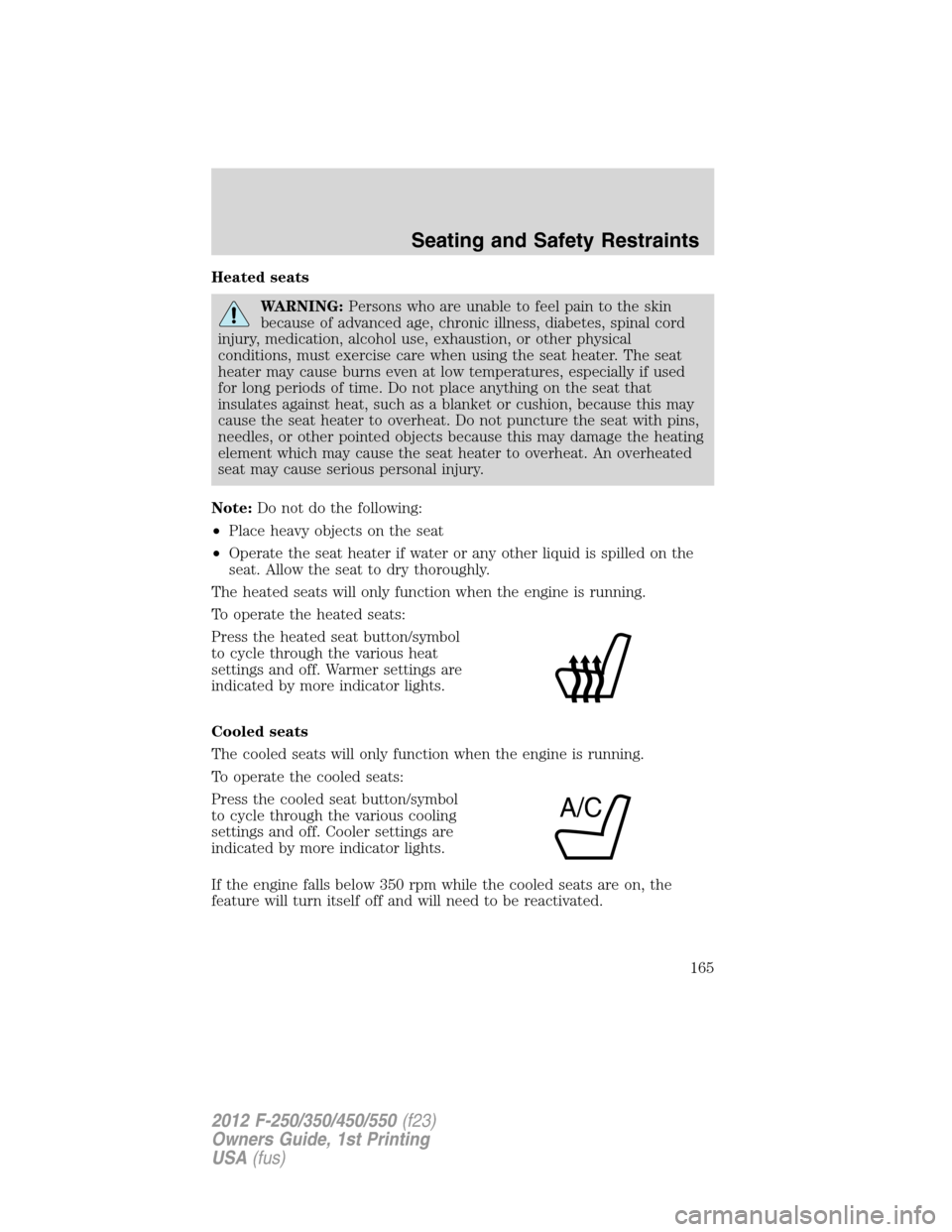
Press the heated seat button/symbol
to cycle through the various heat
settings and off. Warmer settings are
indicated by more indicator lights.
Cooled seats
The cooled seats will only function when the engine is running.
To operate the cooled seats:
Press the cooled seat button/symbol
to cycle through the various cooling
settings and off. Cooler settings are
indicated by more indicator lights.
If the engine falls below 350 rpm while the cooled seats are on, the
feature will turn itself off and will need to be reactivated.
A/C
Seating and Safety Restraints
165
2012 F-250/350/450/550(f23)
Owners Guide, 1st Printing
USA(fus)
Page 166 of 454
Climate controlled seats air filter replacement (if equipped)
The heated and cooled seat system includes air filters that must be
replaced periodically. Refer toScheduled maintenance information.
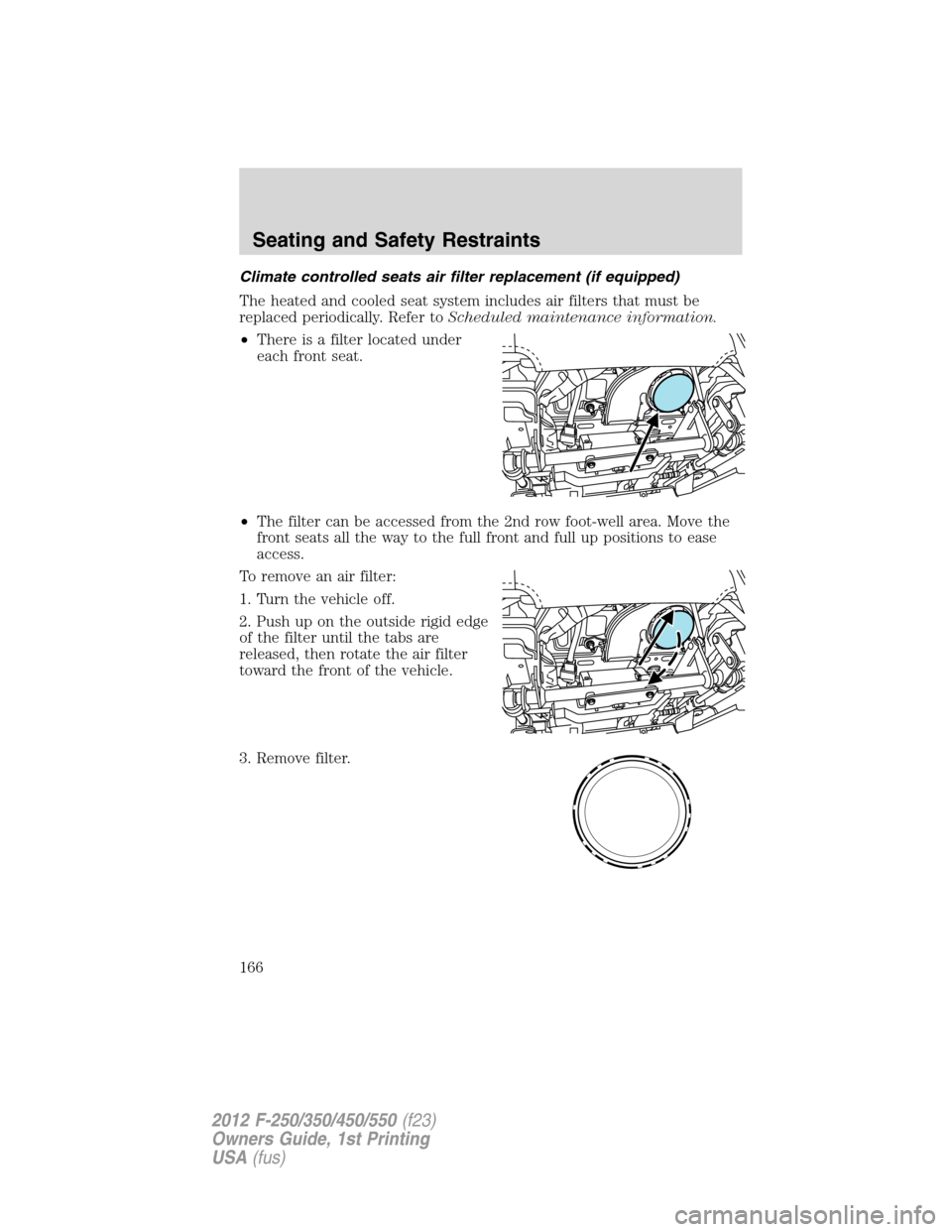
•There is a filter located under
each front seat.
•The filter can be accessed from the 2nd row foot-well area. Move the
front seats all the way to the full front and full up positions to ease
access.
To remove an air filter:
1. Turn the vehicle off.
2. Push up on the outside rigid edge
of the filter until the tabs are
released, then rotate the air filter
toward the front of the vehicle.
3. Remove filter.
Seating and Safety Restraints
166
2012 F-250/350/450/550(f23)
Owners Guide, 1st Printing
USA(fus)
Page 167 of 454
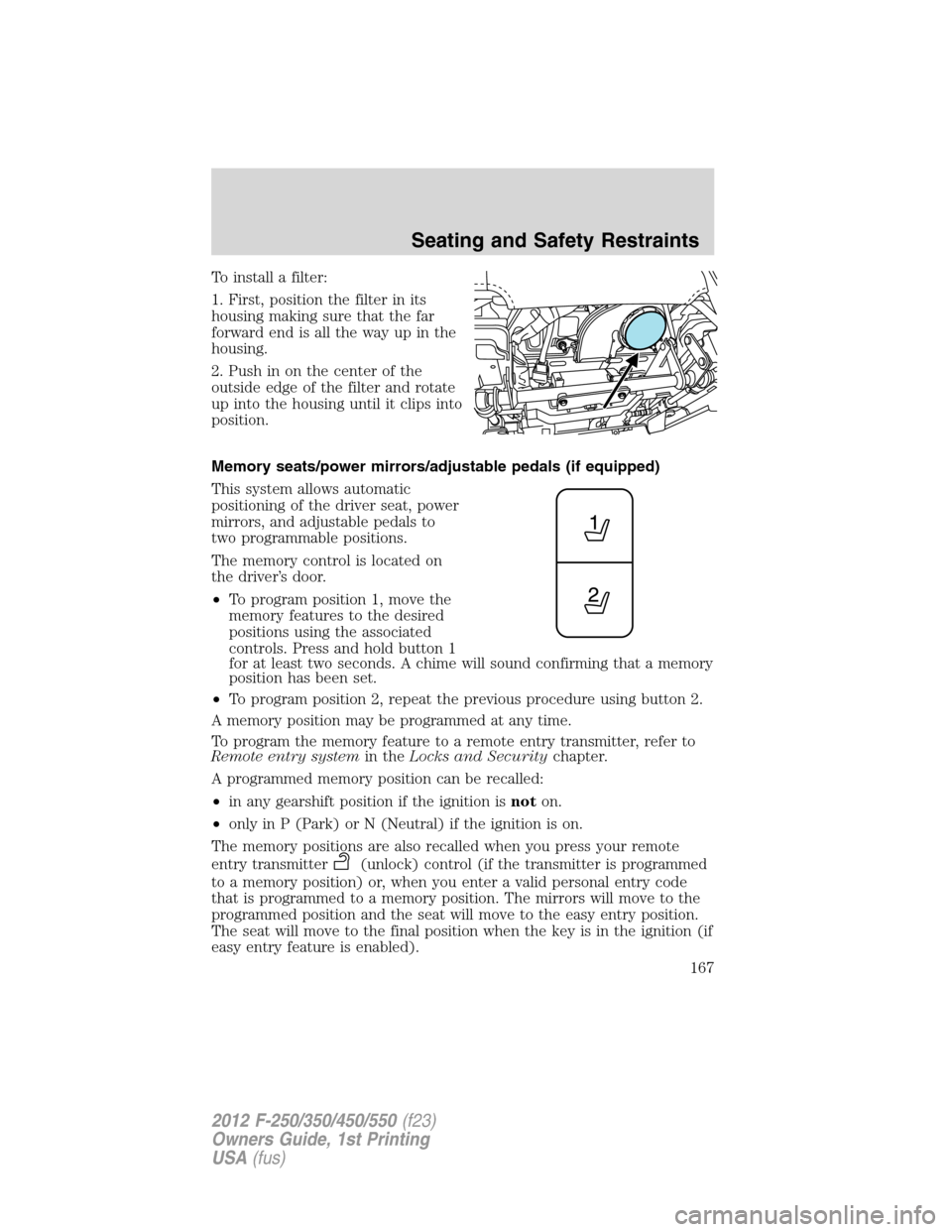
To install a filter:
1. First, position the filter in its
housing making sure that the far
forward end is all the way up in the
housing.
2. Push in on the center of the
outside edge of the filter and rotate
up into the housing until it clips into
position.
Memory seats/power mirrors/adjustable pedals (if equipped)
This system allows automatic
positioning of the driver seat, power
mirrors, and adjustable pedals to
two programmable positions.
The memory control is located on
the driver’s door.
•To program position 1, move the
memory features to the desired
positions using the associated
controls. Press and hold button 1
for at least two seconds. A chime will sound confirming that a memory
position has been set.
•To program position 2, repeat the previous procedure using button 2.
A memory position may be programmed at any time.
To program the memory feature to a remote entry transmitter, refer to
Remote entry systemin theLocks and Securitychapter.
A programmed memory position can be recalled:
•in any gearshift position if the ignition isnoton.
•only in P (Park) or N (Neutral) if the ignition is on.
The memory positions are also recalled when you press your remote
entry transmitter
(unlock) control (if the transmitter is programmed
to a memory position) or, when you enter a valid personal entry code
that is programmed to a memory position. The mirrors will move to the
programmed position and the seat will move to the easy entry position.
The seat will move to the final position when the key is in the ignition (if
easy entry feature is enabled).
Seating and Safety Restraints
167
2012 F-250/350/450/550(f23)
Owners Guide, 1st Printing
USA(fus)
Page 168 of 454
Easy-access/easy-out feature (if equipped)
The easy entry feature can be turned off or on through the vehicle
message center. Refer toMessage centerin theInstrument Cluster
chapter.
The easy entry feature automatically moves the driver’s seat 2 inches
(5 cm) forward when:
•the transmission is in P (Park)
•the key is inserted into the ignition cylinder
(If the seat is located less than 2 inches [5 cm] from the front of the seat
track, the seat will travel up to
14inch (6 mm) to the front of the seat
track).
The easy out feature automatically moves the driver’s seat 2 inches
(5 cm) backward when:
•the transmission is in P (Park)
•the key is removed from the ignition cylinder
(If the seat is located less than 2 inches (5 cm) from the rear of the seat
track, the seat will travel up to
14inch (6 mm) to the rear of the seat
track).
If the memory setting is programmed through the remote transmitter,
upon unlocking the door via remote entry system, the seat position will
travel to the desired memory setting less 2 inches (5 cm). Once entering
the vehicle and inserting the key in the ignition while in P (Park), the
easy entry feature will move the seat an additional 2 inches (5 cm) to
the desired memory location. SeeLocks and Securityfor activating the
memory seat feature through the remote entry system.
REAR SEATS
Non-adjustable second-row head restraints
Your vehicle is equipped with second row head restraints that are
non-adjustable.
WARNING:To minimize the risk of neck injury in the event of a
crash, the driver and passenger occupants should not sit in
and/or operate the vehicle, until the head restraint is placed in its
proper position. The driver should never adjust the head restraint
while the vehicle is in motion.
Seating and Safety Restraints
168
2012 F-250/350/450/550(f23)
Owners Guide, 1st Printing
USA(fus)
Page 170 of 454
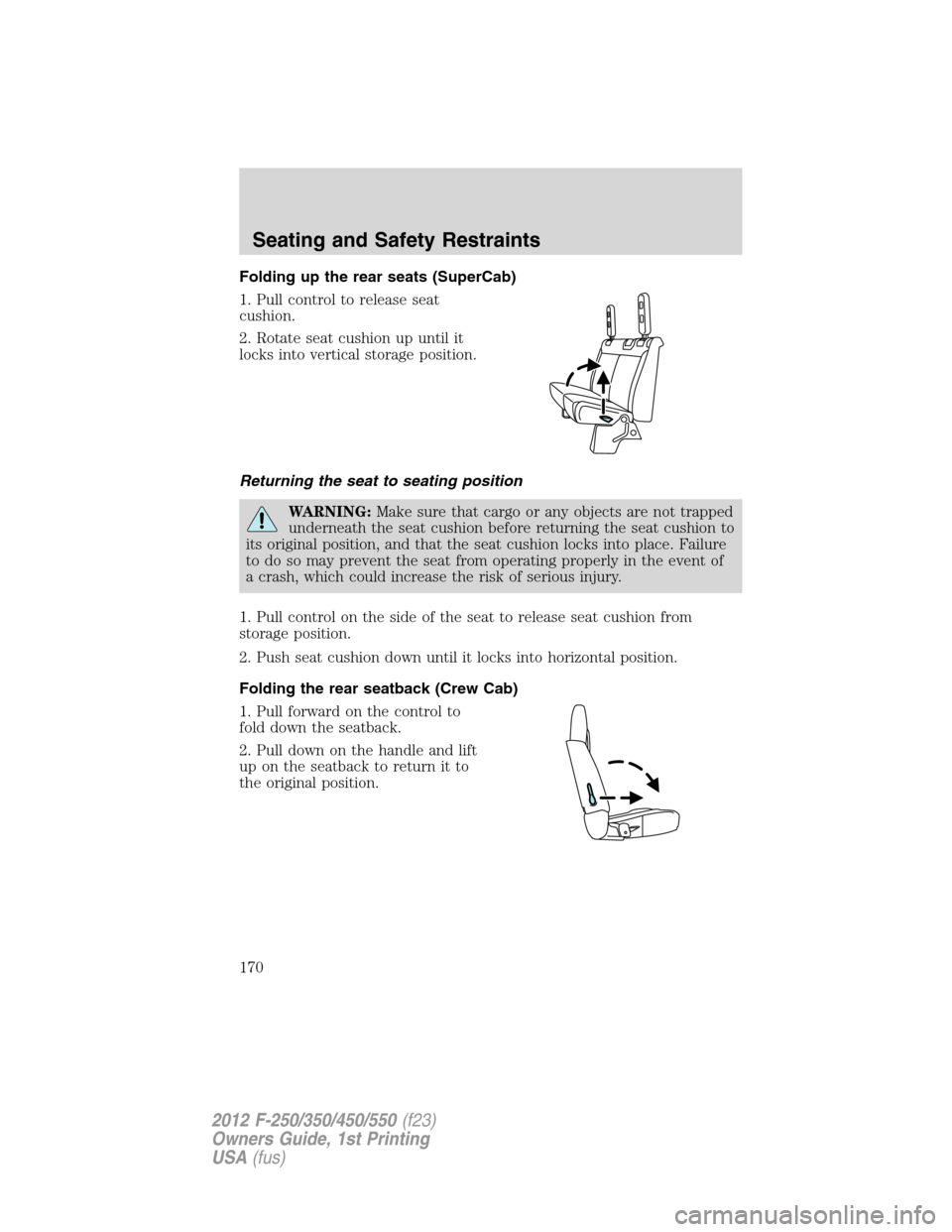
Folding up the rear seats (SuperCab)
1. Pull control to release seat
cushion.
2. Rotate seat cushion up until it
locks into vertical storage position.
Returning the seat to seating position
WARNING:Make sure that cargo or any objects are not trapped
underneath the seat cushion before returning the seat cushion to
its original position, and that the seat cushion locks into place. Failure
to do so may prevent the seat from operating properly in the event of
a crash, which could increase the risk of serious injury.
1. Pull control on the side of the seat to release seat cushion from
storage position.
2. Push seat cushion down until it locks into horizontal position.
Folding the rear seatback (Crew Cab)
1. Pull forward on the control to
fold down the seatback.
2. Pull down on the handle and lift
up on the seatback to return it to
the original position.
Seating and Safety Restraints
170
2012 F-250/350/450/550(f23)
Owners Guide, 1st Printing
USA(fus)
Page 173 of 454
WARNING:Never let a passenger hold a child on his or her lap
while the vehicle is moving. The passenger cannot protect the
child from injury in a collision.
WARNING:All occupants of the vehicle, including the driver,
should always properly wear their safety belts, even when an air
bag supplemental restraint system (SRS) is provided.
WARNING:It is extremely dangerous to ride in a cargo area,
inside or outside of a vehicle. In a collision, people riding in
these areas are more likely to be seriously injured or killed. Do not
allow people to ride in any area of your vehicle that is not equipped
with seats and safety belts. Be sure everyone in your vehicle is in a
seat and using a safety belt properly.
WARNING:In a rollover crash, an unbelted person is
significantly more likely to die than a person wearing a seat belt.
WARNING:Each seating position in your vehicle has a specific
safety belt assembly which is made up of one buckle and one
tongue that are designed to be used as a pair. 1) Use the shoulder belt
on the outside shoulder only. Never wear the shoulder belt under the
arm. 2) Never swing the safety belt around your neck over the inside
shoulder. 3) Never use a single belt for more than one person.
WARNING:When possible, all children 12 years old and under
should be properly restrained in a rear seating position.
WARNING:Safety belts and seats can become hot in a vehicle
that has been closed up in sunny weather; they could burn a
small child. Check seat covers and buckles before you place a child
anywhere near them.
WARNING:Front and rear seat occupants, including pregnant
women, should wear safety belts for optimum protection in an
accident.
Seating and Safety Restraints
173
2012 F-250/350/450/550(f23)
Owners Guide, 1st Printing
USA(fus)
Page 177 of 454
Automatic locking mode
In this mode, the shoulder belt is automatically pre-locked. The belt will
still retract to remove any slack in the shoulder belt. The automatic
locking mode is not available on the driver safety belt or the optional
front or rear seat center safety belt.
When to use the automatic locking mode
This mode should be usedany timea child safety seat is installed in a
front outboard passenger seating position or any outboard rear seating
position (if equipped). The optional front and rear seat center safety belt
have a cinch mechanism. Refer toSafety belt with cinch tongueearlier
in this chapter. Children 12 years old and under should be properly
restrained in a rear seat whenever possible. Refer toSafety restraints
for childrenorSafety seats for childrenlater in this chapter.
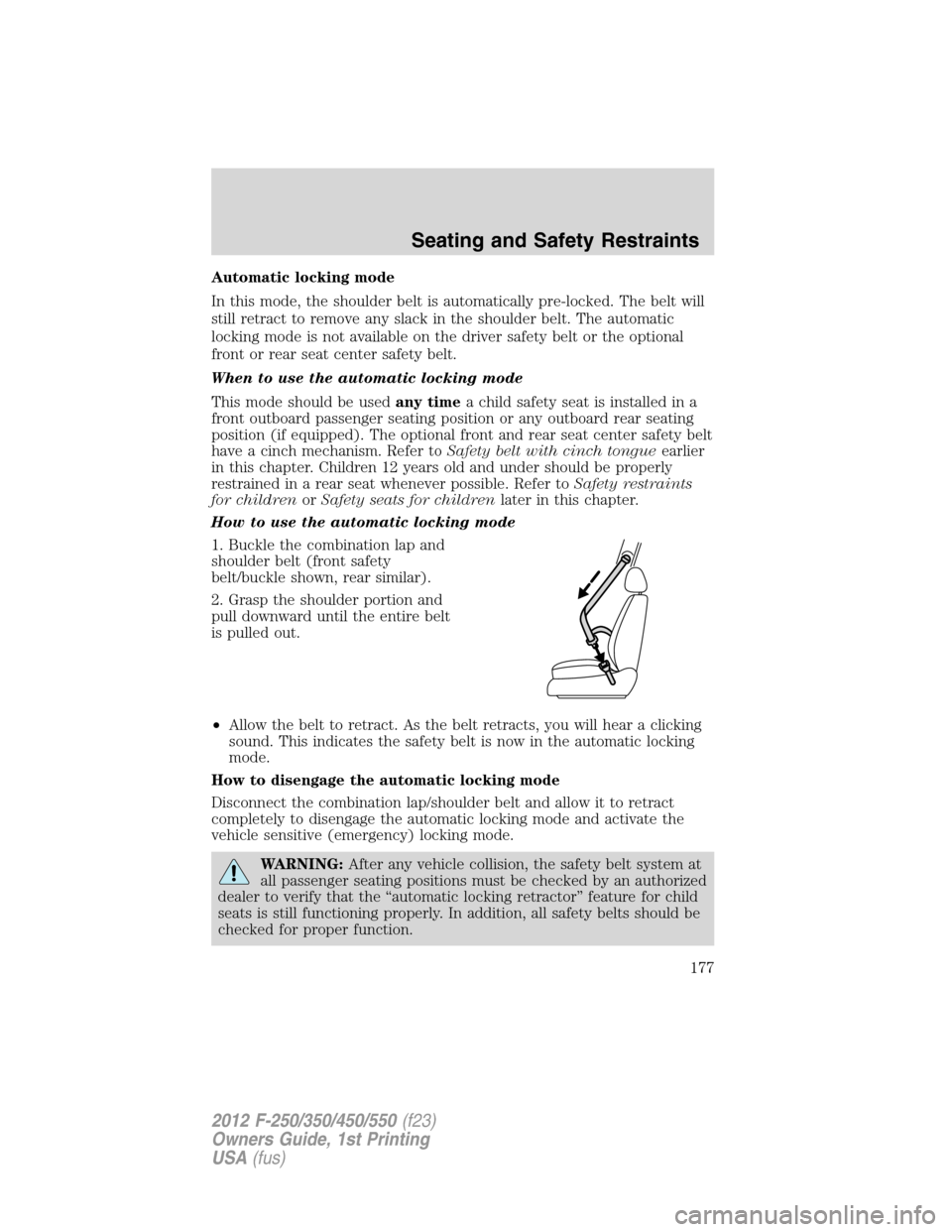
How to use the automatic locking mode
1. Buckle the combination lap and
shoulder belt (front safety
belt/buckle shown, rear similar).
2. Grasp the shoulder portion and
pull downward until the entire belt
is pulled out.
•Allow the belt to retract. As the belt retracts, you will hear a clicking
sound. This indicates the safety belt is now in the automatic locking
mode.
How to disengage the automatic locking mode
Disconnect the combination lap/shoulder belt and allow it to retract
completely to disengage the automatic locking mode and activate the
vehicle sensitive (emergency) locking mode.
WARNING:After any vehicle collision, the safety belt system at
all passenger seating positions must be checked by an authorized
dealer to verify that the “automatic locking retractor” feature for child
seats is still functioning properly. In addition, all safety belts should be
checked for proper function.
Seating and Safety Restraints
177
2012 F-250/350/450/550(f23)
Owners Guide, 1st Printing
USA(fus)
Page 186 of 454
Children and airbags
For additional important safety information, read all information on
safety restraints in this guide.
Children must always be properly restrained. Failure to follow these
instructions may increase the risk of injury in a collision.
WARNING:An infant in a rear-facing seat faces a high risk of
serious or fatal injuries from a deploying passenger airbag. Rear
facing infant seats should NEVER be placed in the front seats, unless
the passenger airbag is turned off. SeePassenger airbag ON/OFF
switch.
WARNING:Front seating positions only: If seating two adults
and a child, Ford recommends properly restraining the child in
the center front seating position, but only if doing so will not interfere
with driving the vehicle. This arrangement provides lap and shoulder
belt and airbag protection for adult occupants and an attachment
method for a child restraint. If the child seat interferes with driving the
vehicle and the child restraint is forward-facing, the child may be
restrained in the passenger seat. Move the seat as far rearward as
possible to minimize the likelihood of interaction with the front
passenger airbag. Never place a rear-facing child seat in front of an
active airbag. Always properly restrain all occupants, including the
child in an appropriate child seat or booster.
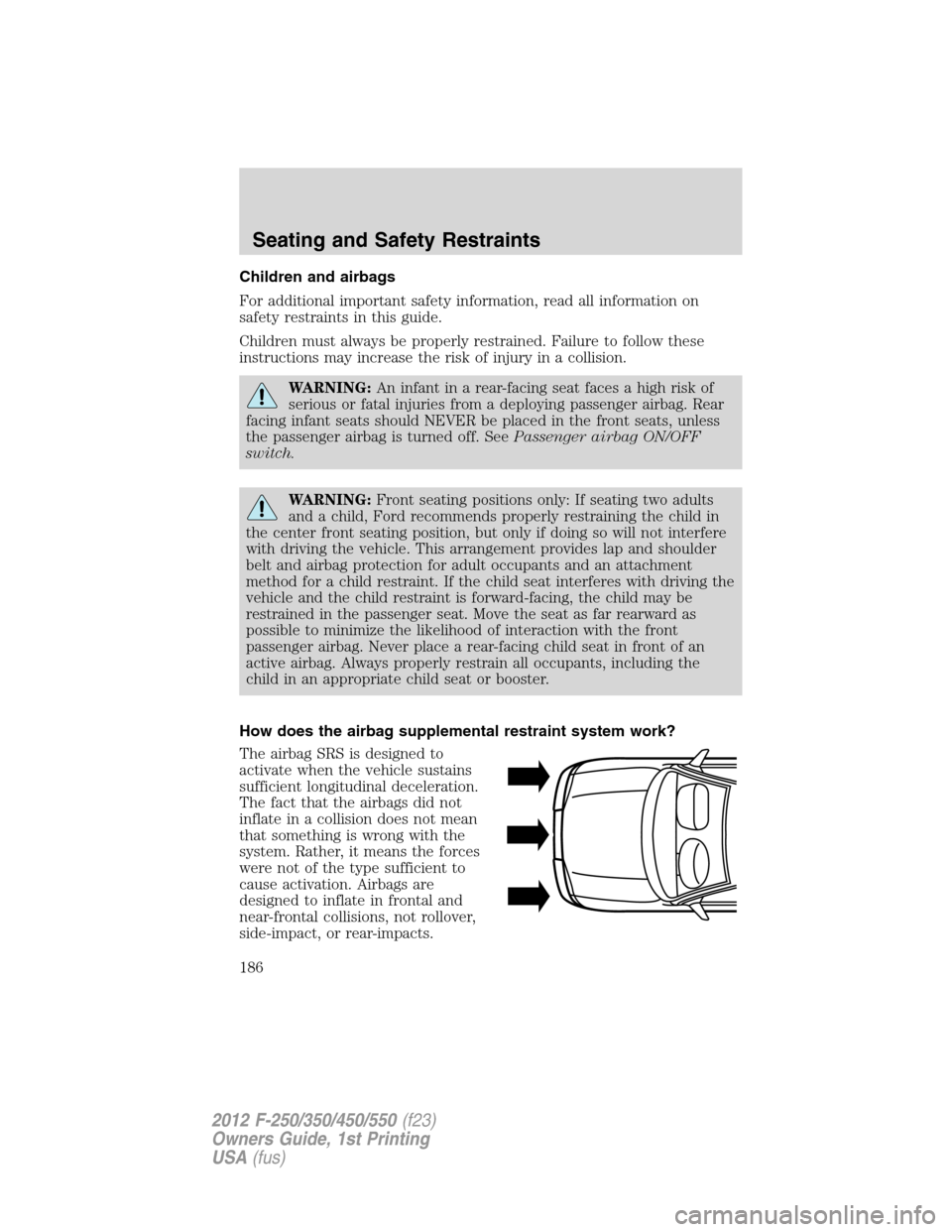
How does the airbag supplemental restraint system work?
The airbag SRS is designed to
activate when the vehicle sustains
sufficient longitudinal deceleration.
The fact that the airbags did not
inflate in a collision does not mean
that something is wrong with the
system. Rather, it means the forces
were not of the type sufficient to
cause activation. Airbags are
designed to inflate in frontal and
near-frontal collisions, not rollover,
side-impact, or rear-impacts.
Seating and Safety Restraints
186
2012 F-250/350/450/550(f23)
Owners Guide, 1st Printing
USA(fus)
Page 188 of 454
•one or more impact and safing sensors,
•a readiness light and tone
•and the electrical wiring which connects the components.
The diagnostic module monitors its own internal circuits and the
supplemental airbag electrical system wiring (including the impact
sensors), the system wiring, the airbag system readiness light, the airbag
backup power and the airbag ignitors.
Seat-mounted side airbag system (if equipped)
WARNING:Do not place objects or mount equipment on or
near the airbag cover on the side of the seatbacks of the front
seats or in front seat areas that may come into contact with a
deploying airbag. Failure to follow these instructions may increase the
risk of personal injury in the event of a collision.
WARNING:Do not use accessory seat covers. The use of
accessory seat covers may prevent the deployment of the side
airbags and increase the risk of injury in an accident.
WARNING:Do not lean your head on the door. The side airbag
could injure you as it deploys from the side of the seatback.
WARNING:Do not attempt to service, repair, or modify the
airbag SRS, its fuses or the seat cover on a seat containing an
airbag. See an authorized dealer.
WARNING:All occupants of the vehicle should always wear
their safety belts even when an airbag SRS is provided.
Seating and Safety Restraints
188
2012 F-250/350/450/550(f23)
Owners Guide, 1st Printing
USA(fus)
Page 189 of 454
How does the side airbag system work?
The design and development of the
side airbag system included
recommended testing procedures
that were developed by a group of
automotive safety experts known as
the Side Airbag Technical Working
Group. These recommended testing
procedures help reduce the risk of
injuries related to the deployment of
side airbags.
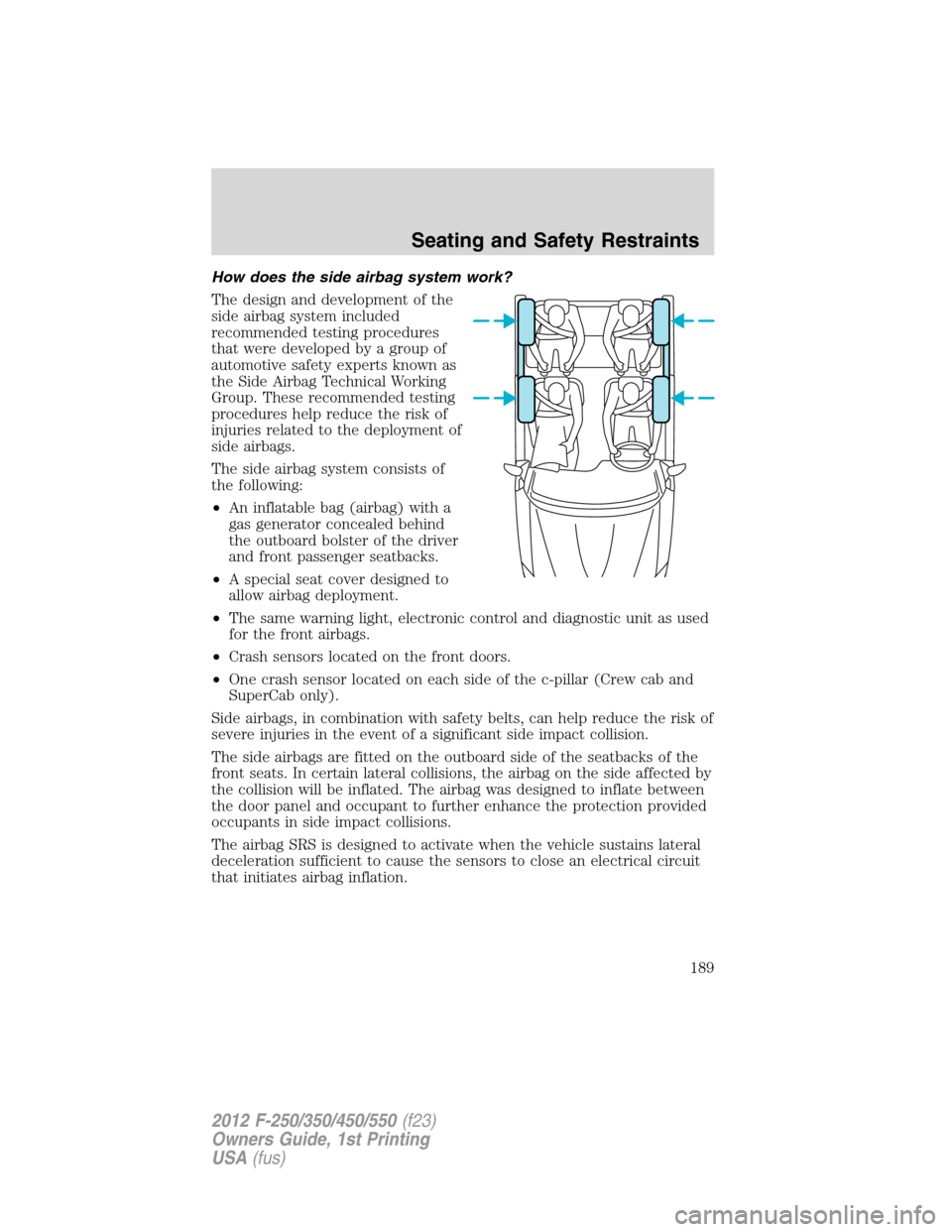
The side airbag system consists of
the following:
•An inflatable bag (airbag) with a
gas generator concealed behind
the outboard bolster of the driver
and front passenger seatbacks.
•A special seat cover designed to
allow airbag deployment.
•The same warning light, electronic control and diagnostic unit as used
for the front airbags.
•Crash sensors located on the front doors.
•One crash sensor located on each side of the c-pillar (Crew cab and
SuperCab only).
Side airbags, in combination with safety belts, can help reduce the risk of
severe injuries in the event of a significant side impact collision.
The side airbags are fitted on the outboard side of the seatbacks of the
front seats. In certain lateral collisions, the airbag on the side affected by
the collision will be inflated. The airbag was designed to inflate between
the door panel and occupant to further enhance the protection provided
occupants in side impact collisions.
The airbag SRS is designed to activate when the vehicle sustains lateral
deceleration sufficient to cause the sensors to close an electrical circuit
that initiates airbag inflation.
Seating and Safety Restraints
189
2012 F-250/350/450/550(f23)
Owners Guide, 1st Printing
USA(fus)