light FORD SUPER DUTY 2013 3.G Diesel Supplement Manual
[x] Cancel search | Manufacturer: FORD, Model Year: 2013, Model line: SUPER DUTY, Model: FORD SUPER DUTY 2013 3.GPages: 95, PDF Size: 2.42 MB
Page 38 of 95
OCR precautions and safe exhaust position
WARNING:Failure to comply with the following instructions for
operator commanded regeneration (OCR) may result in fire,
serious injury, death and/or property damage.
Before you start OCR, observe/do the following:
•Place the vehicle in P (Park) with the parking brake set on stable,
level ground.
•The vehicle must not be parked in a structure.
•The vehicle must be 10 – 15 feet (3 – 5 meters) away from any
obstructions,
•and must be away from materials that can easily combust or melt such
as: paper, leaves, petroleum products, fuels, plastics and other dry
organic material, such as grass.
•Make sure there is a minimum of 1/8 tank of fuel.
•Make sure all fluids are at proper levels.
Make sure that the louvers (holes) located at the tip of the exhaust are
also clear of any obstructions as they are used to introduce fresh air into
the tailpipe to cool the exhaust gas as it leaves. SeeExhaustunder the
Cleaningchapter for more information.
How to start operator commanded regeneration (OCR)
WARNING:Stay clear of exhaust tip during regeneration. You or
others can be burned.
Note:OCR will not be allowed until DPF load percentage has reached
100% (Full). The DPF load percentage will fluctuate up and down when
driving your vehicle due to active and passive regenerations.
Note:During the use of OCR, you may observe a light amount of white
smoke. This is normal.
OCR will not be allowed to operate
if the service engine soon light is
illuminated
Fuel and Refueling
37
2013 Diesel(67l)
Supplement, 1st Printing
USA(fus)
Page 39 of 95
Base information display procedure
1. Start with the vehicle engine fully warmed.
2. Press the Info button on the steering wheel until the information
display reads one of the following choices:
•If the DPF needs cleaning and the vehicle is warmed up, a message
requesting permission to initiate filter cleaning will be displayed
EXHST XX% FULL CLEAN Y/NorEXHAUST FILTER FULL.
Answer yes to this prompt and then follow the prompts regarding
exhaust position as needed to initiate OCR. Be sure to understand
each prompt. If you are not sure what is being asked by each prompt,
contact your authorized dealer. The display will confirm the operation
has started and when it has finished.
•If the vehicle is warmed up, the
powertrain fault indicator will
illuminate and messages
requesting permission to initiate filter cleaning will be displayed
DRIVE TO CLEAN EXHAUST FILTER+EXH OVERLOADED
CLEAN? Y/N. Answer yes to this prompt and then follow the
prompts regarding exhaust position as needed to initiate OCR. Be sure
to understand each prompt. If you are not sure what is being asked by
each prompt, contact your authorized dealer. The display will confirm
the operation has started and when it has finished. You can also drive
to clean the filter. SeeActive regenerationearlier in this chapter.
•The service engine soon light will
illuminate and the following
messagesEXH OVERLOADED
CLEAN? Y/N+REDUCED ENGINE POWERwill appear when the
system is at the point of oversaturation you will not be able to allow
cleaning . The vehicle must be serviced by an authorized dealer.
3. Once OCR starts, the engine’s rpm will rise to approximately 2,000 -
2,400 rpm and the cooling fan will increase speed; you will hear a change
in audible sound due to the fan and engine speed increase.
It is not necessary to open the hood on the engine compartment. Once
OCR is complete, the engine rpm and fan will return to normal idling.
The exhaust system will remain very hot for several minutes even after
regeneration is complete. Do not reposition the vehicle over materials
that could burn until the exhaust system has had sufficient time to
cool. Depending on the amount of soot collected by the DPF, ambient
temperature, and altitude, OCR may last from 10 to 25 minutes.
Fuel and Refueling
38
2013 Diesel(67l)
Supplement, 1st Printing
USA(fus)
Page 40 of 95
Optional information display procedure
1. Start with the vehicle engine fully warmed.
2. From the main menu, select Gauge Mode and scroll through until one
of the following options appear:
•If the DPF needs cleaning and the vehicle is warmed up, you will be
prompted to hold OK to cleanExhaust xx% FullorExhaust Filter
Full. Press OK and then follow the prompts regarding exhaust
position as needed to initiate OCR. Be sure to understand each
prompt. If you are not sure what is being asked by each prompt,
contact your authorized dealer. The display will confirm the operation
has started and when it has finished.
•When the exhaust system is
overloaded cleaning will be
allowed until a certain saturation
level. If the vehicle is warmed up and ready the powertrain fault
indicator will illuminate and you will be prompted to hold OK to clean
Drive to Clean Exhaust System+Exhaust Filter Overloaded.
Press OK and then follow the prompts regarding exhaust position as
needed to initiate OCR. Be sure to understand each prompt. If you are
not sure what is being asked by each prompt, contact your authorized
dealer. The display will confirm the operation has started and when it
has finished. You can also drive to clean the filter. SeeActive
regenerationearlier in this chapter.
•The service engine soon light will
illuminate and the following
messagesExhaust Filter
Overloaded+Reduced Engine PowerorReduced Engine Power
will appear when the system is at the point of oversaturation you will
not be able to allow cleaning . The vehicle must be serviced by an
authorized dealer.
3. Once OCR starts, the engine’s rpm will rise to approximately 2,000 -
2,400 rpm and the cooling fan will increase speed; you will hear a change
in audible sound due to the fan and engine speed increase.
It is not necessary to open the hood on the engine compartment. Once
OCR is complete, the engine rpm and fan will return to normal idling.
The exhaust system will remain very hot for several minutes even after
regeneration is complete. Do not reposition the vehicle over materials
that could burn until the exhaust system has had sufficient time to
cool. Depending on the amount of soot collected by the DPF, ambient
temperature, and altitude, OCR may last from 10 to 25 minutes.
Fuel and Refueling
39
2013 Diesel(67l)
Supplement, 1st Printing
USA(fus)
Page 41 of 95
How to interrupt/cancel OCR
If OCR needs to be cancelled, pressing the brake, accelerator, or shutting
off the vehicle will stop OCR. Depending on the amount of time OCR was
allowed to operate, soot may not have had sufficient time to be
eliminated, but the exhaust system and exhaust gas may still be hot. If
the vehicle is shut off during OCR, you will notice turbo flutter. This is a
normal consequence caused by shutting off a diesel engine during
boosted operation and is considered normal.
Filter service/maintenance
Over time a slight amount of ash will build up in the DPF which is not
removed during the regeneration process. The DPF may need to be
removed for ash cleaning at approximately 120,000 miles (193,000 km)
or greater (actual mileage can vary greatly depending upon
engine/vehicle operating conditions) and replaced with a new or
remanufactured (ash cleaned) part. The filter may need to be replaced
at approximately 250,000 miles (400,000 km) depending upon
engine/vehicle operating conditions.
In both cases the engine control
system will set a service light to
inform you to bring the vehicle to
the dealer for service.
If there are any issues with the
oxidation catalyst/DPF system a
service light will be set by the
engine control system to inform you
to bring the vehicle into your
authorized dealer for service.
Fuel and Refueling
40
2013 Diesel(67l)
Supplement, 1st Printing
USA(fus)
Page 43 of 95
EMISSION CONTROL SYSTEM(S) LAWS
WARNING:Do not remove or alter the original equipment floor
covering or insulation between it and the metal floor of the
vehicle. The floor covering and insulation protect occupants of the
vehicle from the engine and exhaust system heat and noise. On
vehicles with no original equipment floor covering insulation, do not
carry passengers in a manner that permits prolonged skin contact with
the metal floor. Provide adequate insulation. Failure to follow these
instructions may result in fire or personal injury.
In the U.S. federal law and certain state laws prohibit removing or
rendering inoperative emission control system(s). Similar federal or
provincial laws may apply in Canada. Ford recommends against any
vehicle modification without determining applicable law.
Tampering with emissions control
systems (including related sensors
and the diesel exhaust fluid (DEF)
injection system) can result in reduced engine power and the
illumination of the service engine soon light.
NOISE EMISSIONS WARRANTY, PROHIBITED TAMPERING ACTS
AND MAINTENANCE
On January 1, 1978, Federal regulation became effective governing the
noise emission on trucks over 10,000 lbs. (4,536 kg) GVWR (Gross
Vehicle Weight Rating). The following statements concerning prohibited
tampering acts and maintenance, and the noise warranty found in the
Warranty Guide, are applicable to complete chassis cabs over
10,000 lbs. (4,536 kg) GVWR.
Tampering with noise control system prohibited
Federal law prohibits the following acts or the causing thereof: (1) The
removal or rendering inoperative by any person other than for purposes
of maintenance, repair or replacement of any device or element of design
incorporated into any new vehicle for the purpose of noise control prior
to its sale or delivery to the ultimate purchaser or while it is in use, or
(2) the use of the vehicle after such device or element of design has
been removed or rendered inoperative by any person.
Fuel and Refueling
42
2013 Diesel(67l)
Supplement, 1st Printing
USA(fus)
Page 54 of 95
Adding engine coolant
WARNING:Do not add coolant when the engine is hot. Steam and
scalding liquids released from a hot cooling system can burn you
badly. Also, you can be burned if you spill coolant on hot engine parts.
WARNING:Do not put coolant in the windshield washer fluid
container. If sprayed on the windshield, coolant could make it
difficult to see through the windshield.
WARNING:To reduce the risk of personal injury, make sure the
engine is cool before unscrewing the coolant pressure relief cap.
The cooling system(s) are under pressure; steam and hot liquid can
come out forcefully when the cap is loosened slightly.
WARNING:Do not add coolant further than the MAX mark.
Note:Do not use stop leak pellets, cooling system sealants or unapproved
additives as they can cause damage to the engine cooling and/or heating
systems. This damage would not be covered under your vehicle’s warranty.
Note:During normal vehicle operation, the engine coolant may change
color from orange to pink or light red. If the engine coolant is clear and
uncontaminated, this color change does not indicate the engine coolant
has degraded nor does it require the engine coolant to be drained, the
system to be flushed, or the engine coolant to be replaced.
•DO NOT MIX different colors or types of coolant in your vehicle. Only
use prediluted engine coolant that meets Ford specification . Mixing of
engine coolants may harm your engine’s cooling system. The use of an
improper coolant may harm engine and cooling system components
and may void the warranty.
•In case of emergency, a large amount of water without engine coolant
may be added in order to reach a vehicle service location. In this
instance, the cooling system must be drained, chemically cleaned, and
refilled with engine coolant as soon as possible per the instructions in
the Workshop Manual. Water alone (without engine coolant) can cause
engine damage from corrosion, overheating or freezing.DO NOTuse
this method for the secondary cooling system. The secondary cooling
system operates close to ambient temperature, and is susceptible to
freezing in any subfreezing environment, in the absence of coolant.
Maintenance
53
2013 Diesel(67l)
Supplement, 1st Printing
USA(fus)
Page 61 of 95
Air filter replacement:
When replacing the air filter element, use the Motorcraft® air filter
element listed inMotorcraft part numbersin theCapacities and
Specificationschapter.
Failure to use the correct air filter element may result in severe
engine damage.
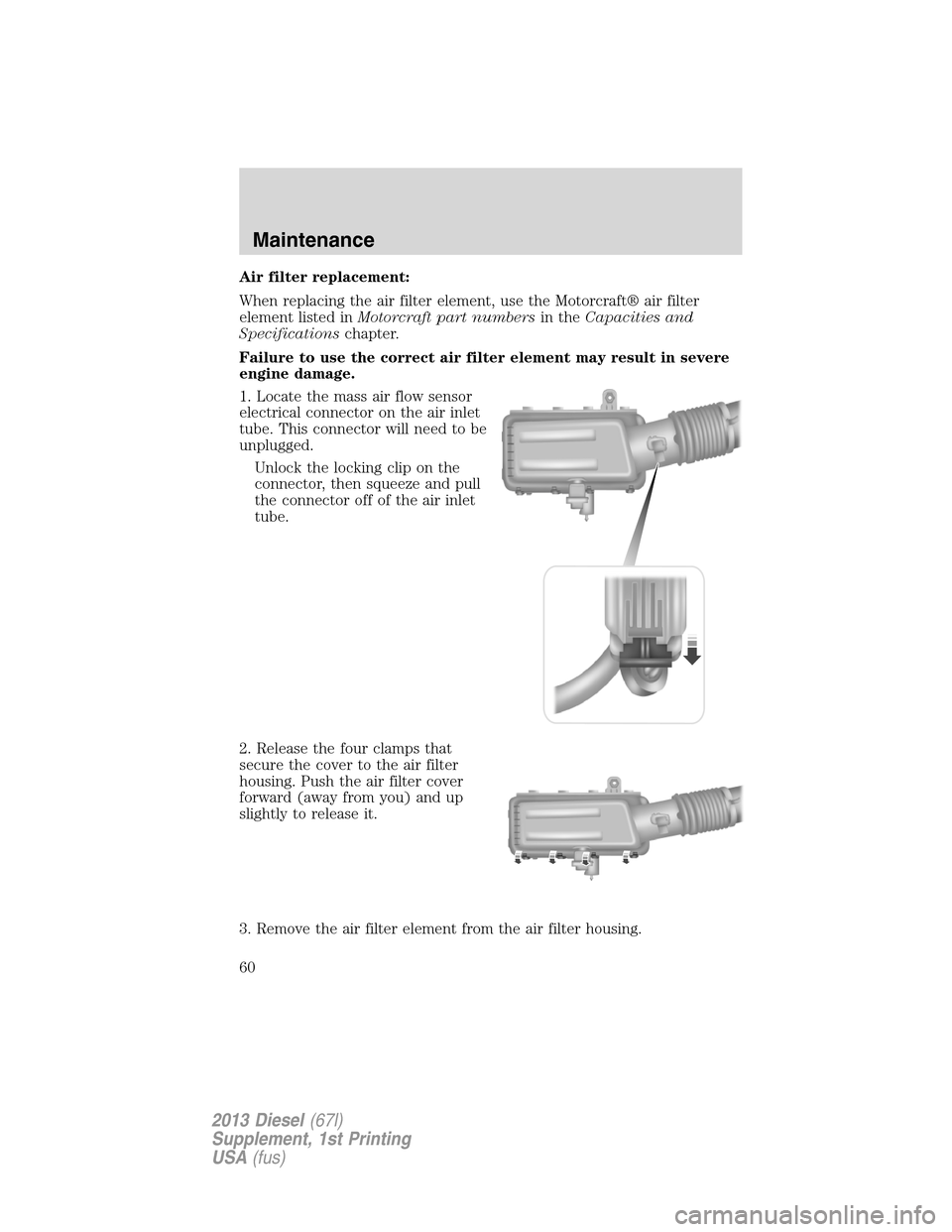
1. Locate the mass air flow sensor
electrical connector on the air inlet
tube. This connector will need to be
unplugged.
Unlock the locking clip on the
connector, then squeeze and pull
the connector off of the air inlet
tube.
2. Release the four clamps that
secure the cover to the air filter
housing. Push the air filter cover
forward (away from you) and up
slightly to release it.
3. Remove the air filter element from the air filter housing.
Maintenance
60
2013 Diesel(67l)
Supplement, 1st Printing
USA(fus)
Page 63 of 95
MINOR TROUBLESHOOTING GUIDE
Air purge procedure
Turn the key on for 30 seconds, then turn off. Repeat the procedure six
times.
If the engine won’t crank
WARNING:Battery posts, terminals and related accessories
contain lead and lead compounds.Wash hands after handling.
Turn on the headlights. If the lights are dim, do not go on at all or when
the ignition is turned to START the lights become dim or go out, the
battery connections may be loose or corroded, or the battery may be
discharged. If there is a clicking or stuttering sound coming from the
engine compartment when you turn the key to START, this may also
indicate a loose or corroded battery connection.
Check the battery connections at the battery posts, cable connection to
the engine grounding point and at the starter connection.
If a discharged battery is suspected, have it checked and corrected.
•The gearshift lever must be in P (Park) or N (Neutral) in order for
the starter to operate.
•Try operating the starter switch several times. Should the switch be
corroded, this operation may clean the contacts or make the switch
temporarily operable until you can reach the dealer.
•If all electrical connections are tight and you need assistance to start,
refer toJump startingin theRoadside Emergencieschapter of your
Owner’s Manual.
If engine cranks but won’t start
Prolonged starter cranking (in excess of 10 seconds) could cause
damage to the starter motor.
•
Check the fuel gauge. You may be out of fuel. If the gauge shows that
there is fuel in the tank, the trouble may be in the electrical system or
the fuel system. If equipped with an auxiliary tank, be sure that the tank
control switch is set for the tank with fuel and not on an empty tank.
•Leaving the ignition key turned to on for over two minutes without
starting may make starting difficult because the glow plugs will cease
activation. Reset the system by turning the ignition key to off and
then back to on again.
Maintenance
62
2013 Diesel(67l)
Supplement, 1st Printing
USA(fus)
Page 65 of 95
ENGINE
Engines are more efficient when they are clean because grease and dirt
buildup keep the engine warmer than normal. When washing:
•Take care when using a power washer to clean the engine. The
high-pressure fluid could penetrate the sealed parts and cause
damage.
•Do not spray a hot engine with cold water to avoid cracking the
engine block or other engine components.
•Spray Motorcraft® Engine Shampoo and Degreaser (ZC-20) on all
parts that require cleaning and pressure rinse clean.
•Never wash or rinse the engine while it is running; water in the
running engine may cause internal damage.
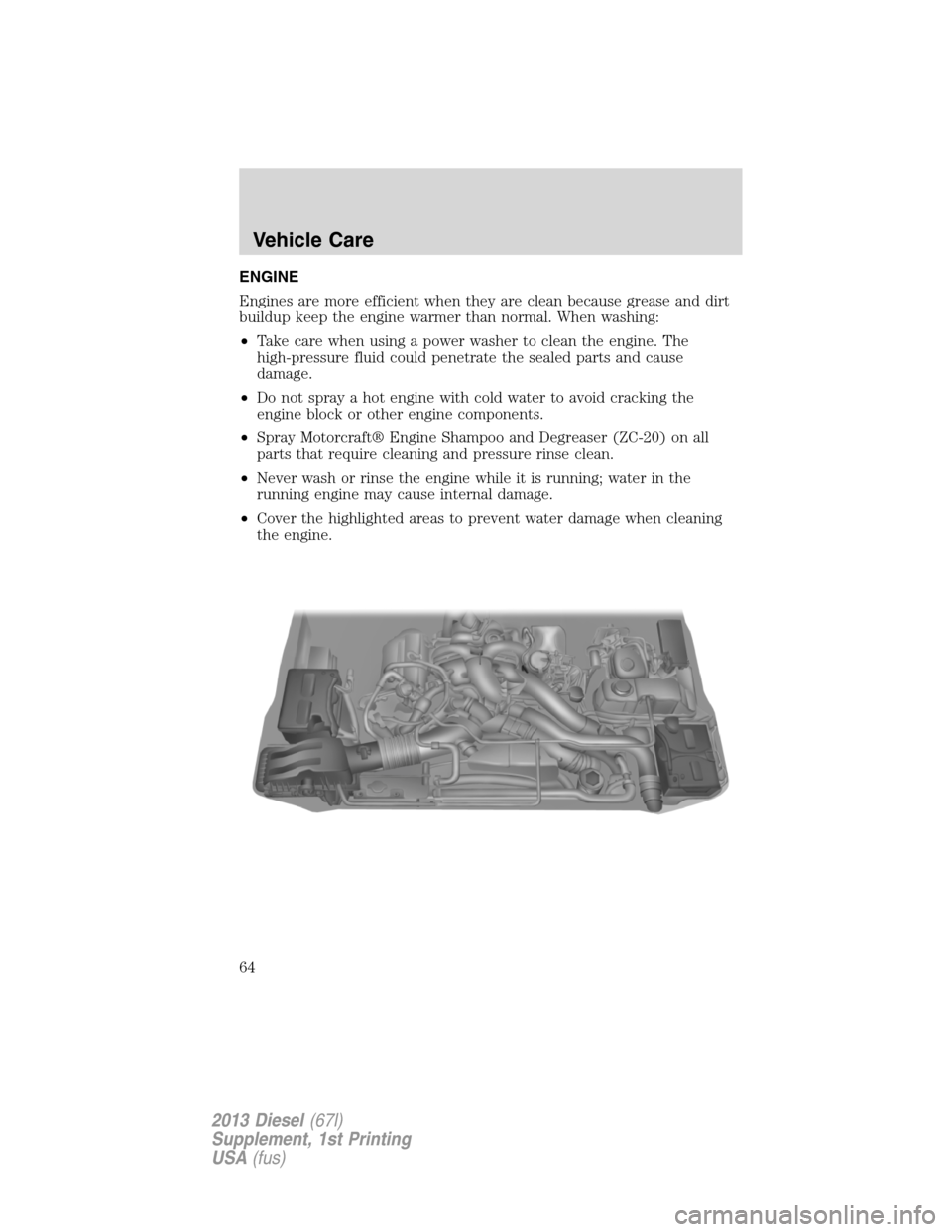
•Cover the highlighted areas to prevent water damage when cleaning
the engine.
Vehicle Care
64
2013 Diesel(67l)
Supplement, 1st Printing
USA(fus)
Page 92 of 95
EXCEPTIONS
In addition, there are several exceptions to the Normal Schedule. They
are listed below:
Normal vehicle axle maintenance:Rear axles and power take-off
(PTO) units with synthetic fluid and light-duty trucks equipped with
Ford-design axles are lubricated for life; do not check or change fluid
unless a leak is suspected, service is required or the assembly has been
submerged in water. During long periods of trailer towing with outside
temperatures above 70°F (21°C) and at wide-open throttle for long
periods above 45 mph (72 km/h), non-synthetic rear axle fluids should
be changed every 3000 miles (4800 kilometers) or three months,
whichever comes first. This interval can be waived if the axle is filled
with 75W140 synthetic gear fluid meeting Ford specification
WSL-M2C192-A, part number F1TZ-19580-B or equivalent. Add friction
modifier XL-3 (EST-M2C118-A) or equivalent for complete refill of
Traction-Lok rear axles (refer toTechnical specificationsin the
Maintenancechapter for details).
F-450 and F-550 axle maintenance:Change rear axle fluid every
100000 miles (160000 kilometers) under normal driving conditions on all
commercial applications. For trucks operated at or near maximum Gross
Vehicle Weights, the rear axle fluid should be changed every 50000 miles
(80000 kilometers). In addition, this 50000 mile (80000 kilometer)
schedule should be observed when the vehicles are operated under the
special operating conditions, where noted.
Diesel Particulate Filter (DPF):The DPF may need to be removed
for ash cleaning at approximately 120000 miles (192000 kilometers) or
greater (actual mileage can vary greatly depending upon engine/vehicle
operating conditions) and replaced with a new or remanufactured (ash
cleaned) part. The filter may need to be replaced at approximately
250000 miles (400000 kilometers) depending upon engine/vehicle
operating conditions. In both cases the engine control system will set a
service light (
) to inform you to bring the vehicle to the dealer for
service. If there are any issues with the oxidation catalyst/DPF system a
service light (
or) will be set by the engine control system to
inform you to bring the vehicle into a dealership for service.
Scheduled Maintenance
91
2013 Diesel(67l)
Supplement, 1st Printing
USA(fus)