lock FORD SUPER DUTY 2013 3.G Diesel Supplement Manual
[x] Cancel search | Manufacturer: FORD, Model Year: 2013, Model line: SUPER DUTY, Model: FORD SUPER DUTY 2013 3.GPages: 95, PDF Size: 2.42 MB
Page 9 of 95
STARTING THE ENGINE
Read all starting instructions carefully before you start your vehicle.
For temperatures below 32°F (0°C), the use of the correct grade engine
oil is essential for proper operation. Refer toEngine oil specifications
in theMaintenancechapter for more information.
Your vehicle may be equipped with a cold weather starting strategy that
prevents severe engine damage by assisting in engine lubrication
warm-up. In extremely cold ambient temperatures, this strategy activates
and prevents the accelerator pedal from being used for 30 seconds after
starting the vehicle. By not allowing the accelerator pedal to be used, the
engine oil is allowed to properly lubricate the bearings preventing engine
damage due to lack of proper lubrication. After the 30 second warm-up
period, the accelerator pedal will be operational again as long as the
pedal is not being pressed when the 30 second time limit expires. When
starting the engine in extremely cold temperatures (-15°F [–26°C]), it is
recommended to allow the engine to idle for several minutes before
driving the vehicle.
Make sure the gearshift lever is in P (Park) and the parking brake is fully
set before you turn the key. Do not press the accelerator during starting.
Cold Weather Starting
WARNING:Do not use starting fluid, such as ether, in the air
intake system (see air filter decal). Such fluid could cause
immediate explosive damage to the engine and possible personal injury.
WARNING:Do not add gasoline, gasohol or alcohol to diesel
fuel. This practice creates a serious fire hazard and causes
engine performance problems.
It is recommended that the engine block heater be used for starting
when the temperature is -10°F (-23°C) or colder. Refer toEngine block
heater (if equipped)in theStarting and Stopping the Enginechapter
of yourOwner’s Manual.
When operating in cold weather, Motorcraft® cetane improvers or
non-alcohol-based cetane improvers from a reputable manufacturer may
be used as needed.
Starting and Stopping the Engine
8
2013 Diesel(67l)
Supplement, 1st Printing
USA(fus)
Page 12 of 95
In cold weather below 32°F (0°C), the engine may slowly increase to a
higher idle speed if left idling in P (Park). As the engine warms-up, the
engine sound level decreases due to the activation of PCM-controlled
sound reduction features.
If your vehicle is operated in a heavy snow storm or blowing snow
conditions, the engine air induction may become partially clogged with
snow and/or ice. If this occurs, the engine may experience a significant
reduction in power output. At the earliest opportunity, clear all the snow
and/or ice away from inside the air filter assembly. Remove the air
cleaner cover and the pleated paper filter, leaving the foam filter in and
remove any snow or ice. Make sure the foam filter is installed correctly
in place. Remove any debris, snow and/or ice on the foam filter by
brushing the surface with soft brush. Do not use water, solvents, or a
hard brush for cleaning the foam filter.
In order to operate the engine in temperatures of 32°F (0°C) or lower,
read the following instructions:
•Make sure that the batteries are of sufficient size and are fully
charged. Check other electrical components to make sure they are in
optimum condition.
•Use the proper coolant solution at the concentration recommended to
protect the engine against damage from freezing.
•Try to keep the fuel tank full as much as possible at the end of
operation to prevent condensation in the fuel system.
•Make sure you use proper cold weather engine oil and that it is at its
proper level. Also, if necessary, make sure to follow the engine oil and
filter change schedule found under theSpecial operating conditions
section listed in thescheduled maintenance information.
•At temperatures of -10°F (-23°C) or below, it is recommended that
you use an engine block heater to improve cold engine starting.
•If operating in arctic temperatures of -20°F (-29°C) or lower, consult
your truck dealer for information about special cold weather
equipment and precautions.
The following cold weather idling guidelines are recommended:
•Motorcraft® cetane improvers or non-alcohol-based cetane improvers
from a reputable manufacturer may be used as needed.
•Maintain the engine cooling system properly.
•Avoid shutting the engine down after an extensive idling period. Drive
the vehicle for several miles with the engine at normal operating
temperatures under a moderate load.
•Consider using an engine block heater.
•For extended idle times use an approved idle speed increase device.
Starting and Stopping the Engine
11
2013 Diesel(67l)
Supplement, 1st Printing
USA(fus)
Page 13 of 95
Winter Operating Tips for Arctic Operation -20°F (-29°C) and Below
The following information is provided as a guideline only, and is not
intended to be the only source of possible solutions in resolving extreme
cold temperature issues.
Starting Aids:
WARNING:Do not use starting fluid, such as ether, in the air
intake system (see air filter decal). Such fluid could cause
immediate explosive damage to the engine and possible personal injury.
The use of the factory engine block heater assists in engine starting in
extreme cold ambient temperatures. Refer toEngine block heaterin the
Starting and Stopping the Enginechapter of yourOwner’s Manual.
Idle Control:
•Your vehicle may have a factory option for a stationary elevated idle
control (SEIC) through dash-mounted upfitter switches which allows
the operator to elevate the idle rpm for extended idle periods, as well
as aftermarket equipment such as PTO operation. This feature must
be configured even if ordered from the factory. See your authorized
dealer for required upfitting.
Operation in Snow and Rain
Vehicle operation in heavy snowfall or extreme rain conditions may feed
excessive amounts of snow/water into the air intake system. This could
plug/soak the air filter with snow and may cause the engine to lose
power and possibly shut down.
The following actions are recommended after operating the vehicle up to
200 miles (320 kilometers) in snowfall or extreme rain:
•Snow:At the earliest opportunity, open the hood and clear all the
snow and ice from the air filter housing inlet (do not remove the
foam filter) and reset the air filter restriction gauge.Note:Removal
of the foam filter degrades vehicle performance during snow and hot
weather conditions.
•Extreme rain:The air filter dries after about 15–30 minutes at
highway speeds. At the earliest opportunity, open the hood and reset
the air filter restriction gauge.
Refer toAir filter and restriction gaugein theMaintenancechapter of
this supplement for more information.
Starting and Stopping the Engine
12
2013 Diesel(67l)
Supplement, 1st Printing
USA(fus)
Page 14 of 95
Operation in Standing Water
Ingestion of water into the diesel engine can result in immediate and
severe damage to the engine. If driving through water, slow down to
avoid splashing water into the intake. If the engine stalls, and ingestion
of water into the engine is suspected, do not try to restart the engine.
Consult your dealer for service immediately.
The fuel tank is vented to atmosphere by valves on top of the tank and
through the fuel cap. If water reaches this level water may be pulled into
the fuel tank. Water in the fuel can cause performance issues and
damage the fuel injection system.
Engine Block Heater (If Equipped)
Refer to theStarting and Stopping the Enginechapter in your
Owner’s Manual.
Rapid Heat Supplemental Heating System (If Equipped)
Note:Additional aftermarket electrical loads operated during engine
warm up may impact the performance of the rapid heat supplemental
heater.
The optional rapid heat feature is an electrically powered device that is
designed to provide supplemental heat during engine warm up. For
maximum effectiveness mid to low blower speed is recommended during
initial warm up. When operating in automatic mode (when equipped) the
climate control unit determines the appropriate blower speed for existing
conditions.
Starting and Stopping the Engine
13
2013 Diesel(67l)
Supplement, 1st Printing
USA(fus)
Page 19 of 95
Care should be taken whenever diesel fuel is stored. Use only clean,
approved containers which will prevent the entry of dirt or water.
Diesel fuel must not be stored in a galvanized container. The fuel will
dissolve the zinc in a galvanized container. The zinc will then remain in
the solution until it is run through the engine where it will be deposited
in the fuel injectors causing expensive-to-repair damage.
Diesel fuel dispensing nozzle fill rate
This truck is equipped with a fuel fill pipe which is able to accept fuel up
to 20 gallons per minute from a 1
18fuel dispensing nozzle. Pumping fuel
at greater flow rates may result in premature nozzle shut-off or spitback.
Fuel filler cap
WARNING:The fuel system may be under pressure. If the fuel
filler cap is venting vapor or if you hear a hissing sound, wait
until it stops before completely removing the fuel filler cap. Otherwise,
fuel may spray out and injure you or others.
WARNING:If you do not use the proper fuel filler cap,
excessive pressure or vacuum in the fuel tank may damage the
fuel system or cause the fuel cap to disengage in a collision, which may
result in possible personal injury.
Note:If you must replace the fuel filler cap, replace it with a fuel filler
cap that is designed for your vehicle. The vehicle warranty may be void
for any damage to the fuel tank or fuel system if the correct genuine
Ford or Motorcraft® fuel filler cap is not used.
Your fuel tank filler cap has an indexed design with a 1/4 turn on/off feature.
When fueling your vehicle:
1. Turn the engine off.
2. Carefully turn the filler cap counterclockwise until it spins off.
3. Pull to remove the cap from the fuel filler pipe.
4. To install the cap, align the tabs on the cap with the notches on the
filler pipe.
5. Turn the filler cap clockwise 1/4 of a turn until it clicks at least once.
Fuel and Refueling
18
2013 Diesel(67l)
Supplement, 1st Printing
USA(fus)
Page 25 of 95
Use only DEF certified by the
American Petroleum Institute (API)
such as Motorcraft® DEF or
equivalent meeting Ford
specification WSS-M99C130-A
and/or ISO 22241. Look for API
certification trademark shown here.
Repairs resulting from the use of
non-certified DEF products will not be covered by your vehicle’s
warranty.
Maintaining the purity of DEF is important to avoid malfunctions in the
SCR system.
If DEF is removed from the tank for repair work, etc., the same DEF
must not be used to refill the tank as its purity is no longer guaranteed.
To fill the DEF tank, see your authorized dealer or do the following
(before filling the DEF tank in cold climates, seeFilling the DEF tank
in cold climateslater in this section):
•DEF bottle fill with spout:
The following procedure applies to Motorcraft® DEF or similar DEF
bottles; for other brands or bottle types, refer to the instructions on the
bottle label.
1. Remove the cap from the DEF container. Remove the spout from the
bottle and insert the straw end into the bottle. Ensure that the arrow
above the nut is aligned with the bottle handle and the small tube end
extends into the far corner of the bottle. Twist the spout nut on the
container until it is tight.
2. Open the DEF filler port on the
vehicle by turning thebluecap
counterclockwise.Do not put DEF
in the fuel tank. This can cause
engine damage not covered by
your vehicle’s warranty.
Fuel and Refueling
24
2013 Diesel(67l)
Supplement, 1st Printing
USA(fus)
Page 32 of 95
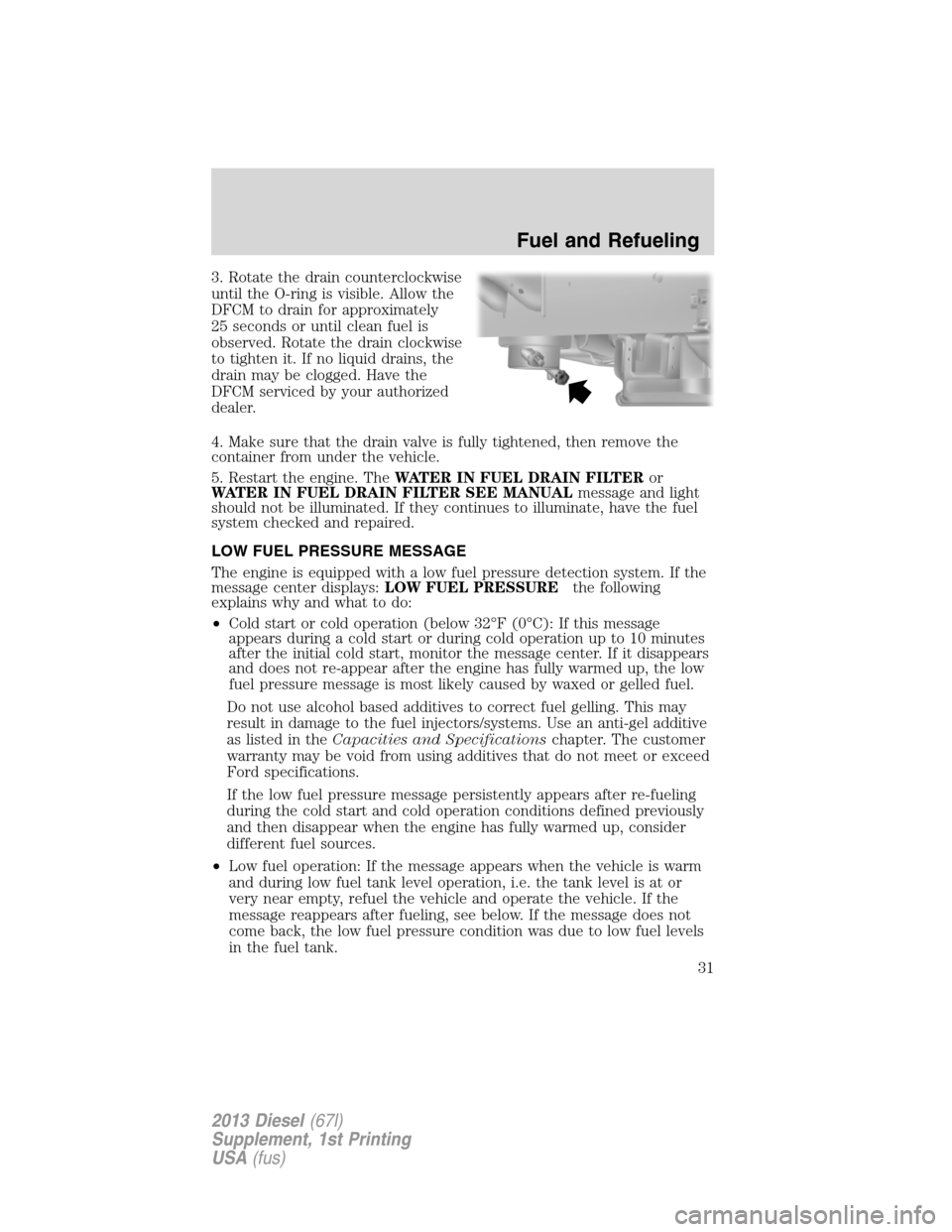
3. Rotate the drain counterclockwise
until the O-ring is visible. Allow the
DFCM to drain for approximately
25 seconds or until clean fuel is
observed. Rotate the drain clockwise
to tighten it. If no liquid drains, the
drain may be clogged. Have the
DFCM serviced by your authorized
dealer.
4. Make sure that the drain valve is fully tightened, then remove the
container from under the vehicle.
5. Restart the engine. TheWATER IN FUEL DRAIN FILTERor
WATER IN FUEL DRAIN FILTER SEE MANUALmessage and light
should not be illuminated. If they continues to illuminate, have the fuel
system checked and repaired.
LOW FUEL PRESSURE MESSAGE
The engine is equipped with a low fuel pressure detection system. If the
message center displays:LOW FUEL PRESSUREthe following
explains why and what to do:
•Cold start or cold operation (below 32°F (0°C): If this message
appears during a cold start or during cold operation up to 10 minutes
after the initial cold start, monitor the message center. If it disappears
and does not re-appear after the engine has fully warmed up, the low
fuel pressure message is most likely caused by waxed or gelled fuel.
Do not use alcohol based additives to correct fuel gelling. This may
result in damage to the fuel injectors/systems. Use an anti-gel additive
as listed in theCapacities and Specificationschapter. The customer
warranty may be void from using additives that do not meet or exceed
Ford specifications.
If the low fuel pressure message persistently appears after re-fueling
during the cold start and cold operation conditions defined previously
and then disappear when the engine has fully warmed up, consider
different fuel sources.
•Low fuel operation: If the message appears when the vehicle is warm
and during low fuel tank level operation, i.e. the tank level is at or
very near empty, refuel the vehicle and operate the vehicle. If the
message reappears after fueling, see below. If the message does not
come back, the low fuel pressure condition was due to low fuel levels
in the fuel tank.
Fuel and Refueling
31
2013 Diesel(67l)
Supplement, 1st Printing
USA(fus)
Page 33 of 95
•Normal operation: If the message appears during normal operation
when the vehicle / engine is fully warm, and fuel level is not low, the
fuel filters must be changed regardless of the maintenance schedule
interval.
•If replacement of the fuel filter does not remedy the low fuel pressure
message during normal operation as defined above, take the vehicle to
your authorized dealer.
CHANGING THE ENGINE-MOUNTED AND DFCM FUEL FILTERS
Your vehicle is equipped with two fuel filters; one is mounted on top of
the driver’s side of the engine and the second filter, inside the DFCM, is
mounted on the frame rail under the driver-side floorboard near the
transmission. Both filters should be replaced at the same time. Regular
fuel filter changes are an important part of engine maintenance; failing to
keep with the scheduled maintenance could lead to engine performance
issues and/or fuel injection system damage. Refer to thescheduled
maintenance informationof this supplement for more information.
Refer toMotorcraft part numbersin theMaintenancechapter for the
fuel filter replacement part number. This part number includes filters
and seals for both the engine-mounted and frame-mounted filters.
Removal - DFCM filter
The DFCM filter is located in the lower portion of the DFCM housing.
1. Drain the DFCM. SeeFuel filter/water separatorin theFuel and
Refuelingchapter.
To install the new DFCM filter, seeInstallation – DFCM filterin the
Fuel and Refuelingchapter.
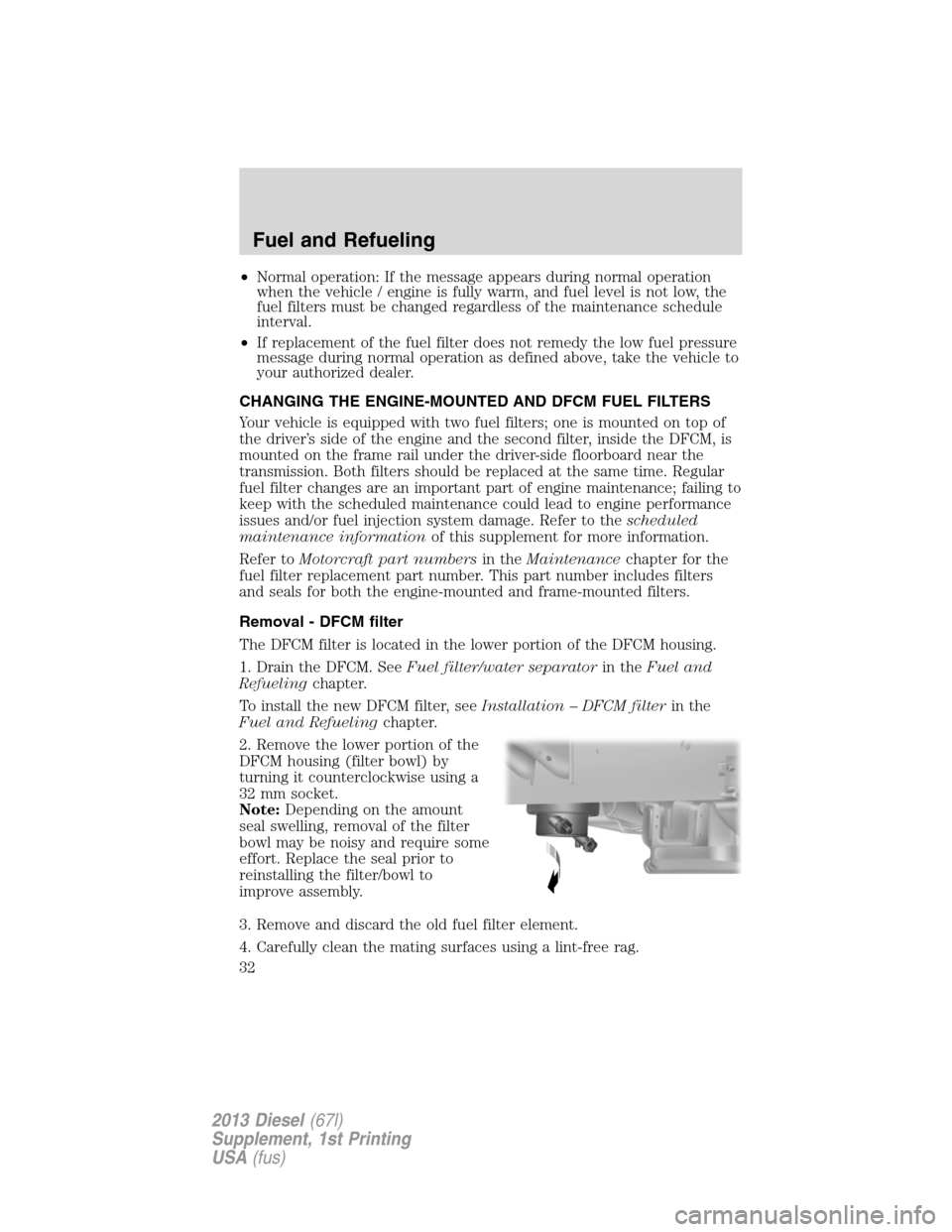
2. Remove the lower portion of the
DFCM housing (filter bowl) by
turning it counterclockwise using a
32 mm socket.
Note:Depending on the amount
seal swelling, removal of the filter
bowl may be noisy and require some
effort. Replace the seal prior to
reinstalling the filter/bowl to
improve assembly.
3. Remove and discard the old fuel filter element.
4. Carefully clean the mating surfaces using a lint-free rag.
Fuel and Refueling
32
2013 Diesel(67l)
Supplement, 1st Printing
USA(fus)
Page 34 of 95
Installation – DFCM filter
1. Install the new filter into the filter bowl tabs and replace the seal on
the DFCM header (top portion of DFCM). Refer toMotorcraft part
numbersin theMaintenancechapter for the fuel filter kit part number.
2. Lube O-ring with lubricant packet in the filter kit. This will assist in
making sure the filter gets properly tightened.
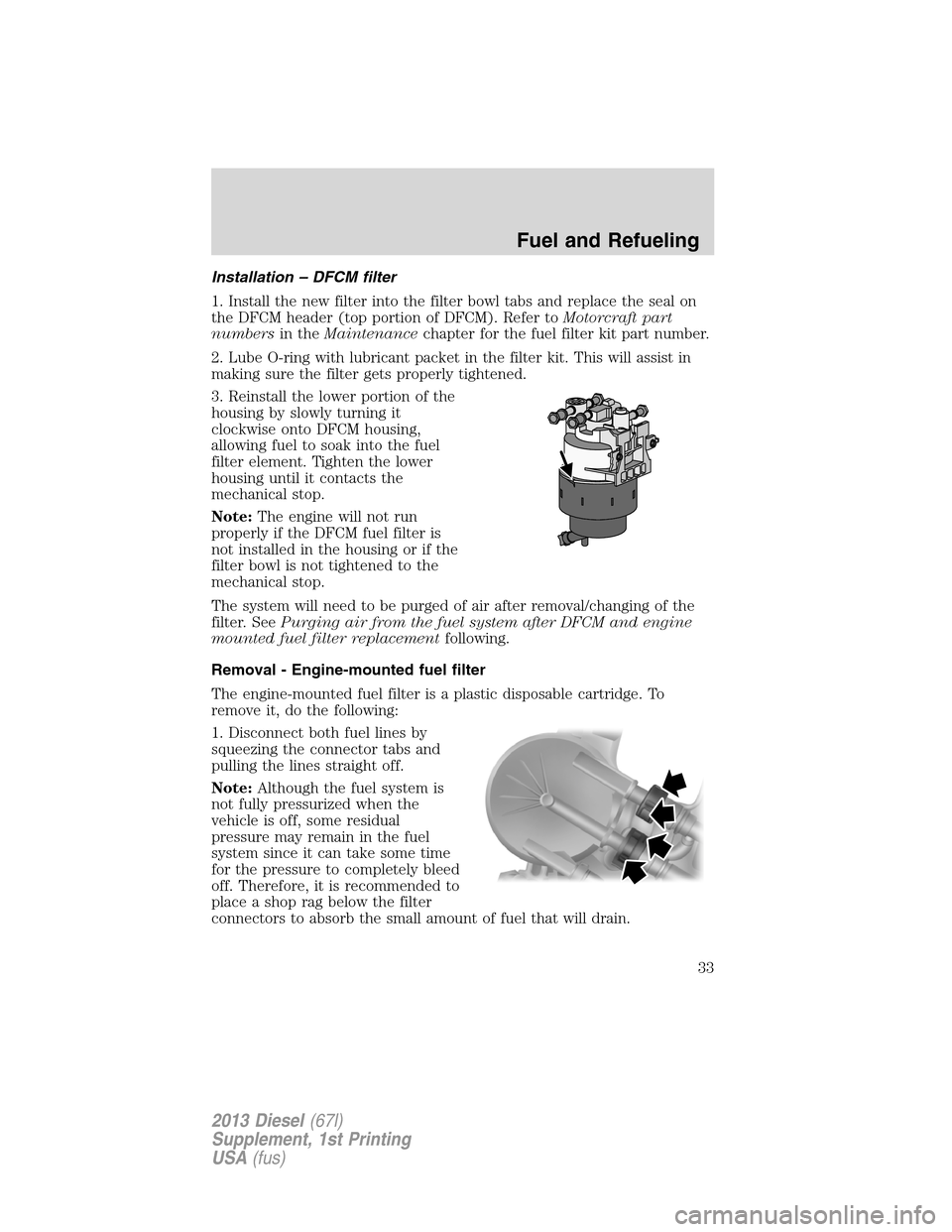
3. Reinstall the lower portion of the
housing by slowly turning it
clockwise onto DFCM housing,
allowing fuel to soak into the fuel
filter element. Tighten the lower
housing until it contacts the
mechanical stop.
Note:The engine will not run
properly if the DFCM fuel filter is
not installed in the housing or if the
filter bowl is not tightened to the
mechanical stop.
The system will need to be purged of air after removal/changing of the
filter. SeePurging air from the fuel system after DFCM and engine
mounted fuel filter replacementfollowing.
Removal - Engine-mounted fuel filter
The engine-mounted fuel filter is a plastic disposable cartridge. To
remove it, do the following:
1. Disconnect both fuel lines by
squeezing the connector tabs and
pulling the lines straight off.
Note:Although the fuel system is
not fully pressurized when the
vehicle is off, some residual
pressure may remain in the fuel
system since it can take some time
for the pressure to completely bleed
off. Therefore, it is recommended to
place a shop rag below the filter
connectors to absorb the small amount of fuel that will drain.
Fuel and Refueling
33
2013 Diesel(67l)
Supplement, 1st Printing
USA(fus)
Page 35 of 95
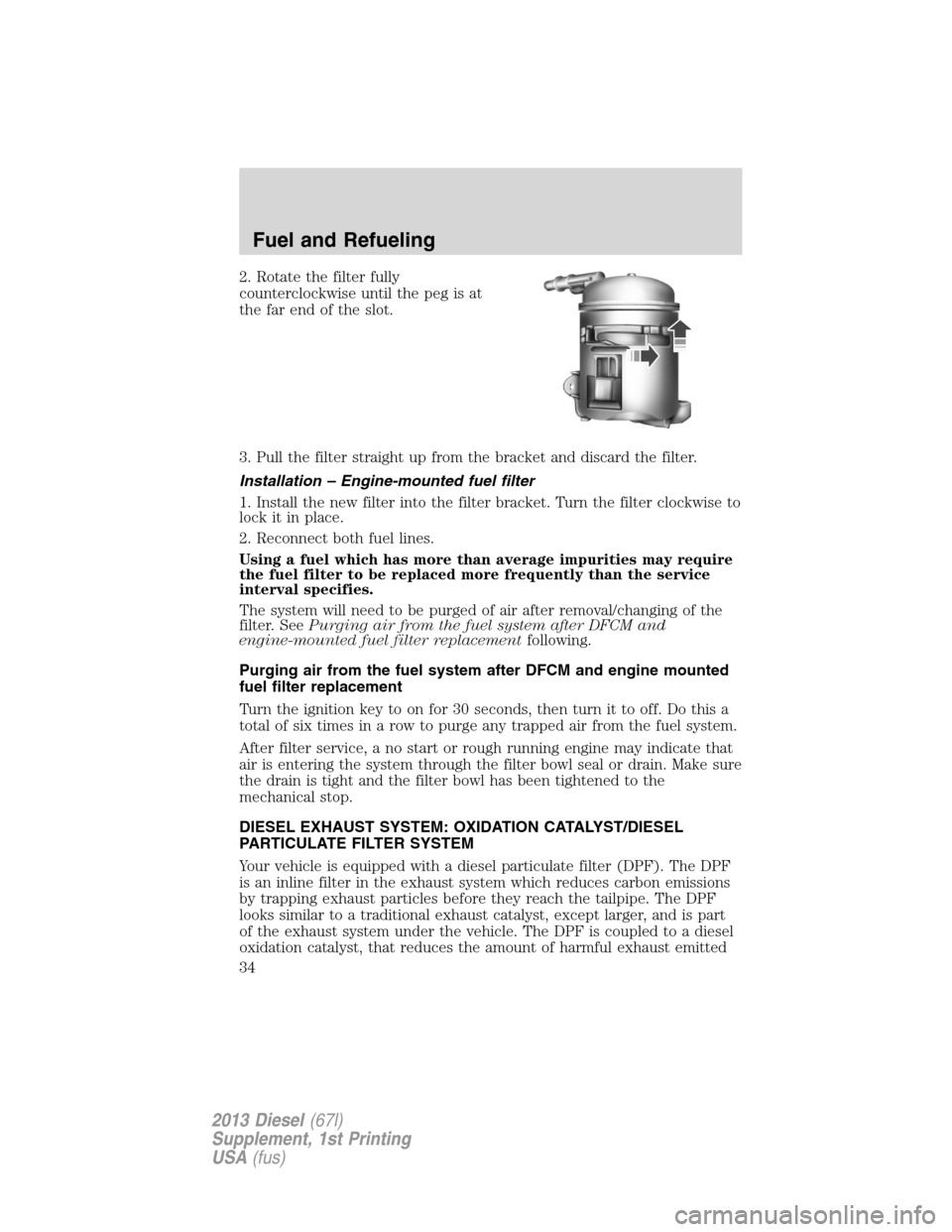
2. Rotate the filter fully
counterclockwise until the peg is at
the far end of the slot.
3. Pull the filter straight up from the bracket and discard the filter.
Installation – Engine-mounted fuel filter
1. Install the new filter into the filter bracket. Turn the filter clockwise to
lock it in place.
2. Reconnect both fuel lines.
Using a fuel which has more than average impurities may require
the fuel filter to be replaced more frequently than the service
interval specifies.
The system will need to be purged of air after removal/changing of the
filter. SeePurging air from the fuel system after DFCM and
engine-mounted fuel filter replacementfollowing.
Purging air from the fuel system after DFCM and engine mounted
fuel filter replacement
Turn the ignition key to on for 30 seconds, then turn it to off. Do this a
total of six times in a row to purge any trapped air from the fuel system.
After filter service, a no start or rough running engine may indicate that
air is entering the system through the filter bowl seal or drain. Make sure
the drain is tight and the filter bowl has been tightened to the
mechanical stop.
DIESEL EXHAUST SYSTEM: OXIDATION CATALYST/DIESEL
PARTICULATE FILTER SYSTEM
Your vehicle is equipped with a diesel particulate filter (DPF). The DPF
is an inline filter in the exhaust system which reduces carbon emissions
by trapping exhaust particles before they reach the tailpipe. The DPF
looks similar to a traditional exhaust catalyst, except larger, and is part
of the exhaust system under the vehicle. The DPF is coupled to a diesel
oxidation catalyst, that reduces the amount of harmful exhaust emitted
Fuel and Refueling
34
2013 Diesel(67l)
Supplement, 1st Printing
USA(fus)