maintenance schedule FORD SUPER DUTY 2013 3.G Owners Manual
[x] Cancel search | Manufacturer: FORD, Model Year: 2013, Model line: SUPER DUTY, Model: FORD SUPER DUTY 2013 3.GPages: 563, PDF Size: 7.27 MB
Page 8 of 563
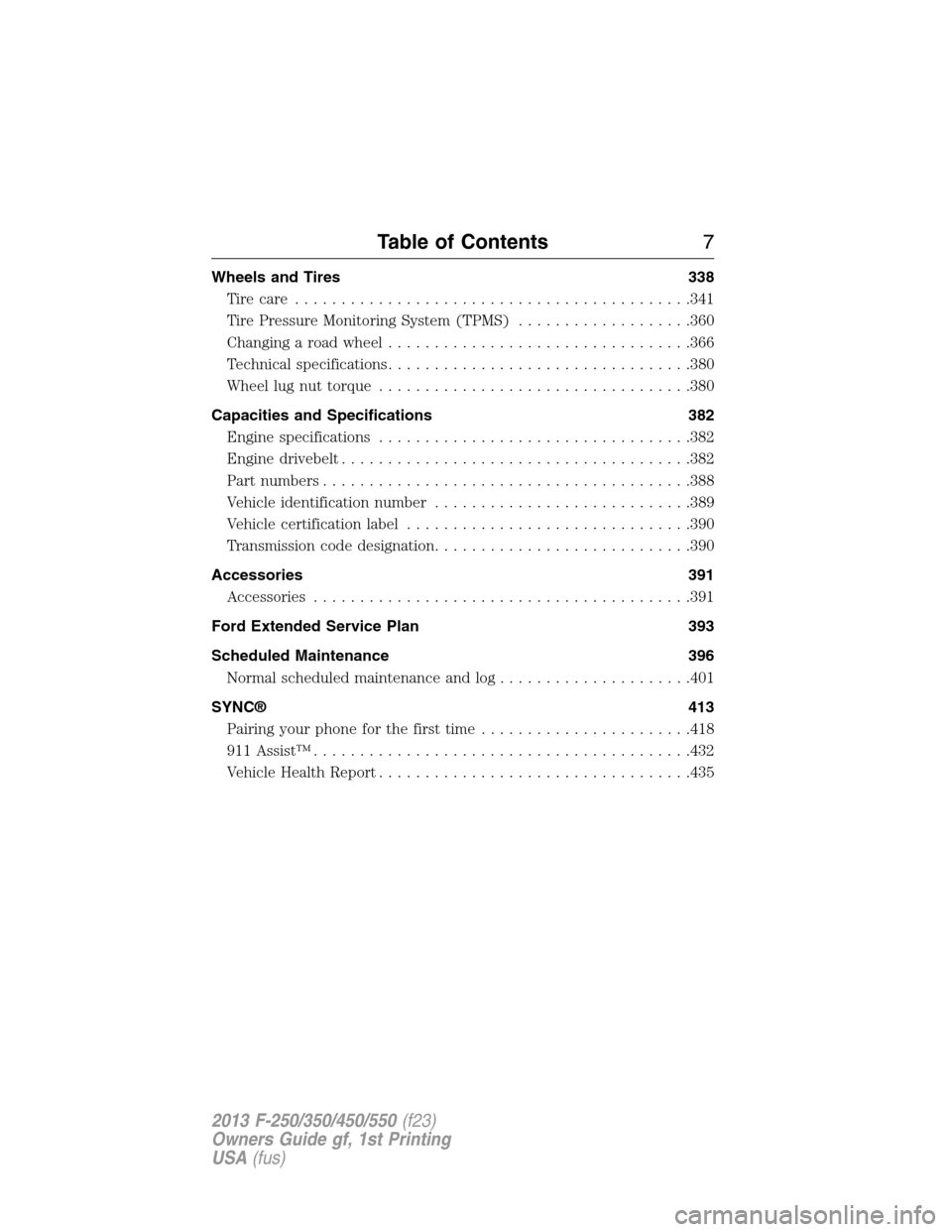
Wheels and Tires 338
Tire care...........................................341
Tire Pressure Monitoring System (TPMS)...................360
Changing a road wheel.................................366
Technical specifications.................................380
Wheel lug nut torque..................................380
Capacities and Specifications 382
Engine specifications..................................382
Engine drivebelt......................................382
Part numbers........................................388
Vehicle identification number............................389
Vehicle certification label...............................390
Transmission code designation............................390
Accessories 391
Accessories.........................................391
Ford Extended Service Plan 393
Scheduled Maintenance 396
Normal scheduled maintenance and log.....................401
SYNC® 413
Pairing your phone for the first time.......................418
911 Assist™.........................................432
Vehicle Health Report..................................435
Table of Contents7
2013 F-250/350/450/550(f23)
Owners Guide gf, 1st Printing
USA(fus)
Page 15 of 563
PERCHLORATE MATERIAL
Note:Certain components in your vehicle, such as airbag modules,
safety belt pretensioners, and remote control batteries, may contain
perchlorate material. Special handling may apply for service or vehicle
end of life disposal. See www.dtsc.ca.gov/hazardouswaste/perchlorate for
more information.
FORD CREDIT (U.S. ONLY)
Ford Credit offers a full range of financing and lease plans to help you
acquire your vehicle. If you have financed or leased your vehicle through
Ford Credit, thank you for your business.
For your convenience, we offer a number of ways to contact us, as well
as help manage your account.
Phone: 1-800-727-7000
For more information regarding Ford Credit, as well as access to
Account Manager, please go to www.fordcredit.com.
REPLACEMENT PARTS RECOMMENDATION
Your vehicle has been built to the highest standards using quality parts.
We recommend that you demand the use of genuine Ford and Motorcraft
parts whenever your vehicle requires scheduled maintenance or repair.
You can clearly identify genuine Ford and Motorcraft parts by looking for
the Ford, FoMoCo or Motorcraft branding on the parts or their
packaging.
Scheduled Maintenance and Mechanical Repairs
One of the best ways for you to make sure that your vehicle provides
years of service is to have it maintained in line with our
recommendations using parts that conform to the specifications detailed
in this owner’s manual. Genuine Ford and Motorcraft parts meet or
exceed these specifications.
Collision Repairs
We hope that you never experience a collision, but accidents do happen.
Genuine Ford replacement collision parts meet our stringent
requirements for fit, finish, structural integrity, corrosion protection and
dent resistance. During vehicle development, we validate that these parts
deliver the intended level of protection as a whole system. A great way
to know for sure you are getting this level of protection is to use genuine
Ford replacement collision parts.
14Introduction
2013 F-250/350/450/550(f23)
Owners Guide gf, 1st Printing
USA(fus)
Page 97 of 563
Engine Coolant Temperature Gauge
Indicates engine coolant temperature. At normal operating temperature,
the level indicator will be in the normal range. If the engine coolant
temperature exceeds the normal range, stop the vehicle as soon as safely
possible, switch off the engine and let the engine cool.
WARNING:Never remove the coolant reservoir cap while the
engine is running or hot.
Transmission Fluid Temperature Gauge
Indicates transmission fluid temperature. At normal operating
temperature, the level indicator will be in the normal range. If the
transmission fluid temperature exceeds the normal range, stop the
vehicle as soon as safely possible and verify the airflow is not restricted
such as snow or debris blocking airflow through the grill. Also, higher
than normal operating temperature can be caused by special operation
conditions (i.e. snowplowing, towing or off-road use). Refer toSpecial
operating conditions in the scheduled maintenance informationfor
instructions. Operating the transmission for extended periods of time
with the gauge in the higher than normal area may cause internal
transmission damage. Altering the severity of the driving conditions is
recommended to lower the transmission temperature into the normal
range. If the gauge continues to show high temperatures, see your
authorized dealer.
Fuel Gauge
Indicates approximately how much fuel is left in the fuel tank (when the
ignition is on). The fuel gauge may vary slightly when the vehicle is in
motion or on a grade. The fuel icon and arrow indicates which side of
the vehicle the fuel filler door is located.
Information Display
Odometer
Located in the bottom of the information display Registers the
accumulated distance your vehicle has travelled.
Trip Computer
SeeTrip A/BinInformation Displays.
Vehicle Settings and Personalization
SeeInformation Displays.
96Instrument Cluster
2013 F-250/350/450/550(f23)
Owners Guide gf, 1st Printing
USA(fus)
Page 106 of 563
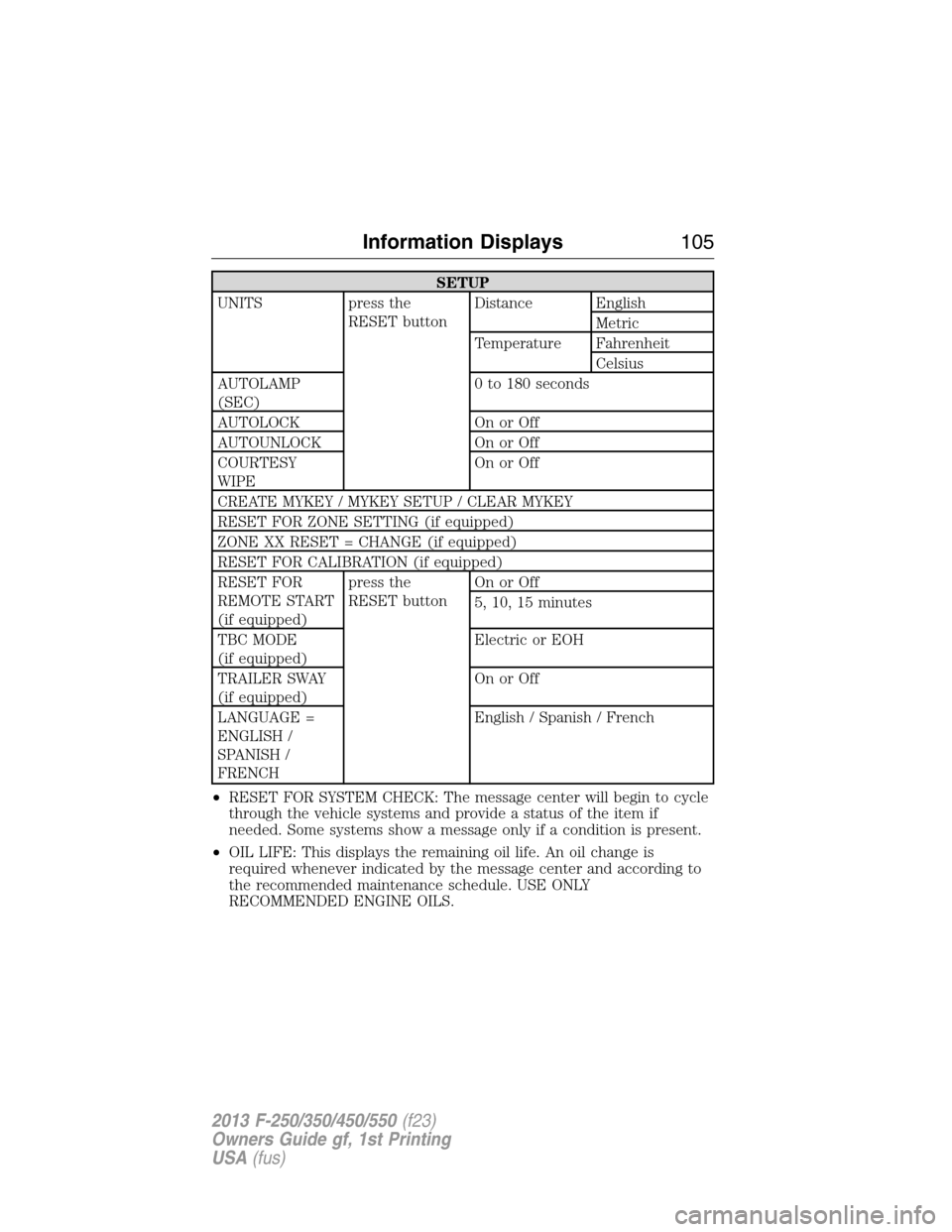
SETUP
UNITS press the
RESET buttonDistance English
Metric
Temperature Fahrenheit
Celsius
AUTOLAMP
(SEC)0 to 180 seconds
AUTOLOCK On or Off
AUTOUNLOCK On or Off
COURTESY
WIPEOn or Off
CREATE MYKEY / MYKEY SETUP / CLEAR MYKEY
RESET FOR ZONE SETTING (if equipped)
ZONE XX RESET = CHANGE (if equipped)
RESET FOR CALIBRATION (if equipped)
RESET FOR
REMOTE START
(if equipped)press the
RESET buttonOn or Off
5, 10, 15 minutes
TBC MODE
(if equipped)Electric or EOH
TRAILER SWAY
(if equipped)On or Off
LANGUAGE =
ENGLISH /
SPANISH /
FRENCHEnglish / Spanish / French
•RESET FOR SYSTEM CHECK: The message center will begin to cycle
through the vehicle systems and provide a status of the item if
needed. Some systems show a message only if a condition is present.
•OIL LIFE: This displays the remaining oil life. An oil change is
required whenever indicated by the message center and according to
the recommended maintenance schedule. USE ONLY
RECOMMENDED ENGINE OILS.
Information Displays105
2013 F-250/350/450/550(f23)
Owners Guide gf, 1st Printing
USA(fus)
Page 125 of 563
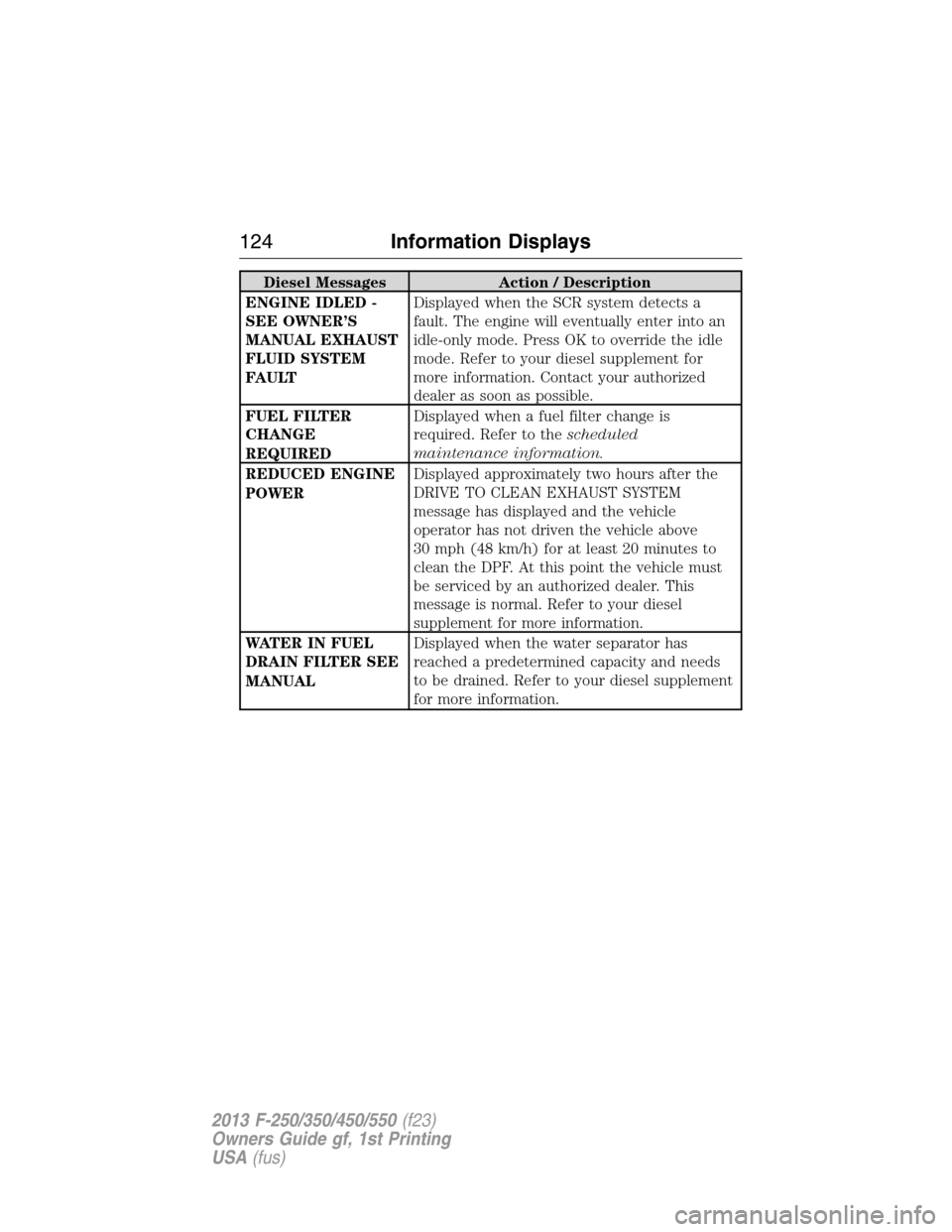
Diesel Messages Action / Description
ENGINE IDLED -
SEE OWNER’S
MANUAL EXHAUST
FLUID SYSTEM
FAULTDisplayed when the SCR system detects a
fault. The engine will eventually enter into an
idle-only mode. Press OK to override the idle
mode. Refer to your diesel supplement for
more information. Contact your authorized
dealer as soon as possible.
FUEL FILTER
CHANGE
REQUIREDDisplayed when a fuel filter change is
required. Refer to thescheduled
maintenance information.
REDUCED ENGINE
POWERDisplayed approximately two hours after the
DRIVE TO CLEAN EXHAUST SYSTEM
message has displayed and the vehicle
operator has not driven the vehicle above
30 mph (48 km/h) for at least 20 minutes to
clean the DPF. At this point the vehicle must
be serviced by an authorized dealer. This
message is normal. Refer to your diesel
supplement for more information.
WATER IN FUEL
DRAIN FILTER SEE
MANUALDisplayed when the water separator has
reached a predetermined capacity and needs
to be drained. Refer to your diesel supplement
for more information.
124Information Displays
2013 F-250/350/450/550(f23)
Owners Guide gf, 1st Printing
USA(fus)
Page 126 of 563
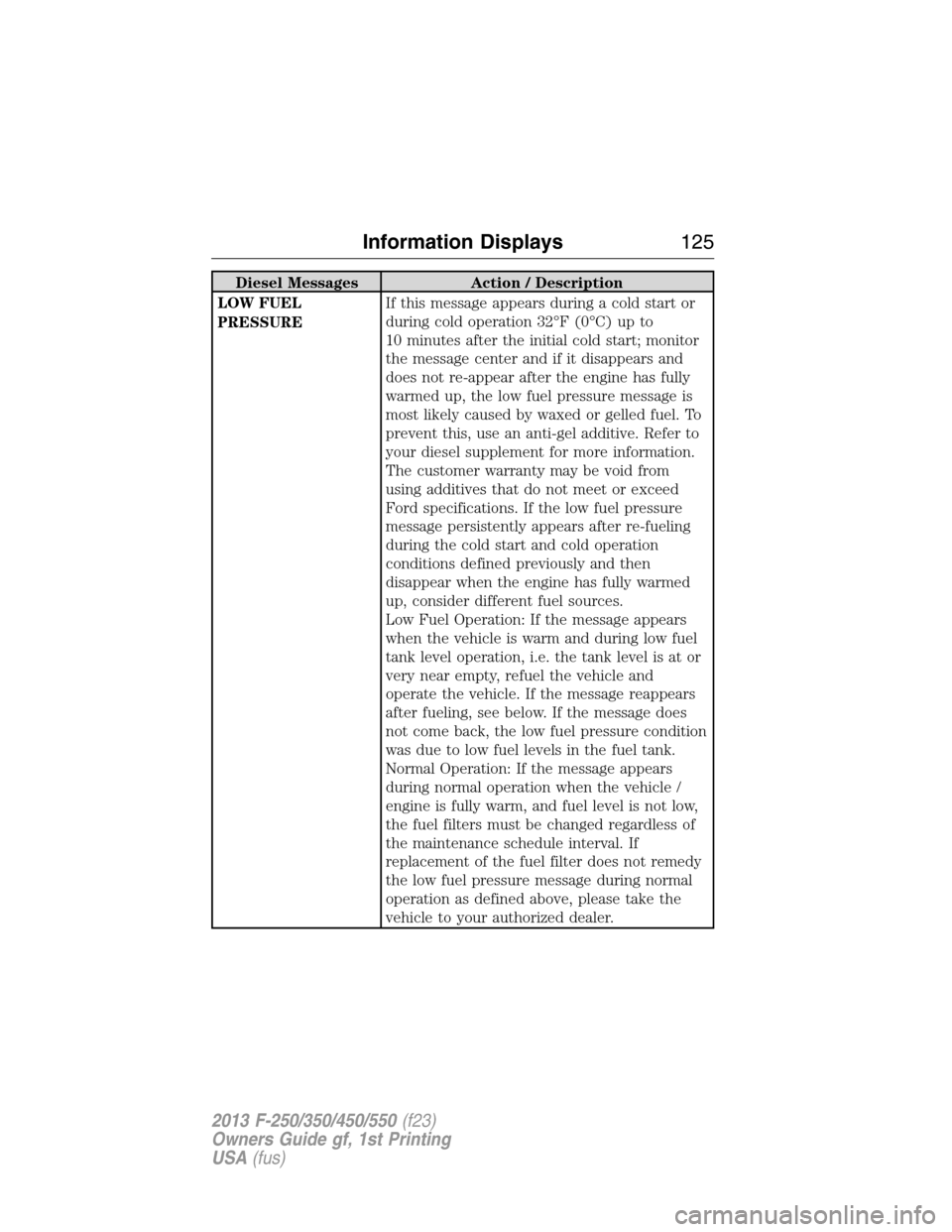
Diesel Messages Action / Description
LOW FUEL
PRESSUREIf this message appears during a cold start or
during cold operation 32°F (0°C) up to
10 minutes after the initial cold start; monitor
the message center and if it disappears and
does not re-appear after the engine has fully
warmed up, the low fuel pressure message is
most likely caused by waxed or gelled fuel. To
prevent this, use an anti-gel additive. Refer to
your diesel supplement for more information.
The customer warranty may be void from
using additives that do not meet or exceed
Ford specifications. If the low fuel pressure
message persistently appears after re-fueling
during the cold start and cold operation
conditions defined previously and then
disappear when the engine has fully warmed
up, consider different fuel sources.
Low Fuel Operation: If the message appears
when the vehicle is warm and during low fuel
tank level operation, i.e. the tank level is at or
very near empty, refuel the vehicle and
operate the vehicle. If the message reappears
after fueling, see below. If the message does
not come back, the low fuel pressure condition
was due to low fuel levels in the fuel tank.
Normal Operation: If the message appears
during normal operation when the vehicle /
engine is fully warm, and fuel level is not low,
the fuel filters must be changed regardless of
the maintenance schedule interval. If
replacement of the fuel filter does not remedy
the low fuel pressure message during normal
operation as defined above, please take the
vehicle to your authorized dealer.
Information Displays125
2013 F-250/350/450/550(f23)
Owners Guide gf, 1st Printing
USA(fus)
Page 166 of 563
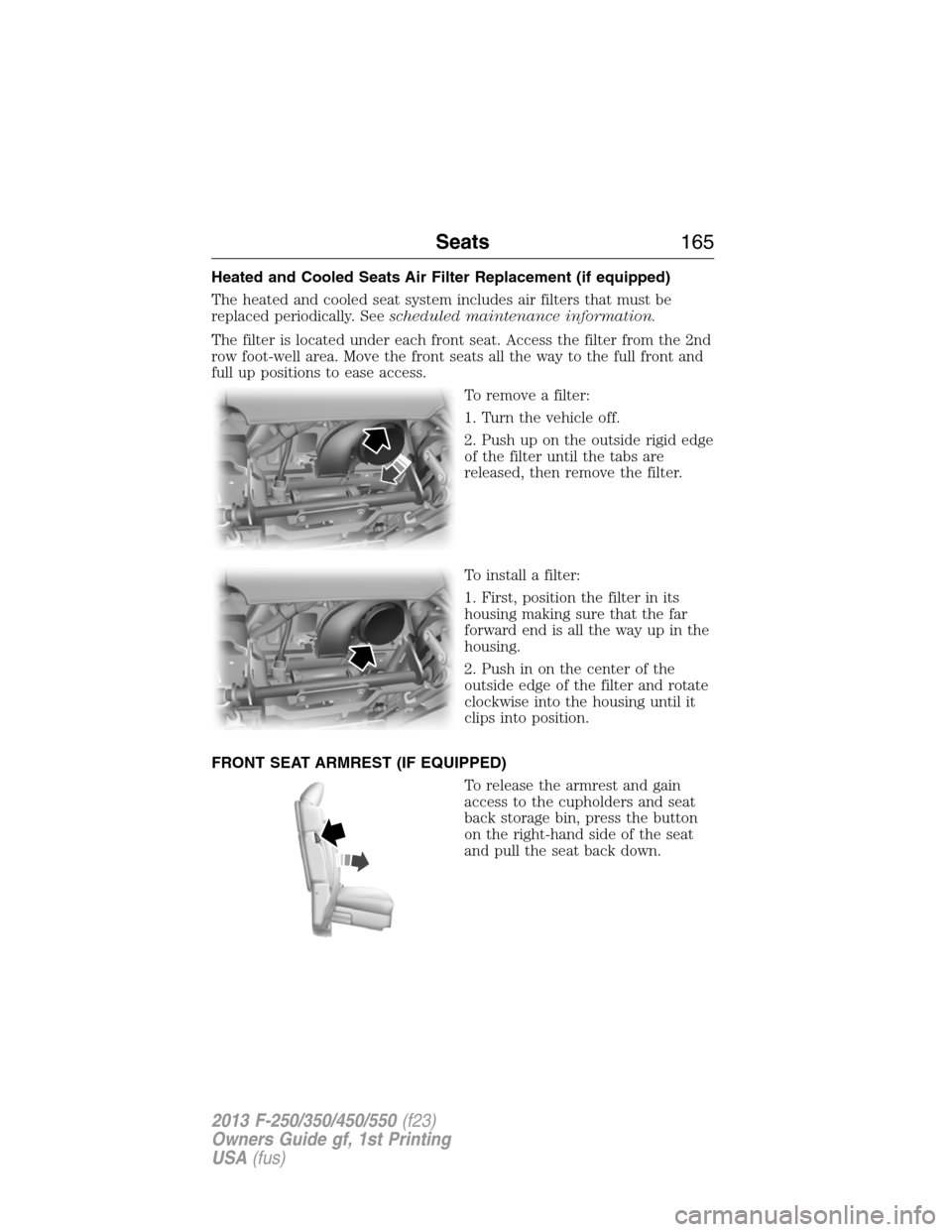
Heated and Cooled Seats Air Filter Replacement (if equipped)
The heated and cooled seat system includes air filters that must be
replaced periodically. Seescheduled maintenance information.
The filter is located under each front seat. Access the filter from the 2nd
row foot-well area. Move the front seats all the way to the full front and
full up positions to ease access.
To remove a filter:
1. Turn the vehicle off.
2. Push up on the outside rigid edge
of the filter until the tabs are
released, then remove the filter.
To install a filter:
1. First, position the filter in its
housing making sure that the far
forward end is all the way up in the
housing.
2. Push in on the center of the
outside edge of the filter and rotate
clockwise into the housing until it
clips into position.
FRONT SEAT ARMREST (IF EQUIPPED)
To release the armrest and gain
access to the cupholders and seat
back storage bin, press the button
on the right-hand side of the seat
and pull the seat back down.
Seats165
2013 F-250/350/450/550(f23)
Owners Guide gf, 1st Printing
USA(fus)
Page 195 of 563
EMISSION CONTROL SYSTEM
WARNING:Do not park, idle, or drive your vehicle in dry grass
or other dry ground cover. The emission system heats up the
engine compartment and exhaust system, which can start a fire.
WARNING:Exhaust leaks may result in entry of harmful and
potentially lethal fumes into the passenger compartment. If you
smell exhaust fumes inside your vehicle, have your dealer inspect your
vehicle immediately. Do not drive if you smell exhaust fumes.
Your vehicle is equipped with various emission control components and a
catalytic converter which will enable your vehicle to comply with
applicable exhaust emission standards. To make sure that the catalytic
converter and other emission control components continue to work
properly:
•Use only the specified fuel listed.
•Avoid running out of fuel.
•Do not turn off the ignition while your vehicle is moving, especially at
high speeds.
•Have the items listed inScheduled Maintenance Information
performed according to the specified schedule.
The scheduled maintenance items listed inScheduled Maintenance
Informationare essential to the life and performance of your vehicle
and to its emissions system.
If other than Ford, Motorcraft® or Ford-authorized parts are used for
maintenance replacements or for service of components affecting
emission control, such non-Ford parts should be equivalent to genuine
Ford Motor Company parts in performance and durability.
Illumination of the service engine soon indicator, charging system
warning light or the temperature warning light, fluid leaks, strange odors,
smoke or loss of engine power could indicate that the emission control
system is not working properly.
An improperly operating or damaged exhaust system may allow exhaust
to enter the vehicle. Have a damaged or improperly operating exhaust
system inspected and repaired immediately.
Do not make any unauthorized changes to your vehicle or engine. By
law, vehicle owners and anyone who manufactures, repairs, services,
194Fuel and Refueling
2013 F-250/350/450/550(f23)
Owners Guide gf, 1st Printing
USA(fus)
Page 252 of 563
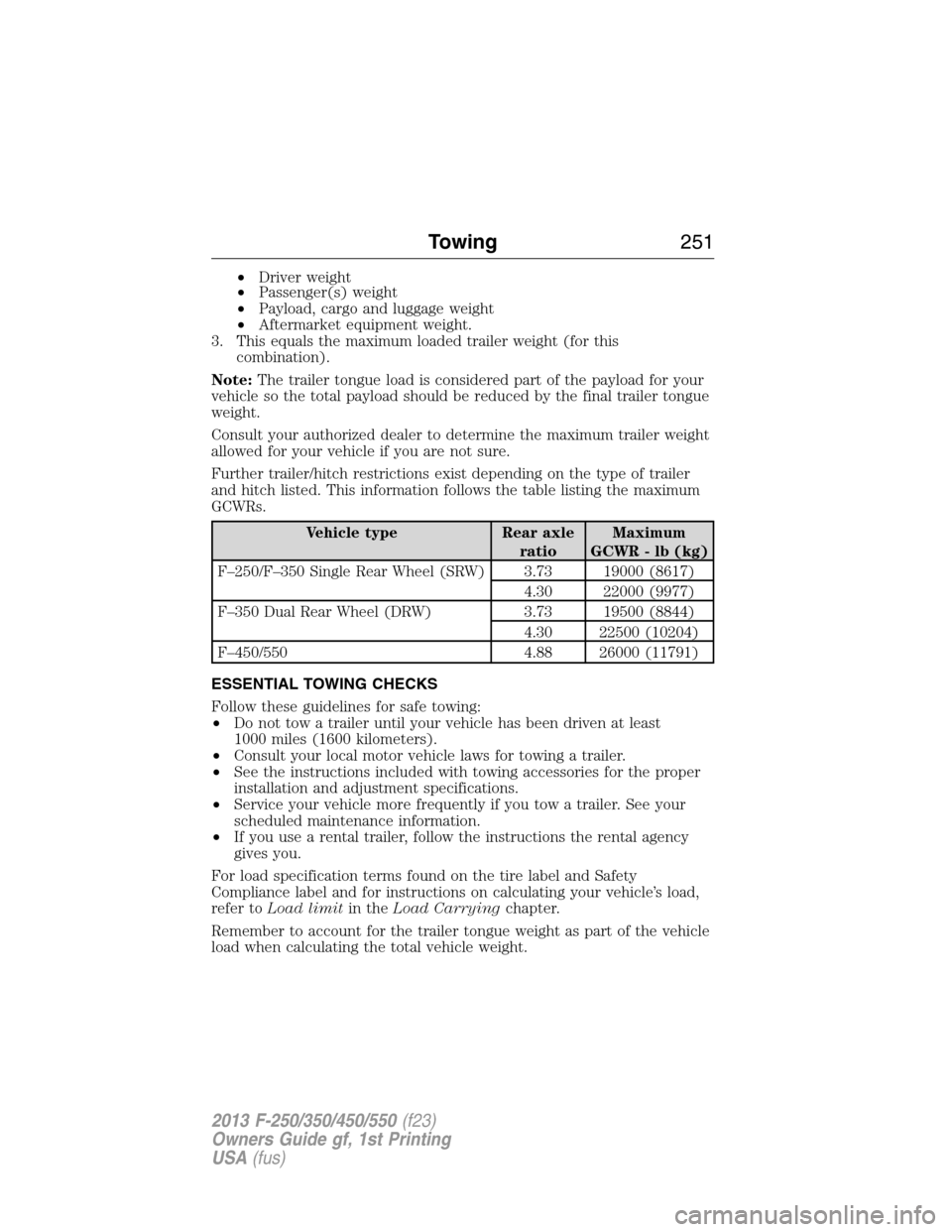
•Driver weight
•Passenger(s) weight
•Payload, cargo and luggage weight
•Aftermarket equipment weight.
3. This equals the maximum loaded trailer weight (for this
combination).
Note:The trailer tongue load is considered part of the payload for your
vehicle so the total payload should be reduced by the final trailer tongue
weight.
Consult your authorized dealer to determine the maximum trailer weight
allowed for your vehicle if you are not sure.
Further trailer/hitch restrictions exist depending on the type of trailer
and hitch listed. This information follows the table listing the maximum
GCWRs.
Vehicle type Rear axle
ratioMaximum
GCWR - lb (kg)
F–250/F–350 Single Rear Wheel (SRW) 3.73 19000 (8617)
4.30 22000 (9977)
F–350 Dual Rear Wheel (DRW) 3.73 19500 (8844)
4.30 22500 (10204)
F–450/550 4.88 26000 (11791)
ESSENTIAL TOWING CHECKS
Follow these guidelines for safe towing:
•Do not tow a trailer until your vehicle has been driven at least
1000 miles (1600 kilometers).
•Consult your local motor vehicle laws for towing a trailer.
•See the instructions included with towing accessories for the proper
installation and adjustment specifications.
•Service your vehicle more frequently if you tow a trailer. See your
scheduled maintenance information.
•If you use a rental trailer, follow the instructions the rental agency
gives you.
For load specification terms found on the tire label and Safety
Compliance label and for instructions on calculating your vehicle’s load,
refer toLoad limitin theLoad Carryingchapter.
Remember to account for the trailer tongue weight as part of the vehicle
load when calculating the total vehicle weight.
Towing251
2013 F-250/350/450/550(f23)
Owners Guide gf, 1st Printing
USA(fus)
Page 265 of 563
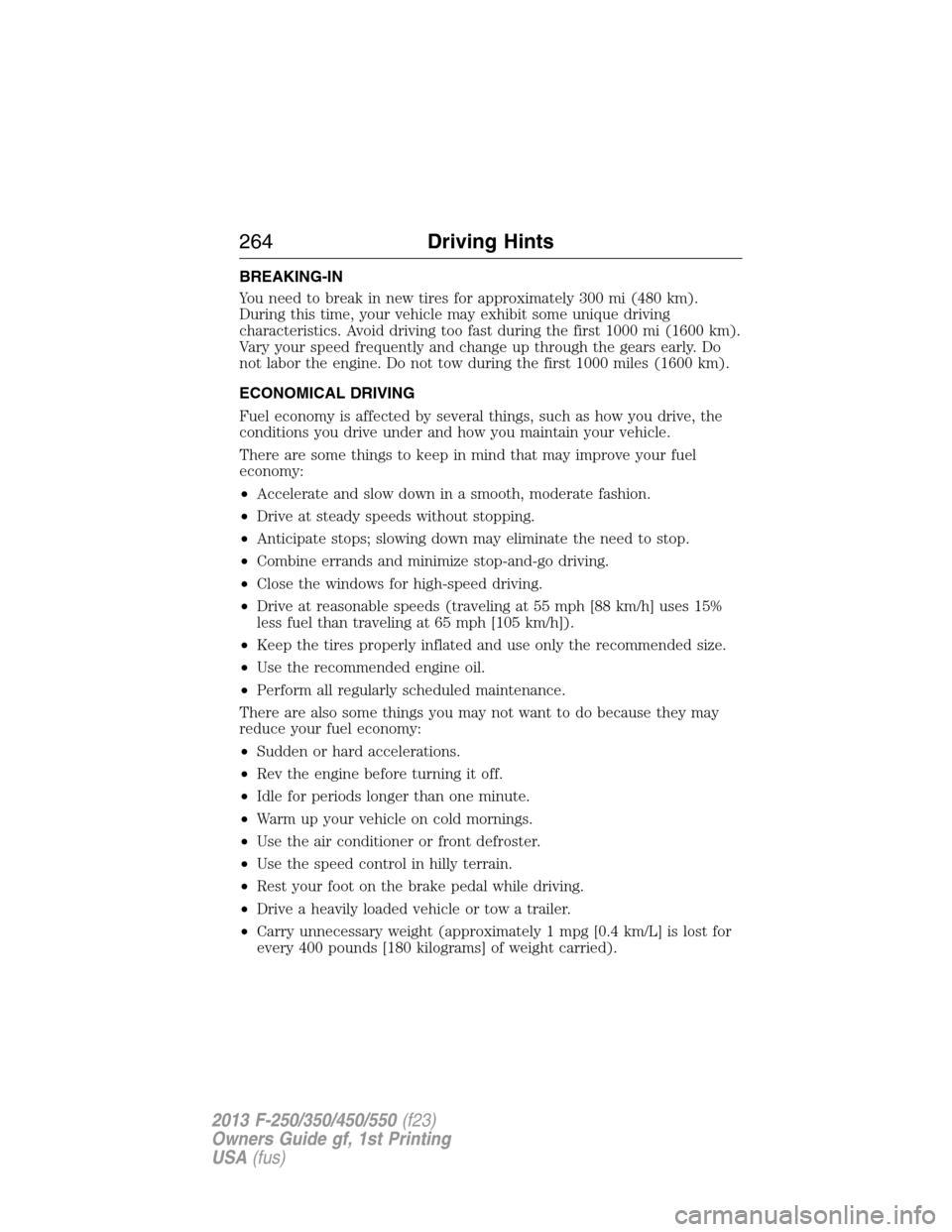
BREAKING-IN
You need to break in new tires for approximately 300 mi (480 km).
During this time, your vehicle may exhibit some unique driving
characteristics. Avoid driving too fast during the first 1000 mi (1600 km).
Vary your speed frequently and change up through the gears early. Do
not labor the engine. Do not tow during the first 1000 miles (1600 km).
ECONOMICAL DRIVING
Fuel economy is affected by several things, such as how you drive, the
conditions you drive under and how you maintain your vehicle.
There are some things to keep in mind that may improve your fuel
economy:
•Accelerate and slow down in a smooth, moderate fashion.
•Drive at steady speeds without stopping.
•Anticipate stops; slowing down may eliminate the need to stop.
•Combine errands and minimize stop-and-go driving.
•Close the windows for high-speed driving.
•Drive at reasonable speeds (traveling at 55 mph [88 km/h] uses 15%
less fuel than traveling at 65 mph [105 km/h]).
•Keep the tires properly inflated and use only the recommended size.
•Use the recommended engine oil.
•Perform all regularly scheduled maintenance.
There are also some things you may not want to do because they may
reduce your fuel economy:
•Sudden or hard accelerations.
•Rev the engine before turning it off.
•Idle for periods longer than one minute.
•Warm up your vehicle on cold mornings.
•Use the air conditioner or front defroster.
•Use the speed control in hilly terrain.
•Rest your foot on the brake pedal while driving.
•Drive a heavily loaded vehicle or tow a trailer.
•Carry unnecessary weight (approximately 1 mpg [0.4 km/L] is lost for
every 400 pounds [180 kilograms] of weight carried).
264Driving Hints
2013 F-250/350/450/550(f23)
Owners Guide gf, 1st Printing
USA(fus)