fuel tank capacity FORD SUPER DUTY 2017 4.G Owners Manual
[x] Cancel search | Manufacturer: FORD, Model Year: 2017, Model line: SUPER DUTY, Model: FORD SUPER DUTY 2017 4.GPages: 636, PDF Size: 10.56 MB
Page 199 of 636
•
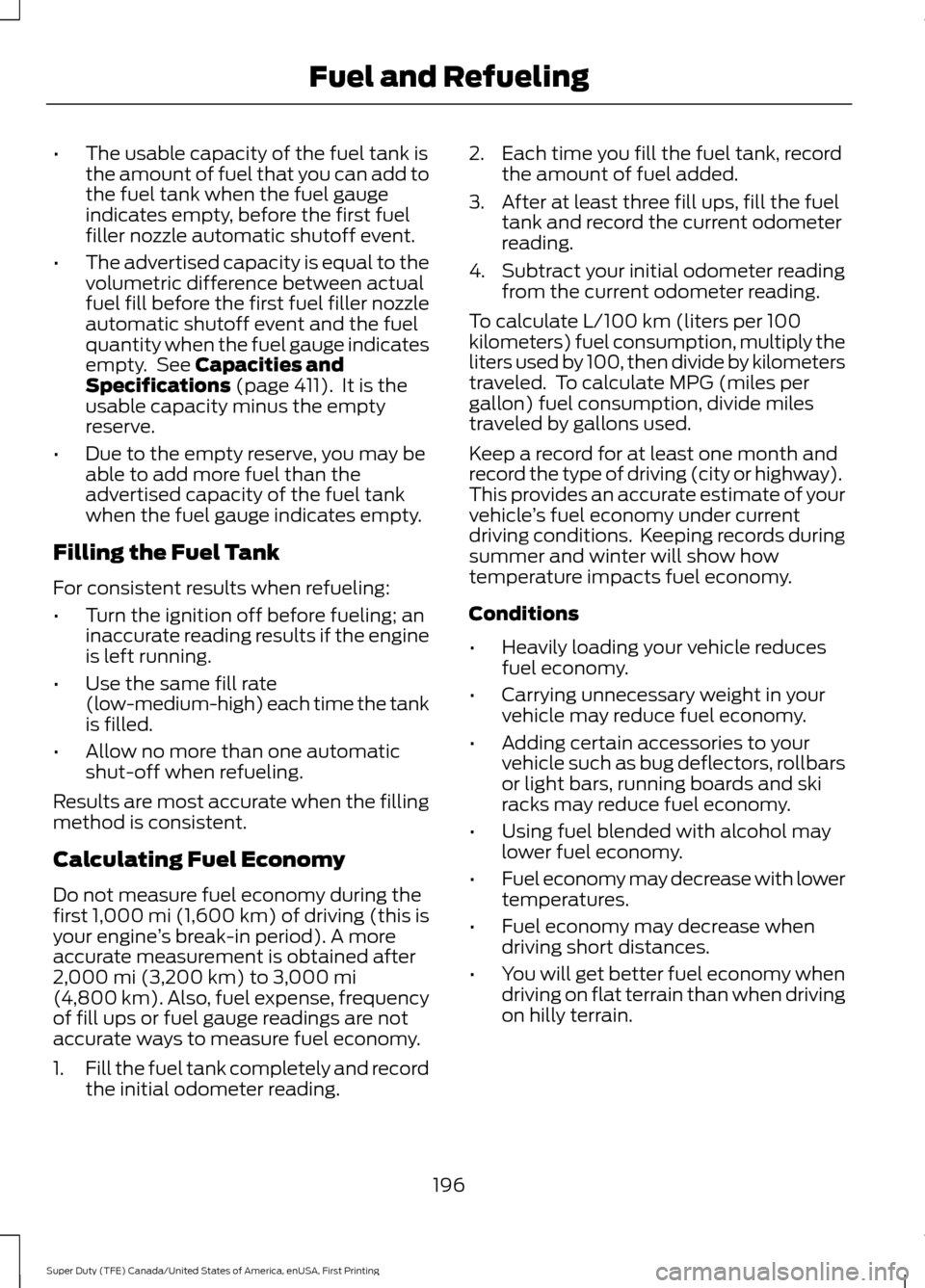
The usable capacity of the fuel tank is
the amount of fuel that you can add to
the fuel tank when the fuel gauge
indicates empty, before the first fuel
filler nozzle automatic shutoff event.
• The advertised capacity is equal to the
volumetric difference between actual
fuel fill before the first fuel filler nozzle
automatic shutoff event and the fuel
quantity when the fuel gauge indicates
empty. See Capacities and
Specifications (page 411). It is the
usable capacity minus the empty
reserve.
• Due to the empty reserve, you may be
able to add more fuel than the
advertised capacity of the fuel tank
when the fuel gauge indicates empty.
Filling the Fuel Tank
For consistent results when refueling:
• Turn the ignition off before fueling; an
inaccurate reading results if the engine
is left running.
• Use the same fill rate
(low-medium-high) each time the tank
is filled.
• Allow no more than one automatic
shut-off when refueling.
Results are most accurate when the filling
method is consistent.
Calculating Fuel Economy
Do not measure fuel economy during the
first
1,000 mi (1,600 km) of driving (this is
your engine ’s break-in period). A more
accurate measurement is obtained after
2,000 mi (3,200 km)
to 3,000 mi
(4,800 km). Also, fuel expense, frequency
of fill ups or fuel gauge readings are not
accurate ways to measure fuel economy.
1. Fill the fuel tank completely and record
the initial odometer reading. 2. Each time you fill the fuel tank, record
the amount of fuel added.
3. After at least three fill ups, fill the fuel tank and record the current odometer
reading.
4. Subtract your initial odometer reading from the current odometer reading.
To calculate L/100 km (liters per 100
kilometers) fuel consumption, multiply the
liters used by 100, then divide by kilometers
traveled. To calculate MPG (miles per
gallon) fuel consumption, divide miles
traveled by gallons used.
Keep a record for at least one month and
record the type of driving (city or highway).
This provides an accurate estimate of your
vehicle ’s fuel economy under current
driving conditions. Keeping records during
summer and winter will show how
temperature impacts fuel economy.
Conditions
• Heavily loading your vehicle reduces
fuel economy.
• Carrying unnecessary weight in your
vehicle may reduce fuel economy.
• Adding certain accessories to your
vehicle such as bug deflectors, rollbars
or light bars, running boards and ski
racks may reduce fuel economy.
• Using fuel blended with alcohol may
lower fuel economy.
• Fuel economy may decrease with lower
temperatures.
• Fuel economy may decrease when
driving short distances.
• You will get better fuel economy when
driving on flat terrain than when driving
on hilly terrain.
196
Super Duty (TFE) Canada/United States of America, enUSA, First Printing Fuel and Refueling
Page 421 of 636
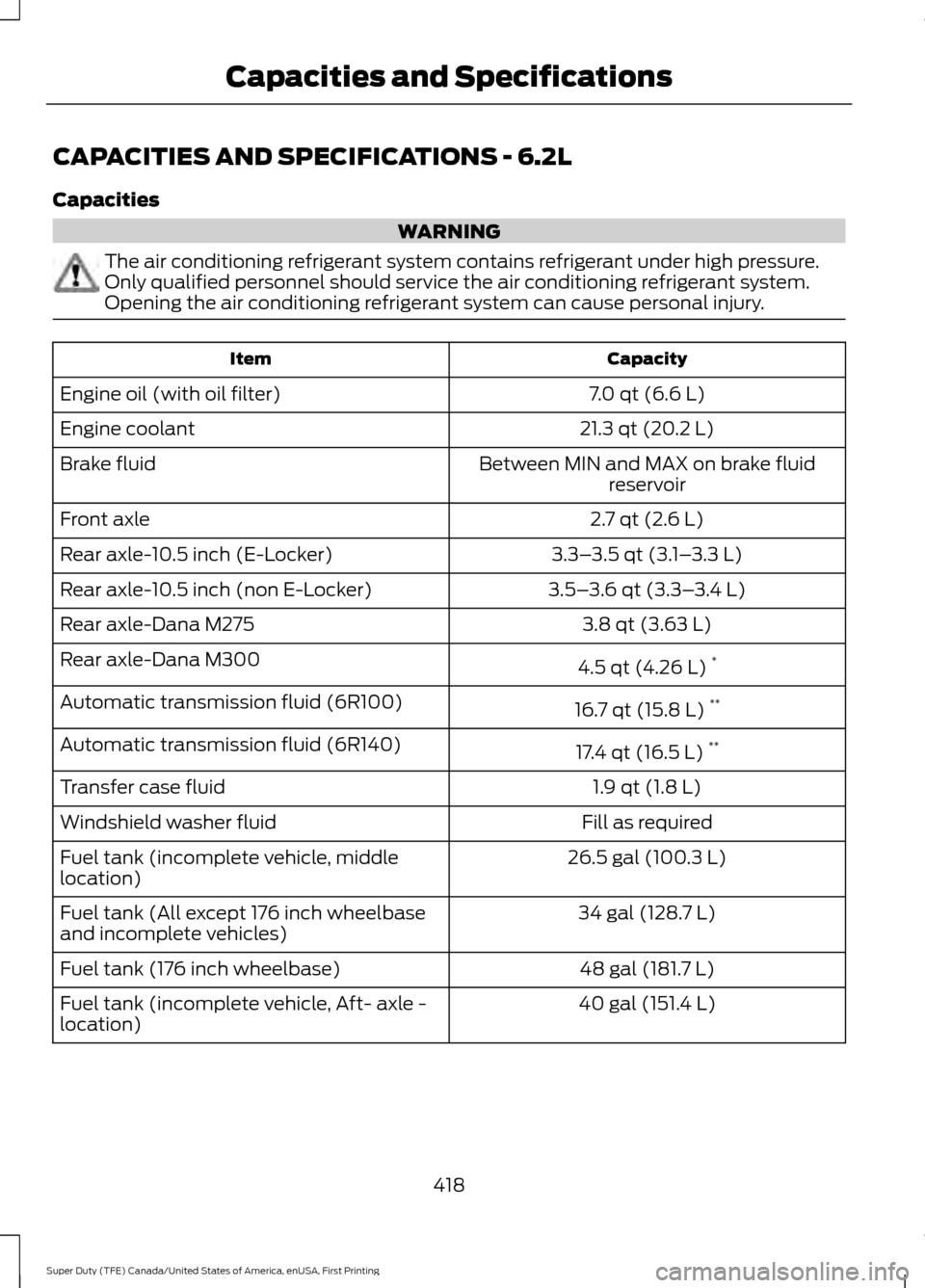
CAPACITIES AND SPECIFICATIONS - 6.2L
Capacities
WARNING
The air conditioning refrigerant system contains refrigerant under high pressure.
Only qualified personnel should service the air conditioning refrigerant system.
Opening the air conditioning refrigerant system can cause personal injury.
Capacity
Item
7.0 qt (6.6 L)
Engine oil (with oil filter)
21.3 qt (20.2 L)
Engine coolant
Between MIN and MAX on brake fluidreservoir
Brake fluid
2.7 qt (2.6 L)
Front axle
3.3–3.5 qt (3.1– 3.3 L)
Rear axle-10.5 inch (E-Locker)
3.5–3.6 qt (3.3– 3.4 L)
Rear axle-10.5 inch (non E-Locker)
3.8 qt (3.63 L)
Rear axle-Dana M275
4.5 qt (4.26 L)*
Rear axle-Dana M300
16.7 qt (15.8 L)**
Automatic transmission fluid (6R100)
17.4 qt (16.5 L)**
Automatic transmission fluid (6R140)
1.9 qt (1.8 L)
Transfer case fluid
Fill as required
Windshield washer fluid
26.5 gal (100.3 L)
Fuel tank (incomplete vehicle, middle
location)
34 gal (128.7 L)
Fuel tank (All except 176 inch wheelbase
and incomplete vehicles)
48 gal (181.7 L)
Fuel tank (176 inch wheelbase)
40 gal (151.4 L)
Fuel tank (incomplete vehicle, Aft- axle -
location)
418
Super Duty (TFE) Canada/United States of America, enUSA, First Printing Capacities and Specifications
Page 426 of 636
Capacity
Item
7.0 qt (6.6 L)1
Engine oil (with oil filter)
26.7 qt (25.3 L)
Engine coolant
Between MIN and MAX on brake fluidreservoir
Brake fluid
2.7 qt (2.6 L)
Front axle
3.3–3.5 qt (3.1– 3.3 L)
Rear axle-10.5 inch (E-Locker)
3.5–3.6 qt (3.3– 3.4 L)
Rear axle-10.5 inch (non E-Locker)
3.8 qt (3.63 L)
Rear axle-Dana M275
4.5 qt (4.26 L)2
Rear axle-Dana M300
17.4 qt (16.5 L)3
Automatic transmission fluid
1.9 qt (1.8 L)
Transfer case fluid
Fill as required
Windshield washer fluid
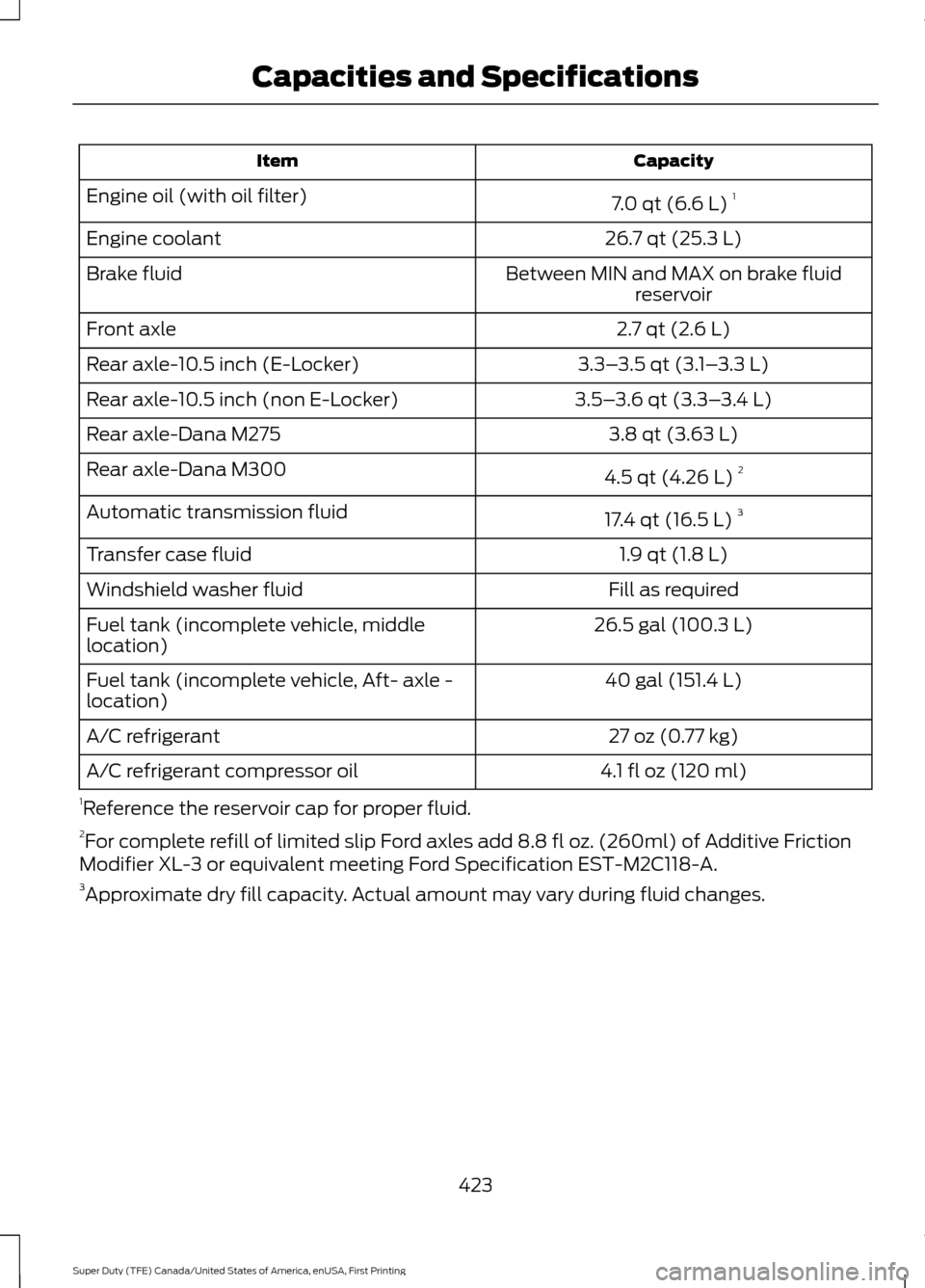
26.5 gal (100.3 L)
Fuel tank (incomplete vehicle, middle
location)
40 gal (151.4 L)
Fuel tank (incomplete vehicle, Aft- axle -
location)
27 oz (0.77 kg)
A/C refrigerant
4.1 fl oz (120 ml)
A/C refrigerant compressor oil
1 Reference the reservoir cap for proper fluid.
2 For complete refill of limited slip Ford axles add 8.8 fl oz. (260ml) of Additive Friction
Modifier XL-3 or equivalent meeting Ford Specification EST-M2C118-A.
3 Approximate dry fill capacity. Actual amount may vary during fluid changes.
423
Super Duty (TFE) Canada/United States of America, enUSA, First Printing Capacities and Specifications
Page 431 of 636
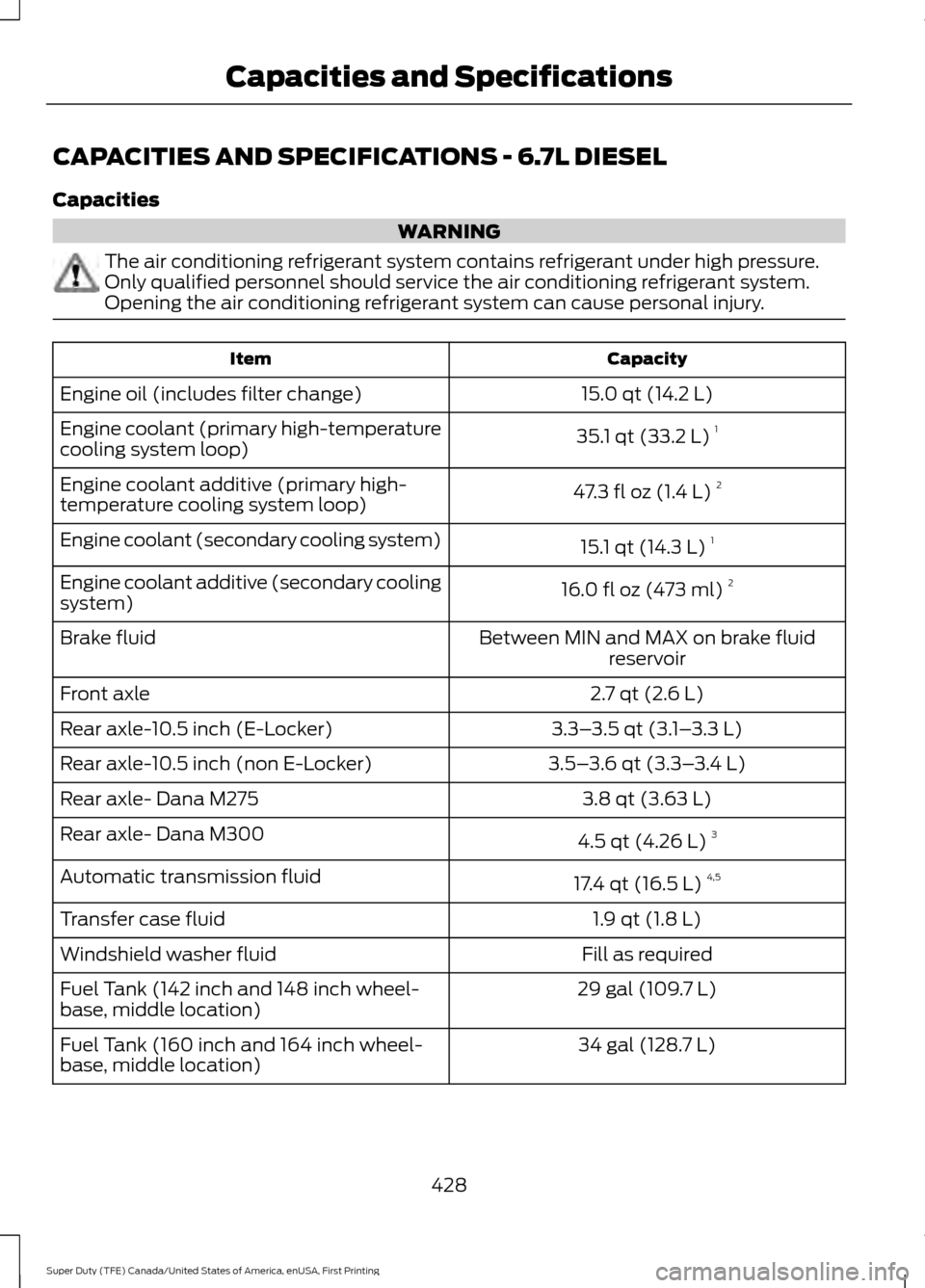
CAPACITIES AND SPECIFICATIONS - 6.7L DIESEL
Capacities
WARNING
The air conditioning refrigerant system contains refrigerant under high pressure.
Only qualified personnel should service the air conditioning refrigerant system.
Opening the air conditioning refrigerant system can cause personal injury.
Capacity
Item
15.0 qt (14.2 L)
Engine oil (includes filter change)
35.1 qt (33.2 L)1
Engine coolant (primary high-temperature
cooling system loop)
47.3 fl oz (1.4 L)2
Engine coolant additive (primary high-
temperature cooling system loop)
15.1 qt (14.3 L)1
Engine coolant (secondary cooling system)
16.0 fl oz (473 ml)2
Engine coolant additive (secondary cooling
system)
Between MIN and MAX on brake fluidreservoir
Brake fluid
2.7 qt (2.6 L)
Front axle
3.3–3.5 qt (3.1– 3.3 L)
Rear axle-10.5 inch (E-Locker)
3.5–3.6 qt (3.3– 3.4 L)
Rear axle-10.5 inch (non E-Locker)
3.8 qt (3.63 L)
Rear axle- Dana M275
4.5 qt (4.26 L)3
Rear axle- Dana M300
17.4 qt (16.5 L)4,5
Automatic transmission fluid
1.9 qt (1.8 L)
Transfer case fluid
Fill as required
Windshield washer fluid
29 gal (109.7 L)
Fuel Tank (142 inch and 148 inch wheel-
base, middle location)
34 gal (128.7 L)
Fuel Tank (160 inch and 164 inch wheel-
base, middle location)
428
Super Duty (TFE) Canada/United States of America, enUSA, First Printing Capacities and Specifications
Page 432 of 636
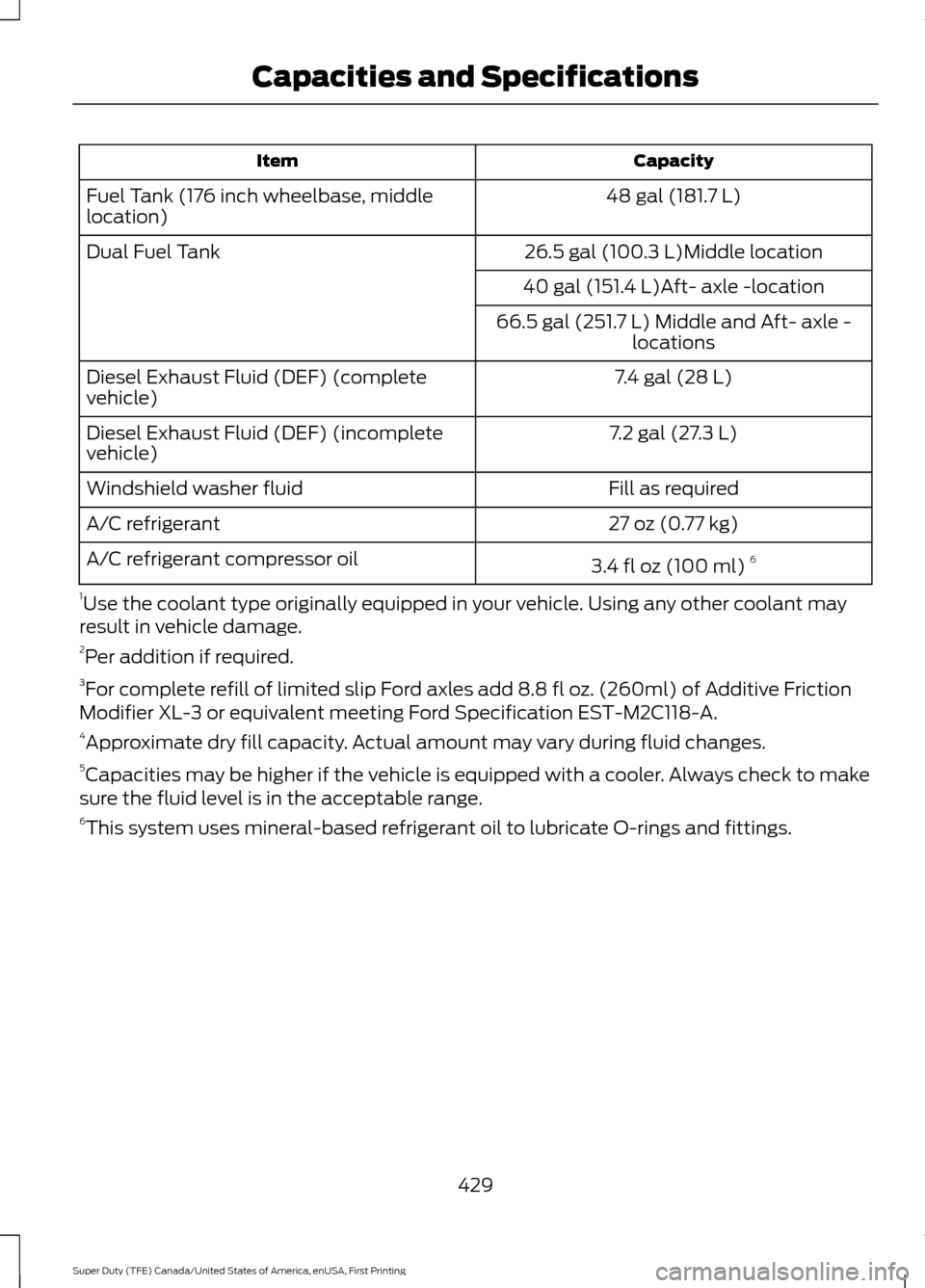
Capacity
Item
48 gal (181.7 L)
Fuel Tank (176 inch wheelbase, middle
location)
26.5 gal (100.3 L)Middle location
Dual Fuel Tank
40 gal (151.4 L)
Aft- axle -location
66.5 gal (251.7 L)
Middle and Aft- axle -
locations
7.4 gal (28 L)
Diesel Exhaust Fluid (DEF) (complete
vehicle)
7.2 gal (27.3 L)
Diesel Exhaust Fluid (DEF) (incomplete
vehicle)
Fill as required
Windshield washer fluid
27 oz (0.77 kg)
A/C refrigerant
3.4 fl oz (100 ml)6
A/C refrigerant compressor oil
1 Use the coolant type originally equipped in your vehicle. Using any other coolant may
result in vehicle damage.
2 Per addition if required.
3 For complete refill of limited slip Ford axles add 8.8 fl oz. (260ml) of Additive Friction
Modifier XL-3 or equivalent meeting Ford Specification EST-M2C118-A.
4 Approximate dry fill capacity. Actual amount may vary during fluid changes.
5 Capacities may be higher if the vehicle is equipped with a cooler. Always check to make
sure the fluid level is in the acceptable range.
6 This system uses mineral-based refrigerant oil to lubricate O-rings and fittings.
429
Super Duty (TFE) Canada/United States of America, enUSA, First Printing Capacities and Specifications