tires FORD SUPER DUTY 2021 Repair Manual
[x] Cancel search | Manufacturer: FORD, Model Year: 2021, Model line: SUPER DUTY, Model: FORD SUPER DUTY 2021Pages: 666, PDF Size: 8.48 MB
Page 442 of 666
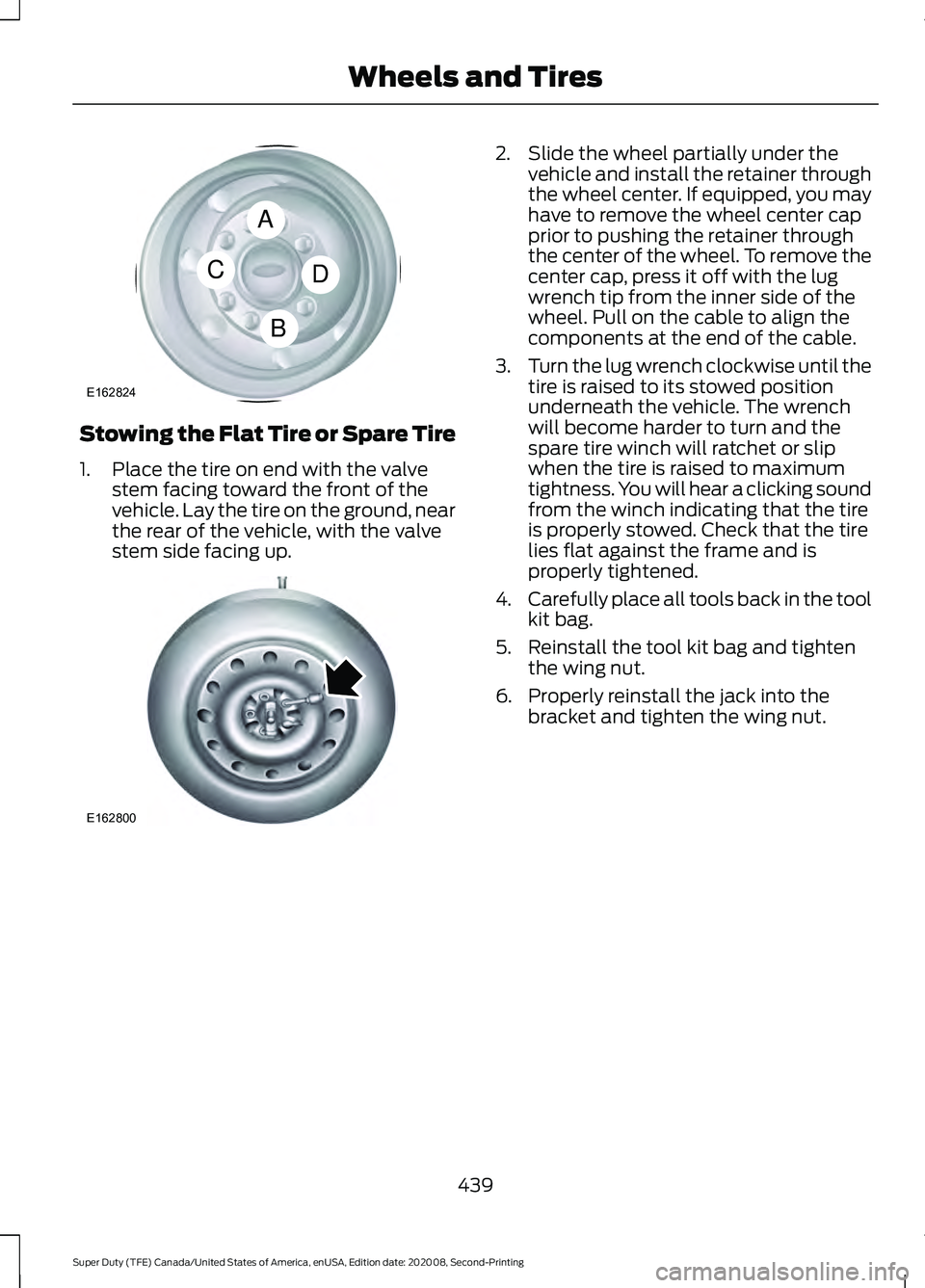
Stowing the Flat Tire or Spare Tire
1. Place the tire on end with the valve
stem facing toward the front of the
vehicle. Lay the tire on the ground, near
the rear of the vehicle, with the valve
stem side facing up. 2. Slide the wheel partially under the
vehicle and install the retainer through
the wheel center. If equipped, you may
have to remove the wheel center cap
prior to pushing the retainer through
the center of the wheel. To remove the
center cap, press it off with the lug
wrench tip from the inner side of the
wheel. Pull on the cable to align the
components at the end of the cable.
3. Turn the lug wrench clockwise until the
tire is raised to its stowed position
underneath the vehicle. The wrench
will become harder to turn and the
spare tire winch will ratchet or slip
when the tire is raised to maximum
tightness. You will hear a clicking sound
from the winch indicating that the tire
is properly stowed. Check that the tire
lies flat against the frame and is
properly tightened.
4. Carefully place all tools back in the tool
kit bag.
5. Reinstall the tool kit bag and tighten the wing nut.
6. Properly reinstall the jack into the bracket and tighten the wing nut.
439
Super Duty (TFE) Canada/United States of America, enUSA, Edition date: 202008, Second-Printing Wheels and TiresA
C
B
D
E162824 E162800
Page 443 of 666
TECHNICAL SPECIFICATIONS
Wheel Lug Nut Torque Specifications
WARNING: When you install a wheel, always remove any corrosion, dirt or foreign
materials present on the mounting surfaces of the wheel or the surface of the wheel
hub, brake drum or brake disc that contacts the wheel. Make sure to secure any fasteners
that attach the rotor to the hub so they do not interfere with the mounting surfaces of
the wheel. Installing wheels without correct metal-to-metal contact at the wheel
mounting surfaces can cause the wheel nuts to loosen and the wheel to come off while
your vehicle is in motion, resulting in loss of vehicle control, personal injury or death. lb.ft (Nm)
1
Bolt size
150 lb.ft (204 Nm)
M14 x 1.5
1 Torque specifications are for nut and bolt threads free of dirt and rust. Use only Ford
recommended replacement fasteners.
On vehicles equipped with single rear wheels, retighten the lug nuts to the specified torque
at 100 mi (160 km) after any wheel disturbance, such as tire rotation, changing a flat tire,
or wheel removal.
On vehicles equipped with dual rear wheels, retighten the wheel lug nuts to the specified
torque at
100 mi (160 km), and again at 500 mi (800 km) of new vehicle operation and
after any wheel disturbance, such as tire rotation, changing a flat tire, or wheel removal.
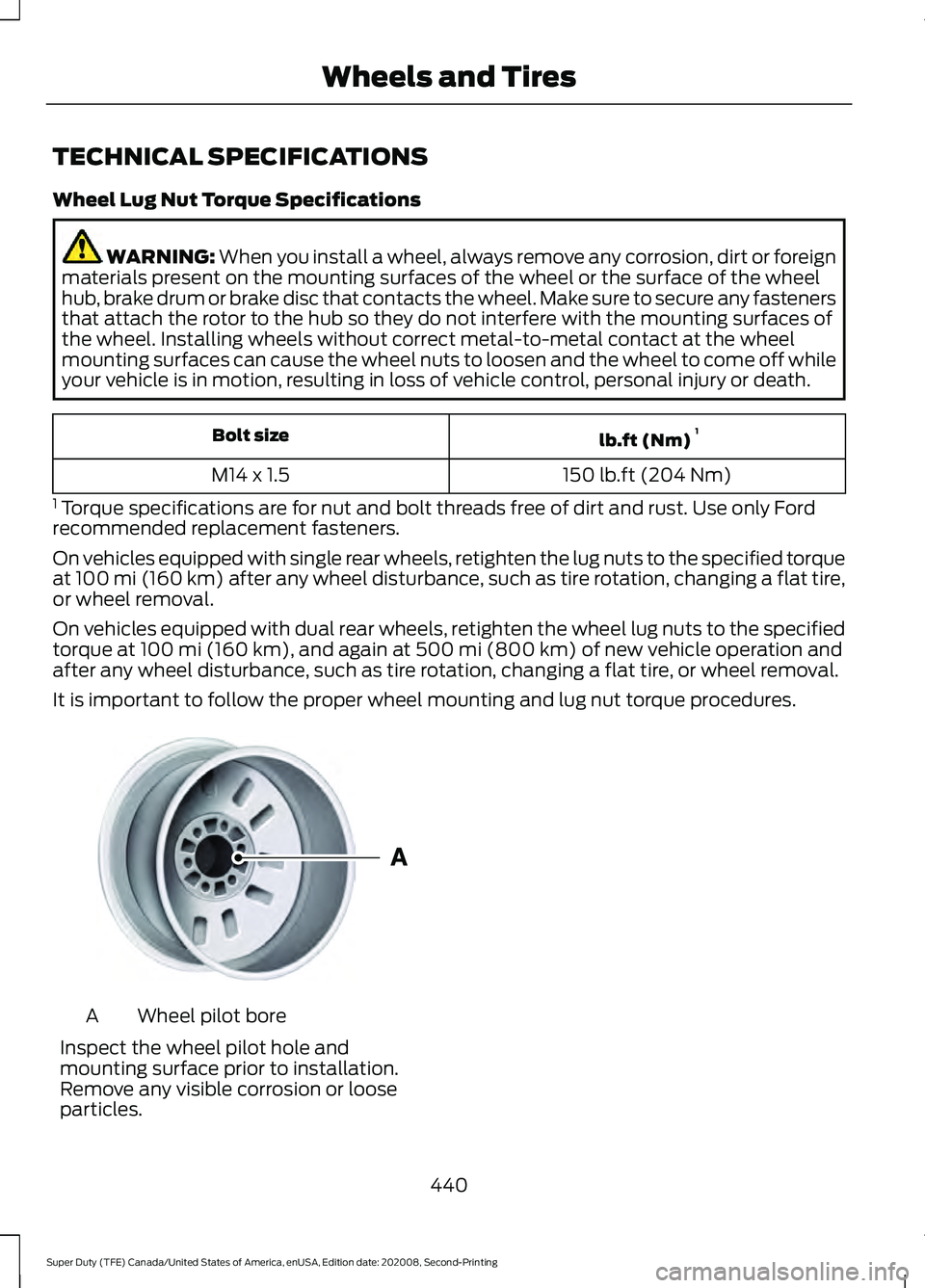
It is important to follow the proper wheel mounting and lug nut torque procedures. Wheel pilot bore
A
Inspect the wheel pilot hole and
mounting surface prior to installation.
Remove any visible corrosion or loose
particles.
440
Super Duty (TFE) Canada/United States of America, enUSA, Edition date: 202008, Second-Printing Wheels and TiresE145950
Page 570 of 666
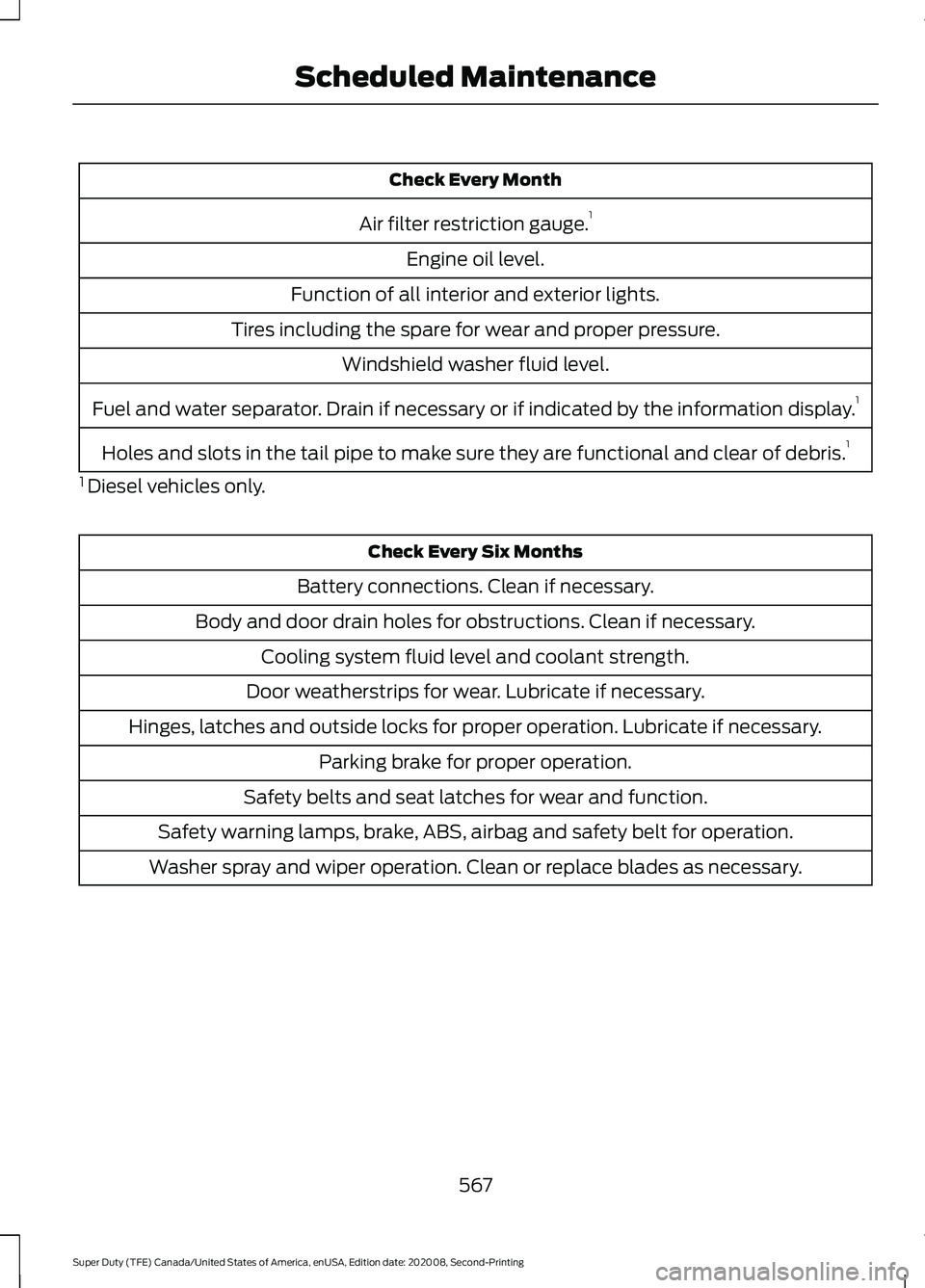
Check Every Month
Air filter restriction gauge. 1
Engine oil level.
Function of all interior and exterior lights.
Tires including the spare for wear and proper pressure. Windshield washer fluid level.
Fuel and water separator. Drain if necessary or if indicated by the information display. 1
Holes and slots in the tail pipe to make sure they are functional and clear of debris. 1
1 Diesel vehicles only. Check Every Six Months
Battery connections. Clean if necessary.
Body and door drain holes for obstructions. Clean if necessary. Cooling system fluid level and coolant strength.
Door weatherstrips for wear. Lubricate if necessary.
Hinges, latches and outside locks for proper operation. Lubricate if necessary. Parking brake for proper operation.
Safety belts and seat latches for wear and function.
Safety warning lamps, brake, ABS, airbag and safety belt for operation.
Washer spray and wiper operation. Clean or replace blades as necessary.
567
Super Duty (TFE) Canada/United States of America, enUSA, Edition date: 202008, Second-Printing Scheduled Maintenance
Page 571 of 666
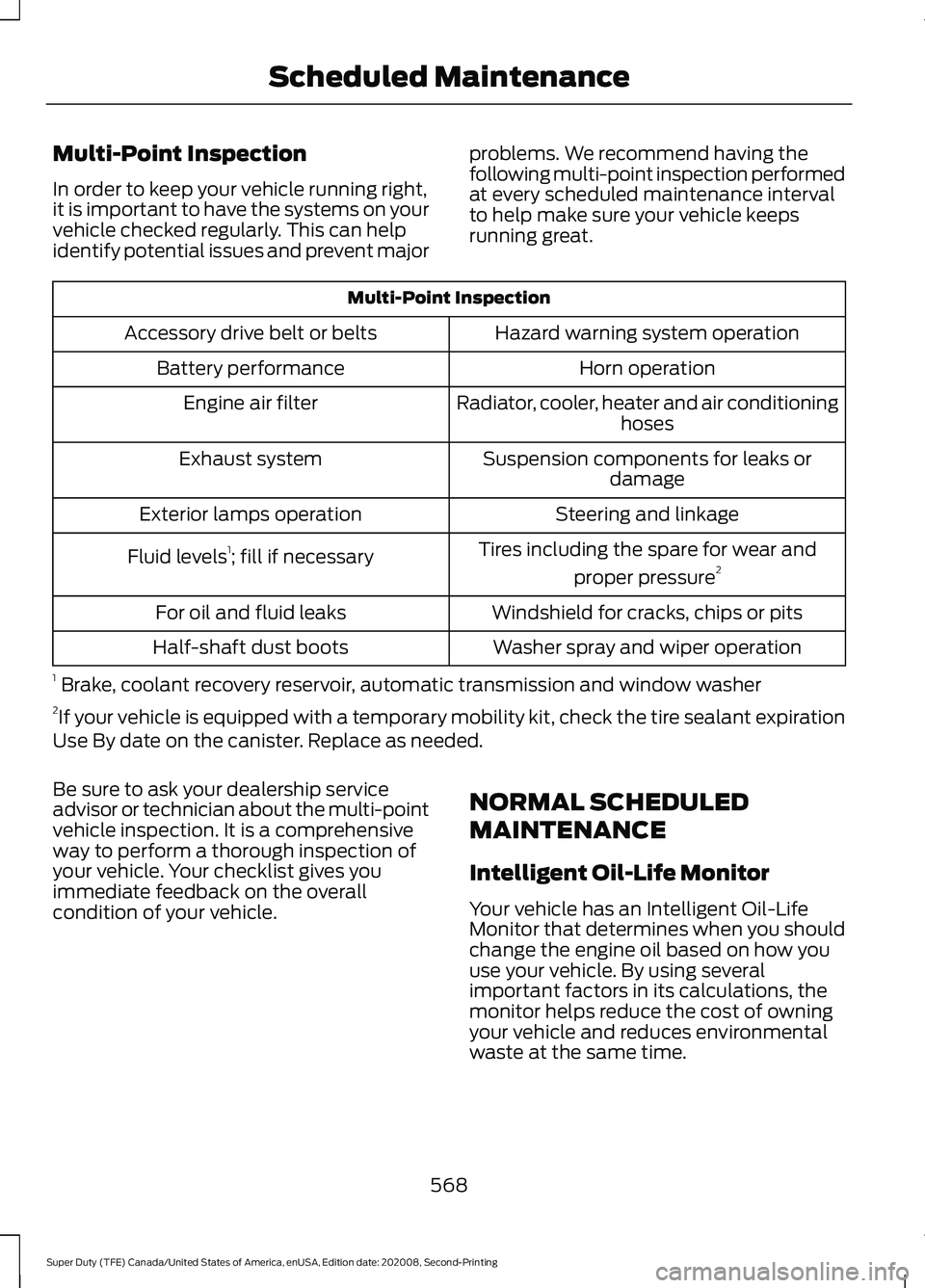
Multi-Point Inspection
In order to keep your vehicle running right,
it is important to have the systems on your
vehicle checked regularly. This can help
identify potential issues and prevent major
problems. We recommend having the
following multi-point inspection performed
at every scheduled maintenance interval
to help make sure your vehicle keeps
running great.Multi-Point Inspection
Hazard warning system operation
Accessory drive belt or belts
Horn operation
Battery performance
Radiator, cooler, heater and air conditioninghoses
Engine air filter
Suspension components for leaks ordamage
Exhaust system
Steering and linkage
Exterior lamps operation
Tires including the spare for wear andproper pressure 2
Fluid levels 1
; fill if necessary
Windshield for cracks, chips or pits
For oil and fluid leaks
Washer spray and wiper operation
Half-shaft dust boots
1 Brake, coolant recovery reservoir, automatic transmission and window washer
2 If your vehicle is equipped with a temporary mobility kit, check the tire sealant expiration
Use By date on the canister. Replace as needed.
Be sure to ask your dealership service
advisor or technician about the multi-point
vehicle inspection. It is a comprehensive
way to perform a thorough inspection of
your vehicle. Your checklist gives you
immediate feedback on the overall
condition of your vehicle. NORMAL SCHEDULED
MAINTENANCE
Intelligent Oil-Life Monitor
Your vehicle has an Intelligent Oil-Life
Monitor that determines when you should
change the engine oil based on how you
use your vehicle. By using several
important factors in its calculations, the
monitor helps reduce the cost of owning
your vehicle and reduces environmental
waste at the same time.
568
Super Duty (TFE) Canada/United States of America, enUSA, Edition date: 202008, Second-Printing Scheduled Maintenance
Page 573 of 666
Gasoline Engine
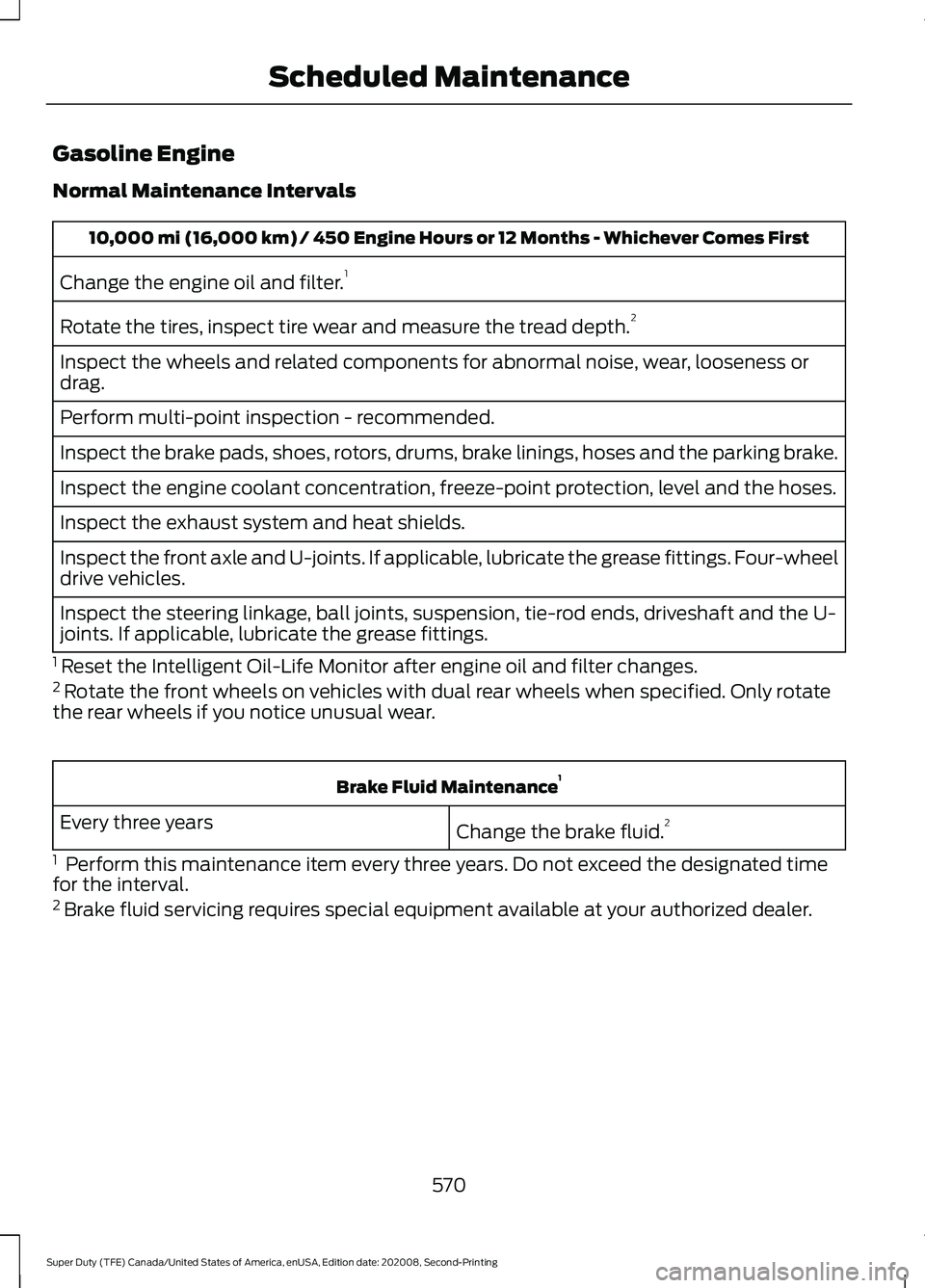
Normal Maintenance Intervals
10,000 mi (16,000 km) / 450 Engine Hours or 12 Months - Whichever Comes First
Change the engine oil and filter. 1
Rotate the tires, inspect tire wear and measure the tread depth. 2
Inspect the wheels and related components for abnormal noise, wear, looseness or
drag.
Perform multi-point inspection - recommended.
Inspect the brake pads, shoes, rotors, drums, brake linings, hoses and the parking brake.
Inspect the engine coolant concentration, freeze-point protection, level and the hoses.
Inspect the exhaust system and heat shields.
Inspect the front axle and U-joints. If applicable, lubricate the grease fittings. Four-wheel
drive vehicles.
Inspect the steering linkage, ball joints, suspension, tie-rod ends, driveshaft and the U-
joints. If applicable, lubricate the grease fittings.
1 Reset the Intelligent Oil-Life Monitor after engine oil and filter changes.
2 Rotate the front wheels on vehicles with dual rear wheels when specified. Only rotate
the rear wheels if you notice unusual wear. Brake Fluid Maintenance
1
Change the brake fluid. 2
Every three years
1 Perform this maintenance item every three years. Do not exceed the designated time
for the interval.
2 Brake fluid servicing requires special equipment available at your authorized dealer.
570
Super Duty (TFE) Canada/United States of America, enUSA, Edition date: 202008, Second-Printing Scheduled Maintenance
Page 575 of 666
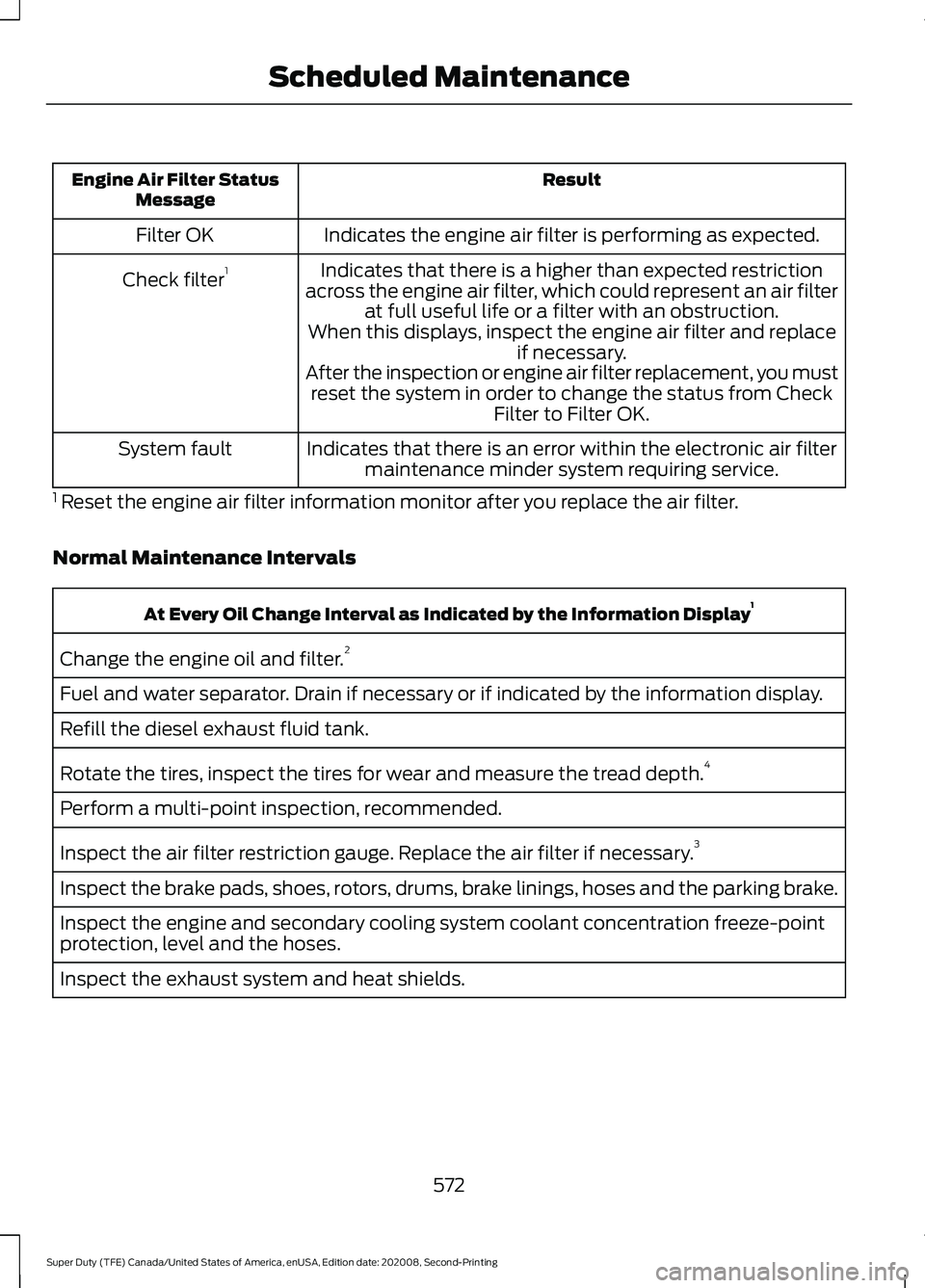
Result
Engine Air Filter Status
Message
Indicates the engine air filter is performing as expected.
Filter OK
Indicates that there is a higher than expected restriction
across the engine air filter, which could represent an air filter at full useful life or a filter with an obstruction.
Check filter
1
When this displays, inspect the engine air filter and replace if necessary.
After the inspection or engine air filter replacement, you must reset the system in order to change the status from Check Filter to Filter OK.
Indicates that there is an error within the electronic air filter maintenance minder system requiring service.
System fault
1 Reset the engine air filter information monitor after you replace the air filter.
Normal Maintenance Intervals At Every Oil Change Interval as Indicated by the Information Display
1
Change the engine oil and filter. 2
Fuel and water separator. Drain if necessary or if indicated by the information display.
Refill the diesel exhaust fluid tank.
Rotate the tires, inspect the tires for wear and measure the tread depth. 4
Perform a multi-point inspection, recommended.
Inspect the air filter restriction gauge. Replace the air filter if necessary. 3
Inspect the brake pads, shoes, rotors, drums, brake linings, hoses and the parking brake.
Inspect the engine and secondary cooling system coolant concentration freeze-point
protection, level and the hoses.
Inspect the exhaust system and heat shields.
572
Super Duty (TFE) Canada/United States of America, enUSA, Edition date: 202008, Second-Printing Scheduled Maintenance
Page 578 of 666
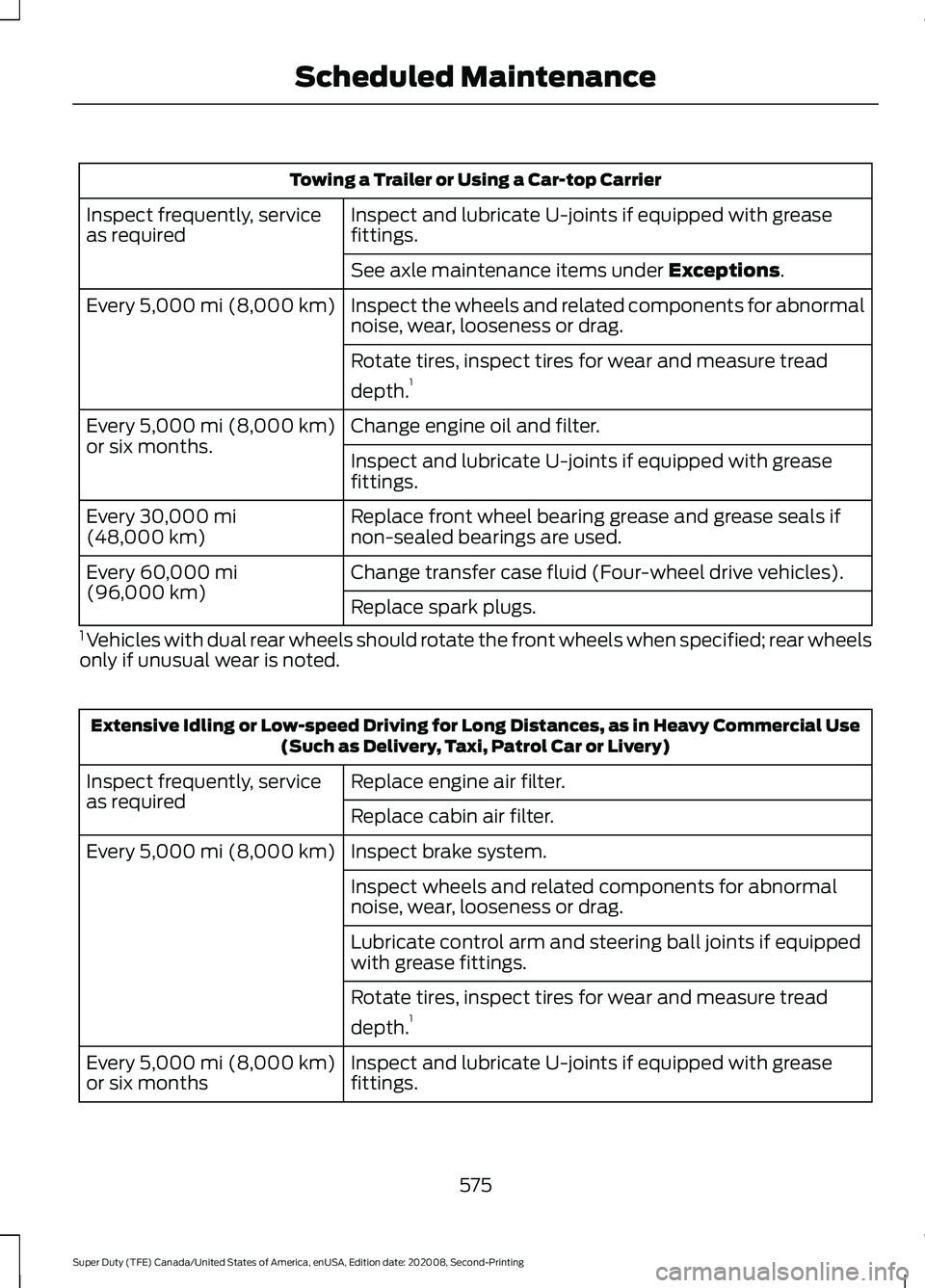
Towing a Trailer or Using a Car-top Carrier
Inspect and lubricate U-joints if equipped with grease
fittings.
Inspect frequently, service
as required
See axle maintenance items under Exceptions.
Inspect the wheels and related components for abnormal
noise, wear, looseness or drag.
Every
5,000 mi (8,000 km)
Rotate tires, inspect tires for wear and measure tread
depth.1
Change engine oil and filter.
Every
5,000 mi (8,000 km)
or six months. Inspect and lubricate U-joints if equipped with grease
fittings.
Replace front wheel bearing grease and grease seals if
non-sealed bearings are used.
Every
30,000 mi
(48,000 km)
Change transfer case fluid (Four-wheel drive vehicles).
Every
60,000 mi
(96,000 km) Replace spark plugs.
1 Vehicles with dual rear wheels should rotate the front wheels when specified; rear wheels
only if unusual wear is noted. Extensive Idling or Low-speed Driving for Long Distances, as in Heavy Commercial Use
(Such as Delivery, Taxi, Patrol Car or Livery)
Replace engine air filter.
Inspect frequently, service
as required
Replace cabin air filter.
Inspect brake system.
Every
5,000 mi (8,000 km)
Inspect wheels and related components for abnormal
noise, wear, looseness or drag.
Lubricate control arm and steering ball joints if equipped
with grease fittings.
Rotate tires, inspect tires for wear and measure tread
depth.1
Inspect and lubricate U-joints if equipped with grease
fittings.
Every
5,000 mi (8,000 km)
or six months
575
Super Duty (TFE) Canada/United States of America, enUSA, Edition date: 202008, Second-Printing Scheduled Maintenance
Page 579 of 666
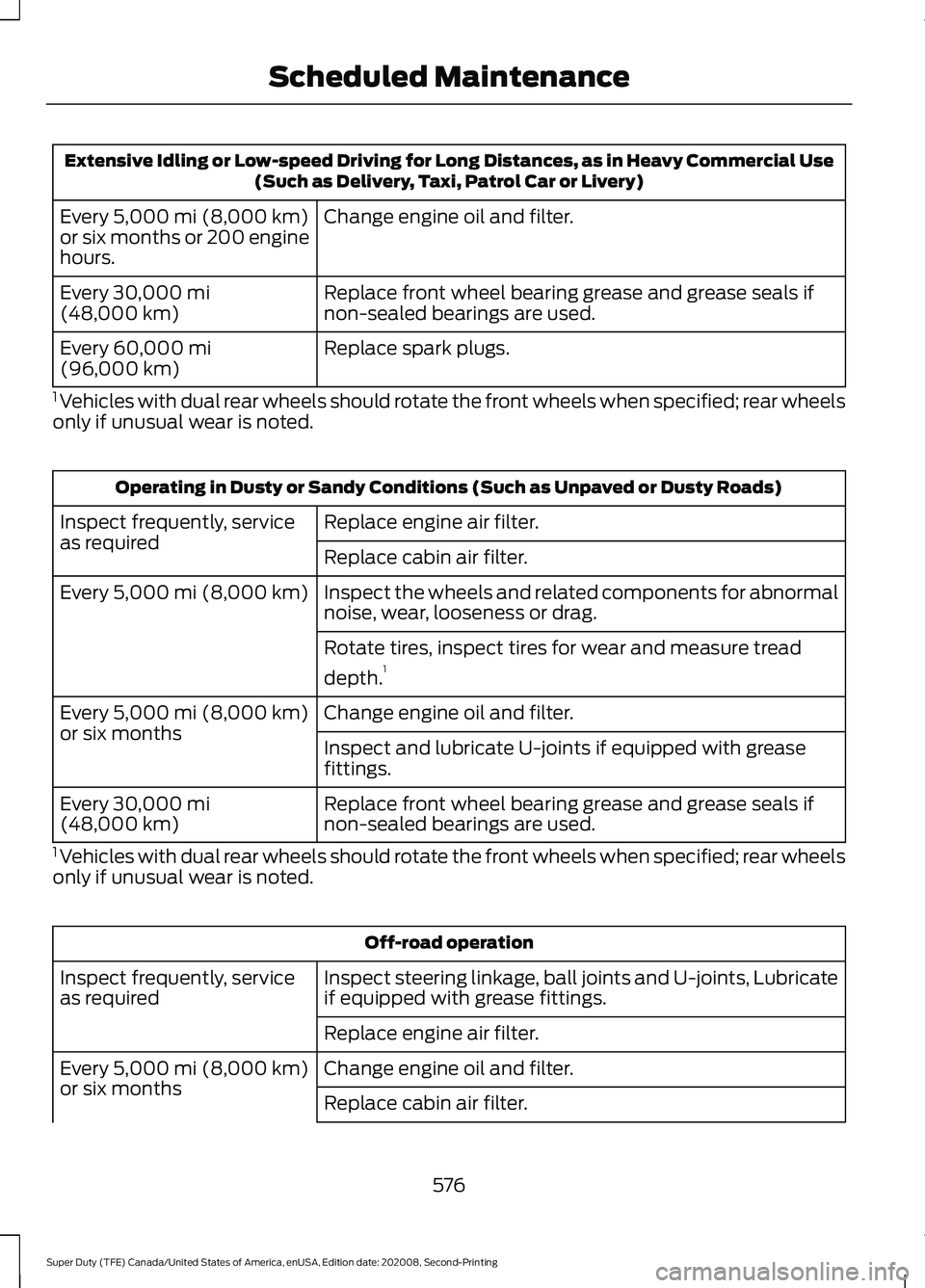
Extensive Idling or Low-speed Driving for Long Distances, as in Heavy Commercial Use
(Such as Delivery, Taxi, Patrol Car or Livery)
Change engine oil and filter.
Every 5,000 mi (8,000 km)
or six months or 200 engine
hours.
Replace front wheel bearing grease and grease seals if
non-sealed bearings are used.
Every
30,000 mi
(48,000 km)
Replace spark plugs.
Every
60,000 mi
(96,000 km)
1 Vehicles with dual rear wheels should rotate the front wheels when specified; rear wheels
only if unusual wear is noted. Operating in Dusty or Sandy Conditions (Such as Unpaved or Dusty Roads)
Replace engine air filter.
Inspect frequently, service
as required
Replace cabin air filter.
Inspect the wheels and related components for abnormal
noise, wear, looseness or drag.
Every
5,000 mi (8,000 km)
Rotate tires, inspect tires for wear and measure tread
depth.1
Change engine oil and filter.
Every
5,000 mi (8,000 km)
or six months Inspect and lubricate U-joints if equipped with grease
fittings.
Replace front wheel bearing grease and grease seals if
non-sealed bearings are used.
Every
30,000 mi
(48,000 km)
1 Vehicles with dual rear wheels should rotate the front wheels when specified; rear wheels
only if unusual wear is noted. Off-road operation
Inspect steering linkage, ball joints and U-joints, Lubricate
if equipped with grease fittings.
Inspect frequently, service
as required
Replace engine air filter.
Change engine oil and filter.
Every
5,000 mi (8,000 km)
or six months Replace cabin air filter.
576
Super Duty (TFE) Canada/United States of America, enUSA, Edition date: 202008, Second-Printing Scheduled Maintenance
Page 580 of 666
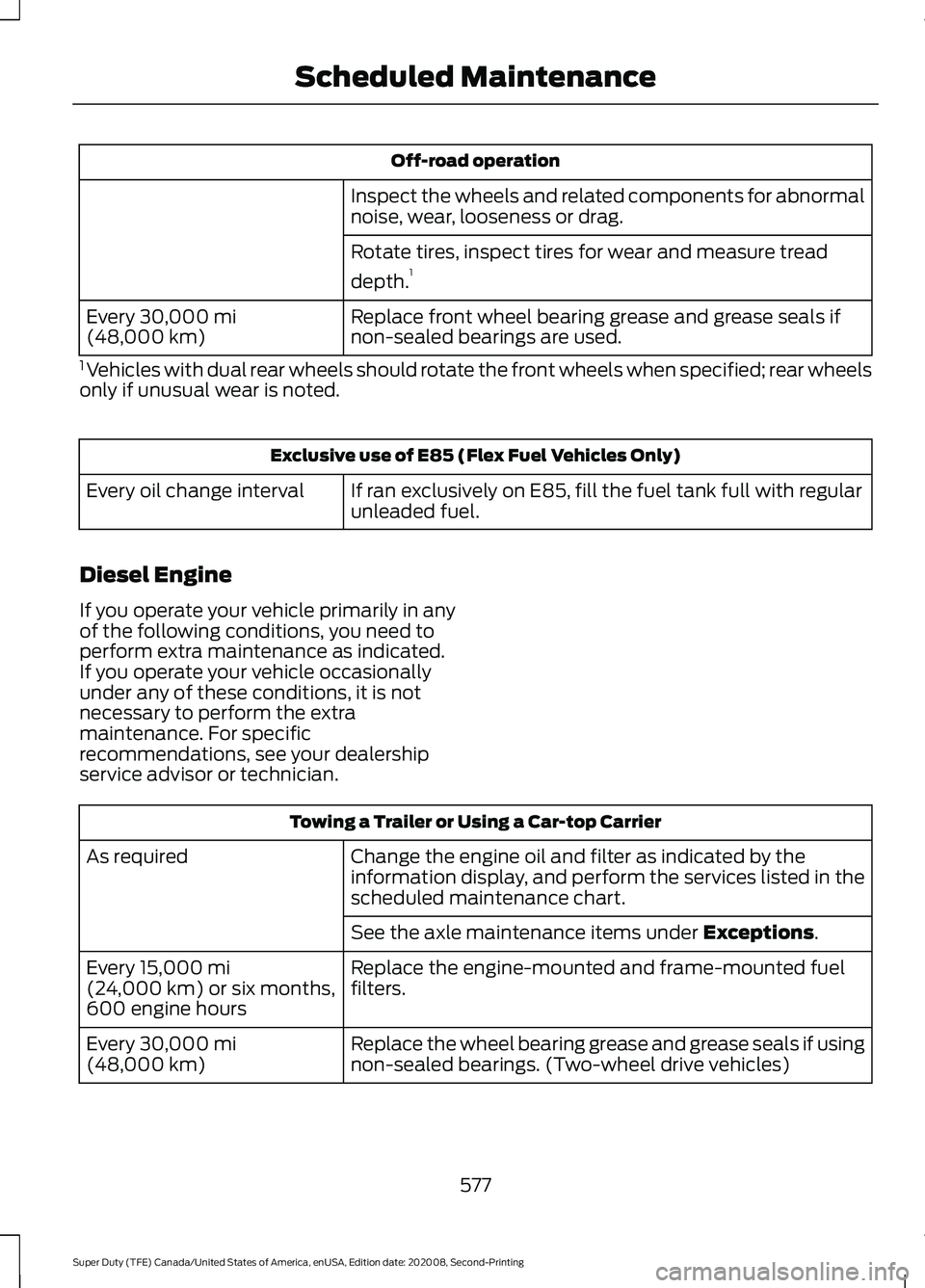
Off-road operation
Inspect the wheels and related components for abnormal
noise, wear, looseness or drag.
Rotate tires, inspect tires for wear and measure tread
depth. 1
Replace front wheel bearing grease and grease seals if
non-sealed bearings are used.
Every 30,000 mi
(48,000 km)
1 Vehicles with dual rear wheels should rotate the front wheels when specified; rear wheels
only if unusual wear is noted. Exclusive use of E85 (Flex Fuel Vehicles Only)
If ran exclusively on E85, fill the fuel tank full with regular
unleaded fuel.
Every oil change interval
Diesel Engine
If you operate your vehicle primarily in any
of the following conditions, you need to
perform extra maintenance as indicated.
If you operate your vehicle occasionally
under any of these conditions, it is not
necessary to perform the extra
maintenance. For specific
recommendations, see your dealership
service advisor or technician. Towing a Trailer or Using a Car-top Carrier
Change the engine oil and filter as indicated by the
information display, and perform the services listed in the
scheduled maintenance chart.
As required
See the axle maintenance items under
Exceptions.
Replace the engine-mounted and frame-mounted fuel
filters.
Every
15,000 mi
(24,000 km) or six months,
600 engine hours
Replace the wheel bearing grease and grease seals if using
non-sealed bearings. (Two-wheel drive vehicles)
Every
30,000 mi
(48,000 km)
577
Super Duty (TFE) Canada/United States of America, enUSA, Edition date: 202008, Second-Printing Scheduled Maintenance
Page 583 of 666
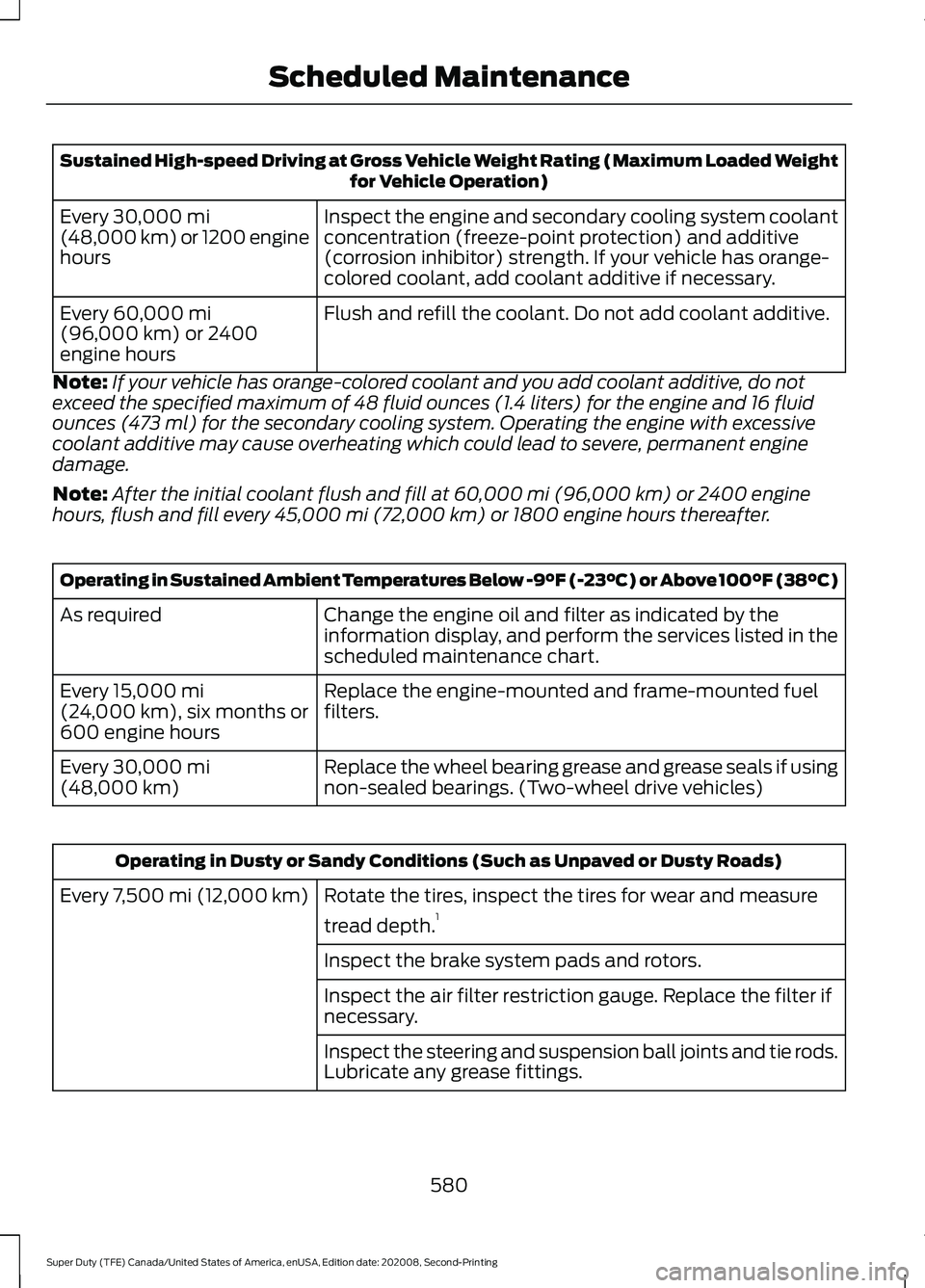
Sustained High-speed Driving at Gross Vehicle Weight Rating (Maximum Loaded Weight
for Vehicle Operation)
Inspect the engine and secondary cooling system coolant
concentration (freeze-point protection) and additive
(corrosion inhibitor) strength. If your vehicle has orange-
colored coolant, add coolant additive if necessary.
Every 30,000 mi
(48,000 km) or 1200 engine
hours
Flush and refill the coolant. Do not add coolant additive.
Every
60,000 mi
(96,000 km) or 2400
engine hours
Note: If your vehicle has orange-colored coolant and you add coolant additive, do not
exceed the specified maximum of 48 fluid ounces (1.4 liters) for the engine and 16 fluid
ounces (473 ml) for the secondary cooling system. Operating the engine with excessive
coolant additive may cause overheating which could lead to severe, permanent engine
damage.
Note: After the initial coolant flush and fill at
60,000 mi (96,000 km) or 2400 engine
hours, flush and fill every 45,000 mi (72,000 km) or 1800 engine hours thereafter. Operating in Sustained Ambient Temperatures Below -9°F (-23°C) or Above 100°F (38°C)
Change the engine oil and filter as indicated by the
information display, and perform the services listed in the
scheduled maintenance chart.
As required
Replace the engine-mounted and frame-mounted fuel
filters.
Every
15,000 mi
(24,000 km), six months or
600 engine hours
Replace the wheel bearing grease and grease seals if using
non-sealed bearings. (Two-wheel drive vehicles)
Every
30,000 mi
(48,000 km) Operating in Dusty or Sandy Conditions (Such as Unpaved or Dusty Roads)
Rotate the tires, inspect the tires for wear and measure
tread depth.1
Every
7,500 mi (12,000 km)
Inspect the brake system pads and rotors.
Inspect the air filter restriction gauge. Replace the filter if
necessary.
Inspect the steering and suspension ball joints and tie rods.
Lubricate any grease fittings.
580
Super Duty (TFE) Canada/United States of America, enUSA, Edition date: 202008, Second-Printing Scheduled Maintenance