ECO mode FORD SUPER DUTY 2021 Owners Manual
[x] Cancel search | Manufacturer: FORD, Model Year: 2021, Model line: SUPER DUTY, Model: FORD SUPER DUTY 2021Pages: 666, PDF Size: 8.48 MB
Page 6 of 666
Climate Control - Vehicles
With: Automatic
Temperature Control
Identifying the Climate Control Unit .....143
Switching Climate Control On and Off ........................................................................\
.
143
Switching Recirculated Air On and Off ........................................................................\
.
143
Switching Air Conditioning On and Off ........................................................................\
.
143
Switching Maximum Defrost On and Off ........................................................................\
.
143
Switching Maximum Cooling On and Off ........................................................................\
.
143
Switching the Heated Wiper Park On and Off .................................................................
144
Switching the Heated Rear Window On and Off ........................................................
144
Switching the Heated Mirrors On and Off ........................................................................\
.
144
Setting the Blower Motor Speed ...........
144
Setting the Temperature ..........................
144
Directing the Flow of Air ............................
145
Auto Mode ......................................................
145
Climate Control – Troubleshooting ......
146
Climate Control - Vehicles With: Manual Temperature
Control
Identifying the Climate Control Unit ......
147
Switching Climate Control On and Off ........................................................................\
.
147
Switching Recirculated Air On and Off ........................................................................\
.
147
Switching Air Conditioning On and Off ........................................................................\
.
147
Switching Maximum Defrost On and Off ........................................................................\
.
147
Switching Maximum Cooling On and Off ........................................................................\
.
147
Switching the Heated Rear Window On and Off ........................................................
148Switching the Heated Mirrors On and Off
........................................................................\
.
148
Setting the Blower Motor Speed ...........
148
Setting the Temperature ..........................
148
Directing the Flow of Air ...........................
148
Climate Control – Troubleshooting ......
149
Interior Air Quality
What Is the Cabin Air Filter ......................
150
Locating the Cabin Air Filter ....................
150
Replacing the Cabin Air Filter .................
150
Seats
Sitting in the Correct Position ..................
151
Head Restraints .............................................
151
Manual Seats ................................................
153
Power Seats ..................................................
154
Memory Function .........................................
157
Rear Seats ......................................................
158
Heated Seats ................................................
160
Ventilated Seats ............................................
161
Rear Occupant Alert System
What is the Rear Occupant Alert System ........................................................................\
.
162
How Does the Rear Occupant Alert System Work .............................................
162
Rear Occupant Alert System Precautions ........................................................................\
.
162
Rear Occupant Alert System Limitations ........................................................................\
.
162
Switching Rear Occupant Alert System On and Off - Vehicles With: SYNC 3
........................................................................\
.
162
Switching Rear Occupant Alert System On and Off - Vehicles With: SYNC
........................................................................\
.
163
Rear Occupant Alert System Indicators - Vehicles With: SYNC 3 ........................
163
Rear Occupant Alert System Indicators - Vehicles With: SYNC ...........................
163
3
Super Duty (TFE) Canada/United States of America, enUSA, Edition date: 202008, Second-Printing Table of Contents
Page 10 of 666
Capacities and Specifications
Engine Specifications - 6.2L
....................441
Engine Specifications - 6.7L Diesel .......
441
Engine Specifications - 7.3L ....................
442
Motorcraft Parts - 6.2L .............................
443
Motorcraft Parts - 6.7L Diesel ................
445
Motorcraft Parts - 7.3L .............................
446
Bulb Specification Chart ..........................
447
Engine Oil Capacity and Specification - 6.2L ..............................................................
449
Engine Oil Capacity and Specification - 6.7L Diesel .................................................
450
Engine Oil Capacity and Specification - 7.3L ...............................................................
453
Cooling System Capacity and Specification - 6.2L ...............................
455
Cooling System Capacity and Specification - 6.7L Diesel ..................
456
Cooling System Capacity and Specification - 7.3L ................................
456
Fuel Tank Capacity - Diesel ....................
457
Fuel Tank Capacity - Gasoline ..............
458
Air Conditioning System Capacity and Specification - 6.2L ...............................
459
Air Conditioning System Capacity and Specification - 6.7L Diesel ..................
460
Air Conditioning System Capacity and Specification - 7.3L .................................
461
Washer Fluid Specification ......................
461
Diesel Exhaust Fluid Capacity and Specification ............................................
462
Automatic Transmission Fluid Capacity and Specification - Diesel ...................
463
Automatic Transmission Fluid Capacity and Specification - Gasoline .............
463
Brake Fluid Specification .........................
465
Transfer Case Fluid Capacity and Specification ............................................
466
Front Axle Fluid Capacity and Specification ............................................
466
Rear Axle Fluid Capacity and Specification - Diesel ............................
467Rear Axle Fluid Capacity and
Specification - Gasoline ......................
469
Hydraulic Power Steering Fluid Capacity and Specification ....................................
472
Vehicle Identification
Vehicle Identification Number ...............
473
Connected Vehicle
Connected Vehicle Requirements ........
474
Connected Vehicle Limitations .............
474
Connecting the Vehicle to a Mobile Network ......................................................
474
Connecting the Vehicle to a Wi-Fi Network ......................................................
474
Connected Vehicle – Troubleshooting - Vehicles With: Modem ..........................
475
Connected Vehicle – Troubleshooting - Vehicles With: SYNC/SYNC 3 ............
476
Vehicle Wi-Fi Hotspot
Creating a Vehicle Wi-Fi Hotspot .........
478
Changing the Vehicle Wi-Fi Hotspot Name or Password ................................
478
Audio System - Vehicles With: SYNC
General Information ..................................
479
Audio Unit ......................................................
479
Digital Radio ..................................................
481
Satellite Radio .............................................
484
USB Port ........................................................
487
Audio System - Vehicles With: SYNC 3
General Information .................................
488
Audio Unit .....................................................
488
Digital Radio .................................................
489
Satellite Radio .............................................
492
USB Port ........................................................
495
7
Super Duty (TFE) Canada/United States of America, enUSA, Edition date: 202008, Second-Printing Table of Contents
Page 12 of 666
ABOUT THIS MANUAL
Thank you for choosing Ford. We
recommend that you take some time to
get to know your vehicle by reading this
manual. The more that you know about
your vehicle, the greater the safety and
pleasure you will get from driving it.
WARNING: Driving while
distracted can result in loss of vehicle
control, crash and injury. We strongly
recommend that you use extreme
caution when using any device that may
take your focus off the road. Your
primary responsibility is the safe
operation of your vehicle. We
recommend against the use of any
hand-held device while driving and
encourage the use of voice-operated
systems when possible. Make sure you
are aware of all applicable local laws
that may affect the use of electronic
devices while driving.
Note: This manual describes product
features and options available throughout
the range of available models, sometimes
even before they are generally available. It
may describe options not fitted to the
vehicle you have purchased.
Note: Some of the illustrations in this
manual may show features as used in
different models, so may appear different
to you on your vehicle.
Note: Always use and operate your vehicle
in line with all applicable laws and
regulations.
Note: Pass on this manual when selling
your vehicle. It is an integral part of your
vehicle.
This manual may qualify the location of a
component as left-hand side or right-hand
side. The side is determined when facing
forward in the seat. Right-hand side.
A
Left-hand side.
B
SYMBOLS GLOSSARY
These are some of the symbols you may
see on your vehicle. Air conditioning system
Air conditioning system lubricant
type
Anti-lock braking system
Avoid smoking, flames or sparks
Battery
Battery acid
Brake fluid - non petroleum
based
Brake system
9
Super Duty (TFE) Canada/United States of America, enUSA, Edition date: 202008, Second-Printing IntroductionE154903 E162384 E231157
Page 17 of 666
Entertainment Data
Data recorded includes, for example:
•
Music, videos or album art.
• Contacts and corresponding address
book entries.
• Navigation destinations.
Services That We Provide
If you use our services, we collect and use
data, for example, account information,
vehicle location and driving characteristics,
that could identify you. We transmit this
data through a dedicated, protected
connection. We only collect and use data
to enable your use of our services to which
you have subscribed, with your consent or
where permitted by law. For additional
information, see the terms and conditions
of the services to which you have
subscribed.
Services That Third Parties
Provide
We recommend that you review the terms
and conditions and data privacy
information for any services to which you
subscribe. We take no responsibility for
services that third parties provide.
Vehicles With a Modem (If Equipped) The modem has a SIM. The
modem was enabled when your
vehicle was built and periodically
sends messages to stay connected to the
cell phone network, receive automatic
software updates and send vehicle-related
information to us, for example, diagnostic
information. These messages could
include information that identifies your
vehicle, the SIM and the electronic serial
number of the modem. Cell phone network service providers could have access to
additional information, for example, cell
phone network tower identification. For
additional information about our privacy
policy, visit
www .For dC onne c t e d . c om or
refer to your local Ford website.
Note: The modem continues to send this
information unless you disable the modem
or stop the modem from sharing vehicle
data by changing the modem settings. See
Connected Vehicle
(page 474).
Note: The service can be unavailable or
interrupted for a number of reasons, for
example, environmental or topographical
conditions and data plan coverage.
Note: To find out if your vehicle has a
modem, visit
www .For dC onne c t e d . c om .
Vehicles With SYNC
Mobile Device Data
If you connect a mobile device to your
vehicle, you can display data from your
device on the touchscreen for example,
music and album art. You can share your
vehicle data with mobile apps on your
device through the system. See
Apps
(page 540).
The mobile apps function operates by your
connected device sending data to us in the
United States. The data is encrypted and
includes, for example, the vehicle
identification number of your vehicle,
odometer, SYNC module number,
anonymous usage statistics and debugging
information. We retain it only as long as
necessary to provide the service, to
troubleshoot, for continuous improvement
and to offer you products and services that
may be of interest to you according to your
preferences and where allowed by law.
14
Super Duty (TFE) Canada/United States of America, enUSA, Edition date: 202008, Second-Printing Introduction
Page 27 of 666
INSTALLING CHILD
RESTRAINTS
Child Seats
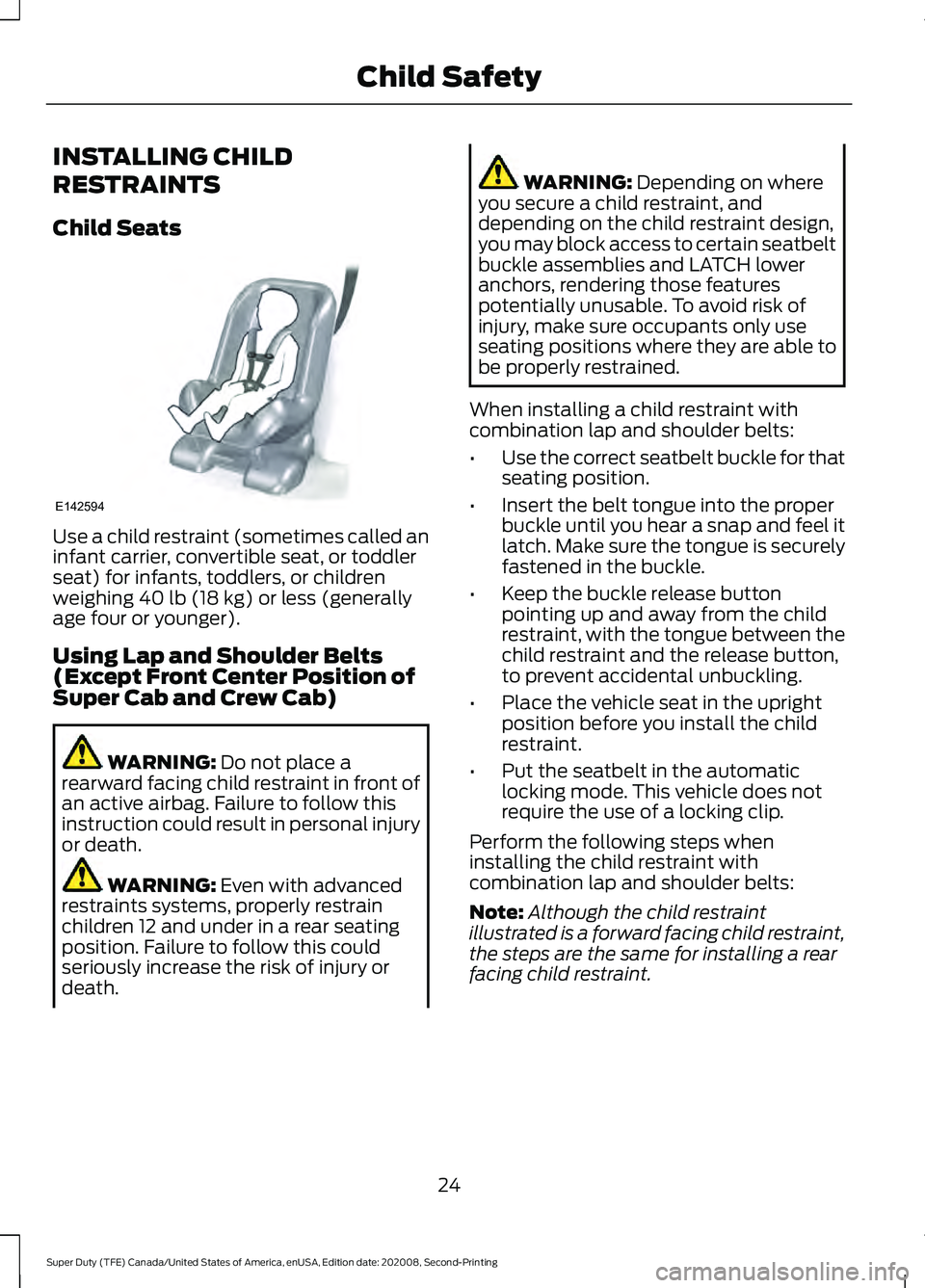
Use a child restraint (sometimes called an
infant carrier, convertible seat, or toddler
seat) for infants, toddlers, or children
weighing 40 lb (18 kg) or less (generally
age four or younger).
Using Lap and Shoulder Belts
(Except Front Center Position of
Super Cab and Crew Cab) WARNING:
Do not place a
rearward facing child restraint in front of
an active airbag. Failure to follow this
instruction could result in personal injury
or death. WARNING:
Even with advanced
restraints systems, properly restrain
children 12 and under in a rear seating
position. Failure to follow this could
seriously increase the risk of injury or
death. WARNING:
Depending on where
you secure a child restraint, and
depending on the child restraint design,
you may block access to certain seatbelt
buckle assemblies and LATCH lower
anchors, rendering those features
potentially unusable. To avoid risk of
injury, make sure occupants only use
seating positions where they are able to
be properly restrained.
When installing a child restraint with
combination lap and shoulder belts:
• Use the correct seatbelt buckle for that
seating position.
• Insert the belt tongue into the proper
buckle until you hear a snap and feel it
latch. Make sure the tongue is securely
fastened in the buckle.
• Keep the buckle release button
pointing up and away from the child
restraint, with the tongue between the
child restraint and the release button,
to prevent accidental unbuckling.
• Place the vehicle seat in the upright
position before you install the child
restraint.
• Put the seatbelt in the automatic
locking mode. This vehicle does not
require the use of a locking clip.
Perform the following steps when
installing the child restraint with
combination lap and shoulder belts:
Note: Although the child restraint
illustrated is a forward facing child restraint,
the steps are the same for installing a rear
facing child restraint.
24
Super Duty (TFE) Canada/United States of America, enUSA, Edition date: 202008, Second-Printing Child SafetyE142594
Page 28 of 666
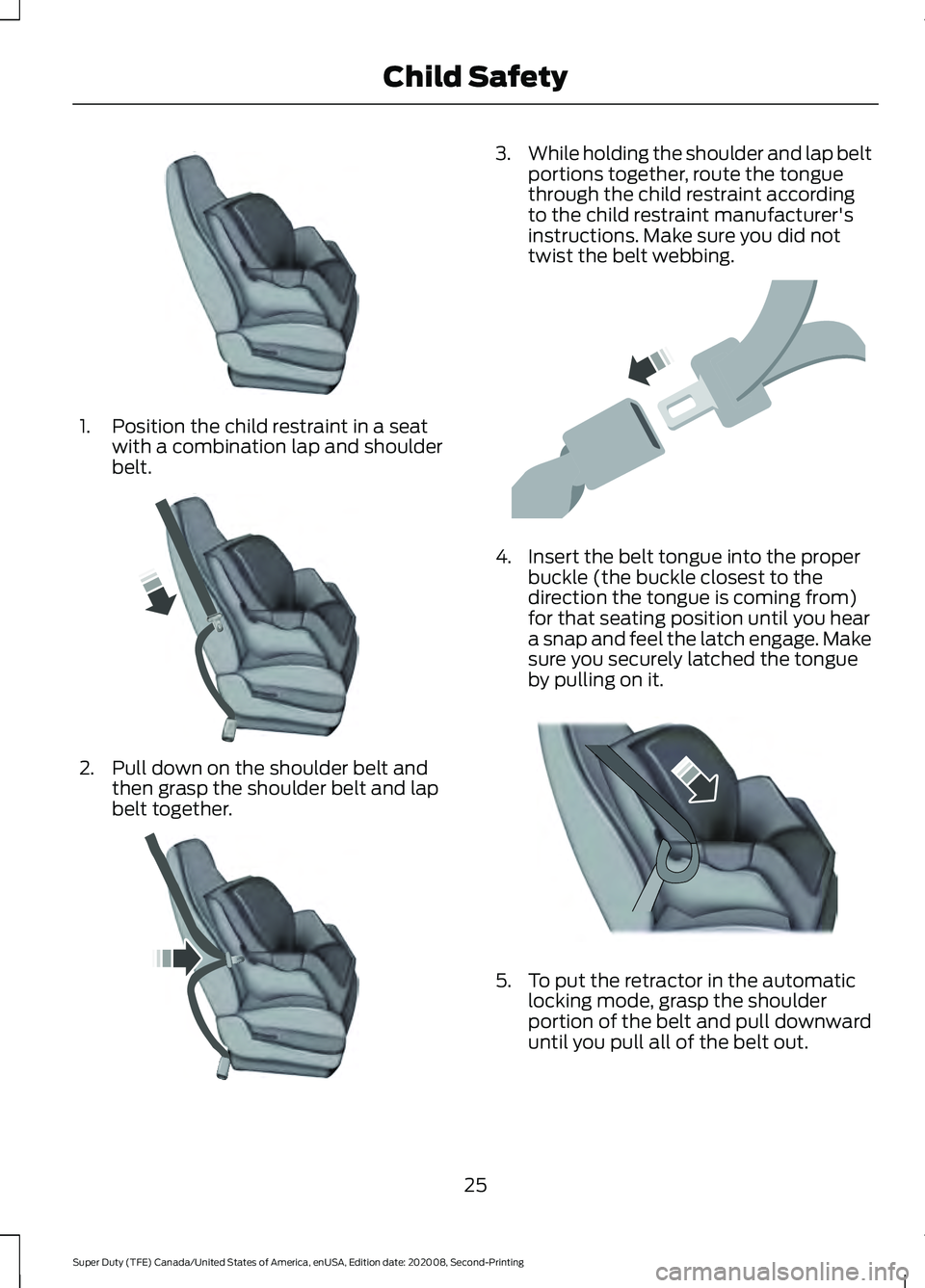
1. Position the child restraint in a seat
with a combination lap and shoulder
belt. 2. Pull down on the shoulder belt and
then grasp the shoulder belt and lap
belt together. 3.
While holding the shoulder and lap belt
portions together, route the tongue
through the child restraint according
to the child restraint manufacturer's
instructions. Make sure you did not
twist the belt webbing. 4. Insert the belt tongue into the proper
buckle (the buckle closest to the
direction the tongue is coming from)
for that seating position until you hear
a snap and feel the latch engage. Make
sure you securely latched the tongue
by pulling on it. 5. To put the retractor in the automatic
locking mode, grasp the shoulder
portion of the belt and pull downward
until you pull all of the belt out.
25
Super Duty (TFE) Canada/United States of America, enUSA, Edition date: 202008, Second-Printing Child SafetyE142528 E142529 E142530 E142531 E142875
Page 29 of 666
Note:
The automatic locking mode is
available on the front passenger and rear
seats. This vehicle does not require the use
of a locking clip.
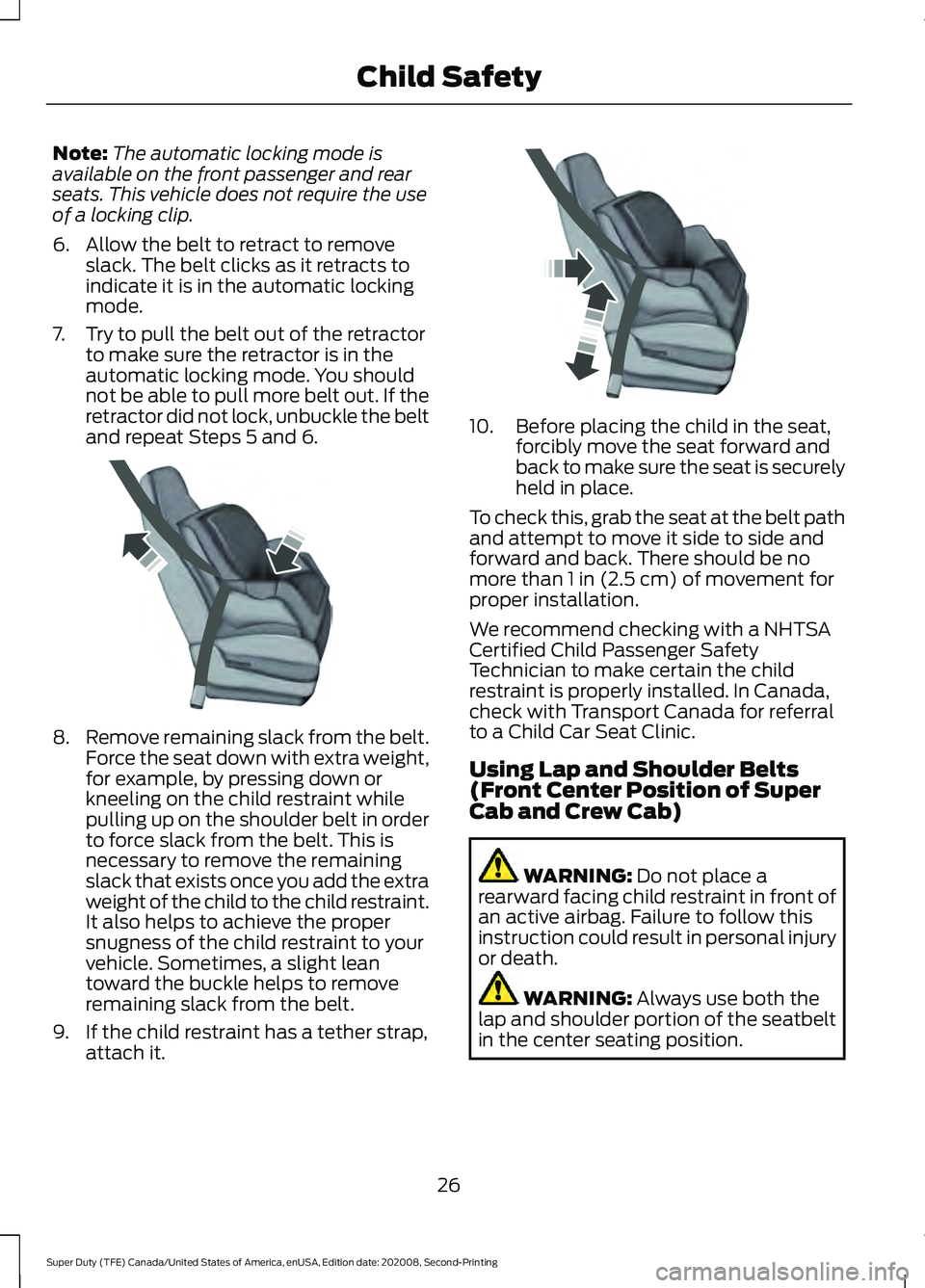
6. Allow the belt to retract to remove slack. The belt clicks as it retracts to
indicate it is in the automatic locking
mode.
7. Try to pull the belt out of the retractor to make sure the retractor is in the
automatic locking mode. You should
not be able to pull more belt out. If the
retractor did not lock, unbuckle the belt
and repeat Steps 5 and 6. 8.
Remove remaining slack from the belt.
Force the seat down with extra weight,
for example, by pressing down or
kneeling on the child restraint while
pulling up on the shoulder belt in order
to force slack from the belt. This is
necessary to remove the remaining
slack that exists once you add the extra
weight of the child to the child restraint.
It also helps to achieve the proper
snugness of the child restraint to your
vehicle. Sometimes, a slight lean
toward the buckle helps to remove
remaining slack from the belt.
9. If the child restraint has a tether strap, attach it. 10. Before placing the child in the seat,
forcibly move the seat forward and
back to make sure the seat is securely
held in place.
To check this, grab the seat at the belt path
and attempt to move it side to side and
forward and back. There should be no
more than 1 in (2.5 cm) of movement for
proper installation.
We recommend checking with a NHTSA
Certified Child Passenger Safety
Technician to make certain the child
restraint is properly installed. In Canada,
check with Transport Canada for referral
to a Child Car Seat Clinic.
Using Lap and Shoulder Belts
(Front Center Position of Super
Cab and Crew Cab) WARNING:
Do not place a
rearward facing child restraint in front of
an active airbag. Failure to follow this
instruction could result in personal injury
or death. WARNING:
Always use both the
lap and shoulder portion of the seatbelt
in the center seating position.
26
Super Duty (TFE) Canada/United States of America, enUSA, Edition date: 202008, Second-Printing Child SafetyE142533 E142534
Page 41 of 666
PRINCIPLE OF OPERATION
WARNING: Always drive and ride
with your seatback upright and the lap
belt snug and low across the hips. WARNING:
Children must always
be properly restrained. WARNING:
Do not allow a
passenger to hold a child on their lap
when your vehicle is moving. Failure to
follow this instruction could result in
personal injury or death in the event of a
sudden stop or crash. WARNING:
All occupants of your
vehicle, including the driver, should
always properly wear their seatbelts,
even when an airbag supplemental
restraint system is provided. Failure to
properly wear your seatbelt could
seriously increase the risk of injury or
death. WARNING:
It is extremely
dangerous to ride in a cargo area, inside
or outside of a vehicle. In a crash, people
riding in these areas are more likely to be
seriously injured or killed. Do not allow
people to ride in any area of your vehicle
that is not equipped with seats and
seatbelts. Make sure everyone in your
vehicle is in a seat and properly using a
seatbelt. Failure to follow this warning
could result in serious personal injury or
death. WARNING:
In a rollover crash, an
unbelted person is significantly more
likely to die than a person wearing a
seatbelt. WARNING:
Each seating position
in your vehicle has a specific seatbelt
assembly made up of one buckle and
one tongue designed to be used as a pair.
Use the shoulder belt on the outside
shoulder only. Never wear the shoulder
belt under the arm. Never use a single
seatbelt for more than one person. WARNING:
Even with advanced
restraints systems, properly restrain
children 12 and under in a rear seating
position. Failure to follow this could
seriously increase the risk of injury or
death. WARNING:
Seatbelts and seats
may be hot in a vehicle that is in the
sunshine. The hot seatbelts or seats may
burn a small child. Check seat covers and
buckles before you place a child
anywhere near them.
All seating positions in this vehicle have
lap and shoulder belts. All occupants of
the vehicle should always properly wear
their seatbelts, even when an airbag
supplemental restraint system is provided.
The seatbelt system consists of:
• Lap and shoulder seatbelts.
• Shoulder seatbelts with automatic
locking mode, (except the driver
seatbelt).
• Height adjusters at the front outermost
seating positions.
• Seatbelt pretensioners at the front
outermost and rear outermost seating
positions. •
Seatbelt warning light and chime.
38
Super Duty (TFE) Canada/United States of America, enUSA, Edition date: 202008, Second-Printing SeatbeltsE71880
Page 44 of 666
Seatbelt Locking Modes
WARNING: If your vehicle is
involved in a crash, have the seatbelts
and associated components inspected
as soon as possible. Failure to follow this
instruction could result in personal injury
or death.
All safety restraints in the vehicle are
combination lap and shoulder belts. The
driver seatbelt has the first type of locking
mode. The front outermost passenger and
rear seat seatbelts have both types of
locking modes described as follows:
Vehicle Sensitive Mode
This is the normal retractor mode, which
allows free shoulder belt length
adjustment to your movements and
locking in response to vehicle movement.
For example, if the driver brakes suddenly,
turns a corner sharply, or the vehicle
receives an impact of about
5 mph
(8 km/h) or more, the combination
seatbelts lock to help reduce forward
movement of the driver and passengers.
In addition, the retractor is designed to lock
if you pull the webbing out too quickly. If
the seatbelt retractor locks, slowly lower
the height adjuster to allow the seatbelt
to retract. If the retractor does not unlock,
pull the seatbelt out slowly then feed a
small length of webbing back toward the
stowed position. For rear seatbelts, recline
the rear seat backrest or push the seat
backrest cushion away from the seatbelt.
Feed a small length of webbing back
toward the stowed position. Automatic Locking Mode
In this mode, the shoulder belt
automatically pre-locks. The belt still
retracts to remove any slack in the
shoulder belt. The automatic locking mode
is not available on the driver seatbelt.
When to Use the Automatic Locking
Mode
Use this mode any time you install a child
restraint in a front outermost passenger
seating position in a Regular Cab,
SuperCab, SuperCrew or any rear seating
position of a SuperCab or SuperCrew. The
optional front center seatbelt has a cinch
mechanism. Properly restrain children 12
years old and under in a rear seat whenever
possible.
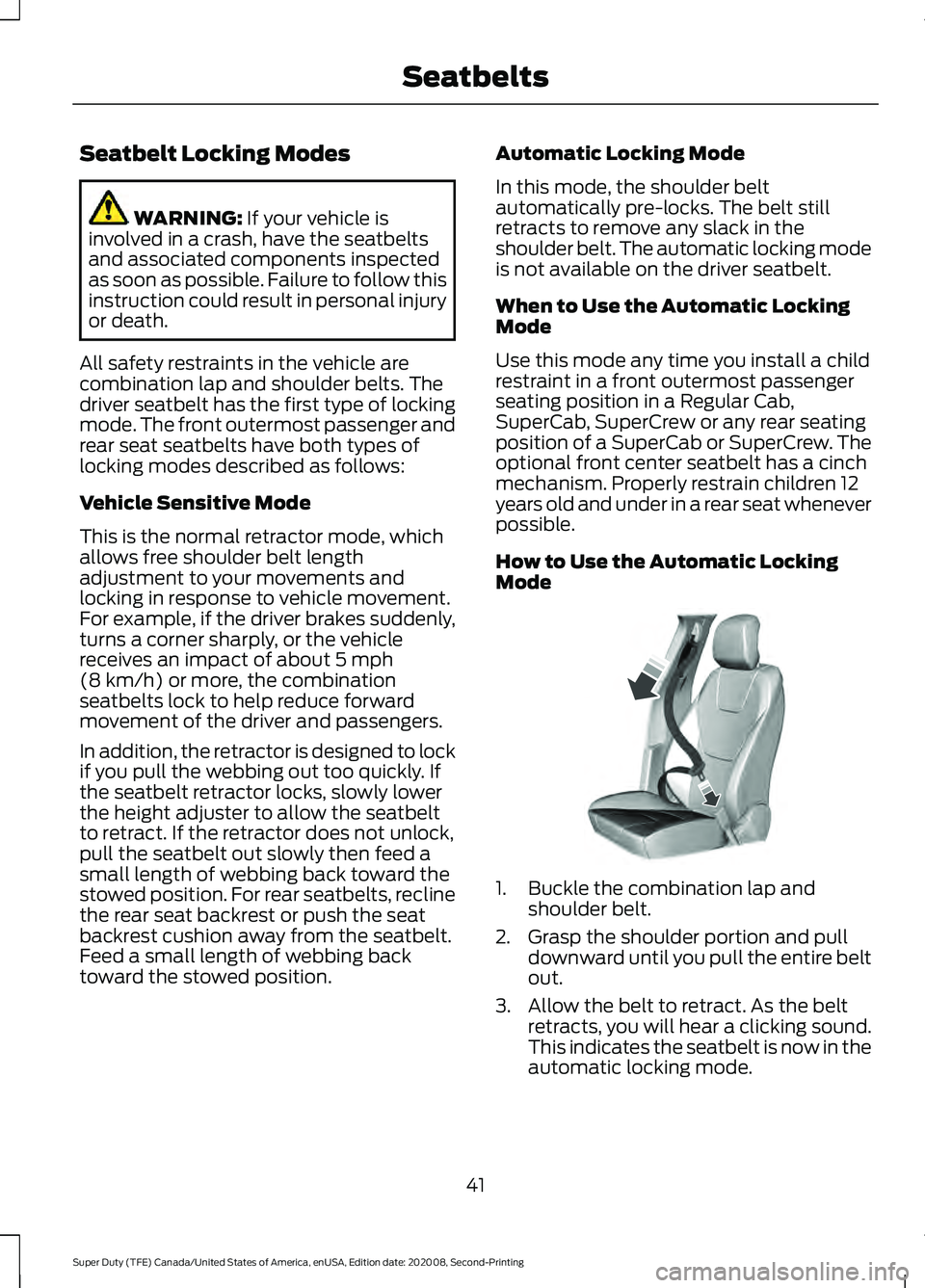
How to Use the Automatic Locking
Mode
1. Buckle the combination lap and
shoulder belt.
2. Grasp the shoulder portion and pull downward until you pull the entire belt
out.
3. Allow the belt to retract. As the belt retracts, you will hear a clicking sound.
This indicates the seatbelt is now in the
automatic locking mode.
41
Super Duty (TFE) Canada/United States of America, enUSA, Edition date: 202008, Second-Printing SeatbeltsE142591
Page 45 of 666
How to Disengage the Automatic
Locking Mode
Unbuckle the combination lap and
shoulder belt and allow it to retract
completely to disengage the automatic
locking mode and activate the vehicle
sensitive (emergency) locking mode.
SEATBELT HEIGHT
ADJUSTMENT
WARNING: Position the safety belt
height adjuster so that the belt rests
across the middle of your shoulder.
Failure to adjust the safety belt properly
could reduce the effectiveness of the
safety belt and increase the risk of injury
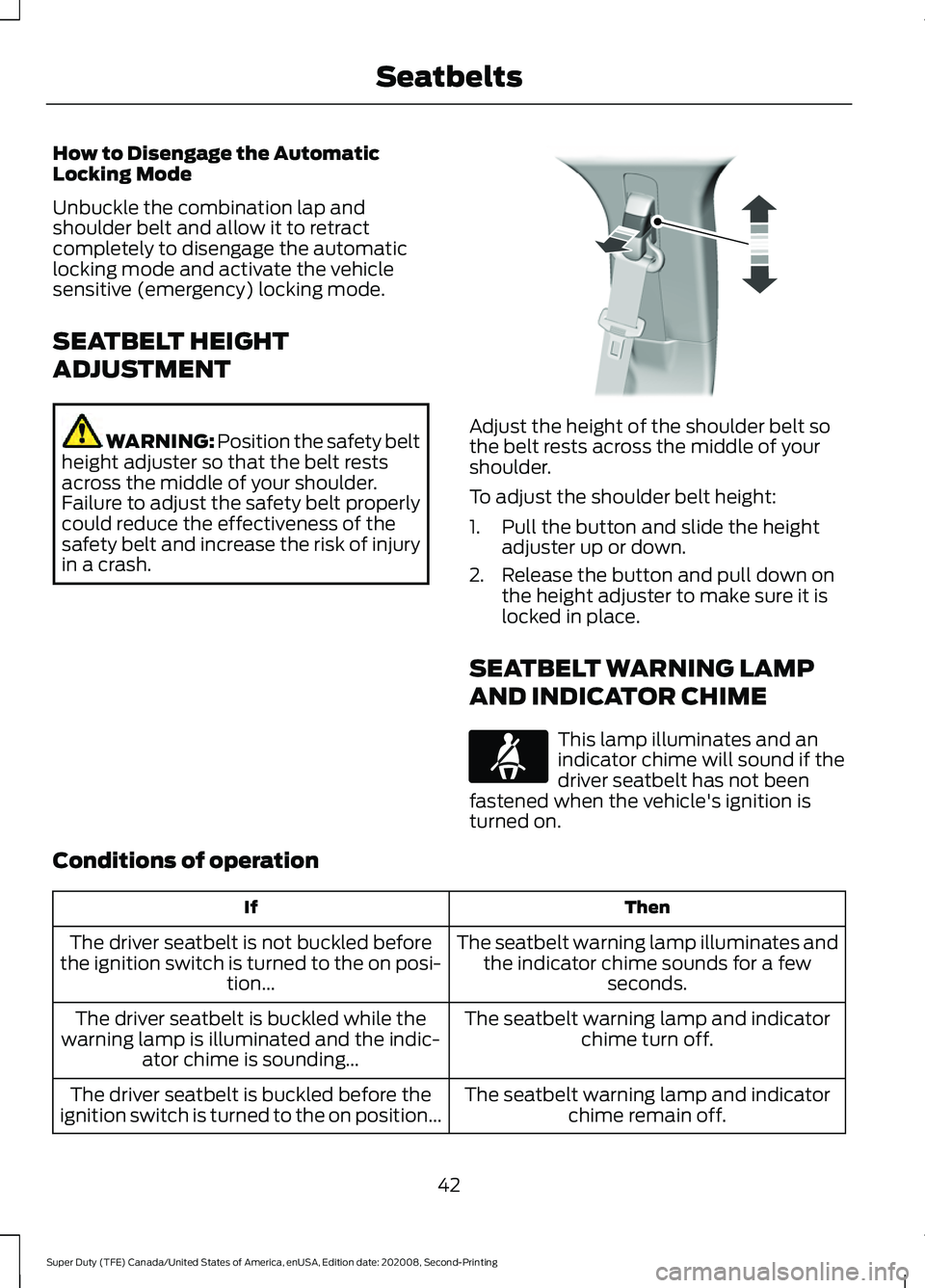
in a crash. Adjust the height of the shoulder belt so
the belt rests across the middle of your
shoulder.
To adjust the shoulder belt height:
1. Pull the button and slide the height
adjuster up or down.
2. Release the button and pull down on the height adjuster to make sure it is
locked in place.
SEATBELT WARNING LAMP
AND INDICATOR CHIME This lamp illuminates and an
indicator chime will sound if the
driver seatbelt has not been
fastened when the vehicle's ignition is
turned on.
Conditions of operation Then
If
The seatbelt warning lamp illuminates andthe indicator chime sounds for a few seconds.
The driver seatbelt is not buckled before
the ignition switch is turned to the on posi- tion...
The seatbelt warning lamp and indicatorchime turn off.
The driver seatbelt is buckled while the
warning lamp is illuminated and the indic- ator chime is sounding...
The seatbelt warning lamp and indicatorchime remain off.
The driver seatbelt is buckled before the
ignition switch is turned to the on position...
42
Super Duty (TFE) Canada/United States of America, enUSA, Edition date: 202008, Second-Printing SeatbeltsE145664 E71880