fuel pump FORD SUPER DUTY 2022 User Guide
[x] Cancel search | Manufacturer: FORD, Model Year: 2022, Model line: SUPER DUTY, Model: FORD SUPER DUTY 2022Pages: 740, PDF Size: 9.95 MB
Page 212 of 740
4. To replace the fuel filler cap, turn it
clockwise until you feel a strong
resistance and it clicks.
5. Fully close the fuel filler door.
Note: If your vehicle runs out of fuel add a
minimum of 1.3 gal (5 L) of fuel to restart
the engine.
Note: You may need to switch the ignition
from off to on several times after refueling
to allow the fuel system to pump the fuel
from the tank to the engine. When
restarting, cranking time takes a few
seconds longer than normal.
REFUELING
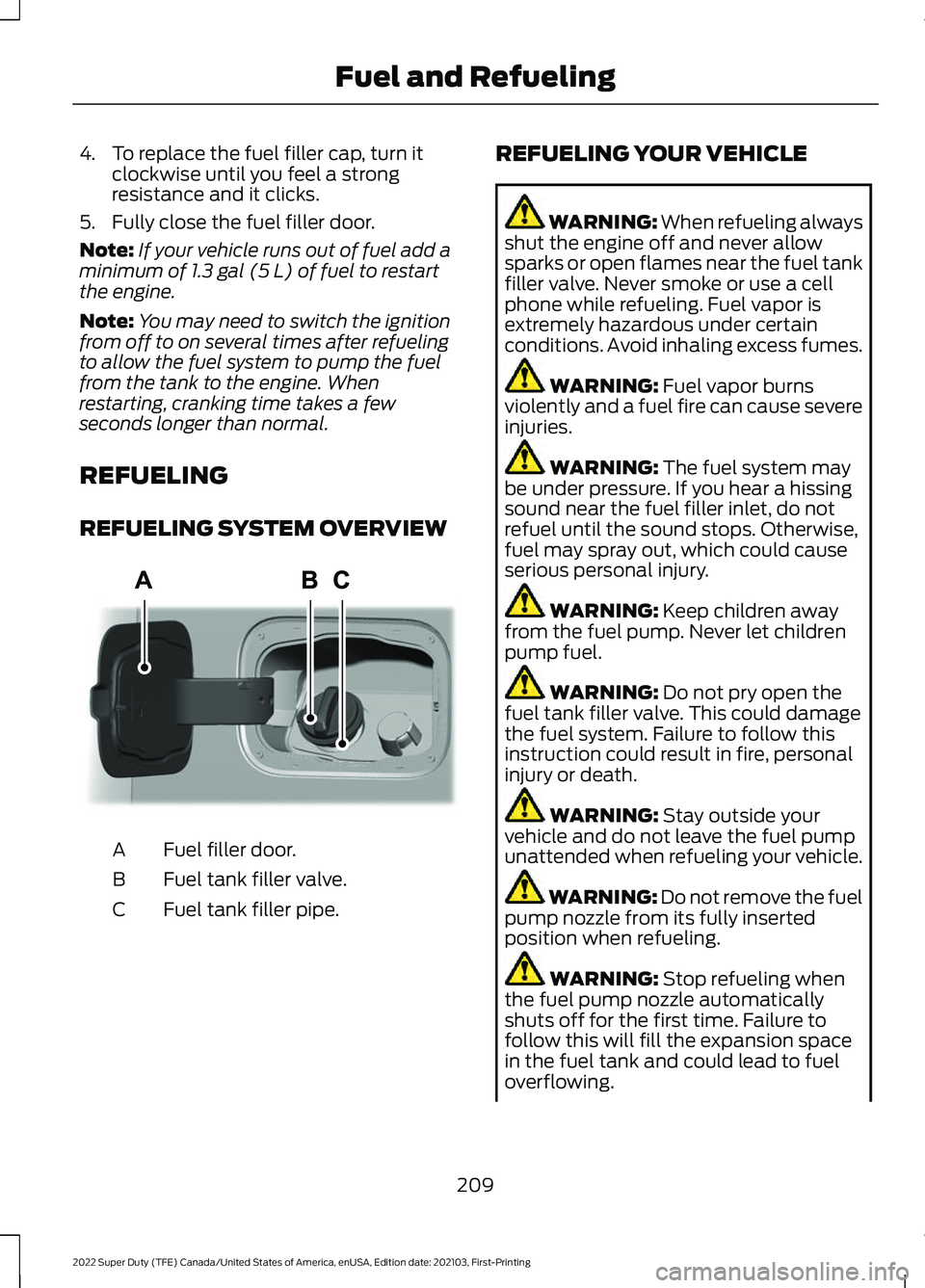
REFUELING SYSTEM OVERVIEW Fuel filler door.
A
Fuel tank filler valve.
B
Fuel tank filler pipe.
C REFUELING YOUR VEHICLE WARNING: When refueling always
shut the engine off and never allow
sparks or open flames near the fuel tank
filler valve. Never smoke or use a cell
phone while refueling. Fuel vapor is
extremely hazardous under certain
conditions. Avoid inhaling excess fumes. WARNING:
Fuel vapor burns
violently and a fuel fire can cause severe
injuries. WARNING:
The fuel system may
be under pressure. If you hear a hissing
sound near the fuel filler inlet, do not
refuel until the sound stops. Otherwise,
fuel may spray out, which could cause
serious personal injury. WARNING:
Keep children away
from the fuel pump. Never let children
pump fuel. WARNING:
Do not pry open the
fuel tank filler valve. This could damage
the fuel system. Failure to follow this
instruction could result in fire, personal
injury or death. WARNING:
Stay outside your
vehicle and do not leave the fuel pump
unattended when refueling your vehicle. WARNING: Do not remove the fuel
pump nozzle from its fully inserted
position when refueling. WARNING:
Stop refueling when
the fuel pump nozzle automatically
shuts off for the first time. Failure to
follow this will fill the expansion space
in the fuel tank and could lead to fuel
overflowing.
209
2022 Super Duty (TFE) Canada/United States of America, enUSA, Edition date: 202103, First-Printing Fuel and RefuelingAAE346555
Page 213 of 740
WARNING: Do not overfill the fuel
tank. The pressure in an overfilled tank
may cause leakage and lead to fuel spray
and fire. WARNING:
Wait at least five
seconds before removing the fuel pump
nozzle to allow any residual fuel to drain
into the fuel tank.
1. Fully open the fuel filler door.
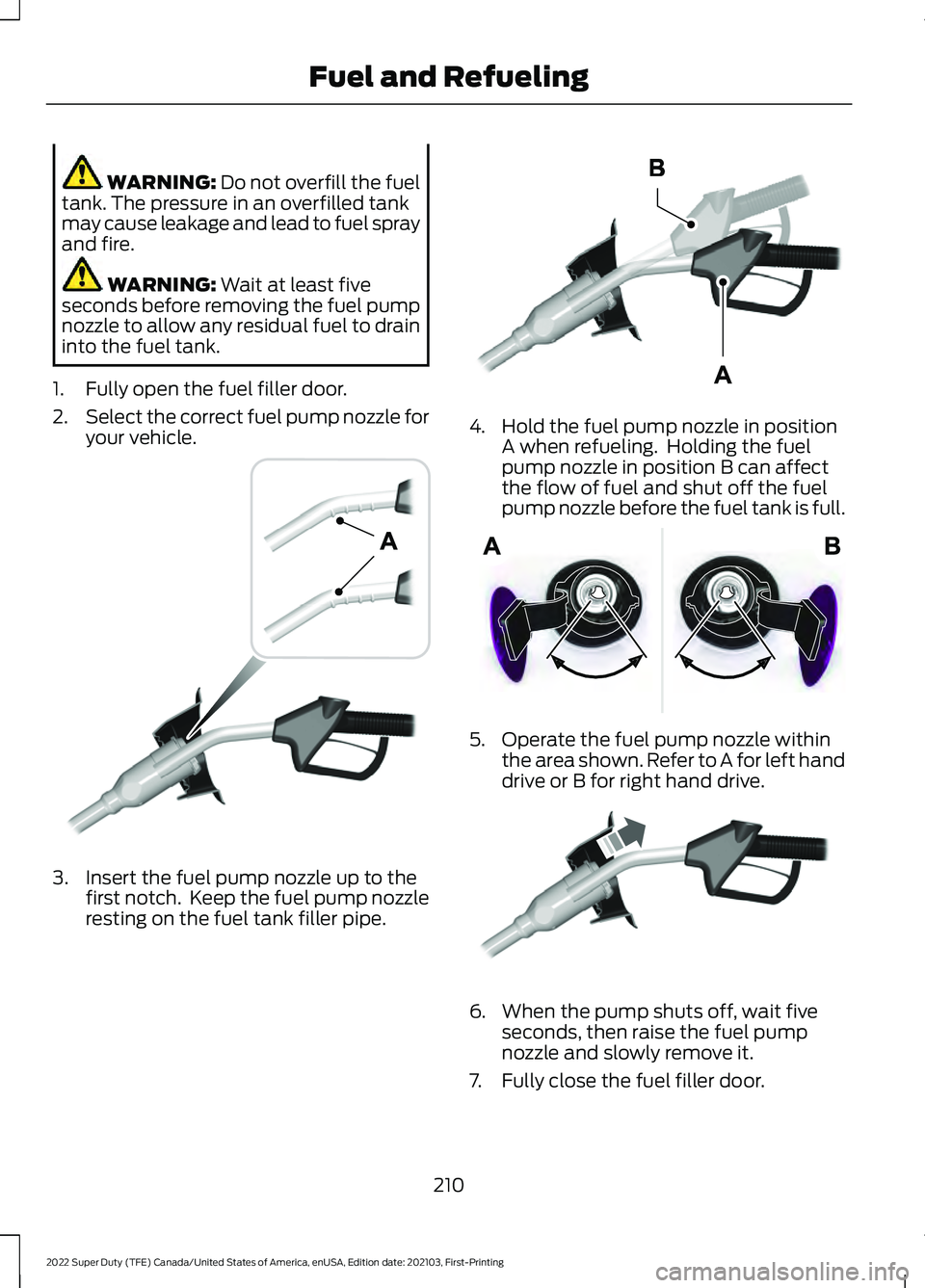
2. Select the correct fuel pump nozzle for
your vehicle. 3. Insert the fuel pump nozzle up to the
first notch. Keep the fuel pump nozzle
resting on the fuel tank filler pipe. 4. Hold the fuel pump nozzle in position
A when refueling. Holding the fuel
pump nozzle in position B can affect
the flow of fuel and shut off the fuel
pump nozzle before the fuel tank is full. 5. Operate the fuel pump nozzle within
the area shown. Refer to A for left hand
drive or B for right hand drive. 6. When the pump shuts off, wait five
seconds, then raise the fuel pump
nozzle and slowly remove it.
7. Fully close the fuel filler door.
210
2022 Super Duty (TFE) Canada/United States of America, enUSA, Edition date: 202103, First-Printing Fuel and RefuelingE139202 E327438 E206912 E119081
Page 222 of 740
•
Avoid spilling diesel exhaust fluid on
painted surfaces, carpeting or plastic
components. Immediately wipe away
any diesel exhaust fluid that has spilled
with a damp cloth and water. If it has
already crystallized, use warm water
and a sponge.
• Do not store the diesel exhaust fluid
bottle in your vehicle. If it leaks it could
cause damage to interior components
or release an ammonia odor inside your
vehicle.
• Do not re-use the diesel exhaust fluid
container once it is emptied.
• Store diesel exhaust fluid out of direct
sunlight and in temperatures between
23–68°F (-5– 20°C).
• The system has a diesel exhaust fluid
quality sensor. Dilution of diesel
exhaust fluid or use of any other liquid
in the selective catalytic reduction
system leads to a diesel exhaust fluid
system fault, eventually leading to the
vehicle only operating in idle-only
mode.
• Do not dilute diesel exhaust fluid with
water or any other liquid. FILLING THE SELECTIVE
CATALYTIC REDUCTION
SYSTEM TANK
FILLING THE SELECTIVE
CATALYTIC REDUCTION SYSTEM
TANK IN COLD WEATHER
Diesel exhaust fluid may freeze if the
ambient temperature is below 12°F (-11°C).
Your vehicle has a preheating system
which allows diesel exhaust fluid to
operate below
12°F (-11°C). If you do not
use your vehicle for an extended period
when the ambient temperature is below
12°F (-11°C)
, the fluid in the tank may
freeze. If the tank is overfilled and the fluid
freezes it may cause damage that your
Warranty will not cover.
FILLING THE SELECTIVE
CATALYTIC REDUCTION SYSTEM
TANK USING A FUEL STATION
PUMP
Filling the diesel exhaust fluid tank using
a fuel station pump is similar to refueling
your vehicle.
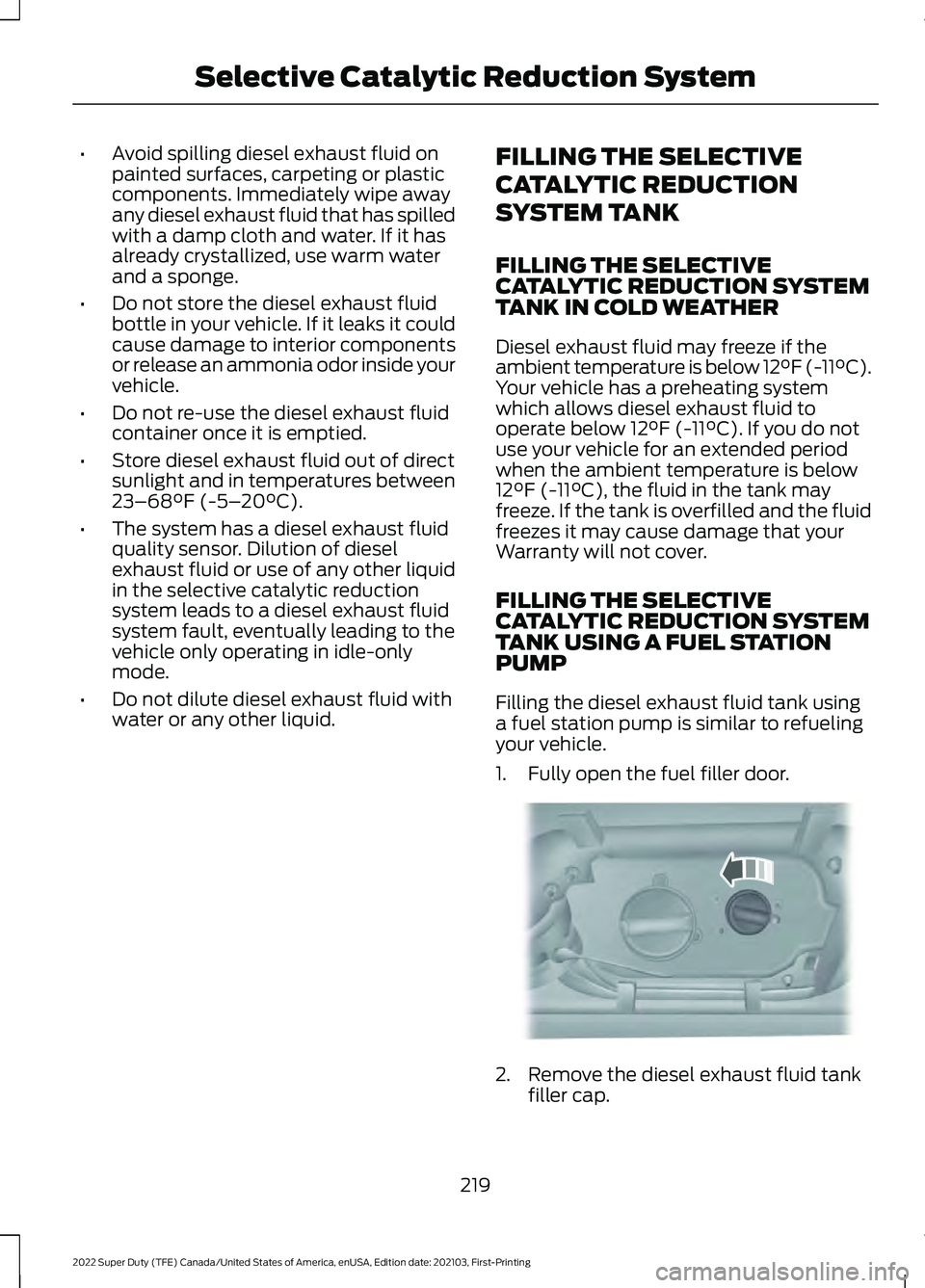
1. Fully open the fuel filler door. 2. Remove the diesel exhaust fluid tank
filler cap.
219
2022 Super Duty (TFE) Canada/United States of America, enUSA, Edition date: 202103, First-Printing Selective Catalytic Reduction SystemE328788
Page 223 of 740
Note:
The diesel exhaust fluid tank has a
blue filler cap.
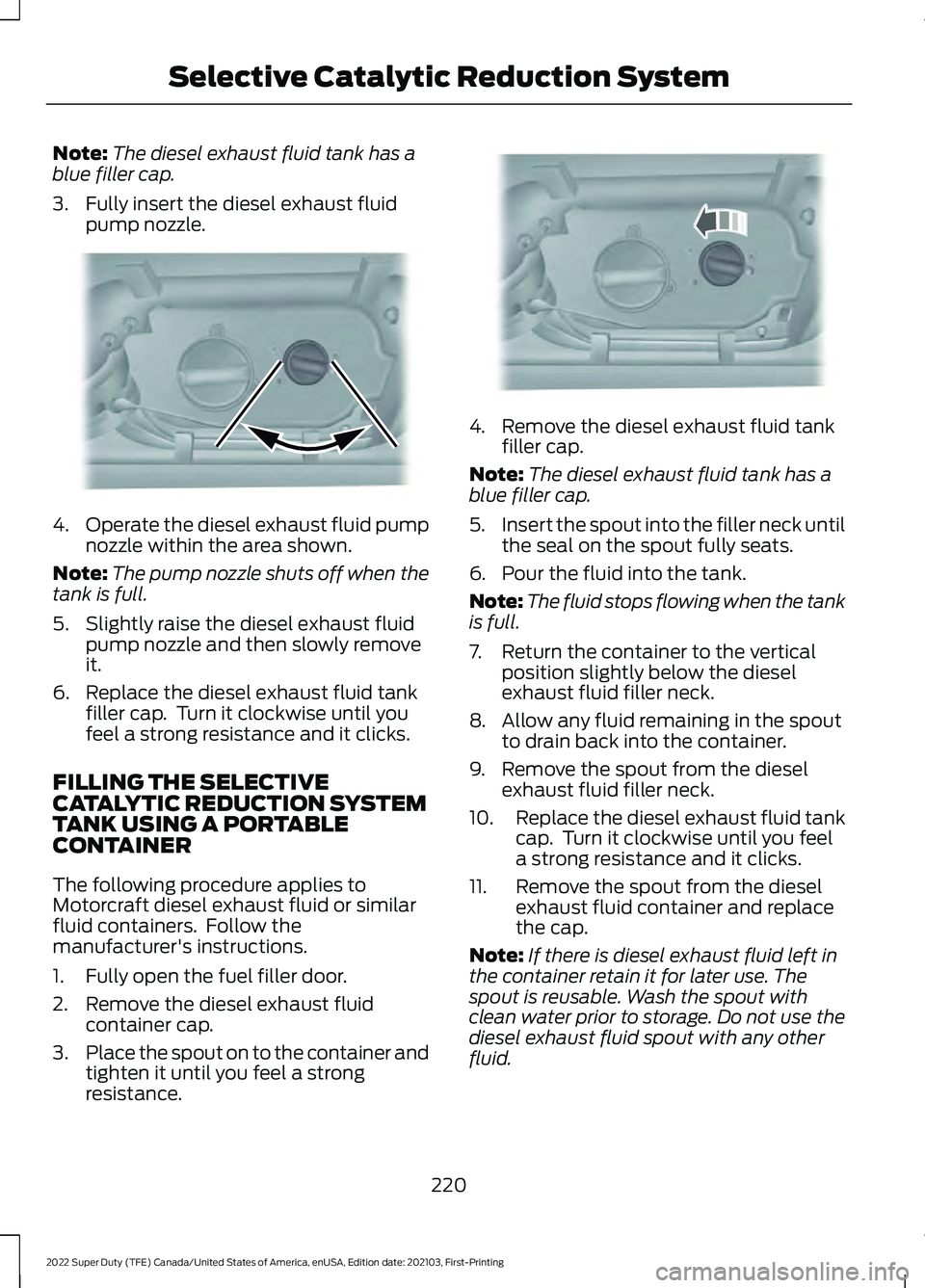
3. Fully insert the diesel exhaust fluid pump nozzle. 4.
Operate the diesel exhaust fluid pump
nozzle within the area shown.
Note: The pump nozzle shuts off when the
tank is full.
5. Slightly raise the diesel exhaust fluid pump nozzle and then slowly remove
it.
6. Replace the diesel exhaust fluid tank filler cap. Turn it clockwise until you
feel a strong resistance and it clicks.
FILLING THE SELECTIVE
CATALYTIC REDUCTION SYSTEM
TANK USING A PORTABLE
CONTAINER
The following procedure applies to
Motorcraft diesel exhaust fluid or similar
fluid containers. Follow the
manufacturer's instructions.
1. Fully open the fuel filler door.
2. Remove the diesel exhaust fluid container cap.
3. Place the spout on to the container and
tighten it until you feel a strong
resistance. 4. Remove the diesel exhaust fluid tank
filler cap.
Note: The diesel exhaust fluid tank has a
blue filler cap.
5. Insert the spout into the filler neck until
the seal on the spout fully seats.
6. Pour the fluid into the tank.
Note: The fluid stops flowing when the tank
is full.
7. Return the container to the vertical position slightly below the diesel
exhaust fluid filler neck.
8. Allow any fluid remaining in the spout to drain back into the container.
9. Remove the spout from the diesel exhaust fluid filler neck.
10. Replace the diesel exhaust fluid tank
cap. Turn it clockwise until you feel
a strong resistance and it clicks.
11. Remove the spout from the diesel exhaust fluid container and replace
the cap.
Note: If there is diesel exhaust fluid left in
the container retain it for later use. The
spout is reusable. Wash the spout with
clean water prior to storage. Do not use the
diesel exhaust fluid spout with any other
fluid.
220
2022 Super Duty (TFE) Canada/United States of America, enUSA, Edition date: 202103, First-Printing Selective Catalytic Reduction SystemE328783 E328788
Page 394 of 740
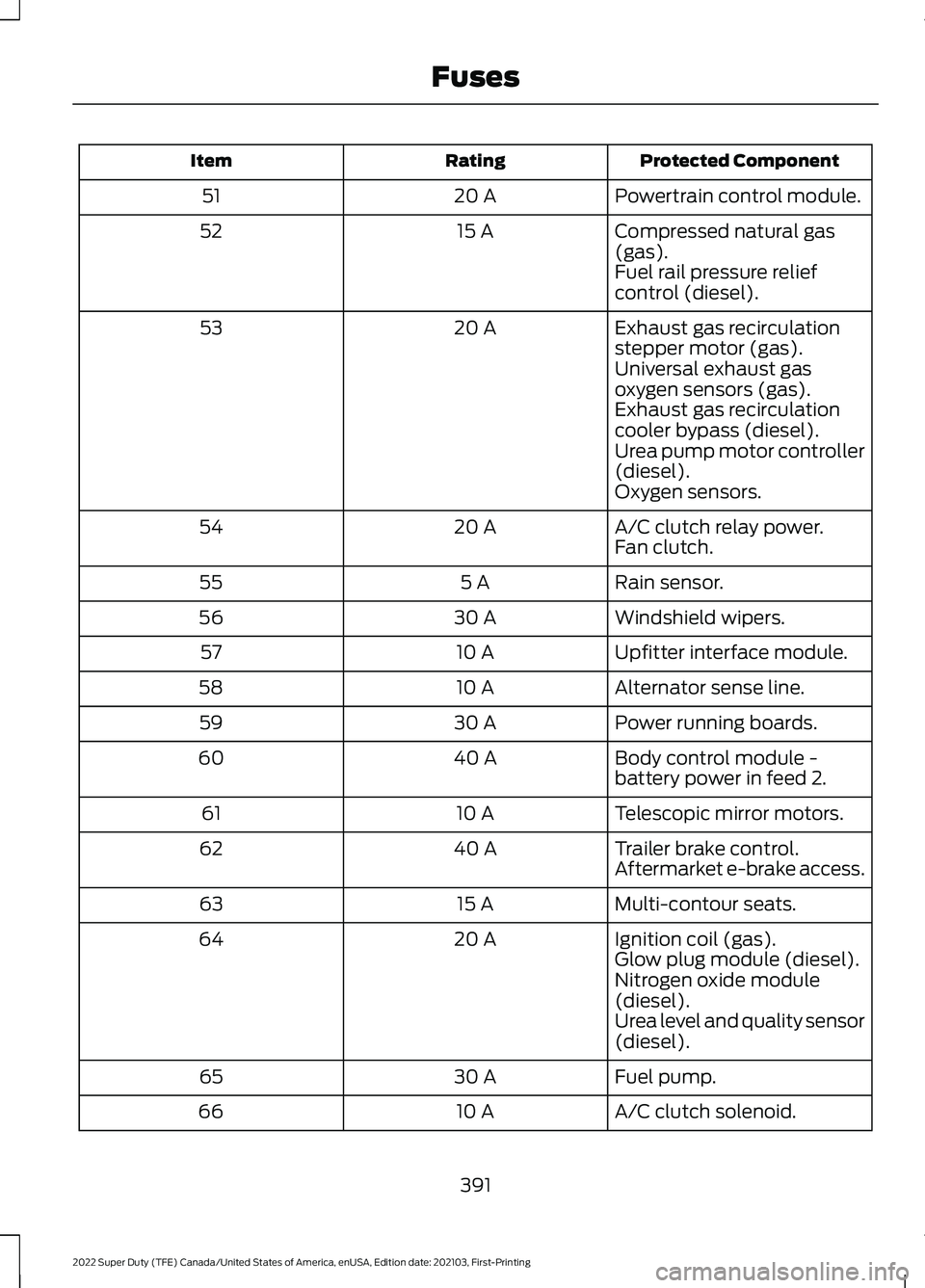
Protected Component
Rating
Item
Powertrain control module.
20 A
51
Compressed natural gas
(gas).
15 A
52
Fuel rail pressure relief
control (diesel).
Exhaust gas recirculation
stepper motor (gas).
20 A
53
Universal exhaust gas
oxygen sensors (gas).
Exhaust gas recirculation
cooler bypass (diesel).
Urea pump motor controller
(diesel).
Oxygen sensors.
A/C clutch relay power.
20 A
54
Fan clutch.
Rain sensor.
5 A
55
Windshield wipers.
30 A
56
Upfitter interface module.
10 A
57
Alternator sense line.
10 A
58
Power running boards.
30 A
59
Body control module -
battery power in feed 2.
40 A
60
Telescopic mirror motors.
10 A
61
Trailer brake control.
40 A
62
Aftermarket e-brake access.
Multi-contour seats.
15 A
63
Ignition coil (gas).
20 A
64
Glow plug module (diesel).
Nitrogen oxide module
(diesel).
Urea level and quality sensor
(diesel).
Fuel pump.
30 A
65
A/C clutch solenoid.
10 A
66
391
2022 Super Duty (TFE) Canada/United States of America, enUSA, Edition date: 202103, First-Printing Fuses
Page 430 of 740
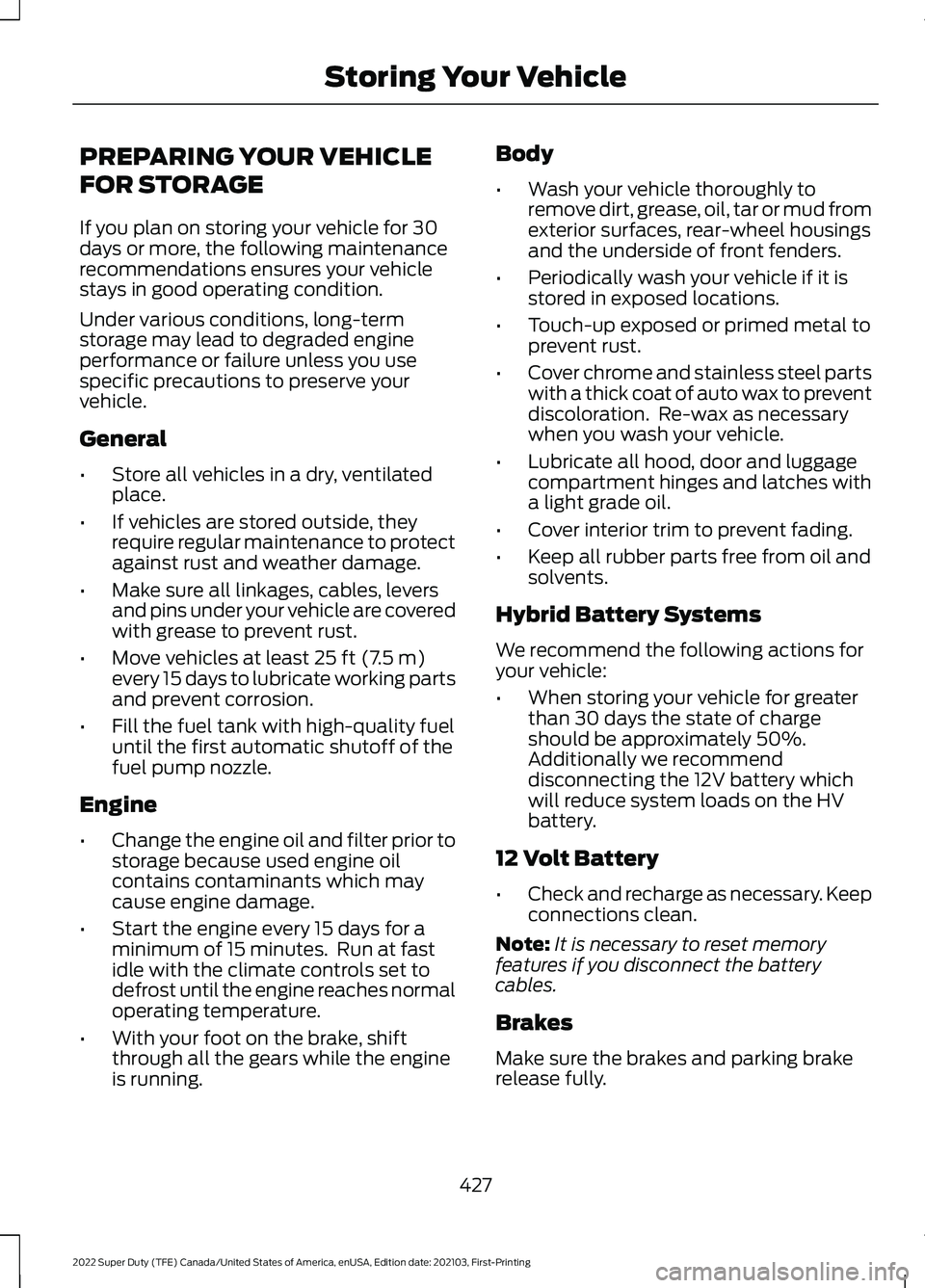
PREPARING YOUR VEHICLE
FOR STORAGE
If you plan on storing your vehicle for 30
days or more, the following maintenance
recommendations ensures your vehicle
stays in good operating condition.
Under various conditions, long-term
storage may lead to degraded engine
performance or failure unless you use
specific precautions to preserve your
vehicle.
General
•
Store all vehicles in a dry, ventilated
place.
• If vehicles are stored outside, they
require regular maintenance to protect
against rust and weather damage.
• Make sure all linkages, cables, levers
and pins under your vehicle are covered
with grease to prevent rust.
• Move vehicles at least 25 ft (7.5 m)
every 15 days to lubricate working parts
and prevent corrosion.
• Fill the fuel tank with high-quality fuel
until the first automatic shutoff of the
fuel pump nozzle.
Engine
• Change the engine oil and filter prior to
storage because used engine oil
contains contaminants which may
cause engine damage.
• Start the engine every 15 days for a
minimum of 15 minutes. Run at fast
idle with the climate controls set to
defrost until the engine reaches normal
operating temperature.
• With your foot on the brake, shift
through all the gears while the engine
is running. Body
•
Wash your vehicle thoroughly to
remove dirt, grease, oil, tar or mud from
exterior surfaces, rear-wheel housings
and the underside of front fenders.
• Periodically wash your vehicle if it is
stored in exposed locations.
• Touch-up exposed or primed metal to
prevent rust.
• Cover chrome and stainless steel parts
with a thick coat of auto wax to prevent
discoloration. Re-wax as necessary
when you wash your vehicle.
• Lubricate all hood, door and luggage
compartment hinges and latches with
a light grade oil.
• Cover interior trim to prevent fading.
• Keep all rubber parts free from oil and
solvents.
Hybrid Battery Systems
We recommend the following actions for
your vehicle:
• When storing your vehicle for greater
than 30 days the state of charge
should be approximately 50%.
Additionally we recommend
disconnecting the 12V battery which
will reduce system loads on the HV
battery.
12 Volt Battery
• Check and recharge as necessary. Keep
connections clean.
Note: It is necessary to reset memory
features if you disconnect the battery
cables.
Brakes
Make sure the brakes and parking brake
release fully.
427
2022 Super Duty (TFE) Canada/United States of America, enUSA, Edition date: 202103, First-Printing Storing Your Vehicle
Page 727 of 740
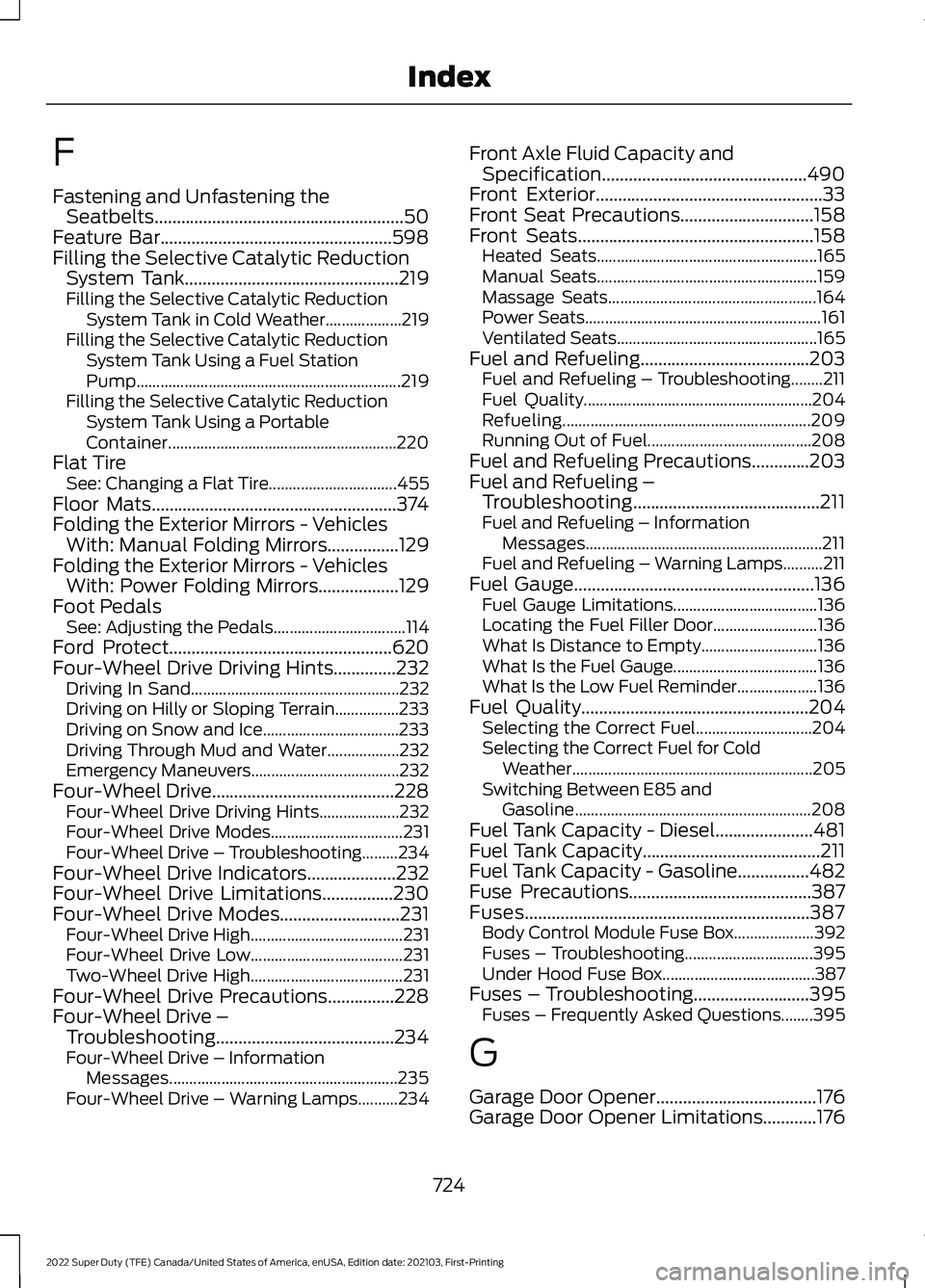
F
Fastening and Unfastening the
Seatbelts........................................................50
Feature Bar....................................................598
Filling the Selective Catalytic Reduction System Tank................................................219
Filling the Selective Catalytic Reduction System Tank in Cold Weather................... 219
Filling the Selective Catalytic Reduction System Tank Using a Fuel Station
Pump.................................................................. 219
Filling the Selective Catalytic Reduction System Tank Using a Portable
Container......................................................... 220
Flat Tire See: Changing a Flat Tire................................ 455
Floor Mats.......................................................374
Folding the Exterior Mirrors - Vehicles With: Manual Folding Mirrors................129
Folding the Exterior Mirrors - Vehicles With: Power Folding Mirrors..................129
Foot Pedals See: Adjusting the Pedals................................. 114
Ford Protect..................................................620
Four-Wheel Drive Driving Hints..............232 Driving In Sand.................................................... 232
Driving on Hilly or Sloping Terrain................233
Driving on Snow and Ice.................................. 233
Driving Through Mud and Water.................. 232
Emergency Maneuvers..................................... 232
Four-Wheel Drive.........................................228 Four-Wheel Drive Driving Hints.................... 232
Four-Wheel Drive Modes................................. 231
Four-Wheel Drive – Troubleshooting.........234
Four-Wheel Drive Indicators....................232
Four-Wheel Drive Limitations
................230
Four-Wheel Drive Modes...........................231 Four-Wheel Drive High...................................... 231
Four-Wheel Drive Low...................................... 231
Two-Wheel Drive High...................................... 231
Four-Wheel Drive Precautions...............228
Four-Wheel Drive – Troubleshooting........................................234
Four-Wheel Drive – Information Messages......................................................... 235
Four-Wheel Drive – Warning Lamps..........234 Front Axle Fluid Capacity and
Specification..............................................490
Front Exterior...................................................33
Front Seat Precautions..............................158
Front Seats
.....................................................158
Heated Seats....................................................... 165
Manual Seats....................................................... 159
Massage Seats.................................................... 164
Power Seats........................................................... 161
Ventilated Seats.................................................. 165
Fuel and Refueling......................................203 Fuel and Refueling – Troubleshooting........211
Fuel Quality......................................................... 204
Refueling.............................................................. 209
Running Out of Fuel......................................... 208
Fuel and Refueling Precautions.............203
Fuel and Refueling – Troubleshooting..........................................211
Fuel and Refueling – Information Messages........................................................... 211
Fuel and Refueling – Warning Lamps..........211
Fuel Gauge......................................................136 Fuel Gauge Limitations.................................... 136
Locating the Fuel Filler Door.......................... 136
What Is Distance to Empty............................. 136
What Is the Fuel Gauge.................................... 136
What Is the Low Fuel Reminder.................... 136
Fuel Quality
...................................................204
Selecting the Correct Fuel............................. 204
Selecting the Correct Fuel for Cold Weather............................................................ 205
Switching Between E85 and Gasoline........................................................... 208
Fuel Tank Capacity - Diesel......................481
Fuel Tank Capacity........................................211
Fuel Tank Capacity - Gasoline
................482
Fuse Precautions.........................................387
Fuses................................................................387 Body Control Module Fuse Box.................... 392
Fuses – Troubleshooting................................ 395
Under Hood Fuse Box...................................... 387
Fuses – Troubleshooting..........................395 Fuses – Frequently Asked Questions........395
G
Garage Door Opener....................................176
Garage Door Opener Limitations
............176
724
2022 Super Duty (TFE) Canada/United States of America, enUSA, Edition date: 202103, First-Printing Index