tow FORD TAURUS 1997 User Guide
[x] Cancel search | Manufacturer: FORD, Model Year: 1997, Model line: TAURUS, Model: FORD TAURUS 1997Pages: 167, PDF Size: 1.48 MB
Page 70 of 167
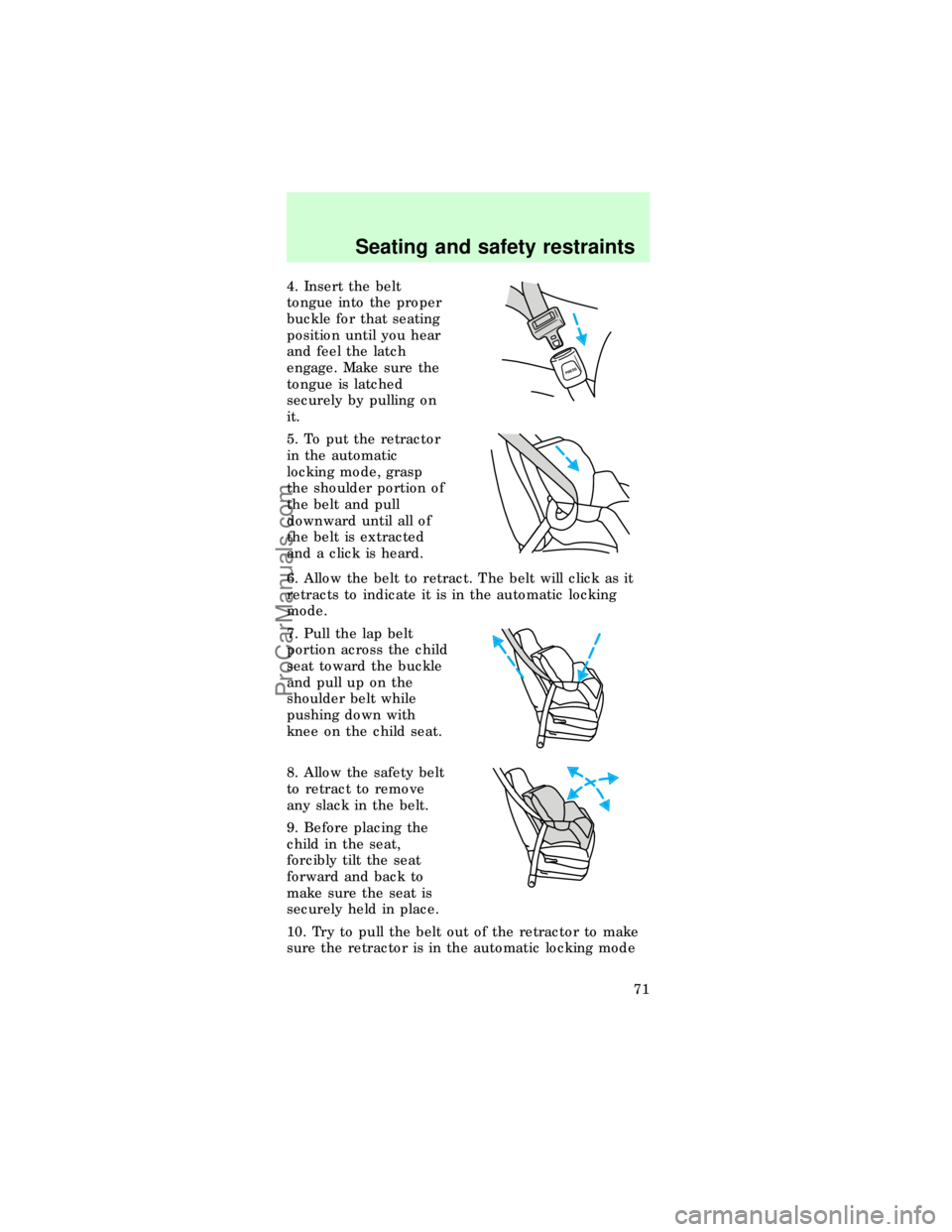
4. Insert the belt
tongue into the proper
buckle for that seating
position until you hear
and feel the latch
engage. Make sure the
tongue is latched
securely by pulling on
it.
5. To put the retractor
in the automatic
locking mode, grasp
the shoulder portion of
the belt and pull
downward until all of
the belt is extracted
and a click is heard.
6. Allow the belt to retract. The belt will click as it
retracts to indicate it is in the automatic locking
mode.
7. Pull the lap belt
portion across the child
seat toward the buckle
and pull up on the
shoulder belt while
pushing down with
knee on the child seat.
8. Allow the safety belt
to retract to remove
any slack in the belt.
9. Before placing the
child in the seat,
forcibly tilt the seat
forward and back to
make sure the seat is
securely held in place.
10. Try to pull the belt out of the retractor to make
sure the retractor is in the automatic locking mode
PRESS
Seating and safety restraints
71
ProCarManuals.com
Page 75 of 167

4. If connected, squeeze the top and the bottom of
the right half of the chest clip and pull to separate
both halves.
5. Place the child on the child seat and position the
shoulder belts over each shoulder.
6. Insert either the left
or the right safety belt
tongue into the single
opening of the crotch
safety belt buckle (it
doesn't matter which
tongue is inserted
first). Insert other
tongue. The color
green must appear in the indicator window on the
crotch safety belt buckle when buckled. Allow belts
to retract and fit snugly.
7. Fasten both halves
of the chest clip below
the child's shoulders
and adjust it to
comfortably hold the shoulder belts in place on the
child's chest. The color green must appear in the
indicator window when fastened.
8. Pull the shoulder belts toward you to make sure
the crotch safety belt buckle is properly fastened
and the retractor is locked.
9. If the belts become too tight, unbuckle the crotch
safety belt buckle to unlock the retractors, then
reinsert both belt tongues.
Removing your child from the built-in child seat
1. Squeeze the tabs on the top and the bottom of
the chest clip and pull the halves apart to open the
chest clip.
2. Press the release button on the crotch safety belt
buckle.
3. Slide the shoulder belts off the child's shoulders
and remove the child.
Seating and safety restraints
76
ProCarManuals.com
Page 76 of 167
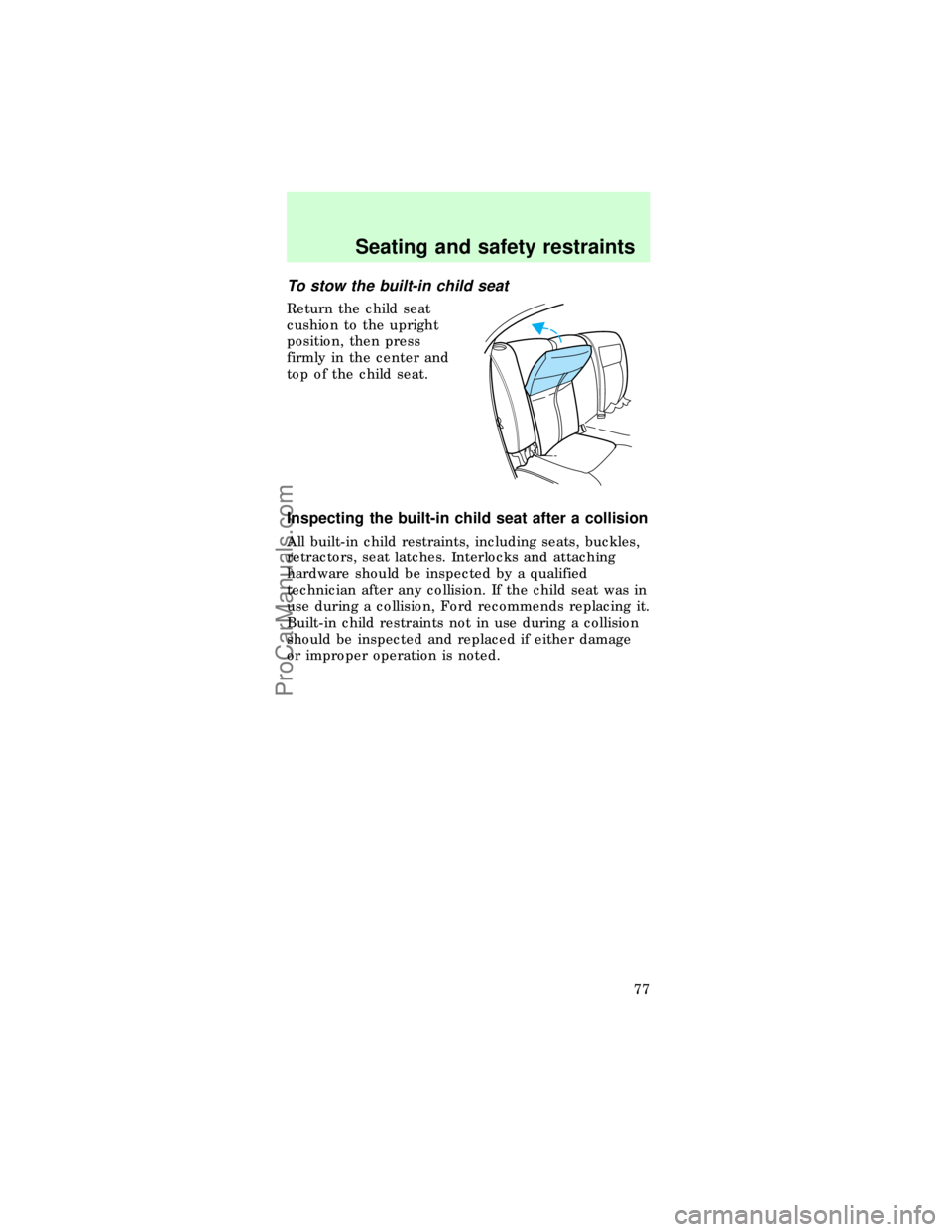
To stow the built-in child seat
Return the child seat
cushion to the upright
position, then press
firmly in the center and
top of the child seat.
Inspecting the built-in child seat after a collision
All built-in child restraints, including seats, buckles,
retractors, seat latches. Interlocks and attaching
hardware should be inspected by a qualified
technician after any collision. If the child seat was in
use during a collision, Ford recommends replacing it.
Built-in child restraints not in use during a collision
should be inspected and replaced if either damage
or improper operation is noted.
Seating and safety restraints
77
ProCarManuals.com
Page 85 of 167

Pull release handle
toward you to release
parking brake. Driving
with the parking brake
on will cause the
brakes to wear out
quickly and reduce fuel
economy.
SEMI-ACTIVE RIDE CONTROL (TAURUS SHO
ONLY)
Firm shock absorber performance enhances ride and
handling during certain road conditions. The shock
absorber is returned to a softer performance when
driver or road induced motion ceases. This system is
automatic and requires no driver input.
TRANSAXLE
Brake-shift interlock
This vehicle is equipped with a brake-shift interlock
feature that prevents the gearshift from being moved
from P (Park) unless the brake pedal is pressed.
If you cannot move the gearshift out of P (Park)
with the brake pedal depressed:
1. Apply the parking brake, turn ignition key to
LOCK, then remove the key.
2. Insert the key and turn it to OFF. Apply the brake
pedal and shift to N (Neutral).
3. Start the vehicle.
If it is necessary to use the above procedure to
move the gearshift, it is possible that a fuse has
blown and the vehicle's brake lamps may not be
operating properly. Refer toFuses and relaysin the
Roadside emergencieschapter.
Driving
86
ProCarManuals.com
Page 92 of 167

²GVW (Gross Vehicle Weight): Base curb weight
plus payload and weight. The GVW is not a limit
or a specification.
²GVWR (Gross Vehicle Weight Rating):
Maximum total weight of the base vehicle,
passengers, optional equipment and cargo. The
GVWR is specific to each vehicle and is listed on
the Safety Compliance Label on the driver's door
pillar.
²GAWR (Gross Axle Weight Rating): Carrying
capacity for each axle system. The GAWR is
specific to each vehicle and is listed on the Safety
Compliance Label on the driver's door pillar.
²GCWR (Gross Combined Weight Rating):
Maximum combined weight of towing vehicle
(including passengers and cargo) and the trailer.
The GCWR indicates the maximum loaded weight
that the vehicle is allowed to tow.
²Maximum Trailer Weight Rating: Maximum
weight of a trailer the vehicle is permitted to tow.
The maximum trailer weight rating equals the
vehicle curb weight for each engine/transaxle
combination, any required option weight for
trailer towing and the weight of the driver from
the GCWR for the towing vehicle.
²Maximum Trailer Weight: maximum weight of a
trailer the loaded vehicle (including passengers
and cargo) is permitted to tow. It is determined
by subtracting the weight of the loaded trailer
towing vehicle from the GCWR for the towing
vehicle.
²Trailer Weight Range: Specified weight range
that the trailer must fall within that ranges from
zero to the maximum trailer weight rating
Remember to figure in the tongue load of your
loaded trailer when figuring the total weight.
Driving
93
ProCarManuals.com
Page 93 of 167
Do not exceed the GVWR or the GAWR
specified on the Safety Compliance
Certification Label.
Do not use replacement tires with lower weight
capacities than the originals because they may lower
the vehicle's GVWR and GAWR limitations.
Replacement tires with a higher weight limit than
the originals do not increase the GVWR and GAWR
limitations.
TRAILER TOWING
Your vehicle is classified as a light duty towing the
vehicle. The amount of weight you can safely tow
depends on the type of engine you have in your
vehicle. Your vehicle does not come from the factory
fully equipped to tow. No towing packages are
available through Ford or Mercury/Lincoln dealers.
Do not tow a trailer until your vehicle has been
driven at least 800 km (500 miles). If towing with a
station wagon, inflate the rear tires to 35 psi.
Towing a trailer places an additional load on your
vehicle's engine, transaxle, brakes, tires and
suspension. Inspect these components carefully after
towing.
The amount of weight that you can tyow depends on
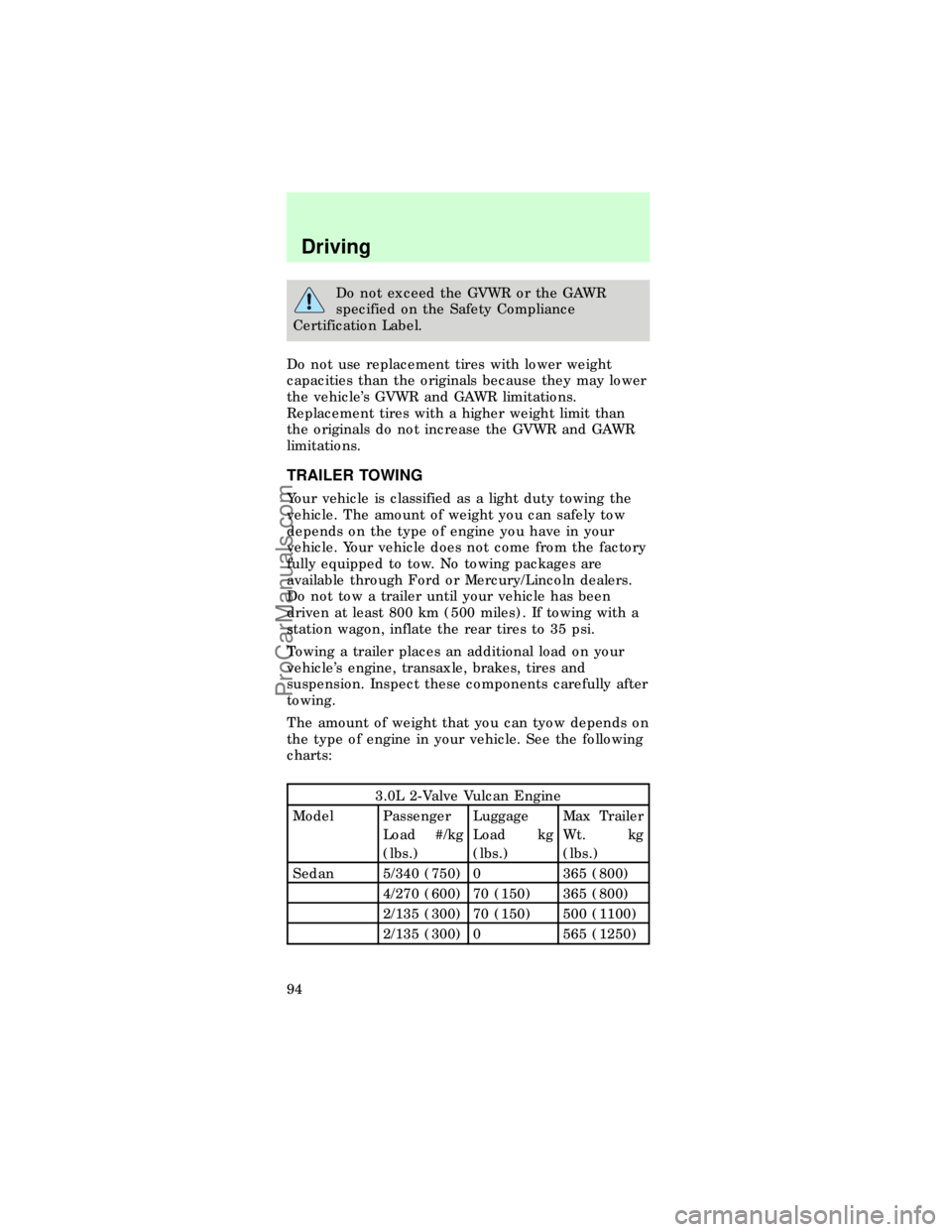
the type of engine in your vehicle. See the following
charts:
3.0L 2-Valve Vulcan Engine
Model Passenger
Load #/kg
(lbs.)Luggage
Load kg
(lbs.)Max Trailer
Wt. kg
(lbs.)
Sedan 5/340 (750) 0 365 (800)
4/270 (600) 70 (150) 365 (800)
2/135 (300) 70 (150) 500 (1100)
2/135 (300) 0 565 (1250)
Driving
94
ProCarManuals.com
Page 94 of 167
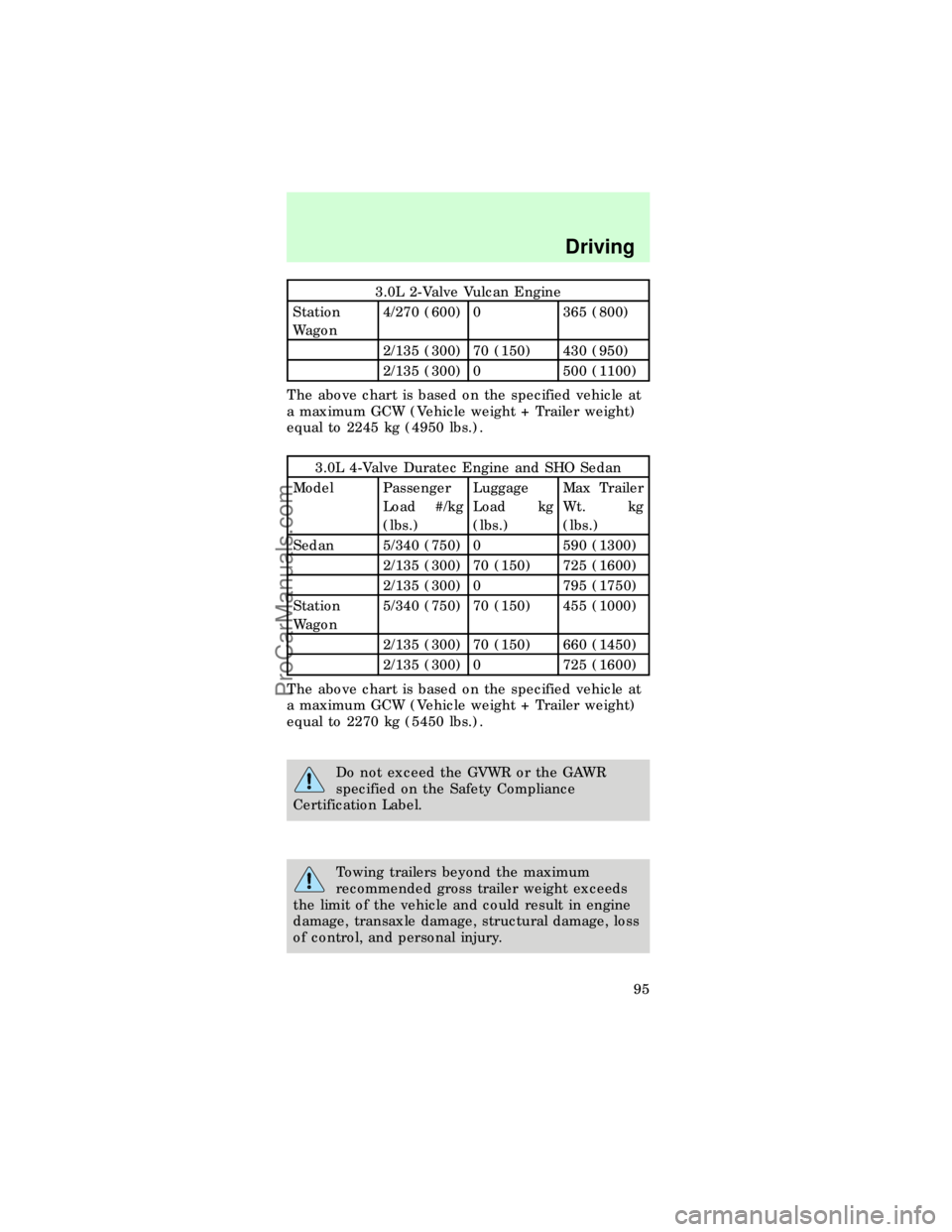
3.0L 2-Valve Vulcan Engine
Station
Wagon4/270 (600) 0 365 (800)
2/135 (300) 70 (150) 430 (950)
2/135 (300) 0 500 (1100)
The above chart is based on the specified vehicle at
a maximum GCW (Vehicle weight + Trailer weight)
equal to 2245 kg (4950 lbs.).
3.0L 4-Valve Duratec Engine and SHO Sedan
Model Passenger
Load #/kg
(lbs.)Luggage
Load kg
(lbs.)Max Trailer
Wt. kg
(lbs.)
Sedan 5/340 (750) 0 590 (1300)
2/135 (300) 70 (150) 725 (1600)
2/135 (300) 0 795 (1750)
Station
Wagon5/340 (750) 70 (150) 455 (1000)
2/135 (300) 70 (150) 660 (1450)
2/135 (300) 0 725 (1600)
The above chart is based on the specified vehicle at
a maximum GCW (Vehicle weight + Trailer weight)
equal to 2270 kg (5450 lbs.).
Do not exceed the GVWR or the GAWR
specified on the Safety Compliance
Certification Label.
Towing trailers beyond the maximum
recommended gross trailer weight exceeds
the limit of the vehicle and could result in engine
damage, transaxle damage, structural damage, loss
of control, and personal injury.
Driving
95
ProCarManuals.com
Page 95 of 167
Preparing to tow
Use the proper equipment for towing a trailer, and
make sure it is properly attached to your vehicle.
See your dealer or a reliable trailer dealer if you
require assistance.
Hitches
Your vehicle has a load carrying hitch. This type of
hitch places the tongue load of a trailer on the rear
wheels of your vehicle. You must distribute the load
in your trailer so that 10±15% of the total weight of
the trailer is on the tongue.
Safety chains
Always connect the trailer's safety chains to the
vehicle. To connect the trailer's safety chains, cross
the chains under the trailer tongue and allow slack
for turning corners.
If your use a rental trailer, follow the instructions
that the rental agency gives to you.
Trailer brakes
Electric brakes and manual, automatic or surge-type
brakes are safe if installed properly and adjust them
to the manufacturer's specifications. The trailer
brakes must meet local and Federal regulations.
Do not connect a trailer's hydraulic brake
system directly to your vehicle's brake
system. Your vehicle may not have enough braking
power and your chances of having a collision
greatly increase.
Trailer lamps
Trailer lamps are required on most towed vehicles.
Make sure your trailer lamps conform to local and
Federal regulations. See your dealer or trailer rental
agency for proper instructions and equipment for
hooking up trailer lamps.
Driving
96
ProCarManuals.com
Page 96 of 167

Driving while you tow
Do not drive faster than 72 km/h (45 mph) with any
weight on the trailer while towing on a hot day or in
hilly country.
Cruise control may shut off if you are towing on
long, steep grades.
When towing a trailer:
²Use 2 (Second) (if equipped) or 1 (First) when
towing up or down steep hills. This will eliminate
excessive downshifting and upshifting for
optimum fuel economy and transaxle cooling.
²Anticipate stops and brake gradually.
Servicing after towing
If you tow a trailer for long distances, your vehicle
will require more frequent service intervals. Refer to
theService Guidefor more information.
Trailer towing tips
²Practice turning, stopping and backing up in an
area before starting on a trip to get the feel of the
vehicle trailer combination. When turning, drive
slightly beyond the normal turning point so the
trailer wheels will clear curbs and other obstacles.
²Allow more room for stopping with a trailer
attached.
²The trailer tongue weight should be 10±15% of
the loaded trailer weight.
²After you have traveled 80 km (50 miles),
thoroughly check your hitch, electrical
connections and trailer wheel lug nuts.
²When stopped in traffic for long periods of time in
hot weather, place the gearshift in P (Park) and
increase idle speed. This aids engine cooling and
air conditioner efficiency.
²Vehicles with trailers should not be parked on a
grade. If you must park on a grade, place wheel
chocks under the trailer's wheels.
Driving
97
ProCarManuals.com
Page 108 of 167
CHANGING THE TIRES
Temporary spare tire information
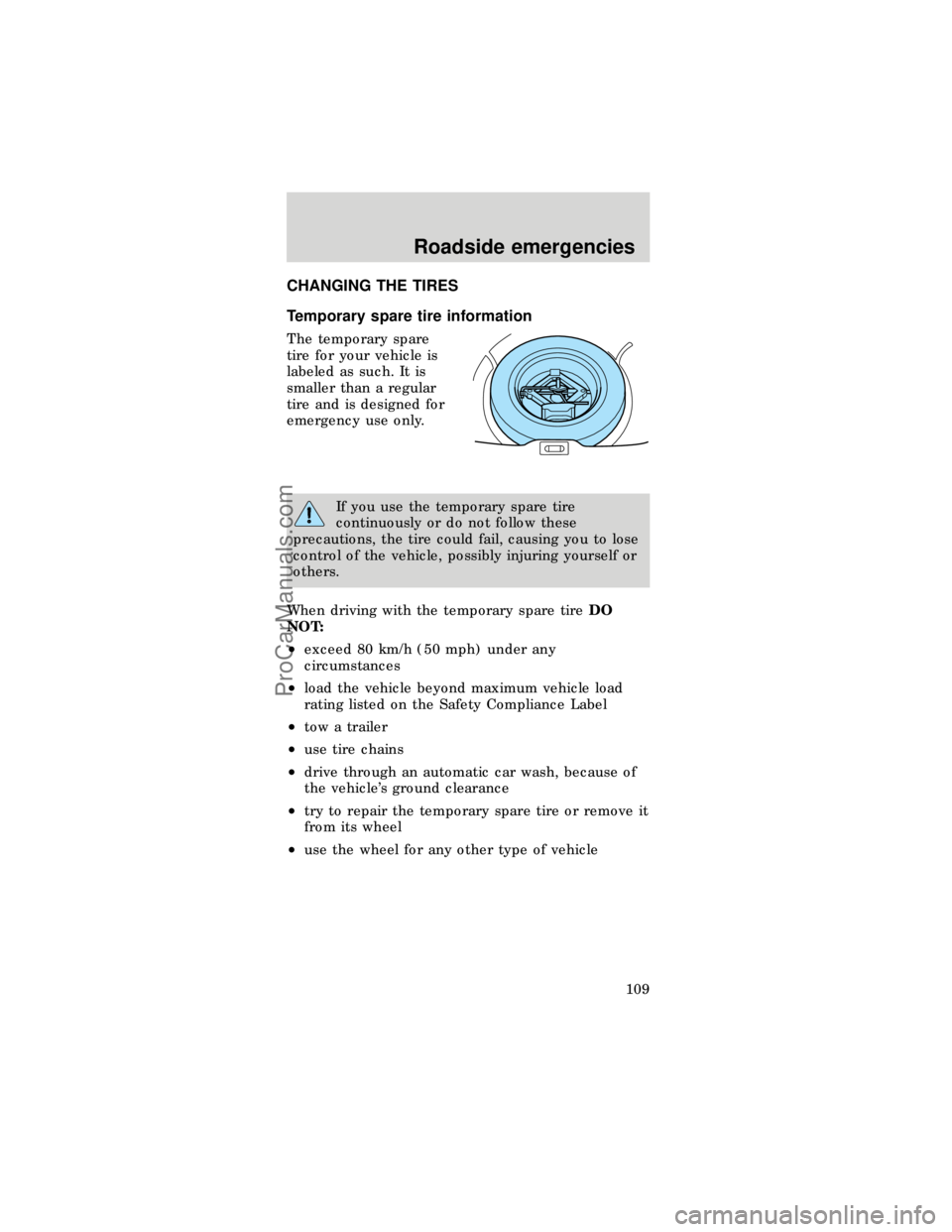
The temporary spare
tire for your vehicle is
labeled as such. It is
smaller than a regular
tire and is designed for
emergency use only.
If you use the temporary spare tire
continuously or do not follow these
precautions, the tire could fail, causing you to lose
control of the vehicle, possibly injuring yourself or
others.
When driving with the temporary spare tireDO
NOT:
²exceed 80 km/h (50 mph) under any
circumstances
²load the vehicle beyond maximum vehicle load
rating listed on the Safety Compliance Label
²tow a trailer
²use tire chains
²drive through an automatic car wash, because of
the vehicle's ground clearance
²try to repair the temporary spare tire or remove it
from its wheel
²use the wheel for any other type of vehicle
Roadside emergencies
109
ProCarManuals.com