fuel FORD TAURUS 1997 Owner's Manual
[x] Cancel search | Manufacturer: FORD, Model Year: 1997, Model line: TAURUS, Model: FORD TAURUS 1997Pages: 167, PDF Size: 1.48 MB
Page 125 of 167
CHECKING AND ADDING WASHER FLUID
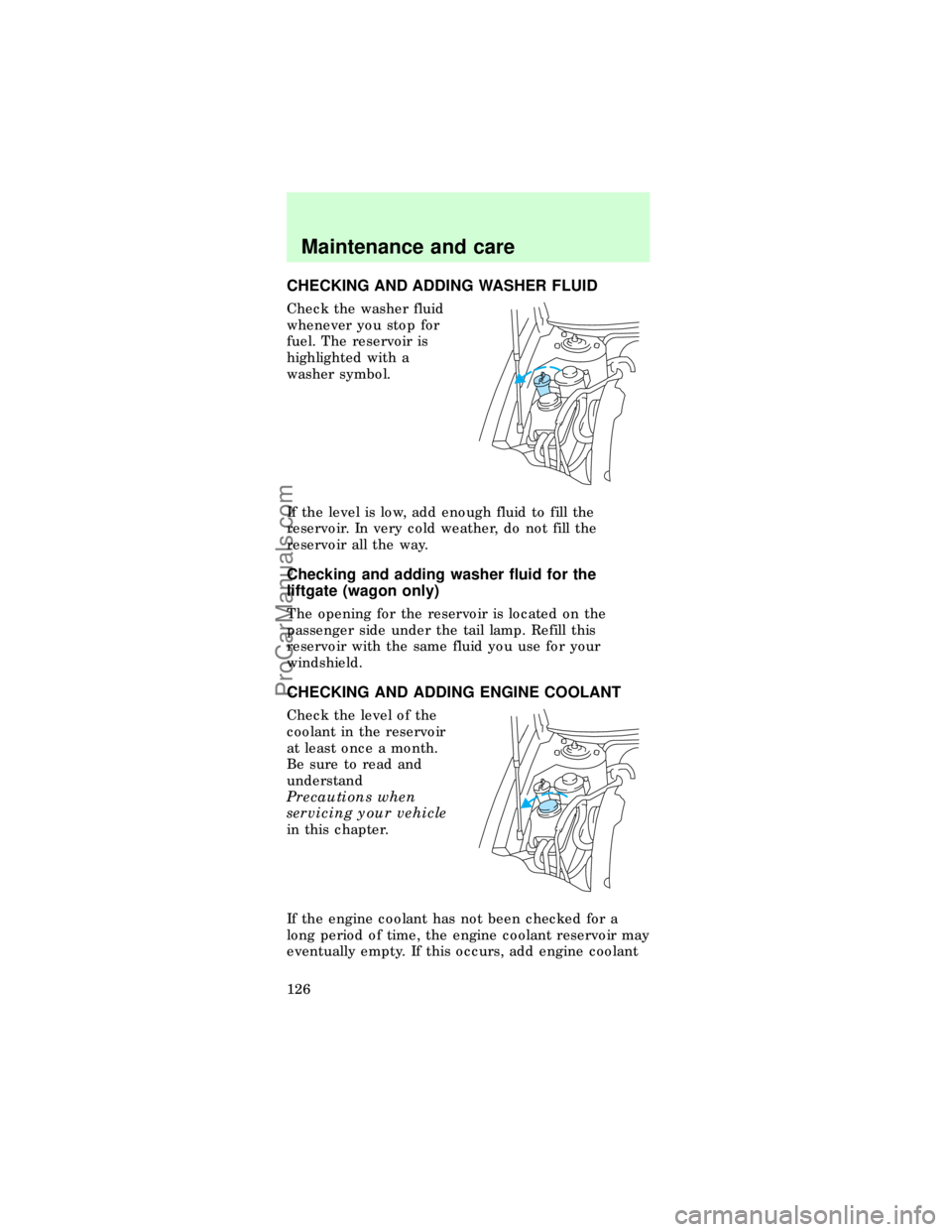
Check the washer fluid
whenever you stop for
fuel. The reservoir is
highlighted with a
washer symbol.
If the level is low, add enough fluid to fill the
reservoir. In very cold weather, do not fill the
reservoir all the way.
Checking and adding washer fluid for the
liftgate (wagon only)
The opening for the reservoir is located on the
passenger side under the tail lamp. Refill this
reservoir with the same fluid you use for your
windshield.
CHECKING AND ADDING ENGINE COOLANT
Check the level of the
coolant in the reservoir
at least once a month.
Be sure to read and
understand
Precautions when
servicing your vehicle
in this chapter.
If the engine coolant has not been checked for a
long period of time, the engine coolant reservoir may
eventually empty. If this occurs, add engine coolant
Maintenance and care
126
ProCarManuals.com
Page 133 of 167
²Always dispose of automotive batteries in a
responsible manner. Follow your communities
standards for disposal. Call your local recycling
center to find out more about recycling
automotive batteries.
CHANGING YOUR AIR FILTER
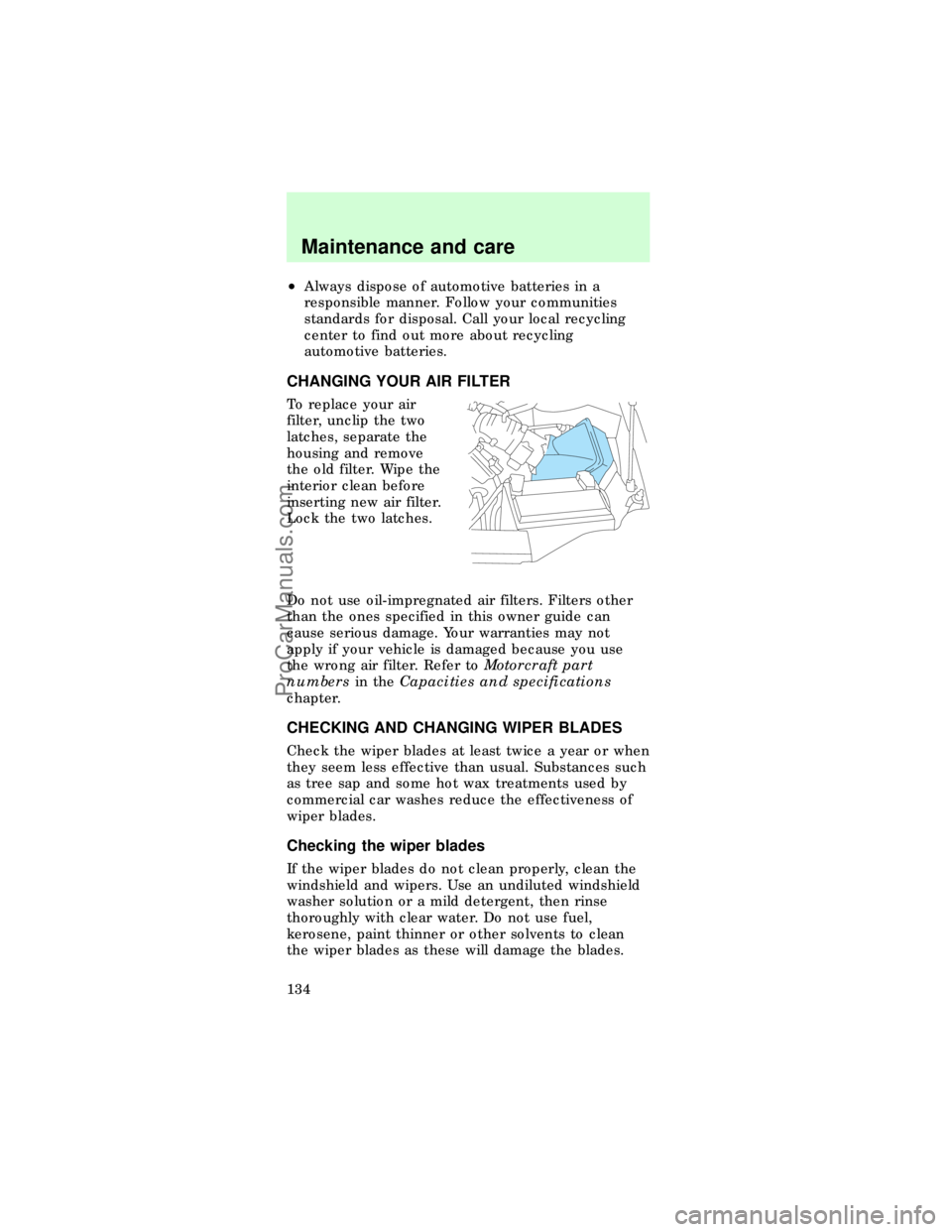
To replace your air
filter, unclip the two
latches, separate the
housing and remove
the old filter. Wipe the
interior clean before
inserting new air filter.
Lock the two latches.
Do not use oil-impregnated air filters. Filters other
than the ones specified in this owner guide can
cause serious damage. Your warranties may not
apply if your vehicle is damaged because you use
the wrong air filter. Refer toMotorcraft part
numbersin theCapacities and specifications
chapter.
CHECKING AND CHANGING WIPER BLADES
Check the wiper blades at least twice a year or when
they seem less effective than usual. Substances such
as tree sap and some hot wax treatments used by
commercial car washes reduce the effectiveness of
wiper blades.
Checking the wiper blades
If the wiper blades do not clean properly, clean the
windshield and wipers. Use an undiluted windshield
washer solution or a mild detergent, then rinse
thoroughly with clear water. Do not use fuel,
kerosene, paint thinner or other solvents to clean
the wiper blades as these will damage the blades.
Maintenance and care
134
ProCarManuals.com
Page 137 of 167
Tires that are larger or smaller than your vehicle's
original tires may also affect the accuracy of your
speedometer.
SNOW TIRES AND CHAINS
The tires on your vehicle have all weather treads to
provide traction in rain and snow. However, in some
climates, you may need to use snow tires and
chains. Follow these guidelines when using snow
tires and chains:
²Use only SAE Class S chains.
²Install chains securely, verifying that the chains do
not touch any wiring, brake lines or fuel lines.
²Drive cautiously. If you hear the chains rub or
bang against your vehicle, stop and re-tighten the
chains. If this does not work, remove the chains
to prevent damage to your vehicle.
²If possible, avoid fully loading your vehicle.
²Do not use tire chains on aluminum wheels.
²Do not use tire chains if your vehicle is equipped
with P225/55VR16 tires.
²Remove the tire chains when they are no longer
needed. Do not use tire chains on dry roads.
²The suspension insulation and bumpers will help
prevent vehicle damage. Do not remove these
components from your vehicle when using snow
tires and chains.
WHAT YOU SHOULD KNOW ABOUT
AUTOMOTIVE FUELS
Important safety precautions
Do not overfill the fuel tank. The pressure in
an overfilled tank may cause leakage and
lead to fuel spray and fire.
Maintenance and care
138
ProCarManuals.com
Page 138 of 167
If you do not use the proper fuel cap, the
pressure in the fuel tank can damage the
fuel system or cause it to work improperly in a
collision.
The fuel system may be under pressure. If
the fuel cap is venting vapor or if you hear a
hissing sound, wait until it stops before completely
removing the cap.
Automotive fuels can cause serious injury or
death if misused or mishandled.
Observe the following guidelines when handling
automotive fuel:
²Extinguish all
smoking materials
and any open flames
before fueling your
vehicle.
²Always turn off the
vehicle before
fueling.
²Automotive fuels can be harmful or fatal if
swallowed. If fuel is swallowed, call a physician
immediately, even if no symptoms are immediately
apparent. The toxic affects of fuel may not be
visible for hours.
²Fuels can also be harmful if absorbed through the
skin. If fuel is splashed on the skin, promptly
remove contaminated clothing and wash skin
thoroughly with soap and water.
²If fuel is splashed in the eyes, remove contact
lenses, flush with water for 15 minutes and seek
medical attention.
Maintenance and care
139
ProCarManuals.com
Page 139 of 167
²Be particularly careful if you are taking
ªAntabuseº or other forms of disulfiram for the
treatment of alcoholism. Breathing gasoline vapors
or skin contact could cause an adverse reaction.
Consult a physician immediately.
Choosing the right fuel
Use only UNLEADED FUEL. The use of leaded fuel
is prohibited by law and could damage your vehicle.
The damage may not be covered by your warranty.
Your vehicle was not designed to use fuel containing
manganese-based additives such as MMT.
Additionally, vehicles certified to California emission
standards (indicated on the underhood Vehicle
Emissions Control Information label) are designed to
operate on California reformulated gasolines. If
California reformulated gasoline is not available
when you refuel, your vehicle can be operated on
non-California fuels. However, even though your
engine will perform adequately on other gasolines,
the performance of the emission control devices and
systems may be adversely affected. Repair of
damage caused by using a fuel that your vehicle was
not designed for may not be covered by your
warranty.
Octane recommendations
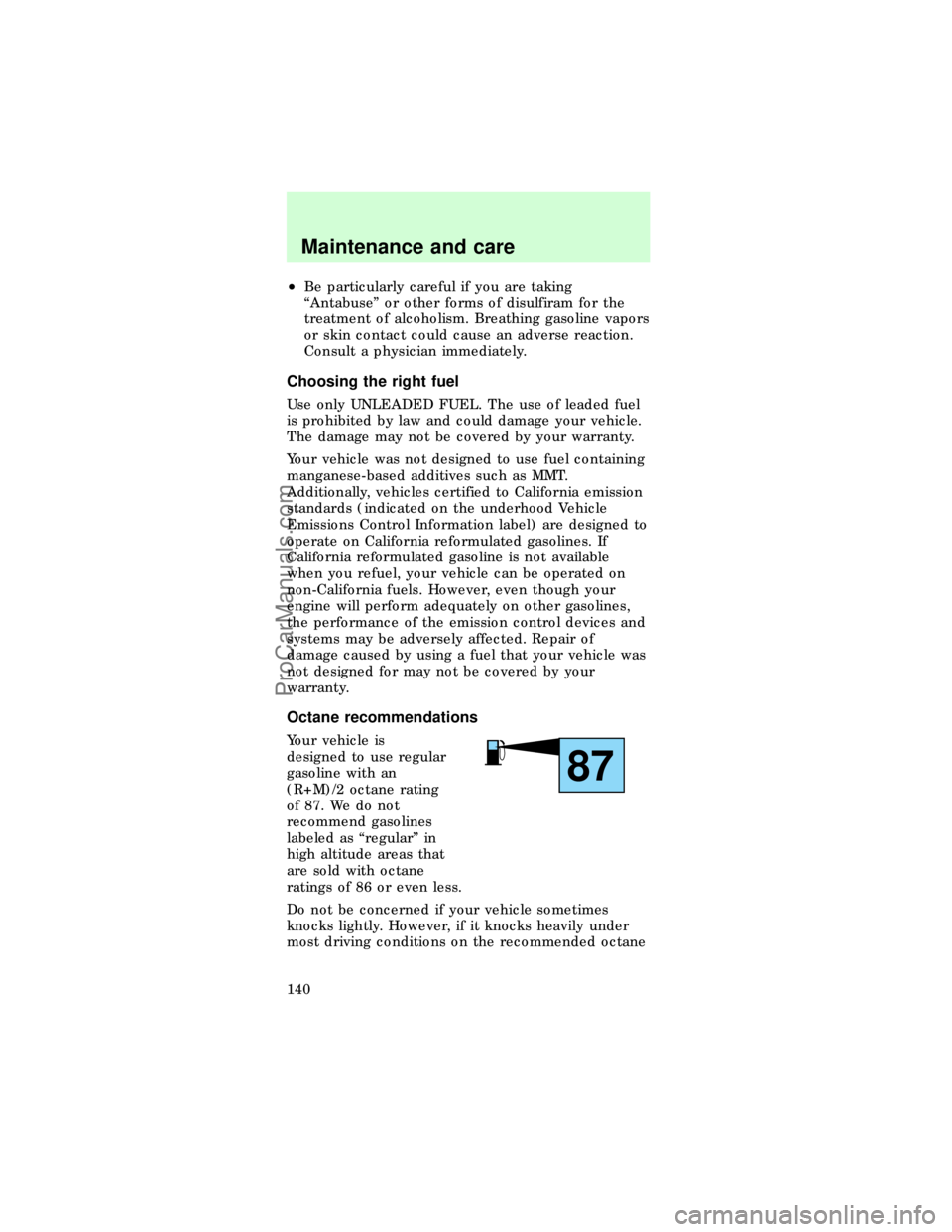
Your vehicle is
designed to use regular
gasoline with an
(R+M)/2 octane rating
of 87. We do not
recommend gasolines
labeled as ªregularº in
high altitude areas that
are sold with octane
ratings of 86 or even less.
Do not be concerned if your vehicle sometimes
knocks lightly. However, if it knocks heavily under
most driving conditions on the recommended octane
87
Maintenance and care
140
ProCarManuals.com
Page 140 of 167
fuel, see your dealer or a qualified service technician
to prevent any engine damage.
SHO engines
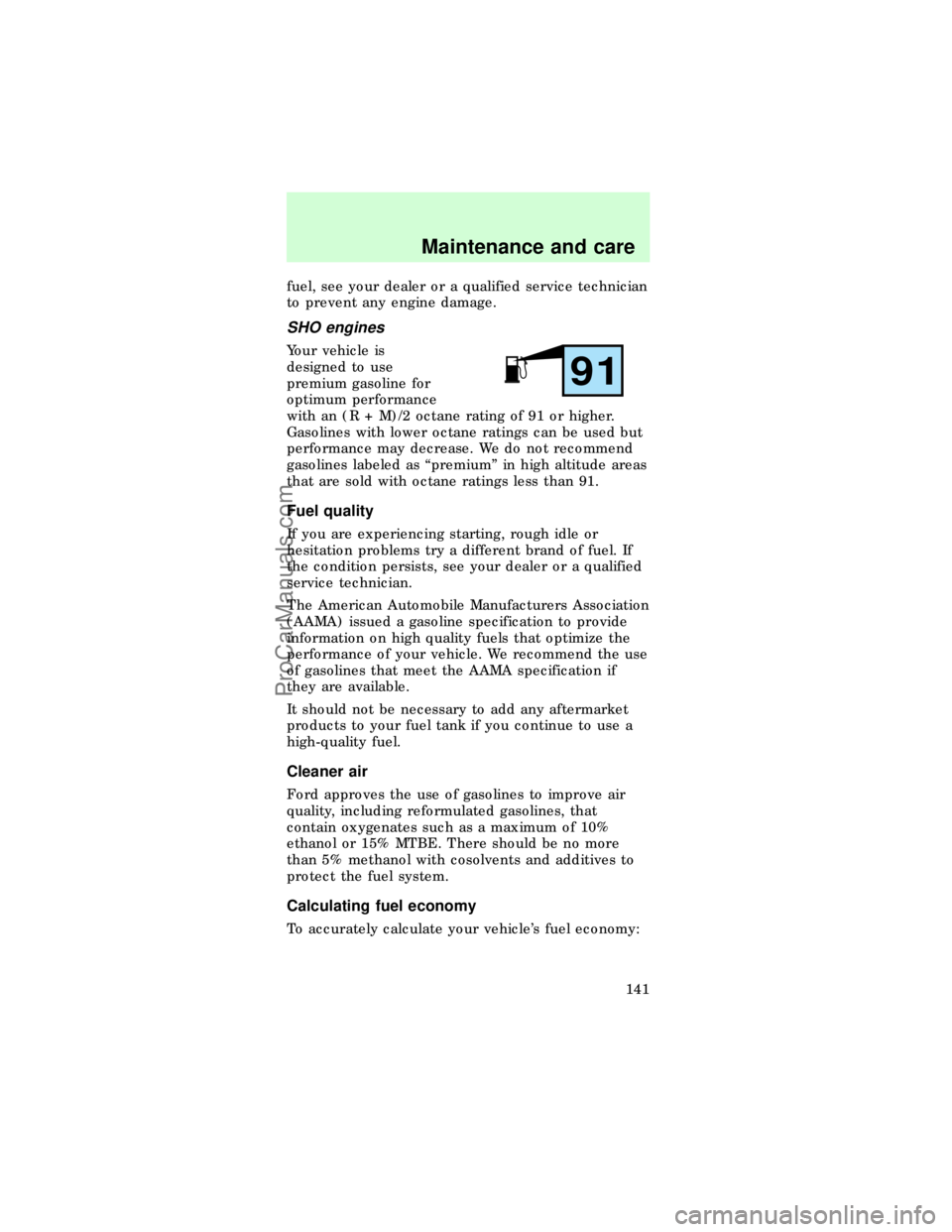
Your vehicle is
designed to use
premium gasoline for
optimum performance
with an (R + M)/2 octane rating of 91 or higher.
Gasolines with lower octane ratings can be used but
performance may decrease. We do not recommend
gasolines labeled as ªpremiumº in high altitude areas
that are sold with octane ratings less than 91.
Fuel quality
If you are experiencing starting, rough idle or
hesitation problems try a different brand of fuel. If
the condition persists, see your dealer or a qualified
service technician.
The American Automobile Manufacturers Association
(AAMA) issued a gasoline specification to provide
information on high quality fuels that optimize the
performance of your vehicle. We recommend the use
of gasolines that meet the AAMA specification if
they are available.
It should not be necessary to add any aftermarket
products to your fuel tank if you continue to use a
high-quality fuel.
Cleaner air
Ford approves the use of gasolines to improve air
quality, including reformulated gasolines, that
contain oxygenates such as a maximum of 10%
ethanol or 15% MTBE. There should be no more
than 5% methanol with cosolvents and additives to
protect the fuel system.
Calculating fuel economy
To accurately calculate your vehicle's fuel economy:
91
Maintenance and care
141
ProCarManuals.com
Page 141 of 167
1. Fill the tank completely and record the initial
odometer reading.
2. Each time you fill the tank, record the amount of
fuel added (in liters or gallons).
3. After at least three to five fuel tank fill-ups, fill
the fuel tank and record the current mileage
reading.
4. Use one of the following equations to calculate
fuel economy.
Liters used x 1004Total kilometers traveled
Total miles traveled4Total gallons used
Keep a record for at least one month. This will
provide an accurate estimate of the vehicle's fuel
economy.
EMISSION CONTROL SYSTEM
Your vehicle is equipped with catalytic converters
which enable your vehicle to comply with applicable
exhaust emission requirements.
Exhaust leaks may result in the entry of
harmful and potentially lethal fumes into the
passenger compartment. Under extreme conditions
excessive exhaust temperatures could damage the
fuel system, the interior floor covering, or other
vehicle components, possibly causing a fire.
To make sure that the catalytic converter and the
other emission control parts continue to work
properly:
²Use only unleaded fuel.
²Avoid running out of fuel.
²Do not turn off the ignition while your vehicle is
moving, especially at high speeds.
²Have the services listed in yourService Guide
performed according to the specified schedule.
Maintenance and care
142
ProCarManuals.com
Page 142 of 167
The Scheduled Maintenance Services listed in the
Service Guideare required because they are
considered essential to the life and performance of
your vehicle and to its emissions system.
Ford strongly recommends the use of genuine Ford
replacement parts. If other than Ford or Motorcraft
parts or Ford authorized parts are used for
maintenance replacements or for the service of
components affecting emission control, such
non-Ford parts should be equivalent to genuine Ford
Motor Company parts in performance and durability.
It is the owner's responsibility to determine the
equivalency of such parts. Please consult your
Warranty Information Booklet for complete warranty
information.
Do not park, idle, or drive your vehicle in
dry grass or other dry ground cover. The
emission system heats up the engine compartment
and exhaust system, which can start a fire.
Watch for fluid leaks, strange odors, smoke, loss of
oil pressure, the charging system warning light, the
service engine soon light or the temperature warning
light. These sometimes indicate that the emissions
system is not working properly.
Do not make any unauthorized changes to your
vehicle or engine. Changes that cause more
unburned fuel to reach the exhaust system can
increase the temperature of the engine or exhaust
system.
By law, anyone who manufactures, repairs, services,
sells, leases, trades vehicles, or supervises a fleet of
vehicles is not permitted to intentionally remove an
emission control device or prevent it from working.
In some of the United States and Canada, vehicle
owners may be liable if their emission control device
is removed or prevented from working.
Maintenance and care
143
ProCarManuals.com
Page 151 of 167
exterior accessories, such as antennas, before
entering a car wash.
²After washing, apply the brakes several times to
dry them.
Waxing your vehicle
The best way to determine when the paintwork
needs waxing is by noting when water stops beading
on the surface. This could be every three or four
months, depending on operating conditions.
Use only carnauba or synthetic-based waxes.
Remove any bugs and tar before waxing vehicle. Use
cleaning fluid or alcohol with a clean cloth to
remove. Use tar remover to remove any tar spots.
Repairing paint chips
Minor scratches or paint damage from road debris
may be repaired with touch-up paint, paint repair
foil or aerosol paint spray from the Ford accessory
line. Observe the application instructions on the
products.
Remove particles such as bird droppings, tree sap,
insect remains, tar spots, road salt and industrial
fallout immediately.
Cleaning the wheels
Wash the wheels with
the same detergent you
use to clean the body
of your vehicle. Do not
use acid-based wheel cleaners, steel wool, fuel or
strong detergents. Never use abrasives that will
damage the finish of special wheel surfaces. Use a
tar remover to remove grease and tar.
Cleaning the engine
Engines are more efficient when they are clean
because grease and dirt buildup act as insulators and
keep the engine warmer than normal. Follow these
guidelines to clean your engine:
Maintenance and care
152
ProCarManuals.com
Page 153 of 167
Cleaning the wiper blades
If the wiper blades do
not wipe properly,
clean both the
windshield and wiper
blades using undiluted
windshield wiper
solution or a mild
detergent. Rinse
thoroughly with clean
water. To avoid
damaging the blades,
do not use fuel,
kerosene, paint thinner
or other solvents.
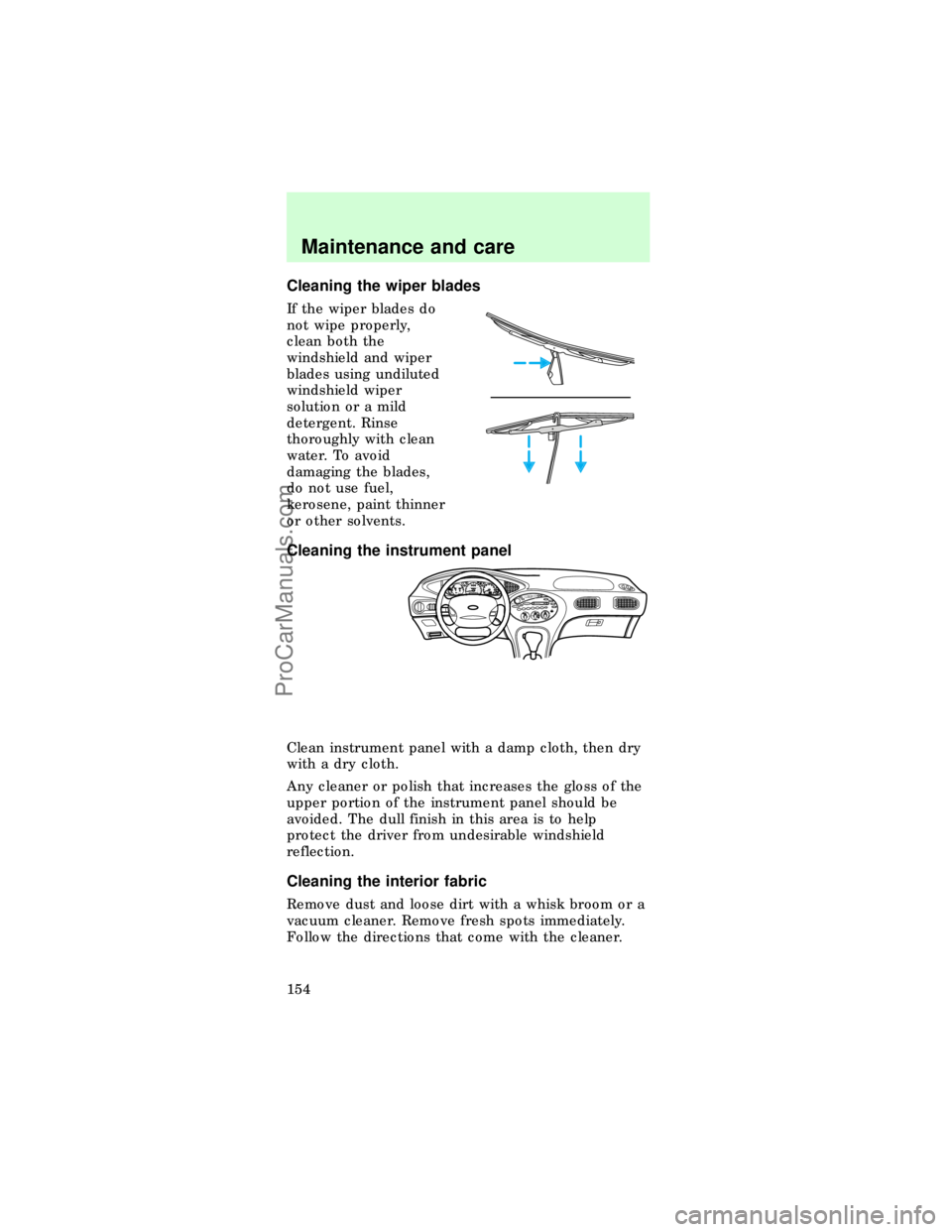
Cleaning the instrument panel
Clean instrument panel with a damp cloth, then dry
with a dry cloth.
Any cleaner or polish that increases the gloss of the
upper portion of the instrument panel should be
avoided. The dull finish in this area is to help
protect the driver from undesirable windshield
reflection.
Cleaning the interior fabric
Remove dust and loose dirt with a whisk broom or a
vacuum cleaner. Remove fresh spots immediately.
Follow the directions that come with the cleaner.
BASSTREBBALFADEREWFFEJECT1234
56wTAPE SIDETAPE
R-DEFTUNESEEKSCAN AM
FMMH
LO
HIOFF
A/C
MAX
A/CVENTVOL
PUSH-ONwSTFM 12
AMCBLRFEFC HFUEL DOOR>SERVICE
ENGINE
SOONLOW
COOLANTTHEFT102030405060
70
80
90
100
1202060100
140
180P R N D 2 1MPH km/h0000000000P!
BRAKE+ –110CRUISERPMx1000ABSO/D
OFFREAR
LAMP
OUTPREMIUM UNLEADED
FUEL RECOMMENDED0 1234
5
6
78
Maintenance and care
154
ProCarManuals.com