key FORD TAURUS 1997 Owner's Manual
[x] Cancel search | Manufacturer: FORD, Model Year: 1997, Model line: TAURUS, Model: FORD TAURUS 1997Pages: 167, PDF Size: 1.48 MB
Page 77 of 167
PREPARING TO START THE VEHICLE
Engine starting is controlled by the spark ignition
system. This system meets all Canadian
Interference-Causing Equipment standard
requirements regulating the impulse electrical field
strength of radio noise.
When starting a fuel-injected engine, avoid pressing
the accelerator before or during starting. Only use
the accelerator when you have difficulty starting the
engine. For more information on starting the vehicle,
refer toStarting the vehiclein this chapter.
Before starting the vehicle:
1. Make sure all vehicle occupants have buckled
their safety belts. For more information on safety
belts and their proper usage, refer to theSeating
and safety restraintschapter.
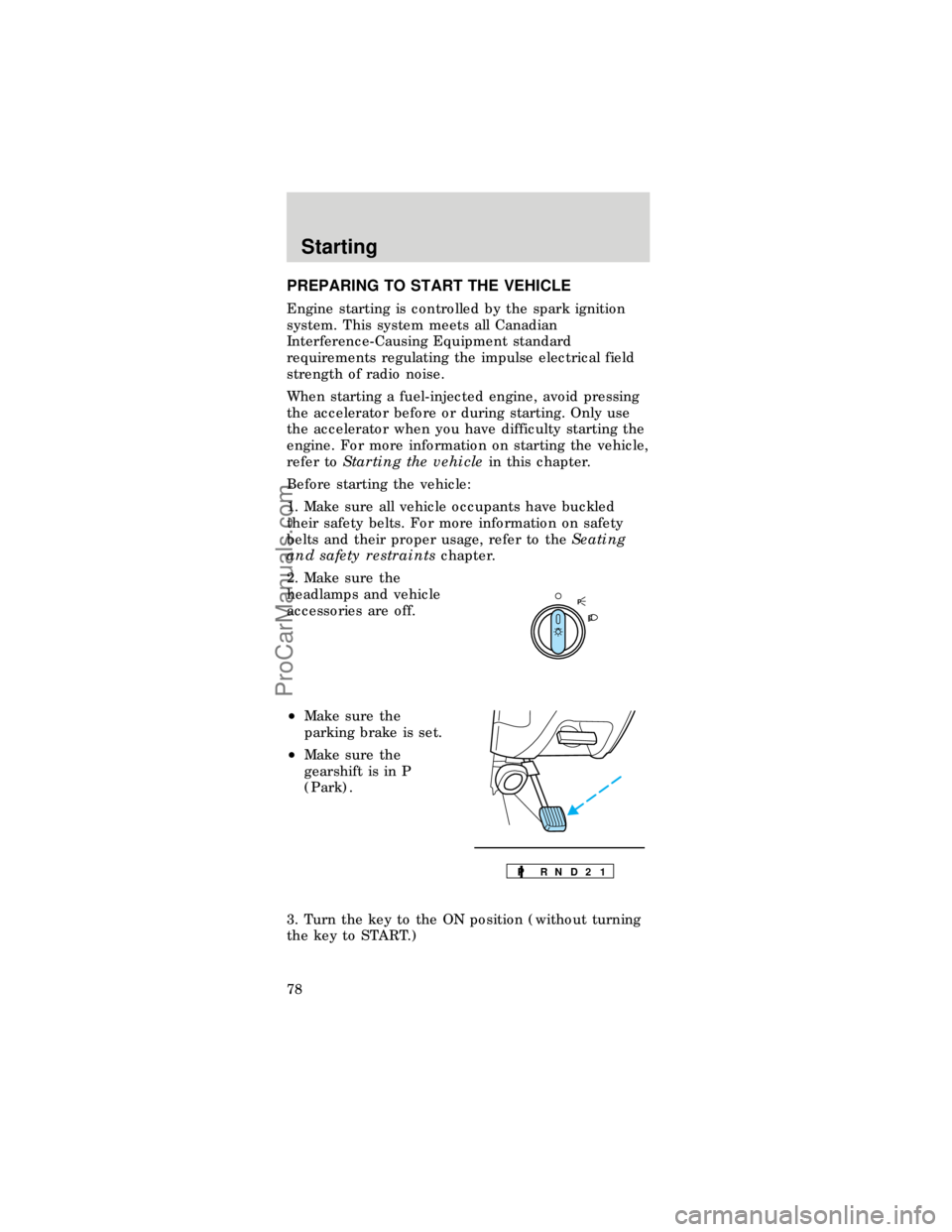
2. Make sure the
headlamps and vehicle
accessories are off.
²Make sure the
parking brake is set.
²Make sure the
gearshift is in P
(Park).
3. Turn the key to the ON position (without turning
the key to START.)
P
P R N D 2 1
Starting
78
ProCarManuals.com
Page 80 of 167
STARTING THE ENGINE
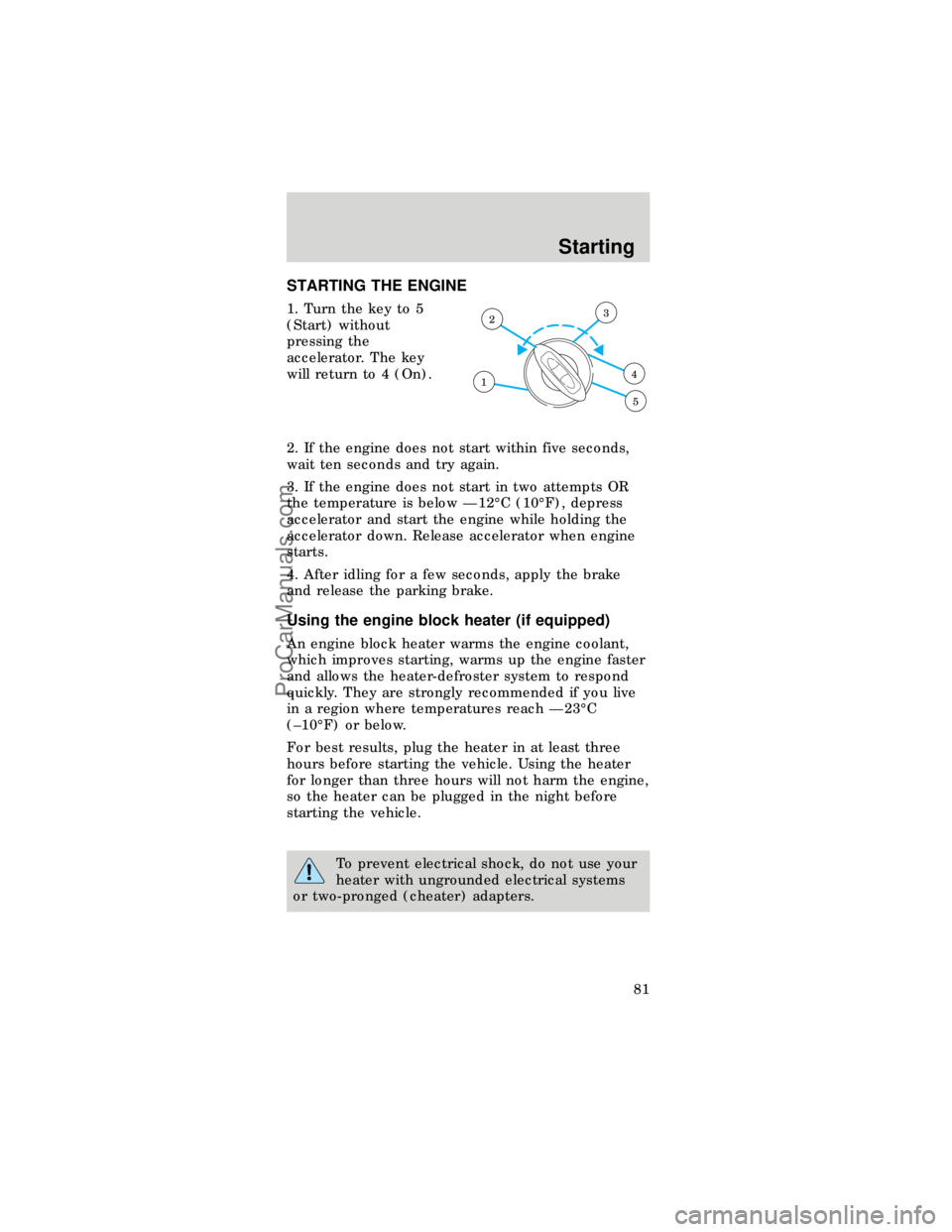
1. Turn the key to 5
(Start) without
pressing the
accelerator. The key
will return to 4 (On).
2. If the engine does not start within five seconds,
wait ten seconds and try again.
3. If the engine does not start in two attempts OR
the temperature is below Ð12ÉC (10ÉF), depress
accelerator and start the engine while holding the
accelerator down. Release accelerator when engine
starts.
4. After idling for a few seconds, apply the brake
and release the parking brake.
Using the engine block heater (if equipped)
An engine block heater warms the engine coolant,
which improves starting, warms up the engine faster
and allows the heater-defroster system to respond
quickly. They are strongly recommended if you live
in a region where temperatures reach Ð23ÉC
(±10ÉF) or below.
For best results, plug the heater in at least three
hours before starting the vehicle. Using the heater
for longer than three hours will not harm the engine,
so the heater can be plugged in the night before
starting the vehicle.
To prevent electrical shock, do not use your
heater with ungrounded electrical systems
or two-pronged (cheater) adapters.
1
23
4
5
Starting
81
ProCarManuals.com
Page 85 of 167

Pull release handle
toward you to release
parking brake. Driving
with the parking brake
on will cause the
brakes to wear out
quickly and reduce fuel
economy.
SEMI-ACTIVE RIDE CONTROL (TAURUS SHO
ONLY)
Firm shock absorber performance enhances ride and
handling during certain road conditions. The shock
absorber is returned to a softer performance when
driver or road induced motion ceases. This system is
automatic and requires no driver input.
TRANSAXLE
Brake-shift interlock
This vehicle is equipped with a brake-shift interlock
feature that prevents the gearshift from being moved
from P (Park) unless the brake pedal is pressed.
If you cannot move the gearshift out of P (Park)
with the brake pedal depressed:
1. Apply the parking brake, turn ignition key to
LOCK, then remove the key.
2. Insert the key and turn it to OFF. Apply the brake
pedal and shift to N (Neutral).
3. Start the vehicle.
If it is necessary to use the above procedure to
move the gearshift, it is possible that a fuse has
blown and the vehicle's brake lamps may not be
operating properly. Refer toFuses and relaysin the
Roadside emergencieschapter.
Driving
86
ProCarManuals.com
Page 98 of 167
HAZARD LIGHTS CONTROL
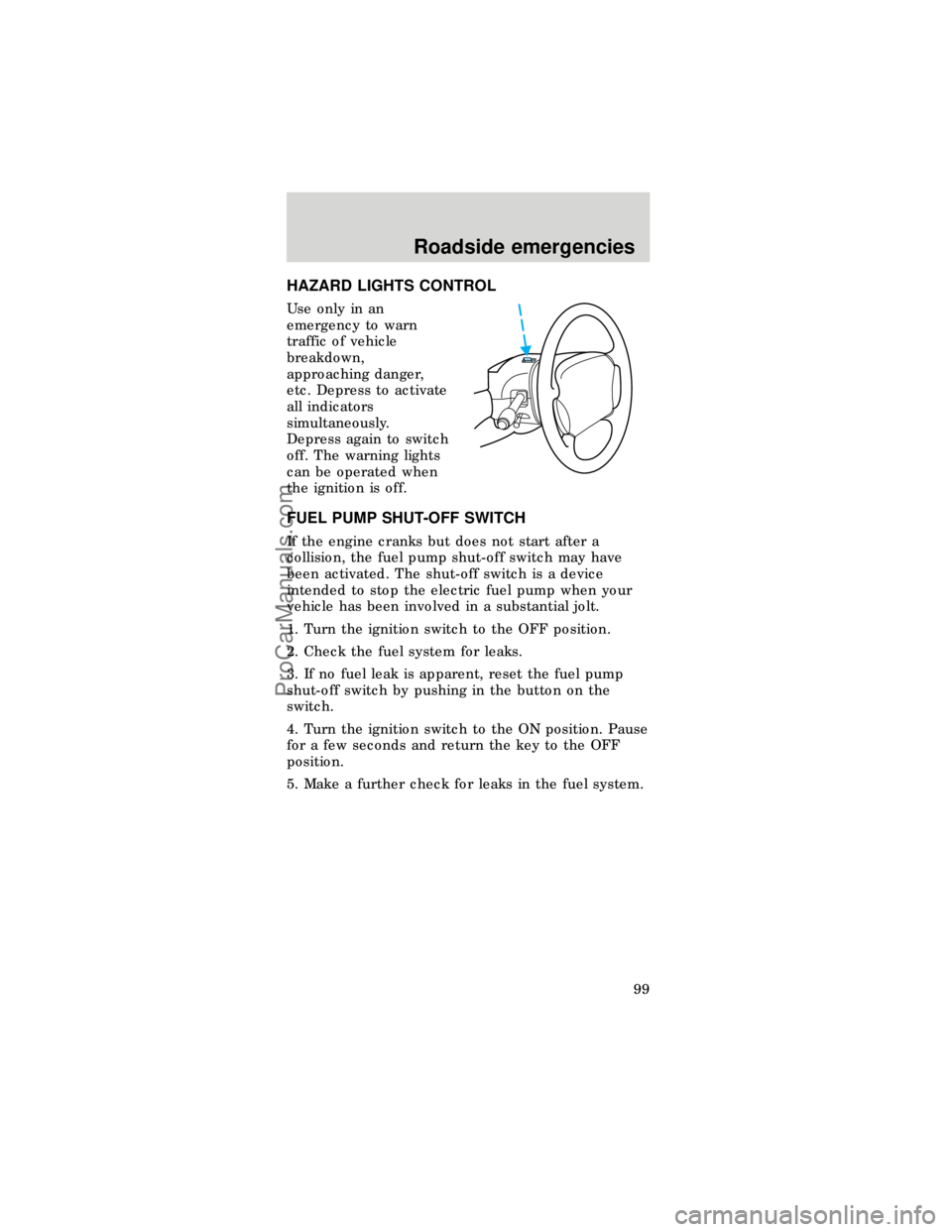
Use only in an
emergency to warn
traffic of vehicle
breakdown,
approaching danger,
etc. Depress to activate
all indicators
simultaneously.
Depress again to switch
off. The warning lights
can be operated when
the ignition is off.
FUEL PUMP SHUT-OFF SWITCH
If the engine cranks but does not start after a
collision, the fuel pump shut-off switch may have
been activated. The shut-off switch is a device
intended to stop the electric fuel pump when your
vehicle has been involved in a substantial jolt.
1. Turn the ignition switch to the OFF position.
2. Check the fuel system for leaks.
3. If no fuel leak is apparent, reset the fuel pump
shut-off switch by pushing in the button on the
switch.
4. Turn the ignition switch to the ON position. Pause
for a few seconds and return the key to the OFF
position.
5. Make a further check for leaks in the fuel system.
Roadside emergencies
99
ProCarManuals.com
Page 112 of 167
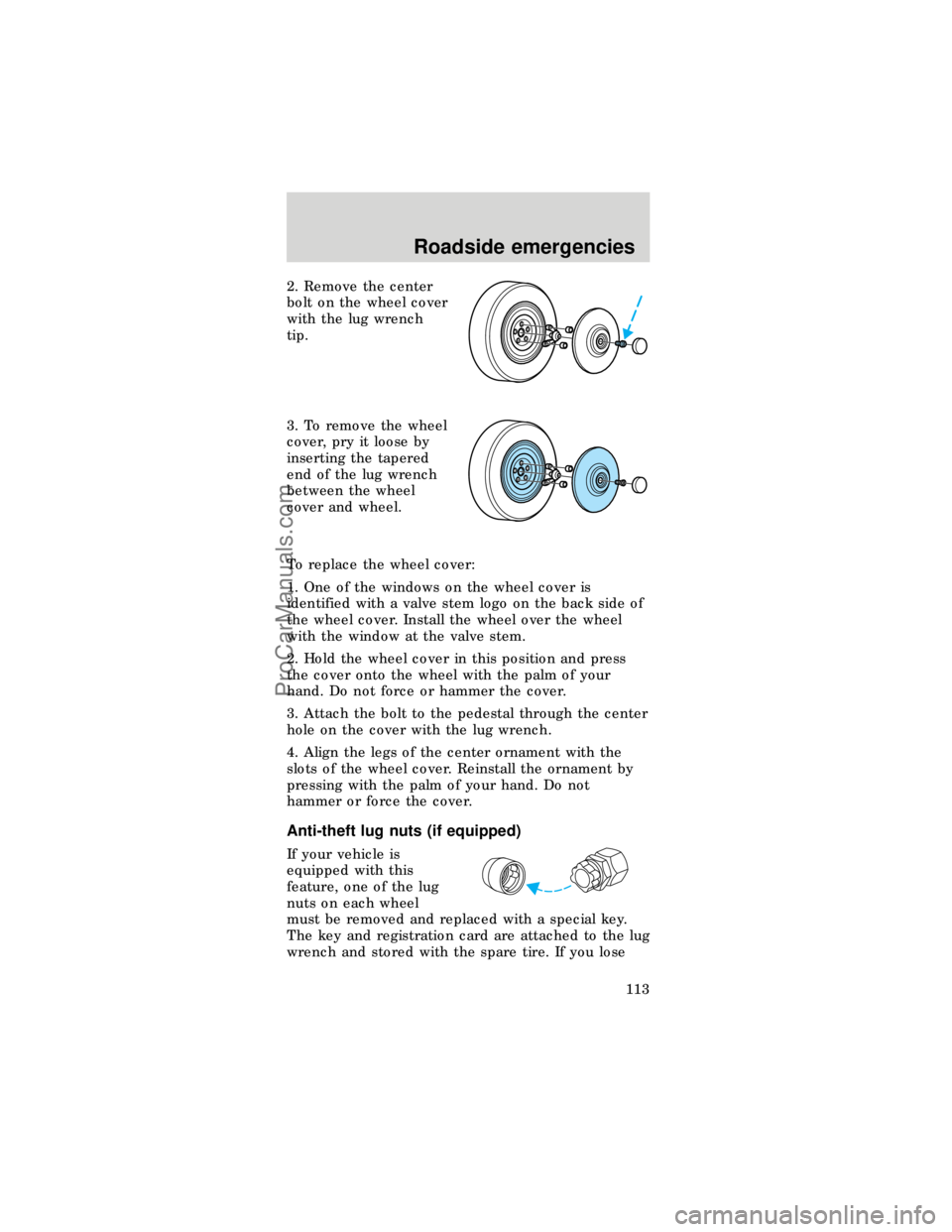
2. Remove the center
bolt on the wheel cover
with the lug wrench
tip.
3. To remove the wheel
cover, pry it loose by
inserting the tapered
end of the lug wrench
between the wheel
cover and wheel.
To replace the wheel cover:
1. One of the windows on the wheel cover is
identified with a valve stem logo on the back side of
the wheel cover. Install the wheel over the wheel
with the window at the valve stem.
2. Hold the wheel cover in this position and press
the cover onto the wheel with the palm of your
hand. Do not force or hammer the cover.
3. Attach the bolt to the pedestal through the center
hole on the cover with the lug wrench.
4. Align the legs of the center ornament with the
slots of the wheel cover. Reinstall the ornament by
pressing with the palm of your hand. Do not
hammer or force the cover.
Anti-theft lug nuts (if equipped)
If your vehicle is
equipped with this
feature, one of the lug
nuts on each wheel
must be removed and replaced with a special key.
The key and registration card are attached to the lug
wrench and stored with the spare tire. If you lose
Roadside emergencies
113
ProCarManuals.com
Page 113 of 167
the key, send the registration card to the
manufacturer (not the dealer) to get a replacement
key. If the lug wrench/lug nut key assembly is lost,
see your nearest Ford or Lincoln/Mercury dealer
who has access to the master set of keys.Do not
use an impact wrench with the anti-theft key.
JUMP STARTING YOUR VEHICLE
The gases around the battery can explode if
exposed to flames, sparks, or lit cigarettes.
An explosion could result in injury or vehicle
damage.
Do not push-start your vehicle. You could
damage the catalytic converter. For further
information, seeJumper Cablesin the Index.
Batteries contain sulfuric acid which burns
skin, eyes, and clothing.
CONNECTING THE JUMPER CABLES
1. Position the vehicles so that they do not touch
one another.
2. Switch off the engine. Switch off any unnecessary
electrical equipment.
Roadside emergencies
114
ProCarManuals.com
Page 116 of 167
TOWING YOUR VEHICLE BEHIND ANOTHER
VEHICLE
At times, you may want to tow your vehicle behind
another vehicle, such as a recreational vehicle, car
or a truck.
Before you have your vehicle towed:
²Release the parking brake.
²Move the gearshift to N (Neutral).
²Turn the key in the ignition to OFF.
²Unlock the steering wheel.
Do not tow your vehicle at a speed faster than 56
km/h (35 mph) or for a distance greater than 80 km
(50 miles), unless the drive wheels are placed on
dollies.
Never use a tow bar that attaches to the
bumper when you tow your vehicle. This
could damage the bumper and cause an accident.
Roadside emergencies
117
ProCarManuals.com
Page 118 of 167
²Keep all lit cigarettes, open flames and other lit
material away from the battery and all fuel related
parts.
If you disconnect the battery, the engine must
ªrelearnº its idle conditions before your vehicle will
drive properly, as explained inBatteryin this
chapter.
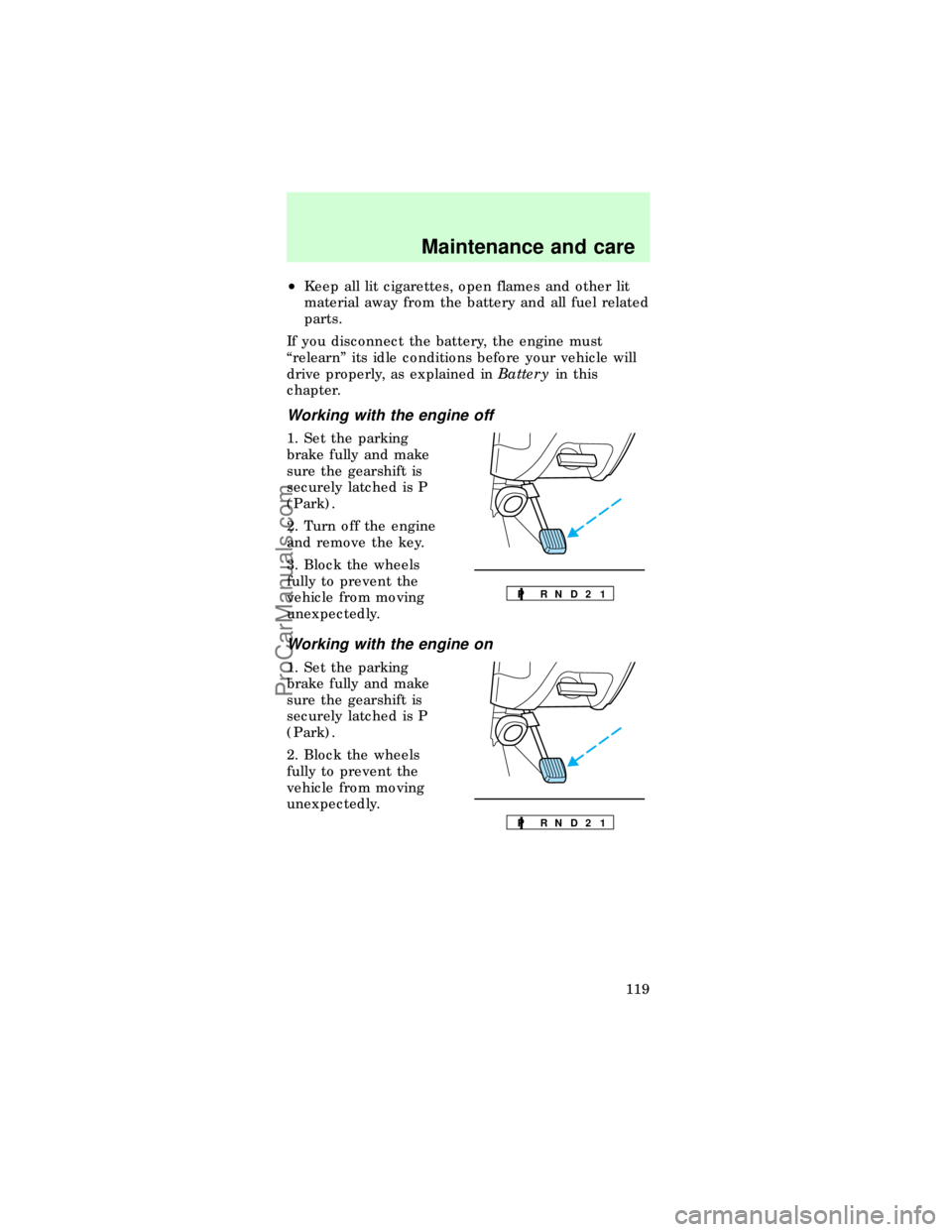
Working with the engine off
1. Set the parking
brake fully and make
sure the gearshift is
securely latched is P
(Park).
2. Turn off the engine
and remove the key.
3. Block the wheels
fully to prevent the
vehicle from moving
unexpectedly.
Working with the engine on
1. Set the parking
brake fully and make
sure the gearshift is
securely latched is P
(Park).
2. Block the wheels
fully to prevent the
vehicle from moving
unexpectedly.
P R N D 2 1
P R N D 2 1
Maintenance and care
119
ProCarManuals.com