battery FORD TAURUS 1998 3.G User Guide
[x] Cancel search | Manufacturer: FORD, Model Year: 1998, Model line: TAURUS, Model: FORD TAURUS 1998 3.GPages: 192, PDF Size: 1.66 MB
Page 126 of 192

3. Remove the jumper cable from the positive (+)
terminal of the booster vehicle's battery.
4. Remove the jumper cable from the positive (+)
terminal of the disabled vehicle's battery.
After the disabled vehicle has been started and the
jumper cables removed, allow it to idle for several
minutes so the engine computer canrelearnits idle
conditions.
+–+–
+–+–
Roadside emergencies
126
Page 128 of 192

SERVICE RECOMMENDATIONS
To help you service your vehicle:
²We highlight do-it-yourself items in the engine
compartment for easy location.
²We provide a ªService Guideº which makes
tracking routine service easy.
If your vehicle requires professional service, your
dealership can provide necessary parts and service.
Check your ªWarranty Guideº to find out which parts
and services are covered.
Use only recommended fuels, lubricants, fluids and
service parts conforming to specifications. Motorcraft
parts are designed and built to provide the best
performance in your vehicle.
PRECAUTIONS WHEN SERVICING YOUR
VEHICLE
Be especially careful when inspecting or servicing
your vehicle.
²Do not work on a hot engine.
²When the engine is running, avoid wearing loose
clothing, jewelry or long hair that could get
caught up in moving parts.
²Do not work on a vehicle with the engine running
in an enclosed space, unless you are sure you
have enough ventilation.
²Keep all lit cigarettes, open flames and other lit
material away from the battery and all fuel related
parts.
If you disconnect the battery, the engine must
ªrelearnº its idle conditions before your vehicle will
drive properly, as explained in theBatterysection in
this chapter.
Working with the engine off
1. Set the parking brake, and ensure the gearshift is
securely latched in park.
Maintenance and care
128
Page 130 of 192
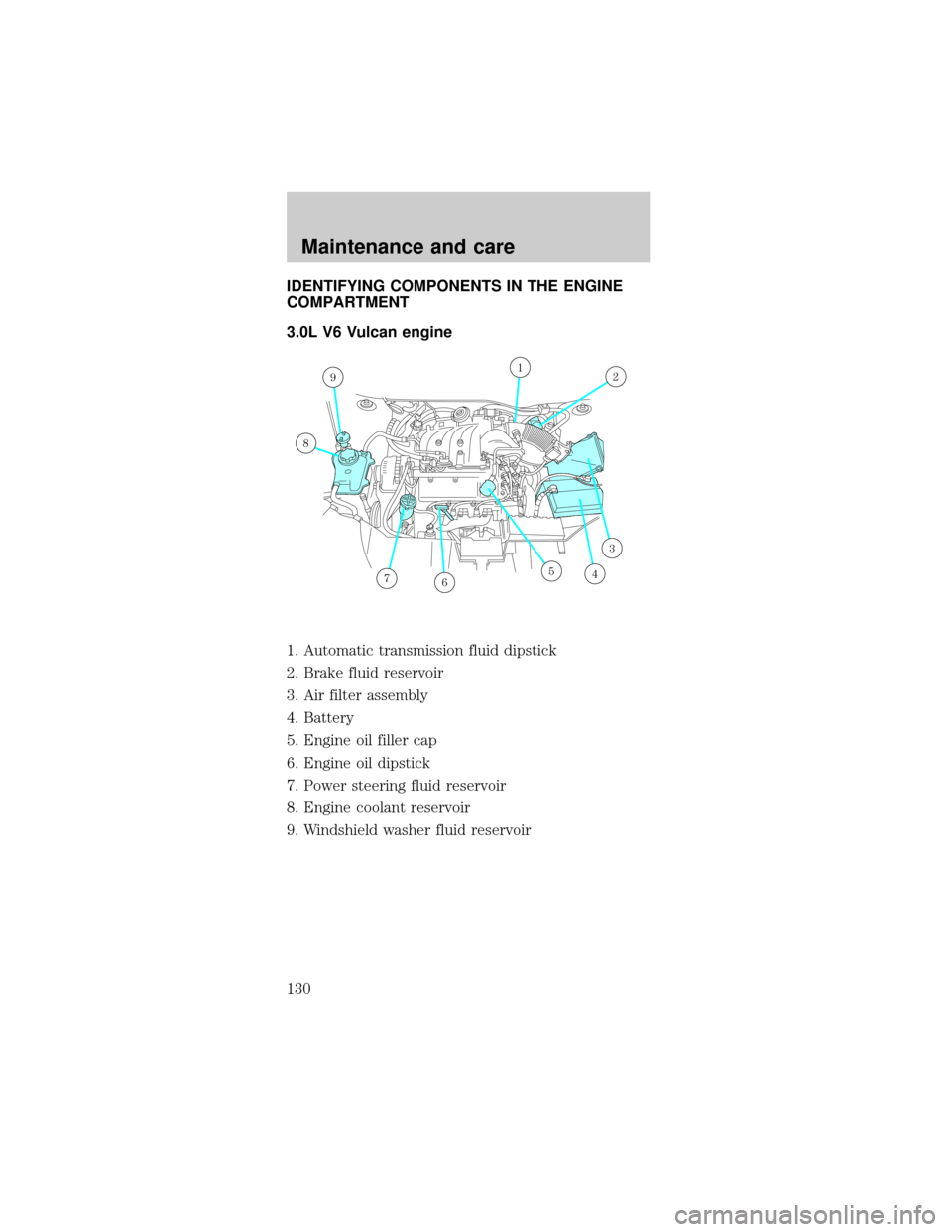
IDENTIFYING COMPONENTS IN THE ENGINE
COMPARTMENT
3.0L V6 Vulcan engine
1. Automatic transmission fluid dipstick
2. Brake fluid reservoir
3. Air filter assembly
4. Battery
5. Engine oil filler cap
6. Engine oil dipstick
7. Power steering fluid reservoir
8. Engine coolant reservoir
9. Windshield washer fluid reservoir
12
3
4567
8
9
Maintenance and care
130
Page 131 of 192
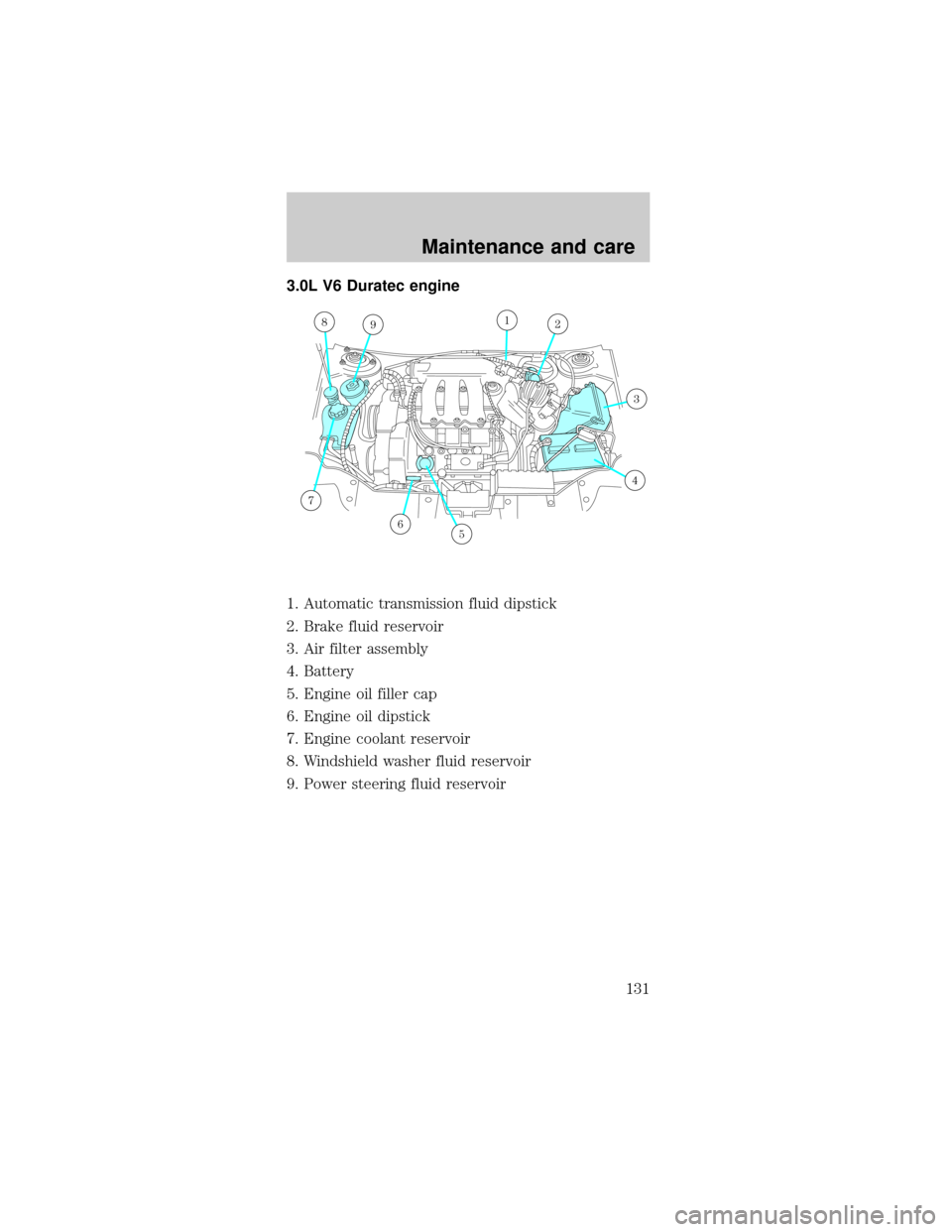
3.0L V6 Duratec engine
1. Automatic transmission fluid dipstick
2. Brake fluid reservoir
3. Air filter assembly
4. Battery
5. Engine oil filler cap
6. Engine oil dipstick
7. Engine coolant reservoir
8. Windshield washer fluid reservoir
9. Power steering fluid reservoir
8912
3
4
56
7
Maintenance and care
131
Page 132 of 192
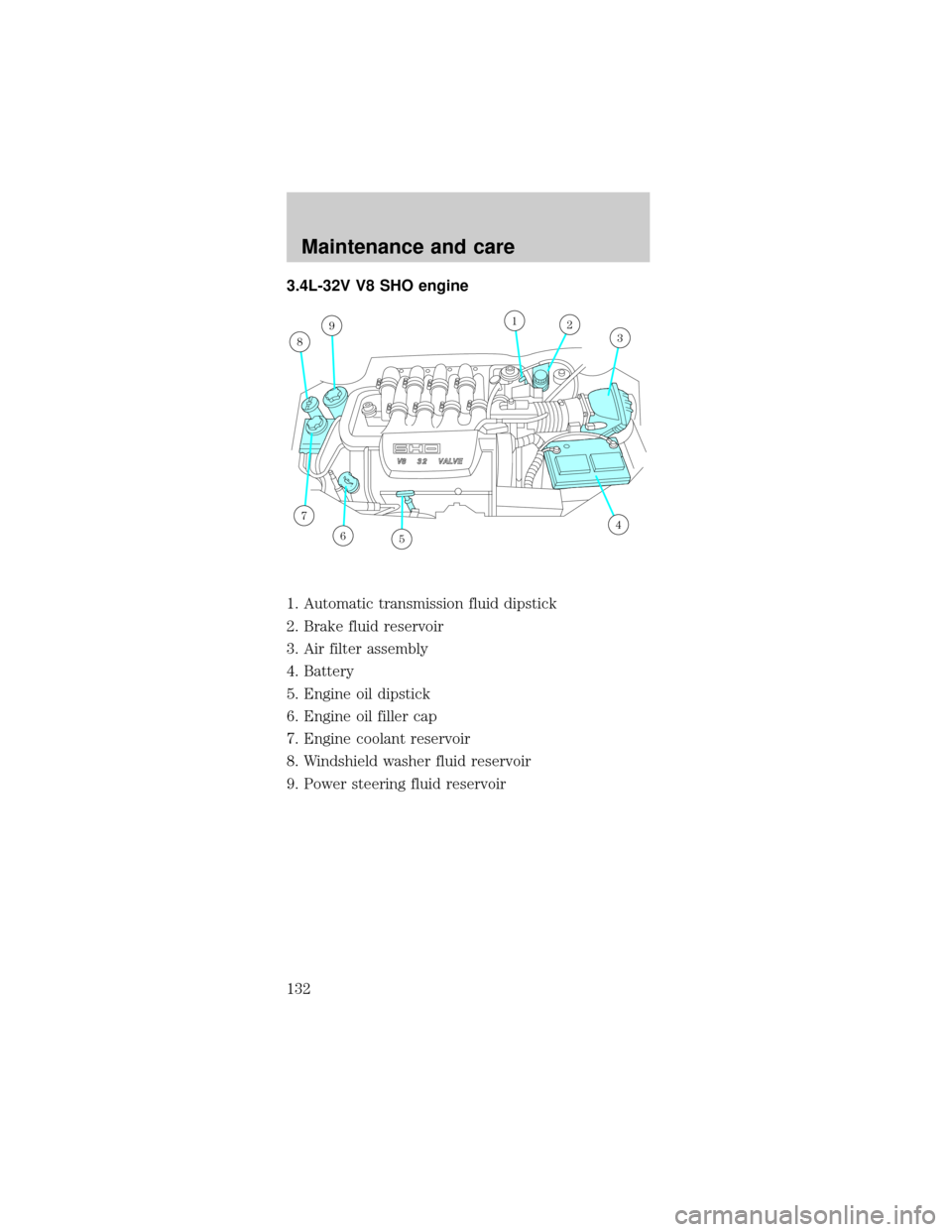
3.4L-32V V8 SHO engine
1. Automatic transmission fluid dipstick
2. Brake fluid reservoir
3. Air filter assembly
4. Battery
5. Engine oil dipstick
6. Engine oil filler cap
7. Engine coolant reservoir
8. Windshield washer fluid reservoir
9. Power steering fluid reservoir
V8 32 VALVE
8
9123
456
7
Maintenance and care
132
Page 144 of 192
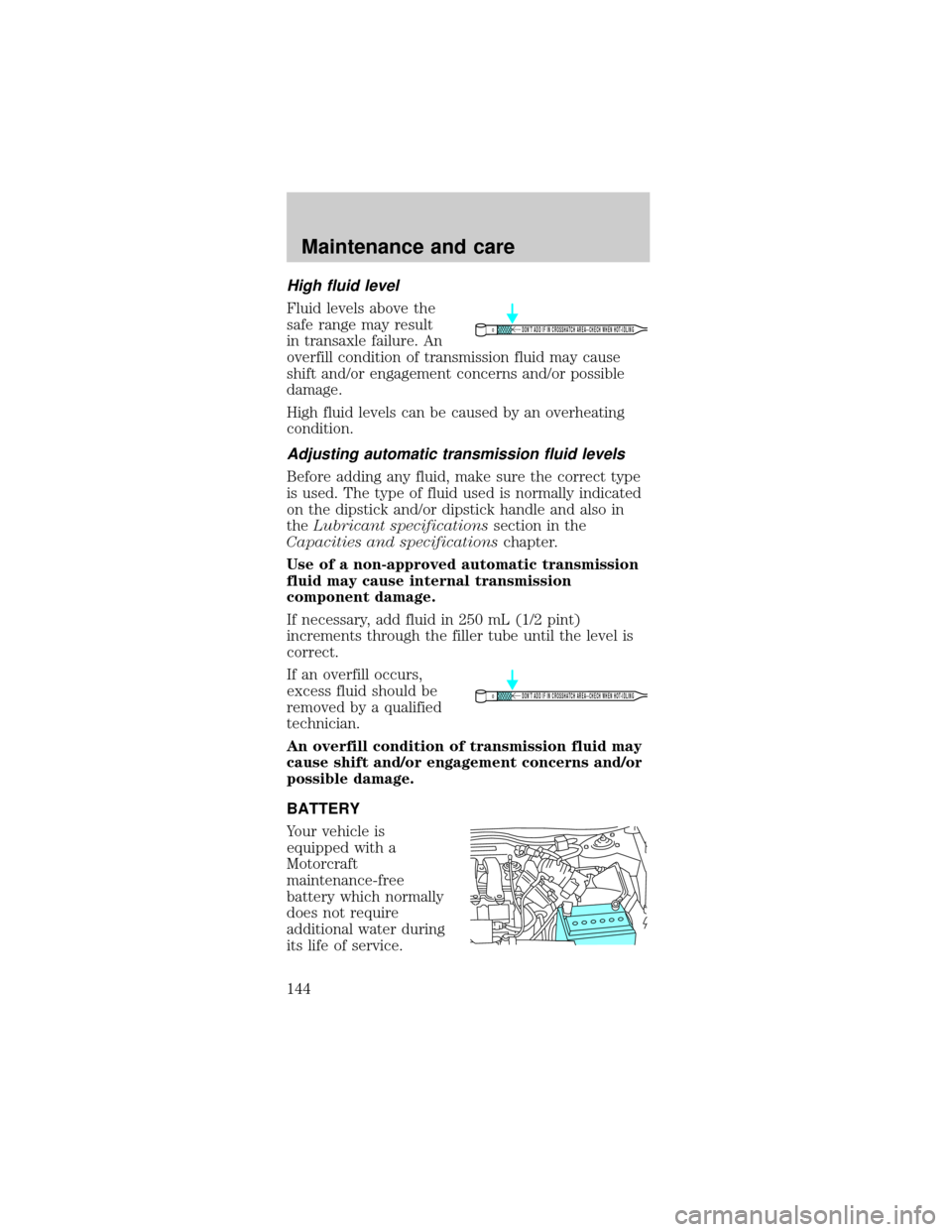
High fluid level
Fluid levels above the
safe range may result
in transaxle failure. An
overfill condition of transmission fluid may cause
shift and/or engagement concerns and/or possible
damage.
High fluid levels can be caused by an overheating
condition.
Adjusting automatic transmission fluid levels
Before adding any fluid, make sure the correct type
is used. The type of fluid used is normally indicated
on the dipstick and/or dipstick handle and also in
theLubricant specificationssection in the
Capacities and specificationschapter.
Use of a non-approved automatic transmission
fluid may cause internal transmission
component damage.
If necessary, add fluid in 250 mL (1/2 pint)
increments through the filler tube until the level is
correct.
If an overfill occurs,
excess fluid should be
removed by a qualified
technician.
An overfill condition of transmission fluid may
cause shift and/or engagement concerns and/or
possible damage.
BATTERY
Your vehicle is
equipped with a
Motorcraft
maintenance-free
battery which normally
does not require
additional water during
its life of service.
DON’T ADD IF IN CROSSHATCH AREA--CHECH WHEN HOT-IDLING
DON’T ADD IF IN CROSSHATCH AREA--CHECH WHEN HOT-IDLING
Maintenance and care
144
Page 145 of 192
However, for severe usage or in high temperature
climates, check the battery electrolyte level. Refer to
the ªService Guideº for the service interval
schedules.
If the electrolyte level in the battery is low, you can
add plain tap water to the battery, as long as you do
not use hard water (water with a high mineral or
alkali content). If possible, however, try to only fill
the battery cells with distilled water. If the battery
needs water often, have the charging system
checked.
Keep the electrolyte level in each cell up to the
ªlevel indicatorº. Do not overfill the battery
cells.
For longer, trouble-free operation, keep the top of
the battery clean and dry. Also, make certain the
battery cables are always tightly fastened to the
battery terminals.
If you see any corrosion on the battery or terminals,
remove the cables from the terminals and clean with
a wire brush. You can neutralize the acid with a
solution of baking soda and water. Reinstall the
cables when you are done cleaning them, and apply
a small quantity of grease to the top of each battery
terminal to help prevent corrosion.
If your battery has a cover/shield, make sure it
is reinstalled after the battery has been
cleaned or replaced.
Batteries normally produce explosive gases
which can cause personal injury. Therefore,
do not allow flames, sparks or lighted substances
to come near the battery. When working near the
battery, always shield your face and protect your
eyes. Always provide proper ventilation.
Maintenance and care
145
Page 146 of 192
When lifting a plastic-cased battery,
excessive pressure on the end walls could
cause acid to flow through the vent caps, resulting
in personal injury and/or damage to the vehicle or
battery. Lift the battery with a battery carrier or
with your hands on opposite corners.
Keep batteries out of reach of children.
Batteries contain sulfuric acid. Avoid contact
with skin, eyes or clothing. Shield your eyes when
working near the battery to protect against
possible splashing of acid solution. In case of acid
contact with skin or eyes, flush immediately with
water for a minimum of 15 minutes and get
prompt medical attention. If acid is swallowed, call
a physician immediately.
Because your vehicle's engine is electronically
controlled by a computer, some control conditions
are maintained by power from the battery. When the
battery is disconnected or a new battery is installed,
the engine must relearn its idle conditions before
your vehicle will drive properly. To begin this
process:
1. Set your parking brake.
2. Put the gearshift in P (Park), turn off all
accessories and start the engine.
3. Let the engine idle for at least one minute.
4. The relearning process will automatically
complete as you drive the vehicle.
²If you do not allow the engine to relearn its idle,
the idle quality of your vehicle may be adversely
affected until the idle is eventually relearned.
Maintenance and care
146
Page 147 of 192
²If the battery has been disconnected or a new
battery has been installed, the clock and the
preset radio stations must be reset once the
battery is reconnected.
²Always dispose of
automotive batteries
in a responsible
manner. Follow your
local authorized
standards for
disposal. Call your
local authorized
authorized recycling center to find out more
about recycling automotive batteries.
CABIN AIR FILTER (IF EQUIPPED)
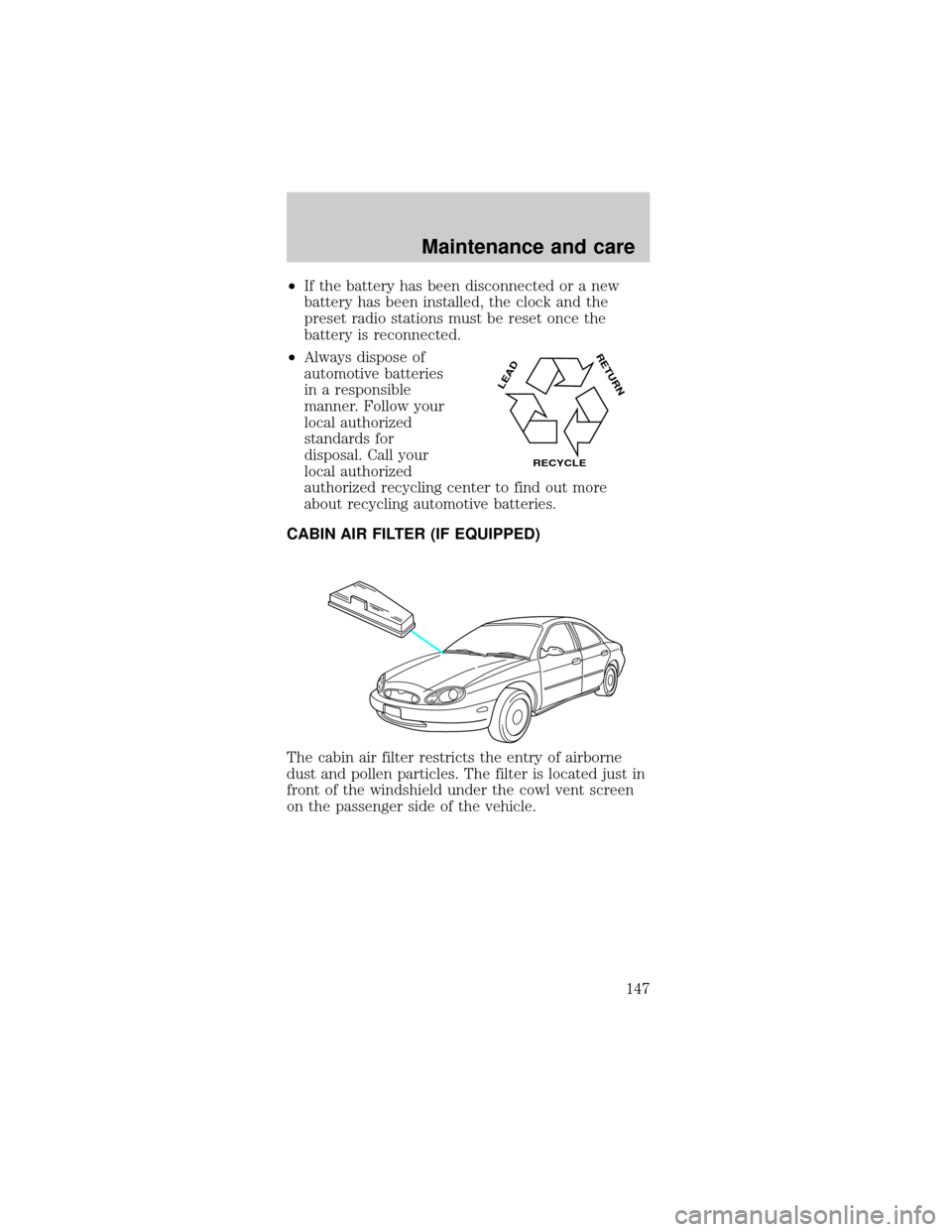
The cabin air filter restricts the entry of airborne
dust and pollen particles. The filter is located just in
front of the windshield under the cowl vent screen
on the passenger side of the vehicle.
LEAD
RETURN
RECYCLE
Maintenance and care
147
Page 162 of 192

Do not make any unauthorized changes to your
vehicle or engine. By law, vehicle owners and anyone
who manufactures, repairs, items, sells, leases,
trades vehicles, or supervises a fleet of vehicles are
not permitted to intentionally remove an emission
control device or prevent it from working.
Information about your vehicle's emission system is
on the Vehicle Emission Control Information Decal
located on or near the engine. This decal identifies
engine displacement and gives some tune up
specifications.
Please consult your ªWarranty Guideº for complete
emission warranty information.
Readiness for inspection/maintenance (I/M)
testing
In some localities, it may be a legal requirement to
pass an I/M test of the on-board diagnostic (OBD-II)
system. If your ªCheck Engine/Service Engine Soonº
light is on, refer to the description in theWarning
Lights and Chimessection of theInstrumentation
chapter. Your vehicle may not pass the I/M test with
the ªCheck Engine/Service Engine Soonº light on.
If the vehicle's powertrain system or its battery has
just been serviced, the OBD-II system is reset to a
ªnot ready for I/M testº condition. To ready the
OBD-II system for I/M testing, a minimum of 30
minutes of city and highway driving is necessary as
described below:
²First, at least 10 minutes of driving on an
expressway or highway.
²Next, at least 20 minutes driving in stop-and-go,
city-type traffic with at least four idle periods.
Allow the vehicle to sit for at least eight hours
without starting the engine. Then, start the engine
and complete the above driving cycle. The engine
must warm up to its normal operating temperature.
Once started, do not turn off the engine until the
above driving cycle is complete.
Maintenance and care
162