lock FORD TAURUS 1998 3.G Owner's Manual
[x] Cancel search | Manufacturer: FORD, Model Year: 1998, Model line: TAURUS, Model: FORD TAURUS 1998 3.GPages: 192, PDF Size: 1.66 MB
Page 54 of 192
Spare SecuriLockykeys can be purchased from
your dealership and programmed to your
SecuriLockyanti-theft system. Refer to
Programming spare SecuriLockykeysfor more
information.
If one or both of your SecuriLockykeys are lost or
stolen and you want to ensure the lost or stolen key
will not operate your vehicle, bring your vehicle and
all available SecuriLockykeys to your dealership for
reinitialization.
Controls and features
54
Page 57 of 192
Press the other side of the control to adjust
softness.
REAR SEATS
2nd seat/Split-folding rear seat (if equipped)
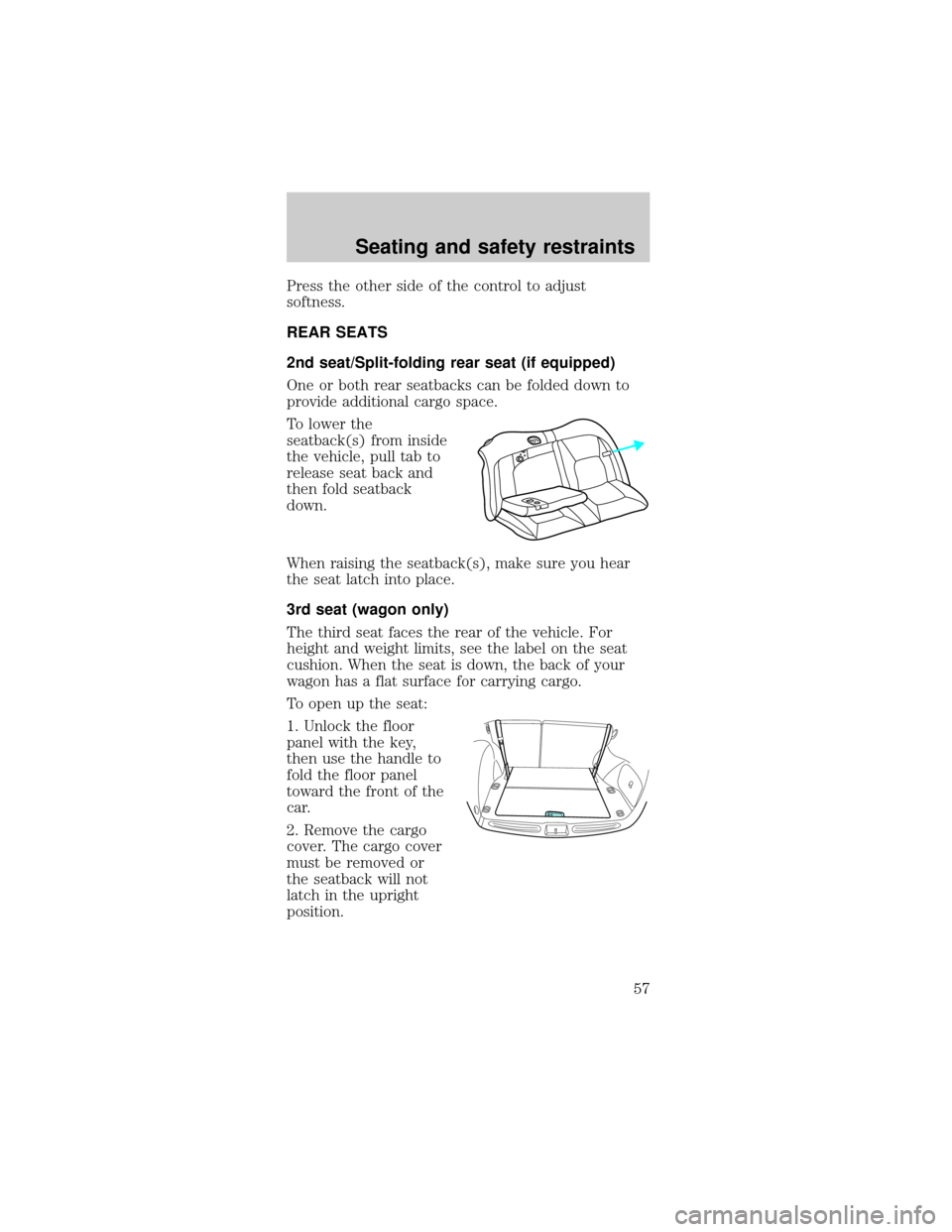
One or both rear seatbacks can be folded down to
provide additional cargo space.
To lower the
seatback(s) from inside
the vehicle, pull tab to
release seat back and
then fold seatback
down.
When raising the seatback(s), make sure you hear
the seat latch into place.
3rd seat (wagon only)
The third seat faces the rear of the vehicle. For
height and weight limits, see the label on the seat
cushion. When the seat is down, the back of your
wagon has a flat surface for carrying cargo.
To open up the seat:
1. Unlock the floor
panel with the key,
then use the handle to
fold the floor panel
toward the front of the
car.
2. Remove the cargo
cover. The cargo cover
must be removed or
the seatback will not
latch in the upright
position.
Seating and safety restraints
57
Page 58 of 192
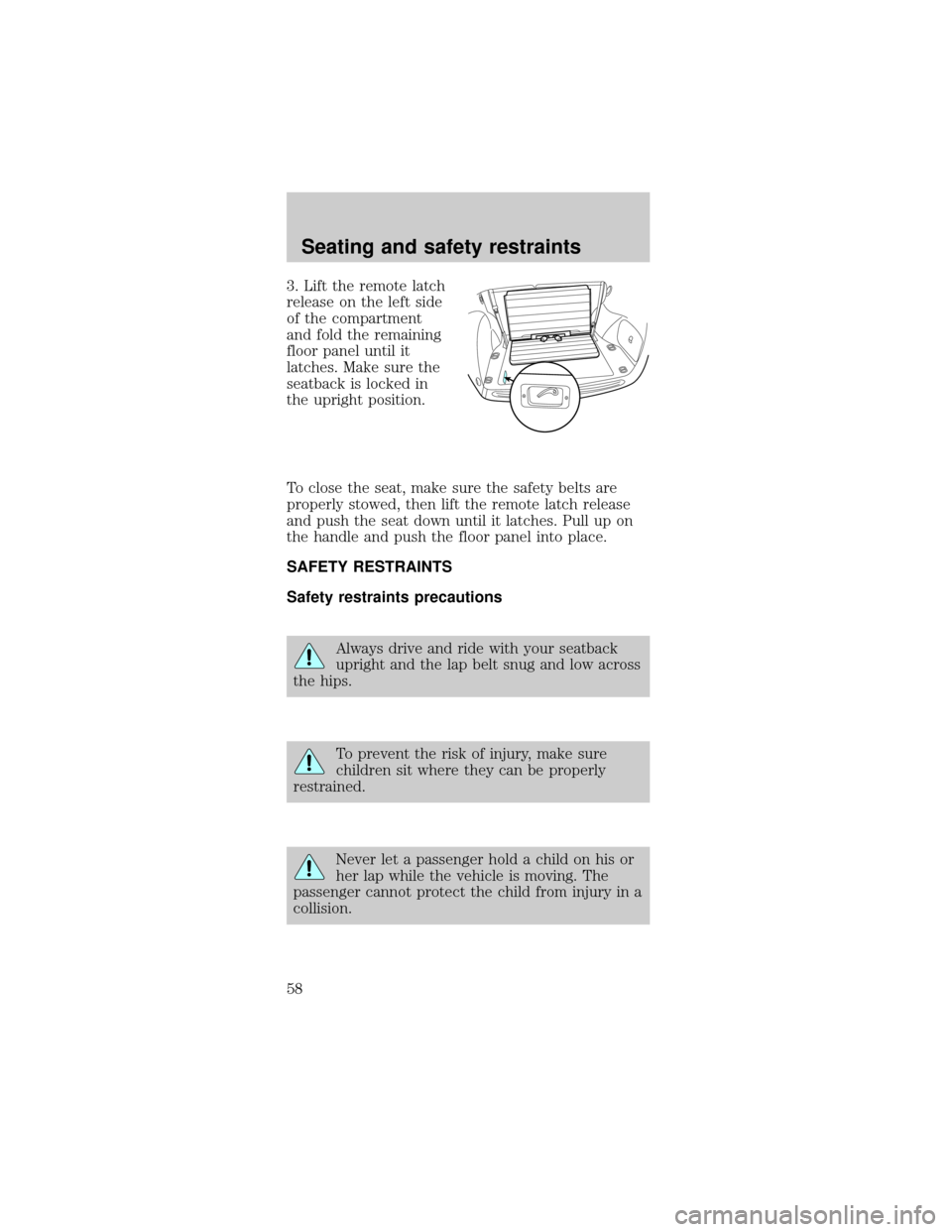
3. Lift the remote latch
release on the left side
of the compartment
and fold the remaining
floor panel until it
latches. Make sure the
seatback is locked in
the upright position.
To close the seat, make sure the safety belts are
properly stowed, then lift the remote latch release
and push the seat down until it latches. Pull up on
the handle and push the floor panel into place.
SAFETY RESTRAINTS
Safety restraints precautions
Always drive and ride with your seatback
upright and the lap belt snug and low across
the hips.
To prevent the risk of injury, make sure
children sit where they can be properly
restrained.
Never let a passenger hold a child on his or
her lap while the vehicle is moving. The
passenger cannot protect the child from injury in a
collision.
Seating and safety restraints
58
Page 60 of 192
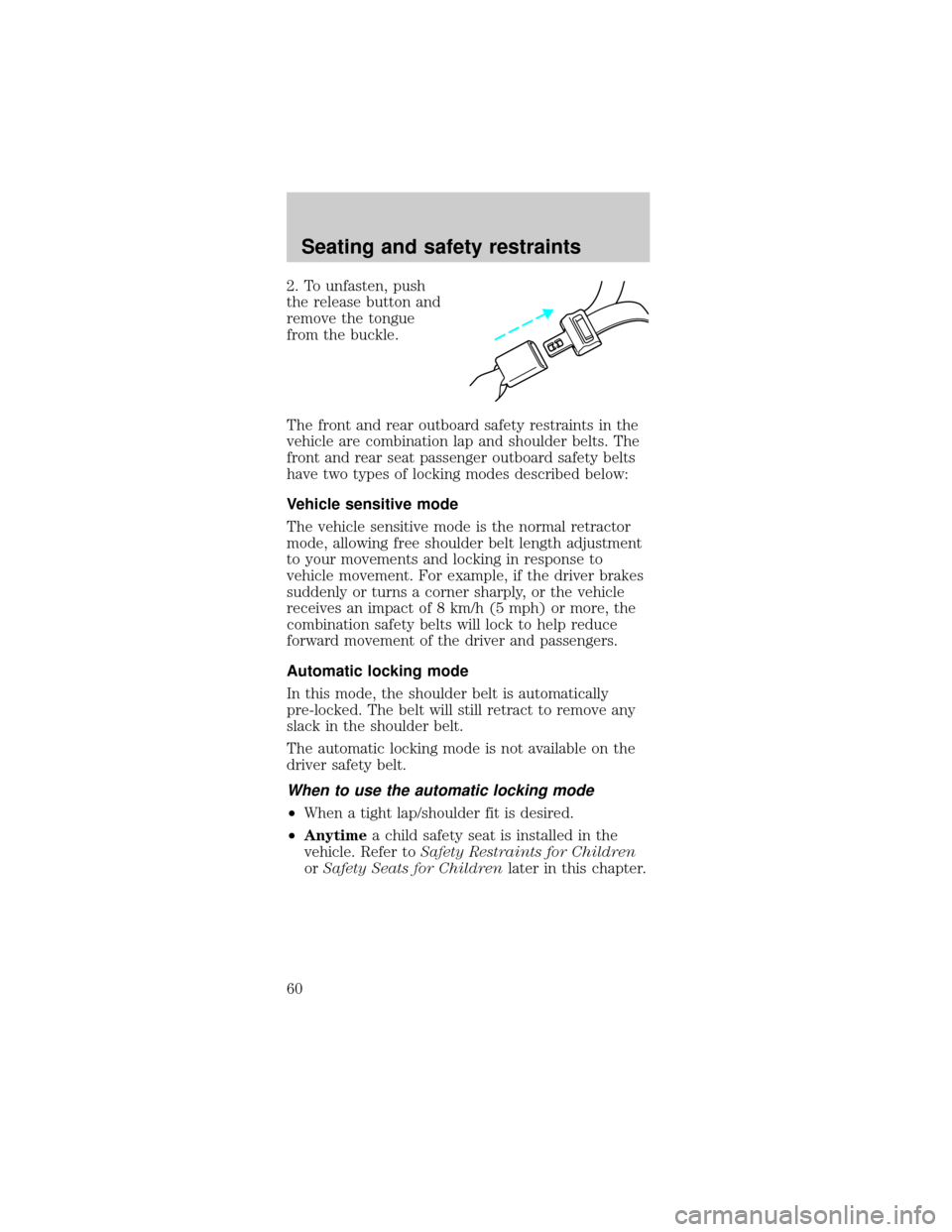
2. To unfasten, push
the release button and
remove the tongue
from the buckle.
The front and rear outboard safety restraints in the
vehicle are combination lap and shoulder belts. The
front and rear seat passenger outboard safety belts
have two types of locking modes described below:
Vehicle sensitive mode
The vehicle sensitive mode is the normal retractor
mode, allowing free shoulder belt length adjustment
to your movements and locking in response to
vehicle movement. For example, if the driver brakes
suddenly or turns a corner sharply, or the vehicle
receives an impact of 8 km/h (5 mph) or more, the
combination safety belts will lock to help reduce
forward movement of the driver and passengers.
Automatic locking mode
In this mode, the shoulder belt is automatically
pre-locked. The belt will still retract to remove any
slack in the shoulder belt.
The automatic locking mode is not available on the
driver safety belt.
When to use the automatic locking mode
²When a tight lap/shoulder fit is desired.
²Anytimea child safety seat is installed in the
vehicle. Refer toSafety Restraints for Children
orSafety Seats for Childrenlater in this chapter.
Seating and safety restraints
60
Page 61 of 192
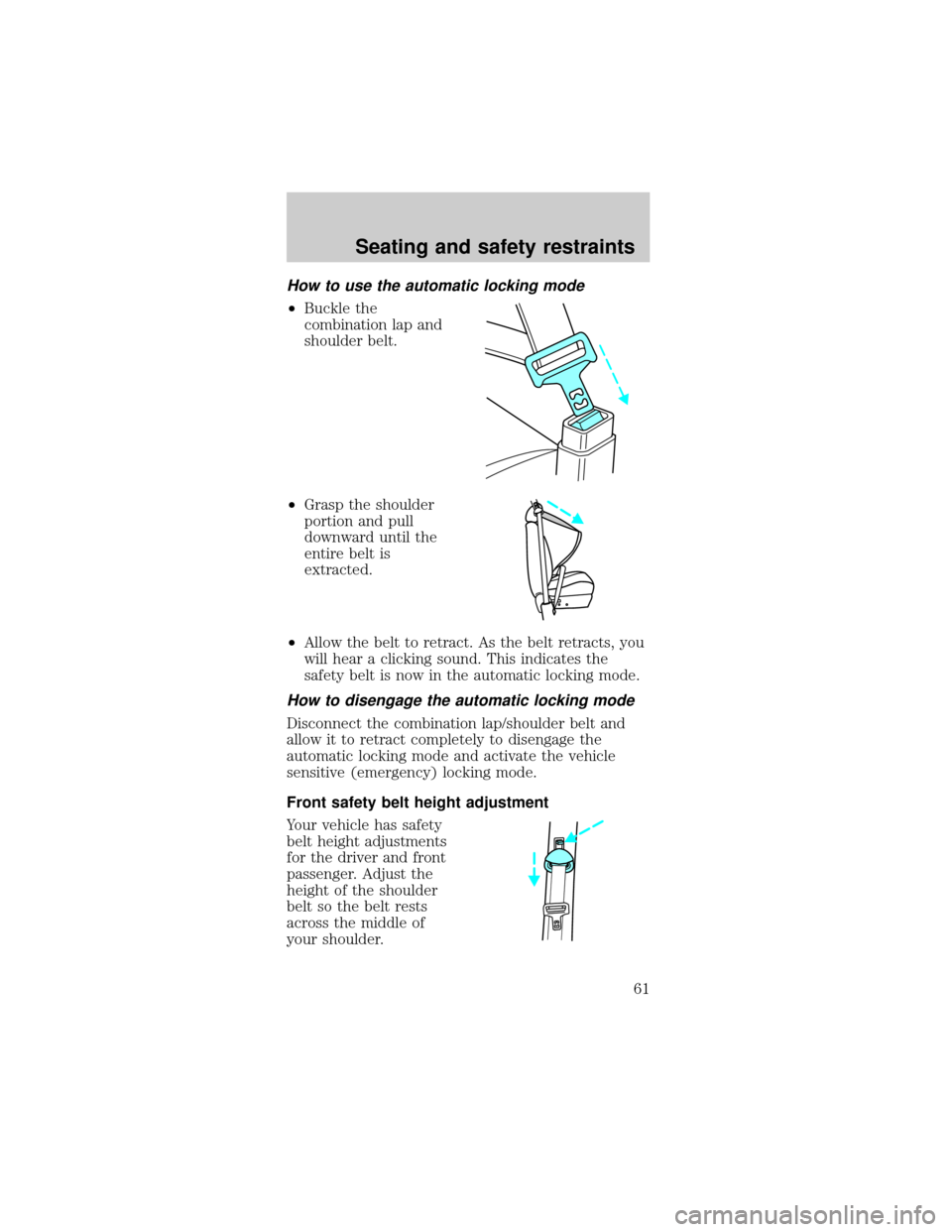
How to use the automatic locking mode
²Buckle the
combination lap and
shoulder belt.
²Grasp the shoulder
portion and pull
downward until the
entire belt is
extracted.
²Allow the belt to retract. As the belt retracts, you
will hear a clicking sound. This indicates the
safety belt is now in the automatic locking mode.
How to disengage the automatic locking mode
Disconnect the combination lap/shoulder belt and
allow it to retract completely to disengage the
automatic locking mode and activate the vehicle
sensitive (emergency) locking mode.
Front safety belt height adjustment
Your vehicle has safety
belt height adjustments
for the driver and front
passenger. Adjust the
height of the shoulder
belt so the belt rests
across the middle of
your shoulder.
Seating and safety restraints
61
Page 62 of 192
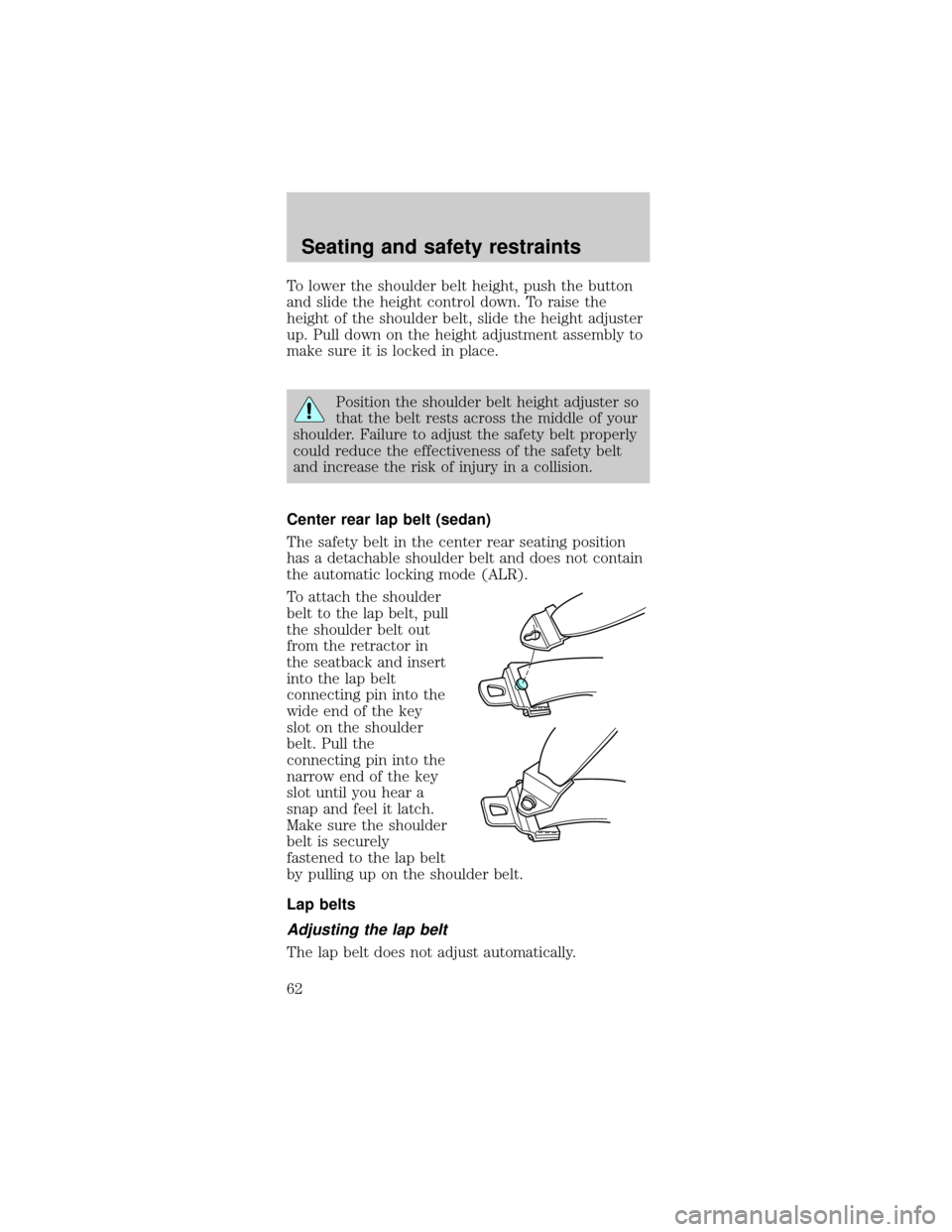
To lower the shoulder belt height, push the button
and slide the height control down. To raise the
height of the shoulder belt, slide the height adjuster
up. Pull down on the height adjustment assembly to
make sure it is locked in place.
Position the shoulder belt height adjuster so
that the belt rests across the middle of your
shoulder. Failure to adjust the safety belt properly
could reduce the effectiveness of the safety belt
and increase the risk of injury in a collision.
Center rear lap belt (sedan)
The safety belt in the center rear seating position
has a detachable shoulder belt and does not contain
the automatic locking mode (ALR).
To attach the shoulder
belt to the lap belt, pull
the shoulder belt out
from the retractor in
the seatback and insert
into the lap belt
connecting pin into the
wide end of the key
slot on the shoulder
belt. Pull the
connecting pin into the
narrow end of the key
slot until you hear a
snap and feel it latch.
Make sure the shoulder
belt is securely
fastened to the lap belt
by pulling up on the shoulder belt.
Lap belts
Adjusting the lap belt
The lap belt does not adjust automatically.
Seating and safety restraints
62
Page 63 of 192
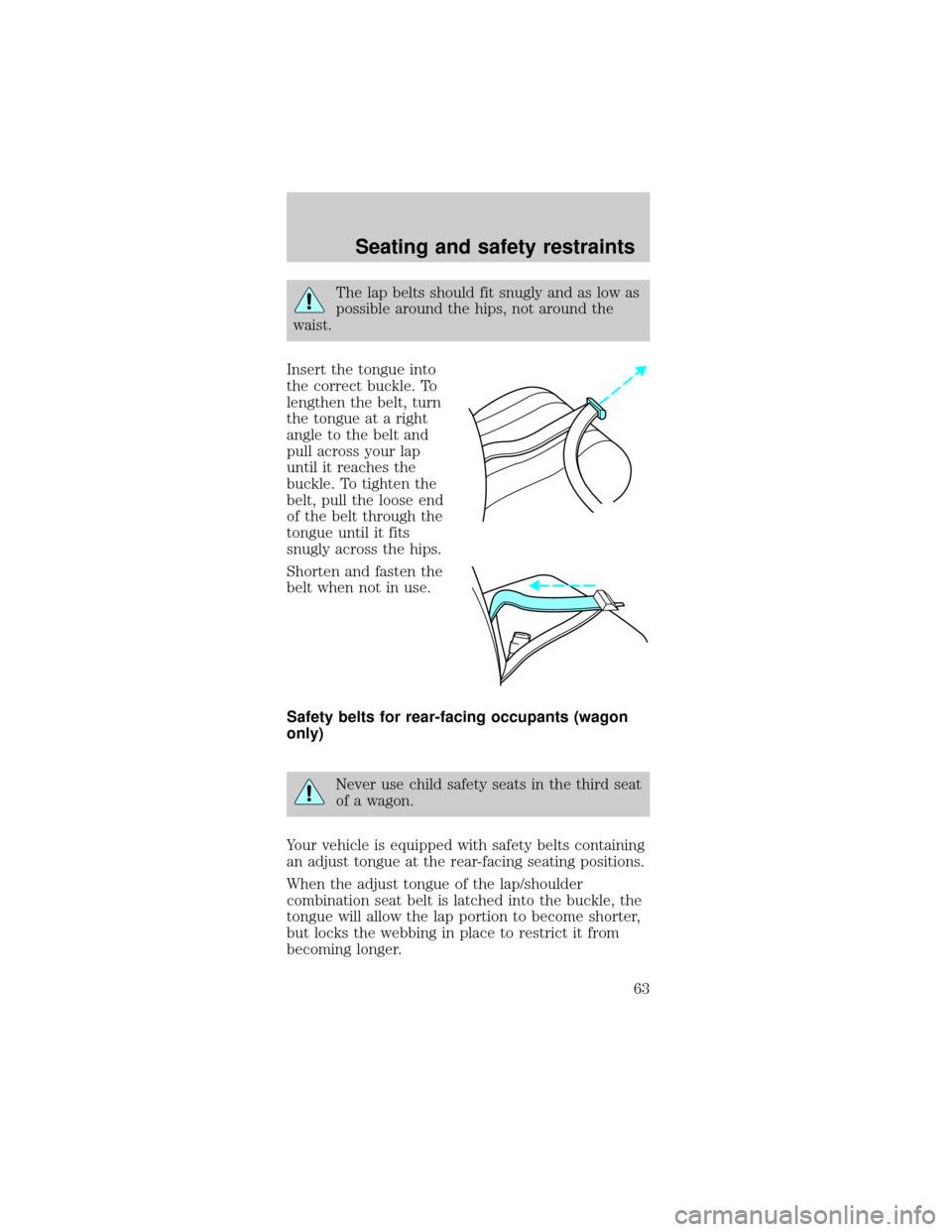
The lap belts should fit snugly and as low as
possible around the hips, not around the
waist.
Insert the tongue into
the correct buckle. To
lengthen the belt, turn
the tongue at a right
angle to the belt and
pull across your lap
until it reaches the
buckle. To tighten the
belt, pull the loose end
of the belt through the
tongue until it fits
snugly across the hips.
Shorten and fasten the
belt when not in use.
Safety belts for rear-facing occupants (wagon
only)
Never use child safety seats in the third seat
of a wagon.
Your vehicle is equipped with safety belts containing
an adjust tongue at the rear-facing seating positions.
When the adjust tongue of the lap/shoulder
combination seat belt is latched into the buckle, the
tongue will allow the lap portion to become shorter,
but locks the webbing in place to restrict it from
becoming longer.
Seating and safety restraints
63
Page 65 of 192
Due to folding rear seats, sometimes the buckles and
tongues toward the center of the vehicle may be
hidden by the rear edge of the seat cushion. Pull
them out so they will be accessible.
While you are fastened in the seat belt, the shoulder
belt adjusts to your movement. However, if you
brake hard, turn hard or your vehicle receives an
impact of 8 km/h (5 mph) or more, the safety belt
will become locked and help reduce your forward
movement.
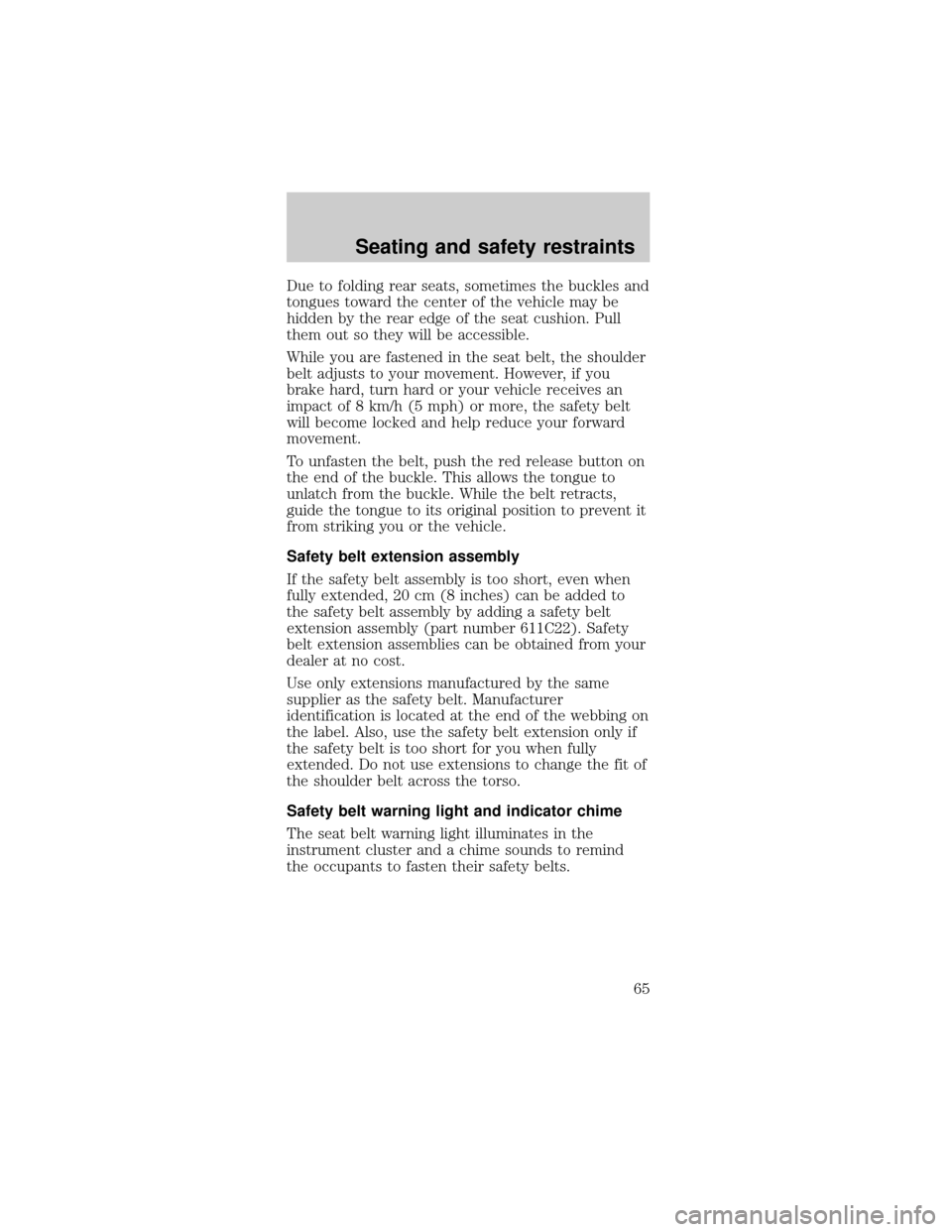
To unfasten the belt, push the red release button on
the end of the buckle. This allows the tongue to
unlatch from the buckle. While the belt retracts,
guide the tongue to its original position to prevent it
from striking you or the vehicle.
Safety belt extension assembly
If the safety belt assembly is too short, even when
fully extended, 20 cm (8 inches) can be added to
the safety belt assembly by adding a safety belt
extension assembly (part number 611C22). Safety
belt extension assemblies can be obtained from your
dealer at no cost.
Use only extensions manufactured by the same
supplier as the safety belt. Manufacturer
identification is located at the end of the webbing on
the label. Also, use the safety belt extension only if
the safety belt is too short for you when fully
extended. Do not use extensions to change the fit of
the shoulder belt across the torso.
Safety belt warning light and indicator chime
The seat belt warning light illuminates in the
instrument cluster and a chime sounds to remind
the occupants to fasten their safety belts.
Seating and safety restraints
65
Page 75 of 192
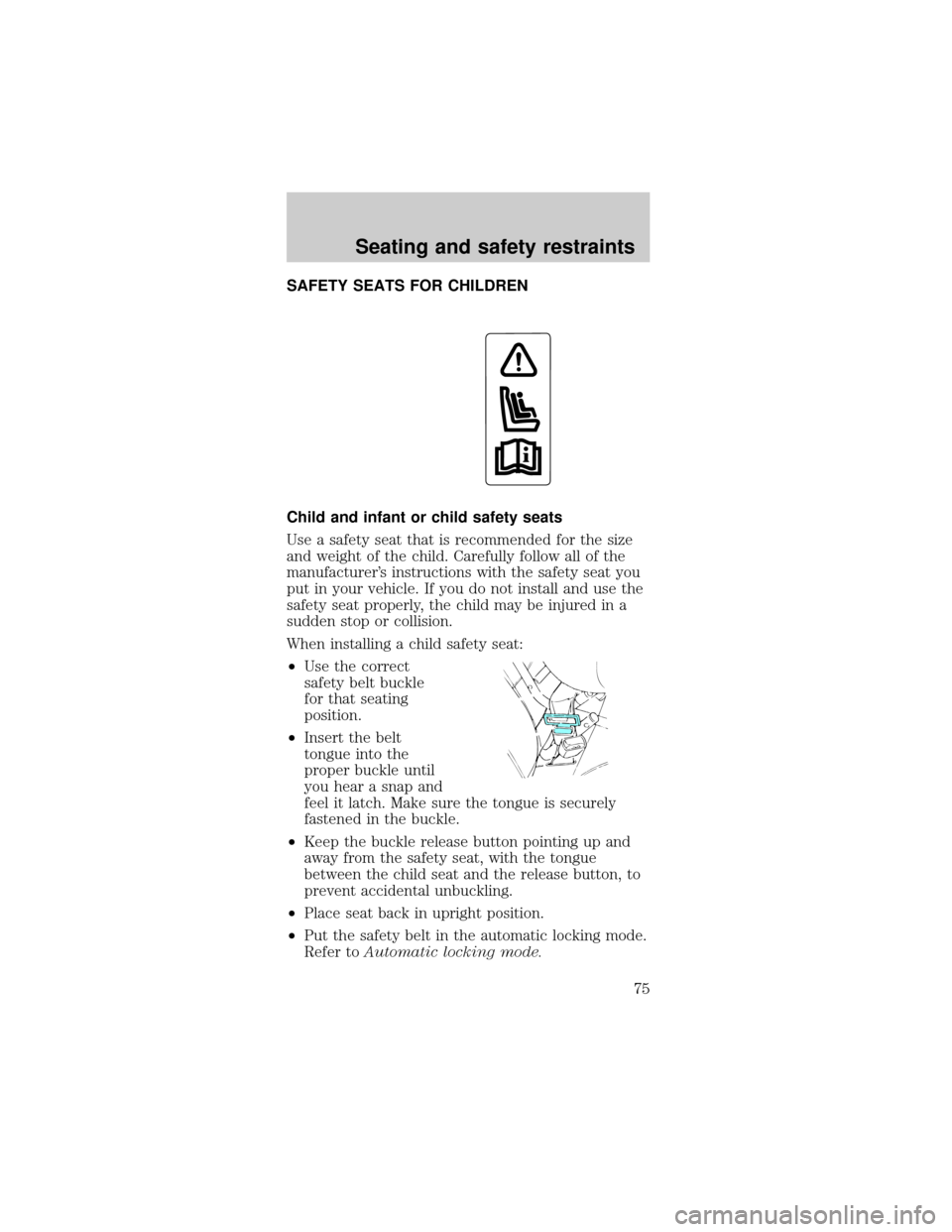
SAFETY SEATS FOR CHILDREN
Child and infant or child safety seats
Use a safety seat that is recommended for the size
and weight of the child. Carefully follow all of the
manufacturer's instructions with the safety seat you
put in your vehicle. If you do not install and use the
safety seat properly, the child may be injured in a
sudden stop or collision.
When installing a child safety seat:
²Use the correct
safety belt buckle
for that seating
position.
²Insert the belt
tongue into the
proper buckle until
you hear a snap and
feel it latch. Make sure the tongue is securely
fastened in the buckle.
²Keep the buckle release button pointing up and
away from the safety seat, with the tongue
between the child seat and the release button, to
prevent accidental unbuckling.
²Place seat back in upright position.
²Put the safety belt in the automatic locking mode.
Refer toAutomatic locking mode.
Seating and safety restraints
75
Page 77 of 192
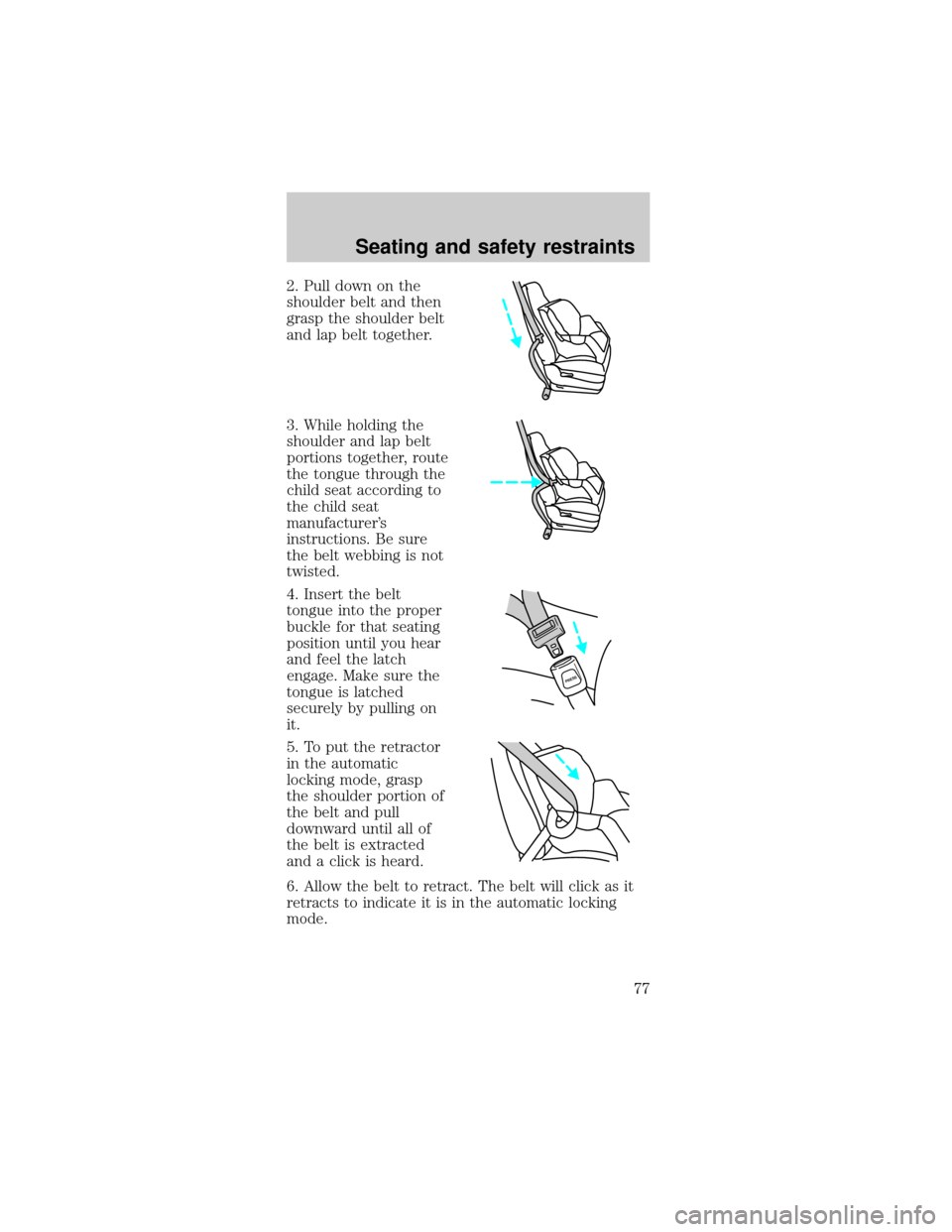
2. Pull down on the
shoulder belt and then
grasp the shoulder belt
and lap belt together.
3. While holding the
shoulder and lap belt
portions together, route
the tongue through the
child seat according to
the child seat
manufacturer's
instructions. Be sure
the belt webbing is not
twisted.
4. Insert the belt
tongue into the proper
buckle for that seating
position until you hear
and feel the latch
engage. Make sure the
tongue is latched
securely by pulling on
it.
5. To put the retractor
in the automatic
locking mode, grasp
the shoulder portion of
the belt and pull
downward until all of
the belt is extracted
and a click is heard.
6. Allow the belt to retract. The belt will click as it
retracts to indicate it is in the automatic locking
mode.
PRESS
Seating and safety restraints
77