brake fluid FORD TAURUS 1998 3.G Owners Manual
[x] Cancel search | Manufacturer: FORD, Model Year: 1998, Model line: TAURUS, Model: FORD TAURUS 1998 3.GPages: 192, PDF Size: 1.66 MB
Page 10 of 192

Anti-lock brake system (ABS) (If equipped)
Momentarily illuminates
when the ignition is
turned on and the
engine is off. If the
light does not illuminate momentarily at start up,
remains on or continues to flash, the ABS needs to
be serviced. With the ABS light on, the anti-lock
brake system is disabled and normal braking is still
effective unless the brake warning light also remains
illuminated with parking brake released.
Speed control (if equipped)
This light comes on
when either the
SET/ACCEL or
RESUME controls are
pressed. It turns off
when the speed control OFF control is pressed, the
brake is applied or the ignition is turned to the OFF
position.
Brake system warning
Momentarily illuminates
when the ignition is
turned to the ON
position and the engine
is off. If brake warning lamp does not illuminate at
this time, seek service immediately. Also illuminates
when the parking brake is engaged. Illumination
after releasing the parking brake indicates low brake
fluid level and the brake system should be inspected
immediately.
Engine oil pressure
Illuminates when the
oil pressure falls below
the normal range. Stop
the vehicle as soon as
safely possible and switch off the engine
immediately. Check the oil level and add oil if
ABS
CRUISE
ON
P!
BRAKE
Instrumentation
10
Page 93 of 192

Pull the release lever
to release the brake.
Driving with the
parking brake on will
cause the brakes to
wear out quickly and
reduce fuel economy.
STEERING
Your vehicle is equipped with power steering. Power
steering uses energy from the engine to help steer
the vehicle.
To prevent damage to the power steering pump:
²Never hold the steering wheel to the extreme
right or the extreme left for more than a few
seconds when the engine is running.
²Do not operate the vehicle with a low power
steering pump fluid level.
If the power steering system breaks down (or if the
engine is turned off), you can steer the vehicle
manually, but it takes more effort.
If the steering wanders or pulls, the condition could
be caused by any of the following:
²underinflated tire(s) on any wheel(s)
²high crown in center of road
²high crosswinds
²wheels out of alignment
²loose or worn components in steering linkage
Driving
93
Page 101 of 192
When parking, do not use the gearshift in
place of the parking brake. Always set the
parking brake fully and make sure that the
gearshift is securely latched in Park (P). Turn off
the ignition whenever you leave your vehicle.
Never leave your vehicle unattended while it is
running. If you do not take these precautions, your
vehicle may move unexpectedly and injure
someone.
VEHICLE LOADING
Before loading a vehicle, familiarize yourself with the
following terms:
²Base Curb Weight: Weight of the vehicle
including any standard equipment, fluids,
lubricants, etc. It does not include passengers or
aftermarket equipment.
²Payload: Combined maximum allowable weight
of cargo, passengers and optional equipment. The
payload equals the gross vehicle weight rating
minus base curb weight.
²GVW (Gross Vehicle Weight): Base curb
weight plus payload weight. The GVW is not a
limit or a specification.
²GVWR (Gross Vehicle Weight Rating):
Maximum total weight of the base vehicle,
passengers, optional equipment and cargo. The
GVWR is specific to each vehicle and is listed on
the Safety Compliance Label on the driver's door
pillar.
²GAWR (Gross Axle Weight Rating): Carrying
capacity for each axle system. The GAWR is
specific to each vehicle and is listed on the Safety
Compliance Label on the driver's door pillar.
Driving
101
Page 128 of 192

SERVICE RECOMMENDATIONS
To help you service your vehicle:
²We highlight do-it-yourself items in the engine
compartment for easy location.
²We provide a ªService Guideº which makes
tracking routine service easy.
If your vehicle requires professional service, your
dealership can provide necessary parts and service.
Check your ªWarranty Guideº to find out which parts
and services are covered.
Use only recommended fuels, lubricants, fluids and
service parts conforming to specifications. Motorcraft
parts are designed and built to provide the best
performance in your vehicle.
PRECAUTIONS WHEN SERVICING YOUR
VEHICLE
Be especially careful when inspecting or servicing
your vehicle.
²Do not work on a hot engine.
²When the engine is running, avoid wearing loose
clothing, jewelry or long hair that could get
caught up in moving parts.
²Do not work on a vehicle with the engine running
in an enclosed space, unless you are sure you
have enough ventilation.
²Keep all lit cigarettes, open flames and other lit
material away from the battery and all fuel related
parts.
If you disconnect the battery, the engine must
ªrelearnº its idle conditions before your vehicle will
drive properly, as explained in theBatterysection in
this chapter.
Working with the engine off
1. Set the parking brake, and ensure the gearshift is
securely latched in park.
Maintenance and care
128
Page 130 of 192
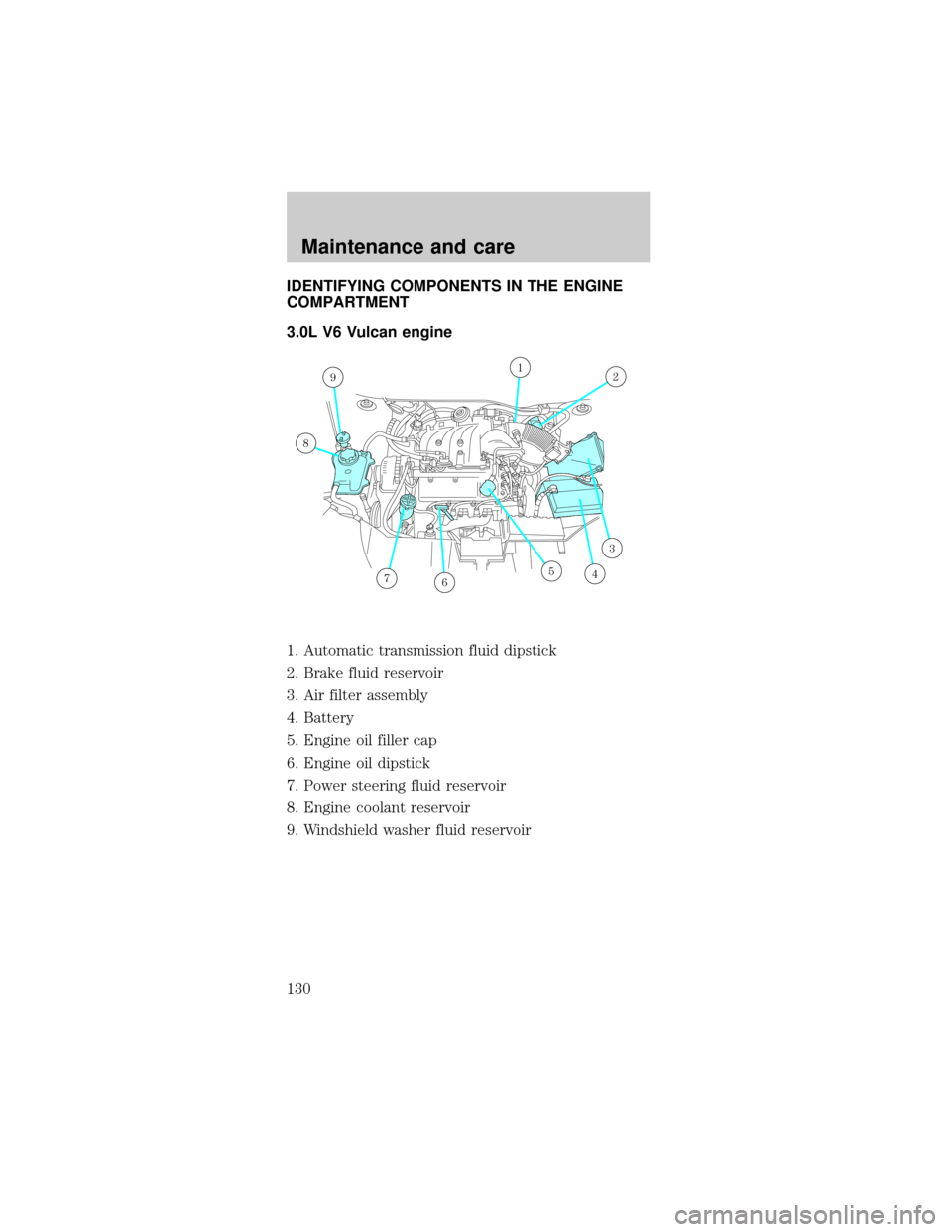
IDENTIFYING COMPONENTS IN THE ENGINE
COMPARTMENT
3.0L V6 Vulcan engine
1. Automatic transmission fluid dipstick
2. Brake fluid reservoir
3. Air filter assembly
4. Battery
5. Engine oil filler cap
6. Engine oil dipstick
7. Power steering fluid reservoir
8. Engine coolant reservoir
9. Windshield washer fluid reservoir
12
3
4567
8
9
Maintenance and care
130
Page 131 of 192
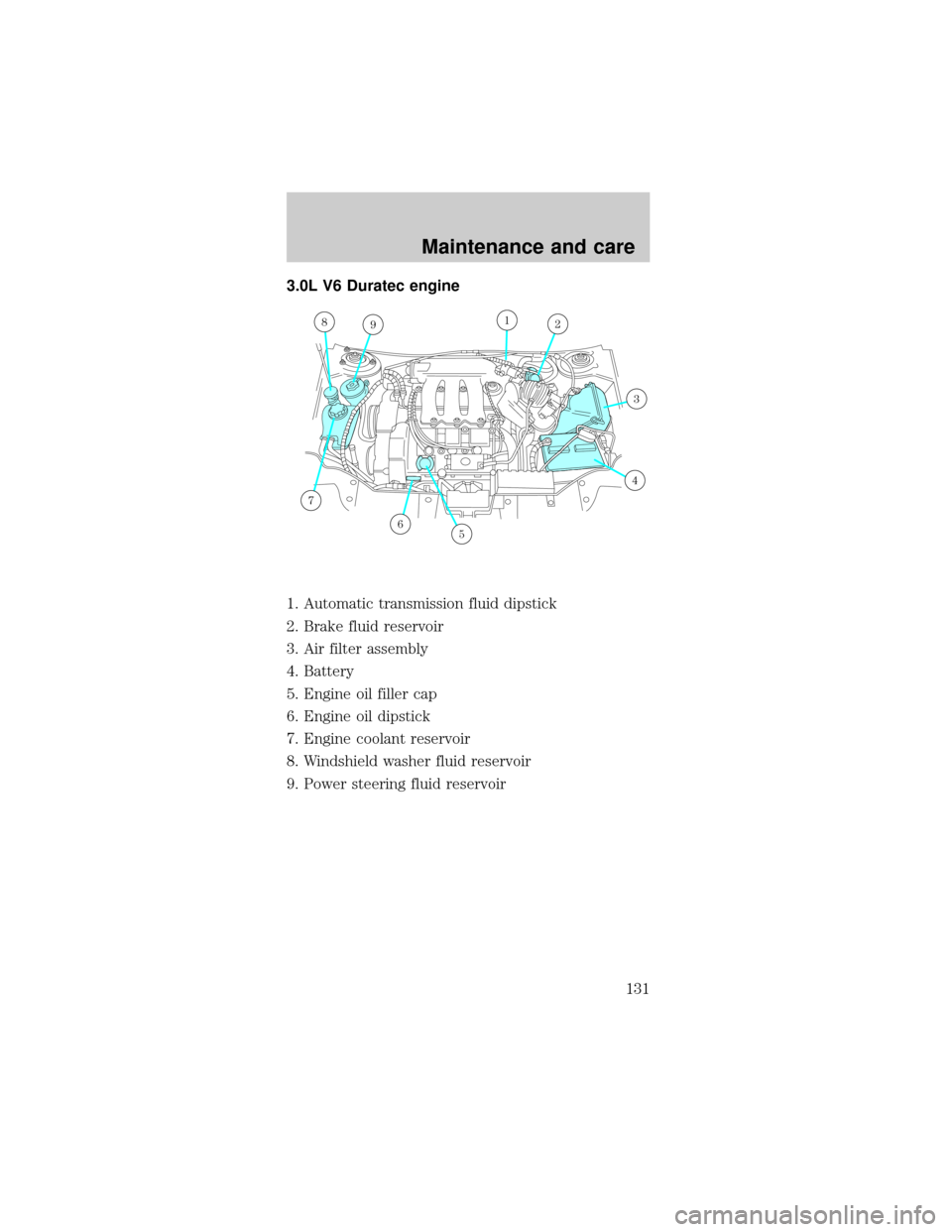
3.0L V6 Duratec engine
1. Automatic transmission fluid dipstick
2. Brake fluid reservoir
3. Air filter assembly
4. Battery
5. Engine oil filler cap
6. Engine oil dipstick
7. Engine coolant reservoir
8. Windshield washer fluid reservoir
9. Power steering fluid reservoir
8912
3
4
56
7
Maintenance and care
131
Page 132 of 192
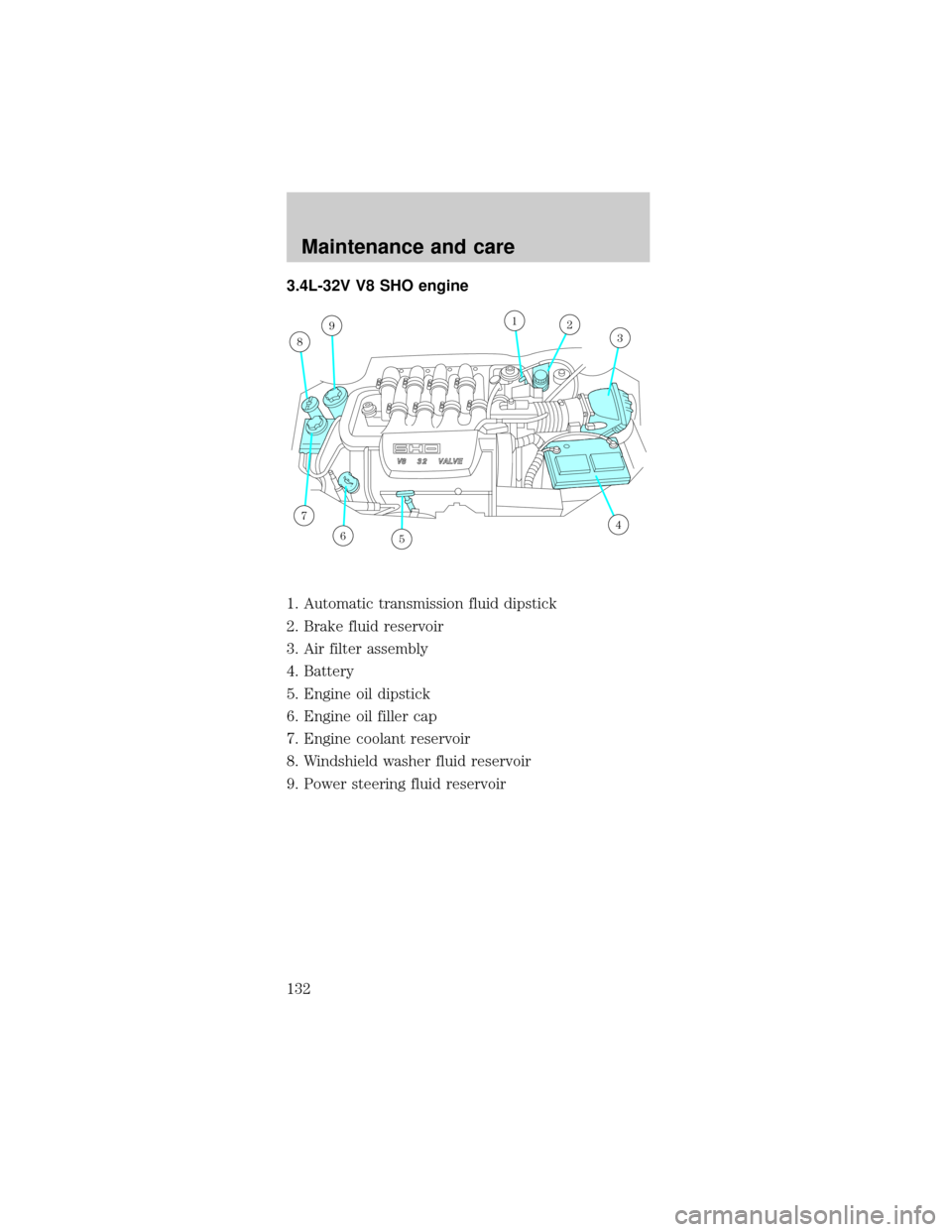
3.4L-32V V8 SHO engine
1. Automatic transmission fluid dipstick
2. Brake fluid reservoir
3. Air filter assembly
4. Battery
5. Engine oil dipstick
6. Engine oil filler cap
7. Engine coolant reservoir
8. Windshield washer fluid reservoir
9. Power steering fluid reservoir
V8 32 VALVE
8
9123
456
7
Maintenance and care
132
Page 136 of 192
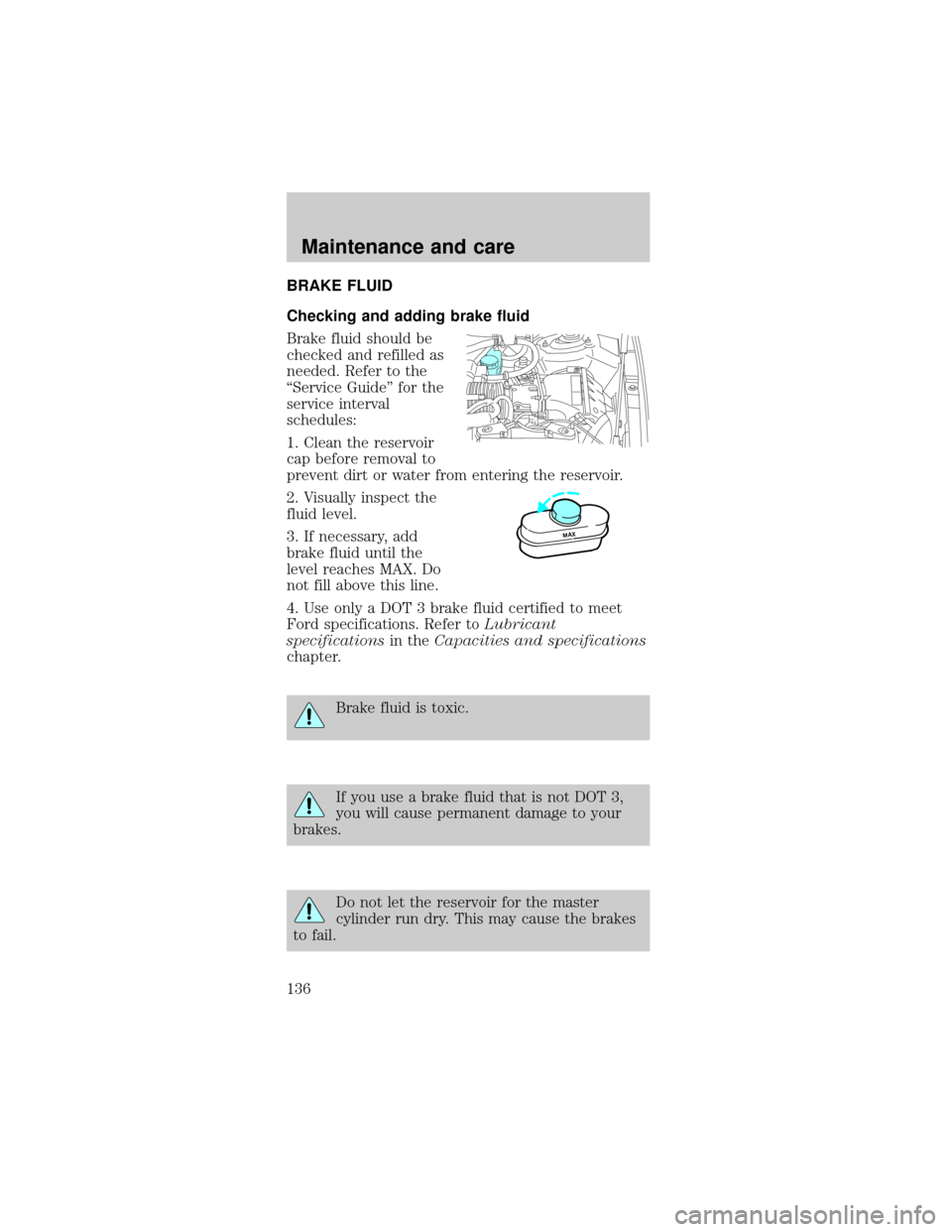
BRAKE FLUID
Checking and adding brake fluid
Brake fluid should be
checked and refilled as
needed. Refer to the
ªService Guideº for the
service interval
schedules:
1. Clean the reservoir
cap before removal to
prevent dirt or water from entering the reservoir.
2. Visually inspect the
fluid level.
3. If necessary, add
brake fluid until the
level reaches MAX. Do
not fill above this line.
4. Use only a DOT 3 brake fluid certified to meet
Ford specifications. Refer toLubricant
specificationsin theCapacities and specifications
chapter.
Brake fluid is toxic.
If you use a brake fluid that is not DOT 3,
you will cause permanent damage to your
brakes.
Do not let the reservoir for the master
cylinder run dry. This may cause the brakes
to fail.
MAX
Maintenance and care
136
Page 143 of 192
2. Park the vehicle on a level surface and engage the
parking brake.
3. With the parking brake engaged and your foot on
the brake pedal, start the engine and move the
gearshift lever through all of the gear ranges. Allow
sufficient time for each gear to engage.
4. Latch the gearshift lever in P (Park) and leave the
engine running.
5. Remove the dipstick, wiping it clean with a clean,
dry lint free rag.
6. Install the dipstick making sure it is fully seated in
the filler tube.
7. Remove the dipstick and inspect the fluid level.
The fluid should be in the designated areas for
normal and room temperature.
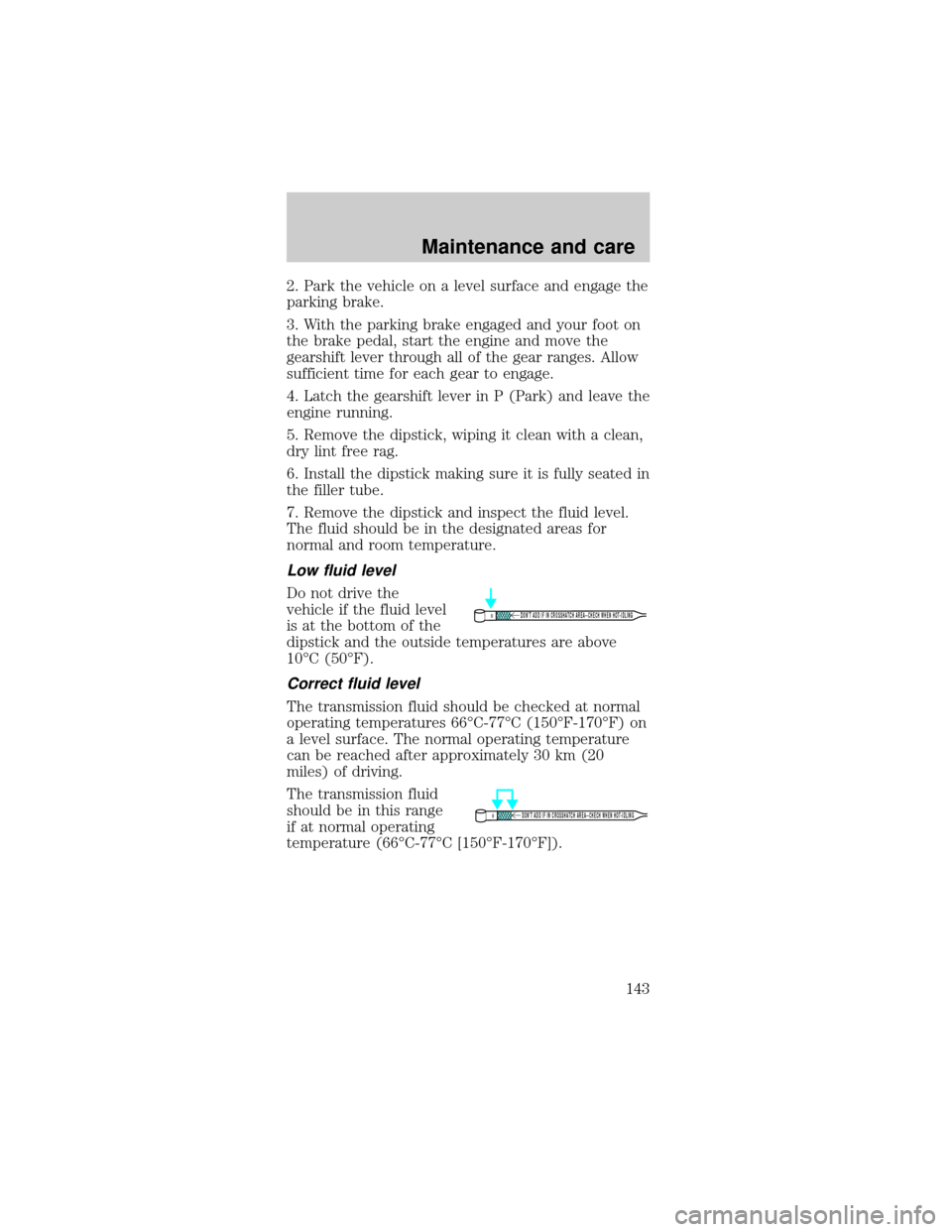
Low fluid level
Do not drive the
vehicle if the fluid level
is at the bottom of the
dipstick and the outside temperatures are above
10ÉC (50ÉF).
Correct fluid level
The transmission fluid should be checked at normal
operating temperatures 66ÉC-77ÉC (150ÉF-170ÉF) on
a level surface. The normal operating temperature
can be reached after approximately 30 km (20
miles) of driving.
The transmission fluid
should be in this range
if at normal operating
temperature (66ÉC-77ÉC [150ÉF-170ÉF]).
DON’T ADD IF IN CROSSHATCH AREA--CHECH WHEN HOT-IDLING
DON’T ADD IF IN CROSSHATCH AREA--CHECH WHEN HOT-IDLING
Maintenance and care
143
Page 170 of 192

After washing, apply the brakes several times to dry
them.
Waxing your vehicle
Wax when water stops beading on the surface. This
could be every three or four months, depending on
operating conditions.
Use only carnauba or synthetic-based waxes. Use
cleaning fluid or alcohol with a clean cloth to remove
any bugs and tar before waxing vehicle. Use tar
remover to remove any tar spots.
Avoid getting wax on the windshield. If you have
wax applied at a commercial car wash, it is
recommended that you clean the wiper blades and
windshield as described inCleaning the wiper
blades and windshield.
Repairing paint chips
Minor scratches or paint damage from road debris
may be repaired with touch-up paint, repair foil or
aerosol paint spray from the Ford accessory line.
Observe the application instructions on the
products.
Remove particles such as bird droppings, tree sap,
insect remains, tar spots, road salt and industrial
fallout immediately.
Cleaning the wheels
Wash with the same detergent as the body of your
vehicle. Do not use acid-based or alcohol-based
wheel cleaners, steel wool, fuel or strong detergents.
Never use abrasives that will damage the finish of
special wheel surfaces. Use a tar remover to remove
grease and tar.
Cleaning the engine
Engines are more efficient when they are clean
because grease and dirt buildup keep the engine
warmer than normal. When washing:
Maintenance and care
170