ECU FORD TAURUS 1999 3.G User Guide
[x] Cancel search | Manufacturer: FORD, Model Year: 1999, Model line: TAURUS, Model: FORD TAURUS 1999 3.GPages: 224, PDF Size: 1.42 MB
Page 85 of 224
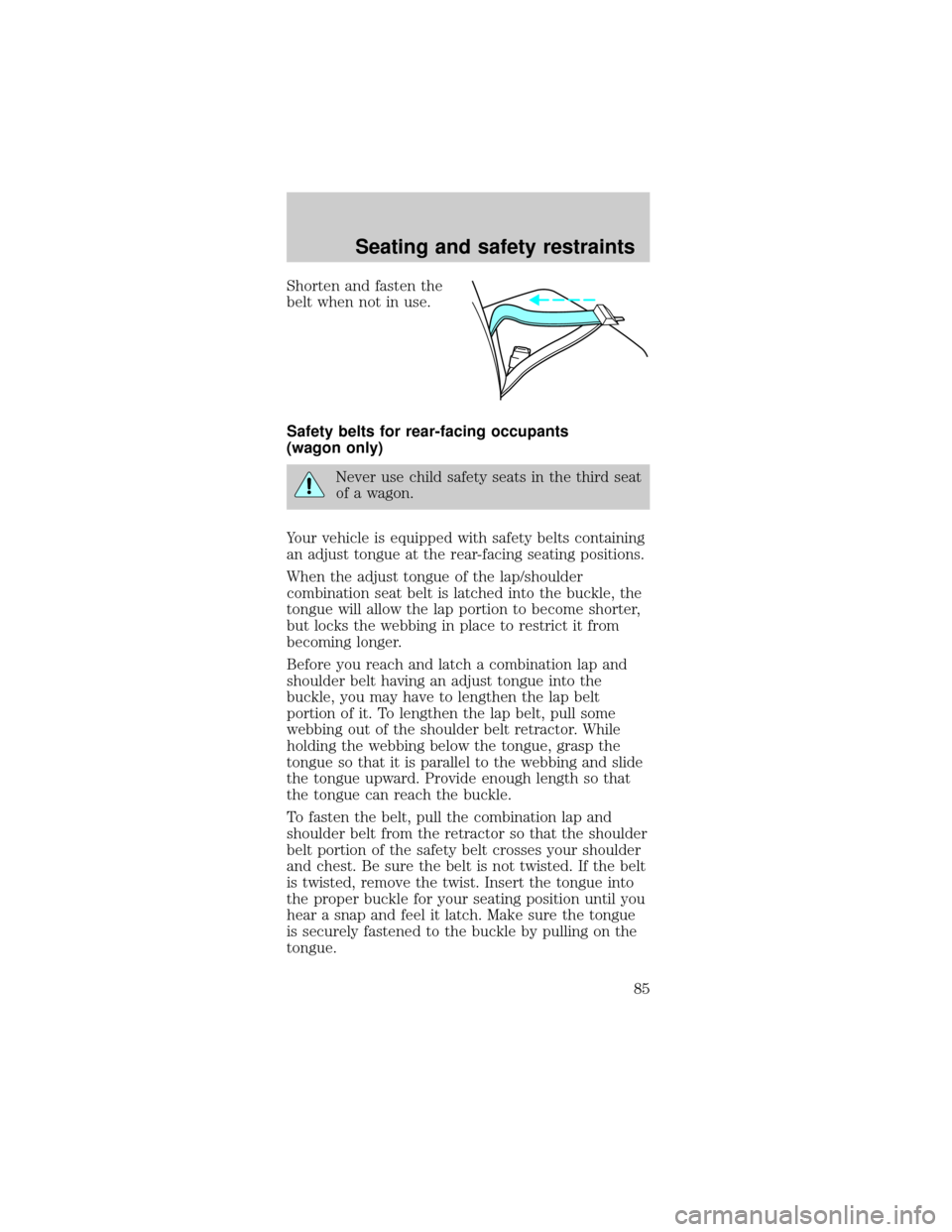
Shorten and fasten the
belt when not in use.
Safety belts for rear-facing occupants
(wagon only)
Never use child safety seats in the third seat
of a wagon.
Your vehicle is equipped with safety belts containing
an adjust tongue at the rear-facing seating positions.
When the adjust tongue of the lap/shoulder
combination seat belt is latched into the buckle, the
tongue will allow the lap portion to become shorter,
but locks the webbing in place to restrict it from
becoming longer.
Before you reach and latch a combination lap and
shoulder belt having an adjust tongue into the
buckle, you may have to lengthen the lap belt
portion of it. To lengthen the lap belt, pull some
webbing out of the shoulder belt retractor. While
holding the webbing below the tongue, grasp the
tongue so that it is parallel to the webbing and slide
the tongue upward. Provide enough length so that
the tongue can reach the buckle.
To fasten the belt, pull the combination lap and
shoulder belt from the retractor so that the shoulder
belt portion of the safety belt crosses your shoulder
and chest. Be sure the belt is not twisted. If the belt
is twisted, remove the twist. Insert the tongue into
the proper buckle for your seating position until you
hear a snap and feel it latch. Make sure the tongue
is securely fastened to the buckle by pulling on the
tongue.
Seating and safety restraints
85
Page 96 of 224

Child and infant or child safety seats
Use a safety seat that is recommended for the size
and weight of the child. Carefully follow all of the
manufacturer's instructions with the safety seat you
put in your vehicle. If you do not install and use the
safety seat properly, the child may be injured in a
sudden stop or collision.
When installing a child safety seat:
²Review and follow
the information
presented in theAir
Bag Supplemental
Restraint System
section in this
chapter.
²Use the correct
safety belt buckle for that seating position.
²Insert the belt tongue into the proper buckle until
you hear a snap and feel it latch. Make sure the
tongue is securely fastened in the buckle.
²Keep the buckle release button pointing up and
away from the safety seat, with the tongue
between the child seat and the release button, to
prevent accidental unbuckling.
²Place seat back in upright position.
²Put the safety belt in the automatic locking mode.
Refer toAutomatic locking mode.
Ford recommends the use of a child safety seat
having a top tether strap. Install the child safety seat
in a seating position which is capable of providing a
tether anchorage. For more information on top
tether straps, refer toAttaching safety seats with
tether straps.
Seating and safety restraints
96
Page 98 of 224

3. While holding the
shoulder and lap belt
portions together, route
the tongue through the
child seat according to
the child seat
manufacturer's
instructions. Be sure
the belt webbing is not
twisted.
4. Insert the belt
tongue into the proper
buckle (the buckle
closest to the direction
the tongue is coming
from) for that seating
position until you hear
a snap and feel the
latch engage. Make
sure the tongue is
latched securely by pulling on it.
5. To put the retractor
in the automatic
locking mode, grasp
the shoulder portion of
the belt and pull
downward until all of
the belt is extracted
and a click is heard.
6. Allow the belt to retract. The belt will click as it
retracts to indicate it is in the automatic locking
mode.
7. Pull the lap belt
portion across the child
seat toward the buckle
and pull up on the
shoulder belt while
pushing down with
your knee on the child
seat.
Seating and safety restraints
98
Page 99 of 224

8. Allow the safety belt
to retract to remove
any slack in the belt.
9. Before placing the
child in the seat,
forcibly tilt the seat
forward and back to
make sure the seat is
securely held in place.
10. Try to pull the belt out of the retractor to make
sure the retractor is in the automatic locking mode
(you should not be able to pull more belt out). If the
retractor is not locked, unbuckle the belt and repeat
steps two through nine.
Check to make sure the child seat is properly
secured before each use.
Installing child safety seats in the lap belt
seating positions
1. Lengthen the lap belt. To lengthen the belt, hold
the tongue so that its bottom is perpendicular to the
direction of webbing while sliding the tongue up the
webbing.
2. Place the child safety seat in the center seating
position.
3. Route the tongue and webbing through the child
seat according to the child seat manufacturer's
instructions.
4. Insert the belt tongue into the proper buckle for
the center seating position until you hear a snap and
feel it latch. Make sure the tongue is securely
fastened to the buckle by pulling on tongue.
5. Push down on the child seat while pulling on the
loose end of the lap belt webbing to tighten the belt.
6. Before placing the child into the child seat,
forcibly tilt the child seat from side to side and in
forward direction to make sure that the seat is held
Seating and safety restraints
99
Page 100 of 224

securely in place. If the child seat moves excessively,
repeat steps 5 through 6, or properly install the
child seat in a different position.
Attaching safety seats with tether straps
Some manufacturers make safety seats that include
a tether strap that goes over the back of the vehicle
seat and attaches to an anchoring point. Other
manufacturers offer the tether strap as an accessory.
Contact the manufacturer of your child safety seat
for information about ordering a tether strap.
Tether anchorage hardware
Attachment holes (at each rear outboard seating
position) have been provided in your vehicle to
attach anchor hardware, if desired. Tether anchorage
hardware kits (part number 613D74) including
instructions, may be obtained at no charge from any
Ford or Lincoln-Mercury dealer. All vehicles built for
sale in Canada include a tether anchor hardware kit.
Be sure to follow the child safety seat
manufacturer's instructions.
Tighten the anchor according to
specifications. Otherwise, the safety seat
may not be properly secured and the child may be
injured in a sudden stop or collision.
If you have a station wagon, tether anchors are
already installed for each of the second row seating
positions.
1. Behind the second
seat, find the plastic
snap-on covers for the
floor anchors.
Seating and safety restraints
100
Page 109 of 224

stopping distance. Always leave enough room
between your vehicle and the vehicle in front of
you to stop.
²We recommend that you familiarize yourself with
this braking technique. However, avoid taking any
unnecessary risks.
Parking brake
Apply the parking
brake whenever the
vehicle is parked. To
set the parking brake,
press the parking brake
pedal down until the
pedal stops.
The BRAKE warning
lamp in the instrument
cluster illuminates and
remains illuminated
(when the ignition is turned ON) until the parking
brake is released.
Always set the parking brake fully and make
sure that the gearshift is securely latched in
P (Park).
The parking brake is not recommended to stop a
moving vehicle. However, if the normal brakes fail,
the parking brake can be used to stop your vehicle
in an emergency. Since the parking brake applies
only the rear brakes, the vehicle's stopping distance
will increase greatly and the handling of your vehicle
will be adversely affected.
P!
BRAKE
Driving
109
Page 113 of 224

To put your vehicle in gear, start the engine, depress
the brake pedal, then move gearshift out of P
(Park).
Hold the brake pedal down while you move
the gearshift lever from P (Park) to another
position. If you do not hold the brake pedal down,
your vehicle may move unexpectedly and injure
someone.
Understanding gearshift positions
P (Park)
Always come to a
complete stop before
shifting into P (Park).
Make sure the gearshift
is securely latched in P
(Park). This locks the
transaxle and prevent
the front wheels from
rotating.
Always set the
parking brake
fully and make sure
the gearshift is
latched in P (Park).
Turn off the ignition
whenever you leave
your vehicle.
PRNDD1
Driving
113
Page 116 of 224

When parking, do not use the gearshift in
place of the parking brake. Always set the
parking brake fully and make sure that the
gearshift is securely latched in Park (P). Turn off
the ignition whenever you leave your vehicle.
Never leave your vehicle unattended while it is
running. If you do not take these precautions, your
vehicle may move unexpectedly and injure
someone.
VEHICLE LOADING
Before loading a vehicle, familiarize yourself with the
following terms:
²Base Curb Weight: Weight of the vehicle
including any standard equipment, fluids,
lubricants, etc. It does not include passengers or
aftermarket equipment.
²Payload: Combined maximum allowable weight of
cargo, passengers and optional equipment. The
payload equals the gross vehicle weight rating
minus base curb weight.
²GVW (Gross Vehicle Weight): Base curb weight
plus payload weight. The GVW is not a limit or a
specification.
²GVWR (Gross Vehicle Weight Rating):
Maximum total weight of the base vehicle,
passengers, optional equipment and cargo. The
GVWR is specific to each vehicle and is listed on
the Safety Compliance Label on the driver's door
pillar.
²GAWR (Gross Axle Weight Rating): Carrying
capacity for each axle system. The GAWR is
specific to each vehicle and is listed on the Safety
Compliance Label on the driver's door pillar.
²GCW (Gross Combined Weight): The combined
weight of the towing vehicle (including passengers
and cargo) and the trailer.
Driving
116
Page 123 of 224
Before you have your vehicle towed:
²Release the parking brake.
²Turn the key in the ignition to OFF.
²Move the gearshift to N (Neutral).
²Unlock the steering wheel.
Do not tow your vehicle at a speed faster than
56 km/h (35 mph) or for a distance greater than 80
km (50 miles), unless the drive wheels are placed on
dollies.
Never use a tow bar that attaches to the
bumper when you tow your vehicle. This
could damage the bumper and cause an accident.
LUGGAGE RACK (IF EQUIPPED)
The rear crossbar can be adjusted to fit the item
being carried. The front crossbar does not move. Do
not load more than 44 kg (100 lbs.) on the luggage
rack.
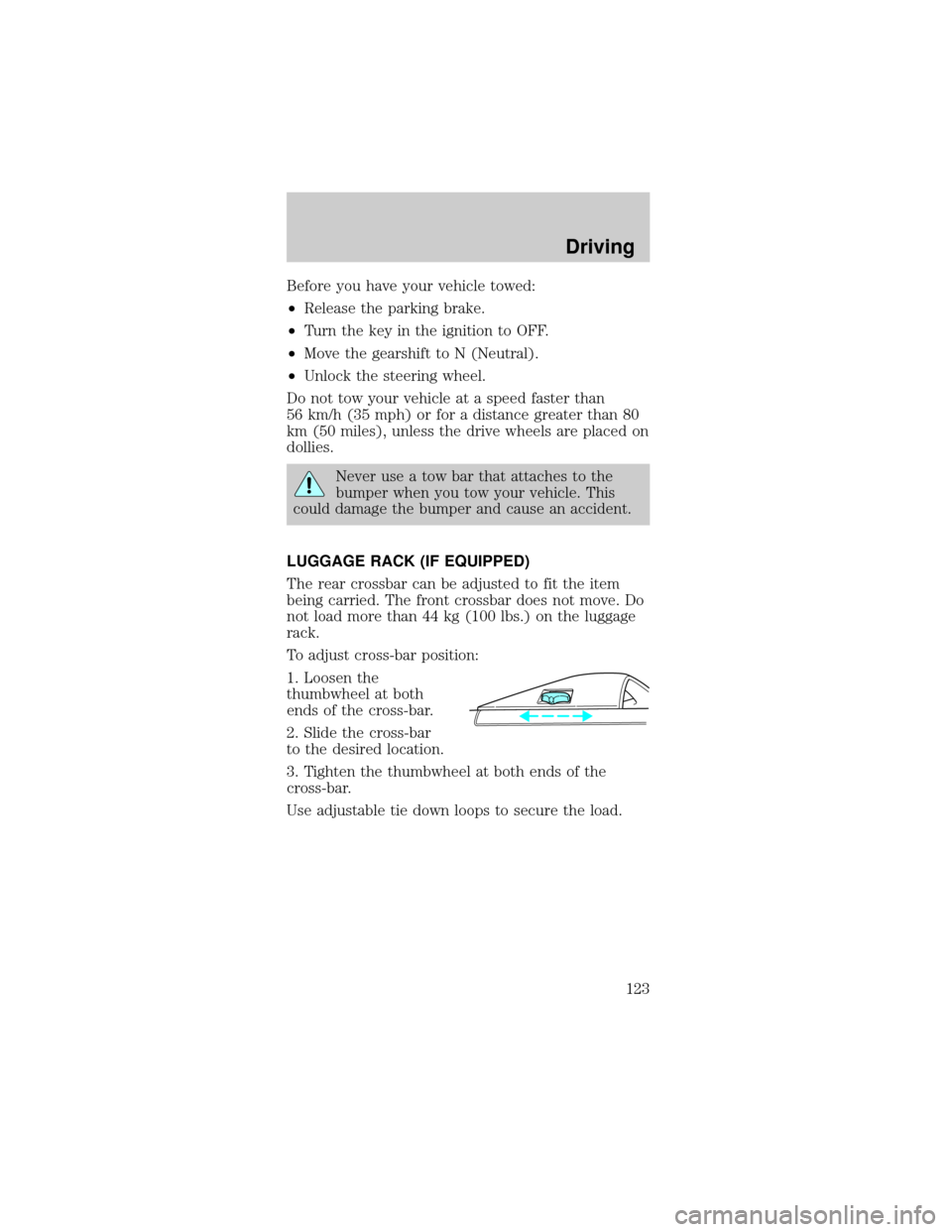
To adjust cross-bar position:
1. Loosen the
thumbwheel at both
ends of the cross-bar.
2. Slide the cross-bar
to the desired location.
3. Tighten the thumbwheel at both ends of the
cross-bar.
Use adjustable tie down loops to secure the load.
Driving
123
Page 128 of 224

Fuse/Relay
LocationFuse Amp
RatingDescription
12 5A Instrument Cluster,
Autolamps,
Transmission Control
Switch, ICP, GEM
13 5A Electronic Crash Unit
(ECU), Blower Motor,
EATC
14 5A Semi-Active Ride
Control Module
15 10A Multifunction Switch
(Turn Signal)
16 Ð Not Used
17 30A Front Wiper/Washer
18 5A Headlamp Switch
19 15A Rear Wiper/Washer
20 5A ICP, RAP, Phone, GEM
21 20A Cigar Lighter
22 5A Power Mirrors, Power
Antenna, Luggage
Compartment Lamp,
Autolamp
23 5A GEM, RAP, PATS
24 5A ICP, RCC, Speedometer
25 10A Data Link Connector
(DLC)
26 15A Luggage Compartment
27 10A Battery Saver Relay
28 15A Speed Control, Brake
Lamp
29 15A Multifunction Switch,
(Hazard)
30 15A High Beams, Daytime
Running Lamps,
Instrument Cluster
Roadside emergencies
128