maintenance FORD TAURUS 1999 3.G User Guide
[x] Cancel search | Manufacturer: FORD, Model Year: 1999, Model line: TAURUS, Model: FORD TAURUS 1999 3.GPages: 224, PDF Size: 1.42 MB
Page 122 of 224

When towing a trailer:
²Use D (Drive) or a lower gear when towing up or
down steep hills. This will eliminate excessive
downshifting and upshifting for optimum fuel
economy and transaxle cooling.
²Anticipate stops and brake gradually.
Servicing after towing
If you tow a trailer for long distances, your vehicle
will require more frequent service intervals. Refer to
your maintenance guide and or service guide for
more information.
Trailer towing tips
²Practice turning, stopping and backing up in an
area before starting on a trip to get the feel of the
vehicle trailer combination. When turning, make
wider turns so the trailer wheels will clear curbs
and other obstacles.
²Allow more distance for stopping with a trailer
attached.
²The trailer tongue weight should be 10% of the
loaded trailer weight.
²After you have traveled 80 km (50 miles),
thoroughly check your hitch, electrical
connections and trailer wheel lug nuts.
²When stopped in traffic for long periods of time in
hot weather, place the gearshift in P (Park) and
increase idle speed. This aids engine cooling and
air conditioner efficiency.
²Vehicles with trailers should not be parked on a
grade. If you must park on a grade, place wheel
chocks under the trailer's wheels.
Towing your vehicle behind another vehicle
At times, you may want to tow your vehicle behind
another vehicle, such as a recreational vehicle, car
or a truck.
Driving
122
Page 130 of 224
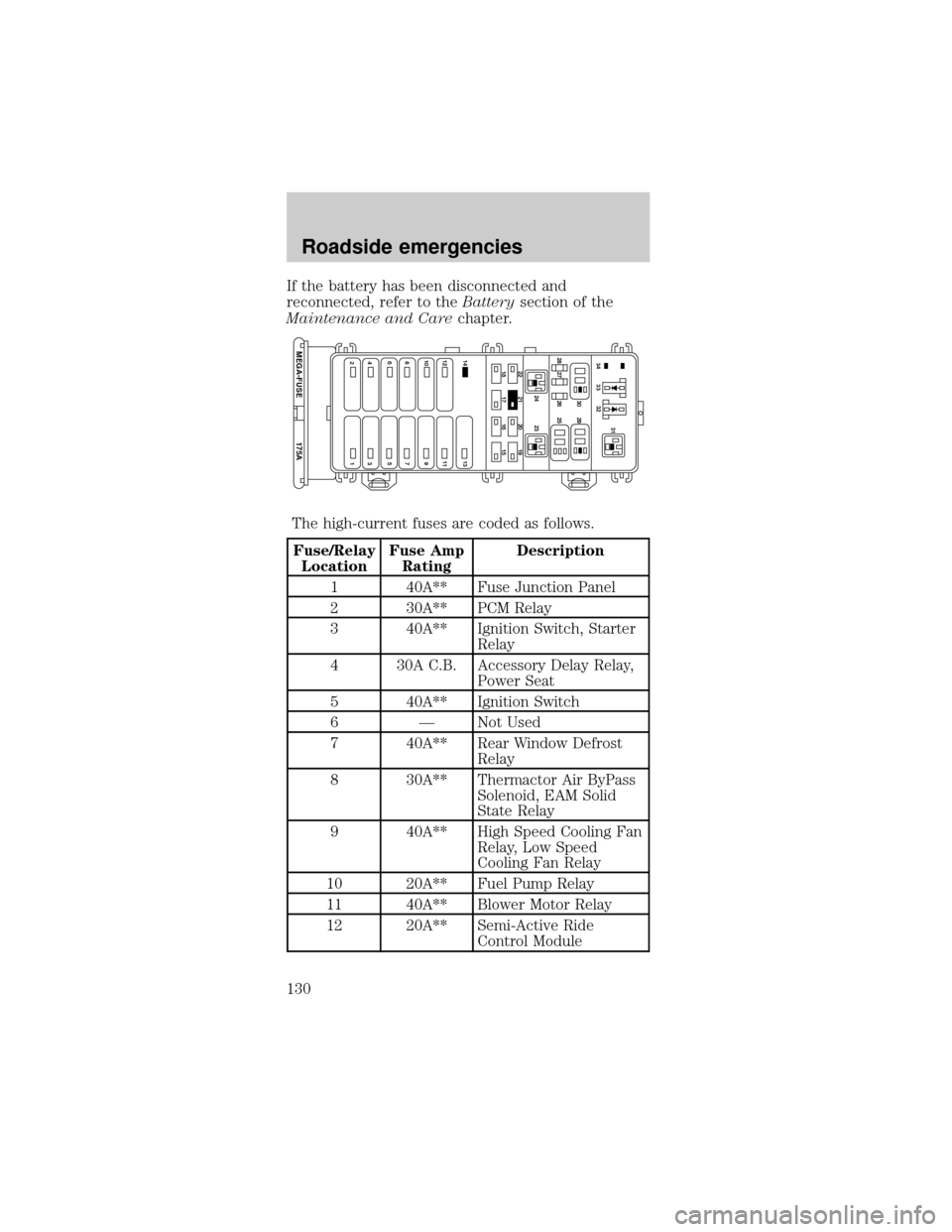
If the battery has been disconnected and
reconnected, refer to theBatterysection of the
Maintenance and Carechapter.
The high-current fuses are coded as follows.
Fuse/Relay
LocationFuse Amp
RatingDescription
1 40A** Fuse Junction Panel
2 30A** PCM Relay
3 40A** Ignition Switch, Starter
Relay
4 30A C.B. Accessory Delay Relay,
Power Seat
5 40A** Ignition Switch
6 Ð Not Used
7 40A** Rear Window Defrost
Relay
8 30A** Thermactor Air ByPass
Solenoid, EAM Solid
State Relay
9 40A** High Speed Cooling Fan
Relay, Low Speed
Cooling Fan Relay
10 20A** Fuel Pump Relay
11 40A** Blower Motor Relay
12 20A** Semi-Active Ride
Control Module
22
14 13
12 11
10 9
87
175A MEGA-FUSE
65
43
2121 24 23 28 27 26 2530 2931
33 3432
20 19
18 17 16 15
Roadside emergencies
130
Page 141 of 224

SERVICE RECOMMENDATIONS
To help you service your vehicle:
²We highlight do-it-yourself items in the engine
compartment for easy location.
²We provide a Scheduled Maintenance Guide which
makes tracking routine service easy.
If your vehicle requires professional service, your
dealership can provide necessary parts and service.
Check your ªWarranty Guideº to find out which parts
and services are covered.
Use only recommended fuels, lubricants, fluids and
service parts conforming to specifications. Motorcraft
parts are designed and built to provide the best
performance in your vehicle.
PRECAUTIONS WHEN SERVICING YOUR
VEHICLE
Be especially careful when inspecting or servicing
your vehicle.
²Do not work on a hot engine.
²When the engine is running, keep loose clothing,
jewelry or long hair away from moving parts.
²Do not work on a vehicle with the engine running
in an enclosed space, unless you are sure you
have enough ventilation.
²Keep all lit cigarettes, open flames and other lit
material away from the battery and all fuel related
parts.
If you disconnect the battery, the engine must
ªrelearnº its idle conditions before your vehicle will
drive properly, as explained in theBatterysection in
this chapter.
Working with the engine off
1. Set the parking brake, and ensure the gearshift is
securely latched in park.
2. Turn off the engine and remove the key.
Maintenance and care
141
Page 142 of 224
3. Block the wheels to prevent the vehicle from
moving unexpectedly.
Working with the engine on
1. Set the parking brake and ensure the gearshift is
securely latched in P (Park).
2. Block the wheels to prevent the vehicle from
moving unexpectedly.
Do not start your engine with the air cleaner
removed and do not remove it while the
engine is running.
OPENING THE HOOD
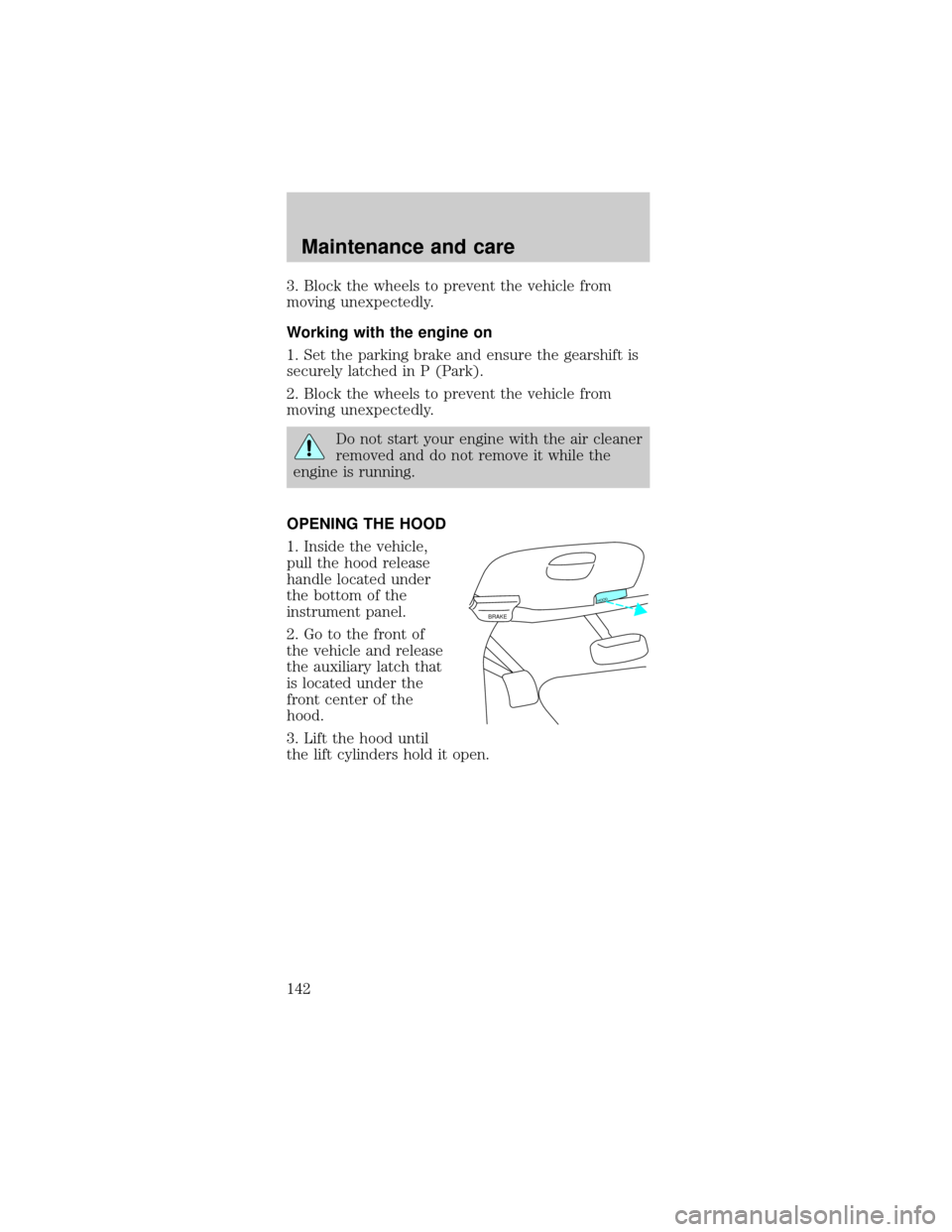
1. Inside the vehicle,
pull the hood release
handle located under
the bottom of the
instrument panel.
2. Go to the front of
the vehicle and release
the auxiliary latch that
is located under the
front center of the
hood.
3. Lift the hood until
the lift cylinders hold it open.
BRAKE
HOOD
Maintenance and care
142
Page 143 of 224
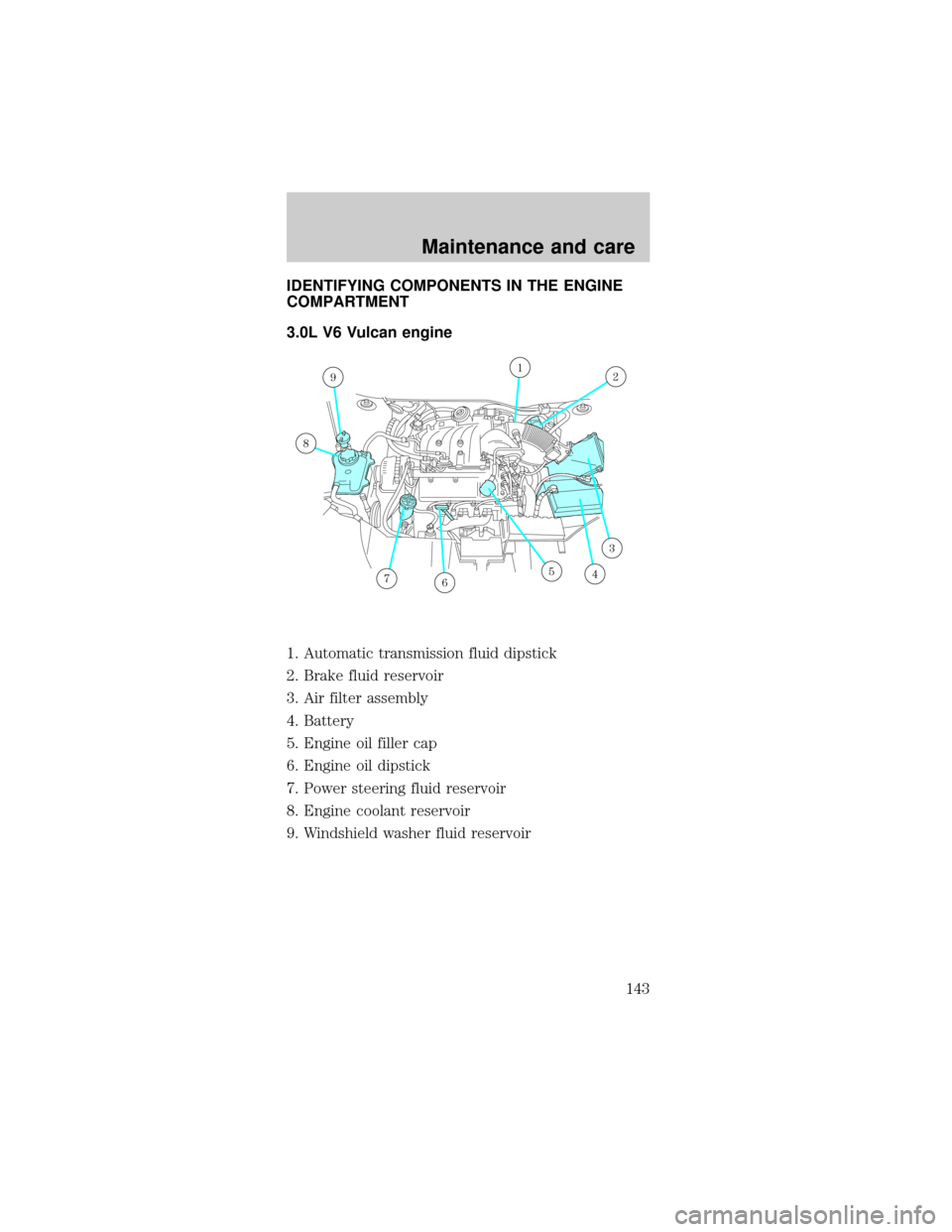
IDENTIFYING COMPONENTS IN THE ENGINE
COMPARTMENT
3.0L V6 Vulcan engine
1. Automatic transmission fluid dipstick
2. Brake fluid reservoir
3. Air filter assembly
4. Battery
5. Engine oil filler cap
6. Engine oil dipstick
7. Power steering fluid reservoir
8. Engine coolant reservoir
9. Windshield washer fluid reservoir
12
3
4567
8
9
Maintenance and care
143
Page 144 of 224
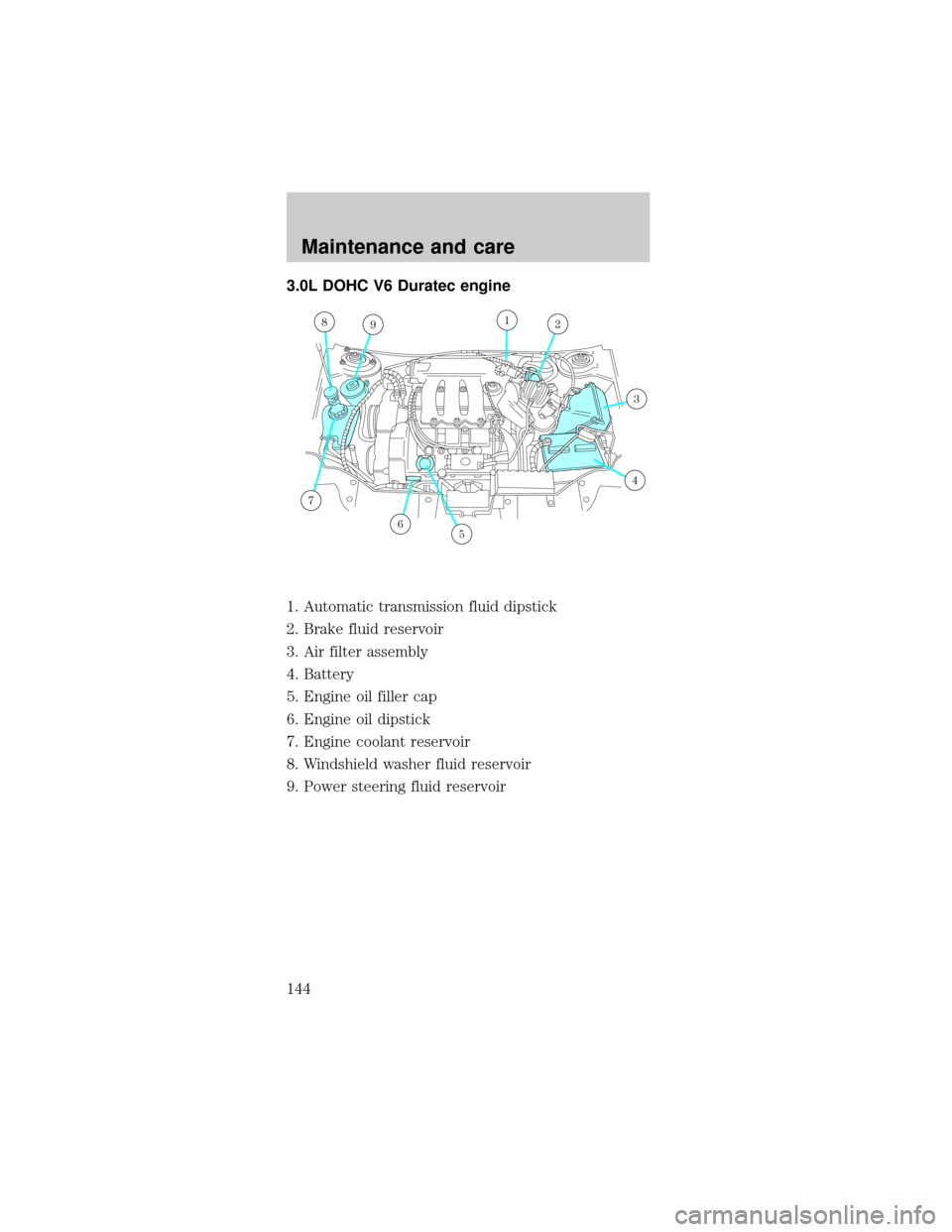
3.0L DOHC V6 Duratec engine
1. Automatic transmission fluid dipstick
2. Brake fluid reservoir
3. Air filter assembly
4. Battery
5. Engine oil filler cap
6. Engine oil dipstick
7. Engine coolant reservoir
8. Windshield washer fluid reservoir
9. Power steering fluid reservoir
8912
3
4
56
7
Maintenance and care
144
Page 145 of 224
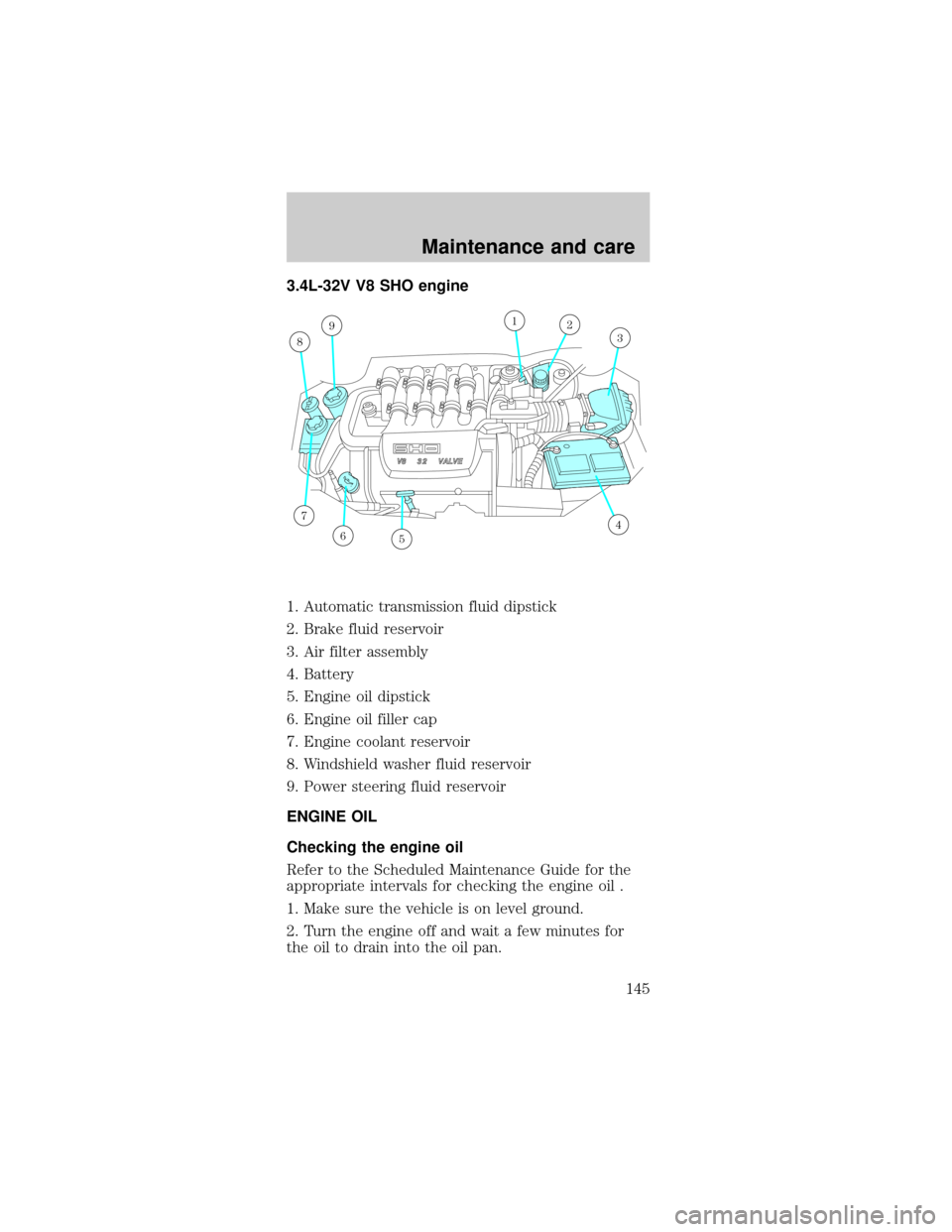
3.4L-32V V8 SHO engine
1. Automatic transmission fluid dipstick
2. Brake fluid reservoir
3. Air filter assembly
4. Battery
5. Engine oil dipstick
6. Engine oil filler cap
7. Engine coolant reservoir
8. Windshield washer fluid reservoir
9. Power steering fluid reservoir
ENGINE OIL
Checking the engine oil
Refer to the Scheduled Maintenance Guide for the
appropriate intervals for checking the engine oil .
1. Make sure the vehicle is on level ground.
2. Turn the engine off and wait a few minutes for
the oil to drain into the oil pan.
V8 32 VALVE
8
9123
456
7
Maintenance and care
145
Page 146 of 224
3. Set the parking brake and ensure the gearshift is
securely latched in P.
4. Open the hood. Protect yourself from engine heat.
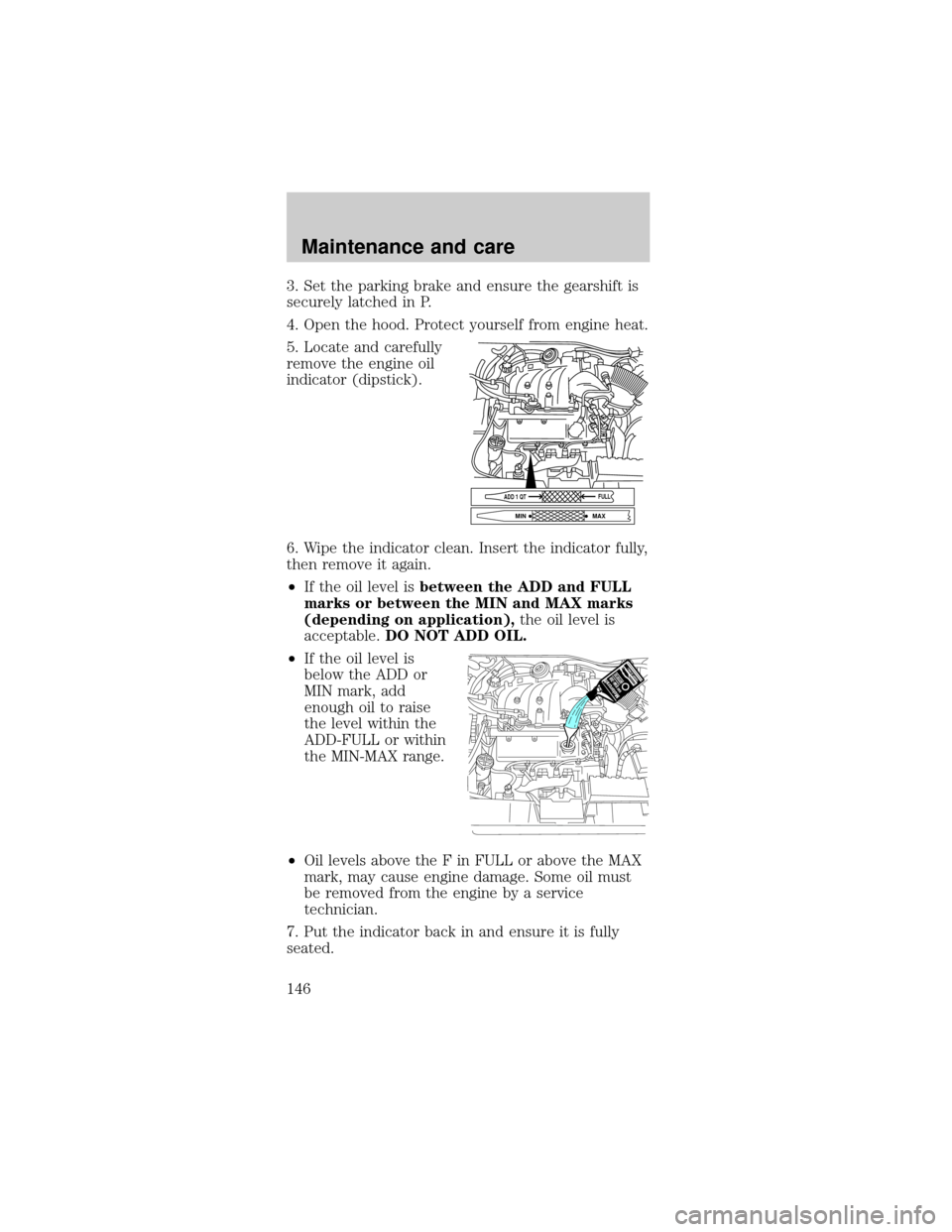
5. Locate and carefully
remove the engine oil
indicator (dipstick).
6. Wipe the indicator clean. Insert the indicator fully,
then remove it again.
²If the oil level isbetween the ADD and FULL
marks or between the MIN and MAX marks
(depending on application),the oil level is
acceptable.DO NOT ADD OIL.
²If the oil level is
below the ADD or
MIN mark, add
enough oil to raise
the level within the
ADD-FULL or within
the MIN-MAX range.
²Oil levels above the F in FULL or above the MAX
mark, may cause engine damage. Some oil must
be removed from the engine by a service
technician.
7. Put the indicator back in and ensure it is fully
seated.
ADD 1 QTFULL
MAX MIN
Maintenance and care
146
Page 147 of 224
Adding engine oil
1. Check the engine oil. For instructions, refer to
Checking the engine oilin this chapter.
2. If the engine oil level is not within the normal
range, add only certified engine oil of the
recommended viscosity. Remove the engine oil filler
cap and use a funnel to pour the engine oil into the
opening.
3. Recheck the engine oil level. Make sure the oil
level is not above the F in FULL mark on the engine
oil level indicator (dipstick).
4. Install the indicator and ensure it is fully seated.
5. Fully install the engine oil filler cap by turning the
filler cap clockwise until three clicks can be heard.
To avoid possible oil loss, DO NOT operate the
vehicle with the engine oil level indicator
and/or the engine oil filler cap removed.
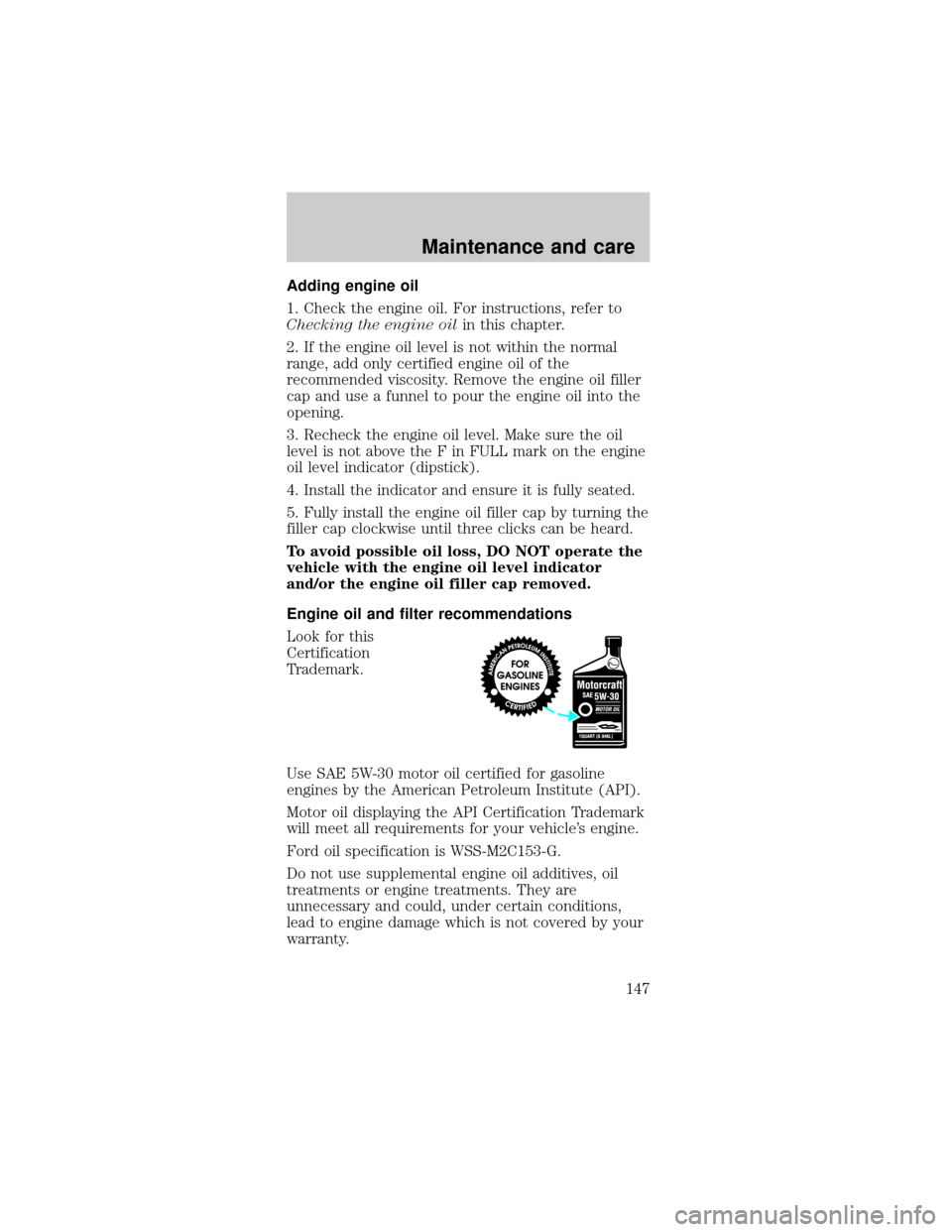
Engine oil and filter recommendations
Look for this
Certification
Trademark.
Use SAE 5W-30 motor oil certified for gasoline
engines by the American Petroleum Institute (API).
Motor oil displaying the API Certification Trademark
will meet all requirements for your vehicle's engine.
Ford oil specification is WSS-M2C153-G.
Do not use supplemental engine oil additives, oil
treatments or engine treatments. They are
unnecessary and could, under certain conditions,
lead to engine damage which is not covered by your
warranty.
Maintenance and care
147
Page 148 of 224
Change your engine oil and filter according to the
appropriate schedule listed in the Scheduled
Maintenance Guide.
Ford production and aftermarket (Motorcraft) oil
filters are designed for added engine protection and
long life. If a replacement oil filter is used that does
not meet Ford material and design specifications,
startup engine noises or knock may be experienced.
It is recommended you use the appropriate
Motorcraft oil filter (or another brand meeting Ford
specifications) for your engine application.
BRAKE FLUID
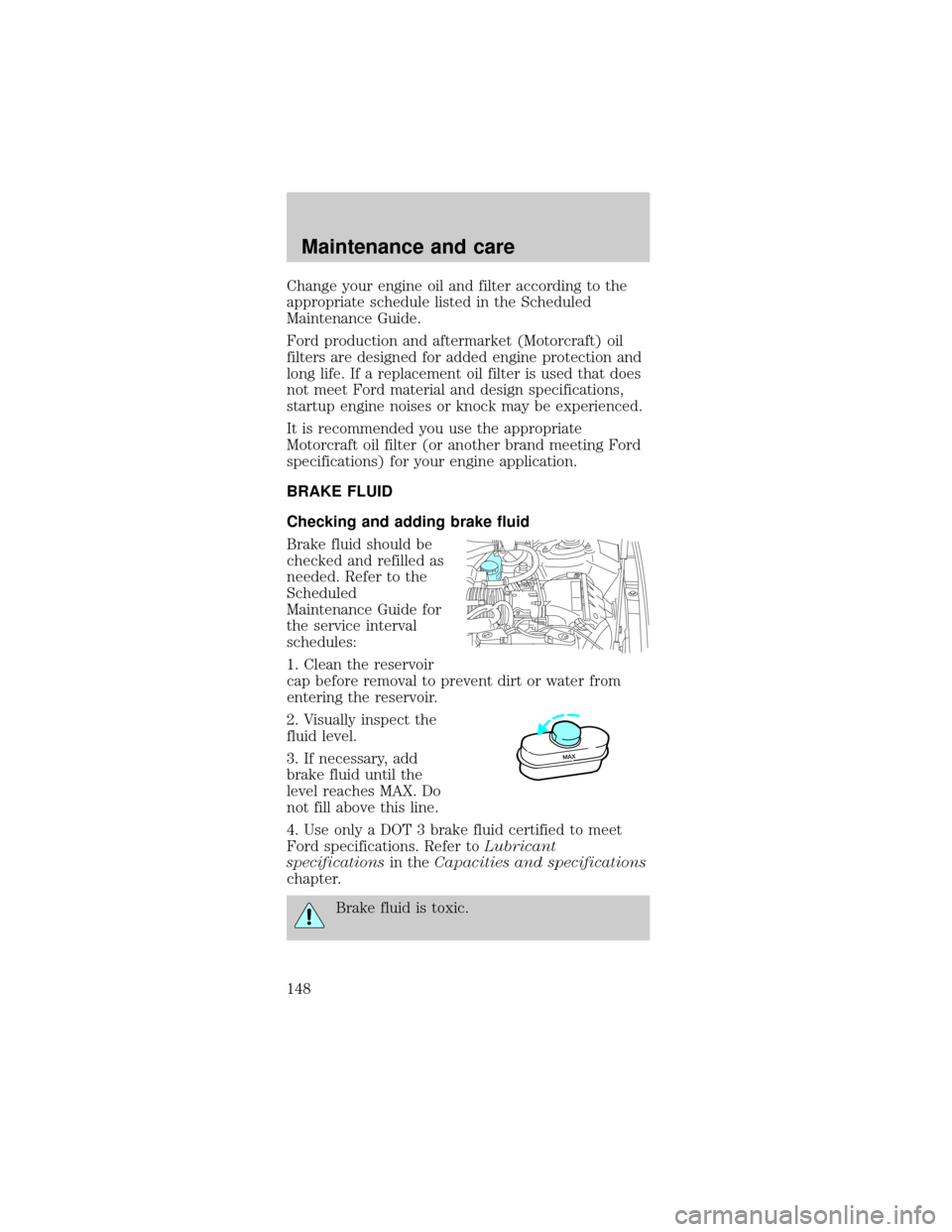
Checking and adding brake fluid
Brake fluid should be
checked and refilled as
needed. Refer to the
Scheduled
Maintenance Guide for
the service interval
schedules:
1. Clean the reservoir
cap before removal to prevent dirt or water from
entering the reservoir.
2. Visually inspect the
fluid level.
3. If necessary, add
brake fluid until the
level reaches MAX. Do
not fill above this line.
4. Use only a DOT 3 brake fluid certified to meet
Ford specifications. Refer toLubricant
specificationsin theCapacities and specifications
chapter.
Brake fluid is toxic.
MAX
Maintenance and care
148