maintenance schedule FORD TAURUS 1999 3.G User Guide
[x] Cancel search | Manufacturer: FORD, Model Year: 1999, Model line: TAURUS, Model: FORD TAURUS 1999 3.GPages: 224, PDF Size: 1.42 MB
Page 170 of 224
Fuel quality
If you are experiencing starting, rough idle or
hesitation driveability problems during a cold start, try
a different brand of gasoline. ªPremiumº unleaded
gasoline should not be used (particularly in the United
States) if ªRegularº unleaded gasoline is recommended
because it may cause these problems to become more
pronounced. If the problems persist, see your dealer or
a qualified service technician.
It should not be necessary to add any aftermarket
products to your fuel tank if you continue to use a
high quality fuel.
Cleaner air
Ford approves the use of gasolines to improve air
quality, including reformulated gasolines that contain
oxygenates up to 10% ethanol or 15% MTBE.
Running out of fuel
Avoid running out fuel because this situation may
have an adverse affect on powertrain components.
If you have run out of fuel:
²You may need to crank the engine several times
after refueling before the system starts to pump
the fuel from the tank to the engine.
²Your ªService Engine Soonº indicator may come
on. For more information on the ªService Engine
Soonº indicator, refer to theInstrumentation
chapter.
Fuel Filter
For fuel filter replacement, see your dealer or a
qualified service technician. Refer to the Scheduled
Maintenance Guide for the appropriate intervals for
changing the fuel filter.
Replace the fuel filter with an authorized
Motorcraft part. The customer warranty may
be void for any damage to the fuel system if an
authorized Motorcraft fuel filter is not used.
Maintenance and care
170
Page 174 of 224
²Combine errands and minimize stop-and-go
driving.
Maintenance
²Keep tires properly inflated and use only
recommended size.
²Operating a vehicle with the wheels out of
alignment will reduce fuel economy.
²Use recommended engine oil. Refer toLubricant
Specifications.
²Perform all regularly scheduled maintenance
items. Follow the recommended maintenance
schedule and owner maintenance checks found in
your vehicle Scheduled Maintenance Guide.
Conditions
²Heavily loading a vehicle or towing a trailer may
reduce fuel economy at any speed.
²Carrying unnecessary weight may reduce fuel
economy (approximately 2 km/h [1 mpg] is lost
for every 180 kg [400 lb] of weight carried).
²Adding certain accessories to your vehicle (for
example bug deflectors, rollover/light bars,
running boards, ski/luggage racks) may reduce
fuel economy.
²Using fuel blended with alcohol may lower fuel
economy.
²Fuel economy may decrease with lower
temperatures during the first 12±16 km
(8±10 miles) of driving.
²Driving on flat terrain offers improved fuel
economy as compared to driving on hilly terrain.
²Transmissions give their best fuel economy when
operated in the top cruise gear and with steady
pressure on the gas pedal.
²Close windows for high speed driving.
Maintenance and care
174
Page 175 of 224
EPA window sticker
Every new vehicle should have the EPA window
sticker. Contact your dealer if the window sticker is
not supplied with your vehicle. The EPA window
sticker should be your guide for the fuel economy
comparisons with other vehicles.
It is important to note the box in the lower left
corner of the window sticker. These numbers
represent the Range of Km/L (MPG) expected on
the vehicle under optimum conditions. Your fuel
economy may vary depending upon the method of
operation and conditions.
EMISSION CONTROL SYSTEM
Your vehicle is equipped with various emission
control components and a catalytic converter which
will enable your vehicle to comply with applicable
exhaust emission standards. To make sure that the
catalytic converter and other emission control
components continue to work properly:
²Use only unleaded fuel.
²Avoid running out of fuel.
²Do not turn off the ignition while your vehicle is
moving, especially at high speeds.
²Have the items listed in your Scheduled
Maintenance Guide performed according to the
specified schedule.
The scheduled maintenance items listed in the
Scheduled Maintenance Guide are essential to the
life and performance of your vehicle and to its
emissions system.
If other than Ford, Motorcraft or Ford-authorized
parts are used for maintenance replacements or for
service of components affecting emission control,
such non-Ford parts should be equivalent to genuine
Ford Motor Company parts in performance and
durability.
Maintenance and care
175
Page 224 of 224
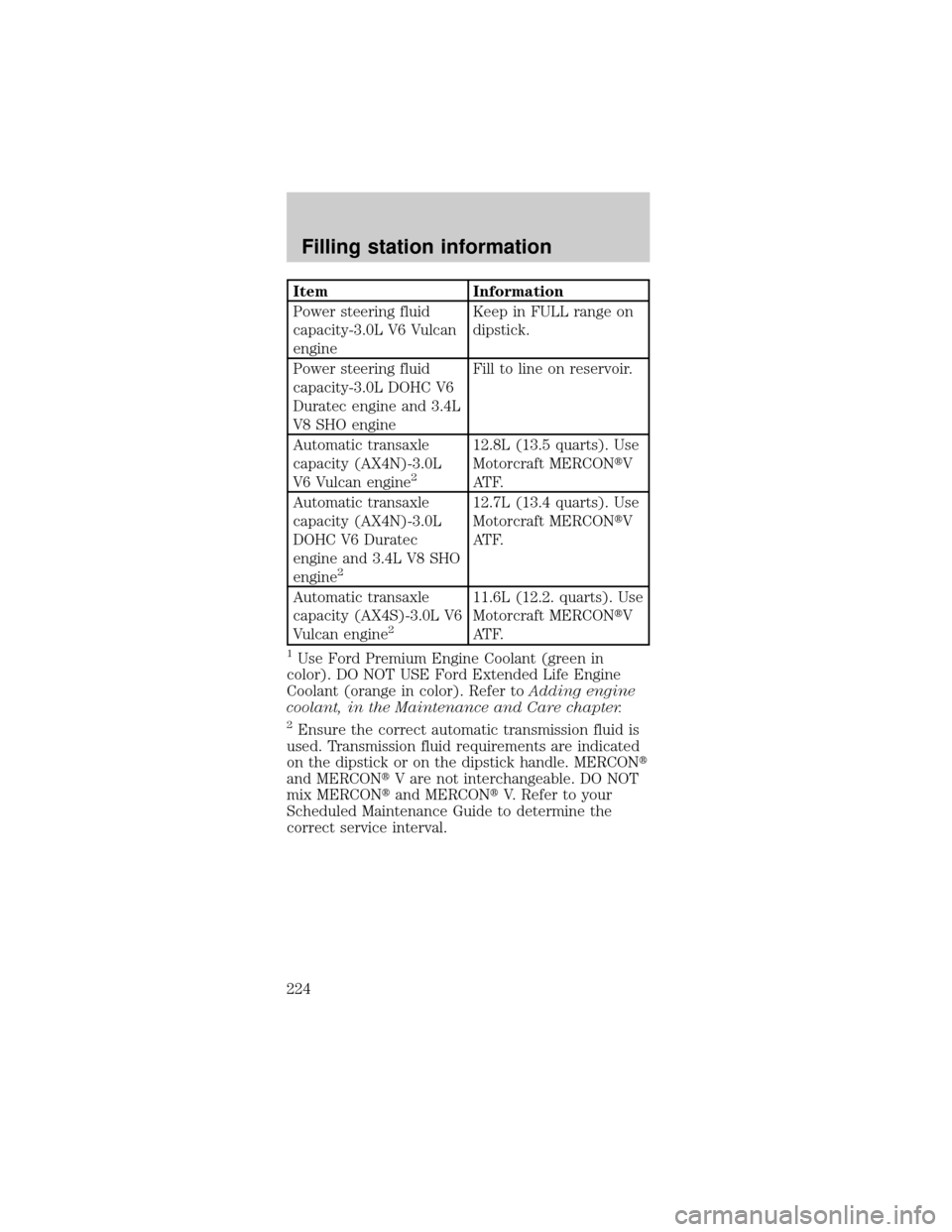
Item Information
Power steering fluid
capacity-3.0L V6 Vulcan
engineKeep in FULL range on
dipstick.
Power steering fluid
capacity-3.0L DOHC V6
Duratec engine and 3.4L
V8 SHO engineFill to line on reservoir.
Automatic transaxle
capacity (AX4N)-3.0L
V6 Vulcan engine
2
12.8L (13.5 quarts). Use
Motorcraft MERCONtV
AT F.
Automatic transaxle
capacity (AX4N)-3.0L
DOHC V6 Duratec
engine and 3.4L V8 SHO
engine
2
12.7L (13.4 quarts). Use
Motorcraft MERCONtV
AT F.
Automatic transaxle
capacity (AX4S)-3.0L V6
Vulcan engine
2
11.6L (12.2. quarts). Use
Motorcraft MERCONtV
AT F.
1Use Ford Premium Engine Coolant (green in
color). DO NOT USE Ford Extended Life Engine
Coolant (orange in color). Refer toAdding engine
coolant, in the Maintenance and Care chapter.
2Ensure the correct automatic transmission fluid is
used. Transmission fluid requirements are indicated
on the dipstick or on the dipstick handle. MERCONt
and MERCONtV are not interchangeable. DO NOT
mix MERCONtand MERCONtV. Refer to your
Scheduled Maintenance Guide to determine the
correct service interval.
Filling station information
224