transmission FORD TAURUS 1999 3.G User Guide
[x] Cancel search | Manufacturer: FORD, Model Year: 1999, Model line: TAURUS, Model: FORD TAURUS 1999 3.GPages: 224, PDF Size: 1.42 MB
Page 156 of 224
Low fluid level
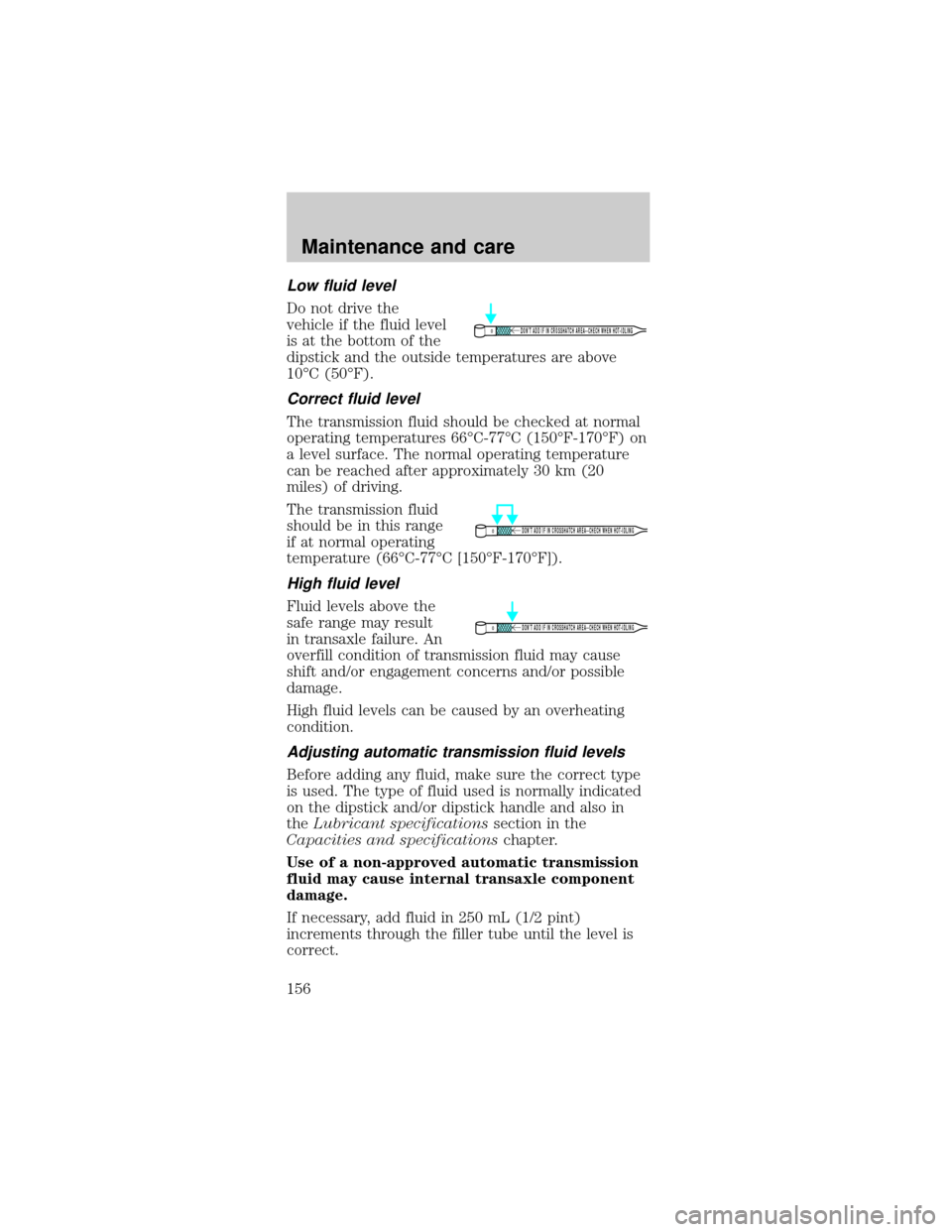
Do not drive the
vehicle if the fluid level
is at the bottom of the
dipstick and the outside temperatures are above
10ÉC (50ÉF).
Correct fluid level
The transmission fluid should be checked at normal
operating temperatures 66ÉC-77ÉC (150ÉF-170ÉF) on
a level surface. The normal operating temperature
can be reached after approximately 30 km (20
miles) of driving.
The transmission fluid
should be in this range
if at normal operating
temperature (66ÉC-77ÉC [150ÉF-170ÉF]).
High fluid level
Fluid levels above the
safe range may result
in transaxle failure. An
overfill condition of transmission fluid may cause
shift and/or engagement concerns and/or possible
damage.
High fluid levels can be caused by an overheating
condition.
Adjusting automatic transmission fluid levels
Before adding any fluid, make sure the correct type
is used. The type of fluid used is normally indicated
on the dipstick and/or dipstick handle and also in
theLubricant specificationssection in the
Capacities and specificationschapter.
Use of a non-approved automatic transmission
fluid may cause internal transaxle component
damage.
If necessary, add fluid in 250 mL (1/2 pint)
increments through the filler tube until the level is
correct.
DON’T ADD IF IN CROSSHATCH AREA--CHECH WHEN HOT-IDLING
DON’T ADD IF IN CROSSHATCH AREA--CHECH WHEN HOT-IDLING
DON’T ADD IF IN CROSSHATCH AREA--CHECH WHEN HOT-IDLING
Maintenance and care
156
Page 157 of 224
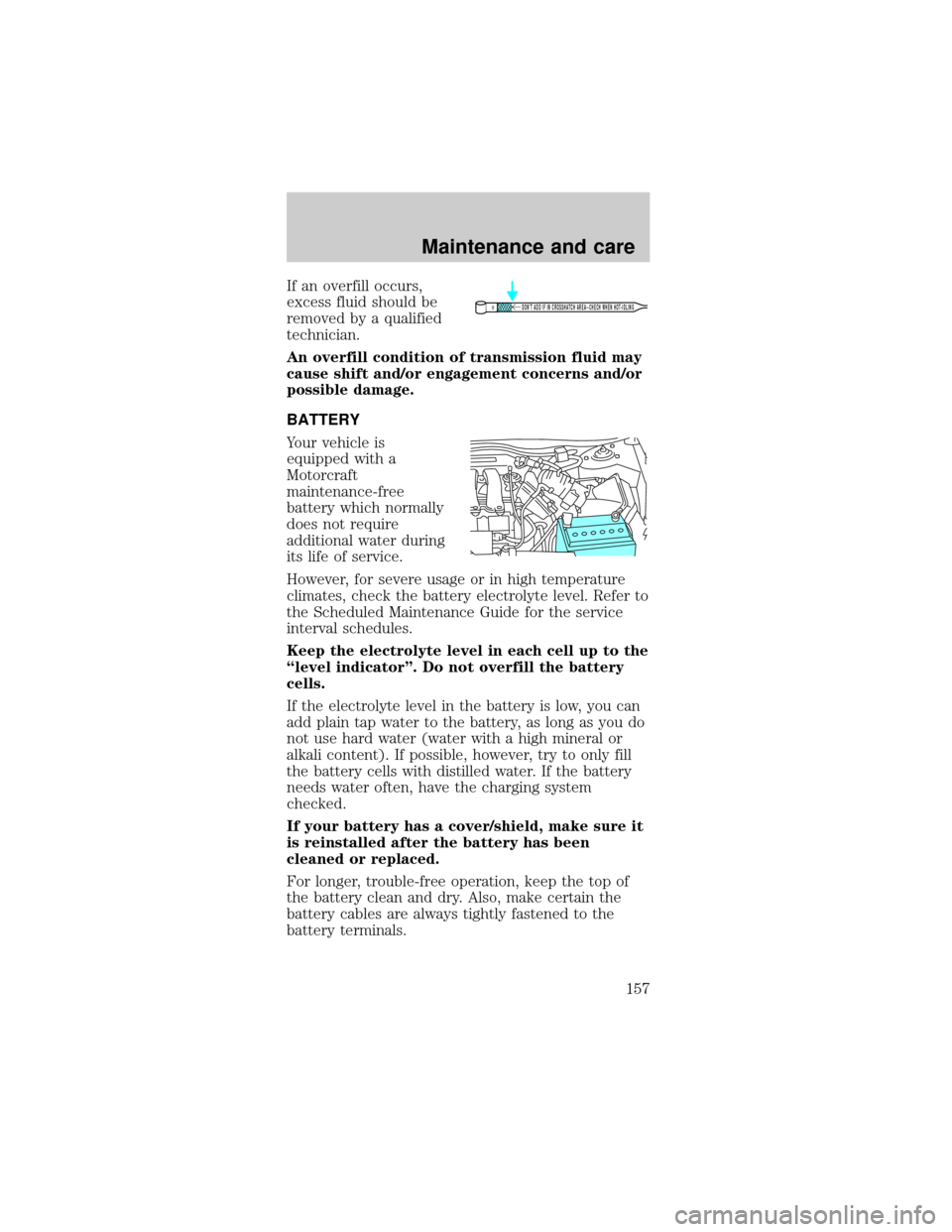
If an overfill occurs,
excess fluid should be
removed by a qualified
technician.
An overfill condition of transmission fluid may
cause shift and/or engagement concerns and/or
possible damage.
BATTERY
Your vehicle is
equipped with a
Motorcraft
maintenance-free
battery which normally
does not require
additional water during
its life of service.
However, for severe usage or in high temperature
climates, check the battery electrolyte level. Refer to
the Scheduled Maintenance Guide for the service
interval schedules.
Keep the electrolyte level in each cell up to the
ªlevel indicatorº. Do not overfill the battery
cells.
If the electrolyte level in the battery is low, you can
add plain tap water to the battery, as long as you do
not use hard water (water with a high mineral or
alkali content). If possible, however, try to only fill
the battery cells with distilled water. If the battery
needs water often, have the charging system
checked.
If your battery has a cover/shield, make sure it
is reinstalled after the battery has been
cleaned or replaced.
For longer, trouble-free operation, keep the top of
the battery clean and dry. Also, make certain the
battery cables are always tightly fastened to the
battery terminals.
DON’T ADD IF IN CROSSHATCH AREA--CHECH WHEN HOT-IDLING
Maintenance and care
157
Page 174 of 224
²Combine errands and minimize stop-and-go
driving.
Maintenance
²Keep tires properly inflated and use only
recommended size.
²Operating a vehicle with the wheels out of
alignment will reduce fuel economy.
²Use recommended engine oil. Refer toLubricant
Specifications.
²Perform all regularly scheduled maintenance
items. Follow the recommended maintenance
schedule and owner maintenance checks found in
your vehicle Scheduled Maintenance Guide.
Conditions
²Heavily loading a vehicle or towing a trailer may
reduce fuel economy at any speed.
²Carrying unnecessary weight may reduce fuel
economy (approximately 2 km/h [1 mpg] is lost
for every 180 kg [400 lb] of weight carried).
²Adding certain accessories to your vehicle (for
example bug deflectors, rollover/light bars,
running boards, ski/luggage racks) may reduce
fuel economy.
²Using fuel blended with alcohol may lower fuel
economy.
²Fuel economy may decrease with lower
temperatures during the first 12±16 km
(8±10 miles) of driving.
²Driving on flat terrain offers improved fuel
economy as compared to driving on hilly terrain.
²Transmissions give their best fuel economy when
operated in the top cruise gear and with steady
pressure on the gas pedal.
²Close windows for high speed driving.
Maintenance and care
174
Page 199 of 224
Vehicle identification number
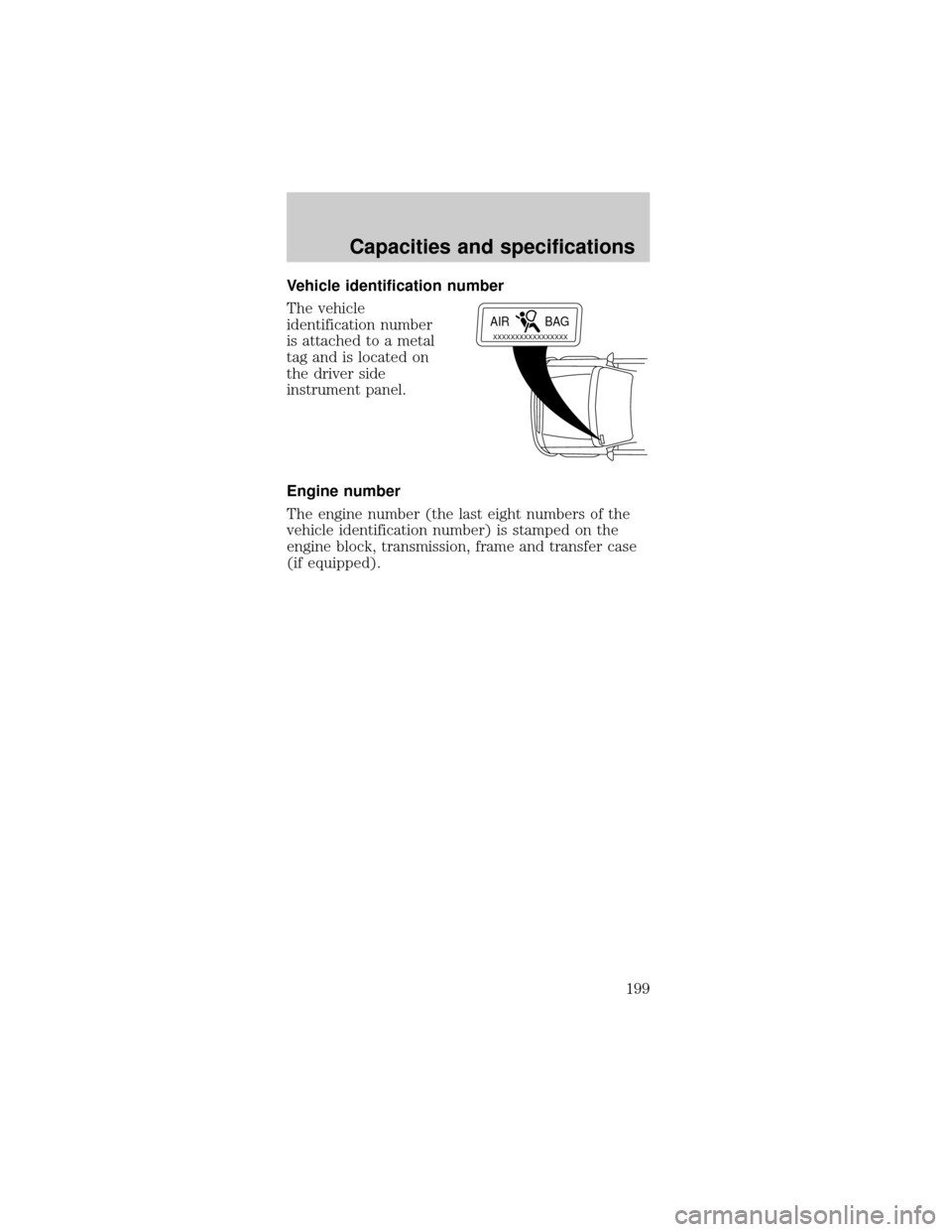
The vehicle
identification number
is attached to a metal
tag and is located on
the driver side
instrument panel.
Engine number
The engine number (the last eight numbers of the
vehicle identification number) is stamped on the
engine block, transmission, frame and transfer case
(if equipped).
XXXXXXXXXXXXXXXXXAIR BAG
Capacities and specifications
199
Page 221 of 224

lubricant
specifications ........ 194
Transmission
fluid, checking
and adding
(automatic) ........... 155
Trip odometer ........... 14
Trunk ......................... 61
remote release ........ 57
Turn signal ............. 6,49
Vehicle dimensions . 195
Vehicle Identification
Number (VIN) ......... 199
Vehicle loading ........ 116
Ventilating
your vehicle ............. 106
Warning chimes ......... 11Warning lights
(see Lights) ................. 6
Washer fluid ............ 149
Water,
Driving through ....... 118
Windows
power ....................... 53
rear wiper/washer ... 50
Windshield washer
fluid and wipers
checking
and cleaning .......... 159
operation ................. 49
replacing
wiper blades .......... 160
Wrecker towing ....... 140
Index
221
Page 224 of 224
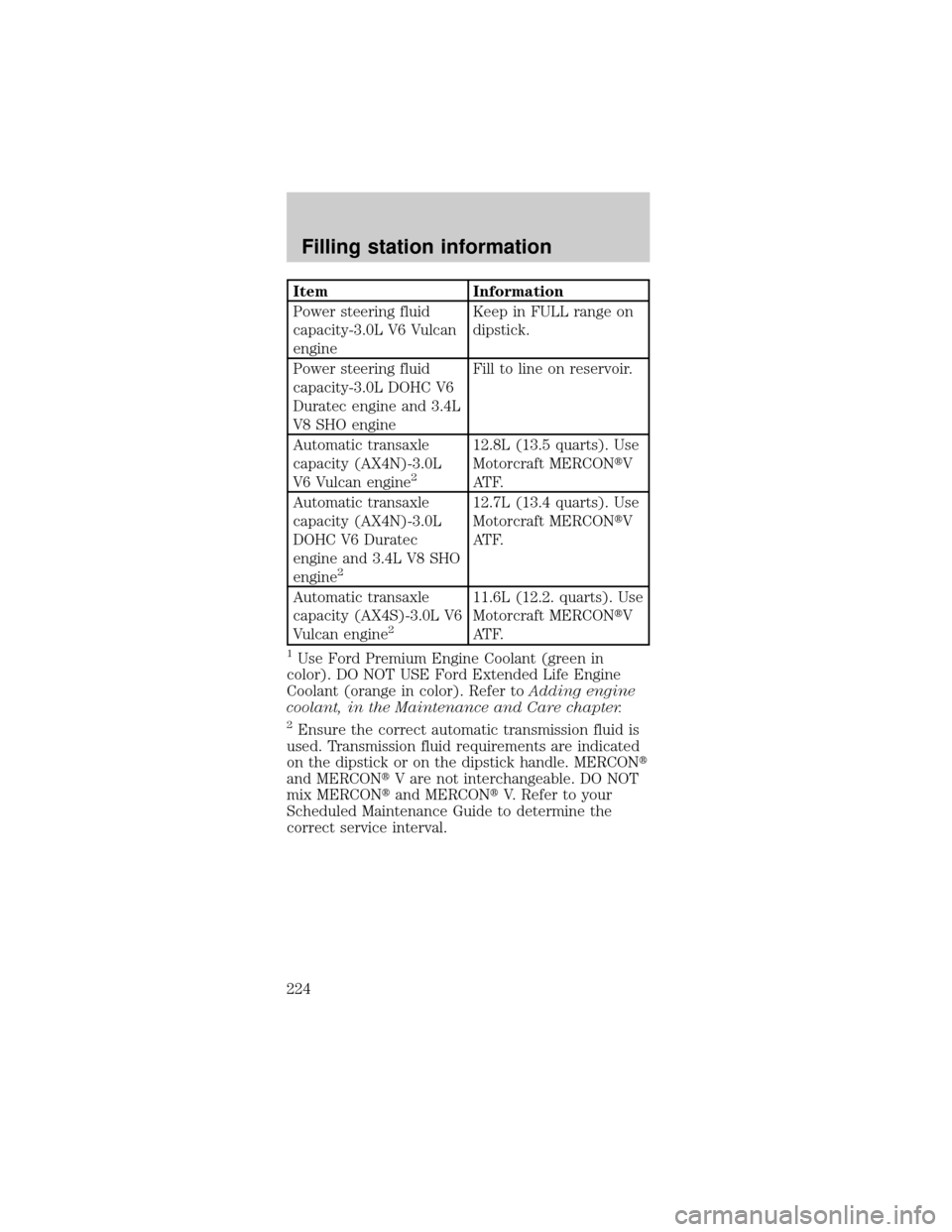
Item Information
Power steering fluid
capacity-3.0L V6 Vulcan
engineKeep in FULL range on
dipstick.
Power steering fluid
capacity-3.0L DOHC V6
Duratec engine and 3.4L
V8 SHO engineFill to line on reservoir.
Automatic transaxle
capacity (AX4N)-3.0L
V6 Vulcan engine
2
12.8L (13.5 quarts). Use
Motorcraft MERCONtV
AT F.
Automatic transaxle
capacity (AX4N)-3.0L
DOHC V6 Duratec
engine and 3.4L V8 SHO
engine
2
12.7L (13.4 quarts). Use
Motorcraft MERCONtV
AT F.
Automatic transaxle
capacity (AX4S)-3.0L V6
Vulcan engine
2
11.6L (12.2. quarts). Use
Motorcraft MERCONtV
AT F.
1Use Ford Premium Engine Coolant (green in
color). DO NOT USE Ford Extended Life Engine
Coolant (orange in color). Refer toAdding engine
coolant, in the Maintenance and Care chapter.
2Ensure the correct automatic transmission fluid is
used. Transmission fluid requirements are indicated
on the dipstick or on the dipstick handle. MERCONt
and MERCONtV are not interchangeable. DO NOT
mix MERCONtand MERCONtV. Refer to your
Scheduled Maintenance Guide to determine the
correct service interval.
Filling station information
224