belt FORD TAURUS 1999 3.G Owner's Manual
[x] Cancel search | Manufacturer: FORD, Model Year: 1999, Model line: TAURUS, Model: FORD TAURUS 1999 3.GPages: 224, PDF Size: 1.42 MB
Page 97 of 224

Carefully follow all of the manufacturer's
instructions included with the safety seat
you put in your vehicle. If you do not install and
use the safety seat properly, the child may be
injured in a sudden stop or collision.
Installing child safety seats in combination lap
and shoulder belt seating positions
1. Position the child
safety seat in a seat
with a combination lap
and shoulder belt.
An air bag can kill or injure a child in a child
seat. If you must use a forward-facing child
seat in the front seat, move seat all the way back.
Children 12 and under should be properly
restrained in the rear seat whenever
possible.
2. Pull down on the
shoulder belt and then
grasp the shoulder belt
and lap belt together.
Seating and safety restraints
97
Page 98 of 224

3. While holding the
shoulder and lap belt
portions together, route
the tongue through the
child seat according to
the child seat
manufacturer's
instructions. Be sure
the belt webbing is not
twisted.
4. Insert the belt
tongue into the proper
buckle (the buckle
closest to the direction
the tongue is coming
from) for that seating
position until you hear
a snap and feel the
latch engage. Make
sure the tongue is
latched securely by pulling on it.
5. To put the retractor
in the automatic
locking mode, grasp
the shoulder portion of
the belt and pull
downward until all of
the belt is extracted
and a click is heard.
6. Allow the belt to retract. The belt will click as it
retracts to indicate it is in the automatic locking
mode.
7. Pull the lap belt
portion across the child
seat toward the buckle
and pull up on the
shoulder belt while
pushing down with
your knee on the child
seat.
Seating and safety restraints
98
Page 99 of 224

8. Allow the safety belt
to retract to remove
any slack in the belt.
9. Before placing the
child in the seat,
forcibly tilt the seat
forward and back to
make sure the seat is
securely held in place.
10. Try to pull the belt out of the retractor to make
sure the retractor is in the automatic locking mode
(you should not be able to pull more belt out). If the
retractor is not locked, unbuckle the belt and repeat
steps two through nine.
Check to make sure the child seat is properly
secured before each use.
Installing child safety seats in the lap belt
seating positions
1. Lengthen the lap belt. To lengthen the belt, hold
the tongue so that its bottom is perpendicular to the
direction of webbing while sliding the tongue up the
webbing.
2. Place the child safety seat in the center seating
position.
3. Route the tongue and webbing through the child
seat according to the child seat manufacturer's
instructions.
4. Insert the belt tongue into the proper buckle for
the center seating position until you hear a snap and
feel it latch. Make sure the tongue is securely
fastened to the buckle by pulling on tongue.
5. Push down on the child seat while pulling on the
loose end of the lap belt webbing to tighten the belt.
6. Before placing the child into the child seat,
forcibly tilt the child seat from side to side and in
forward direction to make sure that the seat is held
Seating and safety restraints
99
Page 103 of 224

Important safety precautions
A computer system controls the engine's idle
revolutions per minute (RPM). When the engine
starts, the idle RPM runs faster to warm the engine.
If the engine idle speed does not slow down
automatically, have the vehicle checked. Do not
allow the vehicle to idle for more than ten minutes
at the higher engine RPM.
Before starting the vehicle:
1. Make sure all vehicle occupants have buckled
their safety belts. For more information on safety
belts and their proper usage, refer to theSeating
and safety restraintschapter.
2. Make sure the headlamps and vehicle accessories
are off.
3. Make sure the
parking brake is set.
4. Make sure the
gearshift is in P (Park).
5. Turn the key to 4
(ON) without turning
the key to 5 (START).
PRNDD1
1
23
4
5
Starting
103
Page 104 of 224

Make sure the corresponding lights illuminate briefly.
If a light fails to illuminate, have the vehicle
serviced.
²If the driver's safety belt is fastened, the
light
may not illuminate.
STARTING THE ENGINE
1. Turn the key to 5
(START) without
pressing the
accelerator pedal and
release as soon as the
engine starts. The key
will return to 4 (ON).
2. If the temperature is above ±12É C (10É F) and
the engine does not start within five seconds on the
first try, turn the key to OFF, wait ten seconds and
try again.
3. If the temperature is below -12ÉC (10ÉF) and the
engine does not start in fifteen seconds on the first
try, turn the key OFF and wait ten seconds and try
again. If the engine does not start in two attempts,
depress the accelerator and start the engine while
holding the accelerator down to the floor. Release
the accelerator when the engine starts.
4. After idling for a few seconds, apply the brake
and release the parking brake.
CRUISE
RPMx1000
0 1234
5
6
7EFC H
FUEL DOOR>
SERVICE
ENGINE
SOONP!
BRAKEABS
+ –
UNLEADED FUEL ONLY
THEFT LOW
COOLANTO/D
OFF102030405060
70
80
90
100
1202060100
140
180
P R N D 2 1MPH km/h
00
000
00000
110
1
23
4
5
Starting
104
Page 138 of 224

5. Be sure that the cables are clear of fan blades,
belts and other moving parts of both engines.
Jump starting
1. Start the engine of the booster vehicle and run
the engine at moderately increased speed.
2. Start the engine of the disabled vehicle.
3. Once the disabled vehicle has been started, run
both engines for an additional three minutes before
disconnecting the jumper cables.
Removing the jumper cables, 3.0L Vulcan, 3.0L
Duratec and 3.4L SHO engines
Remove the jumper cables in the reverse order
that they were connected.
1. Remove the jumper cable. For the 3.0L Vulcan
and 3.4L SHO, remove the jumper cable from the
groundmetal surface. For the 3.0L Duratec, remove
the jumper cable from the hood latch.
2. Remove the jumper cable on the negative (-)
connection of the booster vehicle's battery.
+–+–
+–+–
Roadside emergencies
138
Page 140 of 224

WRECKER TOWING
If you need to have your vehicle towed, contact a
professional towing service or, if you are a member,
your roadside assistance center.
It is recommended that your vehicle be towed with a
wheel lift or flatbed equipment. Do not tow with a
slingbelt. Ford Motor Company has not approved a
slingbelt towing procedure.
If your vehicle is to be towed from the rear using
wheel lift equipment, the front wheels (drive
wheels) must be placed on a dolly to prevent
damage to the transaxle.
Ford Motor Company provides a towing manual for
all authorized tow truck operators. Have your tow
truck operator refer to this manual for proper
hook-up and towing procedures for your vehicle.
Roadside emergencies
140
Page 163 of 224
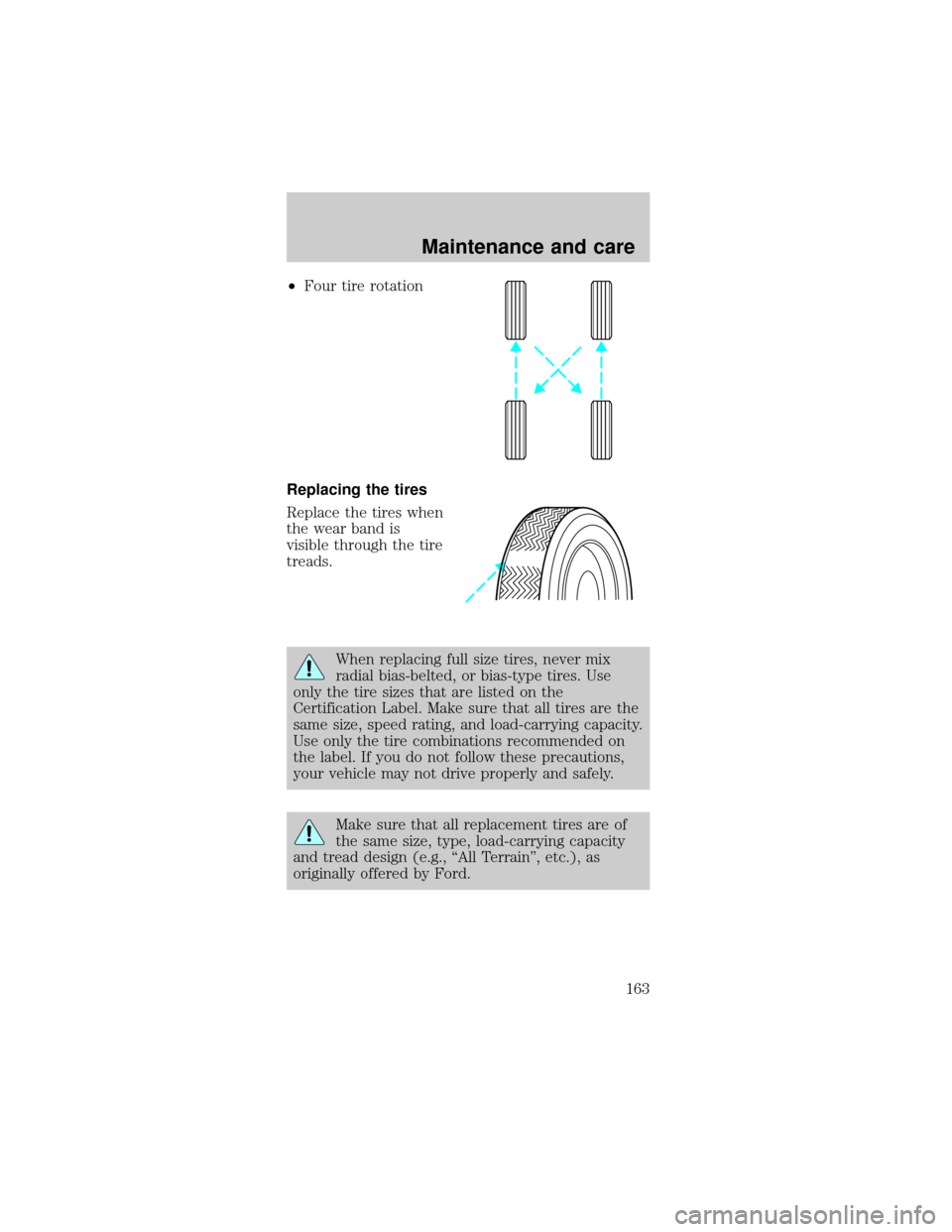
²Four tire rotation
Replacing the tires
Replace the tires when
the wear band is
visible through the tire
treads.
When replacing full size tires, never mix
radial bias-belted, or bias-type tires. Use
only the tire sizes that are listed on the
Certification Label. Make sure that all tires are the
same size, speed rating, and load-carrying capacity.
Use only the tire combinations recommended on
the label. If you do not follow these precautions,
your vehicle may not drive properly and safely.
Make sure that all replacement tires are of
the same size, type, load-carrying capacity
and tread design (e.g., ªAll Terrainº, etc.), as
originally offered by Ford.
Maintenance and care
163
Page 189 of 224

Cleaning and maintaining the safety belts
Clean the safety belts with a mild soap solution
recommended for cleaning upholstery or carpets. Do
not bleach or dye the belts, because these actions
may weaken the belt webbing.
Check the safety belt system periodically to make
sure there are no nicks, wear or cuts. If your vehicle
has been involved in an accident, refer to theSafety
belt maintenancesection in theSeating and safety
restraintschapter.
Maintenance and care
189
Page 216 of 224

Accessory delay ........ 54
Air bag supplemental
restraint system ... 88,89
and child
safety seats ............. 90
description .............. 89
disposal .................... 93
driver air bag .......... 91
indicator light .... 11,93
operation ................. 91
passenger air bag ... 91
Air cleaner filter ..... 190
Air conditioning ........ 18
automatic temperature
control system ........ 22
Anti-theft
system ......... 64,70,71,72
arming the system .. 64
disarming a
triggered system ..... 66
warning light ............. 9
Automatic
transaxle .................. 111
driving with ........... 113
fluid,
refill capacities ...... 191
fluid,
specification .......... 194
Battery ..................... 157
acid, treating
emergencies .......... 157
charging system
warning light ........... 10
jumping a disabled
battery ................... 135
maintenance-free .. 157
replacement,
specifications ........ 190
servicing ................ 157
Brakes ...................... 107
anti-lock .......... 107,108anti-lock brake
system (ABS)
warning light ...... 9,108
brake
warning light ........... 10
fluid, checking and
adding .................... 148
fluid,
refill capacities ...... 191
fluid,
specifications.. 193,194
lubricant
specifications.. 193,194
parking .................. 109
shift interlock ........ 111
Break-in period ........... 2
Capacities for
refilling fluids .......... 191
Cargo area shade ...... 59
Cargo cover ............... 59
Cargo net ................... 58
CD changer ............... 41
Cellular telephone
(see your Cellular
Phone Guide) ............ 56
Child safety
restraints ................... 94
child safety belts .... 94
child safety
seats .................... 95,96
Child safety seats.. 95,96
attaching with
tether straps ......... 100
built-in child seat ... 95
in front seat ............ 97
in rear seat ......... 97,99
tether anchorage
hardware ............... 100
Cleaning
your vehicle ............. 183
engine
compartment ......... 185
Index
216