light FORD TAURUS 1999 3.G Owner's Manual
[x] Cancel search | Manufacturer: FORD, Model Year: 1999, Model line: TAURUS, Model: FORD TAURUS 1999 3.GPages: 224, PDF Size: 1.42 MB
Page 62 of 224
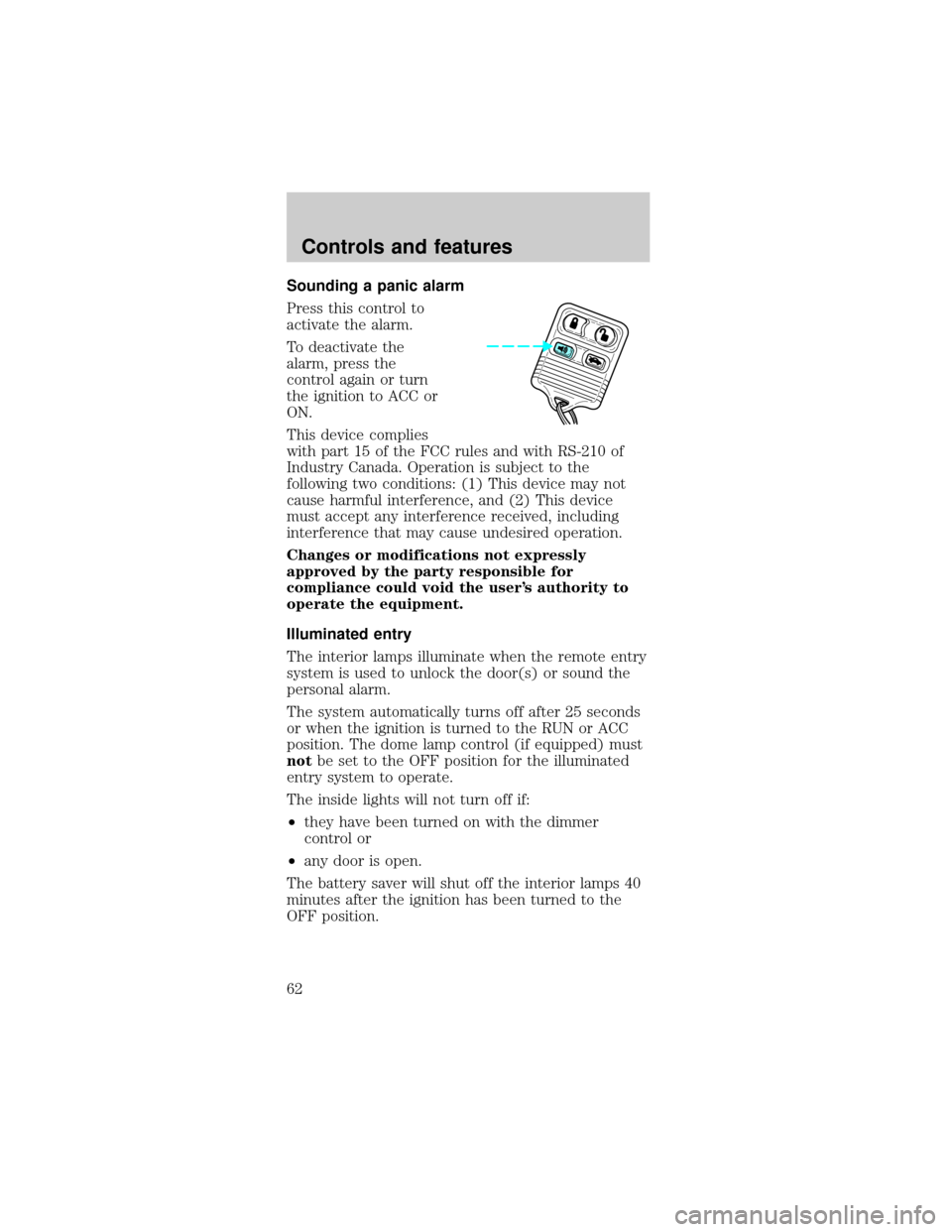
Sounding a panic alarm
Press this control to
activate the alarm.
To deactivate the
alarm, press the
control again or turn
the ignition to ACC or
ON.
This device complies
with part 15 of the FCC rules and with RS-210 of
Industry Canada. Operation is subject to the
following two conditions: (1) This device may not
cause harmful interference, and (2) This device
must accept any interference received, including
interference that may cause undesired operation.
Changes or modifications not expressly
approved by the party responsible for
compliance could void the user's authority to
operate the equipment.
Illuminated entry
The interior lamps illuminate when the remote entry
system is used to unlock the door(s) or sound the
personal alarm.
The system automatically turns off after 25 seconds
or when the ignition is turned to the RUN or ACC
position. The dome lamp control (if equipped) must
notbe set to the OFF position for the illuminated
entry system to operate.
The inside lights will not turn off if:
²they have been turned on with the dimmer
control or
²any door is open.
The battery saver will shut off the interior lamps 40
minutes after the ignition has been turned to the
OFF position.
Controls and features
62
Page 68 of 224

If you wish to erase your personal code, use the
following instructions:
Erasing personal code
1. Enter the factory-set code.
2. Press 1/2 within five
seconds of step 1.
3. Press the 7/8 and 9/0
controls at the same
time within five
seconds of step two.
The system will now only respond to the factory-set
code.
Unlocking the doors and releasing the trunk
with the keyless entry system
The driver's door must be unlocked before any
other. If more than five seconds pass between
pressing numbers, enter the code again. The system
has shut down if the keypad light is out. If the
keyless entry system does not work, use the key or
remote entry transmitter(s).
1. To unlock the driver's door, enter one of the two
codes. After pressing the fifth number, the driver's
door unlocks.
2. To unlock the
passenger's door(s) and
liftgate (wagon), press
the 3/4 control within
five seconds of
unlocking the driver's
door.
3. To unlock the trunk
or liftgate (wagon),
enter the five-digit
factory-set code, then
press the 5/6 control
within five seconds.
123
45678
90
123
45678
90
123
45678
90
Controls and features
68
Page 71 of 224

The SecuriLockypassive anti-theft system is not
compatible with aftermarket remote start systems.
Use of these systems may result in vehicle starting
problems and a loss of security protection. Large
metallic objects or devices such as the Mobil
Speedpassyon the same key ring as your
SecuriLockykey may cause vehicle starting
problems. These objects and devices cannot damage
the SecuriLockykey, but can cause a momentary
problem if they are too close to the key when
starting the engine. If a problem occurs, turn
ignition off and restart the engine with all other
objects on the key ring held away from the
SecuriLockyignition key.
Spare SecuriLockykeys can be purchased from
your dealership and programmed to your
SecuriLockypassive anti-theft system. Refer to
Programming spare SecuriLockykeysfor more
information.
If one or both of your SecuriLockykeys are lost or
stolen and you want to ensure the lost or stolen key
will not operate your vehicle, bring your vehicle and
all available SecuriLockykeys to your dealership for
reinitialization.
Theft indicator
The theft indicator on the instrument cluster will
operate as follows:
²When the ignition is OFF, the theft indicator will
flash briefly every 2 seconds to indicate the
SecuriLockysystem is protecting your vehicle.
²When the ignition is turned to RUN or START, the
theft indicator will light for 3 seconds and then go
out. If the theft indicator stays on for an extended
period of time or flashes rapidly, have the system
serviced by your dealership or a qualified
technician.
Controls and features
71
Page 73 of 224

4. Turn the ignition to OFF and remove the second
SecuriLockykey from the ignition.
5. Within 10 seconds of turning the ignition to OFF,
insert the unprogrammed SecuriLockykey (new
key/valet key) into the ignition and turn the ignition
from OFF to RUN (maintain ignition in RUN for at
least one second). This step will program your new
SecuriLockykey.
6. To program additional SecuriLockykey(s), repeat
this procedure from step 1.
If the programming procedure was successful, the
new SecuriLockykey(s) will start the vehicle's
engine. The theft indicator (located on the
instrument cluster) will light for three seconds and
then go out.
If the programming procedure was not successful,
the new SecuriLockykey(s) will not operate the
vehicle's engine. The theft indicator will flash on and
off. Wait at least one minute and then repeat the
procedure from step 1. If failure repeats, bring your
vehicle to your dealership to have the spare
SecuriLockykey(s) programmed.
Controls and features
73
Page 87 of 224
extension assembly (part number 611C22). Safety
belt extension assemblies can be obtained from your
dealer at no cost.
Use only extensions manufactured by the same
supplier as the safety belt. Manufacturer
identification is located at the end of the webbing on
the label. Also, use the safety belt extension only if
the safety belt is too short for you when fully
extended. Do not use extensions to change the fit of
the shoulder belt across the torso.
Safety belt warning light and indicator chime
The seat belt warning light illuminates in the
instrument cluster and a chime sounds to remind
the occupants to fasten their safety belts.
Conditions of operation
If... Then...
The driver's safety belt
is not buckled before
the ignition switch is
turned to the ON
position...The safety belt warning
light illuminates for one
to two minutes and the
warning chime sounds
for four to eight
seconds.
The driver's safety belt
is buckled while the
indicator light is
illuminated and the
warning chime is
sounding...The safety belt warning
light and warning chime
turn off.
The driver's safety belt
is buckled before the
ignition switch is turned
to the ON position...The safety belt warning
light and indicator chime
remain off.
Seating and safety restraints
87
Page 90 of 224
²Move your seat to the rear as far as you can while
still reaching the pedals comfortably.
²Recline the seat slightly (one or two degrees)
from the upright position.
Do not put anything on or over the air bag
module. Placing objects on or over the air
bag inflation area may cause those objects to be
propelled by the air bag into your face and torso
causing serious injury.
Do not attempt to service, repair, or modify
the Air Bag Supplemental Restraint System
or its fuses. See your Ford or Lincoln-Mercury
dealer.
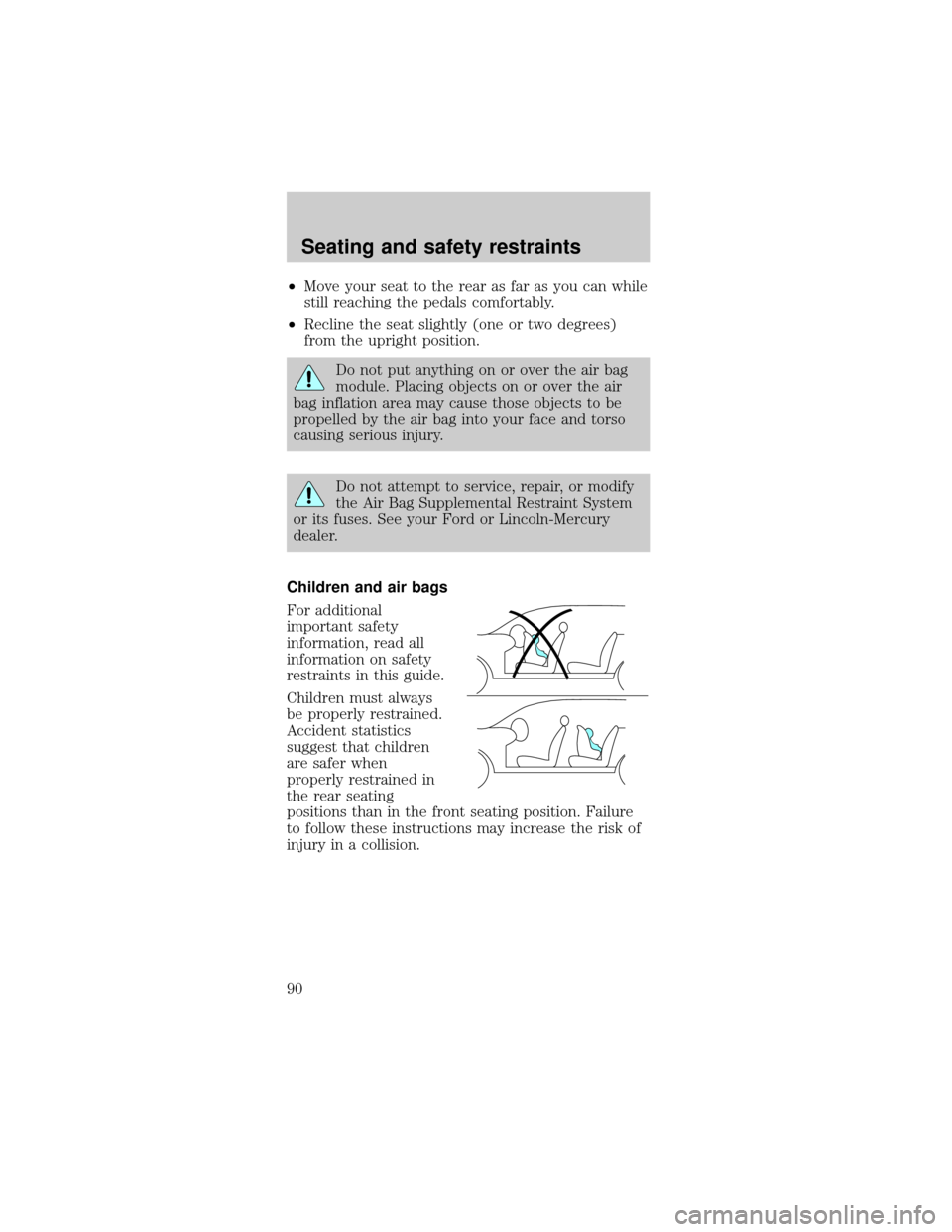
Children and air bags
For additional
important safety
information, read all
information on safety
restraints in this guide.
Children must always
be properly restrained.
Accident statistics
suggest that children
are safer when
properly restrained in
the rear seating
positions than in the front seating position. Failure
to follow these instructions may increase the risk of
injury in a collision.
Seating and safety restraints
90
Page 92 of 224

amounts of sodium hydroxide may be present which
may irritate the skin and eyes, but none of the
residue is toxic.
While the system is designed to help reduce serious
injuries, contact with a deploying air bag may also
cause abrasions, swelling or temporary hearing loss.
Because air bags must inflate rapidly and with
considerable force, there is the risk of death or
serious injuries such as fractures, facial and eye
injuries or internal injuries, particularly to occupants
who are not properly restrained or are otherwise out
of position at the time of air bag deployment. Thus,
it is extremely important that occupants be properly
restrained as far away from the air bag module as
possible while maintaining vehicle control.
Several air bag system components get hot
after inflation. Do not touch them after
inflation.
If the air bag is deployed,the air bag will
not function again and must be replaced
immediately.If the air bag is not replaced, the
unrepaired area will increase the risk of injury in a
collision.
The SRS consists of:
²driver and passenger air bag modules (which
include the inflators and air bags),
²one or more impact and safing sensors,
²a readiness light and tone
²and the electrical wiring which connects the
components.
The diagnostic module monitors its own internal
circuits and the supplemental air bag electrical
system warning (including the impact sensors), the
system wiring, the air bag system readiness light, the
air bag back up power and the air bag ignitors.
Seating and safety restraints
92
Page 93 of 224

Determining if the system is operational
The SRS uses a readiness light in the instrument
cluster or a tone to indicate the condition of the
system. Refer to theAir bag readinesssection in
theInstrumentationchapter. Routine maintenance
of the air bag is not required.
A difficulty with the system is indicated by one or
more of the following:
²The readiness light
will either flash or
stay lit.
²The readiness light
will not illuminate immediately after ignition is
turned on.
²A series of five beeps will be heard. The tone
pattern will repeat periodically until the problem
and light are repaired.
If any of these things happen, even intermittently,
have the SRS serviced at your dealership or by a
qualified technician immediately. Unless serviced,
the system may not function properly in the event of
a collision.
Disposal of air bags and air bag equipped
vehicles (including pretensioners)
For disposal of air bags or air bag equipped vehicles,
see your local dealership or qualified technician. Air
bags MUST BE disposed of by qualified personnel.
SAFETY RESTRAINTS FOR CHILDREN
See the following sections for directions on how to
properly use safety restraints for children. Also see
Air Bag Supplemental Restraint System (SRS)in
this chapter for special instructions about using air
bags.
Seating and safety restraints
93
Page 104 of 224

Make sure the corresponding lights illuminate briefly.
If a light fails to illuminate, have the vehicle
serviced.
²If the driver's safety belt is fastened, the
light
may not illuminate.
STARTING THE ENGINE
1. Turn the key to 5
(START) without
pressing the
accelerator pedal and
release as soon as the
engine starts. The key
will return to 4 (ON).
2. If the temperature is above ±12É C (10É F) and
the engine does not start within five seconds on the
first try, turn the key to OFF, wait ten seconds and
try again.
3. If the temperature is below -12ÉC (10ÉF) and the
engine does not start in fifteen seconds on the first
try, turn the key OFF and wait ten seconds and try
again. If the engine does not start in two attempts,
depress the accelerator and start the engine while
holding the accelerator down to the floor. Release
the accelerator when the engine starts.
4. After idling for a few seconds, apply the brake
and release the parking brake.
CRUISE
RPMx1000
0 1234
5
6
7EFC H
FUEL DOOR>
SERVICE
ENGINE
SOONP!
BRAKEABS
+ –
UNLEADED FUEL ONLY
THEFT LOW
COOLANTO/D
OFF102030405060
70
80
90
100
1202060100
140
180
P R N D 2 1MPH km/h
00
000
00000
110
1
23
4
5
Starting
104
Page 107 of 224

BRAKES
Your service brakes are self-adjusting. Refer to the
scheduled maintenance guide for scheduled
maintenance.
Occasional brake noise is normal and often does not
indicate a performance concern with the vehicle's
brake system. In normal operation, automotive brake
systems may emit occasional or intermittent squeal
or groan noises when the brakes are applied. Such
noises are usually heard during the first few brake
applications in the morning; however, they may be
heard at any time while braking and can be
aggravated by environmental conditions such as
cold, heat, moisture, road dust, salt or mud. If a
ªmetal-to-metalº, ªcontinuous grindingº or
ªcontinuous squealº sound is present while braking,
the brake linings may be worn-out and should be
inspected by a qualified service technician.
Anti-lock brake system (ABS) (if equipped)
On vehicles equipped with an anti-lock braking
system (ABS), a noise from the hydraulic pump
motor and pulsation in the pedal may be observed
during ABS braking events. Pedal pulsation coupled
with noise while braking under panic conditions or
on loose gravel, bumps, wet or snowy roads is
normal and indicates proper functioning of the
vehicle's anti-lock brake system. The ABS performs a
self-check at 17 km/h (10 mph) after you start the
engine and begin to drive away. A brief mechanical
noise may be heard during this test. This is normal.
If a malfunction is found, the ABS warning light will
come on. If the vehicle has continuous vibration or
shudder in the steering wheel while braking, the
vehicle should be inspected by a qualified service
technician.
Driving
107