warning FORD TAURUS 2002 4.G Owner's Manual
[x] Cancel search | Manufacturer: FORD, Model Year: 2002, Model line: TAURUS, Model: FORD TAURUS 2002 4.GPages: 248, PDF Size: 2.12 MB
Page 138 of 248
STARTING
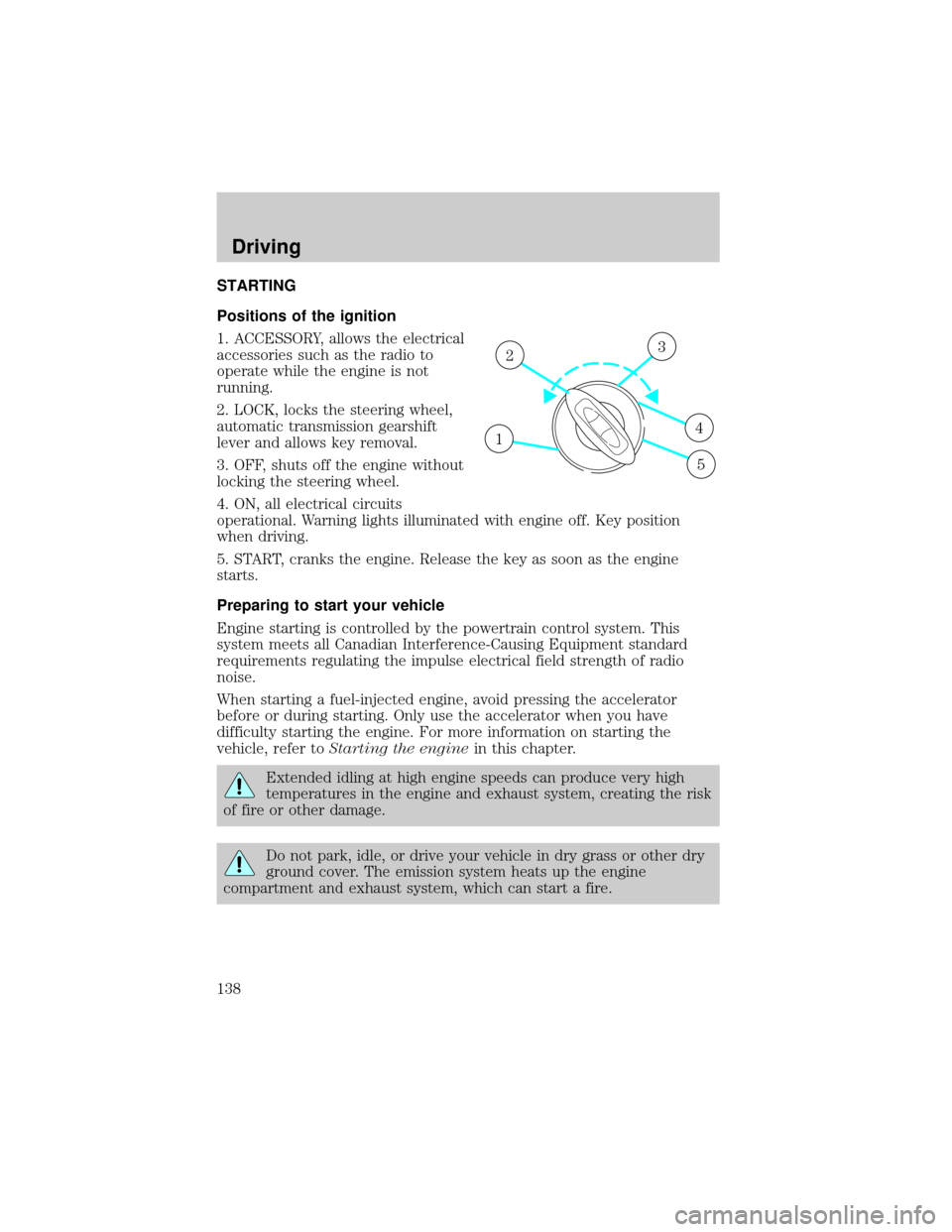
Positions of the ignition
1. ACCESSORY, allows the electrical
accessories such as the radio to
operate while the engine is not
running.
2. LOCK, locks the steering wheel,
automatic transmission gearshift
lever and allows key removal.
3. OFF, shuts off the engine without
locking the steering wheel.
4. ON, all electrical circuits
operational. Warning lights illuminated with engine off. Key position
when driving.
5. START, cranks the engine. Release the key as soon as the engine
starts.
Preparing to start your vehicle
Engine starting is controlled by the powertrain control system. This
system meets all Canadian Interference-Causing Equipment standard
requirements regulating the impulse electrical field strength of radio
noise.
When starting a fuel-injected engine, avoid pressing the accelerator
before or during starting. Only use the accelerator when you have
difficulty starting the engine. For more information on starting the
vehicle, refer toStarting the enginein this chapter.
Extended idling at high engine speeds can produce very high
temperatures in the engine and exhaust system, creating the risk
of fire or other damage.
Do not park, idle, or drive your vehicle in dry grass or other dry
ground cover. The emission system heats up the engine
compartment and exhaust system, which can start a fire.
1
23
4
5
Driving
138
Page 143 of 248
WARNING:Engine exhaust, some of its constituents, and
certain vehicle components contain or emit chemicals known to
the State of California to cause cancer and birth defects or other
reproductive harm. In addition, certain fluids contained in vehicles and
certain products of component wear contain or emit chemicals known
to the State of California to cause cancer and birth defects or other
reproductive harm.
Important ventilating information
If the engine is idling while the vehicle is stopped in an open area for
long periods of time, open the windows at least 2.5 cm (one inch).
Adjust the heating or air conditioning (if equipped) to bring in fresh air.
Improve vehicle ventilation by keeping all air inlet vents clear of snow,
leaves and other debris.
BRAKES
Your service brakes are self-adjusting. Refer to the scheduled
maintenance guide for scheduled maintenance.
Occasional brake noise is normal and often does not indicate a
performance concern with the vehicle's brake system. In normal
operation, automotive brake systems may emit occasional or intermittent
squeal or groan noises when the brakes are applied. Such noises are
usually heard during the first few brake applications in the morning;
however, they may be heard at any time while braking and can be
aggravated by environmental conditions such as cold, heat, moisture,
road dust, salt or mud. If a ªmetal-to-metal,º ªcontinuous grindingº or
ªcontinuous squealº sound is present while braking, the brake linings
may be worn-out and should be inspected by a qualified service
technician.
Anti-lock brake system (ABS) (if equipped)
On vehicles equipped with an anti-lock braking system (ABS), a noise
from the hydraulic pump motor and pulsation in the pedal may be
observed during ABS braking events. Pedal pulsation coupled with noise
while braking under panic conditions or on loose gravel, bumps, wet or
snowy roads is normal and indicates proper functioning of the vehicle's
anti-lock brake system. The ABS performs a self-check after you start
the engine and begin to drive away. A brief mechanical noise may be
Driving
143
Page 144 of 248
heard during this test. This is normal. If a malfunction is found, the ABS
warning light will come on. If the vehicle has continuous vibration or
shudder in the steering wheel while braking, the vehicle should be
inspected by a qualified service technician.
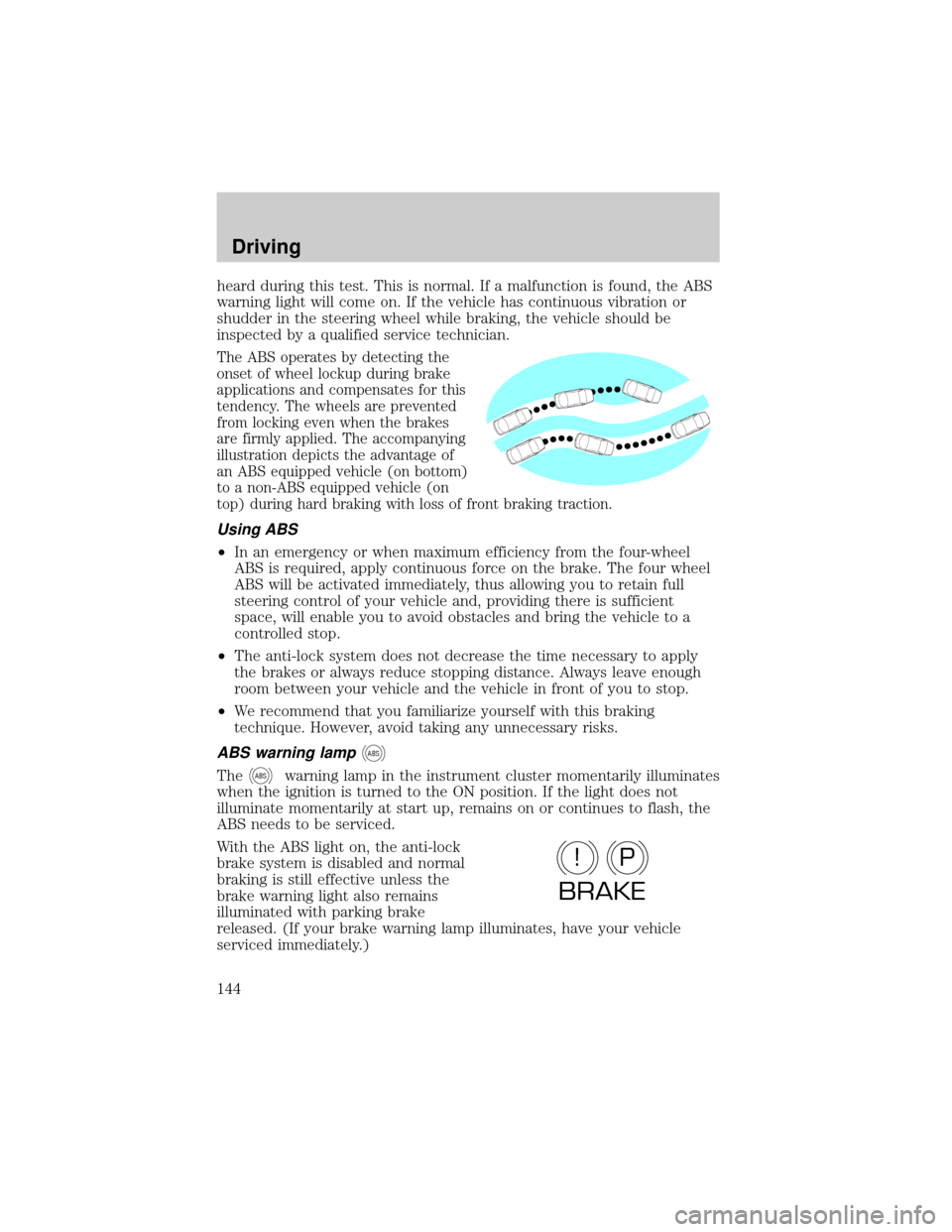
The ABS operates by detecting the
onset of wheel lockup during brake
applications and compensates for this
tendency. The wheels are prevented
from locking even when the brakes
are firmly applied. The accompanying
illustration depicts the advantage of
an ABS equipped vehicle (on bottom)
to a non-ABS equipped vehicle (on
top) during hard braking with loss of front braking traction.
Using ABS
²In an emergency or when maximum efficiency from the four-wheel
ABS is required, apply continuous force on the brake. The four wheel
ABS will be activated immediately, thus allowing you to retain full
steering control of your vehicle and, providing there is sufficient
space, will enable you to avoid obstacles and bring the vehicle to a
controlled stop.
²The anti-lock system does not decrease the time necessary to apply
the brakes or always reduce stopping distance. Always leave enough
room between your vehicle and the vehicle in front of you to stop.
²We recommend that you familiarize yourself with this braking
technique. However, avoid taking any unnecessary risks.
ABS warning lampABS
TheABSwarning lamp in the instrument cluster momentarily illuminates
when the ignition is turned to the ON position. If the light does not
illuminate momentarily at start up, remains on or continues to flash, the
ABS needs to be serviced.
With the ABS light on, the anti-lock
brake system is disabled and normal
braking is still effective unless the
brake warning light also remains
illuminated with parking brake
released. (If your brake warning lamp illuminates, have your vehicle
serviced immediately.)
P!
BRAKE
Driving
144
Page 145 of 248
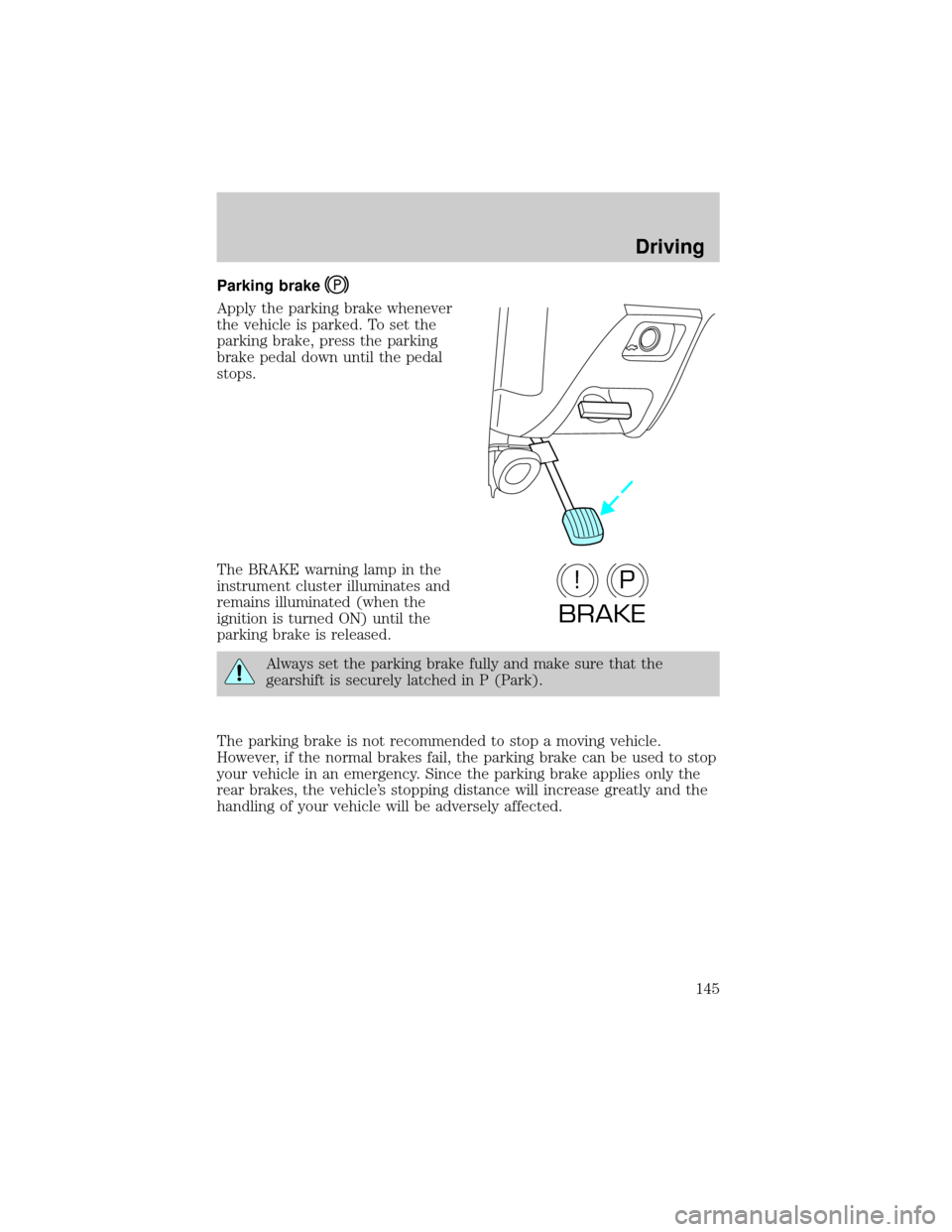
Parking brake
Apply the parking brake whenever
the vehicle is parked. To set the
parking brake, press the parking
brake pedal down until the pedal
stops.
The BRAKE warning lamp in the
instrument cluster illuminates and
remains illuminated (when the
ignition is turned ON) until the
parking brake is released.
Always set the parking brake fully and make sure that the
gearshift is securely latched in P (Park).
The parking brake is not recommended to stop a moving vehicle.
However, if the normal brakes fail, the parking brake can be used to stop
your vehicle in an emergency. Since the parking brake applies only the
rear brakes, the vehicle's stopping distance will increase greatly and the
handling of your vehicle will be adversely affected.
P!
BRAKE
Driving
145
Page 146 of 248
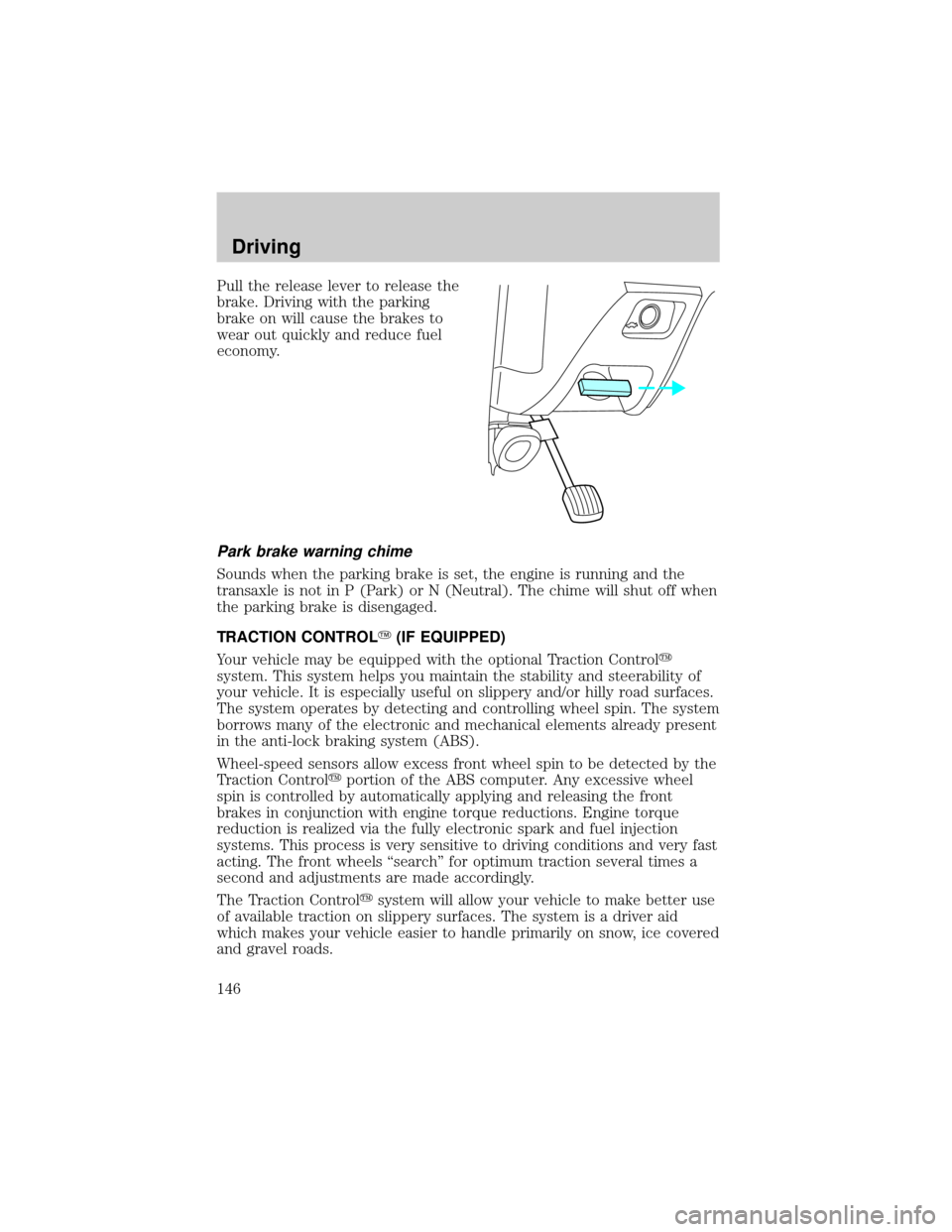
Pull the release lever to release the
brake. Driving with the parking
brake on will cause the brakes to
wear out quickly and reduce fuel
economy.
Park brake warning chime
Sounds when the parking brake is set, the engine is running and the
transaxle is not in P (Park) or N (Neutral). The chime will shut off when
the parking brake is disengaged.
TRACTION CONTROLY(IF EQUIPPED)
Your vehicle may be equipped with the optional Traction Controly
system. This system helps you maintain the stability and steerability of
your vehicle. It is especially useful on slippery and/or hilly road surfaces.
The system operates by detecting and controlling wheel spin. The system
borrows many of the electronic and mechanical elements already present
in the anti-lock braking system (ABS).
Wheel-speed sensors allow excess front wheel spin to be detected by the
Traction Controlyportion of the ABS computer. Any excessive wheel
spin is controlled by automatically applying and releasing the front
brakes in conjunction with engine torque reductions. Engine torque
reduction is realized via the fully electronic spark and fuel injection
systems. This process is very sensitive to driving conditions and very fast
acting. The front wheels ªsearchº for optimum traction several times a
second and adjustments are made accordingly.
The Traction Controlysystem will allow your vehicle to make better use
of available traction on slippery surfaces. The system is a driver aid
which makes your vehicle easier to handle primarily on snow, ice covered
and gravel roads.
Driving
146
Page 149 of 248
Always set the parking brake fully and make sure the gearshift is
latched in P (Park). Turn off the ignition whenever you leave
your vehicle.
If the parking brake is fully released, but the brake warning lamp
remains illuminated, the brakes may not be working properly.
See your dealer or a qualified service technician.
Driving with an automatic overdrive transaxle
Your automatic transaxle electronically controls the shift feel by using an
adaptive learning strategy. This feature is designed to optimize shift
smoothness. It is normal for your transaxle to shift firmly during the first
few hundred kilometers (miles) of operation until the adaptive strategy
has been learned. The adaptive learning strategy is maintained by power
from the battery. When the battery is disconnected or a new battery is
installed, the transaxle must relearn its adaptive strategy. Optimal
shifting will resume within a few hundred kilometers (miles) of
operation.
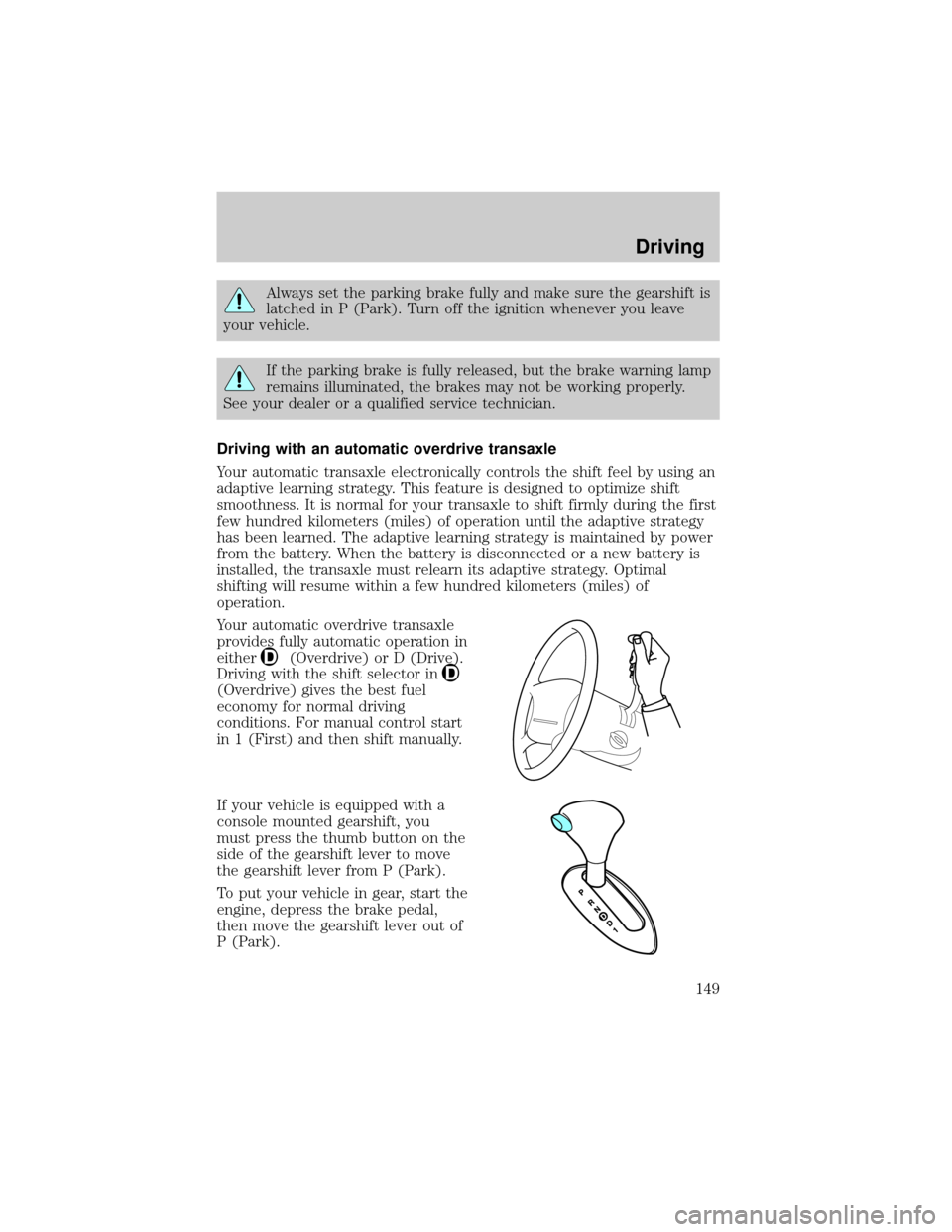
Your automatic overdrive transaxle
provides fully automatic operation in
either
(Overdrive) or D (Drive).
Driving with the shift selector in
(Overdrive) gives the best fuel
economy for normal driving
conditions. For manual control start
in 1 (First) and then shift manually.
If your vehicle is equipped with a
console mounted gearshift, you
must press the thumb button on the
side of the gearshift lever to move
the gearshift lever from P (Park).
To put your vehicle in gear, start the
engine, depress the brake pedal,
then move the gearshift lever out of
P (Park).
Driving
149
Page 164 of 248
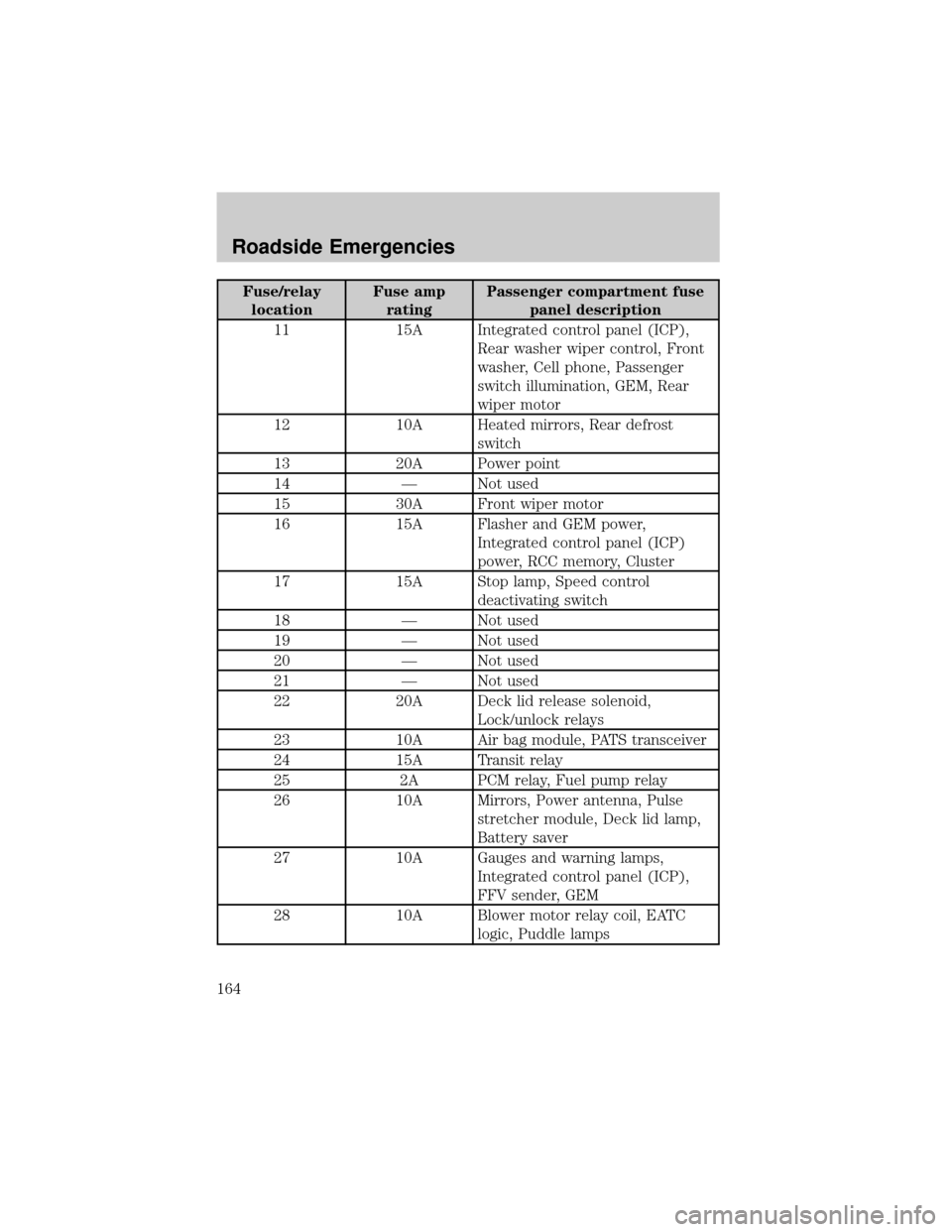
Fuse/relay
locationFuse amp
ratingPassenger compartment fuse
panel description
11 15A Integrated control panel (ICP),
Rear washer wiper control, Front
washer, Cell phone, Passenger
switch illumination, GEM, Rear
wiper motor
12 10A Heated mirrors, Rear defrost
switch
13 20A Power point
14 Ð Not used
15 30A Front wiper motor
16 15A Flasher and GEM power,
Integrated control panel (ICP)
power, RCC memory, Cluster
17 15A Stop lamp, Speed control
deactivating switch
18 Ð Not used
19 Ð Not used
20 Ð Not used
21 Ð Not used
22 20A Deck lid release solenoid,
Lock/unlock relays
23 10A Air bag module, PATS transceiver
24 15A Transit relay
25 2A PCM relay, Fuel pump relay
26 10A Mirrors, Power antenna, Pulse
stretcher module, Deck lid lamp,
Battery saver
27 10A Gauges and warning lamps,
Integrated control panel (ICP),
FFV sender, GEM
28 10A Blower motor relay coil, EATC
logic, Puddle lamps
Roadside Emergencies
164
Page 223 of 248
Do not park, idle, or drive your vehicle in dry grass or other dry
ground cover. The emission system heats up the engine
compartment and exhaust system, which can start a fire.
Illumination of the
indicator, charging system warning light or the
temperature warning light, fluid leaks, strange odors, smoke or loss of
engine power, could indicate that the emission control system is not
working properly.
Exhaust leaks may result in entry of harmful and potentially
lethal fumes into the passenger compartment.
Do not make any unauthorized changes to your vehicle or engine. By law,
vehicle owners and anyone who manufactures, repairs, services, sells, leases,
trades vehicles, or supervises a fleet of vehicles are not permitted to
intentionally remove an emission control device or prevent it from working.
Information about your vehicle's emission system is on the Vehicle Emission
Control Information Decal located on or near the engine. This decal
identifies engine displacement and gives some tune up specifications.
Please consult your ªWarranty Guideº for complete emission warranty
information.
Readiness for Inspection/Maintenance (I/M) testing
In some localities, it may be a legal requirement to pass an I/M test of
the on-board diagnostics system. If your
indicator is on, refer to the
description in theWarning lights and chimessection of the
Instrument Clusterchapter. Your vehicle may not pass the I/M test with
the
indicator on.
If the vehicle's powertrain system or its battery has just been serviced,
the on-board diagnostics system is reset to a ªnot ready for I/M testº
condition. To ready the on-board diagnostics system for I/M testing, a
minimum of 30 minutes of city and highway driving is necessary as
described below:
²First, at least 10 minutes of driving on an expressway or highway.
²Next, at least 20 minutes driving in stop-and-go, city-type traffic with
at least four idle periods.
Allow the vehicle to sit for at least eight hours without starting the
engine. Then, start the engine and complete the above driving cycle. The
engine must warm up to its normal operating temperature. Once started,
do not turn off the engine until the above driving cycle is complete.
Maintenance and Specifications
223
Page 243 of 248

A
Accessory delay ..........................70
Air bag supplemental
restraint system ........121±122, 126
and child safety seats ............124
description ......................122, 126
disposal ....................................128
driver air bag ..........121, 125, 127
indicator light ...................12, 125
operation .................121, 125, 127
passenger air bag ...121, 125, 127
side air bag ..............................126
Air cleaner filter .......................232
Air conditioning ..........................43
manual heating and air
conditioning system .................40
Air filter, cabin ............................50
Antifreeze
(see Engine coolant) ................207
Anti-lock brake system
(see Brakes) ......................143±144
Anti-theft system ........................98
arming the system ....................98
disarming a triggered
system .......................................99
warning light .............................14
Automatic transaxle .................148
driving with .............................150
fluid, adding ............................226
fluid, checking ........................226
fluid, refill capacities ..............233
fluid, specification ..................236
Auxiliary power point .................69
Axle
lubricant specifications ..........234B
Battery .......................................205
acid, treating emergencies .....205
charging system
warning light .............................12
jumping a disabled battery ....172
maintenance-free ....................205
replacement,
specifications ..........................232
servicing ..................................205
Belt minder ...............................116
Brakes ........................................143
anti-lock ...........................143±144
anti-lock brake system
(ABS) warning light .........12, 144
brake warning light ..................12
fluid, checking and adding ....225
fluid, refill capacities ..............233
fluid, specifications .........234, 236
lubricant
specifications ..................234, 236
parking ....................................145
pedals (see Power
adjustable foot pedals) ............74
shift interlock ..........................148
Break-in period .............................6
C
Capacities for refilling fluids ....233
Cargo area shade ........................83
Cargo cover .................................82
Cargo net ...............................81±82
CD changer .................................35
Cellular telephone (see your
Cellular Phone Guide) ................79
Certification Label ....................238
Index
243
Page 244 of 248

Child safety restraints ..............129
child safety belts ....................129
Child safety seats ......................130
attaching with tether straps ..134
in front seat ............................131
in rear seat ......................131, 134
Cleaning your vehicle
engine compartment ..............191
exterior ....................................195
instrument cluster lens ..........193
instrument panel ....................193
interior .....................................194
plastic parts ............................192
safety belts ..............................195
washing ....................................189
waxing .....................................189
wheels ......................................190
windows ..................................195
wiper blades ............................193
woodtone trim ........................195
Clock ................................22, 27, 33
Compass, electronic ....................71
calibration .................................73
set zone adjustment .................72
Console ........................................78
Controls
power seat ...............................103
Coolant
checking and adding ..............207
refill capacities ................211, 233
specifications ..................234, 236
Cruise control
(see Speed control) ....................75
Customer Assistance ................159
Ford accessories for
your vehicle ............................195
Ford Extended
Service Plan ............................181Getting assistance outside
the U.S. and Canada ..............185
Getting roadside assistance ...159
Getting the service
you need .................................179
Ordering additional
owner's literature ...................186
The Dispute Settlement
Board .......................................182
Utilizing the Mediation/
Arbitration Program ...............185
D
Daytime running lamps
(see Lamps) ................................51
Defrost
rear window ..............................50
Dipstick
automatic transmission
fluid ..........................................226
engine oil .................................202
Doors
door ajar warning .....................14
lubricant specifications ..........234
Driving under special
conditions
through water .........................153
E
Emergencies, roadside
jump-starting ..........................172
Emission control system ..........222
Engine ........................................236
check engine/service
engine soon light ......................10
cleaning ...................................191
coolant .....................................207
Index
244