lock FORD TAURUS 2002 4.G Manual PDF
[x] Cancel search | Manufacturer: FORD, Model Year: 2002, Model line: TAURUS, Model: FORD TAURUS 2002 4.GPages: 248, PDF Size: 2.12 MB
Page 207 of 248
²The vehicle may need to be driven 16 km (10 miles) or more to
relearn the idle and fuel trim strategy.
²If you do not allow the engine to relearn its idle trim, the idle
quality of your vehicle may be adversely affected until the idle
trim is eventually relearned.
If the battery has been disconnected or a new battery has been installed,
the clock must be reset once the battery is reconnected.
²Always dispose of automotive
batteries in a responsible manner.
Follow your local authorized
standards for disposal. Call your
local authorized recycling center
to find out more about recycling
automotive batteries.
ENGINE COOLANT
Checking engine coolant
The concentration and level of engine coolant should be checked at the
mileage intervals listed in the scheduled maintenance guide. The coolant
concentration should be maintained at 50/50 coolant and water, which
equates to a freeze point of -36É C (-34É F). Coolant concentration
testing is possible with a hydrometer or antifreeze tester (such as the
Rotunda Battery and Antifreeze Tester, 014±R1060). The level of coolant
should be maintained at the ªcold fullº of ªcold fill rangeº level in the
coolant reservoir. If the level falls below, add coolant per the instructions
in theAdding Engine Coolantsection.
Your vehicle was factory-filled with a 50/50 engine coolant and water
concentration. If the concentration of coolant falls below 40% or above
60%, the engine parts could become damaged or not work properly.A
50±50 mixture of coolant and water provides the following:
²Freeze protection down to -36É C (-34É F).
²Boiling protection up to 129É C (265É F).
²Protection against rust and other forms of corrosion.
²Enables calibrated gauges to work properly.
LEAD
RETURN
RECYCLE
Maintenance and Specifications
207
Page 210 of 248
²Do not mix with recycled coolant unless from a Ford-approved
recycling process (seeUse of Recycled Engine Coolantsection).
For vehicles with overflow coolant systems with a non-pressurized cap
on the coolant recovery system, add coolant to the coolant recovery
reservoir when the engine is cool. Add the proper mixture of coolant and
water to the ªcold fullº level. For all other vehicles, which have a coolant
degas system with a pressurized cap, or if it is necessary to remove the
coolant pressure relief cap on the radiator of a vehicle with an overflow
system, follow these steps to add engine coolant.
To avoid personal injury, make sure the engine is cool before
unscrewing the coolant pressure relief cap. The cooling system is
under pressure; steam and hot liquid can come out forcefully when the
cap is loosened slightly.
1. Before you begin, turn the engine off and let it cool.
2. When the engine is cool, wrap a thick cloth around the coolant
pressure relief cap on the coolant reservoir (an opaque plastic bottle).
Slowly turn cap counterclockwise (left) until pressure begins to release.
3. Step back while the pressure releases.
4. When you are sure that all the pressure has been released, use the
cloth to turn it counterclockwise and remove the cap.
5. Fill the coolant reservoir slowly with the proper coolant mixture (see
above), to within the ªcold fill rangeº or the ªcold fullº level on the
reservoir. If you removed the radiator cap in an overflow system, fill the
radiator until the coolant is visible and radiator is almost full.
6. Replace the cap. Turn until tightly installed. (Cap must be tightly
installed to prevent coolant loss.)
After any coolant has been added, check the coolant concentration see
Checking Engine Coolant section). If the concentration is not 50/50
(protection to ±34É F/±36É C), drain some coolant and adjust the
concentration. It may take several drains and additions to obtain a 50/50
coolant concentration.
Whenever coolant has been added, the coolant level in the coolant
reservoir should be checked the next few times you drive the vehicle. If
necessary, add enough 50/50 concentration of engine coolant and
distilled water to bring the liquid level to the proper level.
Maintenance and Specifications
210
Page 215 of 248
When refueling always shut the engine off and never allow
sparks or open flames near the filler neck. Never smoke while
refueling. Fuel vapor is extremely hazardous under certain conditions.
Care should be taken to avoid inhaling excess fumes.
The flow of fuel through a fuel pump nozzle can produce static
electricity, which can cause a fire if fuel is pumped into an
ungrounded fuel container.
Use the following guidelines to avoid static build-up when filling an
ungrounded fuel container:
²Place approved fuel container on the ground.
²DO NOT fill a fuel container while it is in the vehicle (including the
cargo area).
²Keep the fuel pump nozzle in contact with the fuel container while
filling.
²DO NOT use a device that would hold the fuel pump handle in the fill
position.
Fuel Filler Cap
Your fuel tank filler cap has an indexed design with a 1/8 turn on/off
feature.
When fueling your vehicle:
1. Turn the engine off.
2. Carefully turn the filler cap counterclockwise 1/8 of a turn until it
stops.
3. Pull to remove the cap from the fuel filler pipe.
4. To install the cap, align the tabs on the cap with the notches on the
filler pipe.
5. Turn the filler cap clockwise 1/8 of a turn until it stops.
If the ªCheck Fuel Capº
indicator comes on or if ªService Engine
Soon/Check Engineº indicator comes on and stays on when you start the
engine, the fuel filler cap may not be properly installed. Turn off the
engine, remove the fuel filler cap, align the cap properly and reinstall it.
Maintenance and Specifications
215
Page 234 of 248
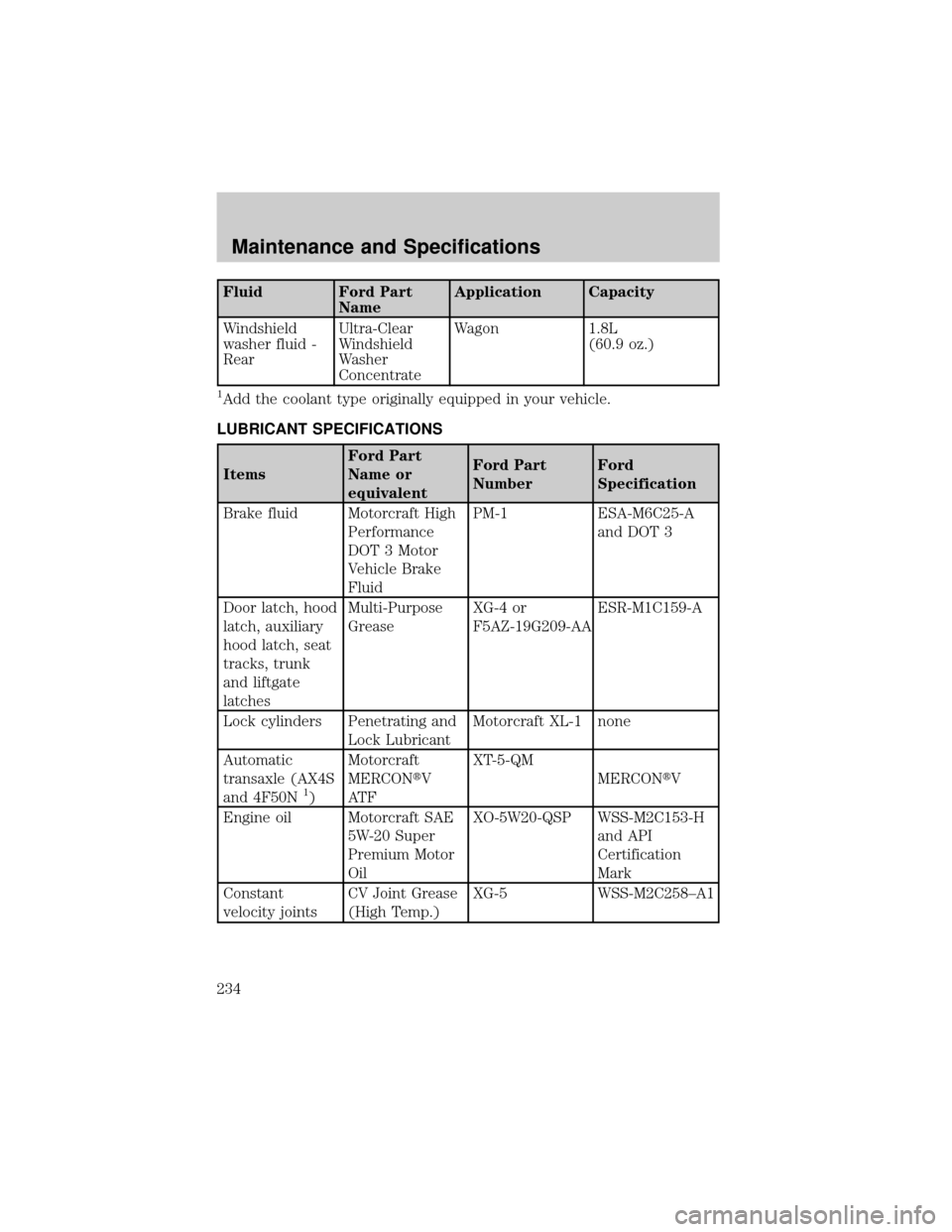
Fluid Ford Part
NameApplication Capacity
Windshield
washer fluid -
RearUltra-Clear
Windshield
Washer
ConcentrateWagon 1.8L
(60.9 oz.)
1Add the coolant type originally equipped in your vehicle.
LUBRICANT SPECIFICATIONS
ItemsFord Part
Name or
equivalentFord Part
NumberFord
Specification
Brake fluid Motorcraft High
Performance
DOT 3 Motor
Vehicle Brake
FluidPM-1 ESA-M6C25-A
and DOT 3
Door latch, hood
latch, auxiliary
hood latch, seat
tracks, trunk
and liftgate
latchesMulti-Purpose
GreaseXG-4 or
F5AZ-19G209-AAESR-M1C159-A
Lock cylinders Penetrating and
Lock LubricantMotorcraft XL-1 none
Automatic
transaxle (AX4S
and 4F50N
1)Motorcraft
MERCONtV
AT FXT-5-QM
MERCONtV
Engine oil Motorcraft SAE
5W-20 Super
Premium Motor
OilXO-5W20-QSP WSS-M2C153-H
and API
Certification
Mark
Constant
velocity jointsCV Joint Grease
(High Temp.)XG-5 WSS-M2C258±A1
Maintenance and Specifications
234
Page 239 of 248
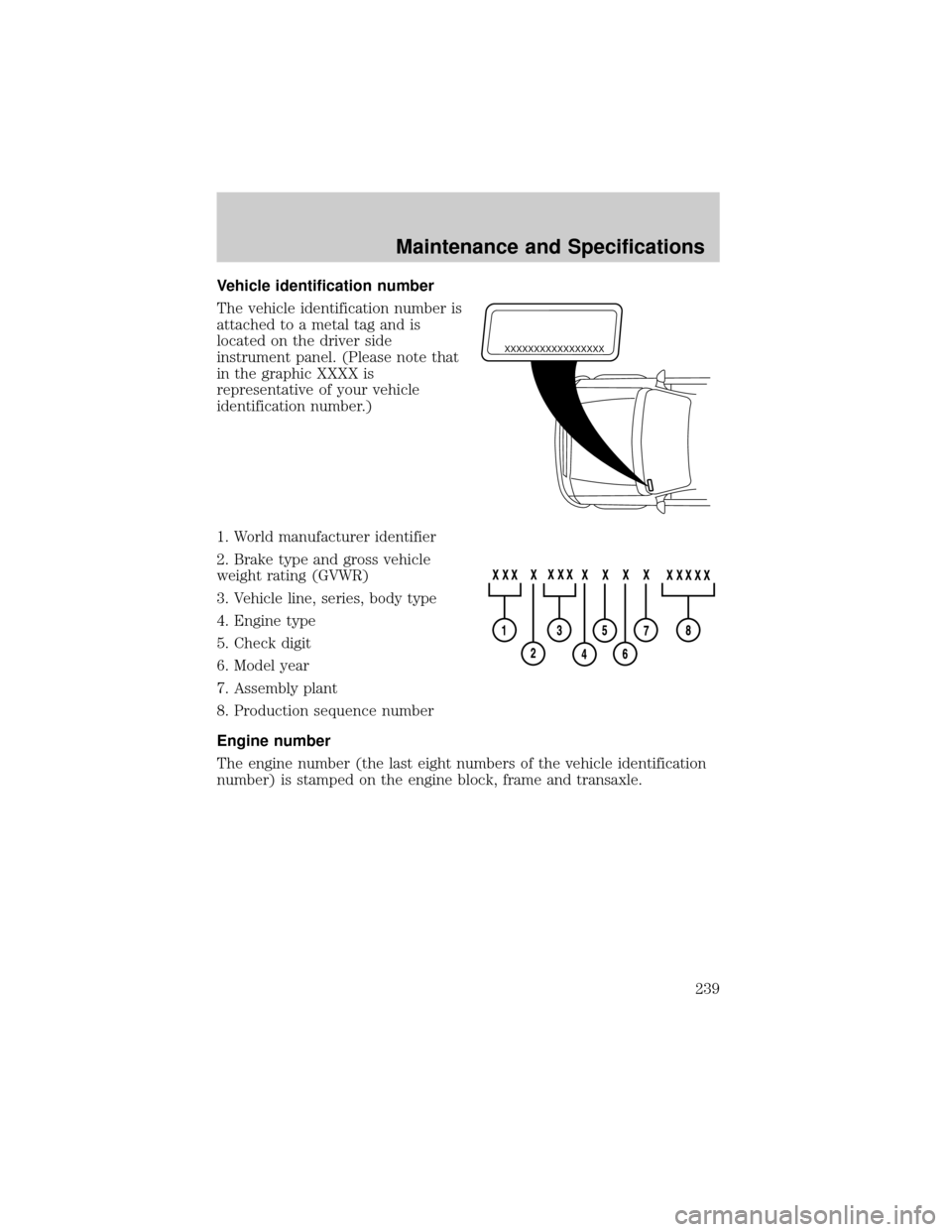
Vehicle identification number
The vehicle identification number is
attached to a metal tag and is
located on the driver side
instrument panel. (Please note that
in the graphic XXXX is
representative of your vehicle
identification number.)
1. World manufacturer identifier
2. Brake type and gross vehicle
weight rating (GVWR)
3. Vehicle line, series, body type
4. Engine type
5. Check digit
6. Model year
7. Assembly plant
8. Production sequence number
Engine number
The engine number (the last eight numbers of the vehicle identification
number) is stamped on the engine block, frame and transaxle.
XXXXXXXXXXXXXXXXX
Maintenance and Specifications
239
Page 240 of 248

FORD ACCESSORIES FOR YOUR VEHICLE
A wide selection of genuine Ford accessories are available for your
vehicle through your local authorized Ford, Lincoln Mercury or Ford of
Canada dealer. These quality accessories have been specifically
engineered to fulfill your automotive needs; they are custom designed to
complement the style and aerodynamic appearance of your vehicle. In
addition, each accessory is made from high quality materials and meets
or exceeds Ford's rigorous engineering and safety specifications. Ford
Motor Company will repair or replace any properly dealer-installed Ford
accessory found to be defective in factory-supplied materials or
workmanship during the warranty period, as well as any component
damaged by the defective accessory. The accessory will be warranted for
whichever provides you the greatest benefit:
²12 months or 20 000 km (12 000 miles) (whichever occurs first), or
²The remainder of your new vehicle limited warranty.
This means that genuine Ford accessories purchased along with your
new vehicle and installed by the dealer are covered for the full length of
your New Vehicle's Limited Warranty Ð 3 years or 60 000 km (36 000 miles)
(whichever occurs first). Contact your dealer for details and a copy of
the warranty.
Not all accessories are available for all models.
Vehicle Security
Remote keyless entry
Styled wheel locks
Vehicle security systems
Comfort and convenience
Air filtration
Cargo nets
Cargo organizers
Cargo tray
Cargo shades (wagon)
Engine block heaters
Remote start
Accessories
240
Page 241 of 248

Travel equipment
Electrochromic inside mirror with compass
Electrochromic inside mirror with compass and temperature
Emergency kit
Factory luggage rack adaptors
First aid kit
Framed luggage carrier
Removable luggage rack
Removable luggage rack adapters
Soft luggage cover
Speed control
Track rider bars
Protection and appearance equipment
Air bag anti-theft locks
Car covers
Cargo liner
Carpet floor mats
Door edge guards
Flat splash guards
Front end covers (full)
Locking gas cap
Molded splash guards
All weather vinyl mats
Pet divider (Wagon only)
Rear decklid spoilers
Styled hood deflector
Styled side air deflectors
Universal floor mats
Accessories
241
Page 243 of 248

A
Accessory delay ..........................70
Air bag supplemental
restraint system ........121±122, 126
and child safety seats ............124
description ......................122, 126
disposal ....................................128
driver air bag ..........121, 125, 127
indicator light ...................12, 125
operation .................121, 125, 127
passenger air bag ...121, 125, 127
side air bag ..............................126
Air cleaner filter .......................232
Air conditioning ..........................43
manual heating and air
conditioning system .................40
Air filter, cabin ............................50
Antifreeze
(see Engine coolant) ................207
Anti-lock brake system
(see Brakes) ......................143±144
Anti-theft system ........................98
arming the system ....................98
disarming a triggered
system .......................................99
warning light .............................14
Automatic transaxle .................148
driving with .............................150
fluid, adding ............................226
fluid, checking ........................226
fluid, refill capacities ..............233
fluid, specification ..................236
Auxiliary power point .................69
Axle
lubricant specifications ..........234B
Battery .......................................205
acid, treating emergencies .....205
charging system
warning light .............................12
jumping a disabled battery ....172
maintenance-free ....................205
replacement,
specifications ..........................232
servicing ..................................205
Belt minder ...............................116
Brakes ........................................143
anti-lock ...........................143±144
anti-lock brake system
(ABS) warning light .........12, 144
brake warning light ..................12
fluid, checking and adding ....225
fluid, refill capacities ..............233
fluid, specifications .........234, 236
lubricant
specifications ..................234, 236
parking ....................................145
pedals (see Power
adjustable foot pedals) ............74
shift interlock ..........................148
Break-in period .............................6
C
Capacities for refilling fluids ....233
Cargo area shade ........................83
Cargo cover .................................82
Cargo net ...............................81±82
CD changer .................................35
Cellular telephone (see your
Cellular Phone Guide) ................79
Certification Label ....................238
Index
243
Page 244 of 248

Child safety restraints ..............129
child safety belts ....................129
Child safety seats ......................130
attaching with tether straps ..134
in front seat ............................131
in rear seat ......................131, 134
Cleaning your vehicle
engine compartment ..............191
exterior ....................................195
instrument cluster lens ..........193
instrument panel ....................193
interior .....................................194
plastic parts ............................192
safety belts ..............................195
washing ....................................189
waxing .....................................189
wheels ......................................190
windows ..................................195
wiper blades ............................193
woodtone trim ........................195
Clock ................................22, 27, 33
Compass, electronic ....................71
calibration .................................73
set zone adjustment .................72
Console ........................................78
Controls
power seat ...............................103
Coolant
checking and adding ..............207
refill capacities ................211, 233
specifications ..................234, 236
Cruise control
(see Speed control) ....................75
Customer Assistance ................159
Ford accessories for
your vehicle ............................195
Ford Extended
Service Plan ............................181Getting assistance outside
the U.S. and Canada ..............185
Getting roadside assistance ...159
Getting the service
you need .................................179
Ordering additional
owner's literature ...................186
The Dispute Settlement
Board .......................................182
Utilizing the Mediation/
Arbitration Program ...............185
D
Daytime running lamps
(see Lamps) ................................51
Defrost
rear window ..............................50
Dipstick
automatic transmission
fluid ..........................................226
engine oil .................................202
Doors
door ajar warning .....................14
lubricant specifications ..........234
Driving under special
conditions
through water .........................153
E
Emergencies, roadside
jump-starting ..........................172
Emission control system ..........222
Engine ........................................236
check engine/service
engine soon light ......................10
cleaning ...................................191
coolant .....................................207
Index
244
Page 245 of 248

idle speed control ...................205
lubrication
specifications ..................234, 236
refill capacities ........................233
service points ..................199±200
starting after a collision .........160
Engine block heater .................142
Engine oil ..................................202
checking and adding ..............202
dipstick ....................................202
filter, specifications ........204, 232
recommendations ...................204
refill capacities ........................233
specifications ..................234, 236
Exhaust fumes ..........................142
F
Flexible Fuel Vehicle (FFV) ....212
Floor mats ...................................80
Fluid capacities .........................233
Fuel ............................................212
calculating fuel economy .......219
cap .....................................11, 215
capacity ...................................233
choosing the right fuel ...........216
comparisons with EPA fuel
economy estimates .................222
detergent in fuel .....................218
filling your vehicle
with fuel ..................212, 215, 219
filter, specifications ........218, 232
fuel pump shut-off switch .....160
gauge .........................................17
improving fuel economy ........219
low fuel warning light ..............13
octane rating ...................216, 236
quality ......................................217
running out of fuel .................218safety information relating
to automotive fuels ................212
Fuses ..................................162±163
G
Gas cap (see Fuel cap) ......11, 215
Gas mileage
(see Fuel economy) .................219
Gauges .........................................16
engine coolant
temperature gauge ...................16
fuel gauge ..................................17
odometer ...................................17
speedometer .............................17
tachometer ................................18
trip odometer ............................18
GAWR (Gross Axle
Weight Rating) ..........................153
definition .................................153
driving with a heavy load ......153
location ....................................153
GVWR (Gross Vehicle
Weight Rating) ..........................153
calculating ...............................153
definition .................................153
driving with a heavy load ......153
location ....................................153
H
Hazard flashers .........................160
Head restraints .........................101
Headlamps ...................................51
aiming ..................................52±53
autolamp system .......................51
bulb specifications ....................56
daytime running lights .............51
flash to pass ..............................52
Index
245