fuel pump FORD TAURUS 2003 4.G User Guide
[x] Cancel search | Manufacturer: FORD, Model Year: 2003, Model line: TAURUS, Model: FORD TAURUS 2003 4.GPages: 216, PDF Size: 10.87 MB
Page 184 of 216
Choosing the right fuel
Use only UNLEADED FUEL. The use of leaded fuel is prohibited by law
and could damage your vehicle.
If your vehicle is a flexible fuel vehicle (FFV), use only UNLEADED
FUEL and (E85) ETHANOL. The use of leaded fuel is prohibited by law
and could damage your vehicle.
Do not use fuel containing methanol. It can damage critical fuel system
components.
Your vehicle was not designed to use fuel or fuel additives with metallic
compounds, including manganese-based compounds containing MMT.
Repairs to correct the effects of using a fuel for which your vehicle was
not designed may not be covered by your warranty.
Octane recommendations
Do not be concerned if your engine
sometimes knocks lightly. However,
if it knocks heavily under most
driving conditions while you are
using fuel with the recommended
octane rating, see your dealer or a qualified service technician to prevent
any engine damage.
Unleaded Gasoline engines
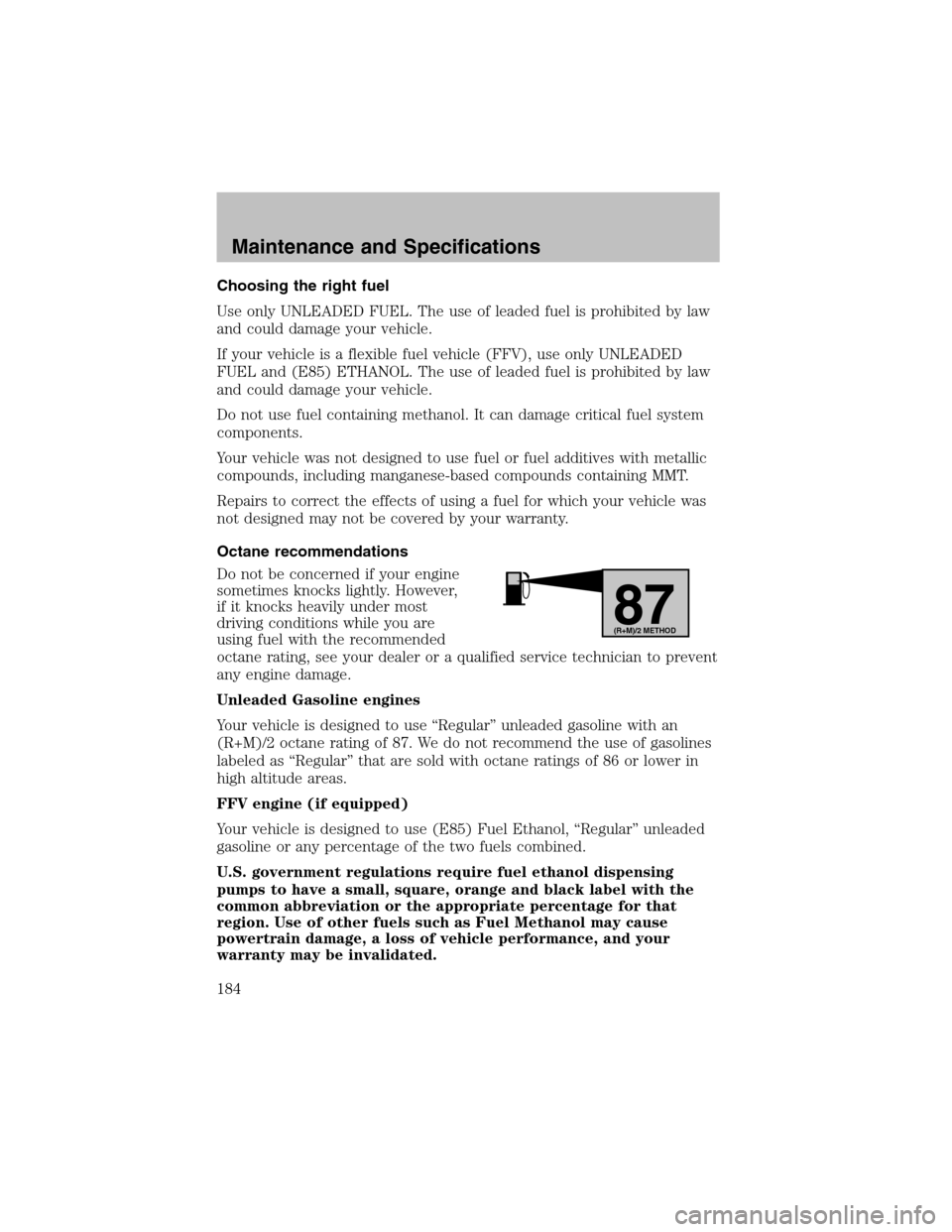
Your vehicle is designed to use“Regular”unleaded gasoline with an
(R+M)/2 octane rating of 87. We do not recommend the use of gasolines
labeled as“Regular”that are sold with octane ratings of 86 or lower in
high altitude areas.
FFV engine (if equipped)
Your vehicle is designed to use (E85) Fuel Ethanol,“Regular”unleaded
gasoline or any percentage of the two fuels combined.
U.S. government regulations require fuel ethanol dispensing
pumps to have a small, square, orange and black label with the
common abbreviation or the appropriate percentage for that
region. Use of other fuels such as Fuel Methanol may cause
powertrain damage, a loss of vehicle performance, and your
warranty may be invalidated.
87(R+M)/2 METHOD
Maintenance and Specifications
184
Page 186 of 216

Cleaner air
Ford endorses the use of reformulated“cleaner-burning”gasolines to
improve air quality.
Running out of fuel
Avoid running out of fuel because this situation may have an adverse
affect on powertrain components.
If you have run out of fuel:
•You may need to cycle the ignition from OFF to ON several times after
refueling, to allow the fuel system to pump the fuel from the tank to
the engine.
•The
indicator may come on. For more information on the
“Service Engine Soon”indicator, refer to theInstrument Cluster
chapter.
Fuel Filter
For fuel filter replacement, see your dealer or a qualified service
technician. Refer to the scheduled maintenance guide for the appropriate
intervals for changing the fuel filter.
Replace the fuel filter with an authorized Motorcraft part. The
customer warranty may be void for any damage to the fuel system
if an authorized Motorcraft fuel filter is not used.
ESSENTIALS OF GOOD FUEL ECONOMY
Measuring techniques
Your best source of information about actual fuel economy is you, the
driver. You must gather information as accurately and consistently as
possible. Fuel expense, frequency of fill-ups or fuel gauge readings are
NOT accurate as a measure of fuel economy. We do not recommend
taking fuel economy measurements during the first 1,600 km (1,000
miles) of driving (engine break-in period). You will get a more accurate
measurement after 3,000 km–5,000 km (2,000 miles-3,000 miles).
Maintenance and Specifications
186
Page 187 of 216
Filling the tank
The advertised fuel capacity of the fuel tank on your vehicle is equal to
the rated refill capacity of the fuel tank as listed in theRefill capacities
section of this chapter.
The advertised capacity is the amount of the indicated capacity and the
empty reserve combined. Indicated capacity is the difference in the
amount of fuel in a full tank and a tank when the fuel gauge indicates
empty. Empty reserve is the small amount of fuel remaining in the fuel
tank after the fuel gauge indicates empty.
The amount of usable fuel in the empty reserve varies and should
not be relied upon to increase driving range. When refueling your
vehicle after the fuel gauge indicates empty, you might not be
able to refuel the full amount of the advertised capacity of the
fuel tank due to the empty reserve still present in the tank.
For consistent results when filling the fuel tank:
•Turn the engine/ignition switch to the off position prior to refueling,
an error in the reading will result if the engine is left running.
•Use the same filling rate setting (low—medium—high) each time
the tank is filled.
•Allow no more than 2 automatic click-offs when filling.
•Always use fuel with the recommended octane rating.
•Use a known quality gasoline, preferably a national brand.
•Use the same side of the same pump and have the vehicle facing the
same direction each time you fill up.
•Have the vehicle loading and distribution the same every time.
Your results will be most accurate if your filling method is consistent.
Calculating fuel economy
1. Fill the fuel tank completely and record the initial odometer reading
(in kilometers or miles).
2. Each time you fill the tank, record the amount of fuel added (in liters
or gallons).
3. After at least three to five tank fill-ups, fill the fuel tank and record
the current odometer reading.
4. Subtract your initial odometer reading from the current odometer
reading.
Maintenance and Specifications
187
Page 212 of 216

refill capacities ........................200
specifications ..................201, 203
Exhaust fumes ..........................116
F
Flexible Fuel Vehicle (FFV) ....180
Floor mats ...................................58
Fluid capacities .........................200
Fuel ............................................180
calculating fuel economy .......186
cap ...........................................183
capacity ...................................200
choosing the right fuel ...........184
comparisons with EPA fuel
economy estimates .................189
detergent in fuel .....................186
filling your vehicle with
fuel ...........................180, 183, 187
filter, specifications ........186, 199
fuel pump shut-off switch .....130
improving fuel economy ........186
octane rating ...................184, 203
quality ......................................185
running out of fuel .................186
safety information relating
to automotive fuels ................180
Fuel - flex fuel vehicle
(FFV) .................................180, 184
Fuses ..................................132–133
G
Gas cap (see Fuel cap) ............183
Gas mileage (see Fuel
economy) ...................................186
Gauges .........................................13
GAWR (Gross Axle Weight
Rating) .......................................123definition .................................123
driving with a heavy load ......123
location ....................................123
GVWR (Gross Vehicle Weight
Rating) .......................................123
calculating ...............................123
definition .................................123
driving with a heavy load ......123
location ....................................123
H
Headlamps ...................................30
aiming ........................................32
autolamp system .......................30
bulb specifications ....................35
daytime running lights .............30
flash to pass ..............................31
high beam .................................31
replacing bulbs .........................37
turning on and off ....................30
Heating
heating and air conditioning
system .................................24, 26
Hood ..........................................166
I
Ignition ...............................112, 203
Infant seats
(see Safety seats) .....................103
Inspection/maintenance (I/M)
testing ........................................191
Instrument panel
cleaning ...................................162
cluster ........................................10
lighting up panel and
interior .......................................31
J
Jack ............................................138
Index
212