traction control FORD TAURUS 2004 4.G User Guide
[x] Cancel search | Manufacturer: FORD, Model Year: 2004, Model line: TAURUS, Model: FORD TAURUS 2004 4.GPages: 240, PDF Size: 3.3 MB
Page 147 of 240
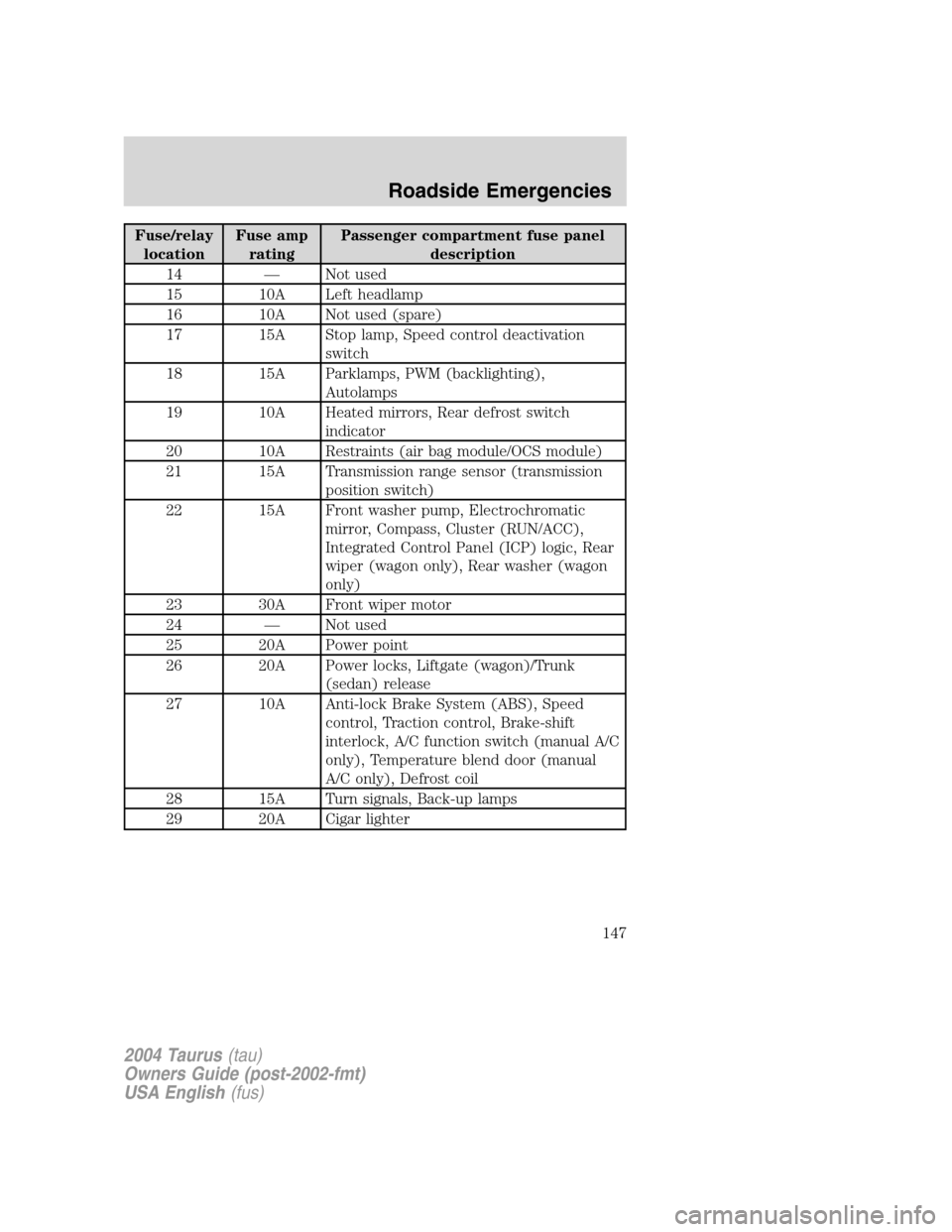
Fuse/relay
locationFuse amp
ratingPassenger compartment fuse panel
description
14—Not used
15 10A Left headlamp
16 10A Not used (spare)
17 15A Stop lamp, Speed control deactivation
switch
18 15A Parklamps, PWM (backlighting),
Autolamps
19 10A Heated mirrors, Rear defrost switch
indicator
20 10A Restraints (air bag module/OCS module)
21 15A Transmission range sensor (transmission
position switch)
22 15A Front washer pump, Electrochromatic
mirror, Compass, Cluster (RUN/ACC),
Integrated Control Panel (ICP) logic, Rear
wiper (wagon only), Rear washer (wagon
only)
23 30A Front wiper motor
24—Not used
25 20A Power point
26 20A Power locks, Liftgate (wagon)/Trunk
(sedan) release
27 10A Anti-lock Brake System (ABS), Speed
control, Traction control, Brake-shift
interlock, A/C function switch (manual A/C
only), Temperature blend door (manual
A/C only), Defrost coil
28 15A Turn signals, Back-up lamps
29 20A Cigar lighter
2004 Taurus(tau)
Owners Guide (post-2002-fmt)
USA English(fus)
Roadside Emergencies
147
Page 207 of 240
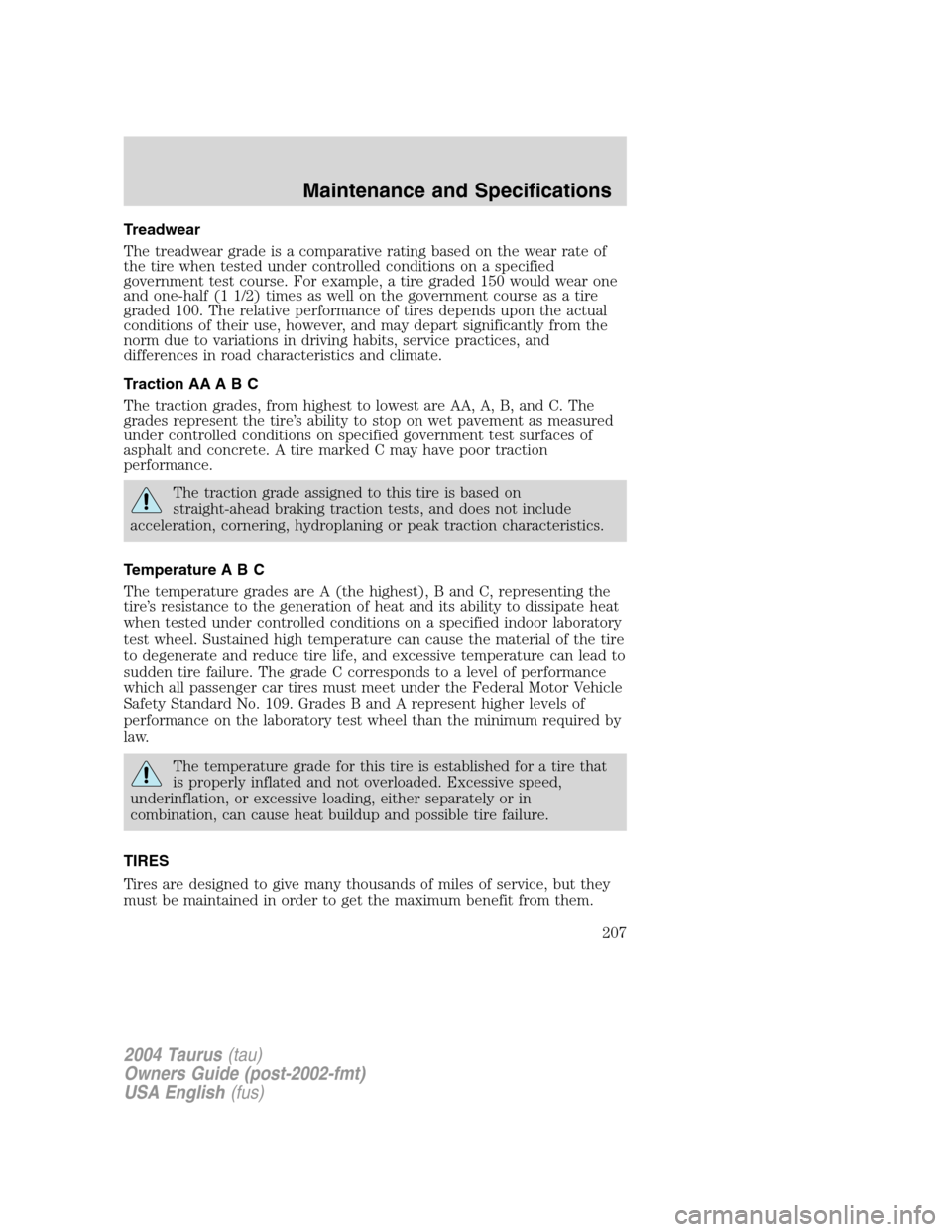
Treadwear
The treadwear grade is a comparative rating based on the wear rate of
the tire when tested under controlled conditions on a specified
government test course. For example, a tire graded 150 would wear one
and one-half (1 1/2) times as well on the government course as a tire
graded 100. The relative performance of tires depends upon the actual
conditions of their use, however, and may depart significantly from the
norm due to variations in driving habits, service practices, and
differences in road characteristics and climate.
Traction AA A B C
The traction grades, from highest to lowest are AA, A, B, and C. The
grades represent the tire’s ability to stop on wet pavement as measured
under controlled conditions on specified government test surfaces of
asphalt and concrete. A tire marked C may have poor traction
performance.
The traction grade assigned to this tire is based on
straight-ahead braking traction tests, and does not include
acceleration, cornering, hydroplaning or peak traction characteristics.
Temperature A B C
The temperature grades are A (the highest), B and C, representing the
tire’s resistance to the generation of heat and its ability to dissipate heat
when tested under controlled conditions on a specified indoor laboratory
test wheel. Sustained high temperature can cause the material of the tire
to degenerate and reduce tire life, and excessive temperature can lead to
sudden tire failure. The grade C corresponds to a level of performance
which all passenger car tires must meet under the Federal Motor Vehicle
Safety Standard No. 109. Grades B and A represent higher levels of
performance on the laboratory test wheel than the minimum required by
law.
The temperature grade for this tire is established for a tire that
is properly inflated and not overloaded. Excessive speed,
underinflation, or excessive loading, either separately or in
combination, can cause heat buildup and possible tire failure.
TIRES
Tires are designed to give many thousands of miles of service, but they
must be maintained in order to get the maximum benefit from them.
2004 Taurus(tau)
Owners Guide (post-2002-fmt)
USA English(fus)
Maintenance and Specifications
207
Page 210 of 240
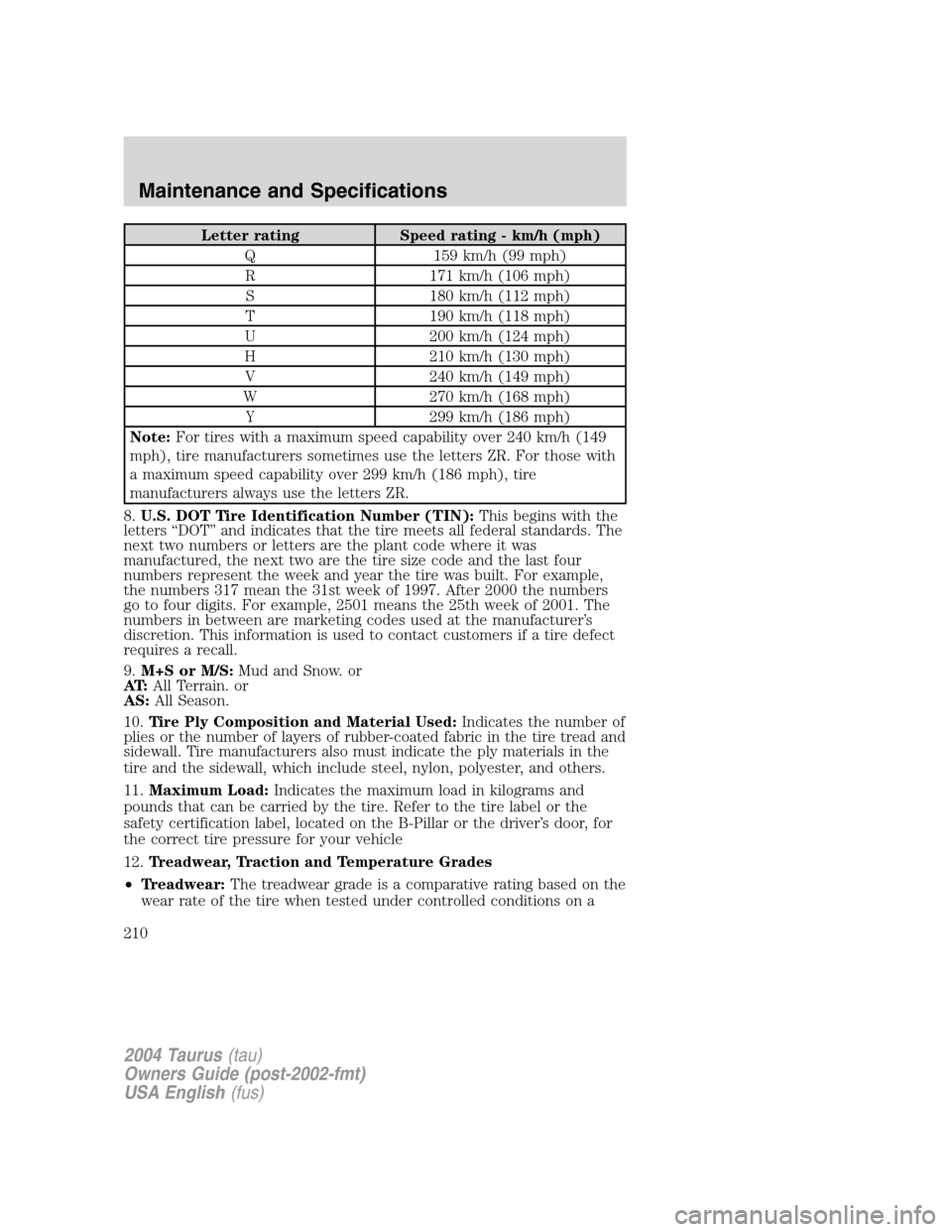
Letter rating Speed rating - km/h (mph)
Q 159 km/h (99 mph)
R 171 km/h (106 mph)
S 180 km/h (112 mph)
T 190 km/h (118 mph)
U 200 km/h (124 mph)
H 210 km/h (130 mph)
V 240 km/h (149 mph)
W 270 km/h (168 mph)
Y 299 km/h (186 mph)
Note:For tires with a maximum speed capability over 240 km/h (149
mph), tire manufacturers sometimes use the letters ZR. For those with
a maximum speed capability over 299 km/h (186 mph), tire
manufacturers always use the letters ZR.
8.U.S. DOT Tire Identification Number (TIN):This begins with the
letters“DOT”and indicates that the tire meets all federal standards. The
next two numbers or letters are the plant code where it was
manufactured, the next two are the tire size code and the last four
numbers represent the week and year the tire was built. For example,
the numbers 317 mean the 31st week of 1997. After 2000 the numbers
go to four digits. For example, 2501 means the 25th week of 2001. The
numbers in between are marketing codes used at the manufacturer’s
discretion. This information is used to contact customers if a tire defect
requires a recall.
9.M+S or M/S:Mud and Snow. or
AT:All Terrain. or
AS:All Season.
10.Tire Ply Composition and Material Used:Indicates the number of
plies or the number of layers of rubber-coated fabric in the tire tread and
sidewall. Tire manufacturers also must indicate the ply materials in the
tire and the sidewall, which include steel, nylon, polyester, and others.
11.Maximum Load:Indicates the maximum load in kilograms and
pounds that can be carried by the tire. Refer to the tire label or the
safety certification label, located on the B-Pillar or the driver’s door, for
the correct tire pressure for your vehicle
12.Treadwear, Traction and Temperature Grades
•Treadwear:The treadwear grade is a comparative rating based on the
wear rate of the tire when tested under controlled conditions on a
2004 Taurus(tau)
Owners Guide (post-2002-fmt)
USA English(fus)
Maintenance and Specifications
210
Page 211 of 240
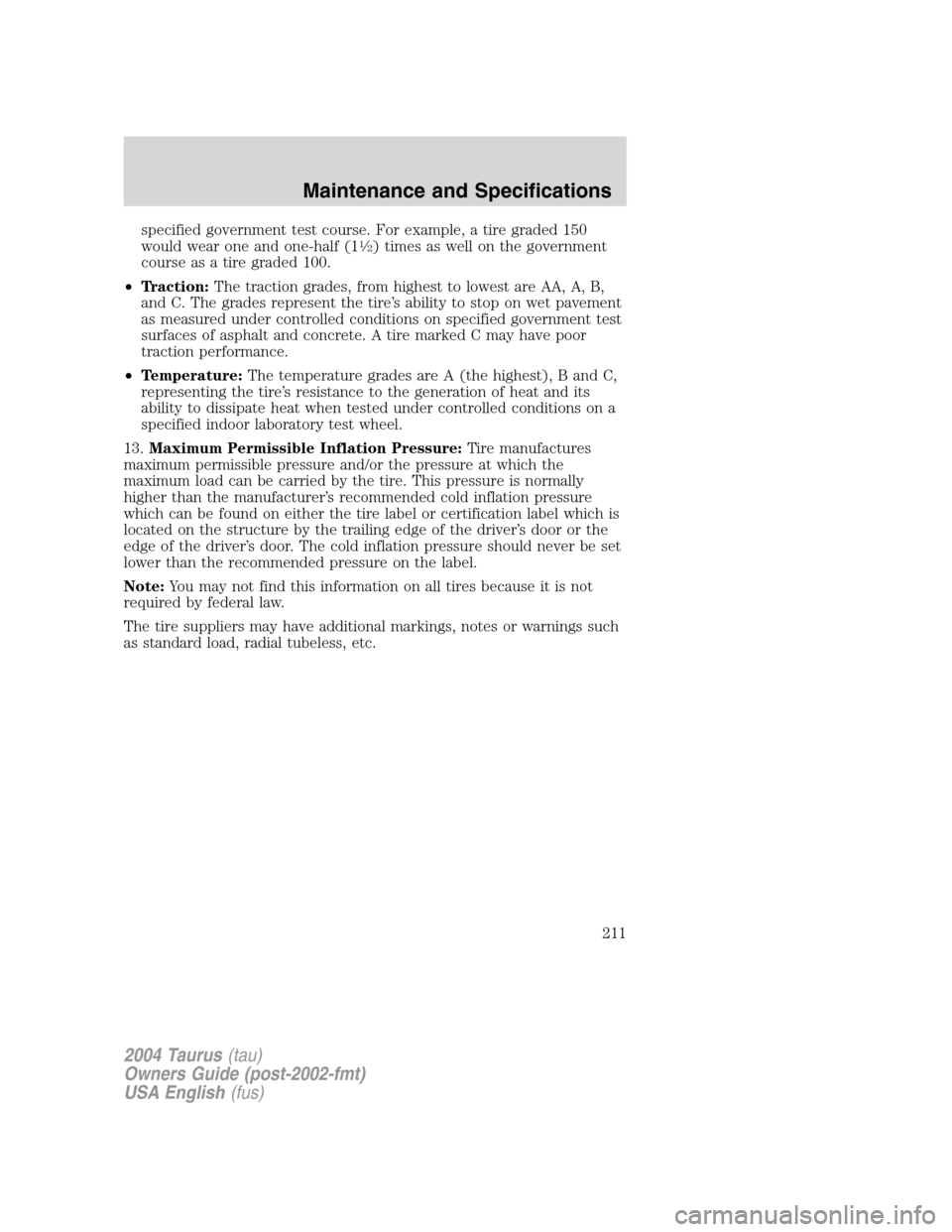
specified government test course. For example, a tire graded 150
would wear one and one-half (11⁄2) times as well on the government
course as a tire graded 100.
•Traction:The traction grades, from highest to lowest are AA, A, B,
and C. The grades represent the tire’s ability to stop on wet pavement
as measured under controlled conditions on specified government test
surfaces of asphalt and concrete. A tire marked C may have poor
traction performance.
•Temperature:The temperature grades are A (the highest), B and C,
representing the tire’s resistance to the generation of heat and its
ability to dissipate heat when tested under controlled conditions on a
specified indoor laboratory test wheel.
13.Maximum Permissible Inflation Pressure:Tire manufactures
maximum permissible pressure and/or the pressure at which the
maximum load can be carried by the tire. This pressure is normally
higher than the manufacturer’s recommended cold inflation pressure
which can be found on either the tire label or certification label which is
located on the structure by the trailing edge of the driver’s door or the
edge of the driver’s door. The cold inflation pressure should never be set
lower than the recommended pressure on the label.
Note:You may not find this information on all tires because it is not
required by federal law.
The tire suppliers may have additional markings, notes or warnings such
as standard load, radial tubeless, etc.
2004 Taurus(tau)
Owners Guide (post-2002-fmt)
USA English(fus)
Maintenance and Specifications
211
Page 236 of 240
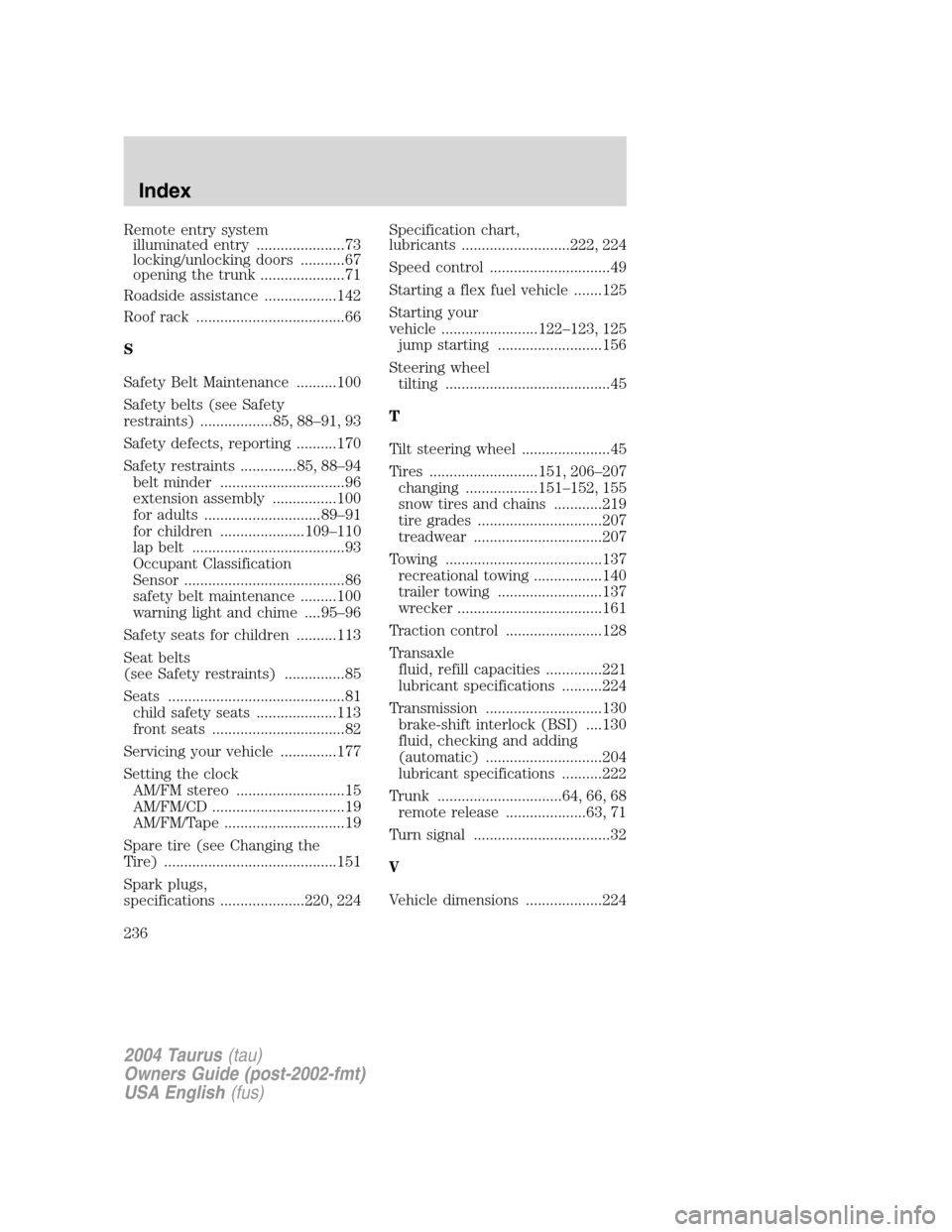
Remote entry system
illuminated entry ......................73
locking/unlocking doors ...........67
opening the trunk .....................71
Roadside assistance ..................142
Roof rack .....................................66
S
Safety Belt Maintenance ..........100
Safety belts (see Safety
restraints) ..................85, 88–91, 93
Safety defects, reporting ..........170
Safety restraints ..............85, 88–94
belt minder ...............................96
extension assembly ................100
for adults .............................89–91
for children .....................109–110
lap belt ......................................93
Occupant Classification
Sensor ........................................86
safety belt maintenance .........100
warning light and chime ....95–96
Safety seats for children ..........113
Seat belts
(see Safety restraints) ...............85
Seats ............................................81
child safety seats ....................113
front seats .................................82
Servicing your vehicle ..............177
Setting the clock
AM/FM stereo ...........................15
AM/FM/CD .................................19
AM/FM/Tape ..............................19
Spare tire (see Changing the
Tire) ...........................................151
Spark plugs,
specifications .....................220, 224Specification chart,
lubricants ...........................222, 224
Speed control ..............................49
Starting a flex fuel vehicle .......125
Starting your
vehicle ........................122–123, 125
jump starting ..........................156
Steering wheel
tilting .........................................45
T
Tilt steering wheel ......................45
Tires ...........................151, 206–207
changing ..................151–152, 155
snow tires and chains ............219
tire grades ...............................207
treadwear ................................207
Towing .......................................137
recreational towing .................140
trailer towing ..........................137
wrecker ....................................161
Traction control ........................128
Transaxle
fluid, refill capacities ..............221
lubricant specifications ..........224
Transmission .............................130
brake-shift interlock (BSI) ....130
fluid, checking and adding
(automatic) .............................204
lubricant specifications ..........222
Trunk ...............................64, 66, 68
remote release ....................63, 71
Turn signal ..................................32
V
Vehicle dimensions ...................224
2004 Taurus(tau)
Owners Guide (post-2002-fmt)
USA English(fus)
Index
236