instrument panel FORD TAURUS 2005 4.G User Guide
[x] Cancel search | Manufacturer: FORD, Model Year: 2005, Model line: TAURUS, Model: FORD TAURUS 2005 4.GPages: 248, PDF Size: 2.66 MB
Page 69 of 248
POSITIVE RETENTION FLOOR MAT
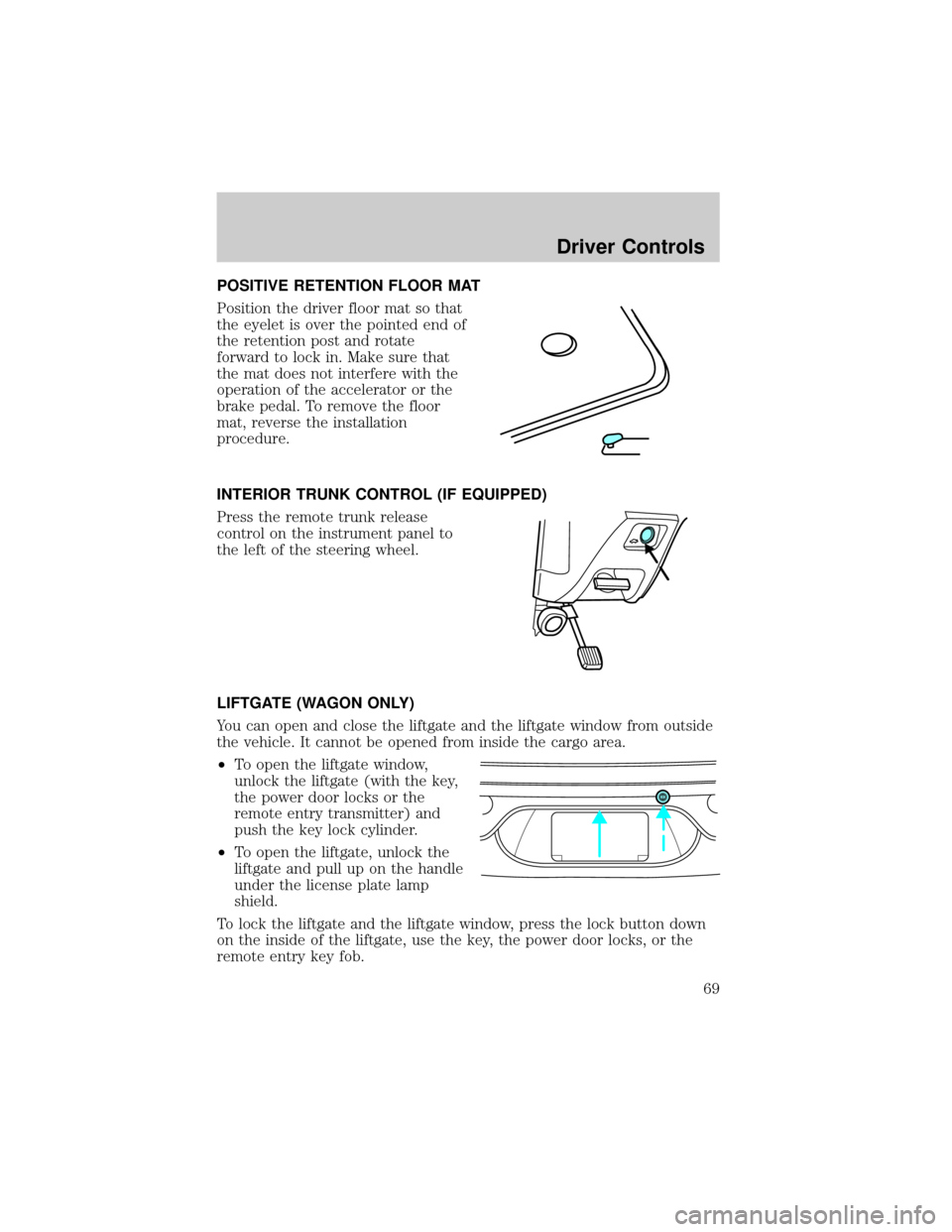
Position the driver floor mat so that
the eyelet is over the pointed end of
the retention post and rotate
forward to lock in. Make sure that
the mat does not interfere with the
operation of the accelerator or the
brake pedal. To remove the floor
mat, reverse the installation
procedure.
INTERIOR TRUNK CONTROL (IF EQUIPPED)
Press the remote trunk release
control on the instrument panel to
the left of the steering wheel.
LIFTGATE (WAGON ONLY)
You can open and close the liftgate and the liftgate window from outside
the vehicle. It cannot be opened from inside the cargo area.
²To open the liftgate window,
unlock the liftgate (with the key,
the power door locks or the
remote entry transmitter) and
push the key lock cylinder.
²To open the liftgate, unlock the
liftgate and pull up on the handle
under the license plate lamp
shield.
To lock the liftgate and the liftgate window, press the lock button down
on the inside of the liftgate, use the key, the power door locks, or the
remote entry key fob.
Driver Controls
69
Page 113 of 248
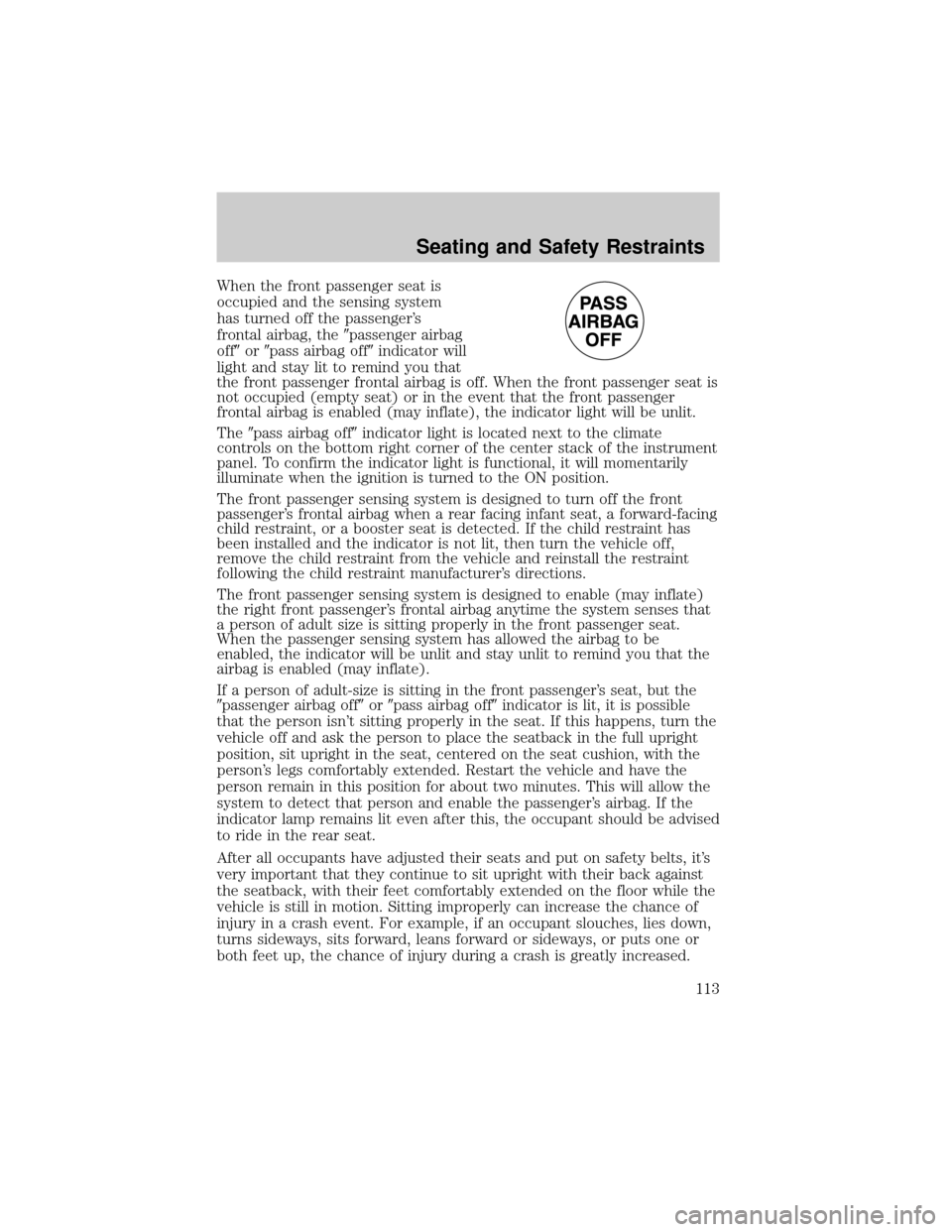
When the front passenger seat is
occupied and the sensing system
has turned off the passenger's
frontal airbag, the9passenger airbag
off9or9pass airbag off9indicator will
light and stay lit to remind you that
the front passenger frontal airbag is off. When the front passenger seat is
not occupied (empty seat) or in the event that the front passenger
frontal airbag is enabled (may inflate), the indicator light will be unlit.
The9pass airbag off9indicator light is located next to the climate
controls on the bottom right corner of the center stack of the instrument
panel. To confirm the indicator light is functional, it will momentarily
illuminate when the ignition is turned to the ON position.
The front passenger sensing system is designed to turn off the front
passenger's frontal airbag when a rear facing infant seat, a forward-facing
child restraint, or a booster seat is detected. If the child restraint has
been installed and the indicator is not lit, then turn the vehicle off,
remove the child restraint from the vehicle and reinstall the restraint
following the child restraint manufacturer's directions.
The front passenger sensing system is designed to enable (may inflate)
the right front passenger's frontal airbag anytime the system senses that
a person of adult size is sitting properly in the front passenger seat.
When the passenger sensing system has allowed the airbag to be
enabled, the indicator will be unlit and stay unlit to remind you that the
airbag is enabled (may inflate).
If a person of adult-size is sitting in the front passenger's seat, but the
9passenger airbag off9or9pass airbag off9indicator is lit, it is possible
that the person isn't sitting properly in the seat. If this happens, turn the
vehicle off and ask the person to place the seatback in the full upright
position, sit upright in the seat, centered on the seat cushion, with the
person's legs comfortably extended. Restart the vehicle and have the
person remain in this position for about two minutes. This will allow the
system to detect that person and enable the passenger's airbag. If the
indicator lamp remains lit even after this, the occupant should be advised
to ride in the rear seat.
After all occupants have adjusted their seats and put on safety belts, it's
very important that they continue to sit upright with their back against
the seatback, with their feet comfortably extended on the floor while the
vehicle is still in motion. Sitting improperly can increase the chance of
injury in a crash event. For example, if an occupant slouches, lies down,
turns sideways, sits forward, leans forward or sideways, or puts one or
both feet up, the chance of injury during a crash is greatly increased.
Seating and Safety Restraints
113
Page 184 of 248
WINDOWS AND WIPER BLADES
The windshield, rear and side windows and the wiper blades should be
cleaned regularly. If the wipers do not wipe properly, substances on the
vehicle's glass or the wiper blades may be the cause. These may include
hot wax treatments used by commercial car washes, tree sap, or other
organic contamination. To clean these items, please follow these tips:
²The windshield, rear windows and side windows may be cleaned with
a non-abrasive cleaner such as Motorcraft Ultra Clear Spray Glass
Cleaner (ZC-23), available from your dealer.
²Do not use abrasives, as they may cause scratches.
²Do not use fuel, kerosene, or paint thinner to clean any parts.
²Wiper blades can be cleaned with isopropyl (rubbing) alcohol or
windshield washer solution. Be sure to replace wiper blades when they
appear worn or do not function properly.
Do not use sharp objects, such as a razor blade, to clean the
inside of the rear window or to remove decals, as it may cause
damage to the rear window defroster's heated grid lines.
INSTRUMENT PANEL AND CLUSTER LENS
Clean the instrument panel with a damp cloth, then dry with a dry cloth.
²Avoid cleaners or polish that increase the gloss of the upper portion of
the instrument panel. The dull finish in this area helps protect the
driver from undesirable windshield reflection.
Do not use chemical solvents or strong detergents when cleaning
the steering wheel or instrument panel to avoid contamination of
the air bag system.
²Be certain to wash or wipe your hands clean if you have been in
contact with certain products such as insect repellent and suntan
lotion in order to avoid possible damage to the interior painted
surfaces.
INTERIOR
For fabric, carpets, cloth seats, safety belts and seats equipped with side
air bags:
²Remove dust and loose dirt with a vacuum cleaner.
²Remove light stains and soil with Motorcraft Extra Strength
Upholstery Cleaner (ZC-41).
Cleaning
184
Page 188 of 248
OPENING THE HOOD
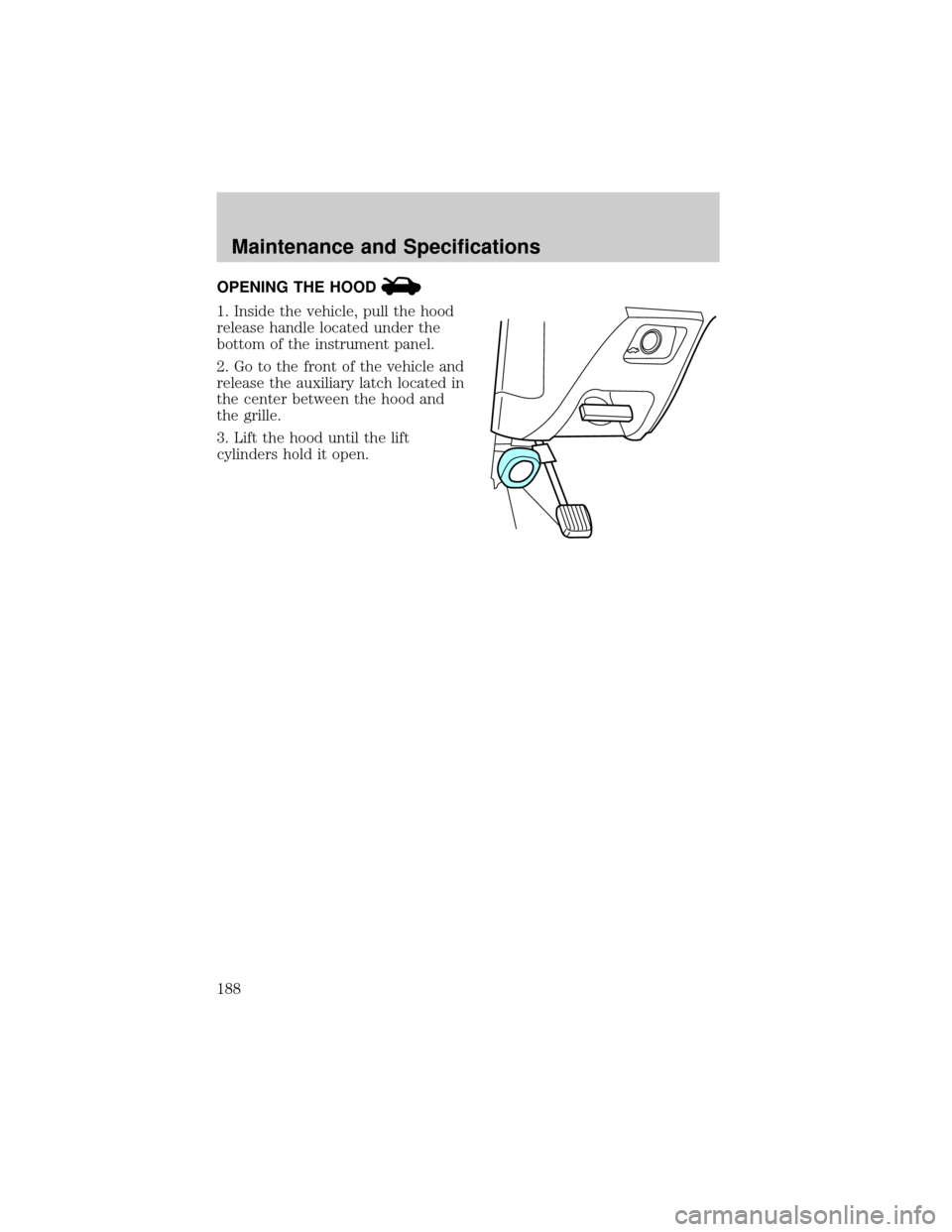
1. Inside the vehicle, pull the hood
release handle located under the
bottom of the instrument panel.
2. Go to the front of the vehicle and
release the auxiliary latch located in
the center between the hood and
the grille.
3. Lift the hood until the lift
cylinders hold it open.
Maintenance and Specifications
188
Page 238 of 248
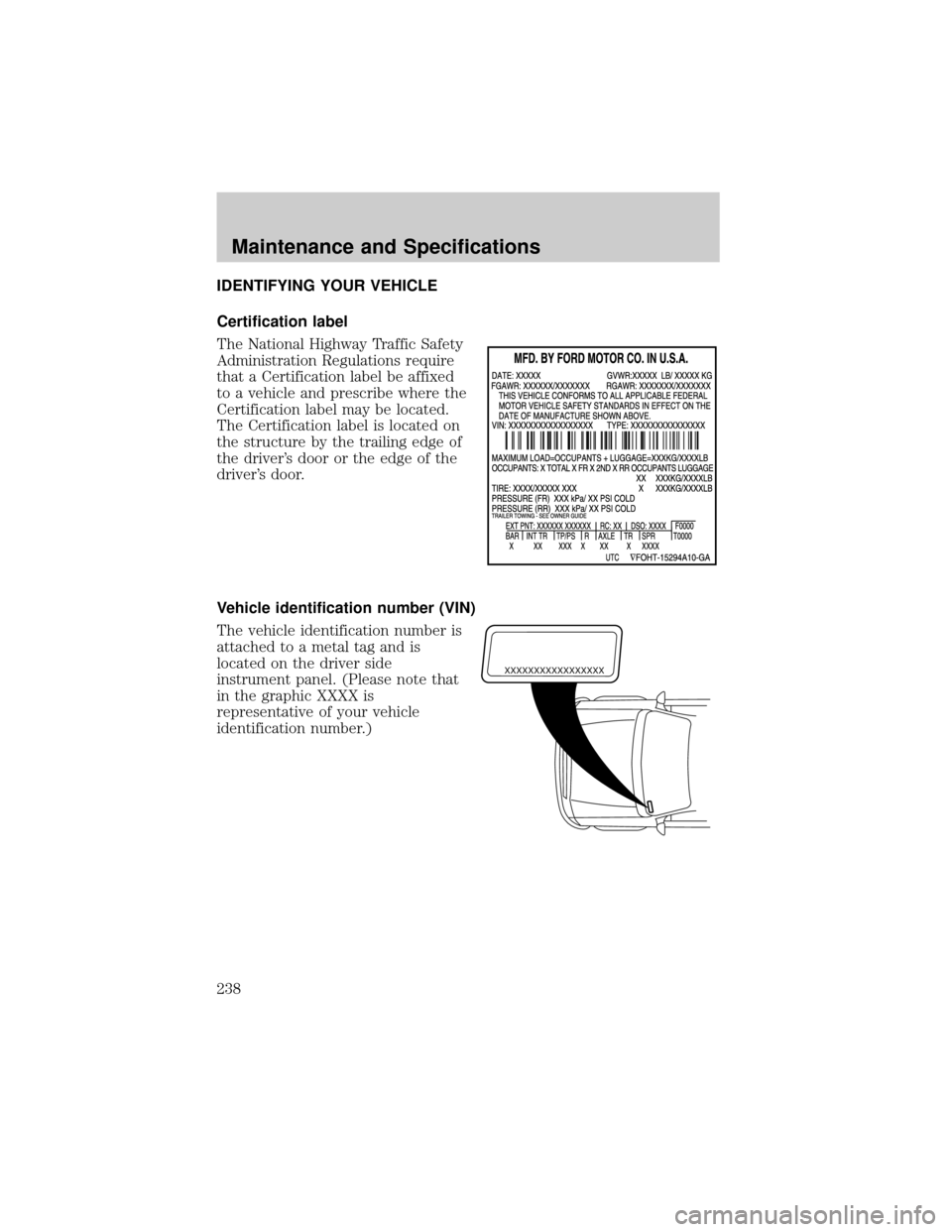
IDENTIFYING YOUR VEHICLE
Certification label
The National Highway Traffic Safety
Administration Regulations require
that a Certification label be affixed
to a vehicle and prescribe where the
Certification label may be located.
The Certification label is located on
the structure by the trailing edge of
the driver's door or the edge of the
driver's door.
Vehicle identification number (VIN)
The vehicle identification number is
attached to a metal tag and is
located on the driver side
instrument panel. (Please note that
in the graphic XXXX is
representative of your vehicle
identification number.)
XXXXXXXXXXXXXXXXX
Maintenance and Specifications
238
Page 244 of 248

instrument panel ....................184
interior .....................................184
interior trim ............................185
plastic parts ............................183
washing ....................................181
waxing .....................................181
wheels ......................................182
wiper blades ............................184
Climate control (see Air
conditioning or Heating) ............26
Clock adjust
AM/FM Stereo ...........................15
AM/FM/CD .................................19
AM/FM/Tape ..............................16
Compass, electronic ....................61
calibration .................................61
set zone adjustment .................61
Console ........................................67
Controls
power seat .................................90
Coolant
checking and adding ..............198
refill capacities ................202, 232
specifications ..................234±235
Cruise control
(see Speed control) ....................51
Customer Assistance ................150
Ford accessories for your
vehicle .....................................186
Ford Extended Service Plan .174
Getting assistance outside
the U.S. and Canada ..............178
Getting roadside assistance ...150
Getting the service
you need .................................172
Ordering additional owner's
literature .................................179
The Dispute Settlement
Board .......................................174Utilizing the Mediation/
Arbitration Program ...............177
D
Daytime running lamps
(see Lamps) ................................30
Defrost
rear window ..............................28
Dipstick
automatic transmission
fluid ..........................................216
engine oil .................................192
Doors
lubricant specifications ..........234
Driving under special
conditions ..................................141
through water .........................142
E
Electronic message center .........58
Emergencies, roadside
jump-starting ..........................165
Emergency Flashers .................151
Emission control system ..........212
Engine ................................235±236
cleaning ...................................182
coolant .....................................198
idle speed control ...................196
lubrication specifications 234±235
refill capacities ........................232
service points ..................189±190
starting after a collision .........151
Engine block heater .................133
Engine oil ..................................192
checking and adding ..............192
dipstick ....................................192
filter, specifications ........195, 231
Index
244
Page 245 of 248

recommendations ...................195
refill capacities ........................232
specifications ..................234±235
Exhaust fumes ..........................134
F
Flexible Fuel Vehicle (FFV) ....203
Floor mats ...................................69
Fluid capacities .........................232
Fuel ............................................203
calculating fuel economy .60, 209
cap ...........................................205
capacity ...................................232
choosing the right fuel ...........206
comparisons with EPA fuel
economy estimates .................211
detergent in fuel .....................208
filling your vehicle
with fuel ..................203, 205, 209
filter, specifications ........208, 231
fuel pump shut-off switch .....151
improving fuel economy ........209
octane rating ...........207, 235±236
quality ......................................207
running out of fuel .................208
safety information relating to
automotive fuels .....................203
Fuel - flex fuel vehicle
(FFV) .........................203, 206±207
Fuses ..........................................153
G
Garage Door Opener
(see Homelink wireless control
system) ........................................54
Gas cap (see Fuel cap) ............205
Gas mileage
(see Fuel economy) .................209Gauges .........................................13
H
Hazard flashers .........................151
Headlamps ...................................30
aiming ........................................32
autolamp system .......................30
bulb specifications ....................35
daytime running lights .............30
flash to pass ..............................31
high beam .................................31
replacing bulbs .........................37
turning on and off ....................30
Heating
heating and air conditioning
system .................................24, 26
Homelink wireless control
system ..........................................54
Hood ..........................................188
I
Ignition .......................130, 235±236
Infant seats
(see Safety seats) .....................120
Inspection/maintenance
(I/M) testing ..............................213
Instrument panel
cleaning ...................................184
cluster ........................................10
lighting up panel
and interior ...............................31
J
Jack ............................................159
positioning ...............................159
storage .....................................159
Jump-starting your vehicle ......165
Index
245
Page 246 of 248

K
Keyless entry system .................81
Keys
positions of the ignition .........130
L
Lamps
autolamp system .......................30
bulb replacement
specifications chart ..................35
daytime running light ...............30
headlamps .................................30
headlamps, flash to pass ..........31
instrument panel, dimming .....31
interior lamps .....................33±36
replacing bulbs .35, 37, 39±42, 44
Lane change indicator
(see Turn signal) ........................33
Liftgate ........................................69
Lights, warning and indicator ....10
anti-lock brakes (ABS) ..........135
Load limits .................................142
Locks
childproof ..................................74
doors ..........................................73
Lubricant specifications ...234±235
Lug nuts ....................................164
Luggage rack ...............................72
Lumbar support, seats ...............89
M
Message center .....................58±59
english/metric button ...............64
system check button ................64
warning messages .....................64
Mirrors ...................................48, 50automatic dimming rearview
mirror ........................................50
heated ........................................51
side view mirrors (power) .......50
Moon roof ....................................54
Motorcraft parts ................208, 231
O
Octane rating ............................207
Oil (see Engine oil) ..................192
Overdrive ...................................139
P
Parking brake ............................136
Parts (see Motorcraft parts) ....231
Passenger Occupant
Classification Sensor ...................93
Pedals (see Power adjustable
foot pedals) .................................51
Power adjustable foot pedals .....51
Power distribution box
(see Fuses) ...............................157
Power door locks ........................73
Power point .................................48
Power steering ..........................137
fluid, checking and adding ....214
fluid, refill capacity ................232
fluid, specifications .........234±235
Power Windows ...........................48
R
Radio ................................15±16, 19
Rear window defroster ...............28
Relays ........................................159
Index
246