oil FORD TAURUS 2005 4.G User Guide
[x] Cancel search | Manufacturer: FORD, Model Year: 2005, Model line: TAURUS, Model: FORD TAURUS 2005 4.GPages: 248, PDF Size: 2.66 MB
Page 154 of 248
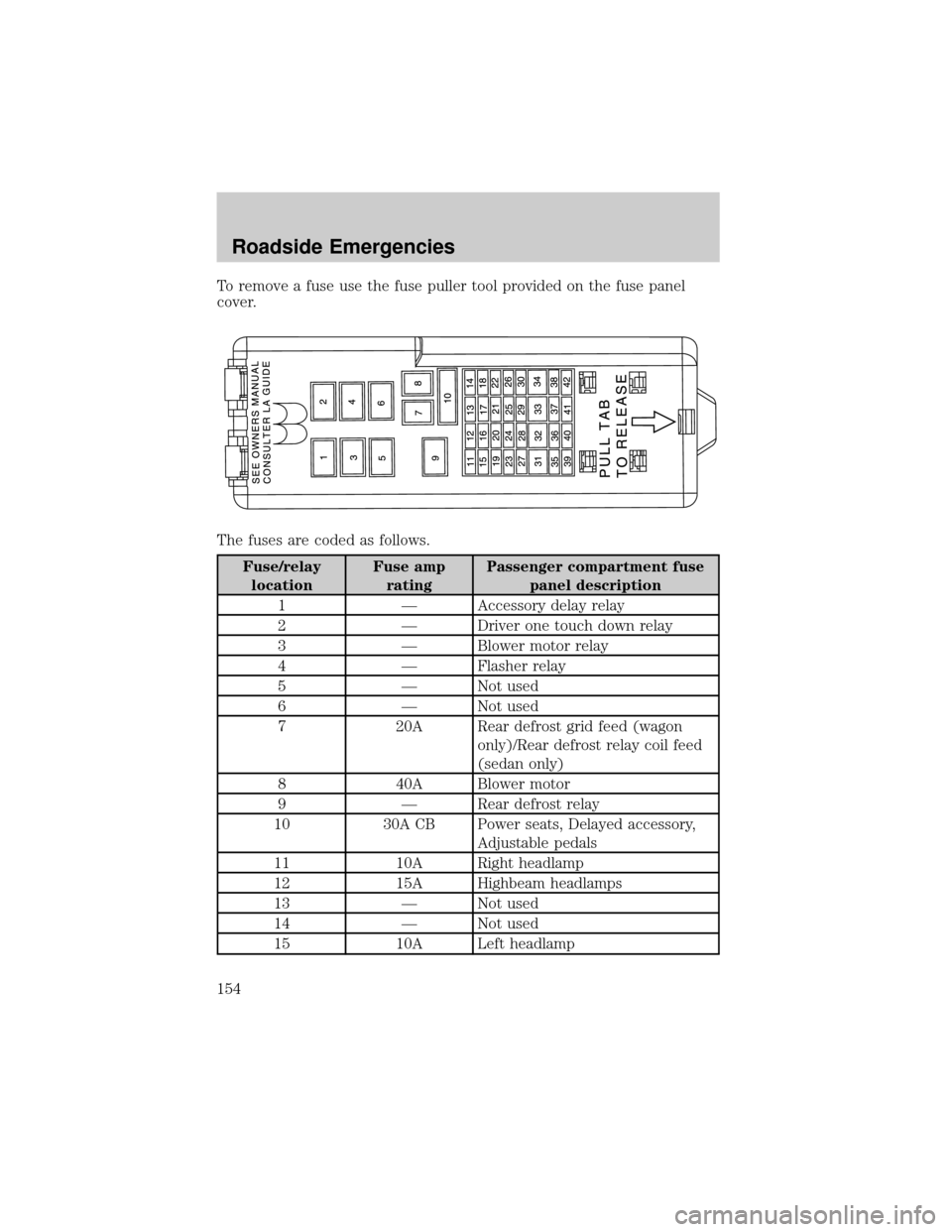
To remove a fuse use the fuse puller tool provided on the fuse panel
cover.
The fuses are coded as follows.
Fuse/relay
locationFuse amp
ratingPassenger compartment fuse
panel description
1 Ð Accessory delay relay
2 Ð Driver one touch down relay
3 Ð Blower motor relay
4 Ð Flasher relay
5 Ð Not used
6 Ð Not used
7 20A Rear defrost grid feed (wagon
only)/Rear defrost relay coil feed
(sedan only)
8 40A Blower motor
9 Ð Rear defrost relay
10 30A CB Power seats, Delayed accessory,
Adjustable pedals
11 10A Right headlamp
12 15A Highbeam headlamps
13 Ð Not used
14 Ð Not used
15 10A Left headlamp
Roadside Emergencies
154
Page 155 of 248
Fuse/relay
locationFuse amp
ratingPassenger compartment fuse
panel description
16 10A Not used (spare)
17 15A Stop lamp, Speed control
deactivation switch
18 15A Parklamps, PWM (backlighting),
Autolamps
19 10A Heated mirrors, Rear defrost
switch indicator
20 10A Restraints (air bag module/OCS
module)
21 15A Transmission range sensor
(transmission position switch)
22 15A Front washer pump,
Electrochromatic mirror,
Compass, Cluster (RUN/ACC),
Integrated Control Panel (ICP)
logic, Rear wiper (wagon only),
Rear washer (wagon only)
23 30A Front wiper motor
24 Ð Not used
25 20A Power point
26 20A Power locks, Liftgate
(wagon)/Trunk (sedan) release
27 10A Anti-lock Brake System (ABS),
Speed control, Traction control,
Brake-shift interlock, A/C function
switch (manual A/C only),
Temperature blend door (manual
A/C only), Defrost coil
28 15A Turn signals, Back-up lamps
29 20A Cigar lighter
Roadside Emergencies
155
Page 156 of 248
Fuse/relay
locationFuse amp
ratingPassenger compartment fuse
panel description
30 10A Courtesy lighting, Battery saver,
Power mirrors, Decklid lamp,
Power antenna (wagon only),
Pulse stretching module (wagon
only)
31 10A Blower motor relay coil, Puddle
lamp relay coil, Electronic
Automatic Temperature Control
(EATC) logic
32 10A Cluster, Flex fuel module, ICP
logic, Passive anti-theft module
(GEM power)
33 15A Hazard flasher, Cluster power, ICP
power, EATC
34 5A GEM logic
35 10A Backlighting
36 2A Powertrain Control Module (PCM)
relay, Fuel pump relay, A/C clutch
37 25A Autolamp, Daytime Running
Lamps (DRL), Flash-to-pass,
Headlamp switch
38 15A Horn, Diagnostic connector (OBD
II)
39 Ð Not used
40 Ð Not used
41 Ð Not used
42 Ð Not used
CB - Circuit Breaker
Roadside Emergencies
156
Page 184 of 248
WINDOWS AND WIPER BLADES
The windshield, rear and side windows and the wiper blades should be
cleaned regularly. If the wipers do not wipe properly, substances on the
vehicle's glass or the wiper blades may be the cause. These may include
hot wax treatments used by commercial car washes, tree sap, or other
organic contamination. To clean these items, please follow these tips:
²The windshield, rear windows and side windows may be cleaned with
a non-abrasive cleaner such as Motorcraft Ultra Clear Spray Glass
Cleaner (ZC-23), available from your dealer.
²Do not use abrasives, as they may cause scratches.
²Do not use fuel, kerosene, or paint thinner to clean any parts.
²Wiper blades can be cleaned with isopropyl (rubbing) alcohol or
windshield washer solution. Be sure to replace wiper blades when they
appear worn or do not function properly.
Do not use sharp objects, such as a razor blade, to clean the
inside of the rear window or to remove decals, as it may cause
damage to the rear window defroster's heated grid lines.
INSTRUMENT PANEL AND CLUSTER LENS
Clean the instrument panel with a damp cloth, then dry with a dry cloth.
²Avoid cleaners or polish that increase the gloss of the upper portion of
the instrument panel. The dull finish in this area helps protect the
driver from undesirable windshield reflection.
Do not use chemical solvents or strong detergents when cleaning
the steering wheel or instrument panel to avoid contamination of
the air bag system.
²Be certain to wash or wipe your hands clean if you have been in
contact with certain products such as insect repellent and suntan
lotion in order to avoid possible damage to the interior painted
surfaces.
INTERIOR
For fabric, carpets, cloth seats, safety belts and seats equipped with side
air bags:
²Remove dust and loose dirt with a vacuum cleaner.
²Remove light stains and soil with Motorcraft Extra Strength
Upholstery Cleaner (ZC-41).
Cleaning
184
Page 185 of 248
²If grease or tar is present on the material, spot-clean the area first
with Motorcraft Spot and Stain Remover (ZC-14).
²Never saturate the seat covers with cleaning solution.
²Do not use household cleaning products or glass cleaners, which can
stain and discolor the fabric and affect the flame retardant abilities of
the seat materials.
Do not use cleaning solvents, bleach or dye on the vehicle's
safety belts, as these actions may weaken the belt webbing.
Do not use chemical solvents or strong detergents when cleaning
the seat-mounted side air bag. Such products could contaminate
the side air bag system and affect performance of the side air bag in a
collision.
LEATHER SEATS (IF EQUIPPED)
Your leather seating surfaces have a clear, protective coating over the
leather.
²To clean, use a soft cloth with Motorcraft Deluxe Leather and Vinyl
Cleaner (ZC-11±A). Dry the area with a soft cloth.
²To help maintain its resiliency and color, use the Motorcraft Deluxe
Leather Care Kit (ZC-11±D), available from your authorized dealer.
²Do not use household cleaning products, alcohol solutions, solvents or
cleaners intended for rubber, vinyl and plastics, or oil/petroleum-based
leather conditioners. These products may cause premature wearing of
the clear, protective coating.
Note:In some instances, color or dye transfer can occur when wet
clothing comes in contact with leather upholstery. If this occurs, the
leather should be cleaned immediately to avoid permanent staining.
INTERIOR TRIM
²Clean the interior trim areas with a damp cloth, then dry by wiping
with a dry, soft, clean cloth.
²Do not use household or glass cleaners as these may damage the
finish.
UNDERBODY
Flush the complete underside of your vehicle frequently. Keep body and
door drain holes free from packed dirt.
Cleaning
185
Page 189 of 248
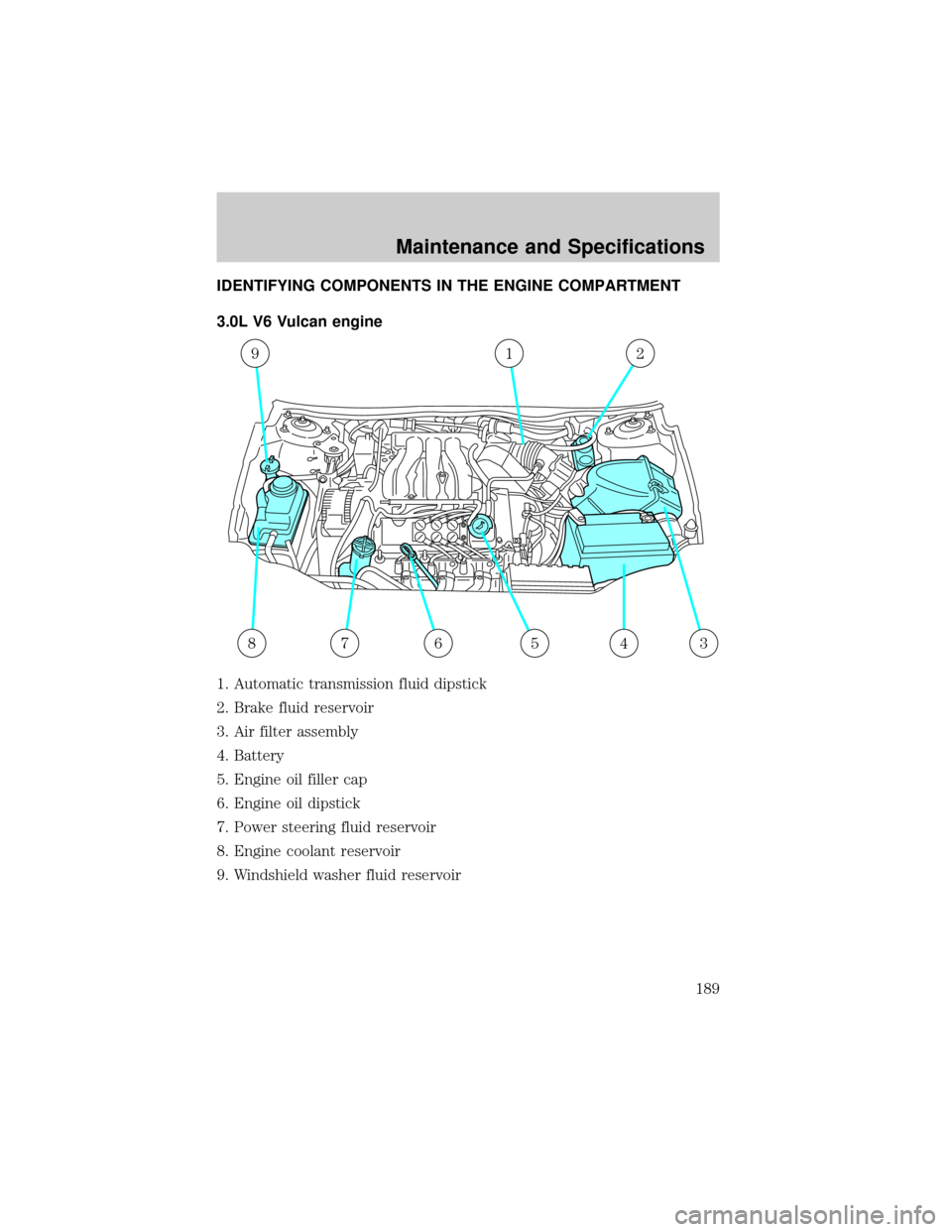
IDENTIFYING COMPONENTS IN THE ENGINE COMPARTMENT
3.0L V6 Vulcan engine
1. Automatic transmission fluid dipstick
2. Brake fluid reservoir
3. Air filter assembly
4. Battery
5. Engine oil filler cap
6. Engine oil dipstick
7. Power steering fluid reservoir
8. Engine coolant reservoir
9. Windshield washer fluid reservoir
786543
912
Maintenance and Specifications
189
Page 190 of 248
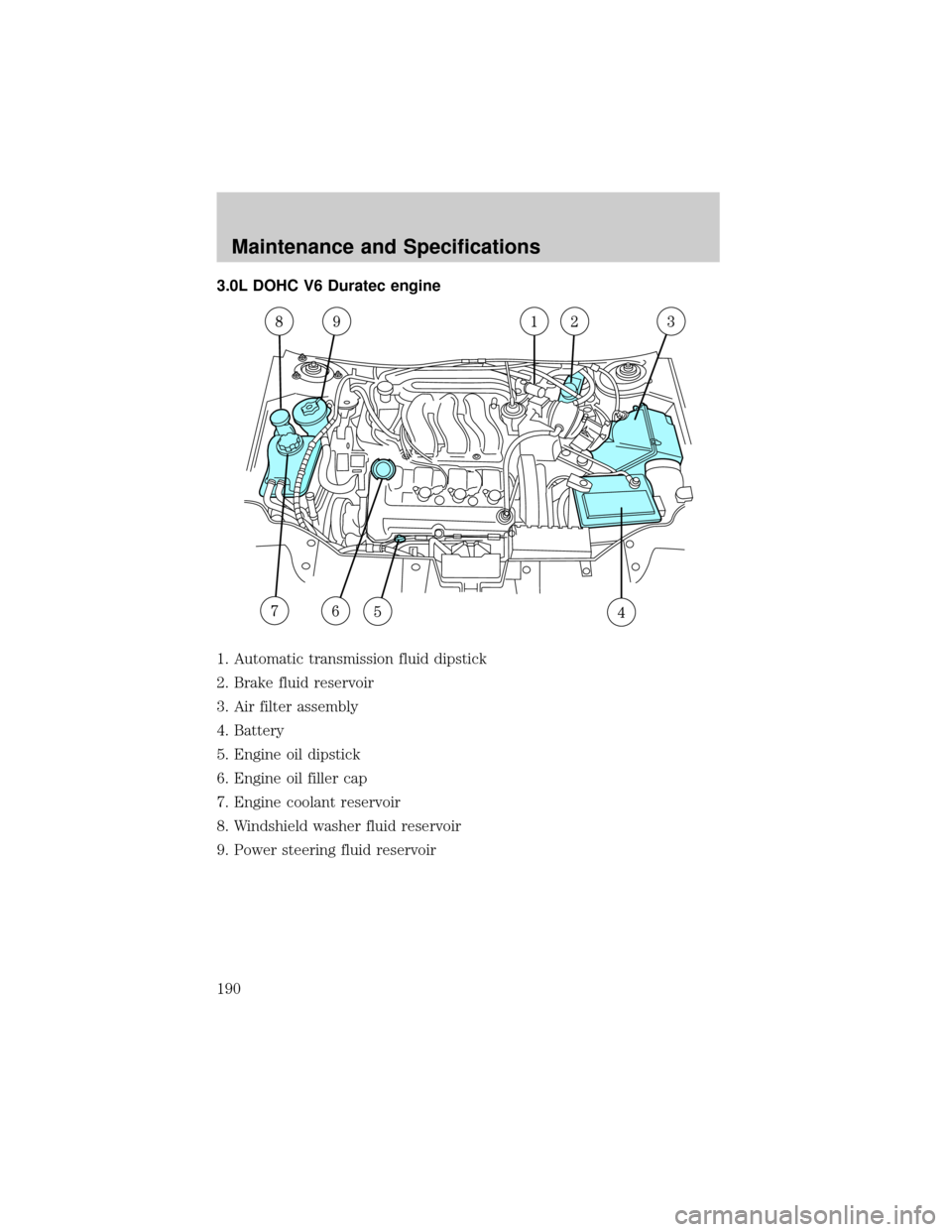
3.0L DOHC V6 Duratec engine
1. Automatic transmission fluid dipstick
2. Brake fluid reservoir
3. Air filter assembly
4. Battery
5. Engine oil dipstick
6. Engine oil filler cap
7. Engine coolant reservoir
8. Windshield washer fluid reservoir
9. Power steering fluid reservoir
Maintenance and Specifications
190
Page 192 of 248
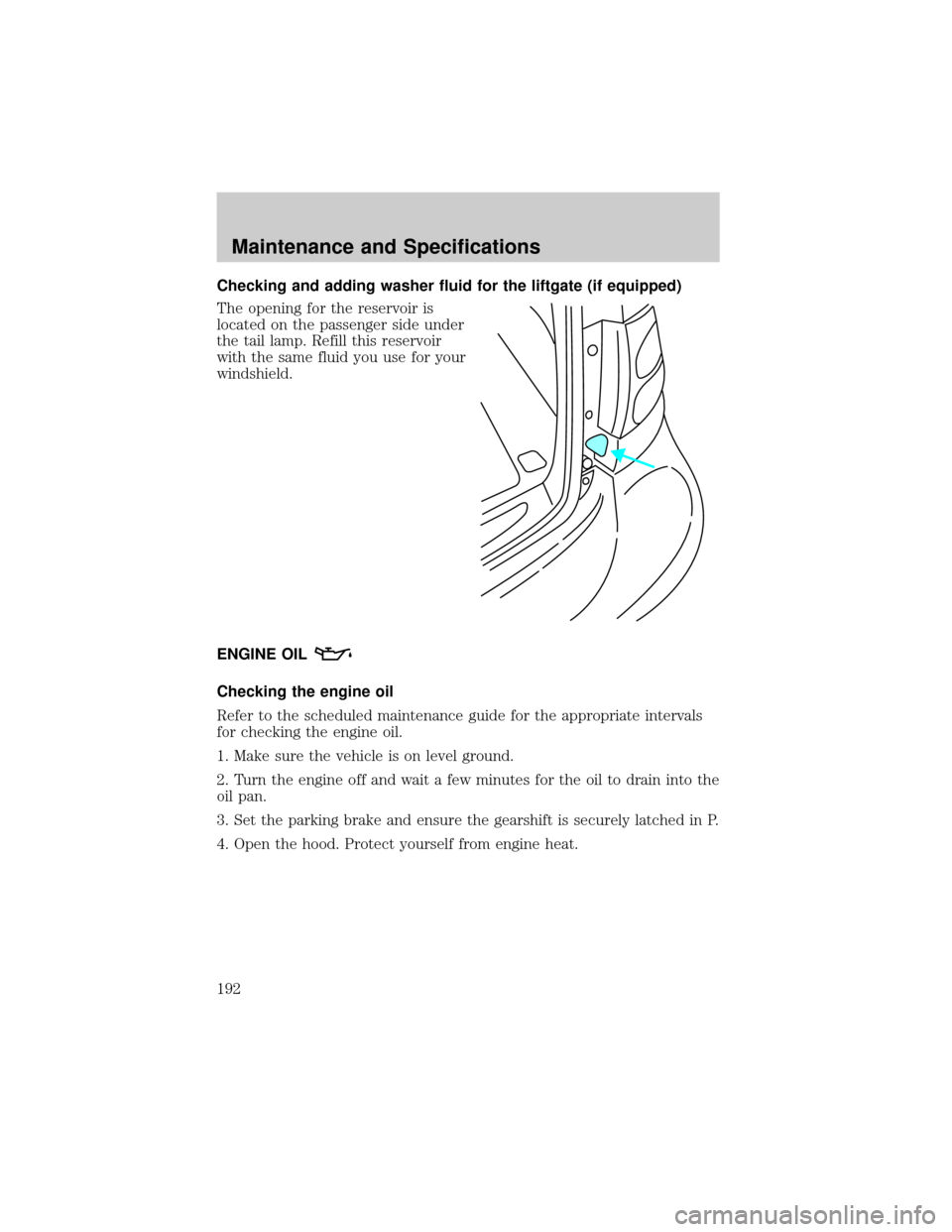
Checking and adding washer fluid for the liftgate (if equipped)
The opening for the reservoir is
located on the passenger side under
the tail lamp. Refill this reservoir
with the same fluid you use for your
windshield.
ENGINE OIL
Checking the engine oil
Refer to the scheduled maintenance guide for the appropriate intervals
for checking the engine oil.
1. Make sure the vehicle is on level ground.
2. Turn the engine off and wait a few minutes for the oil to drain into the
oil pan.
3. Set the parking brake and ensure the gearshift is securely latched in P.
4. Open the hood. Protect yourself from engine heat.
Maintenance and Specifications
192
Page 193 of 248
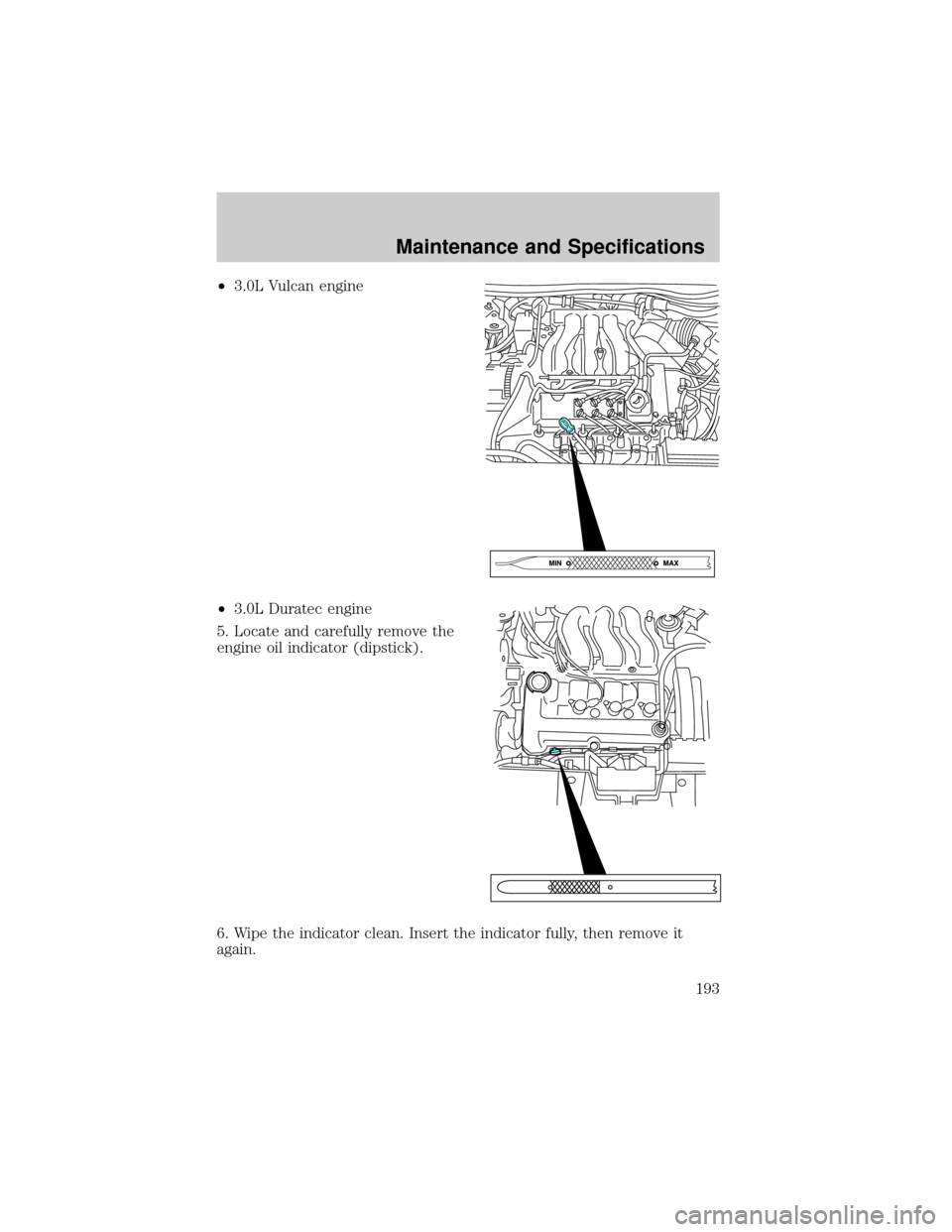
²3.0L Vulcan engine
²3.0L Duratec engine
5. Locate and carefully remove the
engine oil indicator (dipstick).
6. Wipe the indicator clean. Insert the indicator fully, then remove it
again.
Maintenance and Specifications
193
Page 194 of 248
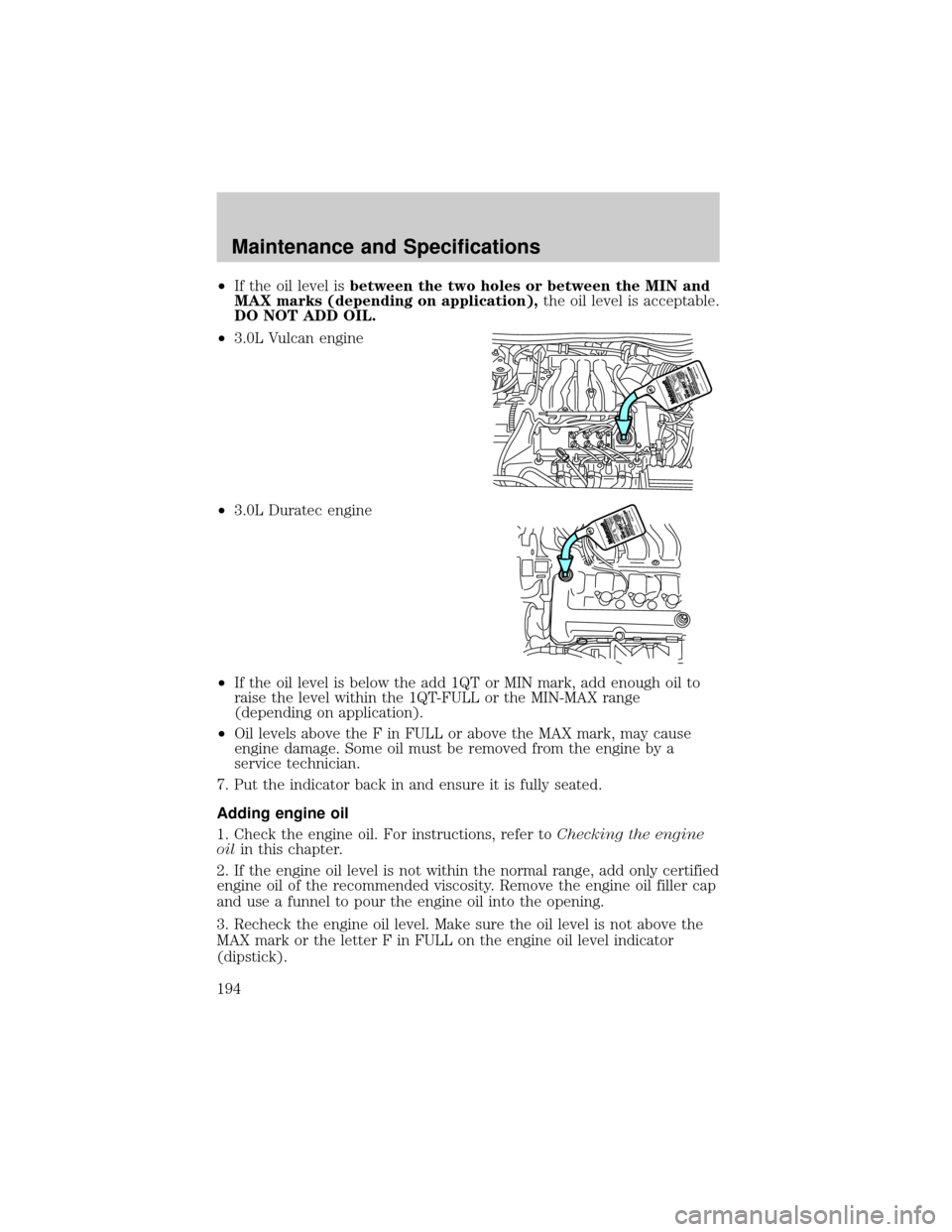
²If the oil level isbetween the two holes or between the MIN and
MAX marks (depending on application),the oil level is acceptable.
DO NOT ADD OIL.
²3.0L Vulcan engine
²3.0L Duratec engine
²If the oil level is below the add 1QT or MIN mark, add enough oil to
raise the level within the 1QT-FULL or the MIN-MAX range
(depending on application).
²Oil levels above the F in FULL or above the MAX mark, may cause
engine damage. Some oil must be removed from the engine by a
service technician.
7. Put the indicator back in and ensure it is fully seated.
Adding engine oil
1. Check the engine oil. For instructions, refer toChecking the engine
oilin this chapter.
2. If the engine oil level is not within the normal range, add only certified
engine oil of the recommended viscosity. Remove the engine oil filler cap
and use a funnel to pour the engine oil into the opening.
3. Recheck the engine oil level. Make sure the oil level is not above the
MAX mark or the letter F in FULL on the engine oil level indicator
(dipstick).
Maintenance and Specifications
194