radio FORD TAURUS 2005 4.G User Guide
[x] Cancel search | Manufacturer: FORD, Model Year: 2005, Model line: TAURUS, Model: FORD TAURUS 2005 4.GPages: 248, PDF Size: 2.66 MB
Page 130 of 248
STARTING
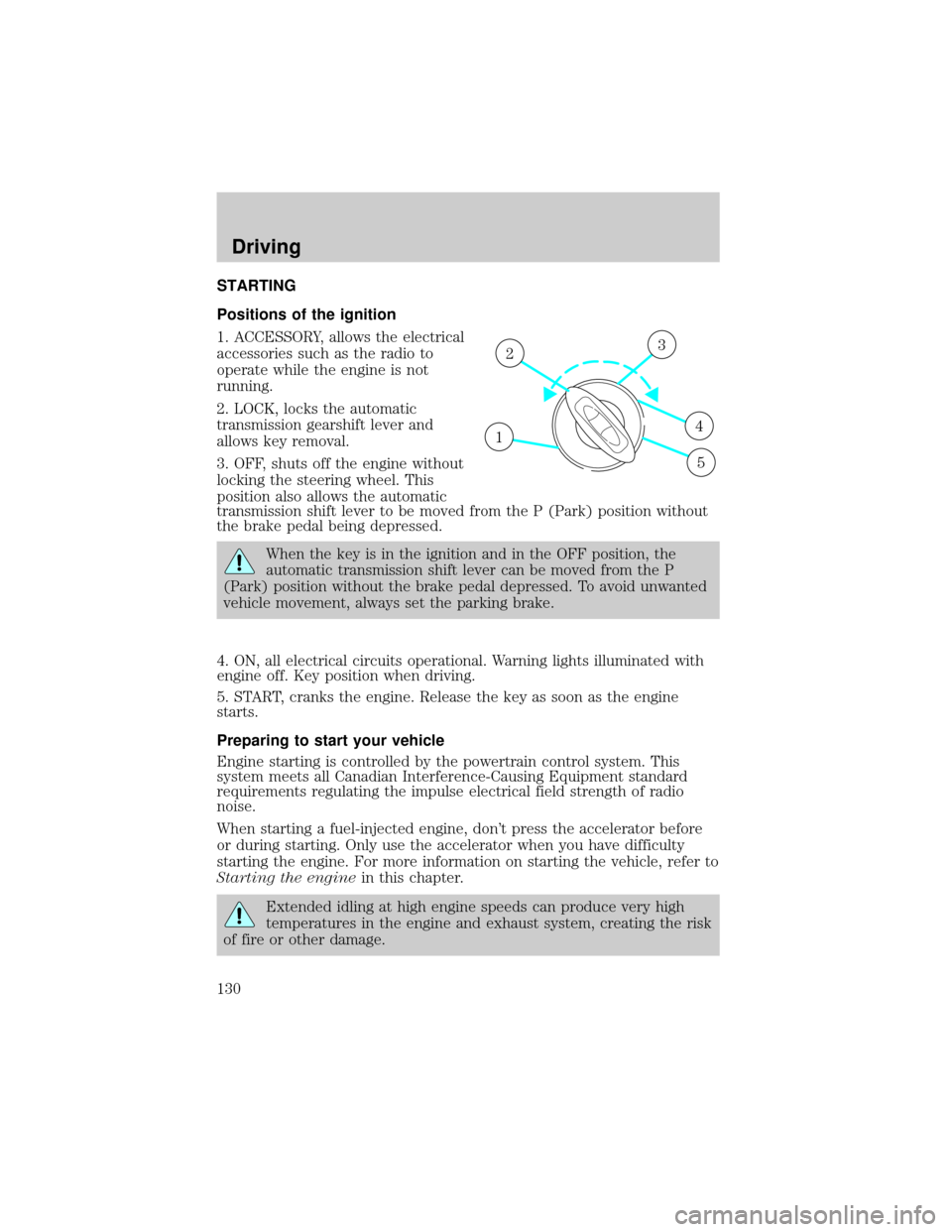
Positions of the ignition
1. ACCESSORY, allows the electrical
accessories such as the radio to
operate while the engine is not
running.
2. LOCK, locks the automatic
transmission gearshift lever and
allows key removal.
3. OFF, shuts off the engine without
locking the steering wheel. This
position also allows the automatic
transmission shift lever to be moved from the P (Park) position without
the brake pedal being depressed.
When the key is in the ignition and in the OFF position, the
automatic transmission shift lever can be moved from the P
(Park) position without the brake pedal depressed. To avoid unwanted
vehicle movement, always set the parking brake.
4. ON, all electrical circuits operational. Warning lights illuminated with
engine off. Key position when driving.
5. START, cranks the engine. Release the key as soon as the engine
starts.
Preparing to start your vehicle
Engine starting is controlled by the powertrain control system. This
system meets all Canadian Interference-Causing Equipment standard
requirements regulating the impulse electrical field strength of radio
noise.
When starting a fuel-injected engine, don't press the accelerator before
or during starting. Only use the accelerator when you have difficulty
starting the engine. For more information on starting the vehicle, refer to
Starting the enginein this chapter.
Extended idling at high engine speeds can produce very high
temperatures in the engine and exhaust system, creating the risk
of fire or other damage.
1
23
4
5
Driving
Driving
130
Page 140 of 248
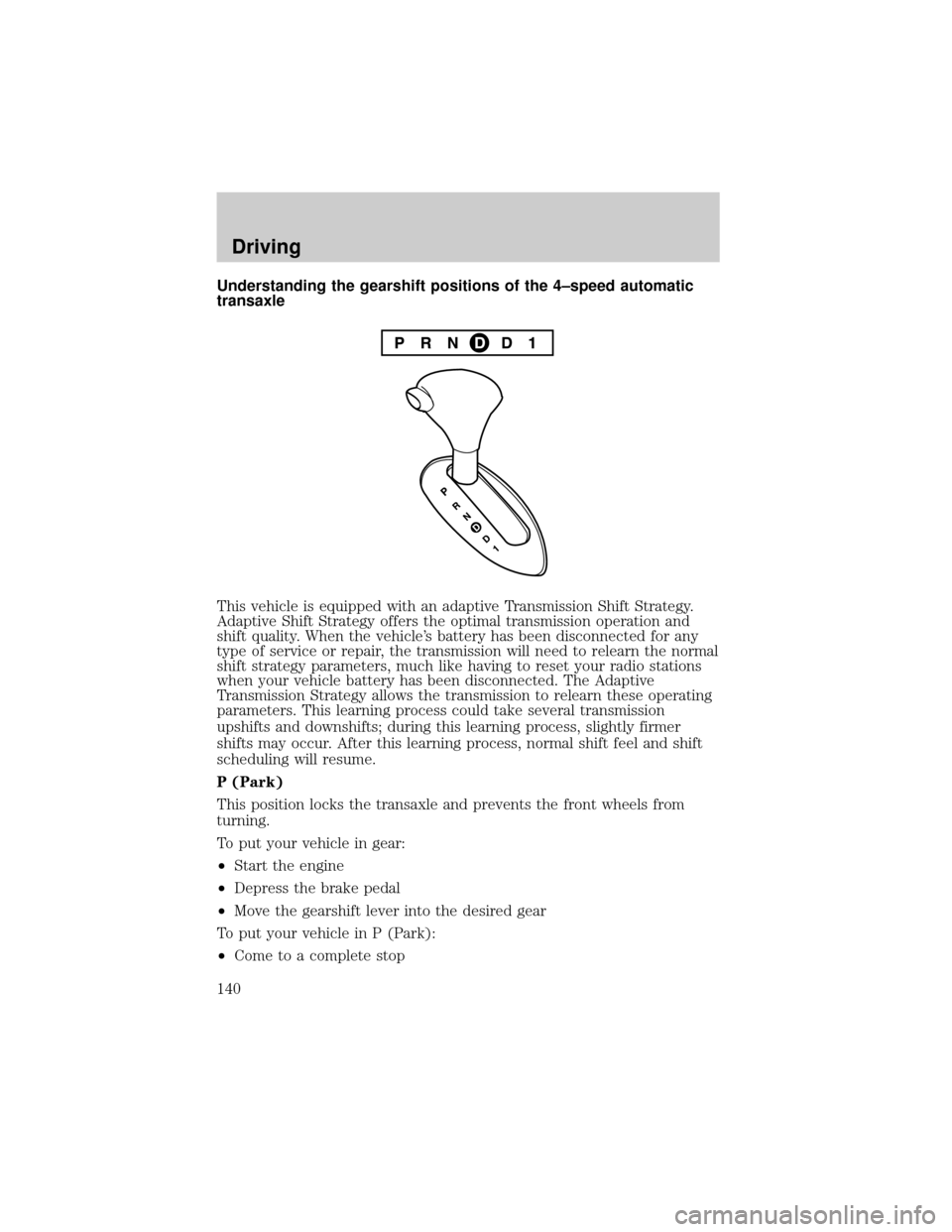
Understanding the gearshift positions of the 4±speed automatic
transaxle
This vehicle is equipped with an adaptive Transmission Shift Strategy.
Adaptive Shift Strategy offers the optimal transmission operation and
shift quality. When the vehicle's battery has been disconnected for any
type of service or repair, the transmission will need to relearn the normal
shift strategy parameters, much like having to reset your radio stations
when your vehicle battery has been disconnected. The Adaptive
Transmission Strategy allows the transmission to relearn these operating
parameters. This learning process could take several transmission
upshifts and downshifts; during this learning process, slightly firmer
shifts may occur. After this learning process, normal shift feel and shift
scheduling will resume.
P (Park)
This position locks the transaxle and prevents the front wheels from
turning.
To put your vehicle in gear:
²Start the engine
²Depress the brake pedal
²Move the gearshift lever into the desired gear
To put your vehicle in P (Park):
²Come to a complete stop
Driving
140
Page 197 of 248
When lifting a plastic-cased battery, excessive pressure on the
end walls could cause acid to flow through the vent caps,
resulting in personal injury and/or damage to the vehicle or battery.
Lift the battery with a battery carrier or with your hands on opposite
corners.
Keep batteries out of reach of children. Batteries contain sulfuric
acid. Avoid contact with skin, eyes or clothing. Shield your eyes
when working near the battery to protect against possible splashing of
acid solution. In case of acid contact with skin or eyes, flush
immediately with water for a minimum of 15 minutes and get prompt
medical attention. If acid is swallowed, call a physician immediately.
Battery posts, terminals and related accessories contain lead and
lead compounds.Wash hands after handling.
Because your vehicle's engine is electronically controlled by a computer,
some control conditions are maintained by power from the battery. When
the battery is disconnected or a new battery is installed, the engine must
relearn its idle and fuel trim strategy for optimum driveability and
performance. To begin this process:
1. With the vehicle at a complete stop, set the parking brake.
2. Put the gearshift in P (Park), turn off all accessories and start the
engine.
3. Run the engine until it reaches normal operating temperature.
4. Allow the engine to idle for at least one minute.
5. Turn the A/C on and allow the engine to idle for at least one minute.
6. Release the parking brake. With your foot on the brake pedal and with
the A/C on, put the vehicle in D (Drive) and allow the engine to idle for
at least one minute.
7. Drive the vehicle to complete the relearning process.
²The vehicle may need to be driven 10 miles (16 km) or more to
relearn the idle and fuel trim strategy.
²If you do not allow the engine to relearn its idle trim, the idle
quality of your vehicle may be adversely affected until the idle
trim is eventually relearned.
If the battery has been disconnected or a new battery has been installed,
the clock and radio settings must be reset once the battery is
reconnected.
Maintenance and Specifications
197
Page 242 of 248

Floor mats
Interior trim kits
Leather wrapped steering wheels
Scuff plates
Speed control
Lifestyle
Bike racks
Cargo organization and management
Engine block heaters and blankets
Peace of mind
Airbag anti-theft locks
First aid and safety kits
Full vehicle covers
Locking gas cap
Navigation systems
Remote start
Vehicle security systems
For maximum vehicle performance, keep the following information in
mind when adding accessories or equipment to your vehicle:
²When adding accessories, equipment, passengers and luggage to your
vehicle, do not exceed the total weight capacity of the vehicle or of
the front or rear axle (GVWR or GAWR as indicated on the Safety
Compliance Certification label). Consult your dealer for specific weight
information.
²The Federal Communications Commission (FCC) and Canadian Radio
Telecommunications Commission (CRTC) regulate the use of mobile
communications systems Ð such as two-way radios, telephones and
theft alarms - that are equipped with radio transmitters. Any such
equipment installed in your vehicle should comply with FCC or CRTC
regulations and should be installed only by a qualified service
technician.
²Mobile communications systems may harm the operation of your
vehicle, particularly if they are not properly designed for automotive
use.
Accessories
242
Page 243 of 248

A
Accessory delay ..........................49
Air bag supplemental restraint
system ........................108±109, 115
and child safety seats ............111
description ......................109, 115
disposal ....................................117
driver air bag ..........109, 111, 116
indicator light .........................115
operation .................109, 111, 116
passenger air bag ...109, 111, 116
side air bag ..............................115
Air cleaner filter .......................231
Air conditioning ..........................26
Antifreeze
(see Engine coolant) ................198
Anti-lock brake system
(see Brakes) ..............................135
Anti-theft system ........................86
arming the system ....................86
disarming a triggered system ..86
Audio system
(see Radio) ......................15±16, 19
Automatic transaxle
fluid, adding ............................216
fluid, checking ........................216
fluid, refill capacities ..............232
fluid, specification ..................235
Automatic transmission
driving an automatic
overdrive .................................140
Auxiliary power point .................48
Axle
lubricant specifications ..........234
B
Battery .......................................196acid, treating emergencies .....196
jumping a disabled battery ....165
maintenance-free ....................196
replacement, specifications ...231
servicing ..................................196
BeltMinder .................................103
Brakes ........................................134
anti-lock ...................................135
anti-lock brake system
(ABS) warning light ...............135
fluid, checking and adding ....216
fluid, refill capacities ..............232
fluid, specifications .........234±235
lubricant specifications ..234±235
parking ....................................136
shift interlock ..........................138
Bulbs ............................................35
C
Capacities for refilling fluids ....232
Cargo area shade ........................71
Cargo cover .................................70
Cargo net .....................................70
CD changer .................................21
CD-single premium .........15±16, 19
Cell phone use ............................68
Certification Label ....................238
Changing a tire .........................159
Child safety restraints ..............118
child safety belts ....................118
Child safety seats ......................120
attaching with tether straps ..125
in front seat ............................122
in rear seat ......................122, 124
Cleaning your vehicle
engine compartment ..............182
Index
Index
243
Page 246 of 248

K
Keyless entry system .................81
Keys
positions of the ignition .........130
L
Lamps
autolamp system .......................30
bulb replacement
specifications chart ..................35
daytime running light ...............30
headlamps .................................30
headlamps, flash to pass ..........31
instrument panel, dimming .....31
interior lamps .....................33±36
replacing bulbs .35, 37, 39±42, 44
Lane change indicator
(see Turn signal) ........................33
Liftgate ........................................69
Lights, warning and indicator ....10
anti-lock brakes (ABS) ..........135
Load limits .................................142
Locks
childproof ..................................74
doors ..........................................73
Lubricant specifications ...234±235
Lug nuts ....................................164
Luggage rack ...............................72
Lumbar support, seats ...............89
M
Message center .....................58±59
english/metric button ...............64
system check button ................64
warning messages .....................64
Mirrors ...................................48, 50automatic dimming rearview
mirror ........................................50
heated ........................................51
side view mirrors (power) .......50
Moon roof ....................................54
Motorcraft parts ................208, 231
O
Octane rating ............................207
Oil (see Engine oil) ..................192
Overdrive ...................................139
P
Parking brake ............................136
Parts (see Motorcraft parts) ....231
Passenger Occupant
Classification Sensor ...................93
Pedals (see Power adjustable
foot pedals) .................................51
Power adjustable foot pedals .....51
Power distribution box
(see Fuses) ...............................157
Power door locks ........................73
Power point .................................48
Power steering ..........................137
fluid, checking and adding ....214
fluid, refill capacity ................232
fluid, specifications .........234±235
Power Windows ...........................48
R
Radio ................................15±16, 19
Rear window defroster ...............28
Relays ........................................159
Index
246