fuel cap FORD TAURUS 2007 4.G User Guide
[x] Cancel search | Manufacturer: FORD, Model Year: 2007, Model line: TAURUS, Model: FORD TAURUS 2007 4.GPages: 232, PDF Size: 2.21 MB
Page 207 of 232
Use the following guidelines to avoid electrostatic charge build-up when
filling an ungrounded fuel container:
•Place approved fuel container on the ground.
•DO NOT fill a fuel container while it is in the vehicle (including the
cargo area).
•Keep the fuel pump nozzle in contact with the fuel container while
filling.
•DO NOT use a device that would hold the fuel pump handle in the fill
position.
Fuel Filler Cap
Your fuel tank filler cap has an indexed design with a 1/4 turn on/off
feature.
When fueling your vehicle:
1. Turn the engine off.
2. Carefully turn the filler cap counterclockwise 1/4 of a turn until it
stops.
3. Pull to remove the cap from the fuel filler pipe.
4. To install the cap, align the tabs on the cap with the notches on the
filler pipe.
5. Turn the filler cap clockwise 1/4 of a turn until it clicks at least once.
If the “Check Fuel Cap”
indicator comes on or if “Service Engine
Soon/Check Engine” indicator comes on and stays on when you start the
engine, the fuel filler cap may not be properly installed. Turn off the
engine, remove the fuel filler cap, align the cap properly and reinstall it.
If you must replace the fuel filler cap, replace it with a fuel filler
cap that is designed for your vehicle. The customer warranty may
be void for any damage to the fuel tank or fuel system if the
correct genuine Ford or Motorcraft fuel filler cap is not used.
The fuel system may be under pressure. If the fuel filler cap is
venting vapor or if you hear a hissing sound, wait until it stops
before completely removing the fuel filler cap. Otherwise, fuel may
spray out and injure you or others.
2007 Taurus(tau)
Owners Guide (post-2002-fmt)
USA(fus)
Maintenance and Specifications
207
Page 208 of 232
If you do not use the proper fuel filler cap, excessive vacuum in
the fuel tank may damage the fuel system or cause the fuel cap
to disengage in a collision, which may result in possible personal injury.
Choosing the right fuel
Use only UNLEADED FUEL. The use of leaded fuel is prohibited by law
and could damage your vehicle.
Your vehicle was not designed to use fuel or fuel additives with metallic
compounds, including manganese-based additives. Studies indicate that
these additives can cause your vehicle’s emission control system to
deteriorate more rapidly. In Canada, premium grade fuel generally
contains more metallic additives than regular grade fuel. We recommend
using regular grade fuel. In Canada, many fuels contain metallic
additives, but fuels free of such additives may be available; check with
your local fuel dealer.
Do not use fuel containing methanol. It can damage critical fuel system
components.
Repairs to correct the effects of using a fuel for which your vehicle was
not designed may not be covered by your warranty.
Octane recommendations
Your vehicle is designed to use
“Regular” unleaded gasoline with
pump (R+M)/2 octane rating of 87.
We do not recommend the use of
gasolines labeled as “Regular” that
are sold with octane ratings of 86 or lower in high altitude areas.
87(R+M)/2 METHOD
2007 Taurus(tau)
Owners Guide (post-2002-fmt)
USA(fus)
Maintenance and Specifications
208
Page 210 of 232
Replace the fuel filter with an authorized Motorcraft part. The
customer warranty may be void for any damage to the fuel system
if an authorized Motorcraft fuel filter is not used.
ESSENTIALS OF GOOD FUEL ECONOMY
Measuring techniques
Your best source of information about actual fuel economy is you, the
driver. You must gather information as accurately and consistently as
possible. Fuel expense, frequency of fill-ups or fuel gauge readings are
NOT accurate as a measure of fuel economy. We do not recommend
taking fuel economy measurements during the first 1,000 miles (1,600
km) of driving (engine break-in period). You will get a more accurate
measurement after 2,000 miles-3,000 miles (3,000 km–5,000 km).
Filling the tank
The advertised fuel capacity of the fuel tank on your vehicle is equal to
the rated refill capacity of the fuel tank as listed in theMaintenance
product specifications and capacitiessection of this chapter.
The advertised capacity is the amount of the indicated capacity and the
empty reserve combined. Indicated capacity is the difference in the
amount of fuel in a full tank and a tank when the fuel gauge indicates
empty. Empty reserve is the small amount of fuel remaining in the fuel
tank after the fuel gauge indicates empty.
The amount of usable fuel in the empty reserve varies and should
not be relied upon to increase driving range. When refueling your
vehicle after the fuel gauge indicates empty, you might not be
able to refuel the full amount of the advertised capacity of the
fuel tank due to the empty reserve still present in the tank.
For consistent results when filling the fuel tank:
•Turn the engine/ignition switch to the off position prior to refueling,
an error in the reading will result if the engine is left running.
•Use the same filling rate setting (low — medium — high) each time
the tank is filled.
•Allow no more than two automatic click-offs when filling.
•Always use fuel with the recommended octane rating.
•Use a known quality gasoline, preferably a national brand.
•Use the same side of the same pump and have the vehicle facing the
same direction each time you fill up.
2007 Taurus(tau)
Owners Guide (post-2002-fmt)
USA(fus)
Maintenance and Specifications
210
Page 214 of 232
Exhaust leaks may result in entry of harmful and potentially
lethal fumes into the passenger compartment.
Do not make any unauthorized changes to your vehicle or engine. By
law, vehicle owners and anyone who manufactures, repairs, services,
sells, leases, trades vehicles, or supervises a fleet of vehicles are not
permitted to intentionally remove an emission control device or prevent
it from working. Information about your vehicle’s emission system is on
the Vehicle Emission Control Information Decal located on or near the
engine. This decal identifies engine displacement and gives some tune up
specifications.
Please consult yourWarranty Guidefor complete emission warranty
information.
On board diagnostics (OBD-II)
Your vehicle is equipped with a computer that monitors the engine’s
emission control system. This system is commonly known as the On
Board Diagnostics System (OBD-II). This OBD-II system protects the
environment by ensuring that your vehicle continues to meet
government emission standards. The OBD-II system also assists your
authorized dealer in properly servicing your vehicle. When the
indicator illuminates, the OBD-II system has detected a malfunction.
Temporary malfunctions may cause the
indicator to illuminate.
Examples are:
1. The vehicle has run out of fuel—the engine may misfire or run poorly.
2. Poor fuel quality or water in the fuel.
3. The fuel cap may not have been securely tightened. SeeFuel filler
capin this chapter.
These temporary malfunctions can be corrected by filling the fuel tank
with good quality fuel and/or properly tightening the fuel cap. After three
driving cycles without these or any other temporary malfunctions
present, the
indicator should turn off—A driving cycle consists of a
cold engine startup followed by mixed city/highway driving. No additional
vehicle service is required.
If the
indicator remains on, have your vehicle serviced at the first
available opportunity.
2007 Taurus(tau)
Owners Guide (post-2002-fmt)
USA(fus)
Maintenance and Specifications
214
Page 218 of 232
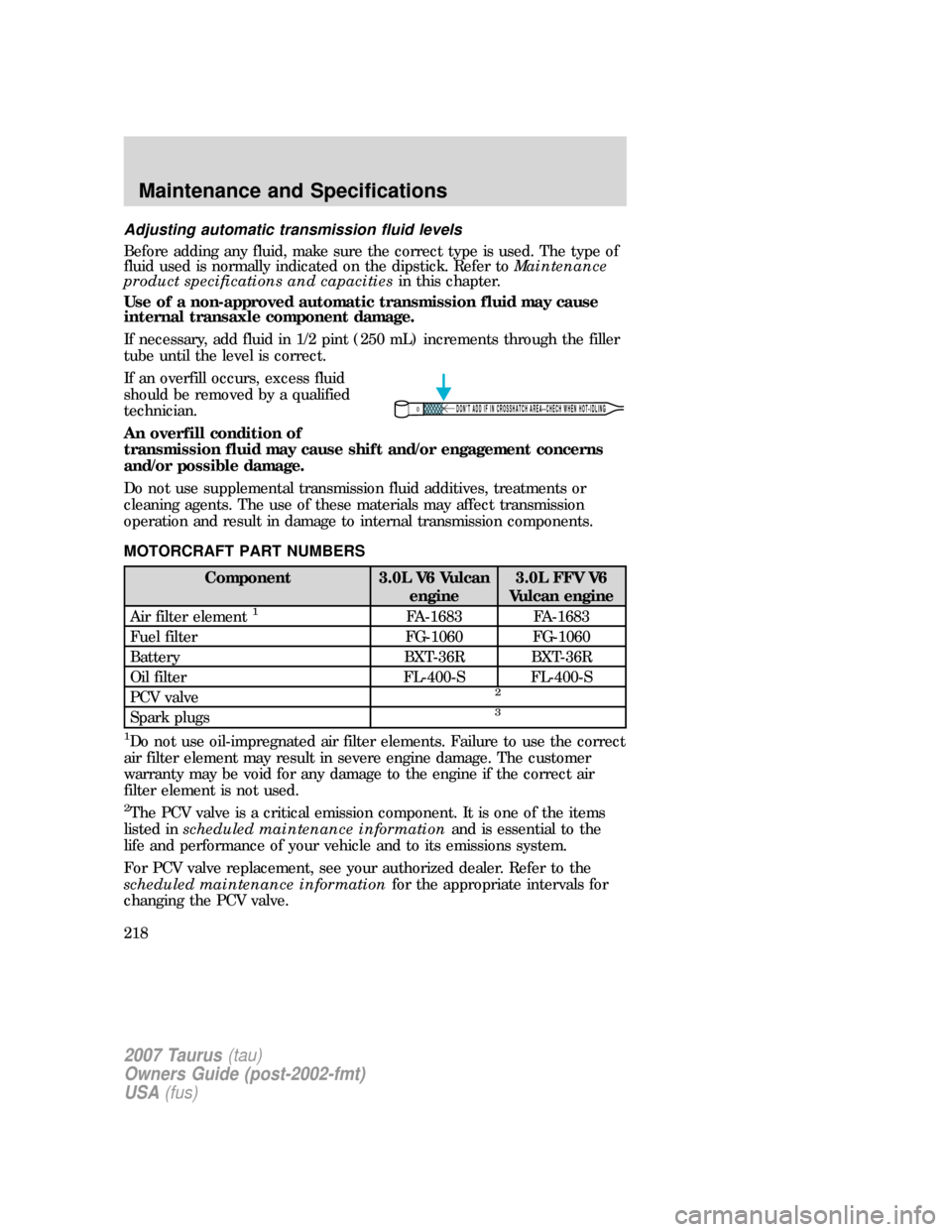
Adjusting automatic transmission fluid levels
Before adding any fluid, make sure the correct type is used. The type of
fluid used is normally indicated on the dipstick. Refer toMaintenance
product specifications and capacitiesin this chapter.
Use of a non-approved automatic transmission fluid may cause
internal transaxle component damage.
If necessary, add fluid in 1/2 pint (250 mL) increments through the filler
tube until the level is correct.
If an overfill occurs, excess fluid
should be removed by a qualified
technician.
An overfill condition of
transmission fluid may cause shift and/or engagement concerns
and/or possible damage.
Do not use supplemental transmission fluid additives, treatments or
cleaning agents. The use of these materials may affect transmission
operation and result in damage to internal transmission components.
MOTORCRAFT PART NUMBERS
Component 3.0L V6 Vulcan
engine3.0L FFV V6
Vulcan engine
Air filter element
1FA-1683 FA-1683
Fuel filter FG-1060 FG-1060
Battery BXT-36R BXT-36R
Oil filter FL-400-S FL-400-S
PCV valve
2
Spark plugs3
1
Do not use oil-impregnated air filter elements. Failure to use the correct
air filter element may result in severe engine damage. The customer
warranty may be void for any damage to the engine if the correct air
filter element is not used.
2The PCV valve is a critical emission component. It is one of the items
listed inscheduled maintenance informationand is essential to the
life and performance of your vehicle and to its emissions system.
For PCV valve replacement, see your authorized dealer. Refer to the
scheduled maintenance informationfor the appropriate intervals for
changing the PCV valve.
DON’T ADD IF IN CROSSHATCH AREA--CHECH WHEN HOT-IDLING
2007 Taurus(tau)
Owners Guide (post-2002-fmt)
USA(fus)
Maintenance and Specifications
218
Page 228 of 232
Climate control (see Air
conditioning or Heating) ............25
Clock adjust
AM/FM/Cassette ........................15
AM/FM/CD .................................18
Compass
zone/calibration adjustment ....56
Compass Display .........................55
Console ........................................42
Controls
power seat .................................79
Coolant
checking and adding ..............200
refill capacities ................204, 220
specifications ..........................220
Cruise control
(see Speed control) ....................45
Customer Assistance ................157
Ford Extended Service
Plan ..........................................182
Getting assistance outside the
U.S. and Canada .....................183
Getting roadside assistance ...157
Getting the service you need 178
Ordering additional owner’s
literature .................................184
Utilizing the
Mediation/Arbitration
Program ...................................181
D
Daytime running lamps
(see Lamps) ................................30
Defrost
rear window ..............................27
Dipstick
automatic transmission
fluid ..........................................216engine oil .................................195
Driving under special
conditions ..................................156
through water .........................156
E
Electronic message center .........53
Emergencies, roadside
jump-starting ..........................172
Emergency Flashers .................159
Emission control system ..........213
Engine ........................................222
cleaning ...................................186
coolant .....................................200
idle speed control ...................198
lubrication specifications .......220
refill capacities ........................220
service points ..........................193
starting after a collision .........159
Engine block heater .................148
Engine oil ..................................195
checking and adding ..............195
dipstick ....................................195
filter, specifications ........197, 218
recommendations ...................197
refill capacities ........................220
specifications ..........................220
Exhaust fumes ..........................147
F
Floor mats ...................................62
Fluid capacities .........................220
Fuel ............................................205
calculating fuel
economy ............................54, 210
cap ...........................................207
capacity ...................................220
2007 Taurus(tau)
Owners Guide (post-2002-fmt)
USA(fus)
Index
228
Page 229 of 232
choosing the right fuel ...........208
comparisons with EPA fuel
economy estimates .................213
detergent in fuel .....................209
filling your vehicle with
fuel ...........................205, 207, 210
filter, specifications ........209, 218
fuel pump shut-off switch .....159
improving fuel economy ........210
octane rating ...................208, 222
quality ......................................209
running out of fuel .................209
safety information relating to
automotive fuels .....................205
Fuses ..................................160–161
G
Gas cap (see Fuel cap) ............207
Gas mileage
(see Fuel economy) .................210
Gauges .........................................13
H
Hazard flashers .........................159
Headlamps ...................................29
aiming ........................................31
autolamp system .......................29
bulb specifications ....................34
daytime running lights .............30
flash to pass ..............................30
high beam .................................29
replacing bulbs .........................35
turning on and off ....................29
Heating
heating and air conditioning
system .................................23, 25
Homelink wireless control
system ..........................................49Hood ..........................................192
I
Ignition ...............................144, 222
Illuminated visor mirror .............42
Infant seats
(see Safety seats) .....................112
Inspection/maintenance (I/M)
testing ........................................215
Instrument panel
cleaning ...................................188
cluster ........................................10
lighting up panel and
interior .......................................30
J
Jack ............................................166
positioning ...............................166
storage .....................................166
Jump-starting your vehicle ......172
K
Keyless entry system .................71
keypad .......................................71
locking and unlocking doors ....72
programming entry code .........71
Keys .......................................63, 73
positions of the ignition .........144
L
Lamps
autolamp system .......................29
bulb replacement
specifications chart ..................34
daytime running light ...............30
headlamps .................................29
2007 Taurus(tau)
Owners Guide (post-2002-fmt)
USA(fus)
Index
229
Page 231 of 232
for children .....................107–108
lap belt ......................................90
Occupant Classification
Sensor ........................................83
safety belt maintenance ...........91
warning light and chime ....91–92
Safety seats for children ..........112
Safety Compliance
Certification Label ....................223
Seat belts
(see Safety restraints) ...............81
Seats ............................................77
child safety seats ....................112
front seats .................................78
SecuriLock passive anti-theft
system ..........................................72
Servicing your vehicle ..............191
Setting the clock
AM/FM/Cassette ........................15
AM/FM/CD .................................18
Spark plugs,
specifications .....................218, 222
Specification chart,
lubricants ...................................220
Speed control ..............................45
Starting a flex fuel vehicle .......147
Starting your
vehicle ........................144–145, 147
jump starting ..........................172
Steering wheel
tilting .........................................41
T
Tail lamps
bulb replacement ......................40
Tilt steering wheel ......................41Tires ...........................120–121, 166
alignment ................................127
care ..........................................124
changing ..........................166, 168
checking the pressure ............124
inflating ...................................122
label .........................................133
replacing ..................................126
rotating ....................................127
safety practices .......................126
sidewall information ...............128
snow tires and chains ............134
spare tire .................................166
terminology .............................121
tire grades ...............................121
treadwear ........................120, 125
Towing .......................................140
recreational towing .................143
trailer towing ..........................140
wrecker ....................................177
Traction control ........................150
Transaxle
fluid, refill capacities ..............220
lubricant specifications ..........220
Transmission .............................152
brake-shift interlock (BSI) ....152
fluid, checking and adding
(automatic) .............................216
Trunk .....................................62, 65
remote release ....................62, 67
Turn signal ..................................32
V
Vehicle Identification Number
(VIN) ..........................................223
Vehicle loading ..........................134
Ventilating your vehicle ...........148
W
Warning lights (see Lights) .......10
2007 Taurus(tau)
Owners Guide (post-2002-fmt)
USA(fus)
Index
231